
Quick Answer
A dog seat belt only protects your dog in a crash if it is independently crash tested, clips to a harness instead of a collar, and uses a short tether that keeps your dog from being thrown forward. Most products sold as a dog seat belt on Amazon are distraction restraints, built to keep a dog off your lap, not to survive a collision. The Center for Pet Safety (CPS), an independent nonprofit, is the main group that crash tests and certifies pet travel gear, and its certified list is much shorter than store shelves suggest (webvet.com). Below are 7 picks, a comparison table, and the fitting steps that actually matter.
Key Takeaways: dog seat belt
- A seat belt and a crash-tested harness are not the same product, even when both clip to the same anchor point.
- Center for Pet Safety is an independent nonprofit that tests pet restraints against a dummy, not a live dog, and publishes a certified list (webvet.com, centerforpetsafety.org).
- The Sleepypod Clickit Range earned five stars from CPS in November 2024 using a 110-pound dummy under protocol CPS-001-014.01 (theconsumers.guide).
- There is no federal U.S. safety standard specifically for pet car restraints, so “crash tested” on a label can mean almost anything (theconsumers.guide).
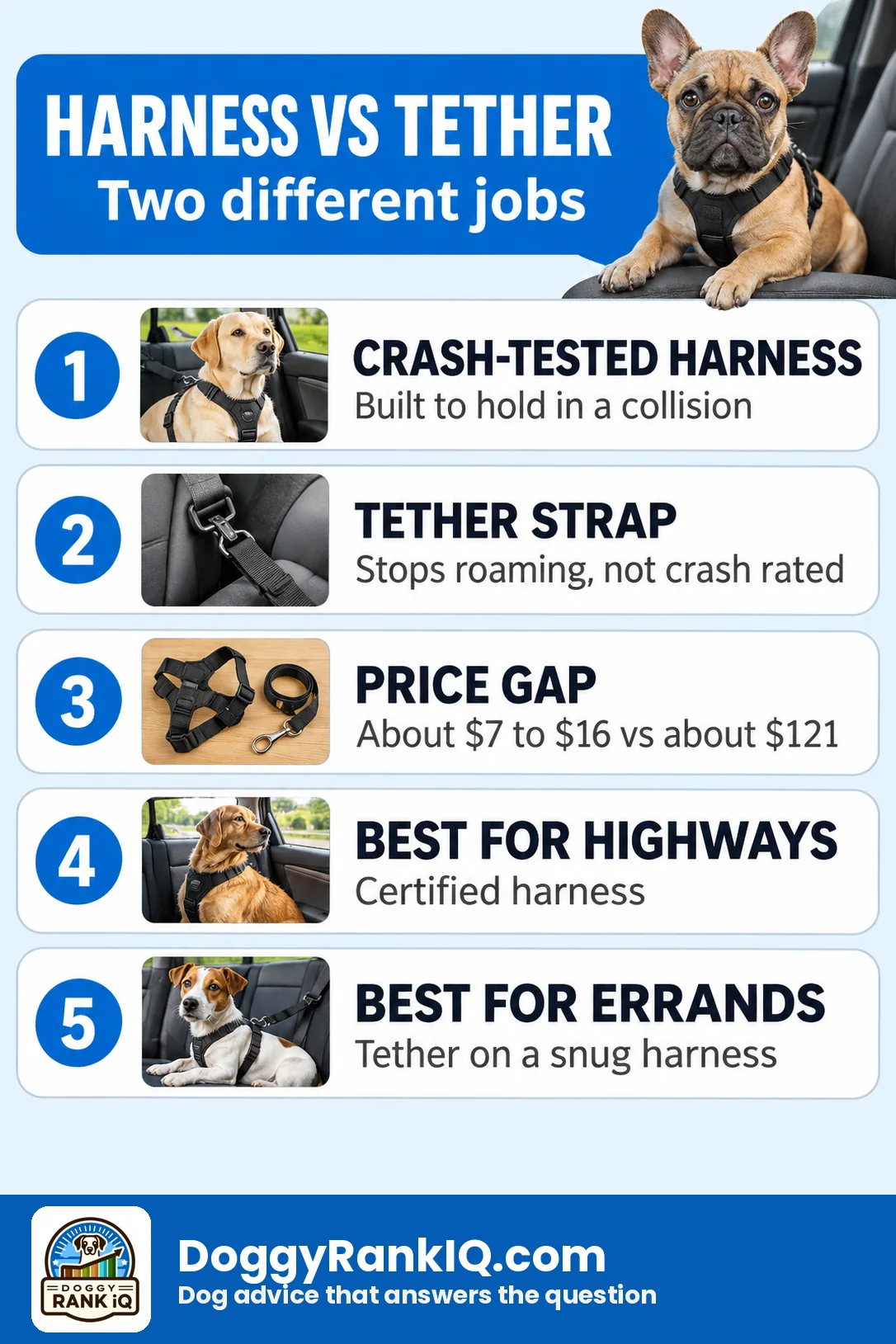
- A tether must clip to a harness, never a collar, because a collar loads the neck in a sudden stop.
- Keep any tether short enough that your dog cannot reach the front seat, the floor, or fall off the bench.
- CPS treated tethers longer than about 6 inches of slack as a hazard in its testing framework, because of a rebound or “clothesline” effect (webvet.com).
- Budget tether straps, often $7 to $16, are fine for stopping roaming on a calm drive. They are not a substitute for a certified harness.
- Front airbags can injure a dog in a crash, so the back seat is the safer location regardless of restraint type.
- Availability changes fast. Some CPS-certified colors and sizes were sold out or waitlisted in late 2026 (theconsumers.guide).

What matters most on your drives?
Tap an option to see the answer.
The crash test truth: what a dog seat belt can and cannot do
Most seat belt products sold online have never been in a crash lab. They are designed to stop a dog from climbing into your lap at a red light, and they do that job well. What they do not do, unless specifically certified, is protect a dog’s spine, neck, or chest in a frontal collision.
CPS runs the closest thing the pet industry has to a real safety standard. Its testing uses weighted, instrumented dummies, not live animals, and it awards certification only to products that score four or five stars (webvet.com, centerforpetsafety.org). Submission is voluntary. A manufacturer has to choose to send a product in, which means plenty of decent harnesses simply were never tested, and plenty of weak ones were tested and failed.
The warning here is not new. A 2013 CPS study tested 12 harnesses and found that only one met the standard at the time, an earlier version of the Sleepypod Clickit Utility. CPS reported that several of the other 11 experienced major structural failures during testing (theconsumers.guide). That study is the reason “crash tested” claims deserve a second look before you trust them with your dog’s life.
A related trap: some brands say a product was “tested to FMVSS 213.” That is a U.S. child car seat standard, not a dog-specific one. Kurgo says its Enhanced Strength Tru-Fit was tested at a university facility to that standard, but CPS has not certified it (theconsumers.guide). Ruffwear describes independent sled testing of its Load Up harness, also outside the CPS protocol (theconsumers.guide). Neither claim is dishonest, but neither is the same thing as CPS certification either.
Decision rule: if your dog rides in the car daily, on highways, or with kids in the back seat, spend the money on a CPS-certified harness. If your dog rides occasionally, locally, under 35 mph, a tether strap paired with a regular walking harness is a reasonable middle ground, as long as you understand it is a distraction restraint, not a crash-rated one.
Crash tested harness vs tether strap: two different jobs
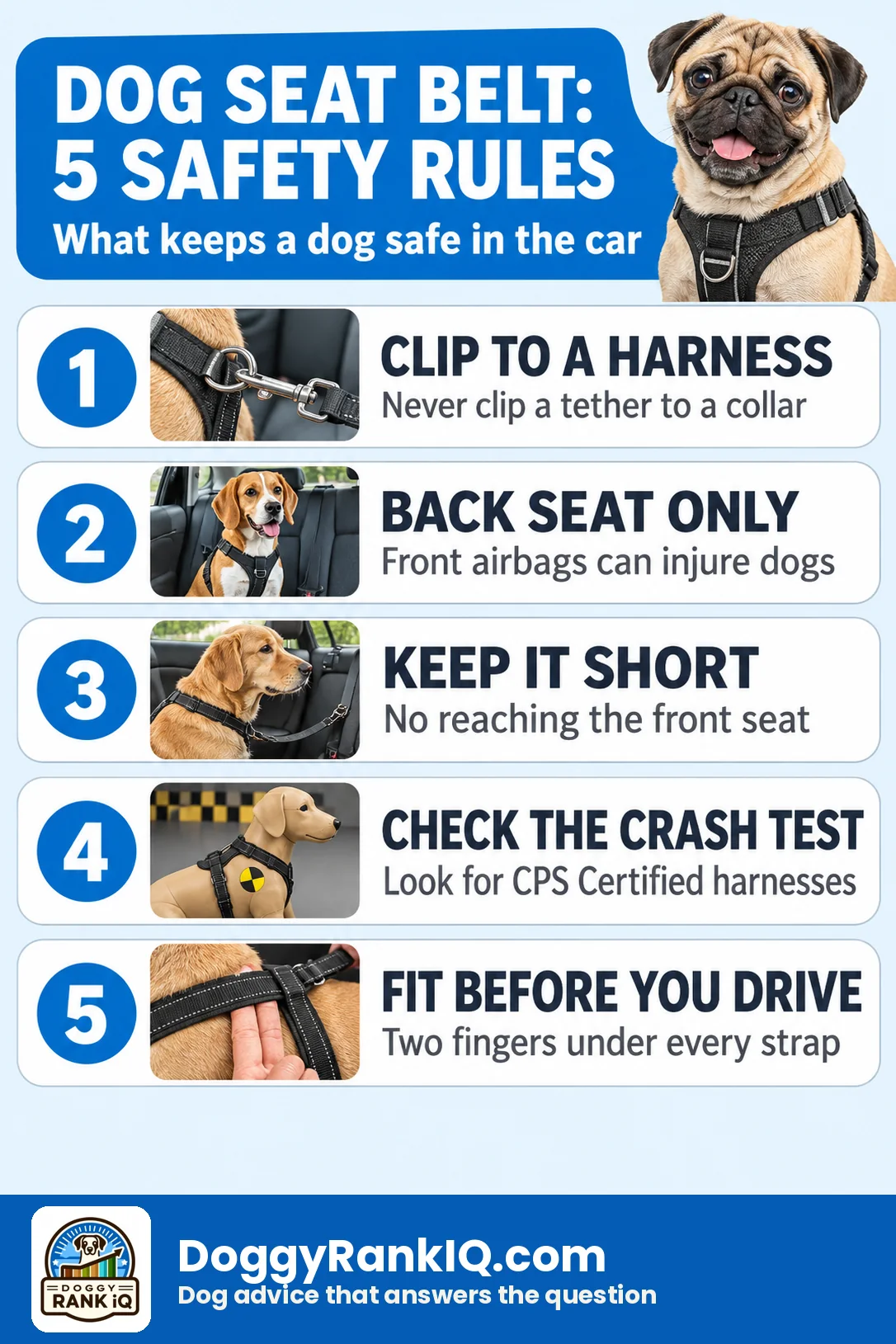
A crash-tested harness is engineered and tested to keep a dog contained and reduce injury risk during a collision. A tether strap is a short leash-like clip that keeps a dog from wandering, standing on the console, or leaping into the front seat.
Here is the honest split:
- Crash-tested harness: wide, padded straps, reinforced stitching, a CPS certification badge, and a published test report. Sleepypod is the main brand with current CPS-certified harness models (centerforpetsafety.org, theconsumers.guide).
- Tether strap: a short bungee or nylon leash that clips from a harness to a seat belt buckle or anchor. Useful, cheap, not rated for impact.
- Carrier restraint: for small dogs, a hard-sided carrier that latches to the seat belt. The Away Pet Carrier received five stars from CPS in 2026 using an 18-pound dummy, and it is built for dogs up to 18 pounds (theconsumers.guide).
Chewy’s 2026 listings show the price gap plainly: ordinary tether products run roughly $4.99 to $33.58, while the one crash-tested harness on the list, the Kurgo Enhanced Strength, sells for $39.95 (chewy.com). Price alone does not prove safety, but a $7 strap was never engineered to the same standard as a CPS-certified harness, and the brands do not claim otherwise.
If your dog already wears a harness for walks, check whether it has a back clip rated for vehicle use before assuming any old harness will do. Our guide to the crash-tested dog harness pick covers the Sleepypod Clickit in more depth.
Dog seat belt comparison table
Prices checked 2026 on Amazon listings. CPS certification status based on current CPS test results (centerforpetsafety.org) and reporting from The Pet Gear Lab (theconsumers.guide).
The 7 dog seat belt picks
1 Sleepypod Clickit Sport (best crash-tested seat belt)
 Sleepypod Clickit Sport (best crash-tested seat belt)
The Sleepypod Clickit Sport is the only pick on this list that is actually a crash-tested harness rather than a seat belt in the traditional sense. CPS tested a related Sleepypod model in November 2024 with a 110-pound dummy under protocol CPS-001-014.01 and awarded five stars, and Sleepypod’s current Clickit Range builds on that lineage with sizing roughly from 18 to 110 pounds depending on the chest shape (theconsumers.guide). It suits narrow, deep, or barrel-chested breeds. At $120.74, price checked 2026, it costs more than any tether on this list, and that price difference reflects the padded webbing, reinforced buckle hardware, and the testing paperwork behind it. Check the current price (rel=”sponsored”).
Drawback: Sleepypod’s own site reportedly showed several Clickit Sport and Clickit Range colors sold out in late 2026, so size and color availability can be a real obstacle (theconsumers.guide). If your dog has sensitive skin or an existing joint issue, ask your veterinarian before fitting any new chest harness snugly.
2Mighty Paw Seat belt with Aluminum Carabiner
 Mighty Paw Seat belt with Aluminum Carabiner
The Mighty Paw Seat belt is a tether strap with an aluminum carabiner clip, priced at $15.99, price checked 2026. It suits medium dogs who ride calmly and need a stop against roaming rather than crash protection. Check the current price (rel=”sponsored”).
3SlowTon Dog Seat Belt 2 Pack with Bungee
Two bungee-style tethers for $12.99, price checked 2026, useful for multi-dog households where each dog needs its own short lead to a separate anchor point. SlowTon’s 2 pack works for small to large dogs who already ride in a harness. Check the current price (rel=”sponsored”).
4AUBELL 3-in-1 Bungee Dog Seat Belt
At $10.99, price checked 2026, the AUBELL 3-in-1 doubles as a leash and a hands-free waist attachment outside the car. It fits a wide range of sizes, which also means it is less fitted to any one dog’s chest shape. Check the current price (rel=”sponsored”).
5COOYOO Retractable Dog Seat Belt
The COOYOO Retractable, priced at $6.99, price checked 2026, is the cheapest pick here. A retractable mechanism gives a dog slightly more reach, which runs against the CPS guidance to keep slack to a minimum. Choose this one only for short, slow local trips. Check the current price (rel=”sponsored”).
6Black Car Seat Belt for Dogs, Adjustable 18 to 24 Inches
This adjustable strap, $14.97, price checked 2026, fits a defined 18 to 24 inch range, which makes it a good choice for medium dogs whose harness chest strap sits in that window. Measure first. Check the current price (rel=”sponsored”).
7Removable 3-in-1 Dog Seat Belt Leash
The budget-friendly Removable 3-in-1 Leash runs $9.00, price checked 2026. It suits owners who want one tool that converts between a leash, a tie-out, and a car tether. Check the current price (rel=”sponsored”).
How to fit a dog seat belt with harness in the back seat
A seat belt with harness only works correctly when the harness fits snugly, the tether clips to the harness back ring, and the length leaves minimal slack. Fit comes before any product decision.
Steps:
- Buckle the harness so you can fit two fingers under the straps, no more.
- Clip the tether to the harness back ring, never the collar.
- Thread the tether through the seat belt buckle or a rear anchor point, then buckle it.
- Shorten the tether so your dog cannot reach the front seats, the door, or the floor well.
- Test by gently pulling the dog forward. It should stop well short of the front headrest.
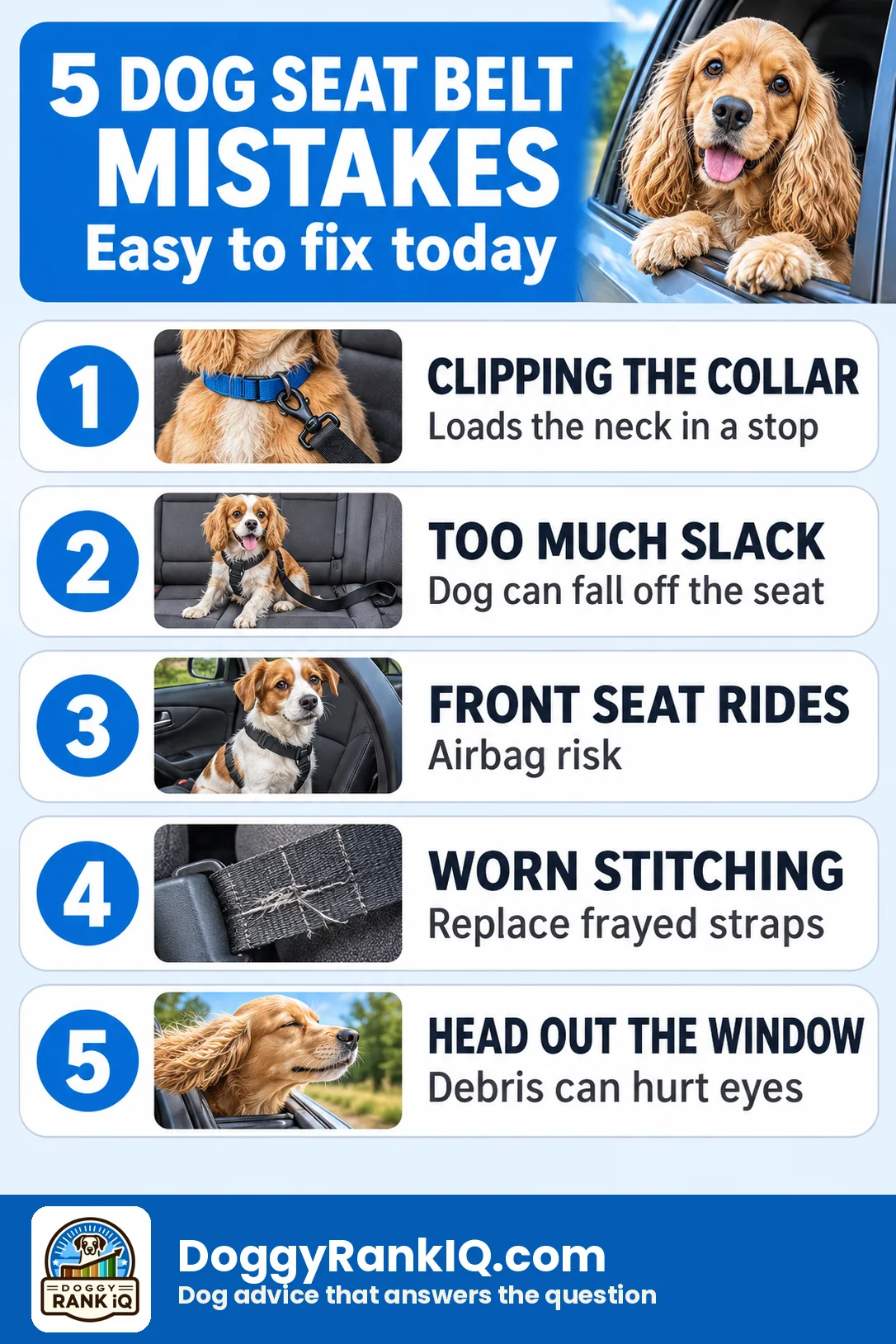
Common mistake: clipping a tether to a collar. CPS and most harness makers warn that a collar concentrates force on the neck during sudden braking, which is exactly the injury a seat belt is supposed to prevent. A car seat cover under the whole setup also helps with cleanup and keeps the dog from sliding; see our best dog car seat cover picks for bench-fit options. For dogs who ride up higher for visibility or comfort, a dog booster seat can pair with the same harness and tether system.
Dog seat belt for large dogs vs dog seat belt for small dogs
A seat belt for large dogs needs wider webbing, reinforced stitching, and a higher weight rating than a seat belt for small dogs, which can rely on lighter hardware and shorter straps.
For large dogs:
- Look for a chest strap rated above 50 pounds and webbing at least 1 inch wide.
- The Sleepypod Clickit Range covers up to roughly 110 pounds in its larger sizes (theconsumers.guide).
- A shorter tether matters more here, since a heavier dog generates more forward force in a stop.
For small dogs:
- A carrier restraint, like the Away Pet Carrier rated to 18 pounds by CPS in 2026, can be a sturdier option than a thin strap harness (theconsumers.guide).
- Lightweight tethers such as the COOYOO Retractable or the Removable 3-in-1 Leash fit small dogs fine for local, low-speed drives.
- Watch for a harness that is too loose. Small dogs can wriggle free of a harness sized for a medium dog in seconds.
Edge case: a long-bodied small dog, like a dachshund, may need a harness designed for the torso length rather than just the chest girth. Check the dimensions before buying, and compare against your dog’s actual measurements, not the breed average.
🚗 Dog seat belt laws and the first practice ride
No federal rule in the United States requires a seat belt. States handle it in pieces: some restrict dogs riding loose in an open truck bed, and distracted driving laws can apply when a dog is on the driver’s lap. The rules change, so check your own state’s statute or DMV page before a long trip. (A ticket is the cheap outcome. A 60-pound dog in the front footwell during a hard stop is the expensive one.)
A new restraint also needs a rehearsal. Clip the dog in while the car sits in the driveway, hand over a chew, and stay parked for five minutes. Next, drive around the block. Dogs that meet the harness for the first time on a four-hour highway run tend to spin, tangle the tether and chew the strap.
One more habit borrowed from child car seats: after any crash, read the maker’s replacement policy. Webbing and stitching that took a full load may not hold a second time, even if the harness looks fine.
⭐ Top 5 Features We Love
- CPS certification badge on the Sleepypod Clickit lineup, which gives owners an independent reference point instead of just a brand’s word (centerforpetsafety.org, theconsumers.guide).
- Aluminum carabiners on tether straps, like the Mighty Paw pick, which hold up better than plastic clips under repeated use.
- Bungee give in short tethers, which absorbs small bumps on rough roads without adding dangerous slack.
- Adjustable length ranges, such as the 18 to 24 inch strap, that let one product fit a defined group of dogs precisely.
- 3-in-1 convertibility on the AUBELL and Removable Leash picks, useful for owners who want fewer separate tools in the car.
⚠️ Things to Look Out For
- “Crash tested” without a named lab or published report. Ask which standard, which dummy weight, and which year.
- Long retractable tethers. CPS treated tethers that could not shorten to about 6 inches of slack as a hazard because of a rebound effect (webvet.com).
- Clipping to a collar. This is the single most common mistake, and it defeats the purpose of any seat belt system.
- Front seat use. Airbags deploy with enough force to hurt a dog; the back seat is the safer location.
- Sold-out certified sizes. Availability for certified Sleepypod colors and sizes shifted in late 2026, so check stock before committing to a specific model (theconsumers.guide).
Who should buy which
Choose the Sleepypod Clickit Sport if your dog rides often, rides at highway speed, or shares the back seat with kids, and the budget allows $120.74. Choose a tether strap in the $7 to $16 range if your dog rides occasionally at low speeds and the goal is stopping distraction, not surviving a collision. Choose a carrier restraint for small dogs under about 18 pounds who are already comfortable in an enclosed space.
Nervous or anxious dogs often do better with a familiar harness they already wear for walks, paired with a short tether, rather than an unfamiliar carrier introduced for the first time on a car trip. If car rides themselves trigger drooling or vomiting, that is a separate issue worth addressing; our guide to dog car sickness covers it directly.
If your dog refuses to tolerate a harness at all, work on acclimation at home before asking for cooperation in a moving vehicle. Short sessions, treats, and letting the dog wear the harness around the house for a few minutes at a time tend to work better than forcing it right before a drive.
FAQ
The bottom line
A seat belt is only as good as the harness it clips to and the length of slack you leave in the tether. The Sleepypod Clickit Sport is the pick with independent crash test backing behind it, and it costs more for that reason. The other six picks on this list are useful, inexpensive tools for keeping a calm dog in place on ordinary drives, not devices built to survive a collision. Check the dimensions of your dog’s chest and the tether’s maximum length before buying, clip to a harness and never a collar, and keep your dog in the back seat, away from the airbags.
Doggy Rank IQ is reader supported. As an Amazon Associate we earn from qualifying purchases, at no extra cost to you.