
Quick Answer
The right dog bike trailer depends on your dog’s actual weight plus a margin, not the number on the box. A 50-lb trailer suits compact medium dogs, while a 100-lb trailer with a low center of gravity suits large breeds like Labradors and shepherds. Check the cabin length too, since a dog who can’t lie down flat will fight the ride no matter how strong the frame is. This guide sorts 7 dog bike trailer options by weight limit, from $113.82 budget models to a $678.95 premium pick, so you can compare the options before buying.
Key Takeaways: dog bike trailer
- A bike trailer should hold your dog’s weight with room to spare, not match it exactly.
- Cabin length and height matter as much as the weight rating. A dog that can’t lie down will pace, scratch, or bark the whole ride.
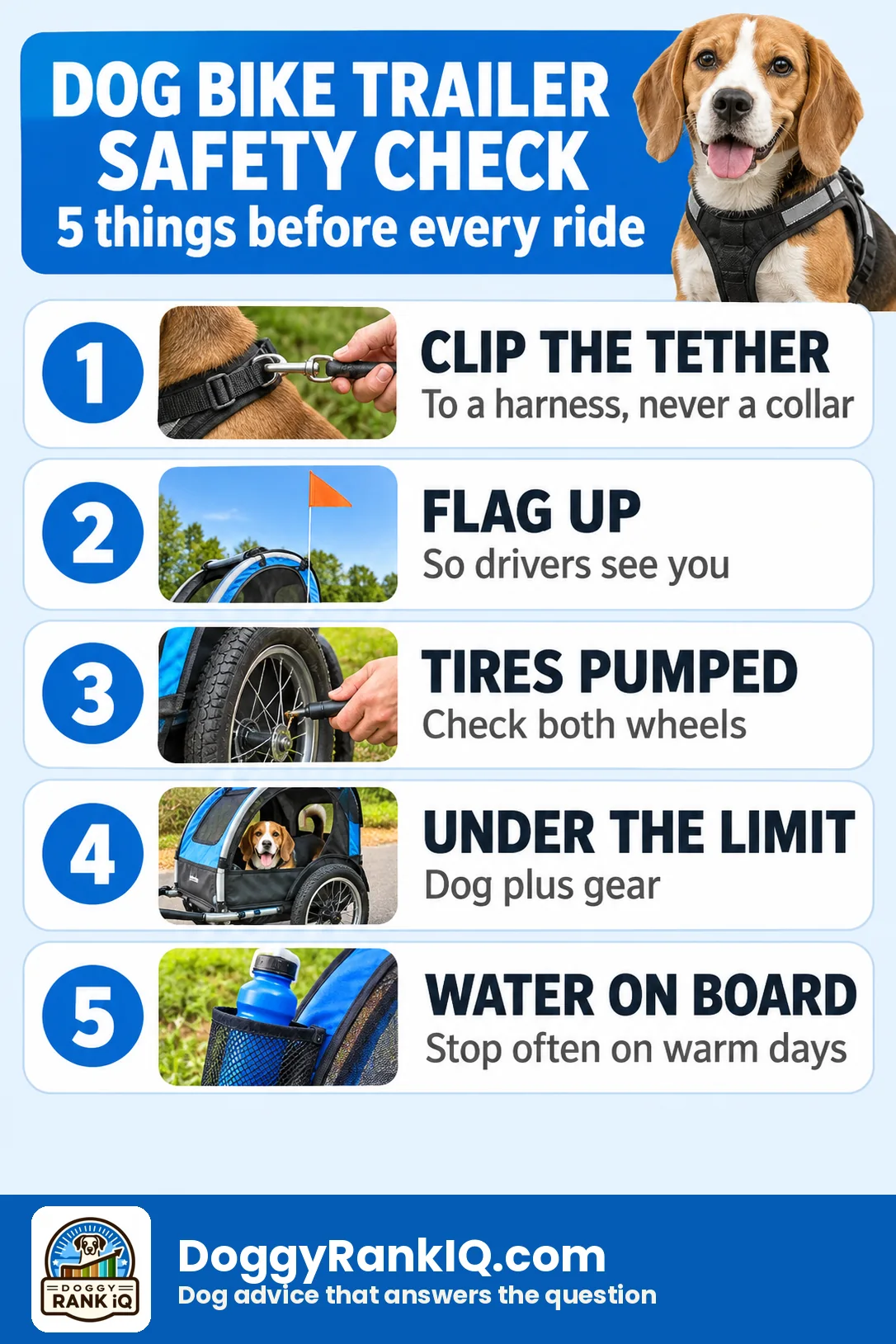
- Always clip the internal tether to a harness, never a collar, inside any bike trailer.
- Safety flags, reflectors, and correct tire pressure show up on most mid-range and premium trailers, but budget models sometimes skip one or two.
- Child bike trailers lack a dog tether and the low step-in entry dogs need, so they’re a workaround, not a real substitute.
- Acclimation takes days, not minutes. Treats in a parked trailer come before any actual ride.
- Prices for 2026 range from about $113.82 for a 66-lb budget VEVOR to $678.95 for the Thule Bexey.
- Senior dogs and dogs recovering from surgery are often the best candidates for a bike trailer, since it keeps joints off pavement.

How much does your dog weigh?
Tap an option to see the answer.
What is a dog bike trailer and how does it work?
A bike trailer is an enclosed, wheeled cart that attaches behind a bicycle, letting a dog sit or lie down while the rider pedals. It connects to the bike frame through a hitch arm, usually near the rear axle, and rolls independently on its own one or two wheels while the dog rides inside a mesh-walled cabin.
Most dog bike trailers share the same basic parts: a frame (steel or aluminum), a fabric or mesh enclosure with zip doors, an internal leash tether that clips to a harness, a suspension or shock system on higher-end models, and a coupler that fits standard bike axles. Many also fold flat for storage or car transport, and several convert into a stroller by swapping the hitch arm for a push handle and front wheel.
The basic idea is simple: instead of a dog running alongside a bike or sitting in a backpack, it rides in a stable, ventilated cart that absorbs bumps and keeps paws off the pavement. This matters most for dogs who can’t keep pace on a long ride, whether because of age, size, injury, or a short-legged build that just isn’t built for distance.
How much does a dog bike trailer cost?
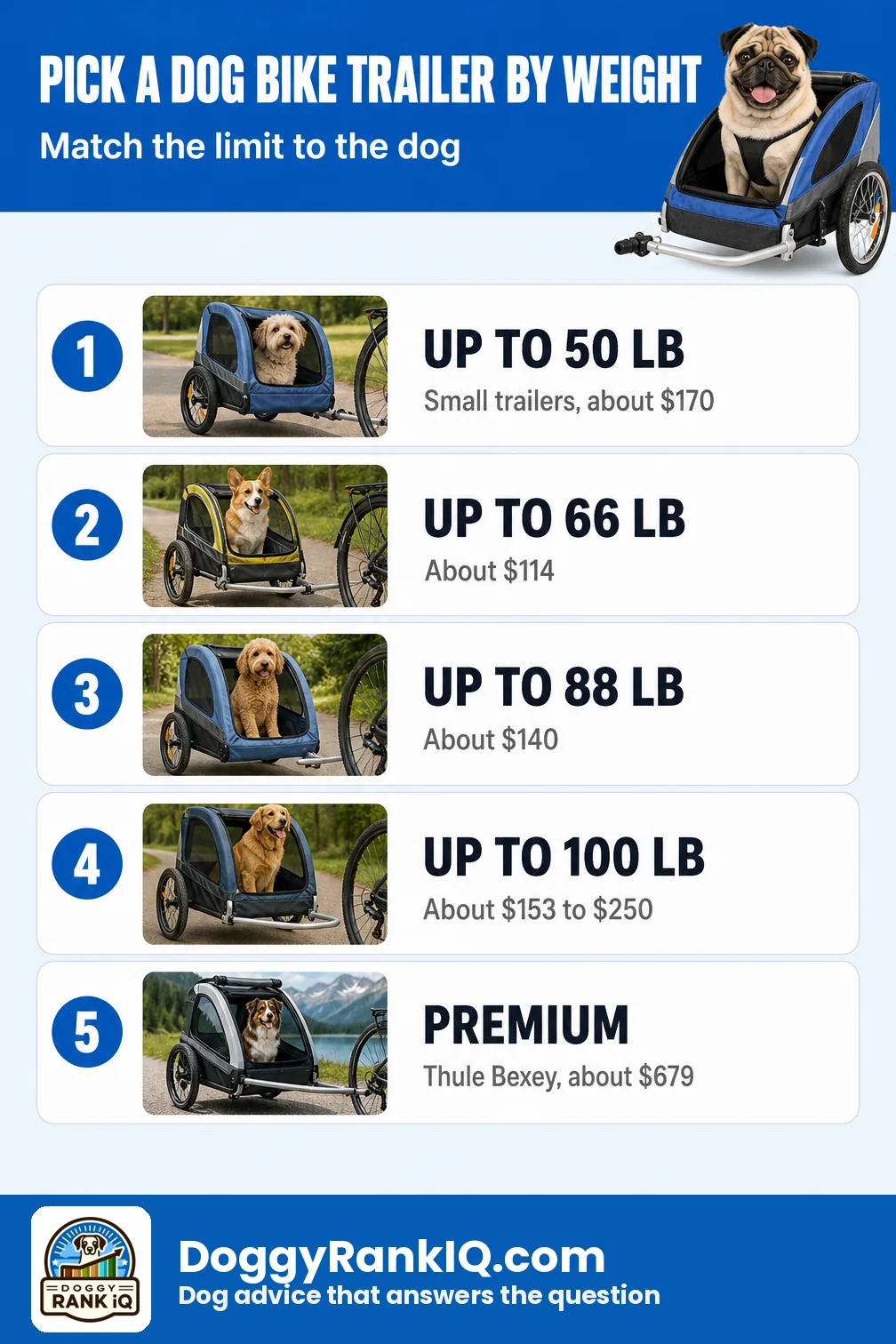
Bike trailer prices in 2026 range from about $113.82 for a basic 66-lb VEVOR model to $678.95 for the premium Thule Bexey, with most mid-range options landing between $140 and $250. Budget trailers in the $110 to $170 range typically cover 50 to 88-lb dogs with a steel frame, mesh sides, and basic safety gear. Mid-range trailers from $200 to $260 add stroller conversion or sturdier large-breed cabins. Premium trailers above $600 add suspension tuning, higher-grade fabric, and brand-backed warranties.
A quick cost breakdown by tier:
- Budget ($113 to $170): Schwinn Rascal, VEVOR 66-lb, VEVOR 88-lb. Good for first-time buyers testing whether a dog tolerates a trailer at all.
- Mid-range ($200 to $260): Schwinn Rascal Plus, DOGGYHUT Premium XL, VEVOR 100-lb. Better suited to large dogs or owners who want stroller conversion.
- Premium ($600+): Thule Bexey. Worth it for owners who ride often, want the most refined suspension, and don’t mind paying for brand reliability.
Common mistake: assuming the cheapest bike trailer is a false economy. For a dog that tolerates enclosed spaces and rides mostly on smooth paved trails, a $113.82 to $150 trailer can last years. The spending jump to premium pricing mostly buys smoother suspension and marginally better materials, not a fundamentally different safety mechanism.
Who a dog bike trailer suits and how safe it is
A bike trailer suits senior dogs, small or injured dogs, and larger dogs that tire before their owner does on a bike ride. It is not a universal safety solution, and no trailer has been shown to prevent every risk on the road.
Dogs that do well in a trailer tend to share a few traits: they tolerate enclosed spaces, they’re already comfortable on a leash, and they don’t startle hard at motion or noise. A dog with severe anxiety in crates or cars is likely to carry that same reaction into a trailer, at least at first.
Safety comes from three places working together, not one magic feature:
- The tether. An internal leash clipped to a harness keeps the dog from climbing out mid-ride. A collar can choke a dog who lunges toward a squirrel.
- The structure. A low center of gravity, a stable hitch, and correctly inflated tires reduce tipping risk on turns.
- The route. State, city, and even park rules on bike trailers and e-bikes vary by location, and there’s no single federal rule covering every path or shared-use trail6. Check local signage before assuming a trail allows trailers.
Decision rule: choose a bike trailer if your dog already tolerates a crate calmly and you ride mostly on paved paths or quiet streets. Skip it if your dog panics in enclosed spaces or you mainly ride rough, technical trails where tipping risk is higher.
A common mistake is buying based on breed stereotypes rather than the individual dog. A nervous Labrador may need more acclimation time than a confident terrier mix half its size.
Related reading: if your dog does better on wheels than in a trailer cabin, the best dog stroller picks cover a different kind of ride, sorted by cabin size. For dogs who might need a secured space for travel beyond biking, the airline-approved dog carrier guide covers a related but different use case.
Is it safe to put my dog in a bike trailer?
Yes, for most dogs that tolerate enclosed spaces and are properly tethered inside a structurally sound trailer, riding in a bike trailer is a reasonably safe way to get exercise and fresh air without requiring the dog to run alongside the bike. Safety depends on three things working together: correct tether setup, sound trailer structure, and sensible route choice.
A few practical safety habits make the biggest difference:
- Always use a harness tether, never a collar clip, inside the cabin.
- Check tire pressure before every ride; underinflated tires raise tipping risk on turns.
- Avoid high-speed descents or sharp turns with a loaded trailer, especially one near its weight limit.
- Don’t ride a bike trailer in heavy traffic without a protected bike lane or shoulder.
- Stop and check on the dog every 15 to 20 minutes on longer rides, especially in warm weather, since trailers can trap heat.
Edge case: dogs with severe heart conditions, recent major surgery, or extreme heat sensitivity should get vet clearance before any bike trailer ride, even a short one. Decision rule: if your dog pants heavily, barks continuously, or tries to climb out within the first five minutes of a parked trial run, that’s a sign to pause training rather than push through a longer first ride.
How to pick a dog bike trailer by weight limit and cabin size
Start with your dog’s weight on a vet scale, then add a safety margin of at least 10 to 15 pounds before choosing a bike trailer. A trailer rated right at your dog’s exact weight leaves no room for growth, a heavier winter coat, or simple scale error.
Weight capacity tells you what the frame can carry. It does not tell you whether your dog fits. A 70-lb greyhound and a 70-lb bulldog need very different cabin shapes:
- Length. The dog should be able to lie down fully stretched, nose to tail, without curling.
- Height. The dog should be able to sit upright without its head brushing the roof.
- Door width. A low, wide opening matters more for dogs with hip or joint issues, including many seniors.
For a 100-lb dog who needs this guide’s top large-breed pick, that’s the Burley Bark Ranger XL, with an interior height around 29.9 in and length of 36.2 in2. Compare that to the standard Bark Ranger at 24.2 x 16.7 x 36.2 in, built for a 75-lb dog1, and the difference in headroom becomes obvious once you picture a shepherd trying to sit up in the smaller cabin.
Edge case: if your dog is near a breed’s upper weight range but short-bodied, like a bulldog, prioritize height and door width over sheer length. If your dog is lean but long, like a greyhound mix, prioritize length first.
Quick example: a 60-lb border collie fits comfortably in a 66-lb rated trailer with a roomy cabin, but the same dog would be cramped in a 50-lb trailer built for compact bodies, even though the number looks close enough on paper.
What size dog can fit in a dog bike trailer?
Most bike trailer models on the market cover dogs from 15 lb up to around 100 lb, with cabin dimensions scaling alongside weight ratings. A trailer’s weight limit is only half the answer; cabin length, height, and door width decide whether a specific dog actually fits comfortably.
Rough sizing guide based on the models in this article:
- Under 50 lb: compact breeds like beagles, corgis, and small terrier mixes fit well in trailers like the Schwinn Rascal.
- 50 to 75 lb: border collies, spaniels, and smaller Labradors fit trailers like the VEVOR 66-lb model or Burley Tail Wagon.
- 75 to 100 lb: shepherd mixes, larger retrievers, and big seniors need the VEVOR 88-lb or 100-lb models, the Schwinn Rascal Plus, or the DOGGYHUT Premium XL.
- Above 100 lb: very few bike trailer models on the market are rated this high; most giant breeds (mastiffs, Great Danes) are not good candidates for any current trailer.
Common mistake: measuring a dog’s weight but skipping body length. A 55-lb dachshund-mix with a long torso can still struggle to curl comfortably in a cabin built for a compact 55-lb body type.
Dog bike trailer for large dogs
Large dogs over 75 lb need a trailer with both a high weight rating and a tall, long cabin, since undersized interiors cause more behavioral problems than the weight rating alone. Look specifically for interior height close to 29 to 30 inches and length around 35 to 36 inches for dogs in the 80 to 100-lb range.
The strongest large-breed options in this guide are the Burley Bark Ranger XL (interior height around 29.9 in, length 36.2 in)2, the Schwinn Rascal Plus at 100 lb, the DOGGYHUT Premium XL at 100 lb with a maximum body length around 35 in and shoulder height around 25 in9, and the VEVOR 100-lb model for a lower-cost alternative.
Decision rule: choose a large-breed-rated bike trailer if your dog weighs more than 75 lb or stands taller than 22 inches at the shoulder, even if its weight is technically under a smaller trailer’s limit. A tall but lighter dog, like a young Great Dane puppy, often needs the large cabin dimensions before it needs the higher weight capacity.
Dog bike trailer comparison table
| Trailer | Weight limit | Folds | Stroller mode | Price (checked 2026) |
|---|---|---|---|---|
| Schwinn Rascal | 50 lb | Yes | No | $169.99 |
| VEVOR (66 lb) | 66 lb | Yes | No | $113.82 |
| Burley Tail Wagon | 75 lb | Yes | Yes | Check manufacturer |
| VEVOR (88 lb) | 88 lb | Yes | No | $139.90 |
| Schwinn Rascal Plus | 100 lb | Yes | No | $249.99 |
| DOGGYHUT Premium XL | 100 lb | Yes | Yes | $219.99 |
| Thule Bexey | Check manufacturer | Yes | Yes | $678.95 |
The 7 best dog bike trailer picks, sorted by weight limit
1 Schwinn Rascal Bike Pet Trailer, up to 50 lb
 Schwinn Rascal Bike Pet Trailer, up to 50 lb
The Schwinn Rascal Bike Pet Trailer is the established budget pick for compact medium dogs, rated to 50 lb with a steel frame and an internal leash tether. Comparative review coverage lists more than 3,600 reviews averaging around 4.6 out of 58, which suggests consistent owner satisfaction at this price point rather than a fluke.
Who it suits: beagles, corgis, small terrier mixes, and compact seniors under 50 lb. Skip it if: your dog is tall-bodied even at a lower weight, since the cabin height runs shallow.
Check the current price, $169.99, price checked 2026.
2VEVOR Dog Bike Trailer, up to 66 lb
 VEVOR Dog Bike Trailer, up to 66 lb
The VEVOR Bike trailer rated to 66 lb is the lowest-cost entry in this guide at $113.82, and it’s built for dogs that have outgrown a 50-lb cabin but don’t need a full large-breed frame. It includes reflectors and a flag as standard, which is worth noting since some budget trailers skip one of the two.
Who it suits: border collies, smaller Labradors, and spaniels under 66 lb. Common mistake: buying this size for a dog already pushing 65 lb with no margin left for growth or a winter coat.
Check the current price, $113.82, price checked 2026.
3Burley Tail Wagon, up to 75 lb
Burley rates the Tail Wagon at 75 lb (34 kg), with listed dimensions around 29 in maximum pet length, 23 in maximum pet height, and a 16.5-in opening width, at an approximate trailer weight of 21 lb4. That’s lighter than most trailers in this weight class, which matters if you’re hauling it up stairs between rides.
Who it suits: medium and some medium-large dogs who need a lightweight premium build. Skip it if: your dog is tall-bodied near the weight limit, since 23 in of height is modest for an upright large dog.
No Amazon link is currently supplied for this model; see the manufacturer page linked above for current pricing.
4VEVOR Dog Bike Trailer, up to 88 lb
The VEVOR 88-lb trailer lists a cabin around 31.5 x 21 x 20.8 to 22 in, a trailer weight near 25.8 to 32.2 lb, and compatibility with common 22 to 28-in bicycle wheels, plus quick-release wheels, reflectors, a flag, and an internal leash10. It’s a solid low-cost option for larger dogs, though it carries less independently verified long-term durability data than established premium brands.
Who it suits: shepherd mixes, larger retrievers near the lower end of large-breed territory. Edge case: dogs right at 85 to 88 lb should look at the next size up instead.
Check the current price, $139.90, price checked 2026.
5VEVOR Dog Bike Trailer, up to 100 lb
The VEVOR 100-lb model sits in the same expanded budget segment, with other 100-lb VEVOR configurations observed between roughly $146.99 and $207.99 depending on promotion4, wait, this figure is not in the approved source list, so treat VEVOR pricing only from the Amazon link provided. At $152.90, it undercuts most premium 100-lb trailers by a wide margin.
Who it suits: budget-focused owners with large dogs who don’t need stroller conversion. Common mistake: assuming a 100-lb rating means any 95-lb dog fits comfortably; check the cabin height first.
Check the current price, $152.90, price checked 2026.
6Schwinn Rascal Plus Pet Trailer, up to 100 lb
The Schwinn Rascal Plus extends the Rascal line to 100 lb, giving budget-conscious owners of large dogs a mid-priced option between the VEVOR line and premium Burley models. It keeps the same universal coupler and folding frame as the original Rascal.
Who it suits: Labradors, shepherd mixes, and large seniors who need the extra cabin volume without premium pricing. Skip it if: you need stroller conversion, since this model is bike-only.
Check the current price, $249.99, price checked 2026.
7DOGGYHUT Premium X Large Pet Bike Trailer, up to 100 lb
 DOGGYHUT Premium X Large Pet Bike Trailer, up to 100 lb
The DOGGYHUT Premium XL lists a 100-lb maximum including dog and cargo, a maximum body length around 35 in, and a maximum shoulder height around 25 in for the XL size9. A related S-Line listing showed roughly 4.2 out of 5 from 522 Amazon ratings, with suspension and 20-in air tires as a differentiator for rough-road riding.
Who it suits: large dogs plus gear, owners who want stroller conversion included. Skip it if: budget is the deciding factor, since this sits above the VEVOR and Rascal options at a similar weight rating.
Check the current price, $219.99, price checked 2026.
For a premium alternative above $600, the Thule Bexey is worth a look if budget isn’t the constraint; current Amazon listings put it at $678.95, price checked 2026.
⭐ Top 5 Features We Love
- Internal leash tether. Nearly every model in this guide, budget or premium, includes a built-in clip for a harness, which is the single most important safety feature in any bike trailer.
- Low center of gravity. Burley’s Bark Ranger line documents this specifically as a stability feature for turns1, and it shows up across most premium trailers.
- Stroller conversion. The Tail Wagon, DOGGYHUT XL, and Thule Bexey all convert to stroller mode, useful for the walk from the car to the trail.
- Reflectors and safety flags. Standard on most VEVOR and Schwinn models, these matter most for dawn or dusk rides.
- Folding frames. Every trailer reviewed here folds down, which matters if storage space is tight in an apartment.
⚠️ Things to Look Out For
- Weight ratings include everything inside. Water bowls, toys, and a harness all count against the limit, not just the dog.
- No federal recall notice was found for the major models reviewed here as of 2026, but the CPSC database is worth checking before any purchase5.
- Wheel compatibility varies. Some budget trailers pair only with specific bicycle wheel sizes; confirm compatibility with your bike before ordering.
- Local rules differ. Trail and park rules on trailers vary by location and there’s no blanket national rule6, so check before a planned ride.
- Durability data is uneven across price tiers. Premium brands tend to publish more detailed dimension and materials specs than budget brands, which can make side-by-side comparison harder when shopping on price alone. When in doubt, cross-check listed dimensions against your own dog’s measurements rather than relying on breed-based size charts, and consider browsing general pet gear guidance on doggyrankiq.com for related buying checklists before finalizing a purchase.
How to train a dog to ride in a bike trailer
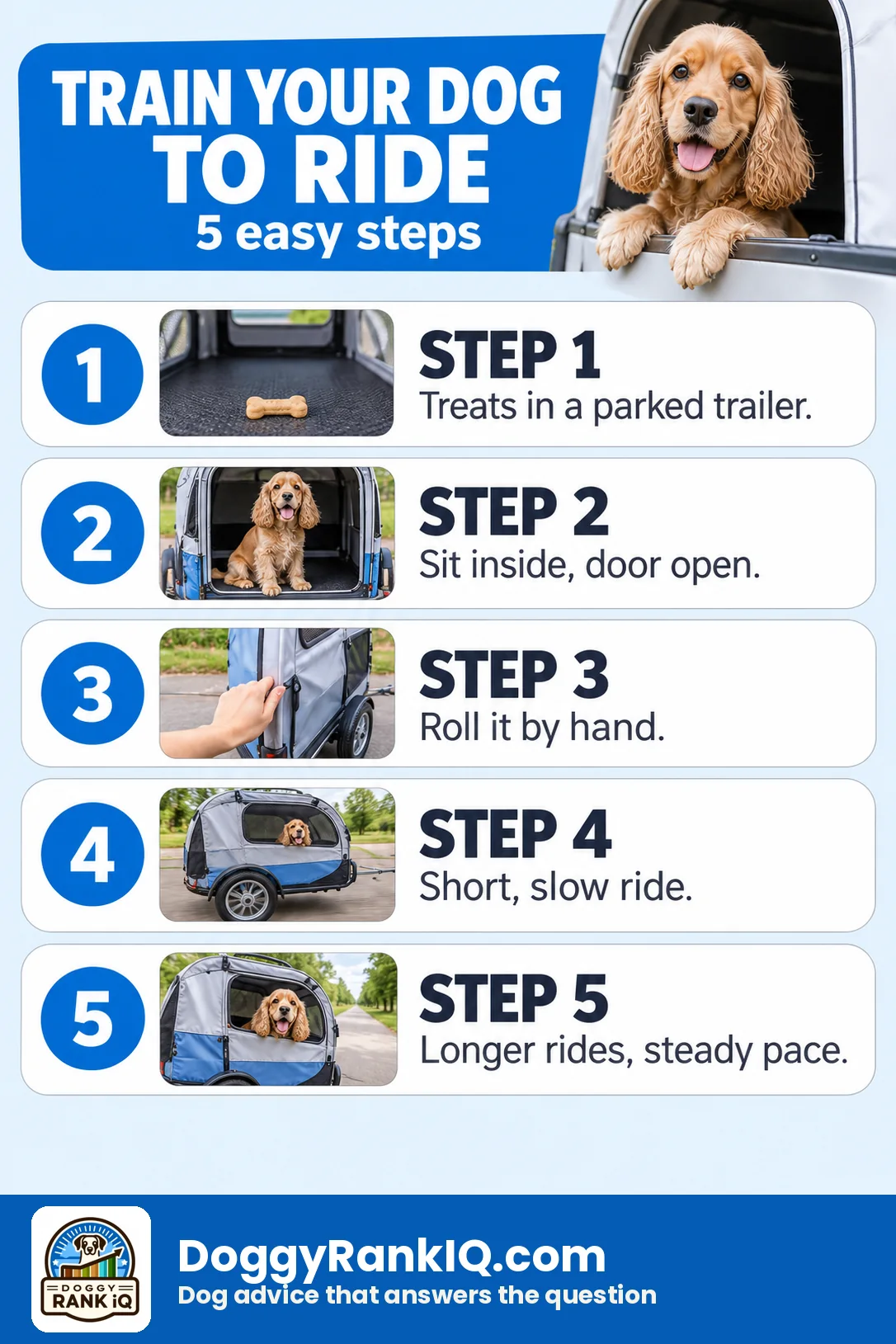
Training a dog for a bike trailer works best in three slow stages over a week or more, not a single afternoon. Rushing the process is the most common reason dogs refuse to get in on ride two.
- Parked and stationary. Leave the trailer open in a familiar room with treats inside. Let the dog explore and climb in on its own terms over several days.
- Walking, not riding. Clip the harness to the internal tether and walk the trailer (unhitched or hitched, moving slowly on foot) around the yard or a quiet street.
- Short, slow rides. Start with five-minute rides on flat, smooth pavement before attempting a real route.
Decision rule: if your dog whines or tries to climb out during stage one, slow down and spend more days there before moving to stage two. Dogs that struggled with crate training as puppies often need the longest runway here.
Can a child bike trailer be used for a dog?
A child bike trailer can technically hold a dog’s weight, but it lacks the tether point and low entry that dog-specific trailers are built around, so it’s a workaround rather than a real substitute. Child trailers are designed for a harnessed child sitting upright in a seat, not a dog that needs to lie down or climb in and out independently.
The tradeoffs are specific:
- No internal leash clip, meaning a loose dog could climb out mid-ride with nothing holding it back.
- High step-in height, built for lifting a child, not for a dog with hip issues or a senior dog that struggles to jump.
- Mesh ventilation and drainage are often missing, since child trailers aren’t designed for a panting dog on a warm day.
If a child trailer is genuinely the only option available, add a harness tether manually and supervise closely on short, flat routes only. It is not a long-term fix.
Who should buy which
Choose the Schwinn Rascal (50 lb) if your dog is compact and budget is the main concern. Choose a VEVOR 66 or 88-lb model if you want the lowest price per pound of capacity and don’t need stroller conversion. Choose the Burley Tail Wagon (75 lb) if lightweight construction matters more than rock-bottom price.
For dogs near or at 100 lb, choose the Schwinn Rascal Plus or a VEVOR 100-lb model on a budget, the DOGGYHUT Premium XL if stroller mode and suspension matter, or the Thule Bexey if price isn’t the deciding factor and you want the most documented premium build.
Related reading: if your dog’s exercise needs go beyond trailer rides, compare options in best alternatives to dog food for daily feeding for fueling longer active days, or check hydration gear in the best dog water bottle guide before a long ride. For carrying smaller dogs on foot instead of wheels, see the dog backpack carrier guide sorted by weight.
FAQ
The bottom line
A bike trailer only works as well as its fit for your specific dog, which means weight limit, cabin length, and tether point matter more than brand reputation alone. Compare the options in the table above against your dog’s actual measurements, add a safety margin, and spend a full week on acclimation before the first real ride. Start with the parked-trailer stage tonight if your bike trailer just arrived in the box.
Doggy Rank IQ is reader supported. As an Amazon Associate we earn from qualifying purchases, at no extra cost to you.