
Quick Answer
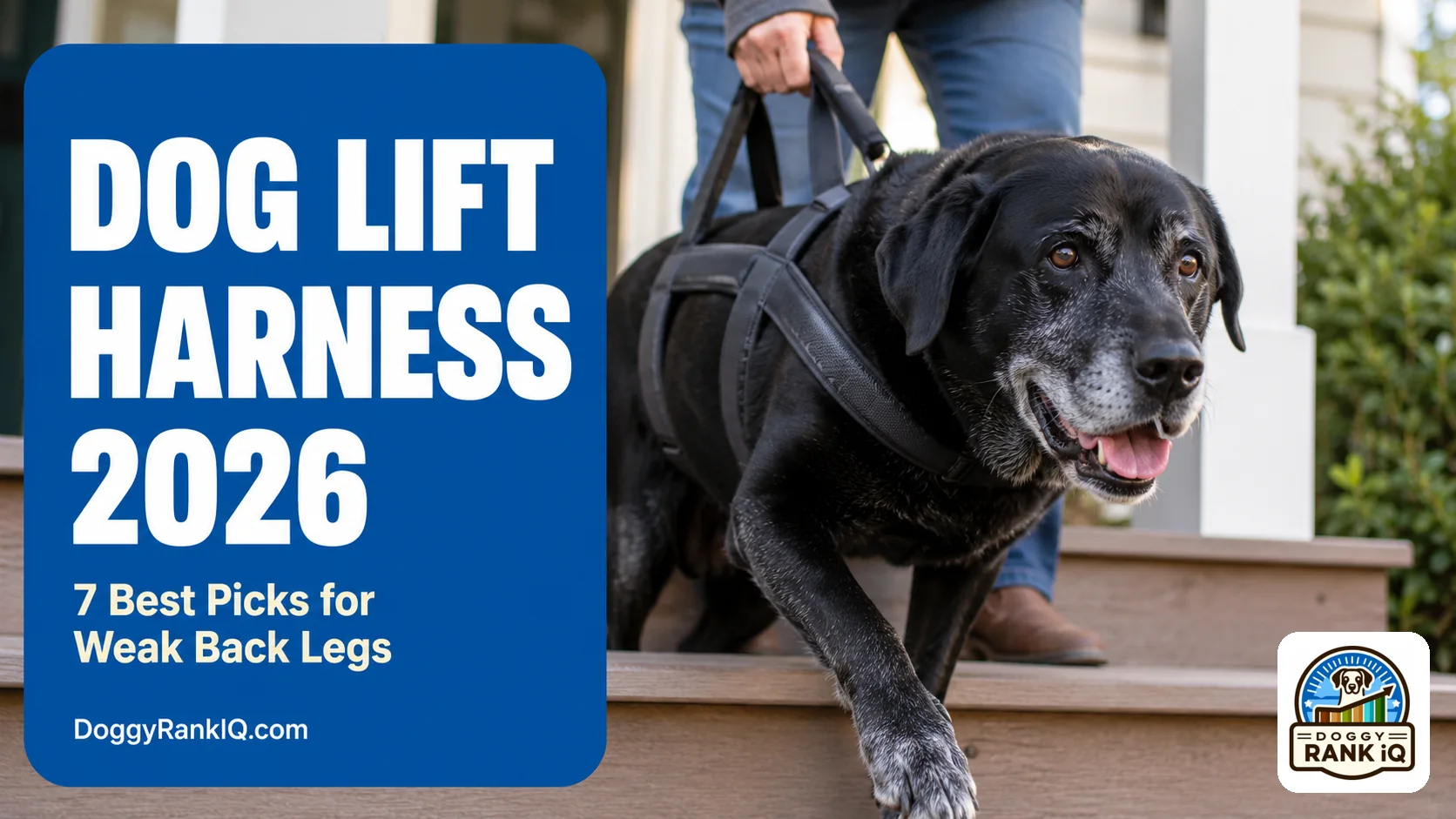
A dog lift harness supports a dog’s weight through fitted straps and a handle, letting an owner assist with stairs, curbs, and car entry without pulling on the dog’s joints or the owner’s back. The right choice depends on which end is weak: rear-only slings and harnesses suit dogs with solid front legs, while a dog lift harness full body design suits dogs whose front end has also started to fail. Prices for the picks below run from under $20 for a basic sling to over $125 for a padded, full-support design, price checked 2026.
Key Takeaways: dog lift harness
- A lift harness is not the same thing as a walking harness with a handle. A true lifting design is built to hold a portion of the dog’s weight, according to VCA Animal Hospitals’ collar and harness guidance.
- Rear slings work for dogs whose front legs still function. A lift harness full body setup is for dogs weak at both ends.
- Prices for a lift harness range from about $18 for a basic sling to over $125 for a padded full-support model, price checked 2026.
- Manufacturer-direct pricing on some brands beats Amazon by roughly $15 per size tier.
- Slings can press against the bladder area in male dogs, so check each listing’s fit notes before buying.
- New weakness, sudden collapse, knuckling, or crying out needs a veterinary visit before a harness purchase, per VCA’s first aid guidance for limping dogs.
- A handle sewn onto a walking harness is not automatically safe for full suspension.
- Home setup matters as much as the harness itself; VCA’s guide to mobility-compromised dogs recommends pairing any harness with non-slip flooring and ramps where possible.

When does your dog need help?
Tap an option to see the answer.
What a dog lift harness does for weak back legs
A lift harness takes weight off a dog’s hind legs during stairs, car entry, and short walks by letting an owner hold a padded handle instead of pulling on the collar or leash. It is a mobility aid, not a treatment, and it works alongside whatever a veterinarian has already diagnosed.
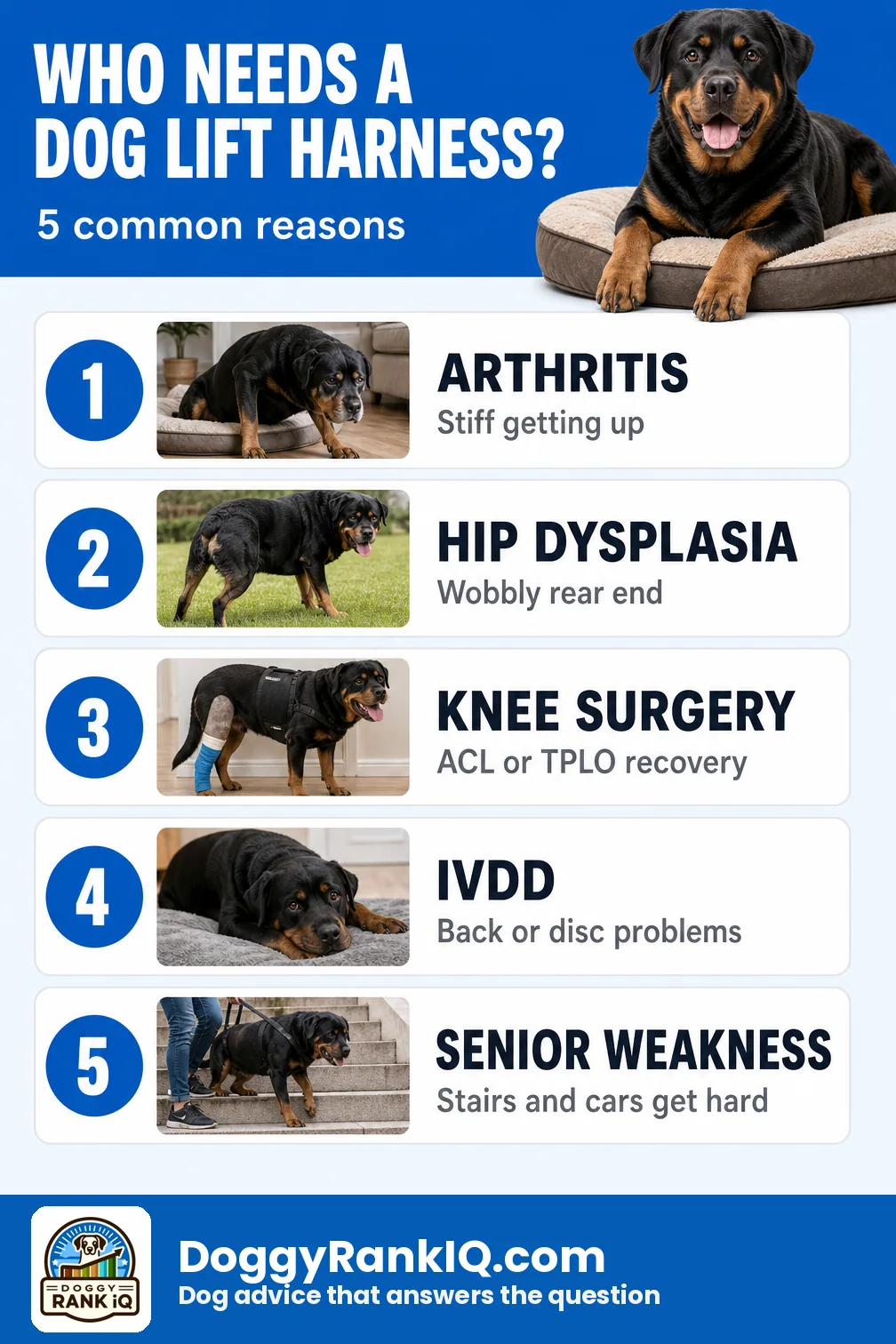
Common reasons owners reach for one include hip dysplasia, arthritis, recovery after cruciate (ACL or TPLO) surgery, and neurologic conditions like IVDD or degenerative myelopathy. The harness itself does not fix any of these. It just gives the dog’s legs a break during the specific moments that hurt the most: a flight of stairs, a tall tailgate, a slick bathroom floor.
Choose a rear-only sling or harness if the dog’s front legs still carry weight normally. Choose a lift harness full body if the front end has started wobbling too, since a rear sling alone cannot compensate for weak forelimbs. Guidance from mobility-focused resources such as the Mobility Dog Resource Group’s harness tips is consistent on this point: support the end that actually needs it, and don’t over-rig a dog that only needs light assistance.
What is a dog lift harness and how does it work
A lift harness is a set of fitted straps, usually with built-in padding and one or more fabric handles, that an owner grips to redistribute a dog’s weight away from a painful or weak limb. It works by wrapping around the chest, belly, or hindquarters so the owner’s lifting force spreads across a wide band of fabric instead of concentrating on the spine or a single joint.
Unlike a plain leash handle or a decorative top loop on a cheap walking harness, a true lift harness is reinforced at the stitching points that bear weight. That difference matters: a flimsy handle can rip or shift under 40 pounds of dog, right when a dog needs the most stability going down a stair.
Most designs fall into three families, covered in detail below: belly slings, rear-only harnesses, and full body harnesses. The right pick depends on which legs are weak, how often the dog needs help, and how much the dog weighs.
Sling vs rear vs dog lift harness full body: which type
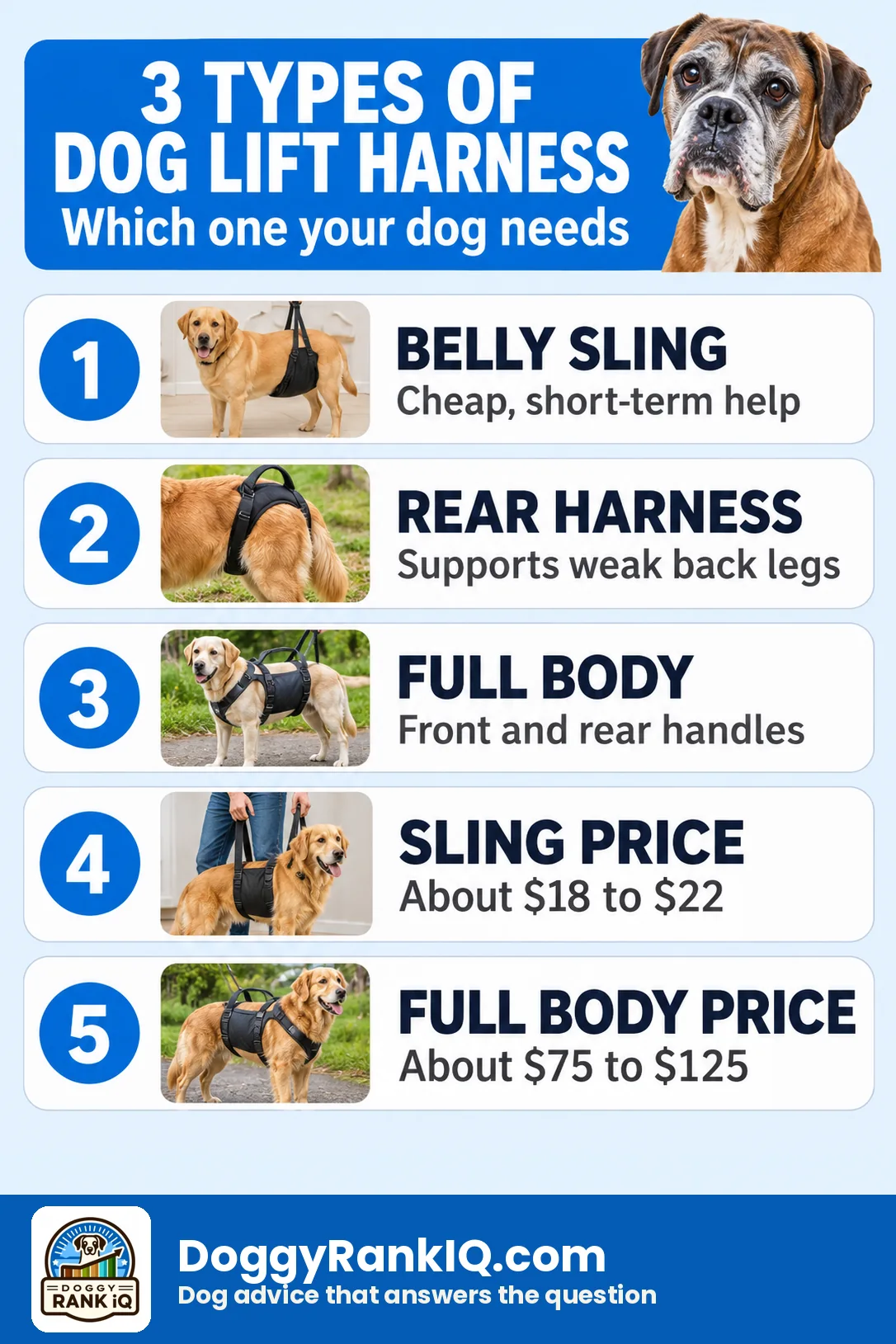
Three basic styles exist, and picking the wrong one wastes money and sometimes still hurts the dog. A cheap sling solves short-term needs. A rear harness suits ongoing hind-leg weakness. A full body design covers dogs weak at both ends.
Belly or rear slings. These are a padded strip with handles, worn like a towel sling. They cost less, pack small, and work for brief lifts, like helping a dog with sudden hind-leg soreness get up a single step. They are not built for all-day wear and can bunch up on a long walk.
Rear-only harnesses. These buckle around the hips and thighs with adjustable straps instead of a simple sling shape, so they stay put better during a real walk. This is the common choice for a lift harness for back legs when the issue is arthritis or post-surgery hind-leg weakness.
Full body harnesses. Front and rear sections connect with a strap along the spine, giving two separate handles. This is the right call for degenerative myelopathy, IVDD affecting multiple limbs, or any dog whose front legs have started to give out too.
Decision rule: if the dog can stand and walk steadily on its front legs but drags or buckles in the rear, a rear harness is usually enough. If both ends wobble, don’t settle for a rear-only product and hope it helps the front, because it structurally cannot.
Dog lift harness vs sling which is better
A sling is better for short, occasional lifts and a tight budget, while a structured rear or full body lift harness is better for daily, ongoing support. The right answer depends on frequency of use, not just cost.
A sling wins when:
- The dog needs help only a few times a day, such as getting up one step to the yard.
- The owner wants a low-cost option to try before committing to a pricier harness.
- The dog is recovering short-term from a minor strain rather than a chronic condition.
A structured harness wins when:
- The dog needs support multiple times a day, every day, such as daily stair access.
- The dog is mid-size or large, where a thin sling strip can slip or roll under real weight.
- The condition is progressive (arthritis, degenerative myelopathy) rather than a short recovery window.
Common mistake: buying a $20 sling for a 70-pound dog that needs help on every outing. The sling will bunch, slip, and wear out fast, and the owner ends up buying a proper harness anyway within weeks.
Dog lift harness comparison table
Help ‘Em Up, a brand frequently recommended by veterinary clinics, lists its own pricing at $80 to $140 depending on size on its manufacturer site, and Amazon listings for comparable sizes ran roughly $15 higher, with a Medium checked at $125 on Amazon versus $110 direct. Availability on Amazon has also been inconsistent for several Help ‘Em Up variants, while the manufacturer’s own site kept all nine sizes in stock during a November 2 check, which makes buying direct worth considering if fit matters.
How much does a good dog lift harness cost
A usable lift harness costs anywhere from about $18 for a basic small-dog sling to $140 or more for a premium, padded full-body design from a veterinary-recommended brand. Mid-range rear harnesses for larger dogs typically land between $40 and $80.
Price generally tracks three things: size (large and giant breed harnesses need more fabric and stronger hardware), number of handles (full body designs with two or four handles cost more than single-handle slings), and padding quality (thicker, washable padding adds cost but reduces chafing on long-term wear).
As a rough budget guide for 2026:
- Under $25: basic rear slings for small to medium dogs, short-term use.
- $40 to $80: rear harnesses with adjustable straps for daily walks.
- $75 to $140: full body harnesses or premium clinic-recommended brands like Help ‘Em Up and PetSafe’s CareLift Support Harness.
Checking manufacturer sites directly, not just Amazon, can save money on premium brands, as the Help ‘Em Up pricing comparison above shows.
The 7 best dog lift harness picks
1 LOOBANI Adjustable Dog Sling for Hind Leg Support
 LOOBANI Adjustable Dog Sling for Hind Leg Support
Price: $21.59, price checked 2026. Check the current price
This is a basic rear sling built for short, frequent lifts rather than long walks. It suits a small or medium dog recovering from minor hind-leg soreness, or a household that wants backup gear for occasional stairs. The padded strip sits under the belly and thighs; owners report it works well for quick bathroom trips but bunches on longer outings.
2OneTigris Invictus Lift harness, Full Body, Large
 OneTigris Invictus Lift harness, Full Body, Large
Price: $74.99, price checked 2026. Check the current price
A full body option with front and rear sections, suited to large dogs whose front legs are starting to weaken alongside the hind legs. Two separate handles let an owner support both ends independently on stairs. This is a better fit than a rear sling for IVDD or degenerative myelopathy cases where a vet has flagged declining front-end strength.
3Lift harness, Full Support, Medium Conventional, 45 to 80 lbs
Price: $125.00, price checked 2026. Check the current price
At the higher end of the Amazon price range, this medium-size full support harness targets dogs in the 45 to 80 pound range needing daily, sustained assistance rather than occasional lifts. The price sits close to manufacturer-direct pricing seen for comparable premium brands, so it’s worth comparing against Help ‘Em Up’s direct site before buying.
42-in-1 Detachable Lift harness with 4 Handles, X-Large
Price: $119.95, price checked 2026. Check the current price
Four handles and a detachable front section make this one flexible for large and giant breeds whose support needs change day to day. On a good day, the dog can wear just the rear section for a walk. On a harder day, the front panel clips back on for full support up a staircase.
5Adjustable Dog Sling for Large Dogs Hind Leg Support
Price: $19.99, price checked 2026. Check the current price
A budget rear sling scaled for large dogs, useful as a backup or travel option rather than daily gear. It is one of the cheapest large-dog options here, which matters for owners managing a short recovery window after surgery and not wanting to commit to a $100-plus harness yet.
6COODEO Mobility Lift harness, XL
Price: $42.99, price checked 2026. Check the current price
A rear harness, not a simple sling, built with adjustable straps for XL dogs who need daily rear support rather than occasional lifting. It sits mid-price between the cheap slings and the full body designs, which makes it a reasonable middle step for a large lift harness for back legs when the front end is still solid.
7Adjustable Lift harness for Small Dogs Hind Leg Support
Price: $17.99, price checked 2026. Check the current price
The lowest-cost pick on this list, built for small dogs with mild hind-leg weakness. It’s a reasonable starting point for a small dog in early arthritis, before committing to a pricier harness. Check the small-dog sizing closely, since a sling that’s too loose will slide rather than support.
A newer entrant worth tracking is PICK FOR LIFE, a budget fleece-lined rear sling added to one review guide’s dataset in 2026 after analysis of 389 written owner reviews. It was not in the original research set used for this list’s Amazon links, so compare it directly against the LOOBANI and small-dog sling picks above before choosing.
Best dog lift harness for large dogs
The best lift harness for large dogs is a full body or structured rear design with wide, padded straps and hardware rated for real weight, not a thin sling. For dogs over 50 pounds, the OneTigris Invictus full body option and the 2-in-1 Detachable harness above are both built for sustained load rather than quick lifts.
Large dogs put more strain on stitching and buckles than small dogs do, so look for:
- Double-stitched seams at the handle attachment points.
- Wide straps (at least 2 inches) across the chest and hips to spread pressure.
- A handle long enough that an owner can stand upright while lifting, not hunch over.
Choose a full body design if the dog is large and showing weakness in both front and rear legs. Choose a rear-only harness, like the COODEO XL pick above, if the front legs are still strong and only the hindquarters need support.
Dog lift harness for senior dogs with mobility issues
For senior dogs, a lift harness works best as one part of a broader mobility plan, not a standalone fix. Older dogs with arthritis, weak joints, or early neurologic decline often need a harness combined with better footing and reduced lifting overall, as outlined in VCA’s guidance on home setup for mobility-compromised dogs.
Senior-specific considerations:
- Senior dogs may tire quickly, so shorter, more frequent assisted walks beat one long outing.
- Weight gain is common in less active senior dogs, which adds strain to the hips and the harness hardware alike.
- A harness used daily should be checked weekly for stretched straps or worn padding, since senior dogs often wear theirs for months or years rather than weeks.
Example: a 12-year-old Labrador with hip dysplasia who struggles on stairs but still walks fine on flat ground is a good candidate for a rear harness used only at the stairs, rather than full-time full body wear.
How to use a dog lift harness properly
Using a lift harness properly means fitting it snugly, lifting with your legs instead of your back, and keeping the dog’s spine level during the lift. Skipping any of these steps risks injury to the dog’s joints or the owner’s back.
Step-by-step:
- Slide the harness into place according to the manufacturer’s diagram, checking that straps sit flat against fur rather than twisted.
- Fasten buckles snug enough that two fingers fit underneath, but tight enough that the harness doesn’t slide when the dog moves.
- Stand close to the dog, bend your knees, and grip the handle with your arm close to your body.
- Lift by straightening your legs, not by bending forward at the waist.
- Keep the dog’s body level, avoiding a tilt that puts extra weight on one hip or shoulder.
- Lower the dog slowly and let all four paws find solid footing before releasing the handle.
Common mistake: yanking the handle upward quickly, which can jolt a sore hip or shoulder. A slow, steady lift is safer even if it takes a few extra seconds.
Lift harness for back leg support
A lift harness for back leg support should wrap around the hips and upper thighs with adjustable straps, not just a loose sling under the belly. This type targets dogs with hind-leg weakness from arthritis, hip dysplasia, or recovery after cruciate surgery, while leaving the front legs free to move normally.
Signs a rear-only harness is the right fit:
- The dog’s front legs still bear weight evenly and don’t buckle or wobble.
- The main struggle is stairs, getting into a car, or standing up from lying down.
- A veterinarian has specifically diagnosed a hind-limb issue rather than a whole-body neurologic condition.
The COODEO Mobility Lift Harness and the two rear sling picks above (LOOBANI and the large-dog sling) all fall into this category, at different price points and dog sizes.
How to fit a lift harness and lift without hurting your back
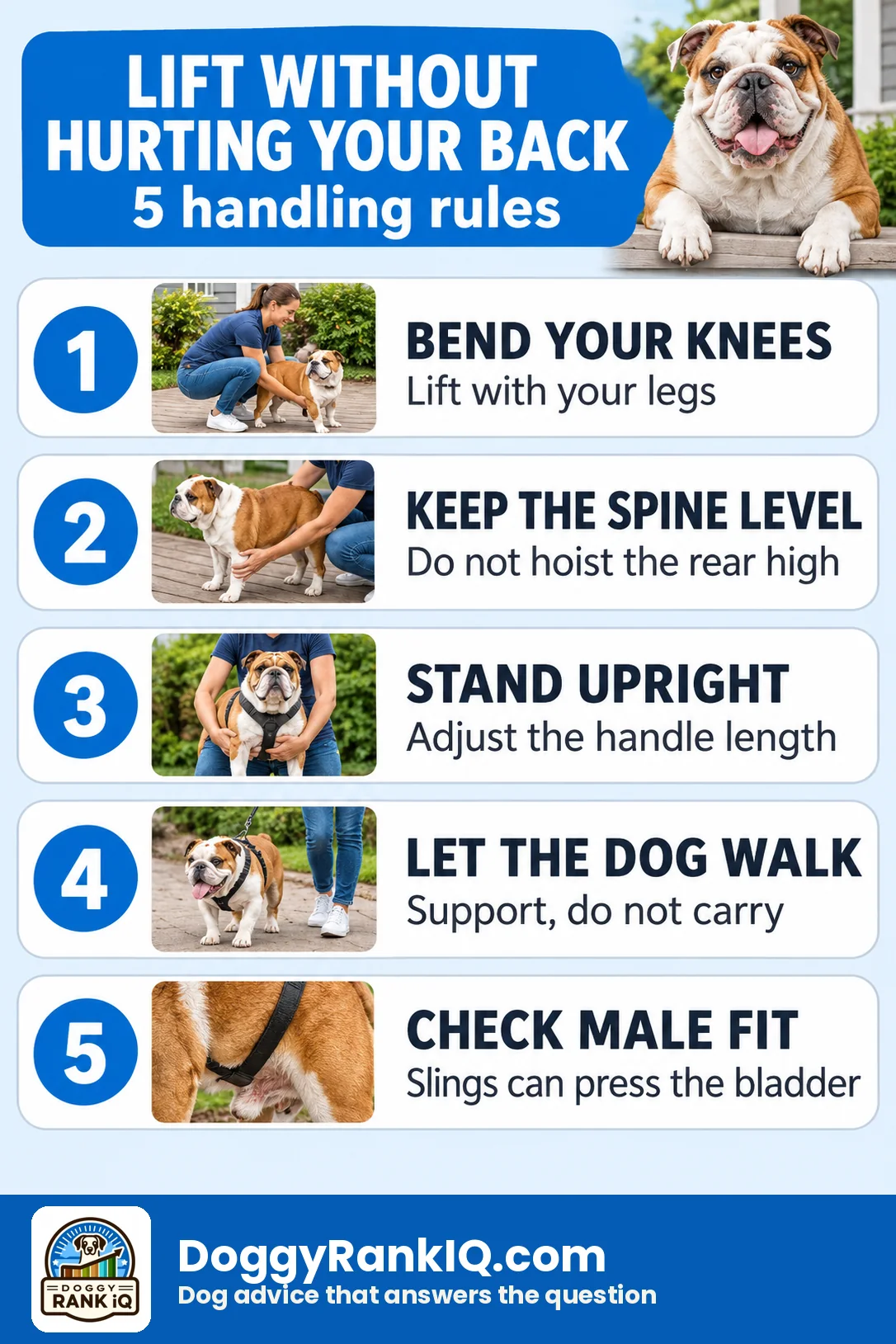
Fit the harness snug enough that it doesn’t slide, but loose enough to fit two fingers underneath the straps. Then lift with your own legs, not your back, and keep the dog’s spine level rather than tilted.
- Handle length matters. Choose a harness whose handle lets you stand upright while lifting. Bending over repeatedly to compensate for a short handle is a fast way to hurt your own back.
- Check the fit for male dogs. Slings that run under the belly can press on the bladder area in male dogs. Read each listing’s fit notes and adjust the strap position if the dog seems uncomfortable or strains to urinate while wearing it.
- Lift with your legs. Bend your knees, keep the dog’s body as level as possible, and avoid twisting your torso while supporting the weight.
- Common mistake: using a regular walking harness’s top handle to suspend a dog’s full weight. A handle is not automatically a hoist, and a conventional harness isn’t built to bear that load, according to VCA’s harness guidance.
- For full instructions on strap placement and adjustment, see our guide on how to fit a dog harness.
If a dog resists wearing the harness, introduce it gradually with short, reward-based sessions before using it for an actual lift. Forcing a frightened dog into unfamiliar gear during a painful moment makes the next attempt harder, not easier.
Lift harness for large dogs vs small dogs
Large lift harness for back legs options need wider straps, sturdier stitching, and a handle rated for real weight, since a 70-pound dog puts far more strain on hardware than a 12-pound dog does. Small dog harnesses can use lighter fabric and simpler single-handle slings.
For large dogs, look at full body or rear harness designs with adjustable straps rather than basic slings, since a sling alone can be hard to control on a dog that outweighs the stairs it’s being carried down. The COODEO XL and the 2-in-1 X-Large pick above fit this category.
For small dogs, a simple rear sling is often enough, and the lower price reflects lower material and hardware needs. The small dog sling pick above, at under $18, is a reasonable starting point rather than an upgrade purchase.
Top 5 features we love
- Padded straps that spread pressure across a wider area instead of digging into a thin-skinned hip or shoulder.
- Separate front and rear handles on full body designs, so one person can adjust support at each end independently.
- Adjustable buckles at multiple points, letting the same harness fit a dog through weight changes during recovery.
- Detachable sections (like the 2-in-1 X-Large pick) that let owners scale support up or down day to day.
- Washable fabric, since a harness worn daily during recovery gets dirty fast and needs regular cleaning.
Things to look out for
- Bladder pressure in male dogs. Some slings sit directly under the belly and can press on sensitive areas; check fit notes before buying.
- Backordered or discontinued listings. Some well-known brands have had inconsistent Amazon stock; one rear harness line appears to have been discontinued by its manufacturer in 2026.
- Mismatched support type. A rear-only product cannot help a dog whose front legs are also failing.
- Short handles that force the owner to bend over repeatedly, risking the owner’s own back.
- No veterinary involvement. A harness is a mobility aid, not a diagnosis. New or worsening weakness should be checked before buying gear, as VCA’s guide to caring for a sick dog emphasizes.
Stairs, cars and other lifts: when a ramp beats a harness
A harness helps for brief assists, but a ramp removes the lifting altogether, which matters for larger dogs or owners with their own back problems. Veterinary guidance increasingly leans toward reducing lifting entirely rather than buying a stronger harness, through ramps, traction runners, and single-floor living arrangements, a point echoed in VCA’s quality of life guidance for aging dogs.
For car entry specifically, a loading ramp avoids the twisting motion that a harness lift still requires. Our dog ramp for car guide covers sizing and weight limits in more detail. Indoors, raised step options reduce the number of full lifts a dog needs per day; see our dog stairs for bed guide for options that pair well with a harness rather than replace it.
For dogs with early joint pain rather than confirmed weakness, catching the signs early changes the gear decision. Our signs of arthritis in dogs guide explains what to watch for before a dog needs a lift harness at all.
Choose a ramp over a harness if the dog is large, the owner has their own back pain, or the lift happens multiple times daily, such as every car trip. Choose a harness for occasional assists, stairs that can’t fit a ramp, or short-term post-surgery recovery.
Who should buy which
A rear sling suits a dog with occasional hind-leg soreness and an owner who needs an inexpensive, short-term option. A rear harness suits ongoing hind-leg weakness from arthritis or post-surgery recovery where daily wear is likely. A full body harness suits a dog that has started losing strength in both the front and rear legs, such as advanced degenerative myelopathy or multi-limb IVDD cases, where a vet has confirmed both ends need support.
Before buying any lift harness, it helps to review general fit and safety basics for harnesses overall, covered in our broader best no-pull dog harness guide, and to keep a dog’s general comfort in mind with supportive bedding like an orthopedic dog bed to reduce how often a lift is needed in the first place.
FAQ
The bottom line
A lift harness is a practical tool for specific moments, not a cure for what’s causing the weakness underneath it. Match the type to the dog’s actual needs: rear support for a dog that’s solid up front, full body for a dog weak at both ends, and a quick vet check before buying anything if the weakness is new or getting worse fast. Compare the options above against the dog’s size, daily routine, and budget, and consider a ramp for tasks the dog faces multiple times a day.
For related gear decisions, our guides on best orthopedic dog bed and best no pull dog harness options round out a full mobility setup.
Doggy Rank IQ is reader supported. As an Amazon Associate we earn from qualifying purchases, at no extra cost to you.