
Quick Answer
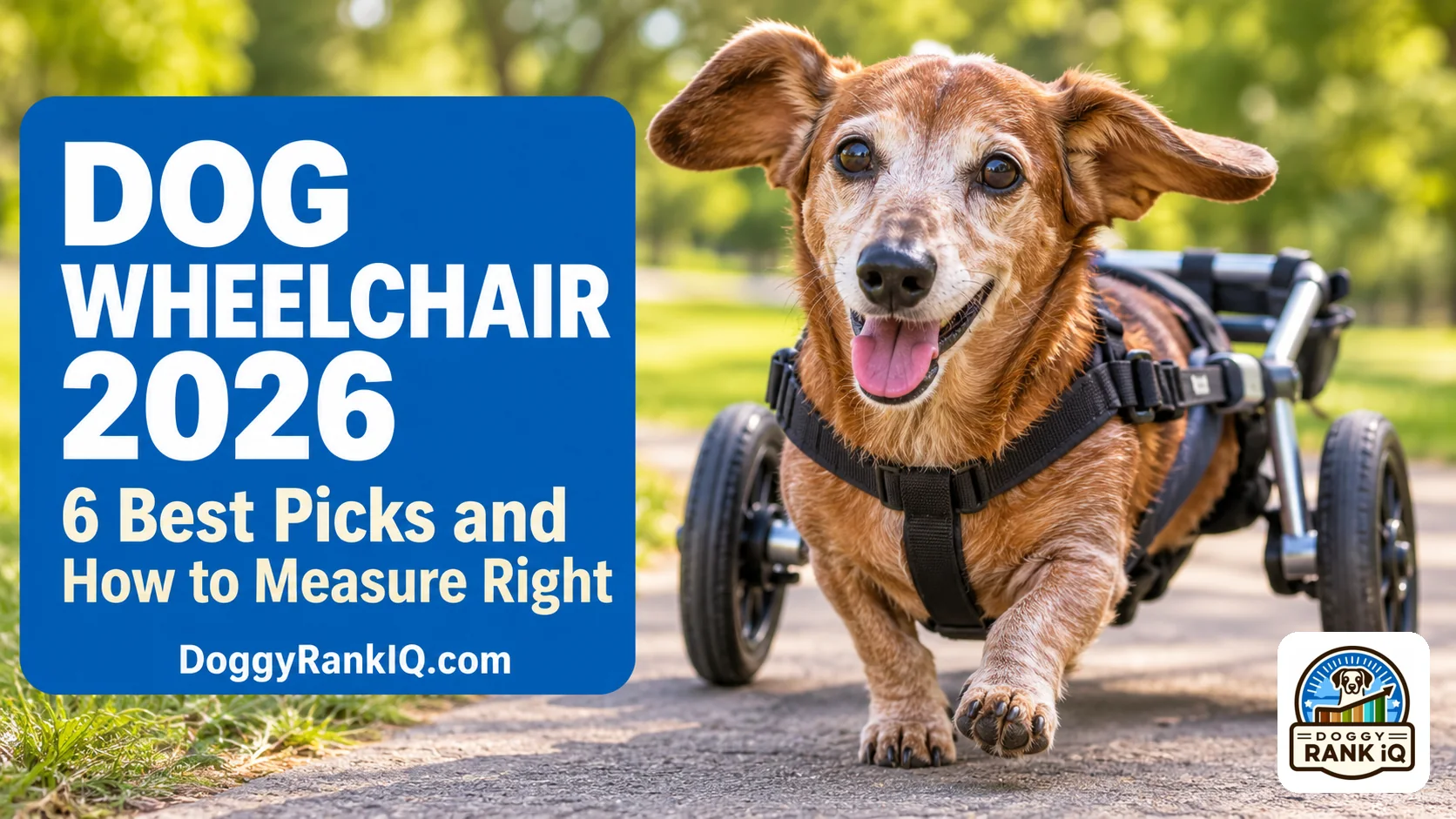
A dog wheelchair supports a dog’s weak or paralyzed legs so the dog can keep walking, sniffing, and moving around during supervised activity. The right choice depends on three numbers (rear leg height, body length, and width) plus whether the weakness is in the back legs, front legs, or all four. This guide covers six dog wheelchair models across price points, the exact measurements to take before buying, and where to find a dog wheelchair rental if you want to test fit before committing.
Key Takeaways: dog wheelchair
- A wheelchair for back legs is the most common type and suits dogs with IVDD, degenerative myelopathy, or hip arthritis that still have working front legs.
- Three measurements matter more than weight alone: rear leg height, body length from armpit to rump, and width at the widest point.
- Rear support carts run roughly $66 to $260 at Amazon price points checked in 2026, while custom-built brands like Walkin’ Wheels and K9 Carts range higher.
- A wheelchair for front and back legs (quad support) is for dogs weak in all four limbs, not just back legs.
- Most dogs cannot lie down in a rear cart, so it’s a tool for supervised exercise, not all-day wear.
- Many dogs adjust within a few days of short, treat-based sessions.
- Wheelchair rental programs and nonprofit loan closets exist, and a vet or canine rehab therapist can often point you toward one before you buy anything.
- Veterinary rehabilitation centers at schools like Cornell and Colorado State often assess gait before recommending a cart, rather than prescribing one based on diagnosis alone.

Which legs need help?
Tap an option to see the answer.
What is a dog wheelchair and how does it work
A wheelchair is a wheeled frame that straps around a dog’s torso and holds up the weak end of the body so the dog can use its remaining strength to walk, turn, and explore. It works by transferring weight that the dog can no longer support on its own legs onto a set of wheels attached to an adjustable harness system.
Most designs use a simple frame of two side rails connected by a saddle or sling that sits under the belly, with leg rings or straps that loop around the thighs (for rear carts) or the chest (for front carts). The dog’s working legs stay free to touch the ground and do the actual walking and steering. The wheels just keep the non-working end from dragging or collapsing.
Rear support carts are by far the most common version, since back-leg weakness is more common than front-leg weakness in dogs. Quad carts, which support all four legs with four wheels, are mechanically more complex because they have to balance the dog’s entire body weight rather than just one end.
A wheelchair is not a treatment. It’s closer to a wheelbarrow for a dog’s hindquarters: it lets the dog keep doing something it already wants to do (moving around, sniffing a yard, following the family to the mailbox) without forcing weak or paralyzed legs to bear weight they can’t handle.
How much does a dog wheelchair cost
Dog wheelchairs sold through major retailers in 2026 generally run from about $66 to $260 for rear support carts, based on the models in this guide checked at Amazon price points. Custom-built brands such as Walkin’ Wheels and K9 Carts cost more because they’re sized and adjusted individually rather than sold off a size chart.
A rough price breakdown by category:
- Budget rear carts ($66 to $100): Lightweight frames for small to medium dogs, often with less refined adjustment hardware.
- Mid-range rear carts ($180 to $260): Built for large or extra-large dogs, with wider adjustment ranges to fit changing body weight during recovery.
- Quad (4 wheel) carts ($100 and up): Typically cost more per pound of dog supported, since they’re a more complex build.
- Custom brands (roughly $219 to $529 and up): Walkin’ Wheels by Walkin’ Pets lists mini models starting around $219 and large models closer to $529, based on the company’s 2026 pricing and sizing guidance Walkin’ Pets. K9 Carts’ custom frames, which use laser-etched adjustment markings, generally price higher than off-the-shelf options.
Choose a budget frame if the dog’s condition is temporary, such as IVDD recovery with a good prognosis. Choose a mid-range or custom frame if the dog has a progressive condition like degenerative myelopathy, since the cart will need to be used for months or years and adjusted as the dog’s body changes.
When should I get my dog a wheelchair
A wheelchair makes sense once a vet confirms the dog cannot bear normal weight on one or more legs but is otherwise alert, eating, and still interested in moving around. Getting one too early, before a diagnosis, risks masking a worsening condition that actually needs rest or surgery instead of exercise.
Good timing usually looks like one of these:
- A vet has diagnosed IVDD, degenerative myelopathy, hip dysplasia, or a similar condition and cleared the dog for supervised movement.
- The dog is recovering from spinal surgery and a rehab therapist has approved light activity.
- A senior dog has lost rear strength gradually but still wants to go on walks and follow the household around.
Skip buying one, for now, if the dog is showing acute pain, hasn’t seen a vet yet, or has a condition (like some acute disc herniations) where movement can make things worse before it’s stabilized. Veterinary rehabilitation teams at places like Purdue’s Small Animal Hospital typically run a gait and pain assessment first, then recommend equipment based on what they see, not just the diagnosis on paper.
Can my dog adjust to using a wheelchair
Most dogs adjust to a wheelchair within a few days of short, treat-based sessions, though timelines vary with age, temperament, and how much pain the dog is in. A nervous or older dog may take one to two weeks of brief daily sessions before walking confidently in the frame.
Signs of good adjustment include:
- The dog starts moving forward voluntarily rather than freezing in place.
- Tail and ear position stay relaxed rather than pinned down.
- The dog accepts being lifted into the harness without struggling after a few tries.
Signs the dog is struggling, not just adjusting slowly:
- Repeated attempts to bite at or chew the straps.
- Refusing to move at all after multiple short sessions.
- Visible distress (panting, whining) that doesn’t settle within the session.
If a dog shows the second set of signs after a week of consistent short sessions, it’s worth rechecking the fit rather than assuming the dog simply dislikes the cart. A poorly fitted cart is one of the most common reasons dogs resist using one, according to guidance from The Farmer’s Dog on helping dogs with mobility challenges.
Can a dog wheelchair help your dog? Conditions it suits
A wheelchair helps dogs that have lost some or all strength in their legs but still want to move, sniff, and engage with their surroundings. It does not fix the underlying condition. It gives the dog a way to keep exercising and keep muscle mass while that condition is managed.
Dogs most likely to benefit:
- IVDD (intervertebral disc disease), especially in long-backed breeds like dachshunds, during recovery or with chronic rear weakness
- Degenerative myelopathy, a progressive condition that weakens the back legs over months
- Hip or elbow arthritis severe enough to limit walking (see our signs of arthritis in dogs guide for what to watch for)
- Dogs recovering from spinal surgery or a traumatic injury, once a vet clears supervised movement
- Senior dogs with general rear-end weakness who still have a clear interest in walks
A cart is not automatically the right call for every weak or slow dog. A dog that’s mostly just stiff might do better with ramps, an orthopedic dog bed, and a dog ramp for the car instead of a full mobility cart. Choose a wheelchair if the dog cannot bear weight on its own but is otherwise alert, eating, and interested in moving. Skip it, for now, if the dog is in acute pain, hasn’t been diagnosed, or a vet suspects a condition that worsens with activity.
Signs my dog needs a wheelchair
A dog typically needs a wheelchair when it drags its back legs, knuckles over on its paws while walking, or can no longer stand long enough to eat, drink, or go outside without help. These signs usually show up gradually with degenerative conditions or suddenly after an injury or disc event.
Watch for:
- Dragging one or both back paws, sometimes with scraped nails or raw skin on the top of the foot
- Knuckling, where the paw flips under instead of landing flat
- Collapsing in the rear after a few steps
- Reluctance to climb stairs or jump that wasn’t there before
- Visible muscle loss in the hindquarters over weeks or months
Veterinary teaching hospitals such as Virginia Tech’s rehabilitation service and UC Davis’s sports medicine and rehabilitation program generally recommend a full gait evaluation before fitting a cart, since the right support type depends on exactly which muscles and nerves are affected, not just how the dog looks when it walks.
Example: a 9 year old Labrador with hip arthritis that still bears some weight but tires after five minutes is a different case than a dachshund with acute IVDD that suddenly can’t move its back legs at all. Both might eventually use a rear cart, but the arthritic Lab may do fine with shorter sessions and pain management first, while the dachshund likely needs a vet visit before any equipment decision.
Dog wheelchair for back legs vs front legs vs 4 wheels: which type
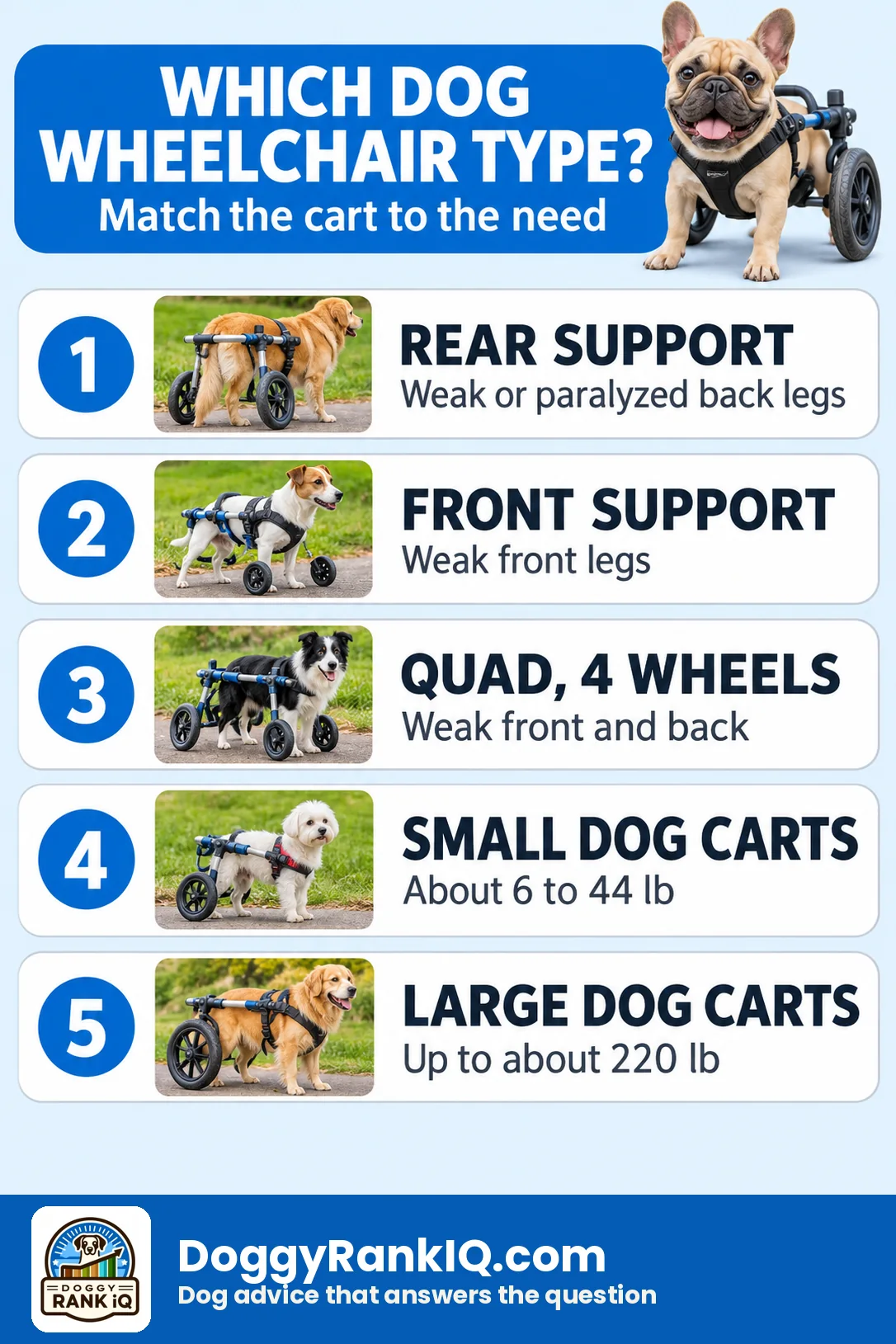
The right wheelchair type depends entirely on which legs are weak, not on the dog’s size or breed. Rear support carts are built for back-leg weakness. Front support carts are rare and built for front-leg weakness. A wheelchair for all legs (quad, usually 4 wheels) supports a dog that’s weak in both the front and back.
Most dogs shopping for a wheelchair for back legs small or large will land in that first row. A wheelchair for front and back legs is a bigger, heavier piece of equipment and usually costs more because it has to balance the dog’s full weight across four wheels instead of two.
Choose rear support if the dog’s front legs are strong enough to bear weight normally. Choose a 4 wheel quad cart if the dog struggles to hold its head and chest up during walking, or a vet specifically identifies front-leg weakness. This is a decision worth confirming with a vet or canine rehab therapist, since guessing wrong means returning or reselling an expensive piece of gear.
How to measure right: 3 measurements before you order
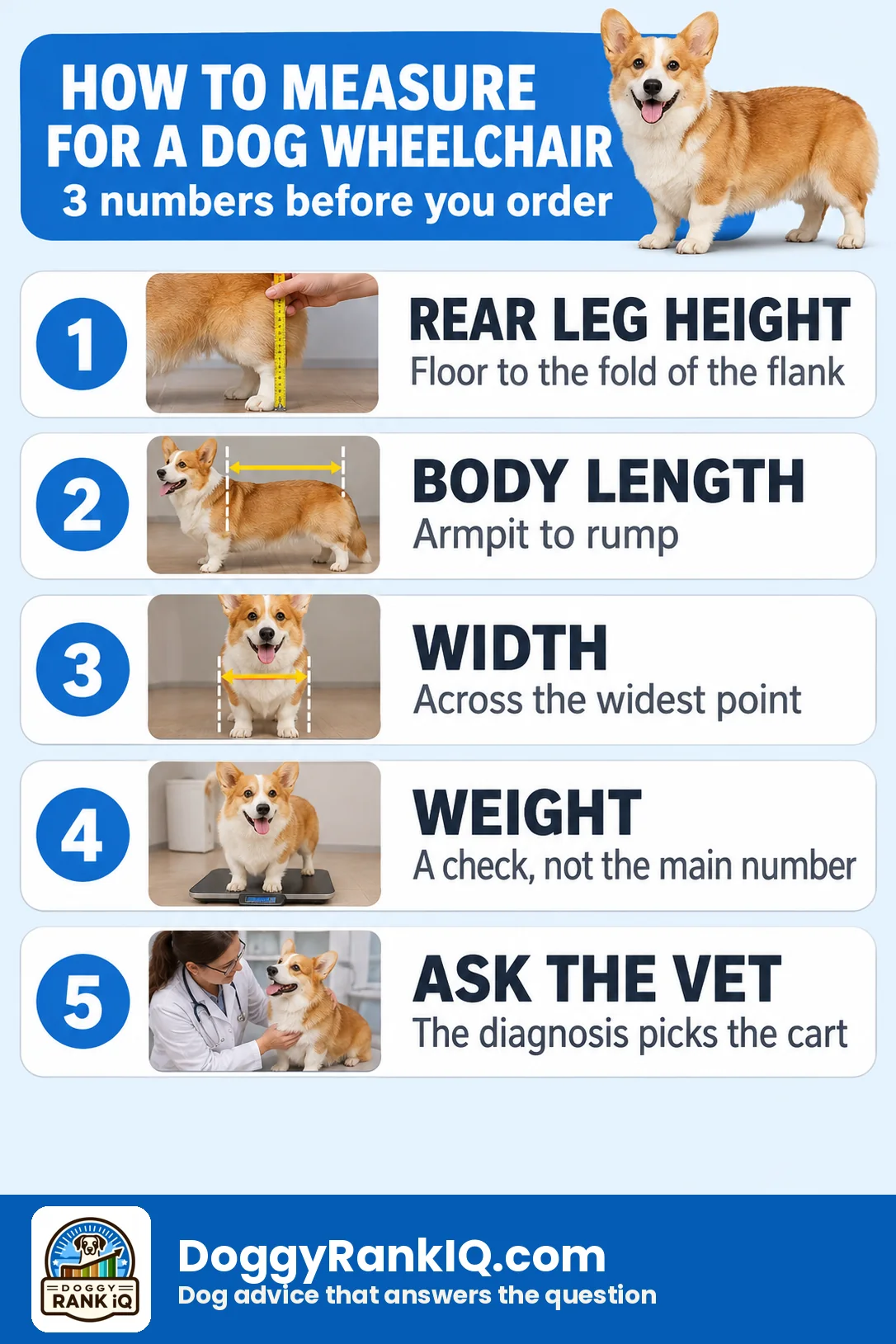
Three measurements determine fit for almost every wheelchair on the market: rear leg height, body length, and width at the widest point. Weight alone is not enough information for any reputable maker to size a cart correctly.
- Rear leg height. Measure from the floor to the fold of the flank (where the back leg meets the body) while the dog stands naturally, or while lying on its side with the leg gently bent, depending on the brand’s instructions. Walkin’ Pets specifically asks owners to measure with the dog lying down and the leg naturally bent, not stretched out, according to the Walkin’ Pets sizing guidance.
- Body length. Measure from the armpit to the rump along the dog’s side. This determines how long the frame needs to be to support the torso without pinching.
- Width at the widest point. Usually the hips or ribcage, whichever is broader. This sets the spacing between the wheels.
K9 Carts’ custom build process asks for four measurements instead of three: back height, body length, body width, and girth, and uses laser-etched markings on the frame for easier adjustments later. That extra step matters more for dogs with unusual proportions, like a barrel-chested bulldog or a long-backed dachshund.
Common mistake: measuring a standing dog for rear leg height instead of a relaxed, slightly bent leg. This tends to oversize the cart, which means the dog’s feet barely clear the ground and the cart does little to support actual walking.
Edge case: dogs with uneven hips, a missing limb, or significant muscle loss on one side often need a brand that reviews photos and measurements directly, such as Eddie’s Wheels, rather than a store-bought model sized off a chart alone.
Dog wheelchair comparison table
| Model | Support type | Dog weight | Adjustable | Price |
|---|---|---|---|---|
| Best Friend Mobility (Large) | Rear legs | Large | Yes | $260.00 |
| Adjustable Rear Cart (budget) | Rear legs | Small to medium | Yes | $69.93 |
| Large Wheelchair (40 to 220 lb) | Rear legs | 40 to 220 lb | Yes | $239.99 |
| Full Legs Cart (6 to 44 lb) | All 4 legs | 6 to 44 lb | Yes | $99.99 |
| Lightweight Rear Cart | Rear legs | Small | Yes | $66.49 |
| Adjustable XL Rear Cart | Rear legs | Extra large | Yes | $185.00 |
Prices checked 2026 at the listed retailers.
The 6 best dog wheelchair picks
1Best Friend Mobility Wheelchair for Back Legs, Large
This is a rear-support cart built for larger dogs with back-leg weakness from arthritis, IVDD recovery, or degenerative myelopathy. The manufacturer documents an adjustable frame that accommodates a range of leg heights and body lengths for large breeds. Owners on the product page report using it for dogs recovering from spinal surgery and for older dogs with hip dysplasia. At $260.00 (price checked 2026), it sits in the middle of the rear-cart price range, below fully custom brands but above the budget frames.
Best Friend Mobility Wheelchair for Back Legs, Large | Check the current price
2Adjustable Wheelchair for Back Legs mobility cart
This wheelchair for back legs small dogs and medium dogs is the lowest-priced entry in this roundup at $69.93 (price checked 2026). It’s a reasonable starting point for owners who want to try a cart before committing to a pricier custom frame, or for a temporary recovery period rather than years of daily use. Reviewers commonly flag adjustment stiffness on budget frames like this one, so plan extra time for the first fitting session.
Adjustable Wheelchair for Back Legs mobility cart | Check the current price
3Large Wheelchair, Adjustable Rear Leg Support, 40 to 220 lb
A wheelchair for back legs built specifically for large and giant breeds, covering a wide 40 to 220 lb weight range. The manufacturer lists adjustable height and width settings meant to fit mastiffs, Great Danes, and similarly large dogs with rear weakness. At $239.99 (price checked 2026), it’s a mid-range option for owners who need one cart to span a broad size bracket as a dog gains or loses weight during recovery.
Large Wheelchair, Adjustable Rear Leg Support, 40 to 220 lb | Check the current price
4Wheelchair for Small Dogs, Full Legs, 6 to 44 lb
This is a wheelchair for front and back legs, the quad-support style, sized for dogs between 6 and 44 lb. It’s one of the only full-leg support options in this price bracket, which makes it worth a look for small dogs with degenerative myelopathy affecting all four limbs. At $99.99 (price checked 2026), it’s a reasonable value for a quad-support frame, though full-leg carts are inherently more complex to fit than rear-only models.
Wheelchair for Small Dogs, Full Legs, 6 to 44 lb | Check the current price
5Lightweight Dog Wheelchair for Back Legs
At $66.49 (price checked 2026), this is the cheapest rear-support cart in this list, built for smaller dogs needing back-leg support. The lightweight frame is worth considering for a small dog where every extra ounce of equipment affects how much effort walking takes. As with most budget frames, confirm the manufacturer’s return policy before buying, since fit issues are more common at this price point.
Lightweight Wheelchair for Back Legs | Check the current price
6Adjustable Large Dog Wheelchair for Back Legs, XL
For extra large dogs with rear-leg weakness, this cart lists at $185.00 (price checked 2026) and sits between the budget frames and the premium Best Friend Mobility large model in this roundup. It’s a reasonable middle ground for owners of big dogs who want an adjustable frame without paying for a fully custom build.
Adjustable Large Wheelchair for Back Legs, XL | Check the current price
For custom and premium builds: Walkin’ Wheels by Walkin’ Pets offers a highly adjustable rear cart line with prices ranging from roughly $219 for mini models to around $529 for large models, and the company’s 2026 sizing guidance recommends measuring rear leg height with the dog lying on its side, leg naturally bent, rather than standing. K9 Carts builds custom rear-support frames using four measurements and laser-etched adjustment markings, with prices generally running higher than off-the-shelf models.
⭐ Top 5 Features We Love
- Adjustable height and width on nearly every model in this list, so the cart can be fine-tuned as a dog’s condition changes or the dog loses or gains weight
- Lightweight aluminum or PVC frames that don’t add significant drag for a weak dog to pull around
- Quad (4 wheel) options at affordable prices, which used to be harder to find outside of custom brands
- A wide weight range on large-dog models like the 40 to 220 lb option, useful for giant breeds
- Padded leg rings and harness straps documented on most manufacturer listings, meant to reduce rubbing during longer sessions
⚠️ Things to Look Out For
- Most rear carts do not let a dog lie down or sit normally, so they’re for supervised exercise sessions, not all-day wear, a point echoed in guidance from the Frontiers in Veterinary Science literature on canine mobility devices
- Budget frames under $100 sometimes ship with unclear adjustment instructions, according to owner reviews on multiple listings
- A cart sized off weight alone, without the three key measurements, commonly ends up too long, too short, or pinching at the hips
- Wheels can struggle on thick carpet, gravel, or sand, so check the terrain where the dog will actually use it
- Skin checks matter: leg rings and straps that rub in the same spot every session can cause sores over weeks of use
How to teach a dog to use a wheelchair
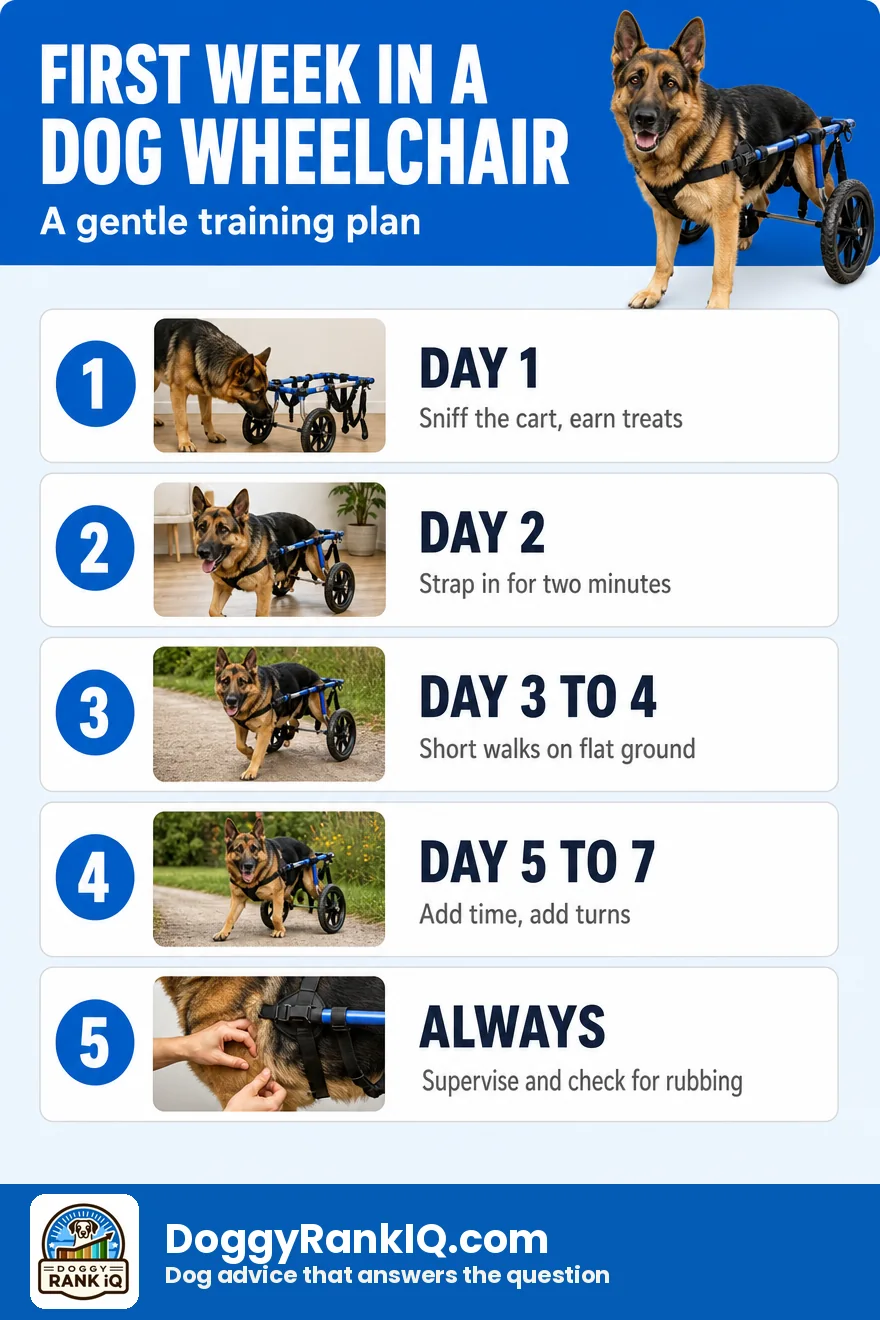
Most dogs need a few short sessions, not a single long one, to get comfortable in a cart. Start indoors on a flat, familiar surface for five to ten minutes at a time, with treats ready before the dog even steps into the frame.
- Let the dog sniff and investigate the stationary cart first
- Lift the dog into position gently, supporting the torso, rather than forcing the legs
Dog wheelchair rental and free options
A wheelchair rental lets owners test fit and function before spending on a purchase, and it’s worth asking about before buying anything. Several manufacturers and third-party medical equipment companies offer rental or loaner programs, particularly for short-term recovery situations like post-surgery IVDD cases where the dog may only need the cart for a few weeks or months.
Where to look:
- Ask the treating vet or a canine rehabilitation clinic directly, since many keep relationships with rental programs or loaner fleets
- Breed-specific rescues, especially for dachshunds and other IVDD-prone breeds, sometimes maintain a small supply of donated or loaned carts
- Local mobility equipment nonprofits occasionally extend pet equipment lending alongside human mobility aids
- Some manufacturers offer trial periods or returns within a set window, which functions similarly to a rental for sizing purposes
Decision rule: choose rental or loan if the condition is likely temporary (post-surgery recovery, a short-term flare-up) or if you’re unsure the dog will tolerate a cart at all. Choose purchase if the diagnosis is progressive, like degenerative myelopathy, where the dog will likely need the cart for months or years.
Who should buy which
Choose a rear support cart like the Adjustable Wheelchair for Back Legs mobility cart if your dog has normal front-leg strength and a diagnosed rear issue such as IVDD or hip arthritis, and you want to test the concept at a lower price point.
Choose a quad or 4 wheel option like the Wheelchair for Small Dogs, Full Legs, 6 to 44 lb if a vet has identified weakness in all four legs, not just the back.
Choose a large or extra-large rear cart like the Best Friend Mobility or Adjustable Large Wheelchair for Back Legs, XL if your dog is a large or giant breed needing durable, size-appropriate support.
Choose a custom build from Walkin’ Wheels or K9 Carts if your dog has unusual proportions, a long-term progressive diagnosis, or didn’t fit well in a standard adjustable frame.
Skip a wheelchair entirely, for now, if your dog hasn’t been formally diagnosed. A vet visit first prevents buying the wrong support type. Pair any cart with other home adjustments, like a supportive orthopedic dog bed for recovery rest and a dog ramp for the car to reduce jumping strain.
FAQ
The bottom line
A wheelchair works when it matches the dog’s actual diagnosis and actual measurements, not just its weight on a chart. Take the rear leg height, body length, and width before ordering anything, confirm rear versus quad support with a vet, and consider a rental or loaner program first if the condition might be temporary. For related home setup, check our guides on signs of arthritis in dogs and orthopedic dog beds to round out a comfortable recovery space.
Doggy Rank IQ is reader supported. As an Amazon Associate we earn from qualifying purchases, at no extra cost to you.