
Quick Answer
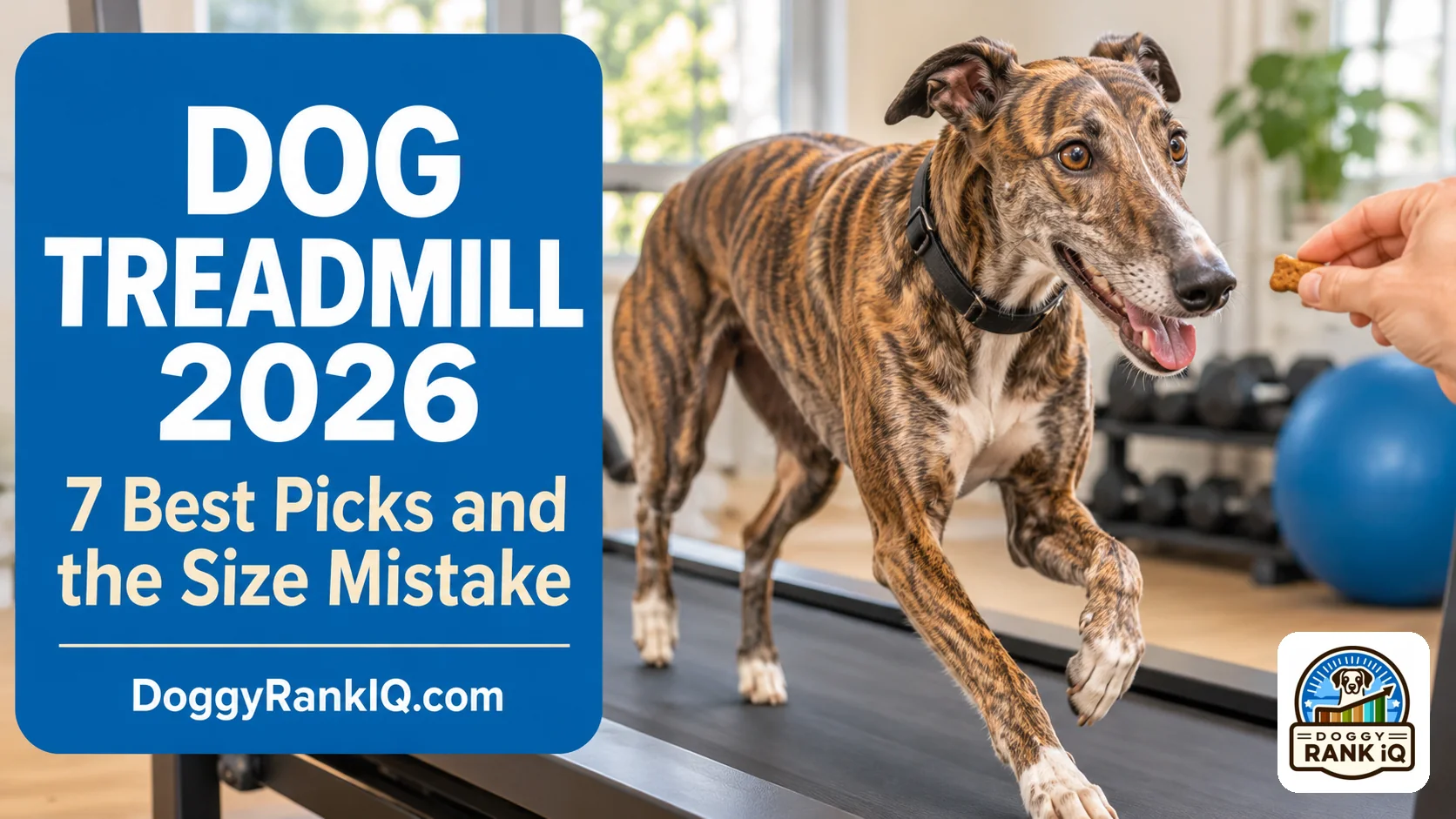
A dog treadmill is a motorized belt or a dog-powered slat mill built for indoor exercise, and the right one depends on matching belt length to your dog’s actual stride, not just its weight class. Most owners pick a dog treadmill too short because they shop by weight limit alone, which forces a choppy, unsafe gait. The best 2026 picks run from the $189 Gymax for small dogs to the $719 slat mill for large breeds, with the dogPACER LF 4.0 ($799) as the versatile middle-size standard. Check the dimensions against your dog’s nose-to-tail-base length before you buy, never the box photo.
Key Takeaways: dog treadmill
- A treadmill belt should be about 1.5 to 2 times your dog’s body length, per Cornell University’s canine treadmill guidance, or 2 to 3 times by a more conservative home-use rule.
- Weight capacity and belt length are two separate checks. A treadmill rated for 179 pounds can still be wrong for your dog if the belt is short.
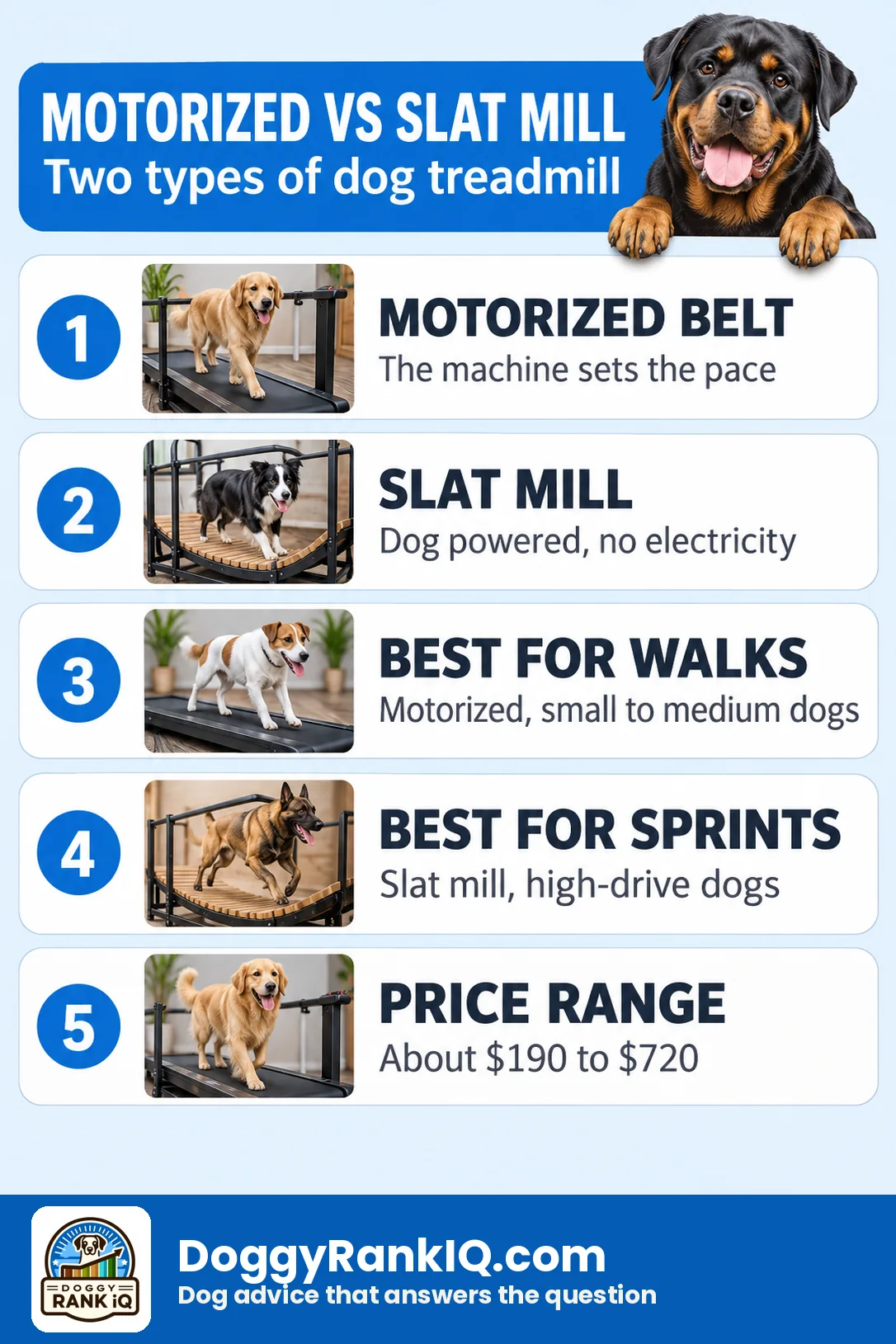
- Motorized dog treadmills set the pace. Manual slat mills are dog-powered and need no electricity, which matters for apartments and power outages.
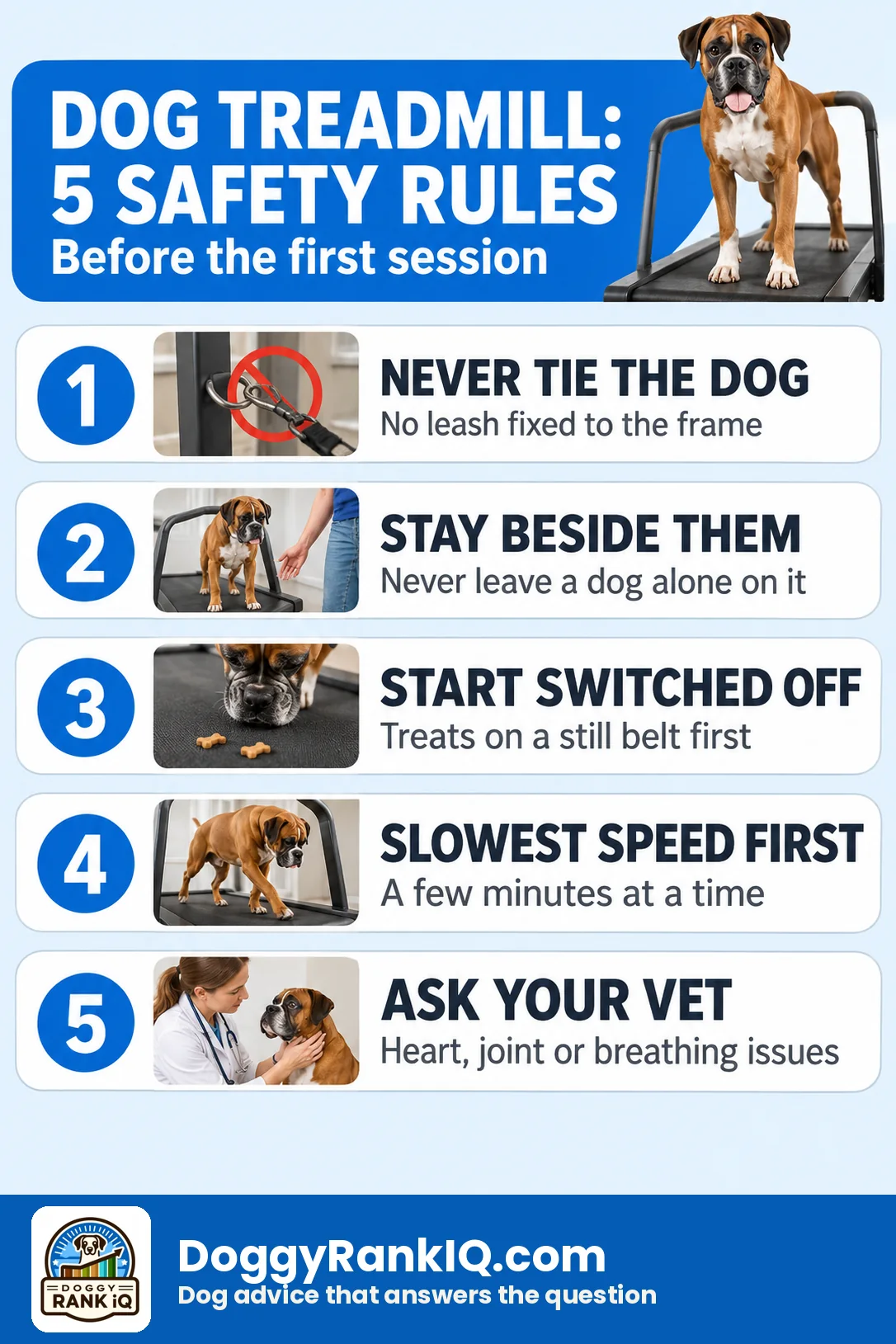
- Never tie a dog to a treadmill and never leave a dog on one unattended, regardless of price or brand.
- Introduce any treadmill switched off first, then at the lowest speed, in short sessions building up over about a week.
- Puppies, seniors, and dogs with heart, joint, or breathing issues need a veterinarian’s okay before starting, a point echoed by the physical rehabilitation teams at Purdue University’s veterinary hospital.
- Prices for a treadmill in 2026 span roughly $189 for compact small-dog models to $1,984 or more for premium large-breed units.

What size is your dog?
Tap an option to see the answer.
Is a dog treadmill safe, and who actually needs one
A treadmill is safe for most healthy dogs when it is sized correctly, introduced slowly, and never used unsupervised. It is not a universal fix. It is a tool for specific situations: bad weather, apartment living, limited mobility for the owner, or a dog with energy that outpaces the available walk time.
Apartment dwellers in cities with brutal winters or scorching summers are the clearest candidates. So are owners of working breeds that get restless without a real job to do, the kind of dog who checks if their energy level signals overweight or just bored before the owner even opens the treadmill box. A treadmill also helps when outdoor heat makes a walk risky; the line between a reasonable afternoon jog and heatstroke is worth knowing, and it’s worth reviewing how cold is too cold for dogs too, since the same caution applies on both ends of the thermometer.
Decision rule: choose a treadmill if your dog’s main exercise barrier is weather, apartment space, or a mismatch between your schedule and your dog’s energy. Skip it if your dog has an unmanaged heart, joint, or breathing condition until a vet clears exercise equipment specifically, not just walks.
A common mistake: buying a treadmill to fix anxiety or destructive chewing. A tired dog is calmer, but a treadmill does not replace training, and it will not resolve a dog who is bored rather than under-exercised; a quick look at dog zoomies explains why some bursts of energy are normal and not a signal to buy equipment at all.
What is a dog treadmill and how does it work
A treadmill is a piece of exercise equipment built specifically for canine proportions, meaning a lower deck height, side rails, a wider belt relative to length than human models, and often a quieter motor designed not to spook an animal standing right on top of it. It works the same basic way a human treadmill does: a moving belt or a set of slats lets the dog walk or trot in place while covering zero actual ground.
Most motorized units plug into a standard outlet and offer a speed dial or button panel, usually starting around 0.5 mph for very slow introductory sessions and climbing to 7 or 8 mph on higher-end models like the dogPACER LF 4.0. Some include incline settings that add resistance without raising speed, which is useful for building muscle in dogs that are already fit but need more of a workout in a smaller footprint. Veterinary rehabilitation programs, including the sports medicine service at Cornell University, use treadmills (often underwater versions for injured dogs) specifically because the controlled pace and surface let clinicians manage exercise intensity precisely, something a leash walk outdoors cannot replicate.
Example: a Border Collie that normally needs 60 minutes of running a day but lives in a third-floor apartment can get a structured 20-minute session on a motorized treadmill at a steady trot, covering more controlled distance than a leash walk around the block in the same amount of time.
How much do dog treadmills cost
Treadmill prices in 2026 range from about $189 for basic small-dog motorized units to nearly $2,000 for premium large-breed models, with most mid-size households landing somewhere between $300 and $800. Manual slat mills tend to sit in the $479 to $719 range because they skip the motor but still require a heavier frame.
Rough price bands seen across current listings:
- Entry-level small/medium motorized treadmills: $189 to $210
- Mid-tier motorized treadmills with wider belts or incline features: $330 to $550
- Manual slat mills for medium to large dogs: $479 to $720
- Premium large-breed motorized treadmills: $799 to nearly $2,400 depending on seller
Common mistake: assuming the cheapest option saves money long term. A $189 treadmill with a belt too short for your dog’s stride often gets abandoned within a few weeks, which makes a properly sized $400 to $500 unit the better value even though the sticker price is higher.
Motorized vs manual dog treadmill (slat mill): the difference
Motorized dog treadmills use an electric belt that sets a fixed pace, while manual slat mills are powered entirely by the dog’s own steps and need no electricity. The choice affects safety, cost, and how much control the dog has over its own pace.
A motorized treadmill works like a human treadmill: plug it in, pick a speed, and the belt moves at that speed whether the dog keeps up or not. That consistency is useful for building cardio and tracking progress, but it also means a dog can be caught off guard if it loses focus or stumbles.
A slat mill has no motor. The dog’s own forward motion moves the slats, similar to how greyhound trainers use them. Because the dog sets the pace, there is less risk of a mismatched speed, but the mill needs a slight incline or resistance to move at all, and some dogs never figure out how to start one.
Common mistake: assuming a slat mill is automatically safer because there’s no motor. A dog can still get a paw caught in the gaps between slats, which is why a brake and sturdy side rails matter as much on a manual unit as a belt-stop switch does on a motorized one.
Dog treadmill vs dog exercise wheel
A treadmill moves the ground under a stationary dog, while a dog exercise wheel is a large rotating drum the dog runs inside, similar to a hamster wheel scaled up for working breeds. Exercise wheels are far less common, built mostly for high-drive breeds like sled dogs, and they take up considerably more floor space than most treadmills.
Treadmills suit apartment living and controlled indoor sessions because they fit against a wall and plug into an outlet. Exercise wheels suit rural properties or kennels with working dogs that need very long, sustained running sessions, since the wheel allows essentially unlimited distance at the dog’s own pace. For a typical household dog, a treadmill is the more practical and space-efficient choice, and far more product options exist at the $200 to $800 price point compared to the niche exercise wheel market.
Decision rule: choose a treadmill if you need a compact, controllable indoor option. Choose an exercise wheel only if you own a very high-drive working breed and have the outdoor or barn space to fit one.
The size mistake: belt length vs your dog’s stride
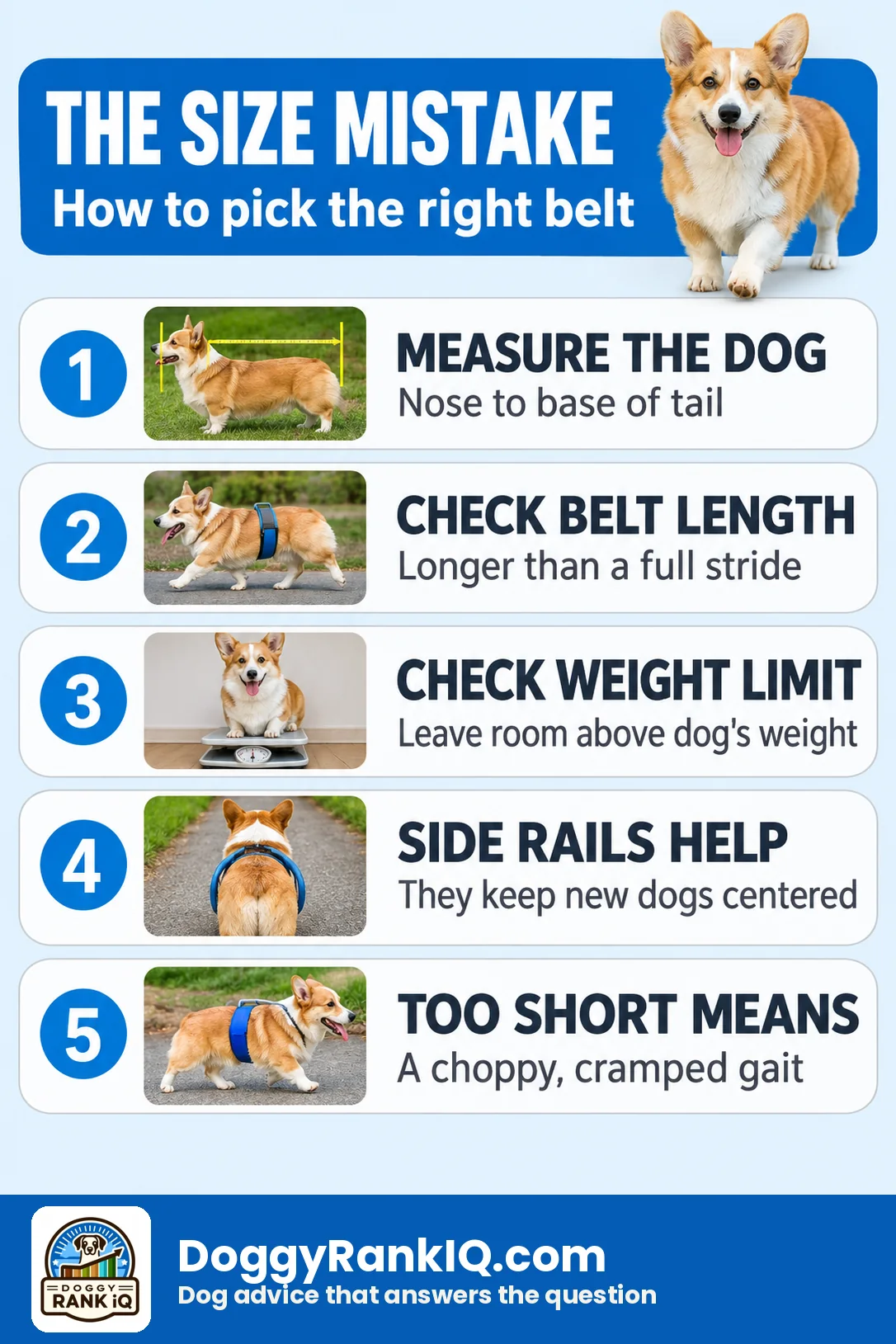
The single biggest treadmill mistake is buying by weight limit instead of belt length, which forces a dog into a choppy, shortened stride that can stress joints over time. Weight capacity tells you what the motor can handle. It says nothing about whether your dog’s legs fit the moving surface.
Cornell University’s veterinary guidance recommends a treadmill belt approximately 1.5 to 2 times the dog’s body length, long enough to support the intended speed and slow enough to allow a controlled walk or trot. The American Kennel Club similarly stresses matching equipment to the dog’s actual size rather than general breed category, since two dogs of the same weight can have very different leg lengths.
How to measure it correctly:
- Stand your dog naturally and measure from the nose or front of the chest to the base of the tail (not including the tail itself).
- Multiply that number by 1.5 to 2 for a minimum, or by 2.5 to 3 for a safer margin if your dog will run instead of walk.
- Compare that figure to the usable belt length listed in the product specs, not the overall treadmill footprint, since side panels and the frame add inches that aren’t moving surface.
- Check width too. A belt that’s long enough but narrow can push a broad-chested dog’s paws onto the side rails mid-stride.
Approximate starting ranges by weight class, useful only as a first filter: dogs under 25 pounds generally need about 28 to 36 inches of belt length and 10 to 14 inches of width; 25 to 60-pound dogs need roughly 40 to 50 by 14 to 17 inches; 60 to 100-pound dogs need about 50 to 60 by 16 to 20 inches; dogs over 100 pounds typically need 60-plus inches long and at least 20 inches wide.
Edge case: a long-backed breed like a Dachshund or a Corgi can need more belt length relative to its weight than a stockier dog of the same size, because stride length tracks with body length, not pounds. When in doubt, size up.
What size treadmill does my dog need
The right treadmill size comes from your dog’s nose-to-tail-base measurement multiplied by 1.5 to 3, not from its weight class alone. A 30-pound dog with a long body still needs more belt length than a 30-pound dog with a compact, stocky frame.
Start by measuring your dog as described above, then check the belt dimensions listed for any treadmill you’re considering against that number before comparing weight capacity or price. If a listing only advertises weight capacity with no belt measurements, treat that as a red flag rather than a convenience. Reputable manufacturers, including dogPACER, publish exact belt length and width figures because serious buyers ask for them.
Quick example: a 20-inch-long Beagle needs a minimum belt of about 30 to 40 inches if it will mostly walk, and closer to 50 to 60 inches if it will trot or jog regularly.
Best dog treadmill for small dogs
The best treadmill for small dogs balances a compact footprint with a belt long enough to avoid the choppy-gait problem common in budget units. For dogs under about 25 pounds, look for a belt of at least 28 to 36 inches even though many small-dog listings advertise shorter decks as a space-saving feature.
The Gymax Treadmill remains the lowest-cost entry point at $189.99, suited to apartment dogs under roughly 44 pounds who need light cardio rather than sprint training. For owners who want a documented, longer belt, the dogPACER Minipacer lists a 38 by 16-inch running area for dogs up to 55 pounds at around $479, according to dogPACER’s official specs. It costs more, but the longer belt matters more for a small dog’s comfort than the price tag suggests.
Dog treadmill comparison table
Prices reflect listings seen in 2026 and can shift; always confirm the current figure before buying.
The 7 best dog treadmill picks
1 Best small treadmill: Gymax Dog Treadmill for Small and Medium Dogs
 Best small treadmill: Gymax Dog Treadmill for Small and Medium Dogs
The Gymax Treadmill is the lowest-cost entry point for owners of smaller dogs who want a basic, no-frills motorized unit. It suits apartment dogs under roughly 44 pounds who need light cardio rather than sprint training.
Owners researching this category often compare it against the better-known dogPACER Minipacer, which lists a 38 by 16-inch running area for dogs up to 55 pounds and runs $479 according to dogPACER’s official specs. The Minipacer costs more but documents a longer belt, which matters for the size mistake above.
2Best budget pick: Petbobi 2-in-1 Treadmill
The Petbobi 2-in-1 Treadmill adds a convertible incline mode for roughly $204.99, making it a reasonable budget option for small to medium dogs who need variety in a compact footprint. It suits renters and first-time buyers testing whether their dog will even use a treadmill before spending more.
3Best for medium dogs: CIIHI Treadmill for Medium and Small Dogs
The CIIHI Treadmill runs about $209.99 and lists a wider belt than most budget units in its price tier, which helps medium dogs avoid the side-panel problem described above. It suits dogs in the 40 to 65-pound range who need more room than a strictly small-dog model offers.
4Best mid-tier option: Lifepro PawRunner Treadmill
 Best mid-tier option: Lifepro PawRunner Treadmill
The Lifepro PawRunner costs $331.33 and documents a larger weight allowance, up to about 75 pounds, making it a reasonable step up for owners whose dog outgrew a smaller unit. It suits households upgrading from a basic model without jumping all the way to a premium slat mill.
5Treadmill for large dogs: Dog Slatmill with Brake, up to 330 lbs
The Dog Slatmill with Brake lists a weight capacity up to 330 pounds for $719.99, built for large and giant breeds that would overwhelm a standard motorized belt. The included brake lets owners control resistance manually, which suits strength-building sessions rather than steady cardio.
This is also where premium alternatives enter the picture. The GoPet PR725 lists a 71 by 16-inch belt and roughly 176-pound capacity, with Walmart pricing it at approximately $2,399.30 in 2026, while a 2026 comparison found it closer to $1,984.30 through a different seller. That price gap is a reminder to check seller status and return policy before committing to a four-figure treadmill.
6Best slat mill for medium dogs: HotFeed Dog Slat Mill for Medium Dogs
The HotFeed Dog Slat Mill runs about $479.99 and gives medium dogs a dog-powered option without the cost of the large-breed slat mill above. It suits dogs who already show interest in walking into motion rather than being coaxed onto a moving belt.
7Best shock-absorbing motorized pick: Dog Treadmill with Pin-Hinged Track and 3-Layer Shock Absorption
The Treadmill with 3-Layer Shock Absorption costs $499.99 and documents a pin-hinged track built to reduce joint impact, which matters for senior dogs cleared for light exercise or dogs recovering from minor injuries under veterinary guidance. Confirm with your veterinarian before using any treadmill for recovery or joint support, since impact-absorption claims describe construction, not a medical benefit.
For owners who want the industry’s most documented option rather than a newer entrant, the dogPACER LF 4.0 remains the benchmark at $799, with a manufacturer-listed 71 by 16.5-inch belt, 179-pound capacity, and a 0.5 to 7.5 mph range according to dogPACER. The cheaper LF 3.1, around $499 to $549, shares similar specs, though recent review coverage has flagged support and fulfillment complaints with some sellers of that model, so verify the seller’s return policy before buying according to Animalso’s 2026 review roundup.
Why is my dog scared of the treadmill
Most dogs are scared of a treadmill because the moving surface is unfamiliar and the motor noise or vibration feels unpredictable, not because something is wrong with the dog. Fear usually fades with a slow, treat-based introduction rather than forced exposure.
Common triggers include a motor that’s louder than expected, a belt that starts too fast on the first try, or an owner placing the dog directly on a moving surface without letting it investigate the stationary machine first. Dogs that have had a bad experience on a slippery floor or an unstable surface before may generalize that fear to the treadmill.
What to do: go back a step in the training process below. If a dog flinches at low speed, drop to the lowest setting available, and if it still resists, let several sessions pass with the treadmill simply running nearby (with the dog off it) before trying again.
⭐ Top 5 Features We Love
- Removable, washable belt covers or surfaces that handle muddy paws without a full disassembly.
- A visible emergency stop or clip-style safety key, the same concept as a human treadmill’s kill switch.
- Low-speed starting range (0.5 mph or lower) that lets nervous dogs learn the motion before it feels like running.
- Side rails tall enough to discourage a dog from stepping off sideways mid-stride.
- Documented belt length and width in the product listing itself, not buried in a manual, so you can do the size math before buying.
⚠️ Things to Look Out For
- Belt length shorter than your dog’s actual stride, the single most common and most overlooked mistake on this list.
- No incline lock or loose frame joints, which can wobble under a dog that leans while adjusting to the pace.
- Vague weight capacity claims with no belt dimensions attached, a sign the listing wants you to shop by number alone.
- Motors that run loud enough to spook a sound-sensitive dog, something owner reviews flag more often than spec sheets do.
- Slat mills without a functioning brake, which makes it harder to slow a dog that gets overexcited mid-session.
How to train a dog to use a treadmill in 7 days
Training a dog to use a treadmill takes patience measured in days, not minutes, and rushing it is the fastest way to create a dog who refuses to go near the machine again. The process should move at the dog’s pace, not a training schedule’s.
- Day 1 to 2: Place the treadmill switched off in a normal living space. Drop treats on and near the belt so the dog associates it with something good, nothing more.
- Day 3: Encourage the dog to stand on the stationary belt and eat a treat there. No movement yet.
- Day 4: Turn the belt on at the lowest possible speed for a few seconds while the dog watches from a distance, then reward calm behavior before turning it off again.
- Day 5: Invite the dog onto the belt while it’s switched off, then turn it on at the lowest speed for just a few steps, rewarding immediately for staying calm and walking in place.
- Day 6: Extend the low-speed session to 1 or 2 minutes, watching closely for signs of stress such as pinned ears, tucked tail, or attempts to jump off sideways.
- Day 7: Aim for a 3 to 5 minute session at a comfortable walking pace, then stop on a positive note even if the dog seems ready for more.
- Beyond day 7: Keep sessions short and consistent for another week or two before gradually increasing time toward the 15 to 30 minute range appropriate for a fit adult dog, always supervising the entire session and never leaving the dog on the treadmill unattended.
Dogs working through structured training programs, including basic obedience fundamentals covered in essential commands every puppy should learn, tend to pick up treadmill training faster, since commands like “stay” and “wait” transfer directly to standing calmly while the belt starts.
Who should buy which, and who should skip it
Choose a motorized treadmill if you want structured, trackable cardio sessions and your dog is a healthy adult cleared for regular exercise. Choose a manual slat mill if you want a dog-powered option immune to power outages, or if your dog does better setting its own pace.
- Small dog, apartment living: the Gymax or Petbobi options above, or the dogPACER Minipacer if budget allows for the longer belt.
- Medium dog, moderate budget: the CIIHI or Lifepro PawRunner, both sized to avoid a cramped stride.
- Large or giant breed: the Dog Slatmill with Brake or a premium motorized unit like the GoPet PR725, matched carefully against the belt-length math above.
- Senior dog cleared for light activity: the shock-absorbing motorized model, with a veterinarian’s sign-off first.
- Skip it entirely if: your dog has an unmanaged heart or breathing condition, is a puppy whose growth plates haven’t closed, or if outdoor walks remain an option and your dog simply prefers them.
A treadmill vs walking outside isn’t really a competition; it’s a backup plan. Fresh air, scent work, and a change of scenery do things a belt can’t replicate, so a treadmill works best as a supplement on bad-weather days, not a permanent substitute for real walks.
FAQ
The bottom line
A treadmill earns its price when the belt actually fits the dog using it, and that single measurement matters more than brand name, motor speed, or weight rating. Measure your dog’s body length first, multiply it by at least 1.5 to 2, and only then start comparing the seven picks above against your budget. For everything else your dog needs between treadmill sessions, from puzzle toys that reward the calmer energy a treadmill helps create to the basics of choosing the right harness for a long-bodied breed, the same rule applies: fit the gear to the dog you actually have, not the one on the box.
Doggy Rank IQ is reader supported. As an Amazon Associate we earn from qualifying purchases, at no extra cost to you.