
A dog that goes blind does not stop wanting to play. That part surprises a lot of owners. They assume vision loss means the end of fetch, the end of digging through a toy box, the end of that specific head-tilt a dog gives a squeaky duck. What actually changes is which sense does the work. Blind dog toys built around sound and scent let a dog track, chase, and find an object using ears and nose instead of eyes, and for most dogs that transition happens faster than owners expect.
This list covers nine picks, seven of them specific Amazon products and two no-buy options you can build at home tonight. All are organized by which sense they use, who they suit, and what might not work for every dog.
Key Takeaways: blind dog toys
The short version of this blind dog toys guide:
- The best blind dog toys combine a sound cue (bell, rattle, giggle) with a scent cue (treat-stuffed, rubber, or natural fabric scent) so a dog has two ways to locate the object.
- Continuous sound, like a bell that rings while a ball rolls, works better for fetch and tracking than a squeaker that only sounds when bitten. (ovrs.com)
- Snuffle mats and scent games turn a nose into the main play tool and tend to calm anxious or newly blind dogs rather than overstimulate them.
- Battery-free toys avoid the button-battery ingestion risk that has driven several pet toy recalls.
- A blind dog that ignores a new toy is not broken. It usually means the toy needs a stronger scent, a quieter sound, or an introduction on the dog’s own terms.

What does your dog follow best?
Check the current price
Check the current price
Check the current price
Tap an option to see the answer.
How do you play with a blind dog?
Here is the plain picture on blind dog toys.
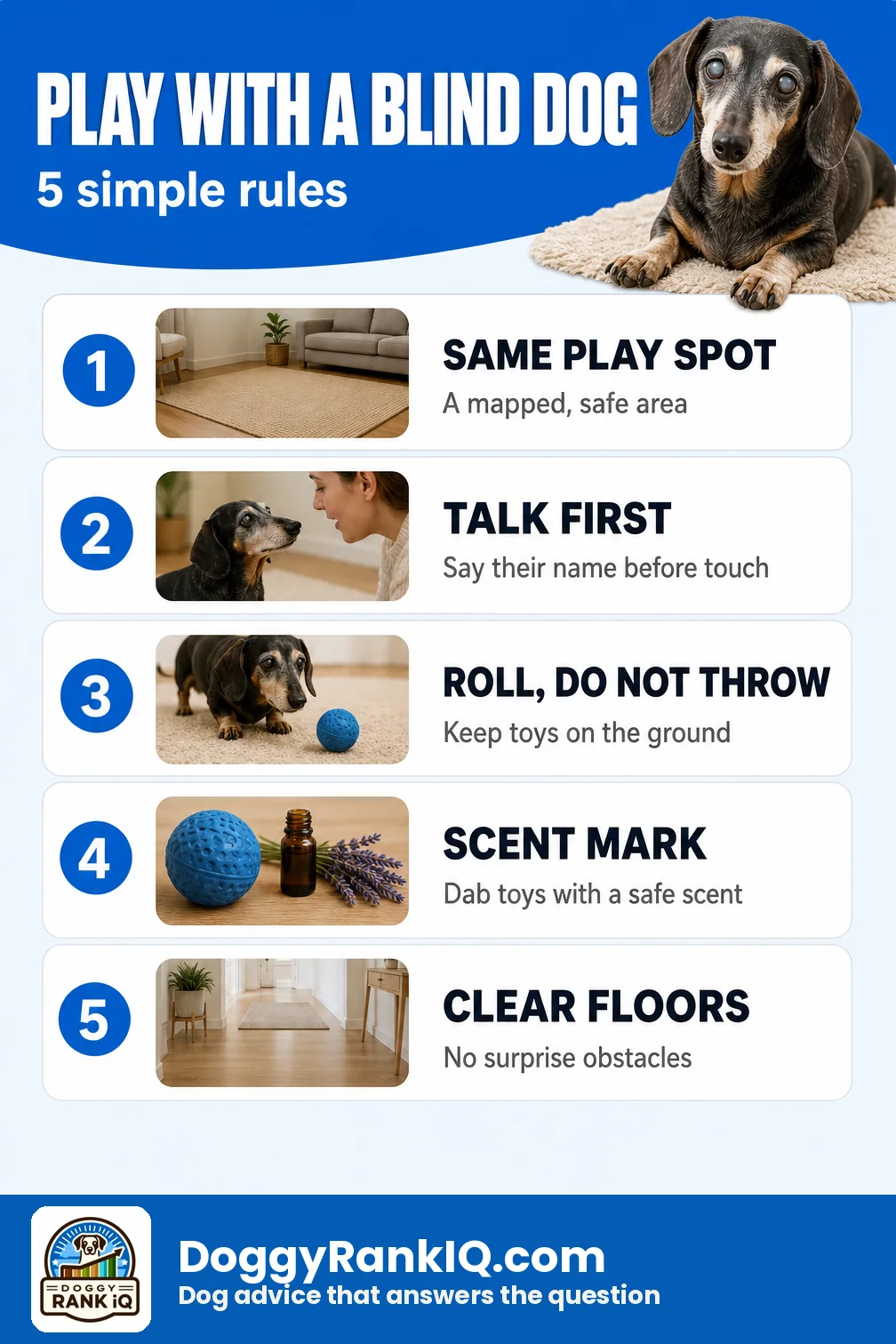
Start on the ground, not in the air. A thrown toy that lands out of a blind dog’s hearing range just becomes a mystery object somewhere in the yard. Roll it instead, or drop it a short distance away so the dog can follow the sound the whole way.
Say the dog’s name before you start, then make a consistent sound (a verbal cue, a clap, the toy itself) so play has a clear beginning. The Royal Veterinary College recommends keeping cues and locations consistent so a dog builds a mental map of safe spaces and reliable signals. (rvc.ac.uk) Short sessions work better than long ones at first. A dog relying entirely on hearing and smell is doing more mental work per minute than a sighted dog chasing a ball visually, and that effort is tiring in a good way.
What makes a good toy for a blind dog: sound, scent and texture
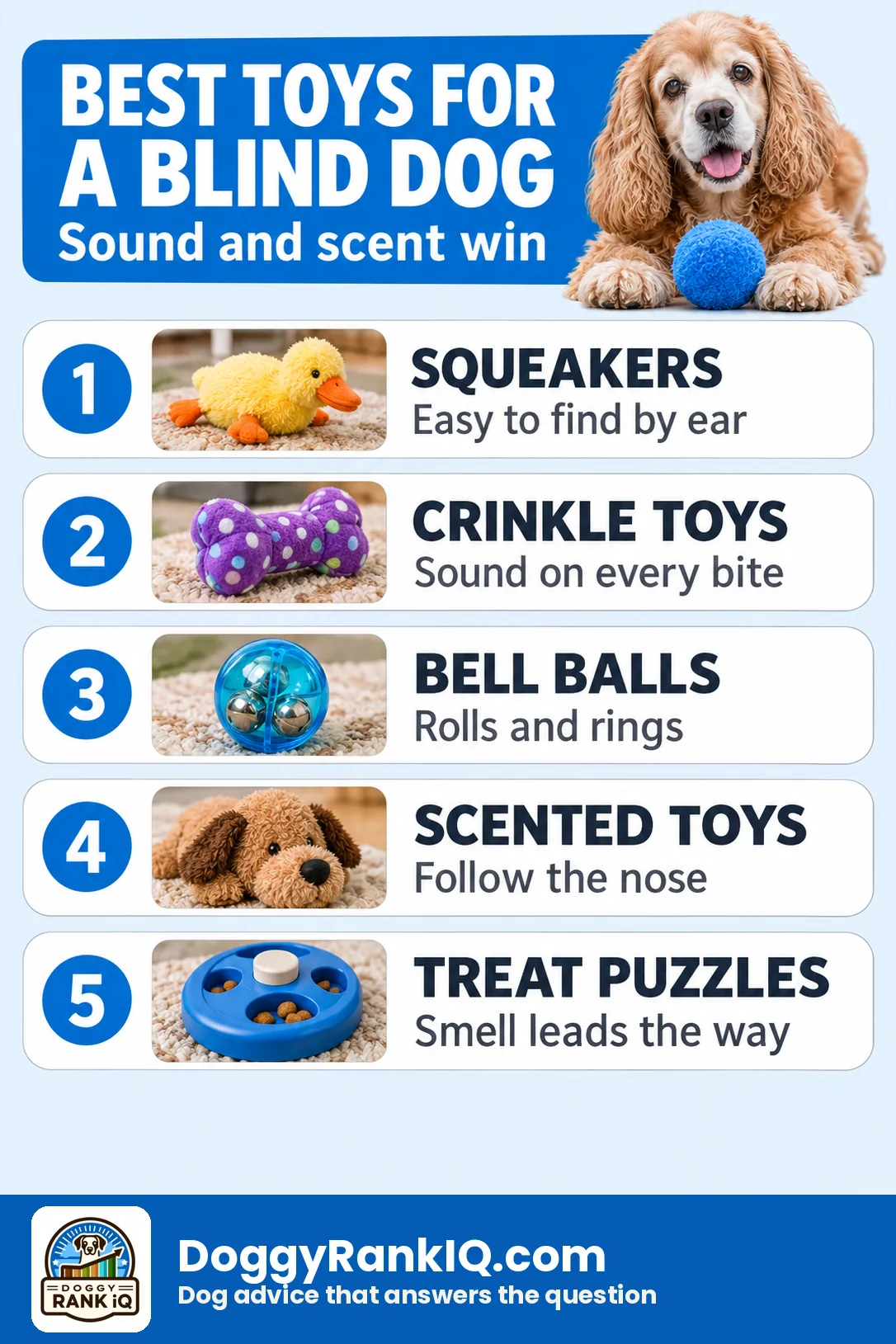
A toy earns a spot on this list if it gives a blind dog at least one of three clear signals.
Sound. Bells, rattles, and crinkle material all work, and the type of sound matters more than volume. A continuous sound that plays while the toy moves, like a bell rolling inside a ball, helps a dog track the object in real time. A squeaker that only activates when bitten tells the dog nothing until the toy is already in its mouth, which defeats the purpose for fetch. (ovrs.com) Veterinary guidance backs this up directly: the PDSA recommends rubber balls with bells specifically because the sound helps dogs track the toy as it moves. (pdsa.org.uk)
Scent. Treat-stuffed toys, scented rubber, and natural fabric scent all give a dog something to home in on using the nose, which research suggests is roughly as reliable for dogs as hearing, and sometimes more so in tight or cluttered spaces. The RSPCA’s updated blind-dog guidance specifically recommends introducing scent work and noisy toys together rather than picking one. (education.rspca.org.uk)
Texture. A dog that cannot see a toy coming benefits from a distinct feel. Nubby rubber, rope, and fleece all give tactile feedback the moment a dog’s nose or paw makes contact, confirming “this is the toy” without needing a visual check.
If you are also outfitting a dog with chew needs beyond this list, the best dog puzzle toys by skill level guide and the no-stuffing squeaky toy picks cover related categories that work well alongside sound and scent toys.
Do blind dogs prefer sound toys or scent toys? Owners report real variation here. Dogs with strong prey drive from their sighted years tend to gravitate toward sound, chasing a ringing ball the way they once chased a visible one. Dogs that were always more nose-driven, including many scent hounds, often ignore the bell and go straight for the treat pocket. There is no single correct answer, which is exactly why most of the picks below combine both signals.
The 9 picks at a glance
This table sums up blind dog toys at a glance.
Prices checked 2026 and subject to change.
1. Blind Dogs Jingle Bell Balls
The Blind Dogs Jingle Bell Balls are built around a continuous internal bell that rings as the ball rolls, which is the exact design feature veterinary sources point to as more useful than a standard squeaker for dogs tracking a moving object. (ovrs.com) They suit dogs who were ball-chasers before vision loss and still have the instinct, just not the sight line. The soft outer material also means a direct hit to the nose, which happens often with a blind dog chasing sound, does not hurt. The drawback: the bell can rattle loudly on hard floors, which may overstimulate a dog who startles easily, something The Dog Clinic specifically flags as a risk with louder toys.
2. Snuffle Mat for Blind Dogs
This Snuffle Mat for Blind Dogs hides kibble or treats inside layers of fleece strips, turning a meal into a nose-driven search. It suits dogs of any size, including seniors who have slowed down but still enjoy a project. The RSPCA’s enrichment research notes that novel scent activities like snuffle mats can increase a dog’s engagement and resting time while reducing stress-related behavior, which makes this a strong option for a dog adjusting to recent vision loss. (education.rspca.org.uk) The drawback is washing frequency. Food residue builds up in the fleece fast, and the mat needs regular cleaning to avoid attracting ants or smelling stale.
3. SCHITEC Dog Balls with Bell Sound, 4 Pack
The SCHITEC Bell Sound Balls come four to a pack, which matters more than it sounds. Blind dogs lose toys. They roll under furniture, get lost in grass, and disappear behind a door, and a dog cannot visually scan the room to find a replacement. Having spares on hand means playtime does not stall out waiting for a single ball to turn up. These suit small to medium dogs with a moderate chew style. The drawback: the rubber shell is lighter than some single-ball competitors, so dogs who like to carry and chomp hard may wear through one faster than expected.
4. Pet Snuffle Ball
The Pet Snuffle Ball is a compact, fabric-strip ball designed to hold treats inside its folds rather than spread across a flat mat, which makes it a better fit for apartments or smaller play areas. It suits small to medium dogs and travels well, since it can be stuffed and handed over in a car or a hotel room without setting up a full mat on the floor. The drawback is capacity. It holds less food than a mat-style toy, so it empties faster and needs more frequent refilling during a single session.
5. Vivifying Snuffle Mat
The Vivifying Snuffle Mat is a larger-format mat, which suits bigger dogs or multi-dog households where more than one nose needs something to do at once. Veterinary blindness guidance consistently lists treat-stuffable toys among the top recommendations for dogs who have lost vision, specifically because they replace the visual search with a scent-based one that a dog can do entirely on its own. (pdsa.org.uk) The drawback shows up with food-motivated dogs who may finish the search faster than expected and then look for the next thing to do, so this works best as part of a rotation rather than a standalone solution.
6. SPOT Sensory Ball
The SPOT Sensory Ball combines a bell, a squeaker, and a beef scent in one toy, which makes it the most multi-sensory pick on this list for the price. It suits dogs across a wide size range and works well as an introductory toy for a newly blind dog still figuring out which cues matter. The drawback: three sensory features in one object can occasionally overload a dog that gets anxious with too much stimulation at once, so first introductions are worth doing in a quiet room rather than a busy one.
7. WishLotus Bell Squeak Ball
The WishLotus Bell Squeak Ball pairs a bell with a squeaker in a single rubber ball, giving two sound options in one toy. It suits small to medium dogs who like fetch-style play but have not fully settled into tracking a single sound type yet. The drawback is durability under aggressive chewing; dogs with a strong bite will likely puncture the squeaker chamber before the ball itself wears out, at which point the bell still works but the squeak stops.
8. Towel scent roll (no-buy option)
This one costs nothing and takes under five minutes to set up. Take a clean towel, place a few small training treats along one edge, and roll it up tightly so the treats sit inside the folds. Hand it to the dog, or place it a short distance away and let the dog follow the scent to unroll it.
This suits dogs of any age and works especially well for dogs who seem anxious around new objects, since the towel carries a familiar laundry scent alongside the treat smell, which research on blind-dog comfort routines suggests can be calming in a new environment. (veterinaryvision.co.uk) For a more structured version of this kind of scent search, see the lick mat for dogs guide, which covers similar scent-based engagement with a few recipe ideas.
9. Muffin tin scent game (no-buy option)
Place a treat in a few cups of a standard muffin tin, then cover each cup with a tennis ball. The dog has to nose each ball off its cup to find which ones hide food. This is a five-minute setup using items already in most kitchens.
It suits dogs who enjoy a slower, more deliberate search rather than fast-paced fetch, and it is a good option for apartment dwellers without floor space for a full snuffle mat. For a broader set of structured enrichment options once a dog has mastered this, the best dog puzzle toys by skill level article has picks that build on the same search-and-find skill.
Scented toys for blind dogs: what the scent does
A scented toy is not decoration. For a blind dog, scent functions the way a bright color or a moving shape used to: it is the signal that says “this object exists and it is here.” Treat-stuffed rubber, natural fabric smell, and even a lightly beef-scented ball all give the nose a target strong enough to follow across a room.
The RSPCA’s enrichment research found that novel scent activities increased engagement and resting time in dogs generally, while also warning that too much or poorly matched scent enrichment can backfire. (education.rspca.org.uk) In practice that means starting with a mild scent and a short search distance, then increasing difficulty only once a dog shows confident, repeated success. A dog that gives up after one try is not failing. It likely needs an easier starting point.
How to set up a safe play space
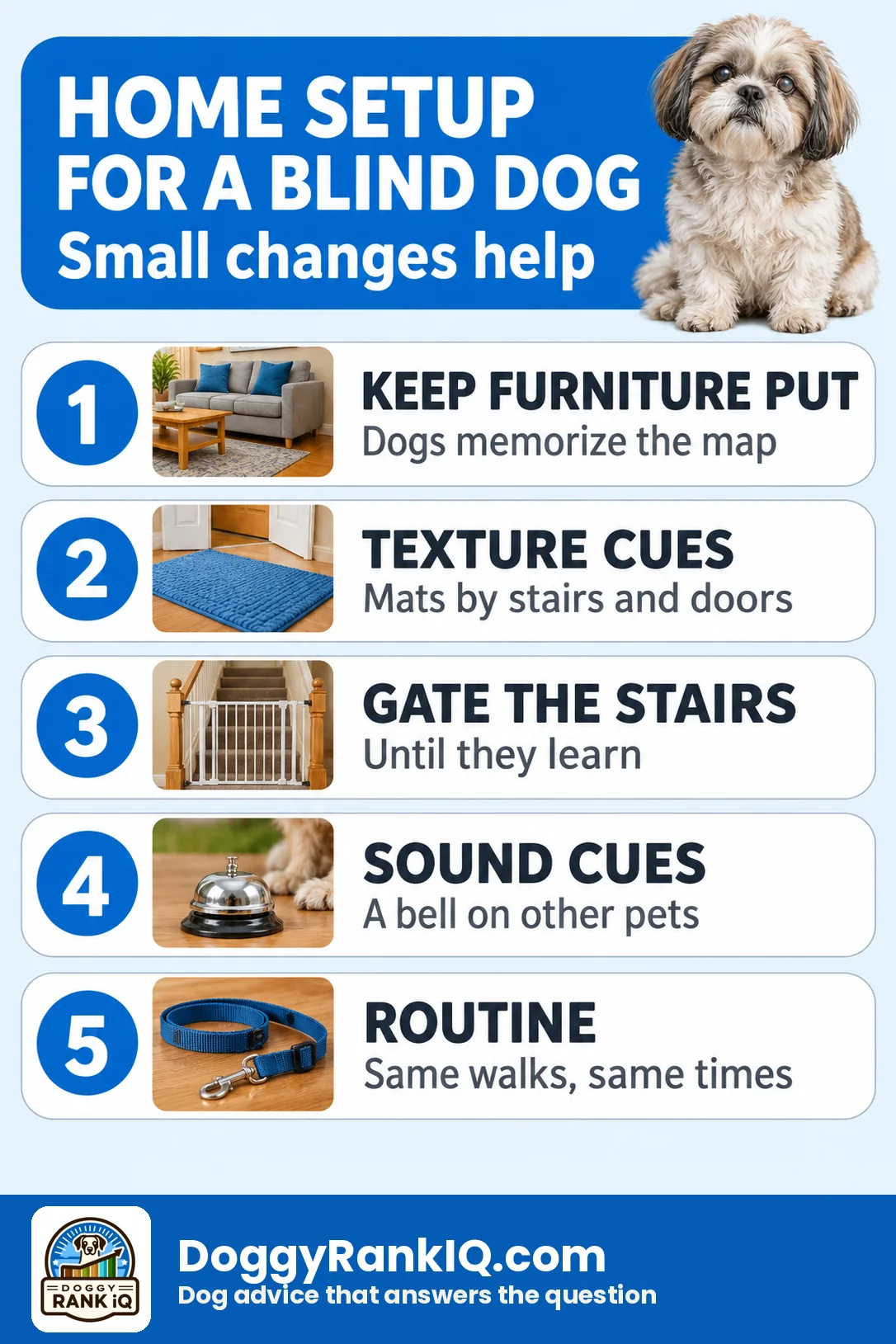
Clear the floor path before introducing any new sound or scent toy. Blind dogs memorize room layouts, and a chair moved six inches can turn a familiar space into an obstacle course. Keep the same play area each session so the dog associates that specific spot with toy time, which lines up with the Royal Veterinary College’s broader recommendation to use consistent scent and sound landmarks throughout the home, not just during play. (rvc.ac.uk)
Remove anything with sharp corners near the play zone, since a chasing dog relying on sound will not see furniture edges coming. Play on carpet or grass rather than hard tile when possible, both for traction and because hard floors amplify bell sounds in ways that can startle a sound-sensitive dog.
⭐ Top 5 Features We Love
What stands out most about blind dog toys:
- Continuous sound over single-trigger sound. A bell that rings the entire time a toy moves beats a squeaker that only activates on bite contact, because it gives a dog real-time tracking information instead of a one-time confirmation.
- Treat-stuffable cavities. Any toy a dog can smell food through turns ordinary play into independent enrichment, which matters most on days an owner cannot actively play fetch.
- Soft, forgiving materials. Blind dogs occasionally misjudge contact and take a direct hit to the face chasing sound. Soft rubber and fleece make that a non-event instead of a flinch.
- Battery-free mechanisms. Bells and squeakers need no electronics, which removes the button-battery ingestion risk tied to several recent pet toy recalls.[Petmate recall, CPSC]
- Washable fabric components. Snuffle mats and rope toys that survive a washing machine cycle stay usable long-term instead of becoming a smell problem after a few weeks of treat residue.
⚠️ Things to Look Out For
A few cautions on blind dog toys:
- Squeakers alone are not enough for fetch. A toy that only squeaks when bitten gives a dog no way to locate it mid-air or after it lands, so pair squeak with a bell or rattle whenever possible. (ovrs.com)
- Loud is not automatically better. The Dog Clinic and ElleVet Sciences both note that blind dogs can be startled or overstimulated by sudden or loud noises, so test any new sound toy in a quiet room first.
- Battery-powered toys need supervision. The main hazard with electronic toys for a blind dog is not the blindness itself, it is access to a battery compartment if the casing cracks, so check seams regularly if a toy has electronics.
- Snuffle mats need regular washing. Leftover food residue attracts pests and can turn a favorite toy into one a dog avoids due to a stale or sour smell.
- New toys deserve a quiet introduction. Letting a dog sniff and investigate on its own terms, rather than tossing a new object into its space unannounced, avoids startling a dog that cannot see what is coming.
Other blind dog equipment worth knowing
Halo bumpers are soft, foam-rimmed harness attachments that circle a dog’s head and bump into obstacles before the dog’s face does. They are one of the most-recommended pieces of blind dog equipment for dogs handling new or cluttered spaces, and several veterinary sources list them alongside scent and sound toys as part of a complete setup. (petcircle.com.au, mvsvets.com)
Textured floor mats placed at key transition points (top of stairs, in front of exterior doors, near a water bowl) give a dog a tactile landmark underfoot before reaching a hazard. The Royal Veterinary College recommends this exact approach, combining tactile markers with consistent scent cues at the same locations, so a dog builds a reliable internal map over time. (rvc.ac.uk)
A note on individual variation: dogs born blind and dogs who lose sight later in life often need different approaches. A dog that has always been blind has no visual memory to miss and tends to adapt to sound and scent cues from the start. A newly blind dog, especially an older one, may need more patience and a slower reintroduction to toys it previously relied on sight to enjoy, since the skill of tracking by ear or nose is new rather than lifelong.
FAQ: blind dog toys
The bottom line: blind dog toys
A blind dog playing with a bell ball or digging through a snuffle mat is not working around a disability so much as using the senses it already relies on most. Start with one sound toy and one scent toy, watch which one the dog returns to more often, and build the rest of the rotation from there. Rotate toys every week or two to keep scent and sound cues fresh, and if a dog ignores every new toy at first, try a quieter introduction in a familiar room before assuming the toy itself is the problem.
Know another owner looking into blind dog toys? Send them this page.
Bookmark this blind dog toys guide for the next time it comes up.
Doggy Rank IQ is reader supported. As an Amazon Associate we earn from qualifying purchases, at no extra cost to you.