
Quick Answer
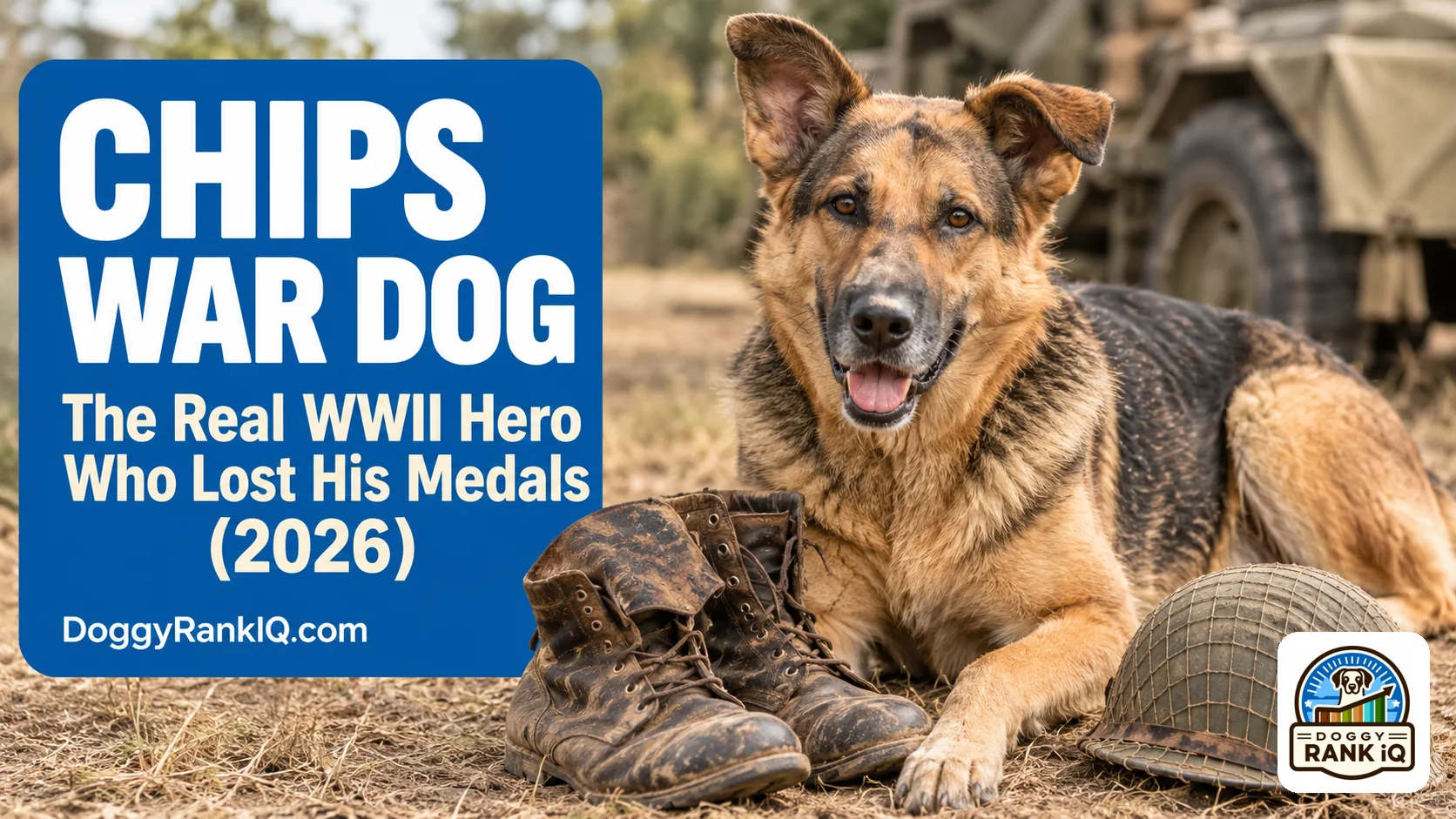
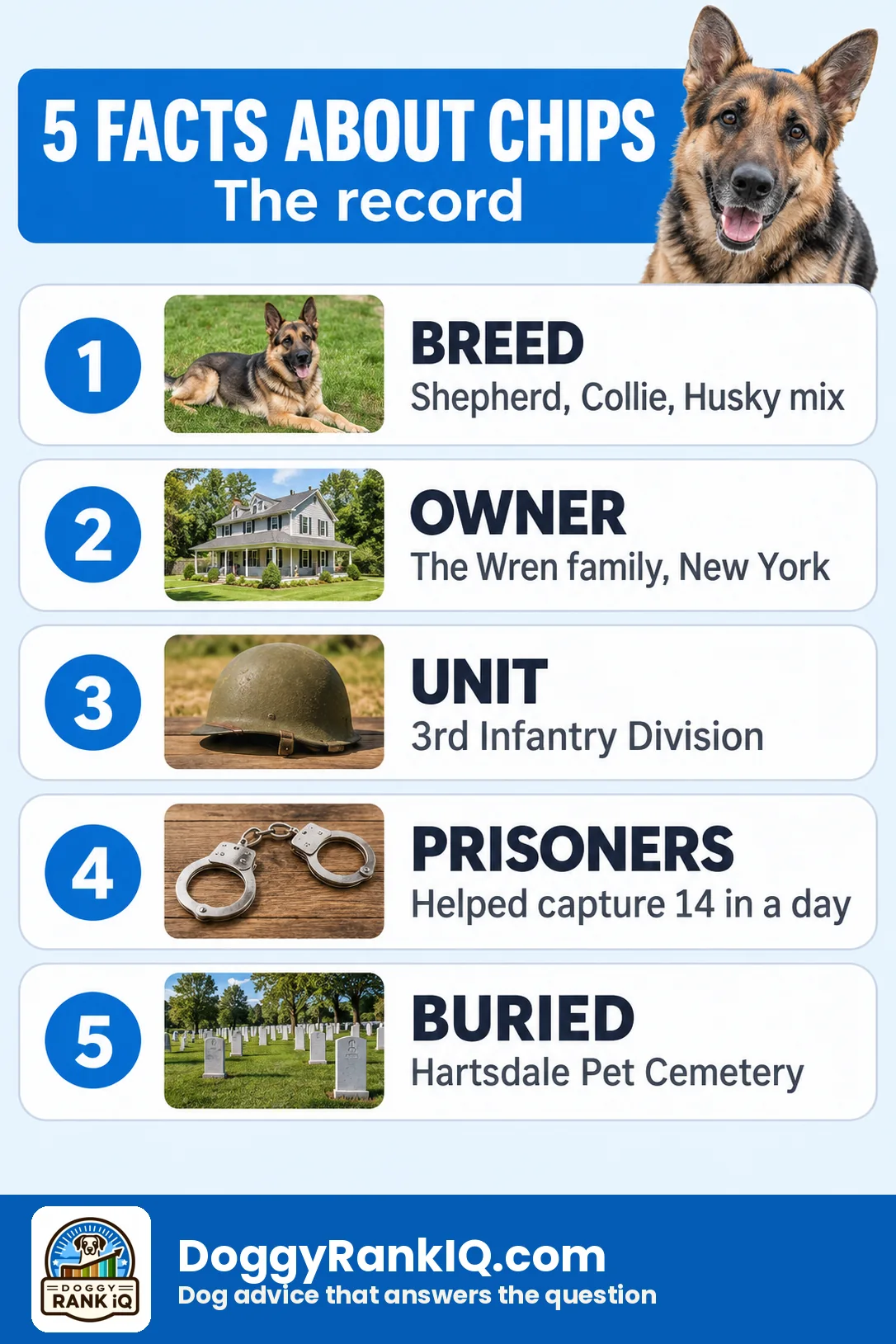
Chips war dog was a German Shepherd, Collie and Husky mix who attacked an Italian machine-gun nest in Sicily on July 10, 1943, helping force four enemy soldiers to surrender. He received the Distinguished Service Cross, Silver Star and Purple Heart for that action, but the Army revoked the human decorations within months after complaints that medals belonged to people, not animals. Chips never got those specific medals back, though he received the United Kingdom’s PDSA Dickin Medal posthumously in 2018. Disney’s film “Chips, the War Dog” told a version of his story back in 1990.
Key Takeaways: chips war dog
- Chips war dog served with the 3rd Infantry Division through North Africa, Sicily, Italy, France and Germany.
- He broke from handler Pvt. John P. Rowell on July 10, 1943 and attacked a machine-gun crew near Licata, Sicily (pdsa.org.uk).
- Maj. Gen. Lucian K. Truscott Jr. pinned the Distinguished Service Cross on Chips on November 19, 1943 (military.com, army.mil).
- The Army reversed the human-style decorations after a formal complaint, then barred future animal awards.
- Chips war dog received the posthumous PDSA Dickin Medal on January 15, 2018, timed to the Casablanca Conference anniversary (pdsa.org.uk).
- That medal now lives at the 3rd Infantry Division Museum at Fort Stewart, Georgia (army.mil).
- He died in 1946, about seven months after his December 1945 discharge, and is buried at Hartsdale Pet Cemetery.
- Chips is frequently compared to Sergeant Stubby, a different decorated dog from an earlier war.
What do you want to know?
Tap an option to see the answer.
The short answer: who Chips the war dog was
Chips war dog started life as a family pet in Pleasantville, New York, owned by Edward J. Wren. He ended up as arguably the most decorated American dog of World War II, and also as the clearest example of the Army changing its mind about giving animals human medals.
Wren donated Chips to the Dogs for Defense program in August 1942 (military.com). From there the dog went through sentry training and landed with the 3rd Military Police Platoon, 30th Infantry Regiment, 3rd Infantry Division, paired with handler Pvt. John P. Rowell (military.com). That partnership carried Chips through guard duty at a presidential summit and into one of the odder footnotes of military history: a dog nominated for the Distinguished Service Cross, then told, in effect, that dogs don’t qualify.
Readers who also want the comparison point should check our record on Sergeant Stubby’s real documented history, since the two dogs get mixed up in casual retellings.
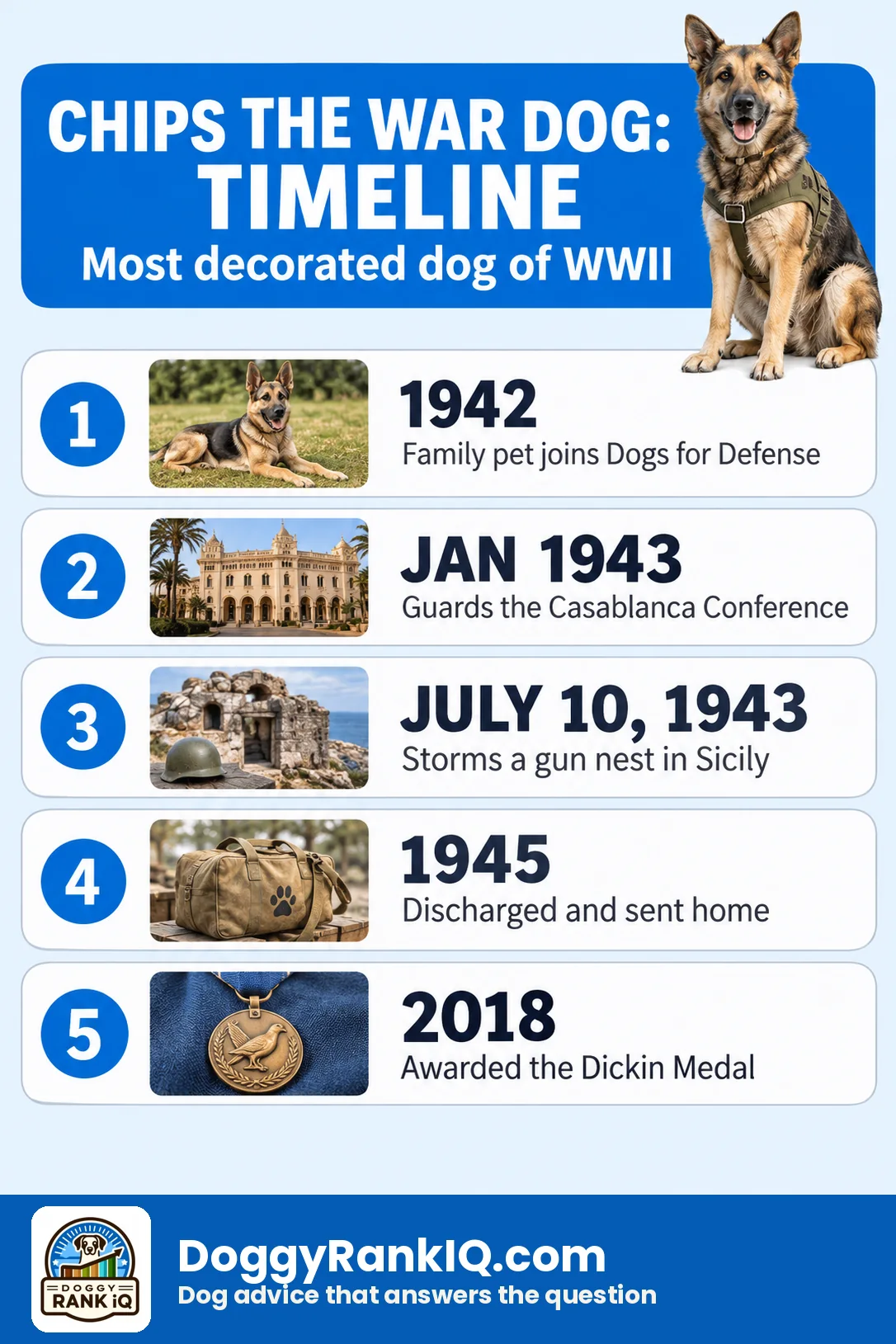
Timeline table: Chips’ service in dates
From family pet to Dogs for Defense
Chips war dog’s path to the battlefield began the same way thousands of family dogs reached the front: a civilian donation program. Dogs for Defense recruited household pets across the country starting in 1942, and the Wren family in Pleasantville, New York put Chips forward (military.com).
He trained as a sentry dog at the War Dog Training Center in Front Royal, Virginia (military.com). Sentry dogs were taught to patrol, detect intruders, and hold a line rather than attack on command, which makes his later combat behavior notable. Nothing in his training file predicted a dog that would charge a machine-gun crew on his own.
By 1943 he was attached to the 3rd Military Police Platoon under the 3rd Infantry Division, working alongside handler Pvt. John P. Rowell. That division carried him through North Africa, then into the invasion of Sicily, and eventually through Italy, France and Germany. Along the way he stood guard at the Casablanca Conference, where Roosevelt and Churchill met in January 1943, according to accounts of his record (pdsa.org.uk). A former pet from a New York suburb was now standing post near two heads of state.
Owners curious about the breeds behind military dogs like Chips can compare traits in our German Shepherd guide, since that breed makes up part of his documented mix.
Sicily, July 10, 1943: the machine-gun nest
On July 10, 1943, during Operation Husky, the Allied invasion of Sicily, an Italian machine-gun position opened fire on Chips’ platoon near Licata (pdsa.org.uk). Chips broke from Rowell’s lead and went straight at the gun crew.
PDSA’s record describes Chips entering the emplacement and attacking the soldiers manning the gun, which ended with four Italian soldiers surrendering (pdsa.org.uk). Military.com adds that an Italian soldier fired a pistol at the dog during the struggle, and that Chips came away with a scalp wound and powder burns (pdsa.org.uk, military.com). He kept working that same day. Later that night he reportedly helped detect a group of infiltrators, a discovery that led to roughly ten more Italian soldiers being captured (constitutioncenter.org).
Here’s the detail that sold the story to his chain of command: Capt. Edward G. Parr recommended Chips for the Distinguished Service Cross, writing that the dog showed “courageous action in single-handedly eliminating a dangerous machine gun nest and causing surrender of its crew” (military.com). That recommendation sat outside normal War Department rules, since those rules were built for soldiers, not sentry dogs.
Maj. Gen. Lucian K. Truscott Jr. pinned the Distinguished Service Cross on Chips in person on November 19, 1943 (military.com, army.mil). For a few months, a dog wore one of the Army’s higher combat decorations.
The real WWII hero who lost his medals
Chips war dog kept his medals for a matter of months before the Army reversed course. The reversal came after a formal complaint arguing that awards meant for human soldiers should not go to an animal, regardless of what that animal had done under fire.
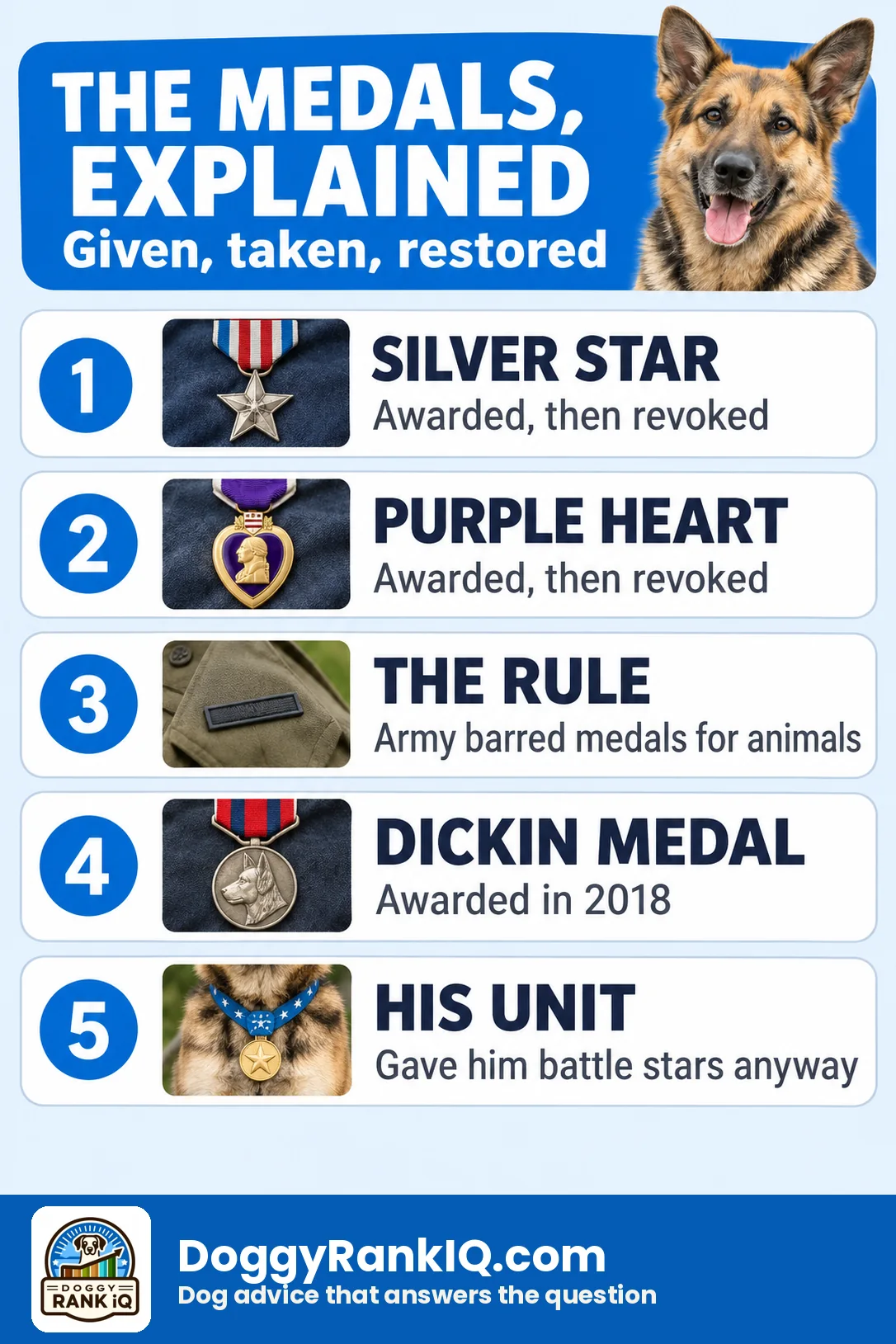
The complaint worked. The Army withdrew the Distinguished Service Cross, Silver Star and Purple Heart recognition tied to Chips and then set a policy barring future animal decorations altogether (constitutioncenter.org). It is worth being precise here: this was not a dispute over whether Chips earned the recognition. The action in Sicily was not in question. The objection was about category, specifically whether a medal designed for a person could sit on a dog’s collar.
“Courageous action in single-handedly eliminating a dangerous machine gun nest and causing surrender of its crew.”, Capt. Edward G. Parr’s recommendation for Chips (military.com)
His unit responded the way units often do when official channels fail them: unofficially. They gave Chips a theater ribbon with battle stars anyway, a gesture with no legal standing but a clear message about how the men who served beside him actually felt.
The policy that came out of the Chips decision still shapes how dogs are recognized today. Anyone looking into adopting a retired service dog can see how far that policy has traveled in our guide on military working dog adoption rules.
Facts table: medals awarded, revoked and restored in spirit
The Dickin Medal deserves a footnote of its own. It is not a U.S. military decoration. It is a British animal-service award created by the charity PDSA in 1943, often called the animal version of the Victoria Cross (pdsa.org.uk). So Chips war dog got meaningful recognition in 2018, just not the specific American medals that were taken back in 1943. That medal now sits at the 3rd Infantry Division Museum at Fort Stewart, Georgia, after moving there from the National World War II Museum in New Orleans in April 2022 (army.mil).
What breed was Chips the dog?
Chips war dog was a mixed breed, most commonly described as part German Shepherd, part Collie and part Husky, with Military.com’s reporting specifying a German Shepherd-Collie-Husky-Malamute mix (military.com). Other sources shorten the description to a Shepherd-Collie-Husky mix (constitutioncenter.org).
That mix mattered on the job. Shepherds bring guarding instinct and trainability, Collies bring alertness and handler focus, and Husky or Malamute lines tend to add stamina for long marches and rough terrain. None of that is a guarantee about any individual dog’s temperament. Breed tendencies describe a direction, not a fixed outcome, and individual variation inside any mix is large.
Readers weighing a guard-style dog breed today can compare traits in our protection dog breeds overview, which covers the same traits that made Chips useful without promising that any dog from these lines will behave the same way under pressure.
What happened to Chips after the war?
Chips war dog was discharged from service in December 1945 and returned to civilian life with the Wren family. He died about seven months later, in 1946, and is buried at Hartsdale Pet Cemetery in New York.
His story went quiet for decades after that, resurfacing mainly in military histories and the occasional museum display. That changed in two visible ways. First, the PDSA Dickin Medal arrived in January 2018, timed to the 75th anniversary of the Casablanca Conference where Chips had stood guard (pdsa.org.uk). Second, Disney made “Chips, the War Dog” for television in 1990, a dramatized version that introduced his story to a much wider audience than the military history books ever reached.
A more recent historical feature, published by Military.com in 2026, revisited the Sicily action and the medal reversal in detail for readers discovering the story through renewed interest in his case (military.com). No new official U.S. government decoration or federal action regarding Chips has been documented beyond that renewed coverage.
🇺🇸 Dogs for Defense: how 20,000 family pets were drafted
Chips the war dog was one of thousands. The program that took him began with a poodle breeder in New York.
When Pearl Harbor was attacked, the U.S. military had almost no dogs beyond sled teams in Alaska. Alene Erlanger, a well-known breeder and exhibitor, thought that was a mistake. In January 1942, with help from the American Kennel Club and professional handlers, she and a small group launched Dogs for Defense. The pitch to the public was simple: lend your dog to the war. By March of that year the Army had agreed to take its first 200 trained sentry dogs from the group.
Families answered in numbers nobody expected. Roughly 20,000 dogs were procured during the war, most of them donated pets. About half were disqualified for one reason or another, temperament and health among them, and a little over 10,000 finished training.
“The Wrens of Pleasantville were one family out of thousands who handed over the leash.”
Army records list 10,425 dogs trained at the war dog centers. Nearly 9,300 of those were sentry dogs, the job Chips was first trained for, and about a third of the sentries went to the Coast Guard to patrol beaches. Scout dogs, the ones who walked ahead of patrols to warn of ambush, numbered 571. Messenger dogs, 151. Mine detection dogs, 140, an experiment that did not hold up in the field.
In the beginning the program accepted more than 30 breeds and plenty of mixes like Chips. As the war went on, the list narrowed to a handful that had proved themselves, with German Shepherds near the top.
🏡 Coming home
The promise to owners was that the dogs would be returned. Before discharge each dog went through a period of retraining meant to undo sentry and attack habits: handling by different people, exposure to crowds and play, and a veterinary exam. Dogs that passed went back to their owners where possible, and where a family could not take a dog back, Dogs for Defense found a new home.
By the accounts collected after the war, the great majority settled back into family life. Chips went home to Pleasantville after his discharge. His story stands out for the medals and the machine-gun nest, but the plain version was repeated in towns across the country: a dog left, did a job and came back to the same porch.
⭐ Top 5 Features We Love
- A documented combat action, not folklore. The Sicily attack has a date, a location near Licata, and a named handler, which separates it from vague legend (pdsa.org.uk).
- A real policy outcome. The medal reversal led directly to the Army’s standing rule against decorating animals, a detail many retellings skip.
- A named officer behind the nomination. Capt. Edward G. Parr’s written recommendation gives the story a human voice and a paper trail (military.com).
- International recognition that still stands. The PDSA Dickin Medal from 2018 was never revoked and remains on public display (pdsa.org.uk, army.mil).
- A believable mixed-breed hero. Chips war dog was not a show dog bred for the job. He was a family pet, which makes the Sicily action land harder.
⚠️ Things to Look Out For
- The Eisenhower bite story is repeated often but thinly sourced. Treat it as a popular anecdote rather than a confirmed event until a primary source is located.
- “Most decorated dog of WWII” is a fair summary, not an official title. No governing body ranks war dogs that way.
- The Dickin Medal is sometimes described as restoring his American medals. It did not. It is a separate British award for animal service (pdsa.org.uk).
- Some retellings claim the medals were later reinstated by the U.S. Army. No confirmed source supports a formal American reversal of the 1943 decision.
- Chips is often confused with Sergeant Stubby, who served in World War I, not World War II. The two dogs, two wars and two award histories are easy to mix up.
War dog books worth reading
These picks fit readers who want more documented military dog history after finishing Chips’ story. None of these have been lab tested by our team; descriptions reflect publisher information and reported reader feedback.
War Dog covers the broader history of American war dogs, including sentry and scout dogs from Chips’ era. Price checked 2026: $8.99. Check the current price.
The Official U.S. Military Working Dog Training Handbook gives a look at how modern military dog training differs from the 1942 sentry program that trained Chips. Price checked 2026: $14.72. Check the current price.
The Dog Encyclopedia (DK) is a useful reference for readers trying to picture the German Shepherd, Collie and Husky traits that made up Chips’ mix. Price checked 2026: $13.29. Check the current price.
FAQ
The bottom line
Chips war dog earned real combat recognition in Sicily, lost the human-style medals to a policy decision months later, and received lasting international honor through the Dickin Medal more than 70 years after his death. The record holds up because it rests on named officers, dated events and a documented location near Licata, not secondhand legend. Readers who want the fuller military-dog picture can follow up with Sergeant Stubby’s documented record for the World War I comparison point.
Doggy Rank IQ is reader supported. As an Amazon Associate we earn from qualifying purchases, at no extra cost to you.