
Quick Answer: Is a German Shepherd Right for You?
A german shepherd suits people with time, structure and a tolerance for fur, not people who want a low-effort dog. The breed is large (50 to 90 pounds), highly trainable, deeply attached to its people, and famous for a puppy biting phase that makes new owners question their decisions around week ten. Most of that biting is normal teething and play, and it fades as adult teeth come in by roughly seven months. The dog that comes out the other side is one of the most capable companions you can live with, provided you spend the first year teaching rather than hoping.
Key Takeaways: German Shepherd
- Puppy mouthing is normal exploration and teething. Baby teeth start dropping around 12 weeks and teething usually finishes near 7 months, according to Dogs Trust.
- The breed dates to 1899, when cavalry officer Max von Stephanitz registered the first dog and built the German Shepherd Dog club around working ability.
- Lifespan estimates vary: WebMD gives roughly 7 to 10 years, while other breed references cite 9 to 13 years. The spread reflects different datasets, not a single truth.
- The AKC breed standard describes the dog as direct, fearless and self-confident, and explicitly says it should not be timid, nervous or hostile.
- A 2025 PNAS genome study publicized by LMU Munich in January 2026 found repeated population bottlenecks, including one tied to the popular sire Quanto von der Wienerau (born 1967), that researchers say have “almost certainly impacted” breed health.
- Budget realistically: $1,500 to $3,500 for a well-bred puppy from a health-tested litter, plus $2,500 to $4,500 in the first year.
- Shedding is year-round with two heavy coat blows. Plan on it. No grooming product stops it.
Where Does the German Shepherd Come From?
The breed is a deliberate engineering project from 1899 Germany, not an ancient landrace. Max von Stephanitz, a former cavalry officer, bought a working sheepdog named Hektor Linksrhein at a dog show, renamed him Horand von Grafrath, and registered him as the first German Shepherd Dog. Then he founded the Verein für Deutsche Schäferhunde and wrote the motto that still governs the breed: utility and intelligence.
Stephanitz saw sheep herding disappearing and pushed the dog into police and military work instead. That pivot is why the breed shows up in bomb detection, search and rescue, guide work, herding trials and protection sport today. You can read how it stacks up against other working guardians in our guide to protection dog breeds.
One consequence of a closed studbook built from a small founder group: genetic narrowing. Researchers at LMU Munich sequenced nine historical German Shepherds that lived between 1906 and 1993 and found repeated bottlenecks, with one linked to the heavily used sire Quanto von der Wienerau. Their suggested fix is to breed in genetically diverse dogs from less affected national lines while keeping the breed recognizable. That is a breeder-level problem, but it shapes the health odds you inherit.
What Makes the German Shepherd So Special (and So Cute)?
What owners describe most is not the ears. It is the feeling of being tracked by something that is clearly thinking about you.
The breed learns fast. Not “sits for a treat” fast. More like “has figured out which jacket means a walk and which one means you are leaving” fast. Owners routinely teach 30 or 40 cues without trying very hard, which is why the breed shows up near the top of most high-intelligence dog breed lists.
Then there is the attachment. A german shepherd tends to pick a person and then follow that person into the bathroom for the next decade. Owners joke that the dog becomes their entire personality. They are not entirely joking.
The cute part, for the record:
- 🐾 Puppy ears that go up, down and sideways independently for about four months
- 🐾 The head tilt, which is genuinely useful to them for locating sound
- 🐾 The lean, where 75 pounds of dog quietly transfers its weight onto your shin
- 🐾 Sleeping in doorways, because the hallway is a strategic asset
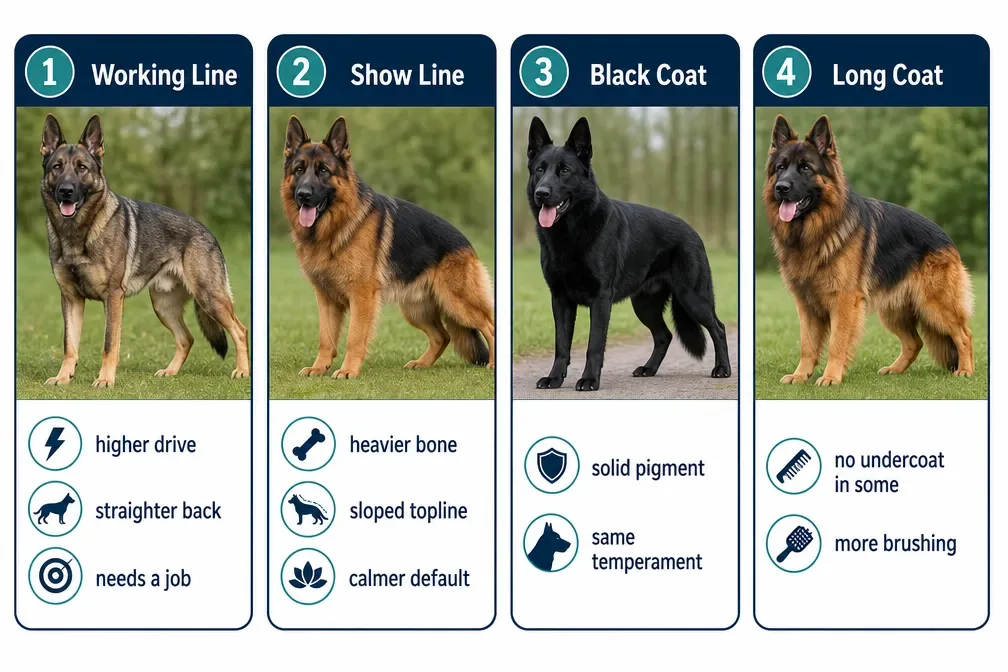
Black German Shepherds, by the way, are a recessive coat color, not a separate breed. Same temperament range, same health risks, same shedding. Solid pigment, nothing else changes.
German Shepherd Size, Weight and Lifespan
Males run noticeably larger than females, and both sexes sit squarely in the large breed category rather than giant. Use the table below as a planning tool for crates, car space and harness sizing.
| Measure | Male | Female |
|---|---|---|
| Height at shoulder | 24 to 26 inches | 22 to 24 inches |
| Adult weight | 65 to 90 lb | 50 to 70 lb |
| Full physical maturity | 24 to 36 months | 18 to 24 months |
| Typical lifespan | 7 to 13 years (source dependent) | 7 to 13 years (source dependent) |
Lifespan deserves honesty. WebMD lists about 7 to 10 years. Other breed references put it at 9 to 13. The gap comes down to which dogs were counted: working dogs, insured pet populations, dogs who died young of disease or injury. Treat 10 as a reasonable planning number and treat anything beyond 12 as a good outcome, not a promise.
If you are unsure whether to buy large or giant sized gear, our dog size classification guide sorts the categories out. Most adult German Shepherds take a large crate (42 inch) rather than the 48 inch giant size.
What Is the German Shepherd Temperament Like?
Stable means confident and reserved, not friendly to everyone and not suspicious of everyone. The AKC breed standard spells it out: direct, fearless, self-confident, alert, willing to serve, and specifically not hostile, timid, nervous or fearful. A well-bred german shepherd can ignore a stranger on the sidewalk without reacting. That is the target.
Working lines and show lines differ enough to change your daily life:
- Working lines (often sable, straighter topline) carry more drive, recover faster from exercise, and get destructive quickly when under-worked. Great for sport, detection, serious training hobbies.
- Show lines (classic black and tan, sloped topline in some European and American lines) tend to settle more easily indoors. Still high energy by normal dog standards.
Neither line is “nicer.” They are differently demanding.
Where temperament goes wrong is usually two things: a puppy bred from nervous parents, or a puppy that missed early socialization. The AKC’s puppy socialization guidance treats the first three months as the window that shapes later reactions to people, sounds, surfaces and handling. Reserved is fine. Fearful is a problem that gets bigger.
Are German Shepherds Good With Kids and Other Pets?
Yes, with supervision and with a plan for the biting phase, which is the part families underestimate.
The breed is patient and protective with children it grows up around. The complication is physics and teeth. An eight-week-old puppy with needle teeth and a five-year-old with flapping hands is a predictable disaster, because flapping hands look exactly like a toy. Herding heritage also means some dogs nip at running kids. That is chase behavior, not aggression, and it responds to training.
Practical rules that work:
- Kids under eight do not do the tug games. Adults do.
- Teach the dog a mat or crate spot and use it when kids have friends over.
- Children never take anything out of the dog’s mouth. Trade with a treat instead.
- Running and shrieking happens outside, with the puppy on a long line or behind a gate until bite inhibition is solid.
With other pets, early calm exposure matters more than breed. Cats raised alongside a german shepherd puppy are usually fine. A high-drive adult meeting a strange cat for the first time is a different conversation. Our child-friendly pet guide covers household matching in more detail.
Who Is the German Shepherd Made For, and Who Should Skip It?
Choose this breed if you want a training partner and can give it two hours of daily attention for 10 years. Skip it if your schedule is unpredictable or your tolerance for hair is low.
Good fit if you:
- Enjoy training as a hobby, not a chore
- Are home most days, or can pay for daycare and walkers
- Have a yard or live near real walking space
- Want a dog that deters without being reactive (see guard dog breeds)
Poor fit if you:
- Work 11-hour days with nobody home
- Live in a small apartment with no exercise plan
- Want a first dog with a gentle learning curve
- Need a low-shedding dog for allergy reasons
First-time owners can succeed with this breed, but the honest version is that it is a hard first dog. The puppy phase is loud, mouthy and relentless. If you want protective instincts with less intensity, look at the comparisons in our best dog breed selection guide. For apartments specifically, a Greyhound, a Whippet or a Cavalier is a saner pick, and our apartment dog breeds list has the rest.
German Shepherd vs Belgian Malinois: Which One Fits Your Home?
People often shortlist these two herding breeds together, and they look alike at a glance. Living with them is a different story. The Malinois runs leaner, hotter and faster, and most trainers steer first-time owners toward the German Shepherd for good reason.
| Trait | German Shepherd | Belgian Malinois |
|---|---|---|
| Height (male) | 24 to 26 in | 24 to 26 in |
| Weight (male) | 65 to 90 lb | 60 to 80 lb |
| Coat | Medium double coat, heavy seasonal shed | Short double coat, seasonal shed |
| Typical lifespan (AKC) | 7 to 10 years | 14 to 16 years |
| Energy and drive | High | Very high |
| Best fit | Active families ready to train | Experienced handlers with a daily job for the dog |
Pick the German Shepherd if you want a loyal family dog that can settle in the evening after a solid walk and a short training session. Pick the Malinois only if you already train dogs, enjoy structured sports such as agility, scent work or protection sports, and can give it purposeful work every single day. A bored Malinois tends to invent its own job, and its ideas rarely match yours.
Either way, meet adult dogs from the breeder's line, ask to see OFA hip and elbow results, and ask the breeder to match you with a puppy whose energy fits your household rather than the boldest one in the litter.
How Much Exercise Does a German Shepherd Need?
Plan on 90 to 120 minutes of physical activity daily for an adult, plus 20 to 30 minutes of thinking work. Thinking work is not optional with this breed.
A tired body with a bored brain still eats the couch. Owners who complain about destruction when left alone are usually meeting the walk quota and skipping the mental side entirely.
A workable weekday:
- Morning: 30 minute brisk walk with five minutes of cue practice mixed in
- Midday: food puzzle or scatter feed in the yard (10 minutes)
- Evening: 45 to 60 minutes of off-leash running, fetch, hiking or sport training
- Night: 10 minutes of nose work, a frozen stuffed toy, or a chew
Puppies get less, not more. The common guideline is roughly five minutes of structured exercise per month of age, twice daily, with free play on soft ground on top. Repetitive forced running on pavement before the growth plates close (around 14 to 18 months) is a bad trade against joints that already carry dysplasia risk.
Scent games are the cheapest upgrade available. Hiding ten treats around a room burns more energy than a block of walking, costs nothing, and works on rainy days.
German Shepherd Grooming and Shedding
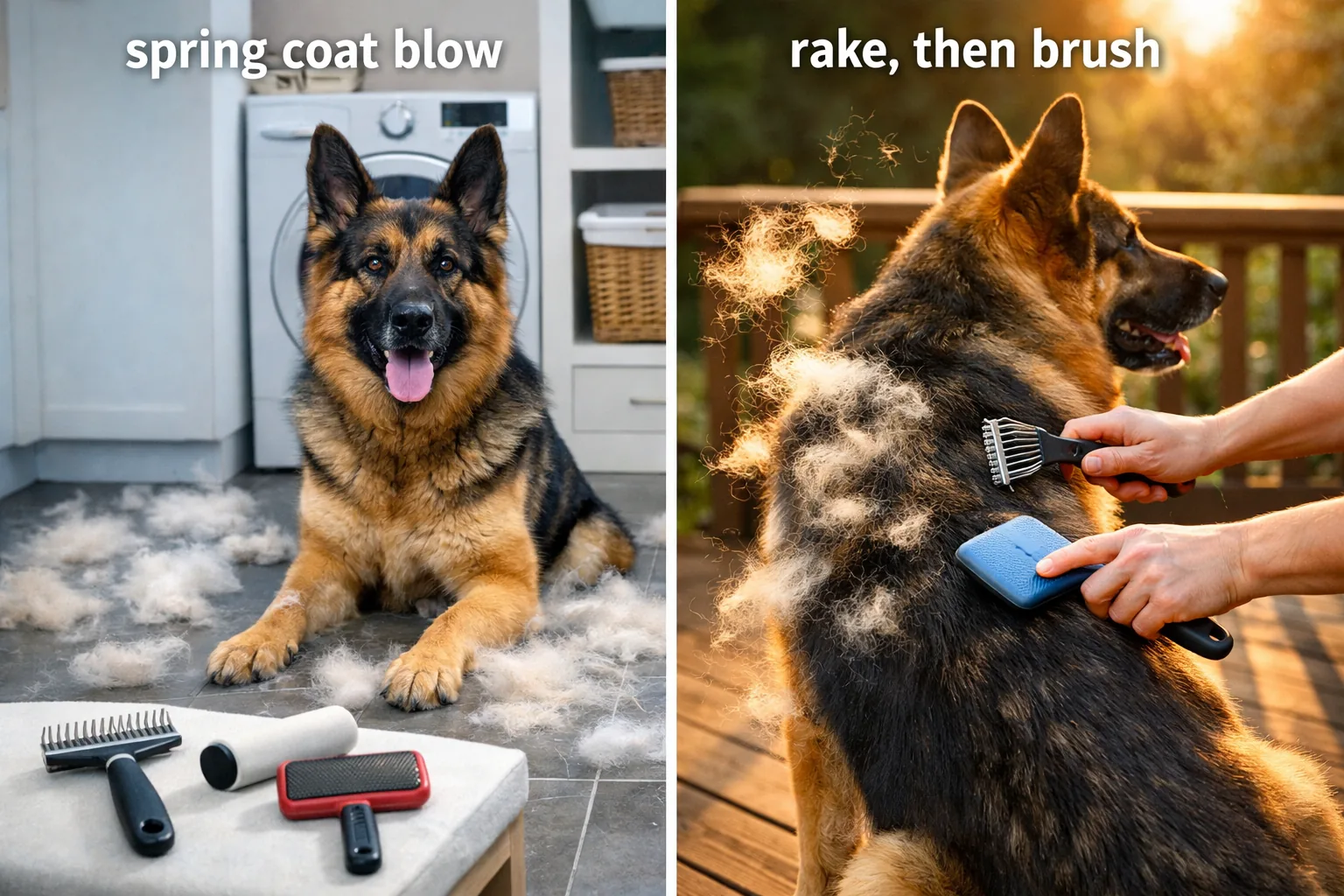
German shepherd shedding is constant, with two seasonal coat blows that look like a crime scene. There is no product that stops it, and shaving a double coat is a mistake that can damage regrowth and insulation.
What actually reduces fur in the house:
- Undercoat rake, twice weekly, moving to daily during spring and fall blows
- Slicker brush after the rake to catch loose topcoat
- High velocity dryer after bathing, which pulls out more undercoat in 20 minutes than a week of brushing
- Bath every 6 to 10 weeks, not more, with a plain dog shampoo
- Nails every three to four weeks, ears checked weekly, teeth brushed if you can manage three times a week
Long-coated German Shepherds need more brushing behind the ears, in the armpits and along the trousers, where mats form first.
Budget for a decent vacuum. Owners talk about this more than they talk about training. If you are new to coat care, our beginner’s dog grooming guide covers tool choice and technique.
The fur will reach rooms the dog has never entered. Accept it early and buy the rake.
Common German Shepherd Health Problems
The breed’s main risks are orthopedic, neurological and gastric. Screening before you buy changes your odds more than anything you do later.
Hip and elbow dysplasia. Malformed joints leading to arthritis. Ask breeders for OFA or PennHIP hip scores and OFA elbow clearances on both parents, with certificate numbers you can look up. No scores, no puppy.
Degenerative myelopathy (DM). A progressive spinal cord disease, usually starting after age eight, that causes rear limb weakness and loss of coordination. There is a DNA test for the SOD1 variant. Not every at-risk dog develops it, but two carrier parents is avoidable.
Bloat and GDV. The stomach fills with gas and can twist. This is a same-day emergency. A distended belly, unproductive retching, drooling and restlessness means you call the vet immediately, not in the morning. Our guide to bloat symptoms in dogs walks through the warning signs.
Also worth watching: exocrine pancreatic insufficiency, chronic digestive sensitivity, allergies and ear infections, perianal fistulas, and arthritis in older dogs. A 2026 industry report discussed the probiotic strain Pediococcus acidilactici Long21 for German Shepherds with gut sensitivity, but the underlying peer-reviewed data has not been widely reviewed, so treat it as a question rather than a protocol.
Rare things stay rare. A March 2026 case report in Frontiers in Veterinary Science documented a single Italian german shepherd with a Penicillium labradorum infection. Interesting, not a breed trend.
What Do German Shepherds Love to Eat? Favorite Foods and Feeding
Feed a large-breed formula with AAFCO adequacy for the right life stage, split into two or three meals, and keep the dog lean. Lean is the single cheapest joint intervention available.
Puppies need large-breed puppy food specifically, with controlled calcium and a managed growth rate. Fast growth on rich food is linked to joint problems. Our guide to reading a dog food label and what AAFCO means explains what to check on the bag.
Treats this breed tends to go stupid for:
- Plain cooked chicken or turkey, no seasoning
- Freeze-dried liver (tiny pieces, high value, great for recall)
- Sardines in water, once or twice a week
- Carrot sticks and green beans, free crunch for a dog on a diet
- Frozen plain yogurt in a stuffable toy
- Pumpkin puree, plain, helpful for loose stool
Never feed: grapes, raisins, onion, garlic, xylitol (check peanut butter labels), chocolate, macadamia nuts, cooked bones, alcohol, or anything with large amounts of fat trimmings.
Given the breed’s digestive sensitivity, change foods slowly over 7 to 10 days. Our food switching guide has the ratios. Raised bowls have no proven protection against bloat, so skip that claim. Slow feeders are a fairer bet for fast eaters.
How to Train a German Shepherd
Train with rewards, start on day one, and treat the biting phase as teaching bite inhibition rather than eliminating mouthing overnight.
German Shepherd puppies bite a lot because mouths are how they explore, because teething hurts, and because biting usually produces an exciting reaction. The reaction is the reward. The AKC’s puppy training guidance frames the goal as bite inhibition: the dog learning to control pressure, not just stopping.
The sequence Dogs Trust recommends, and that works:
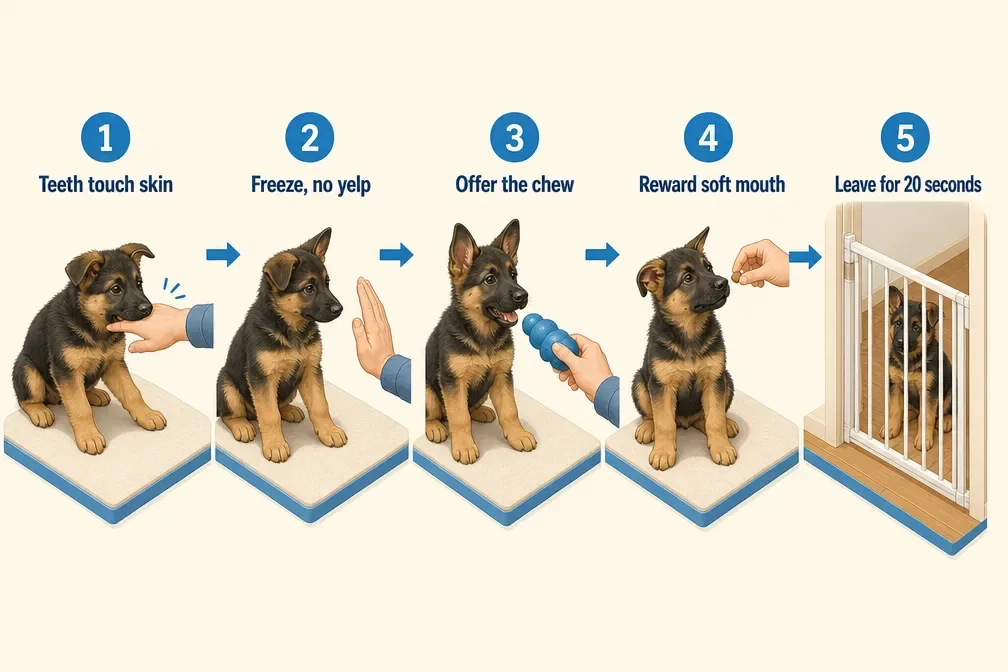
- Stay still. Hands go quiet. Flailing is a game.
- Withdraw attention. Turn away, stop talking, three to five seconds.
- Redirect to a chew or tug toy the second the mouth opens.
- Reward soft mouth and calm contact with food or calm praise.
- Leave briefly (20 to 30 seconds behind a gate) if arousal is climbing.
Do not shout, scruff, hold the muzzle or “bite back.” Dogs Trust notes punishment can raise arousal, fear and confusion, which gives you a harder dog, not a softer one.
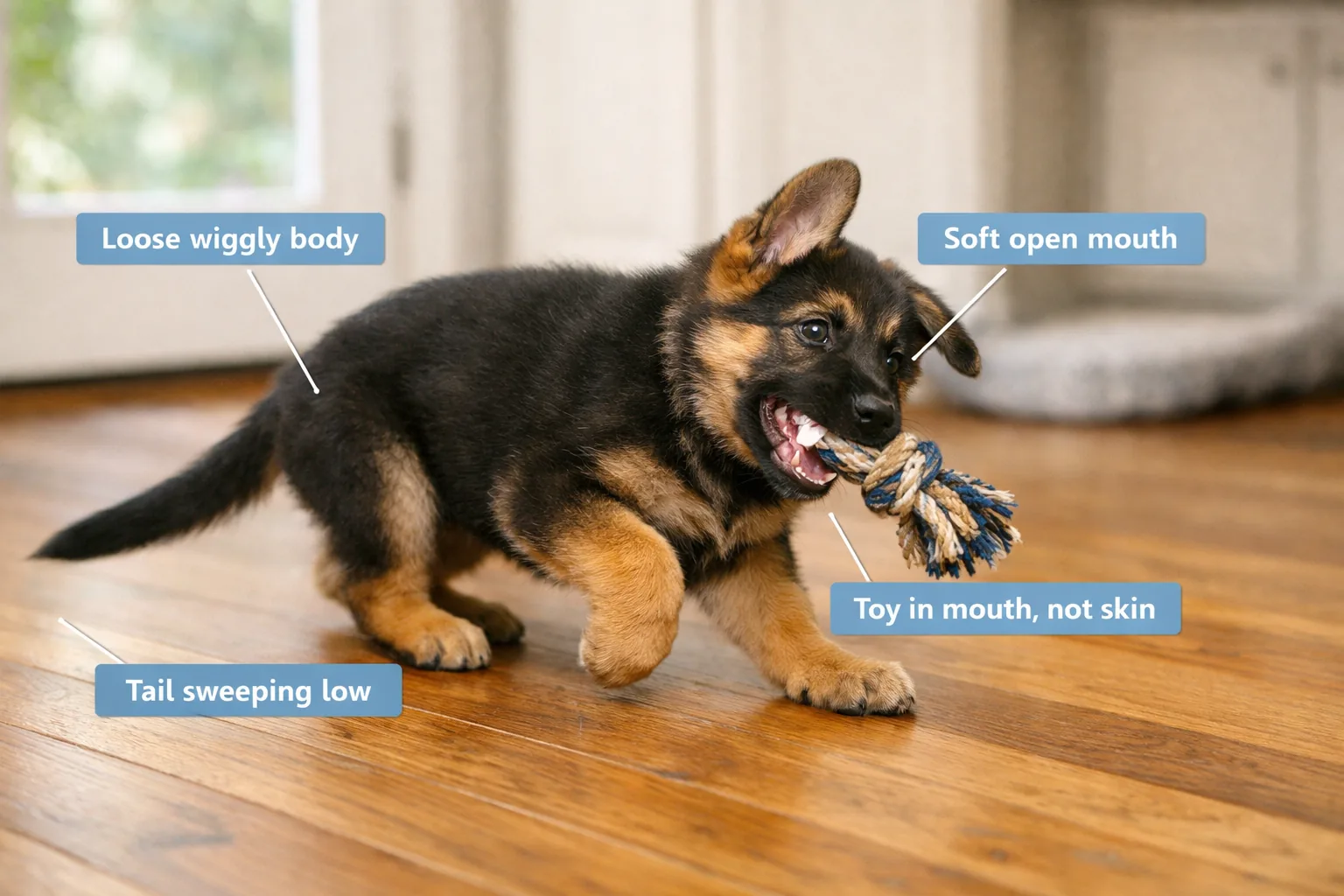
Playing vs. a real problem: play biting comes with a loose wiggly body, bouncy movement, a soft open mouth and quick re-engagement. Warning signs include stiffness, a hard freeze, growling that escalates, resource guarding, pain when touched, broken skin, or sudden biting in an adult dog. Those get a vet visit and a qualified behavior professional, not more management.
Start with our five essential puppy commands and keep sessions short. Five minutes, five times a day, beats one long drill.
Common mistakes: skipping crate training, free-roaming the puppy too early (which also wrecks potty training), using the crate as punishment, wrestling with hands, and socializing by overwhelming the puppy at a busy park instead of building calm, short, pleasant exposures.
Try It: German Shepherd Puppy Biting Timeline
This tool matches your puppy’s age and biting style to what is typical for that stage and what to do next. German Shepherd puppies bite harder and longer than most breeds, so knowing whether you are at week 10 or month six changes the plan entirely.
Doggy Rank IQ Tool
German Shepherd Puppy Biting Timeline

German Shepherd puppies are famous for sharp teeth. Enter your puppy's age and what the biting looks like to see what is normal and what to do next.
How Much Does a German Shepherd Cost?
Expect $1,500 to $3,500 for a puppy from a breeder who health tests, and $2,500 to $4,500 total in year one. Rescue adoption usually runs $150 to $500.
First year, typical US ranges:
| Item | Cost |
|---|---|
| Puppy from health-tested parents | $1,500 to $3,500 |
| Vaccines, exams, spay or neuter | $500 to $1,200 |
| Crate, gates, bed, leashes, bowls | $300 to $600 |
| Training classes | $300 to $900 |
| Food (large breed puppy) | $700 to $1,100 |
Ongoing years land around $1,800 to $3,200: food, preventives, annual vet, grooming supplies, insurance ($40 to $90 a month for a german shepherd, higher than average because of orthopedic risk), plus daycare or a walker if you work out of the house.
Cheap puppies get expensive. A $600 dog with no hip scores can become a $6,000 hip surgery at age four. Pay for the clearances or adopt an adult whose health history you can see.
German Shepherd Puppy Tips for the First 90 Days
The first three months at home are your socialization window and your management window. Do both badly and you will spend year two undoing it.
Weeks 1 to 2. Crate training starts immediately. Puppy sleeps in the crate in your bedroom. Take them out every 45 to 60 minutes while awake, after every nap, meal and play session. Reward outside, never scold indoor accidents; clean with an enzyme cleaner so the spot stops smelling like a toilet. If nights are rough, our guide to a puppy crying in the crate at night has gentler fixes than waiting it out.
Weeks 3 to 6. Socialization in short pleasant doses: five new surfaces, car rides that end somewhere good, different people at a distance the puppy chooses, household noises at low volume. Pair every new thing with food. Quality over quantity.
Weeks 7 to 12. Add alone-time practice in five minute blocks, building to an hour. This is what prevents the destruction complaints later. Keep a chew rotation going and track the teething stages against our puppy teething timeline.
Non-negotiables all 90 days: 16 to 18 hours of sleep a day, no stairs marathons, no forced jogging, and a hard rule that hands are never toys.
What German Shepherd Owners Say
Two posts from the r/germanshepherds community capture the arc fairly well.
“They are totally worth the trouble” Owner on Reddit
That is the long view, and it holds for most owners who get past month six. The practical read: the hard part has an end date. If you are in week 11 and bleeding slightly, the work you are doing now (crate routine, redirection, naps) is what produces the dog in that post. Write down what the puppy could do a month ago versus today. Progress with this breed is real but invisible day to day.
“This puppy sets my hair on end at times” Owner on Reddit
Also fair. The fix is usually sleep and structure rather than more training. Overtired German Shepherd puppies get frantic, mouthy and loud, and owners read it as a behavior problem when it is a nap problem. Enforce two or three crate naps a day. Cut free-roaming time. Use a long line in the yard so you are not chasing. And if the biting involves stiffness, growling or broken skin, that is the point to bring in a reward-based professional rather than pushing through.
German Shepherd FAQ
Why do german shepherd puppies bite so much? Mouthing is how puppies explore, and teething makes gums sore from about 12 weeks. The breed also has high play drive, so biting gets a big reaction from humans, which reinforces it.
What age do German Shepherds stop biting? Mouthing usually drops off sharply once adult teeth are in, around seven months per Dogs Trust. It does not disappear on its own without teaching bite inhibition.
Do German Shepherds bite more than other breeds? As puppies, they mouth more intensely than many breeds because of drive and size. Adult bite risk depends far more on breeding, socialization and training than on breed label.
Are German Shepherds good for first-time dog owners? They can be, but it is a demanding first dog. Succeed by committing to training classes, two hours of daily activity and strict management during the puppy phase.
How bad is german shepherd shedding really? Constant, with two heavy seasonal blows. Twice-weekly undercoat raking plus daily brushing in spring and fall is the realistic minimum.
What are the most common german shepherd health problems? Hip and elbow dysplasia, degenerative myelopathy, bloat and digestive sensitivity top the list. Ask for OFA or PennHIP hip results, OFA elbow results and a DM DNA test on both parents.
What is the best food for German Shepherds? A large-breed formula with AAFCO adequacy for the life stage, fed in two or three meals, with the dog kept lean. Transition foods over 7 to 10 days.
Are there better breeds for apartments? Yes. Greyhounds, Whippets, Cavaliers and French Bulldogs need far less space and exercise than a german shepherd.