
Quick Answer: Is a Shih Tzu Right for You?
A shih tzu suits you if you want a small, affectionate lap dog and you are genuinely willing to do daily grooming. That last part is where most people get surprised. Shih Tzu hair grows continuously like human hair, so a full coat needs combing every single day plus a professional trim roughly every four to eight weeks at around $50 to $120 per visit in the U.S., according to care-cost estimates compiled by VetExplains. Exercise needs are modest. Grooming, eye care, dental care and heat management are not.
Key Takeaways: Shih Tzu
- Grooming is the real job. Daily brushing and combing for a long coat, bathing roughly every two to three weeks, and a groomer visit every 4 to 8 weeks at about $50 to $120 per appointment (VetExplains).
- Breathing deserves attention. A University of Cambridge-led study of nearly 900 dogs across 14 flat-faced breeds, published February 18, 2026, placed Shih Tzus in a group where roughly 50% to 75% of dogs showed some degree of breathing abnormality (University of Cambridge).
- Weight control is a breathing intervention. The same Cambridge work found higher body-condition score was a significant risk factor for Shih Tzus specifically.
- Size: typically 9 to 10.5 inches at the shoulder and 9 to 16 pounds, with males and females overlapping heavily (AKC breed standard).
- Lifespan: commonly quoted at 10 to 16 years, which is long even for a toy breed.
- Shedding is low, matting is high. Hair that does not drop out stays tangled in the coat instead.
- Potty training is the number one owner complaint. Small bladder, small accidents, slow progress. It is fixable with a schedule, not with scolding.
Where Does the Shih Tzu Come From?
The Shih Tzu is a Chinese palace companion dog with Tibetan ancestry, bred for centuries to sit near people rather than work for them. The name translates roughly as “lion dog,” a reference to Buddhist lion imagery rather than to anything the dog actually does.
Small Tibetan lap dogs were given as gifts to Chinese emperors, and palace breeding programs inside the Forbidden City refined them into the dog recognizable today. Eunuchs in the imperial household reportedly managed the breeding lines, and the dogs were not sold to outsiders. That isolation is part of why the breed stayed small, flat-faced and relentlessly people-focused.
The modern Western population traces back to a very small number of dogs exported in the 1930s. A narrow founding population matters for health conversations later in this guide, because it concentrates inherited conditions.
The practical meaning for you: this is a breed with no job history. No herding drive, no retrieving instinct, no guarding mandate. Just a long documented record of being a companion. That explains both the charm and the clinginess.
What Makes the Shih Tzu So Special (and So Cute)?
The appeal is a specific combination: a calm, low-energy temperament paired with a face built for eye contact. Owners who switch from a terrier or a working breed often describe the Shih Tzu as the first dog that actually relaxes on the sofa.
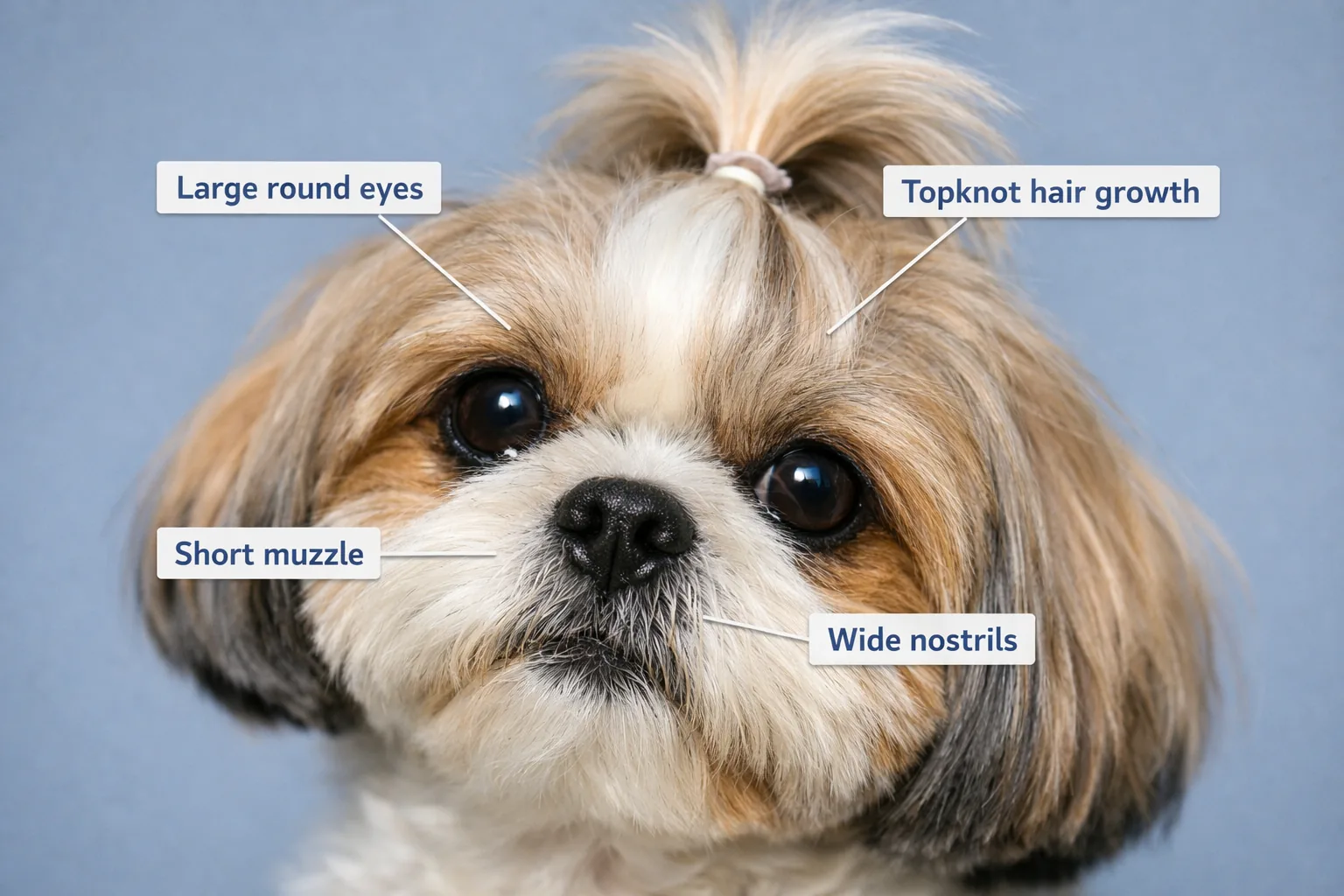
The cuteness is measurable in features. Large, round, forward-facing eyes. A short muzzle. A domed head. Human brains respond strongly to those proportions because they overlap with infant facial geometry. That is not a reason to buy a dog, but it does explain why people stop you on the sidewalk.
The temperament is the better reason. The AKC describes the breed as outgoing, happy, affectionate, friendly and trusting, and its 2026 lifestyle guide notes how adaptable the breed is to different living situations. Owners consistently report the same three things: a dog that is quiet indoors, a dog that is content with short walks, and a dog that wants to be in the room with you.
One honest note. Those same big eyes sit in shallow sockets and protrude more than most breeds. Beautiful, and vulnerable to scratches, dryness and ulcers. The look and the risk come from the same anatomy.
Shih Tzu Size, Weight and Lifespan
A Shih Tzu stands about 9 to 10.5 inches at the withers and weighs roughly 9 to 16 pounds when adult, with a typical lifespan of 10 to 16 years. Sex differences are small compared with most breeds.
| Measure | Male Shih Tzu | Female Shih Tzu | Notes |
|---|---|---|---|
| Height at shoulder | 9 to 10.5 in | 9 to 10.5 in | Breed standard range is the same for both (AKC standard) |
| Adult weight | 10 to 16 lb | 9 to 16 lb | Males average slightly heavier, overlap is large |
| Typical lifespan | 10 to 16 yr | 10 to 16 yr | Females often reach the upper end |
| Adult size reached | ~10 months | ~10 months | Coat keeps changing until roughly 12 to 18 months |
Anything marketed as an “imperial” or “teacup” Shih Tzu is a sales term, not a recognized variety. Dogs bred deliberately under the standard weight tend to carry more fragility, more dental crowding and more low blood sugar risk as puppies. If a breeder uses those words in a price list, treat it as a flag.
Decision rule: if you need a dog under 12 pounds for an apartment weight limit or for lifting in and out of a car, a Shih Tzu fits comfortably without shopping for a miniaturized version.
What Is the Shih Tzu Temperament Like?
Shih Tzus are typically calm indoors, strongly attached to their people, playful in short bursts, and selectively cooperative about obedience. They were bred for company, and they behave like it.
The attachment is the defining trait. A Shih Tzu often follows you from room to room, settles wherever you sit, and notices when you pick up your keys. Many owners find that delightful. Some find it limiting by week three.
Three temperament realities worth planning for:
- Clinginess can slide into separation distress. A dog bred for constant human proximity does not automatically cope with eight hours alone. Build alone-time practice from day one, in minutes, before you need hours.
- Stubbornness is usually a motivation problem. The breed responds poorly to repetition drills and well to short, food-paid sessions. Harsh corrections tend to shut a sensitive companion dog down rather than teach it anything.
- Barking varies a lot. Some Shih Tzus alert at every hallway footstep. Others barely speak. Individual variation here is wide, and early habit matters more than breed average.
Common mistake: treating a quiet, agreeable puppy as a dog that does not need socialization. Calm is not the same as confident. Introduce handling, nail touching, grooming tools, visitors and traffic noise during the first four months.
Are Shih Tzus Good With Kids and Other Pets?
Shih Tzus are generally good with children and other pets, with one size-based caveat: a 10 pound dog with prominent eyes is physically easy to injure. The breed’s tolerance is usually fine. The physics are not.
For families with children under about six, set two household rules and keep them boring and consistent:
- The dog is petted on the floor, not carried. Most serious small-dog injuries come from drops.
- No face-level grabbing, especially around the eyes. A poking finger is a genuine corneal risk in this breed.
With other dogs, Shih Tzus are typically sociable and non-confrontational, though they do not always recognize that a Labrador playing at full speed outweighs them by 60 pounds. Supervise mixed-size play. With cats, most Shih Tzus coexist easily because they lack a strong chase drive.
Edge case to watch: resource guarding around food, chews or a favorite lap. It shows up more in small breeds partly because owners dismiss early growling as cute. Do not. Trade, do not take. If a puppy stiffens over a chew, hand over something better and pick the item up calmly afterward. Guarding that escalates past a few weeks of management deserves a qualified trainer.
If you want more options for family households, compare the breed against our list of family friendly dog breeds for kids.
Who Is the Shih Tzu Made For, and Who Should Skip It?
Choose a Shih Tzu if you want a calm indoor companion and you have 10 to 15 minutes a day for coat and eye care. Skip it if nobody in the house will do that grooming, or if your lifestyle is built around heat and distance.

Good fit:
- Apartment residents. Low exercise needs, small footprint, moderate noise. The breed is a regular on our guide to the best dog breeds for apartment living.
- Seniors and people with limited mobility. A dog that is content with two short walks and a lap.
- Families with school-age children who can follow handling rules.
- People who work from home or have a flexible schedule.
- Owners who actually enjoy grooming, or who budget for a groomer every 4 to 6 weeks without resenting it.
Poor fit:
- Runners, hikers and anyone wanting a sports partner. Flat-faced dogs struggle with sustained exertion.
- Households in hot climates without reliable air conditioning. Heat intolerance is a documented breed trait.
- People out of the house 10 hours a day with no midday help.
- Anyone who wants a dog that swims. Shih Tzus are poor swimmers, a point the AKC makes explicitly.
- Owners who want housetraining finished in three weeks.
First-time owners? Yes, with one condition. The breed is forgiving about training mistakes and unforgiving about grooming neglect. If you read one thing before pickup, make it a grooming plan, starting with our beginner’s guide to dog grooming.
How Much Exercise Does a Shih Tzu Need?
Most adult Shih Tzus do well on 20 to 30 minutes of walking a day, split into two outings, plus short indoor play. They are a low-to-moderate exercise breed, not a zero-exercise breed.
What that looks like in practice:
- Two walks of 10 to 15 minutes, at a sniffing pace rather than a fitness pace.
- Two or three short play sessions indoors: a flirt pole, a rolled treat, a brief tug game.
- Daily mental work. Scatter feeding, a snuffle mat, a frozen lick mat or a puzzle feeder. Ten minutes of nose work tires this breed more reliably than an extra lap of the block.
Heat is the hard limit. A flat-faced dog cools itself inefficiently because panting through a shortened airway is less effective. Walk early morning and after sunset in summer. If your dog is open-mouth breathing hard, making loud snorting noises at rest, standing with elbows out, or has blue-tinged gums, that is a potential emergency. Cool the dog and call a vet immediately.
Decision rule: if your dog cannot complete a flat 15 minute walk in mild weather without noisy labored breathing, book a veterinary airway assessment rather than assuming it is just “being a Shih Tzu.”
Shih Tzu Grooming and Shedding
Shih Tzus shed very little, and that is precisely why they mat. Hair that would fall out on another breed stays trapped in the coat and knots instead. A full-length coat needs combing to the skin every day. A short clip needs it two or three times a week.
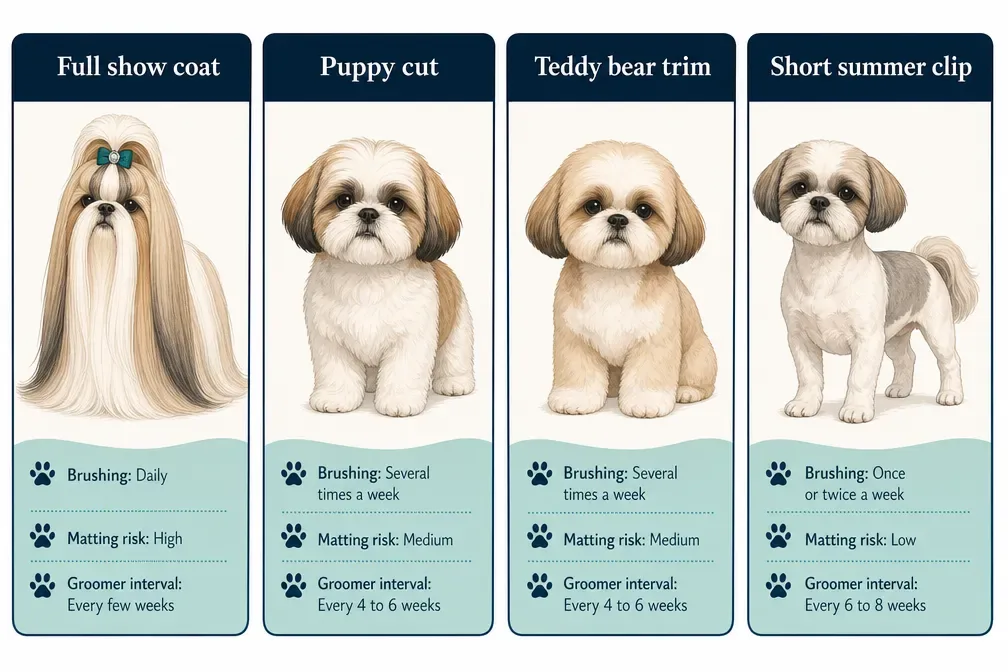
How often you really need to groom. The AKC’s 2026 guidance calls for daily brushing and combing, daily eye-area cleaning, and bathing roughly every two to three weeks for a dog in full coat. Professional appointments typically land every 4 to 8 weeks at about $50 to $120 depending on your city, coat condition and whether the dog arrives matted (VetExplains). Matted dogs cost more, and many groomers charge a de-matting fee by the quarter hour.
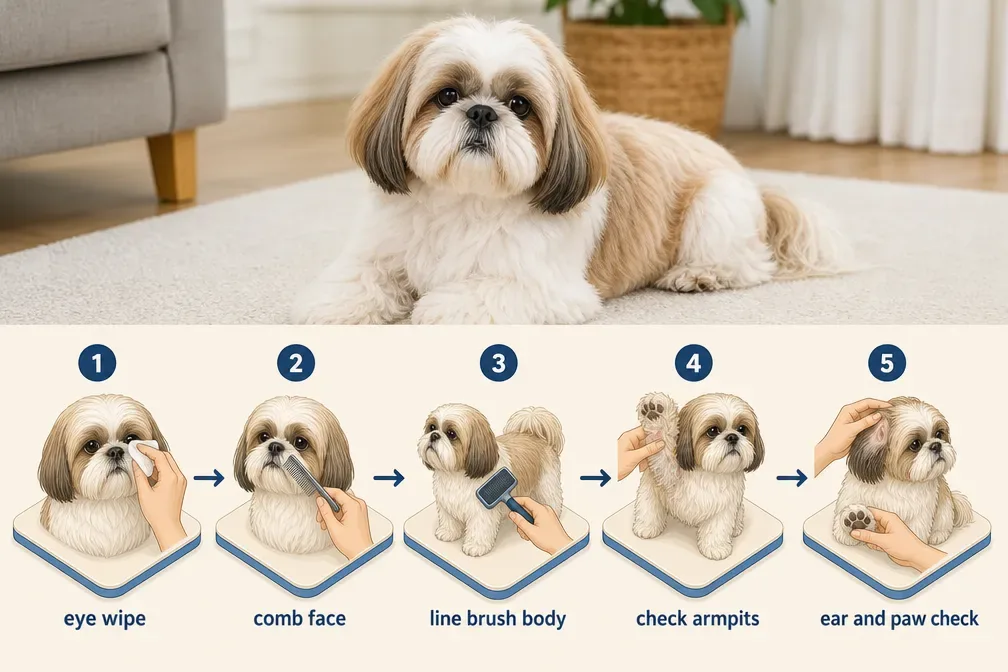
Why the coat mats so fast. Shih Tzu hair grows continuously and has a fine texture with a soft undercoat. Friction points do the damage: behind the ears, the armpits, the groin, under a collar or harness, and the rear. Those are the five places a rushed brushing session always misses.
Can you shave a Shih Tzu? Yes. A short clip does not ruin the coat the way it can in a true double-coated breed such as a Husky, because Shih Tzu hair grows rather than cycling the same way. Expect texture to return within a few months. Two cautions: do not clip shorter than about a half inch in strong sun, because a near-bald dog with pale skin can sunburn, and a very short clip offers less insulation in cold weather.
The mistakes that cost the most:
- Brushing only the top layer. The mat forms at the skin, under the shine.
- Bathing a matted dog. Water sets the knot like concrete. Comb out first, always.
- Skipping the face. Tear staining and eye irritation start with damp hair pressing on the cornea.
- Using a slicker brush alone. Finish with a steel comb. If the comb does not pass to the skin, the dog is not brushed.
- Waiting for a groomer to fix six weeks of neglect.
Home or professional? You can absolutely do maintenance at home with a steel comb, a slicker, blunt-tipped scissors and patience. Most owners outsource the face trim, the sanitary trim and the body clip, because scissors near a protruding eye is a skill worth paying for. If you do bathe at home, a grooming vacuum handles loose hair during clipping, and dog grooming wipes cover the daily face and paw clean-up between baths.
Shih Tzu vs Maltese. Both are small white-capable companion breeds with hair rather than typical fur. The Maltese is lighter (usually under 7 pounds), carries a single silky coat with no undercoat, and has a longer muzzle, so it does not share the Shih Tzu’s breathing risk profile. The Shih Tzu is sturdier, broader and generally calmer. A Maltese Shih Tzu cross sits somewhere between, with coat care that is still a daily job.
A Shih Tzu in a puppy cut is not a lazy owner’s compromise. It is a reasonable welfare decision for a dog that would otherwise live in knots.
Common Shih Tzu Health Problems
The four areas veterinarians watch most in Shih Tzus are eyes, airway, teeth and body weight. A Shih Tzu can look perfectly healthy while quietly accumulating dental disease or corneal damage.
Eyes. Prominent, shallow-set eyes mean a higher rate of corneal ulcers, dry eye, scratches from hair and, in some lines, inherited conditions. Any squinting, pawing at the face, cloudiness or green discharge is a same-day vet call, not a wait-and-see. Chronic tear film problems are worth reading about in our guide to dry eye in dogs.
Airway. The Cambridge-led study published February 18, 2026 assessed nearly 900 dogs across 14 brachycephalic breeds using pre- and post-exercise respiratory tests. Shih Tzus fell in a group where roughly 50% to 75% of dogs showed some degree of breathing abnormality (University of Cambridge). Two findings matter for owners. Narrowed nostrils and higher body condition score were significant risk factors for Shih Tzus. And conformation alone explained only about 20% of the variation in airway status, which is why the researchers recommend functional breathing assessment rather than judging a dog by muzzle length.
Teeth. A standard number of teeth in a shortened jaw produces crowding, rotation and plaque traps. Dental disease is one of the most common diagnoses in the breed. Daily brushing genuinely changes the outcome. Our explainer on whether you need to brush your dog’s teeth covers technique.
Weight. Easy to overfeed, hard to see under coat. Run your hands along the ribs weekly. Overweight is a breathing problem in this breed, not a cosmetic one.
Other conditions to ask a breeder about. The AKC’s toy group page lists no mandatory health tests for the breed, while the American Shih Tzu Club encourages breeders to screen lines for renal dysplasia, portal-systemic liver shunts, eye disease, allergies, von Willebrand disease, thyroid disorders and hernias (American Shih Tzu Club health statement). Patellar luxation and intervertebral disc issues also appear. Sudden back pain with wobbly or weak hind legs is an emergency. Call a vet.
Given the known risk list, pet insurance math is worth running before a pre-existing condition appears on the record.
What Do Shih Tzus Love to Eat? Favorite Foods and Feeding
Most adult Shih Tzus eat roughly half a cup to one cup of quality dry food per day, split into two meals, adjusted by weight and activity. Measure it. Eyeballing a toy breed’s portion is how a 12 pound dog becomes a 17 pound dog.
Practical feeding points:
- Kibble size matters. A small-breed or toy-breed kibble is easier for a crowded, undershot jaw to pick up and chew.
- Two meals beats one. Small stomachs, steadier energy, fewer begging campaigns.
- Flat faces are messy eaters. A shallow, wide bowl is easier to work with than a deep one. Wipe the face after wet food to prevent damp fur against the skin.
- Treats count. Ten percent of daily calories, maximum. For a Shih Tzu that is a very small allowance, so break treats into pieces.
Safe foods many Shih Tzus love: plain cooked chicken, small pieces of carrot, green beans, blueberries, plain pumpkin puree, and a thin smear of plain unsweetened yogurt on a lick mat. Our safe fruits and vegetables list covers the fuller picture.
Foods to avoid completely: grapes and raisins, onion and garlic, chocolate, xylitol (check peanut butter labels), macadamia nuts, alcohol, cooked bones, and anything heavily salted. Also skip rawhide for a dog this size.
If you are comparing brands, start with how to read a dog food label and what AAFCO means rather than with marketing claims. A food is suitable if it meets AAFCO requirements for the life stage, the portion is practical, and your dog maintains condition on it.
How to Train a Shih Tzu
Train a Shih Tzu with short, food-paid sessions and a rigid potty schedule. The breed learns quickly and complies selectively, which owners often mislabel as stupidity. It is negotiation.
Housetraining, the number one complaint. Small bladders, small puddles that are easy to miss, and a genuine dislike of rain and cold. A plan that works:
- Outside every 45 to 60 minutes for an 8 to 12 week puppy, plus immediately after waking, eating and playing.
- Same door, same patch of ground, every time.
- Pay the correct behavior within two seconds of finishing, outdoors, with a high-value treat. Not after you get back inside.
- Use a crate or pen when unsupervised. Unsupervised roaming is how accidents become habits.
- Clean accidents with an enzyme cleaner. Regular cleaner leaves a scent marker you cannot smell and your dog can.
- Never scold after the fact. A punished Shih Tzu learns to pee where you are not looking, which is worse.
Expect reliability somewhere between 4 and 8 months. Some take longer. That is normal for the breed, not a failure.
Puppy biting and nipping. Redirect to a chew, end the game for 20 seconds when teeth hit skin, and make sure the puppy is sleeping enough. Overtired toy puppies bite more.
Separation distress. Start with 30 second departures while the dog is awake and relaxed. Build slowly. Feed a stuffed toy at the door so leaving predicts something good. If your dog panics, drools or destroys within minutes of departure, read our guide to separation anxiety in dogs and involve a qualified behavior professional.
Grooming cooperation is a training skill. Teach a chin rest, pay for stillness, and do 60 second sessions with the comb before you ever need a 20 minute one.
Try It: Shih Tzu Grooming Routine Builder
Shih Tzu hair grows continuously like human hair, and those large eyes need attention every day, so the right routine depends on the coat length you choose and how much tearing your dog has. Pick your coat type and eye situation below to get a simple daily and weekly plan you can actually keep.
Doggy Rank IQ Tool
Shih Tzu Grooming Routine Builder

Shih Tzu hair grows like human hair and those big eyes need daily care. Pick your Shih Tzu's coat and eyes to get a simple daily and weekly routine.
How Much Does a Shih Tzu Cost?
Expect roughly $800 to $2,500 for a puppy from a responsible U.S. breeder, with first-year costs commonly landing in the $1,800 to $3,500 range once vaccines, neutering, supplies and early grooming are included. Rescue adoption typically runs $150 to $500.
Ongoing annual costs for a healthy adult tend to sit around $1,200 to $2,500, with grooming as the line item that separates this breed from a short-coated small dog:
- Grooming: 7 to 12 professional visits a year at roughly $50 to $120 each (VetExplains). That alone can be $500 to $1,200.
- Food: modest, because the dog is small. Often $200 to $400 a year.
- Routine veterinary care: exam, vaccines, parasite prevention.
- Dental cleanings under anesthesia: budget for these. Many Shih Tzus need one every one to three years, and they are not cheap.
- Insurance or a savings buffer: eye and airway surgery are the realistic big-ticket items.
Cost-saving decision rule: learning to comb properly at home does not remove the groomer, but it does prevent de-matting surcharges and keeps appointments at the lower end of the price range.
Shih Tzu Puppy Tips for the First 90 Days
The first 90 days decide three things: housetraining reliability, grooming tolerance and comfort with being alone. Work on all three from week one, in small daily doses.
Days 1 to 14
- Set up a pen or crate near where you sit. Proximity reduces early distress.
- Start the potty schedule immediately, on the clock, not on guesswork.
- Touch paws, ears, tail and muzzle daily for a few seconds, paying with food.
- Introduce the comb as an object that predicts treats before you ever brush with it.
Days 15 to 45
- Begin alone-time practice: 30 seconds, then 2 minutes, then 5.
- Enroll in a well-run puppy class. Socialization windows close early.
- Book a short “happy visit” grooming appointment, no full groom, just handling.
- Start toothbrushing with a finger brush and dog-safe paste.
Days 46 to 90
- First full groom, kept short and positive.
- Expand walks gradually, watching for labored breathing in warm weather.
- Introduce puzzle feeders and scatter feeding as daily enrichment.
- Weigh monthly and compare against the breeder’s or vet’s growth notes.
Common mistake in this window: carrying the puppy everywhere because it is small and adorable. A dog that never walks on its own feet does not learn to be confident on them.
What Shih Tzu Owners Say
Owner reports line up with the breed literature on two points: the attachment is intense, and the people who like the breed tend to like it a lot.
“I truly believe Tzus are the best and quite und”
An owner on Reddit, in this r/Shihtzu thread. The post is cut off, but the sentiment is one of the most repeated things in that community. Practical read: enthusiasm this consistent usually reflects a genuinely easy indoor temperament. Just do not let it talk you out of planning for the grooming workload, because the same forum is full of de-matting horror stories.
“She either wants to be with me or wants to see me.”
An owner on Reddit, in this new-owner thread. That is the breed described in one sentence. Practical advice: treat this as information, not as a problem. Start short, boring absences now, while the dog is relaxed, and pair your departure with a stuffed frozen toy. A dog that has never practiced being alone will not suddenly manage a six hour workday.
Shih Tzu FAQ
How often do you really need to groom a shih tzu? Daily combing to the skin for a full coat, two to three times a week for a short clip, plus a professional trim every 4 to 8 weeks and a bath every two to three weeks.
Do Shih Tzus shed a lot? No. Shedding is low because the hair grows continuously rather than cycling out quickly. The trade-off is that loose hair stays in the coat and forms mats.
Can you shave a Shih Tzu? Yes, a short clip is safe and often kinder than a neglected long coat. Avoid going near-bald in strong sun, and expect normal texture to return within a few months.
How long do Shih Tzus typically live? Commonly 10 to 16 years. Dental care, weight control and airway health have the biggest practical influence on the upper end.
Are Shih Tzus good for first time dog owners? Yes, if you commit to the grooming and a slow potty-training timeline. The temperament is forgiving. The coat is not.
Is a Shih Tzu good for apartment living? Very. Low exercise needs, small size and generally quiet indoor behavior suit apartments, provided the dog is not alone for long stretches.
What is the difference between a Shih Tzu and a Maltese? The Maltese is lighter, usually under 7 pounds, with a single silky coat and a longer muzzle, so it does not share the Shih Tzu’s breathing risk profile. The Shih Tzu is sturdier and typically calmer.
What are the most common Shih Tzu health problems? Eye injuries and dry eye, breathing abnormalities, dental disease and obesity lead the list, with patellar luxation, liver shunts and renal dysplasia also reported in some lines.
Conclusion and Next Steps
A Shih Tzu gives you a calm, affectionate, apartment-friendly companion that will follow you from the kitchen to the sofa for the next decade or more. The cost of that is daily maintenance: a comb through the coat, a wipe under the eyes, a toothbrush, and a vet who checks the airway rather than just the vaccine record.
Do these four things this week if you are moving ahead:
- Buy a steel comb before anything else. A slicker alone will not reach the skin.
- Book a groomer and ask what they charge for de-matting, so you know what neglect costs.
- Write out a potty schedule on paper and stick it on the fridge.
- Ask any breeder what functional breathing assessment, eye screening and liver or kidney history exists in the line.
Then enjoy the dog. Most of the Shih Tzu experience is a small, warm animal asleep against your leg while you read something. That part needs no plan at all.