
Quick Answer
The RCA dog is Nipper, a terrier mix born around 1884 in Bristol, England, who inspired the painting His Master’s Voice. Painter Francis Barraud sketched him from memory in 1898, years after Nipper’s death, listening to a phonograph. The Gramophone Company bought the image in 1899, Victor Talking Machine Company used it in the United States, and RCA inherited the rca dog logo when it purchased Victor in 1929.
Key Takeaways: rca dog
- The rca dog, Nipper, was a real terrier mix who died in 1895, three years before the painting existed.
- Nipper’s original owner was Mark Barraud; after Mark died, his brother Francis Barraud painted the dog from memory.
- The first version of the painting showed an Edison-Bell cylinder phonograph. Edison-Bell rejected it.
- The Gramophone Company bought the repainted version in 1899, and the rca dog logo name “His Master’s Voice” followed.
- Emile Berliner registered the image as a US trademark in 1900.
- RCA acquired the rights when it bought Victor Talking Machine Company in 1929.
- RCA added a puppy, Chipper, to the branding in 1991.
- No confirmed DNA test has ever settled the rca dog breed question. “Terrier mix” is the most defensible label.
- A 28-foot Nipper statue stands on a building in Albany, New York.
- Collectors still look for original rca dog images, statues, and stuffed animals, often paying more for pieces tied to the Victor era than later RCA reproductions.

What do you want to know?
Tap an option to see the answer.
The short answer: who the RCA dog was
The rca dog was a real terrier named Nipper, and the image people recognize on records and radios is based on him, though he never actually heard the recording equipment shown in the final painting.
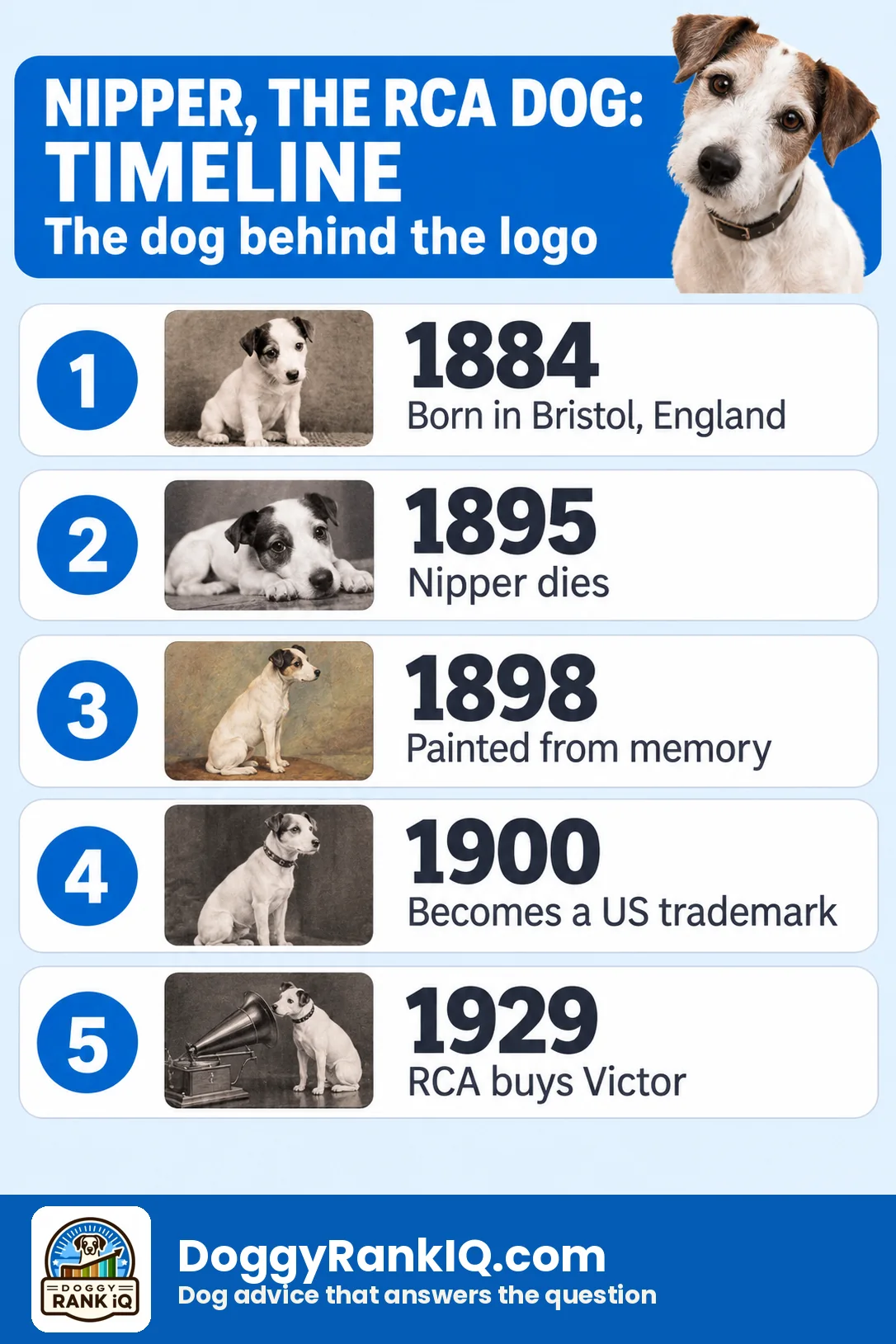
Nipper was born in 1884 in Bristol, England, and died in September 1895 at around 11 years old (global.rca.com, startribune.com). His first owner, Mark Barraud, worked as a scenic artist connected to the theater in Bristol (global.rca.com, startribune.com). The dog reportedly earned his name by nipping at the backs of visitors’ legs, a detail repeated across historical accounts even though it was never written down in any kennel record (startribune.com).
When Mark Barraud died in 1887, Nipper went to live with Mark’s brothers, including Francis Barraud, a painter. Nipper died eight years later. Francis did not paint him while he was alive. He painted him from memory, three years after the dog was gone (global.rca.com, en.wikipedia.org). That gap matters: the most famous dog painting in commercial history is a tribute, not a sitting portrait.
Timeline table: Nipper and the trademark in dates
RCA dog breed: what kind of dog Nipper was
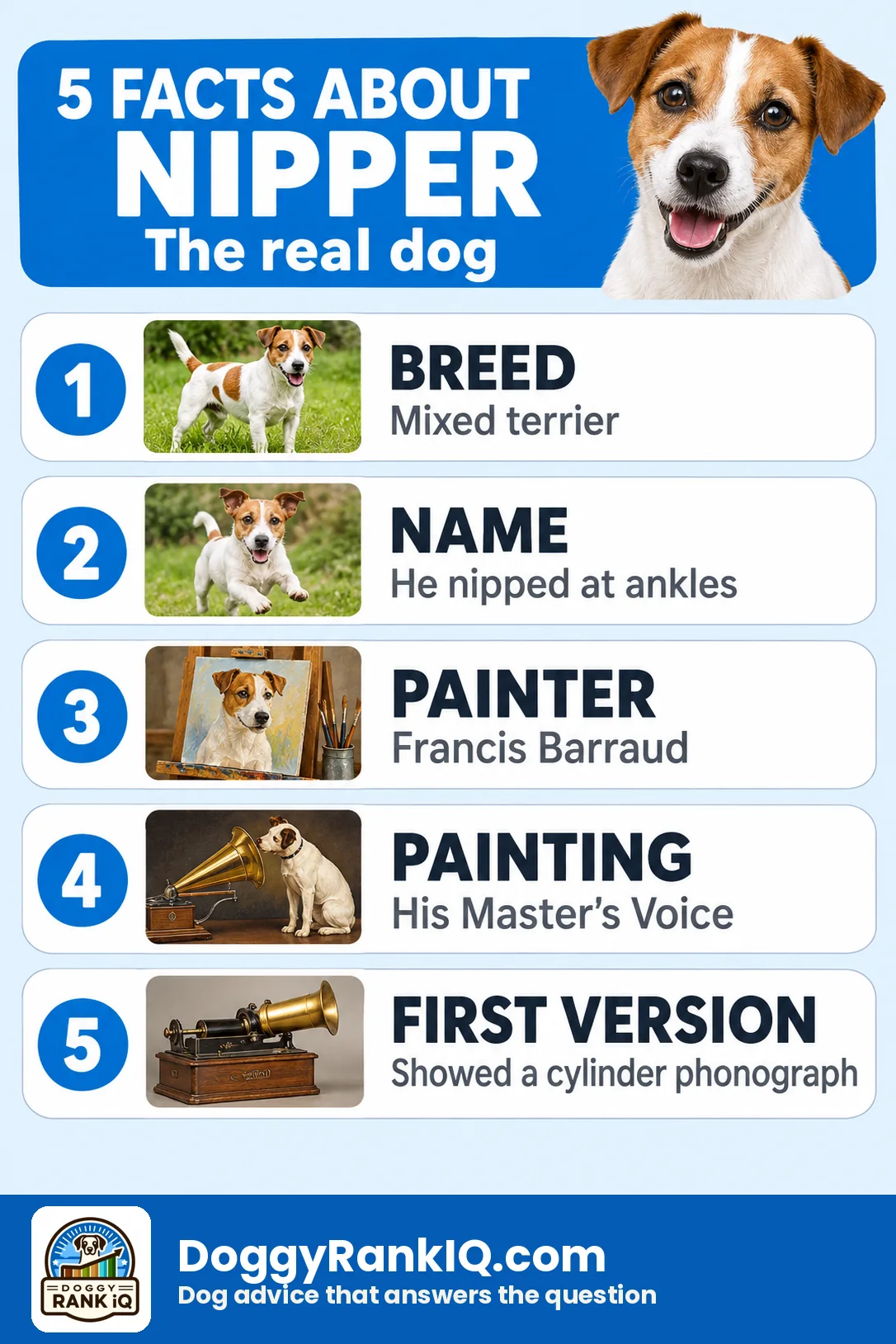
The honest answer to the Nipper breed question is “terrier mix,” and no confirmed DNA test has ever named an exact combination.
RCA’s own historical materials describe Nipper as commonly called a fox terrier but probably a terrier cross rather than a purebred (global.rca.com). Other sources add Jack Russell terrier and even a possible Bull Terrier influence based on reading photographs and the painting itself, not a surviving pedigree (en.wikipedia.org). A 1950 excavation connected to Nipper’s grave reportedly turned up remains identified as a mixed-breed dog, which backs up the general terrier mix label without pinning down specifics [source: Philadelphia Inquirer, 2022, linked below].
So when someone asks what kind of dog Nipper actually was, the fair answer is: a terrier mix, likely with fox terrier and Jack Russell traits, and anything more specific is an educated guess dressed up as fact. If you are curious how breed identity gets debated and reinterpreted over time with modern tools, the same questions come up around when dogs were domesticated, where genetics research is still filling gaps that old photographs cannot.
Was Nipper a real dog or just an illustration? He was real. The illustration came after he was gone.
The real story behind the painting His Master’s Voice
The painting known as His Master’s Voice shows Nipper listening to a machine he reportedly never heard, because Francis Barraud painted the scene from memory in 1898, after Nipper had died (global.rca.com, en.wikipedia.org).
The original version featured an Edison-Bell cylinder phonograph, the recording technology of that moment. Barraud offered it to the Edison-Bell company first. They turned it down [per the supplied research]. He then repainted the machine as a Berliner-style disc gramophone, and in 1899 the Gramophone Company bought the reworked piece [per the supplied research]. That swap, cylinder to disc, is the detail collectors chase today: an early version of the canvas under the paint, visible under X-ray analysis performed by conservators studying the work over the years.
Did the real Nipper dog actually listen to a gramophone? No. He died three years before the image existed in its final form. The story people repeat, that Nipper tilted his head because he recognized his late owner’s recorded voice, is a charming piece of folklore layered onto a dog who was already gone when the machine in the painting was invented for the scene. If you want to understand why dogs actually tilt their heads at sounds, including recorded voices, the mechanics are explained in why do dogs tilt their heads, which covers sound localization rather than sentiment.
Is the Nipper painting still worth money? The original 1899 canvas is owned by corporate archives tied to the EMI legacy and is not for public sale, so its market value is largely theoretical. Where can you see the original Nipper painting today? Reproductions and related period pieces have appeared in UK heritage institutions, including a 1937-era reproduction unveiled at the Huguenot Museum in Rochester, Kent, in November 2025 (kentonline.co.uk). That museum connection exists partly because Francis Barraud descended from Huguenot refugee families, giving the local museum a genealogical reason to display the work (kentonline.co.uk).
From Gramophone to Victor to RCA: the RCA dog logo name and owners
The Nipper logo name, “His Master’s Voice,” followed the image through at least four corporate owners before it became shorthand for RCA itself.
The chain runs roughly like this:
- Gramophone Company bought the painting in 1899 and began using it in Britain, where “His Master’s Voice” eventually became the company’s own name, often shortened to HMV.
- Emile Berliner, inventor of the flat disc gramophone, registered the image as a US trademark in 1900, bringing Nipper to American advertising.
- Victor Talking Machine Company licensed the mark in the United States and built the “Victor dog” into a dominant symbol for early phonograph sales.
- RCA bought Victor Talking Machine Company outright in 1929, and the Nipper came along with the acquisition.
So what is Victor’s dog called? The same dog, Nipper, under a company name that preceded RCA by decades. What type of dog was the RCA Victor dog? The terrier mix described above, no different from the dog Victor had already been using before RCA existed. Why did RCA use a dog as their mascot? They inherited rather than invented it. RCA did not design Nipper. It bought a company that already owned one of the most recognized trademarks in American commerce, and kept using what worked.
Original RCA dog vs later versions, and Chipper
The original Nipper image shows one dog, alone, facing a horn speaker. The version most people picture today, with a second, smaller dog beside him, did not exist until more than ninety years after the painting was finished.
RCA introduced a puppy named Chipper in 1991, placing him next to Nipper in updated marketing [per the supplied research]. The idea was continuity, a company passing something down, not a factual claim that Nipper ever had a companion. Collectors treat the two eras differently: pre-1991 pieces featuring Nipper alone are generally considered closer to the “original Nipper” branding, while Nipper-and-Chipper items mark the modern RCA refresh.
Why did RCA get rid of their dog logo? RCA did not fully get rid of it. Use of Nipper declined as RCA’s ownership structure splintered through mergers in the 1980s and beyond, and the brand name itself has been licensed to different companies for different product categories over time, which thinned out how consistently the logo appeared. The image never disappeared completely; it simply stopped being the centerpiece it once was.
RCA dog statue, images and collectibles
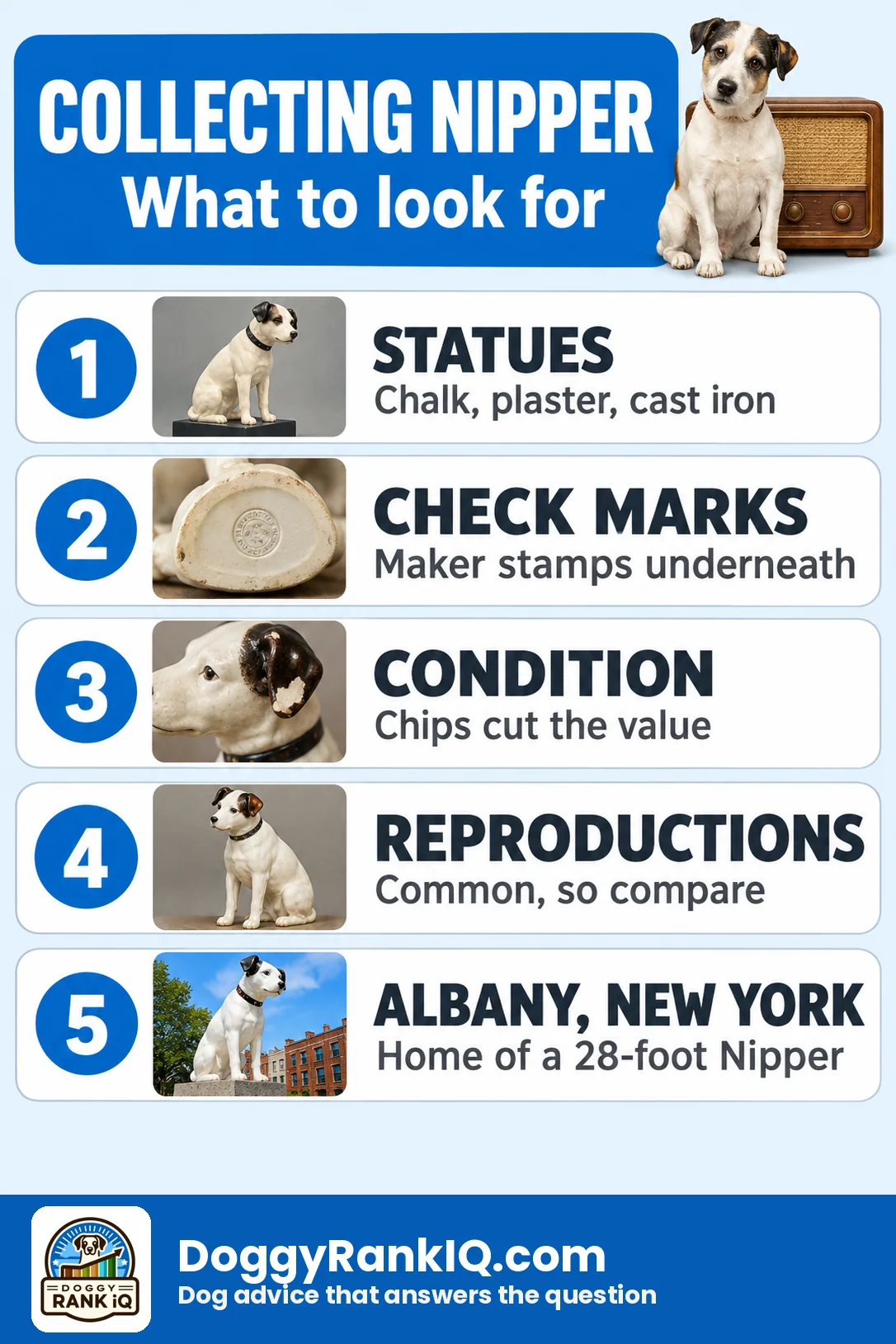
The best known Nipper statue is a 28-foot Nipper that sits on top of a building in Albany, New York, originally built as rooftop signage for a local RCA distributor and now treated as a local landmark (news10.com).
People search for Nipper images in several forms:
- Vintage tin and ceramic Nipper figurines from the Victor and early RCA eras, often valued by condition and base markings.
- Rooftop and storefront signage pieces, rarer and usually in museum or private collections rather than on the open market.
- Nipper statue reproductions, modern cast pieces sold as home décor rather than antiques.
- Nipper stuffed animal promotional items, given away or sold during RCA retail campaigns in the mid-to-late 20th century.
A separate and still unresolved thread involves alleged physical remains. Entrepreneur Graham Alexander, who holds rights tied to former Victor and RCA Victor branding, acquired 11 small bone fragments in 2022 and has proposed a Nipper memorial connected to a planned Victor Vault project in Berlin Borough, New Jersey [per the supplied research]. That preservation effort has not been independently confirmed through forensic verification as of this writing, so collectors should treat any item marketed as containing “Nipper’s remains” with caution rather than as established fact.
Facts table: 5 myths about Nipper checked
🎨 Look closely at the painting: the phonograph under the paint
The original canvas still exists, and it carries its own correction.
When Francis Barraud first painted Nipper, the machine in the picture was a cylinder phonograph. The Gramophone Company agreed to buy the painting on one condition: replace it with their disc gramophone. Barraud painted the new machine over the old one. He did not scrape the canvas first, so the outline of the original phonograph can still be made out under the surface when the light hits it at an angle.
Barraud then spent a good part of the rest of his career repainting it. The company commissioned copies for its offices and partners, and he produced 24 of them by the usual count, each done by hand. So the Nipper was a repeated image long before it was printed on a record label, and the first run of copies came from the artist’s own brush.
“He painted his late brother’s dog once out of affection and 24 more times for a living.”
🌍 One dog, three companies, different countries
The trademark split along national lines, and it is still split.
In Britain, the picture gave its name to HMV. The first His Master’s Voice shop opened on Oxford Street in London in 1921, and the composer Edward Elgar opened it. In the United States, the dog passed from the Victor Talking Machine Company to RCA in 1929. In Japan, Victor’s local branch became JVC, the Victor Company of Japan, and kept the right to use Nipper at home, which is why Japanese record sleeves and electronics carried him for decades after he faded elsewhere.
That history explains a common collector’s puzzle. A Nipper item marked “His Master’s Voice” with no RCA name may be British, Japanese or early American Victor. The wording around the dog and the country of manufacture date a piece better than the picture does.
⭐ Top 5 Features We Love
- The honest timeline. A dog dying before his own famous portrait exists is a better story than the sentimental version, and it is the true one.
- The rejected first draft. Edison-Bell said no to the cylinder-phonograph painting, which is a detail most people never learn.
- One trademark, four owners. Gramophone Company, Berliner, Victor, and RCA all used the same image across decades without redesigning it.
- A local landmark that survived. The Albany Nipper statue has outlasted several corporate reshuffles of RCA itself (news10.com).
- A mixed-breed mascot. The most recognized commercial dog in history was not a show dog. He was a terrier mix who nipped at ankles.
⚠️ Things to Look Out For
- Unverified “authentic bone” items. Claims tied to the New Jersey bone fragments have not been independently confirmed; treat related memorabilia as speculative.
- Chipper-era pieces sold as “original.” Anything showing two dogs postdates 1991 and is not the original Nipper image.
- Breed claims printed on packaging. No confirmed DNA test backs a specific breed, so “genuine Jack Russell Nipper” marketing is a guess, not a fact.
- Reproduction paintings without provenance. Ask where a dealer’s “original” His Master’s Voice canvas came from; the real 1899 piece is not privately sold.
- Condition issues on vintage tin figures. Paint loss and rust are common on pre-1960s pieces and affect value more than age alone.
If you are evaluating any collectible dog-shaped item for a home with an actual dog in it, worth remembering: a glass or cast-iron statue and a curious terrier mix do not mix well on a low shelf.
Nipper keepsakes and dog history books
For readers who want a tabletop nod to the Nipper story rather than a museum-grade antique, a few accessible picks fit the theme.
The HomArt Cast Iron Victor The Dog statue ($28.80, price checked 2026) is a small cast-iron reproduction styled after the classic Victor-era Nipper figure, a reasonable option for a shelf or desk rather than a true antique purchase. Check the current price.
For readers more interested in how a terrier mix like Nipper compares to recognized breeds, The Dog Encyclopedia (DK) ($13.29, price checked 2026) breaks down breed traits in plain language. Check the current price.
And for the bigger picture of how dogs like Nipper came to look and behave the way they do, The Invention of the Dog: 75 Breeds that Changed the World ($32.62, price checked 2026) covers the history behind terrier breeds and dozens of others. Check the current price.
None of these are official RCA merchandise, and nobody currently sells authenticated original Nipper memorabilia on Amazon. Treat these as themed gifts for a vinyl collector or trivia fan, not as investment pieces. Can you buy Nipper Nipper merchandise? Only reproduction items like these; the genuine antique market runs through estate sales, specialty auction houses, and heritage collectors, not standard retail.
FAQ
The bottom line
The Nipper was a real terrier mix named Nipper, and the image everyone recognizes was painted from memory three years after he died, which makes the whole story stranger and more interesting than the sentimental version usually told. If a vinyl collection or antique shelf already has a spot waiting for a Nipper piece, check the era (pre- or post-1991 Chipper) and the provenance before paying collector prices, and treat any breed claim printed on packaging as a guess rather than a certificate.
For related dog behavior and science questions that come up alongside breed history and old advertising folklore, it’s worth reading how dogs recognize their own names, a question that connects directly to the myth about Nipper responding to a recorded voice.
Doggy Rank IQ is reader supported. As an Amazon Associate we earn from qualifying purchases, at no extra cost to you.