
Quick Answer
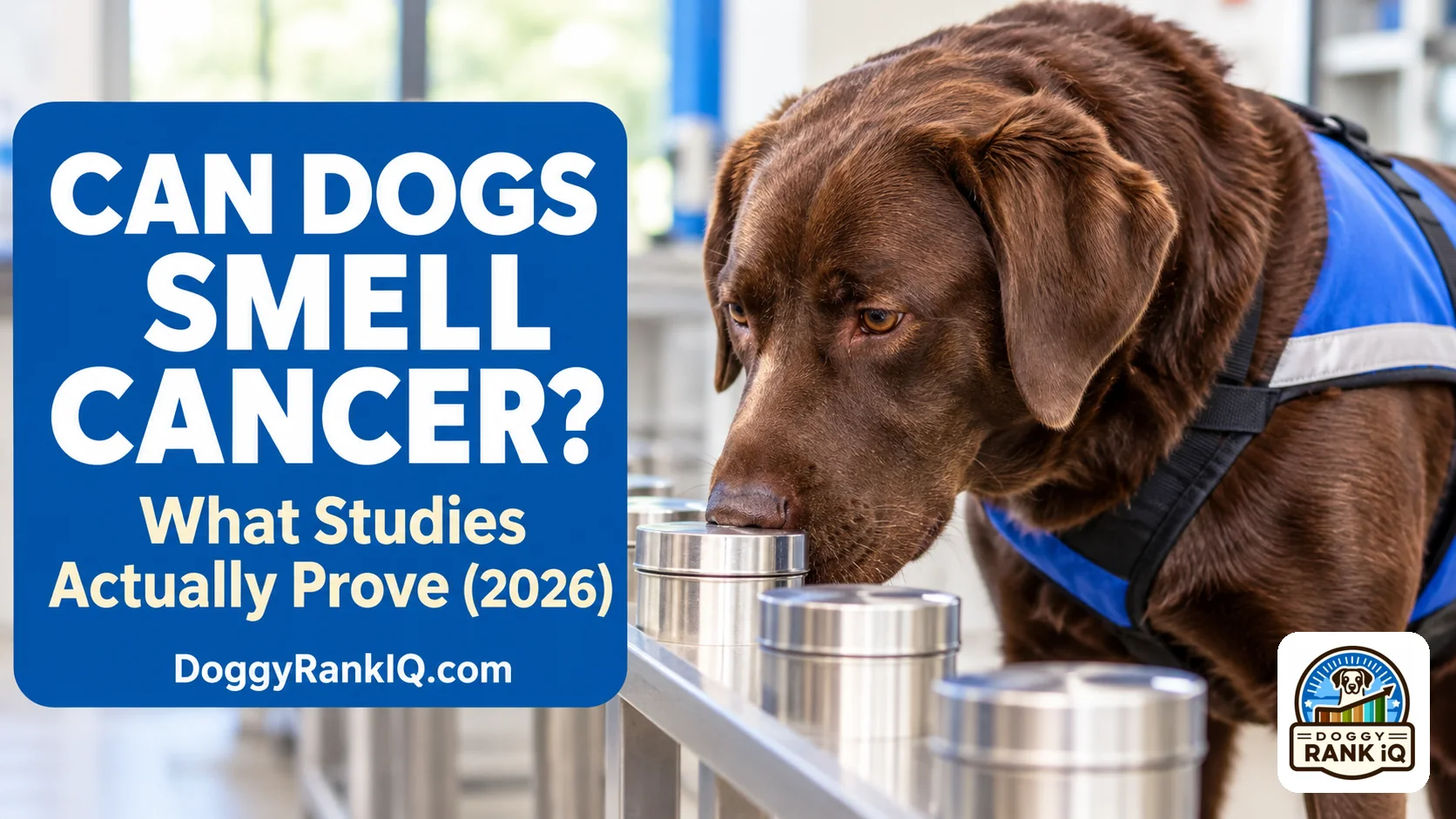
Can dogs smell cancer? Yes, trained dogs have detected cancer-related scent in breath, urine, and blood samples in multiple peer-reviewed studies, some with accuracy above 90%. The catch: these are controlled research settings using specially trained dogs and prepared samples, not the family dog on your couch. No dog detection system is an approved medical screening tool in 2026, and a pet that keeps sniffing one spot on you is a reason to call a doctor, not a diagnosis.
Key Takeaways: can dogs smell cancer
- Trained dogs can smell cancer in research settings by detecting volatile organic compounds, chemicals released by tumors into breath, urine, and blood.
- A 2026 Indian study combining multiple dogs with a statistical model reported 90.8% sensitivity and 91.3% specificity across seven cancer types (PubMed).
- The famous 2006 McCulloch lung and breast cancer study reported near-perfect results that later studies have not consistently matched.
- Results vary widely by cancer type, sample type, dog training, and study design. Bladder cancer detection, for example, has performed far worse than lung or colorectal cancer.
- Can untrained dogs smell cancer reliably? No. The research only supports trained dogs under controlled conditions.
- Cancer detection dogs are a research tool, not a replacement for CT scans, biopsies, or medical screening.
- A dog fixating on one mole or one spot on a person’s body has sparked real diagnoses before, but it is anecdotal, not proof.
- No human cancer detection dog program is clinically approved as of 2026.

What brought you here?
Tap an option to see the answer.
The short answer: can dogs smell cancer?
Dogs can detect odor signatures linked to cancer in trained, controlled studies. That much is established. What is not established is whether an untrained pet can do the same thing reliably in your living room, or whether any dog-based system is ready to replace a biopsy.
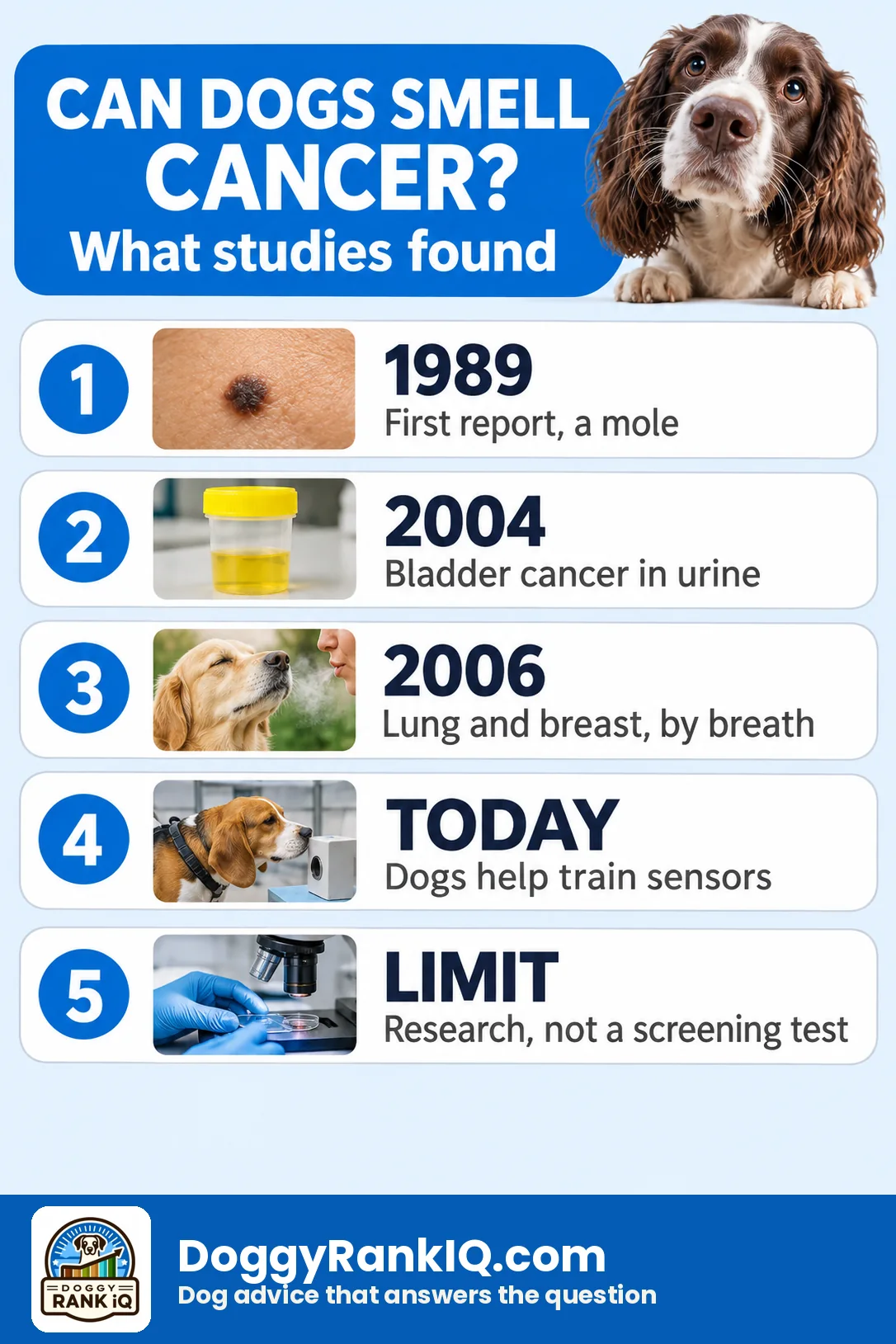
The idea is not new. In 1989, researchers Williams and Pembroke described a case in The Lancet of a dog that would not stop sniffing a mole on its owner’s leg. The mole turned out to be malignant melanoma. That single case report launched decades of actual study into whether dogs’ noses could be turned into a diagnostic tool.
Since then, the field has split into two camps: studies that show surprisingly strong results under tight laboratory control, and studies that show the same approach performs inconsistently once the sample type, cancer stage, or dog changes. Both camps are real. Neither cancels out the other. A useful answer to “can dogs smell cancer” has to hold both truths at once: dogs can do this under the right conditions, and those conditions are hard to reproduce outside a lab.
What studies actually prove
Each study below answers a narrow question under specific conditions. None of them proves dogs can diagnose cancer in an ordinary home.
1Williams and Pembroke (1989): the mole that started it
A dog repeatedly sniffed and nipped at a mole on its owner’s leg. A doctor examined the mole and found melanoma. This was one case, reported as an observation, not a controlled trial. It raised the question researchers later tried to test formally.
2McCulloch and colleagues (2006): the headline numbers
Published in Integrative Cancer Therapies, this blinded breath-sample study with 169 participants reported 99% sensitivity and 99% specificity for lung cancer, and 88% sensitivity and 98% specificity for breast cancer (PubMed). These numbers are often quoted as proof that dogs beat medical imaging. They have not been consistently reproduced since.
3Follow-up lung cancer studies: the spread
A prospective German study found only 71% sensitivity and 93% specificity for lung cancer breath detection. A separate study using one trained dog and 113 participants reported 95% sensitivity and 98% specificity (PMC review). That range, from 71% to 99%, shows how much training quality and sample handling can shift the outcome.
4Colorectal cancer (2011)
Using breath samples, a trained dog achieved 91% sensitivity and 99% specificity. Using stool samples from the same patients, the numbers rose to 97% sensitivity and 99% specificity (PubMed). Performance reportedly held up even for early-stage cancer, though this remained a controlled study, not a screening program.
5Bladder cancer: the weak spot
The original proof-of-principle bladder cancer study used 144 urine samples and produced a mean success rate of only 41% (BMC review). This is the clearest example in the research record that dogs do not perform equally well across every cancer type.
6Penn Vet and canine hemangiosarcoma (2026)
Five dogs from the Penn Vet Working Dog Center tested blood-serum samples in blinded trials across 423 total trials. They alerted to hemangiosarcoma samples 73.4% of the time, compared with 21.3% for other canine diseases and 17.1% for healthy dogs (AKC). This study is about dogs detecting cancer in other dogs, and the researchers described it as proof of a detectable odor signature, not a ready veterinary test (The 824 Journal).
7Lung cancer feasibility study (2026)
A retrospective evaluation using five trained dogs found sensitivities of 82% to 89%, specificities above 95%, and accuracies above 94% on breath samples (IOP Science). Small trained-dog groups like this cannot stand in for population-level screening numbers.
8The 2026 Indian multicancer study
Published in the Journal of Clinical Oncology in 2026, this was the largest and most tightly designed study to date. Kulgod and colleagues ran an assessor-masked, multicenter phase II case-control study across six hospitals in Karnataka, India. Of 3,275 participants, 1,773 trained the system and 1,502 tested it. The test group had 283 treatment-naïve, biopsy-confirmed cancer cases and 1,219 controls. The system reached 90.8% sensitivity, 91.3% specificity, and an AUC of 0.962 (PubMed).
One detail matters here: this was not one dog making a call. At least three dogs assessed each breath sample, and a Bayesian statistical model combined their responses with participant information (NDTV Profit). The reported accuracy belongs to a dog-plus-model system, not to one animal’s nose. Sensitivity for stage I to II cancers was 90.6%, which is the number that actually matters clinically, since catching cancer early is the whole point (Institut national du cancer). Still, this was a case-control study, not a population screening trial, so it did not establish mortality benefit or what the false-positive rate would look like in people without symptoms.
In 2026, media coverage of Dognosis, the Bengaluru company behind the work, suggested real-world programs were in development. Independent coverage was more careful, noting the results need confirmation in larger, independent studies before anyone calls this a diagnostic tool (Euronews).
Facts table: cancer detection dog studies
This table answers “can dogs smell cancer” at a glance.
How do dogs smell cancer? The chemistry
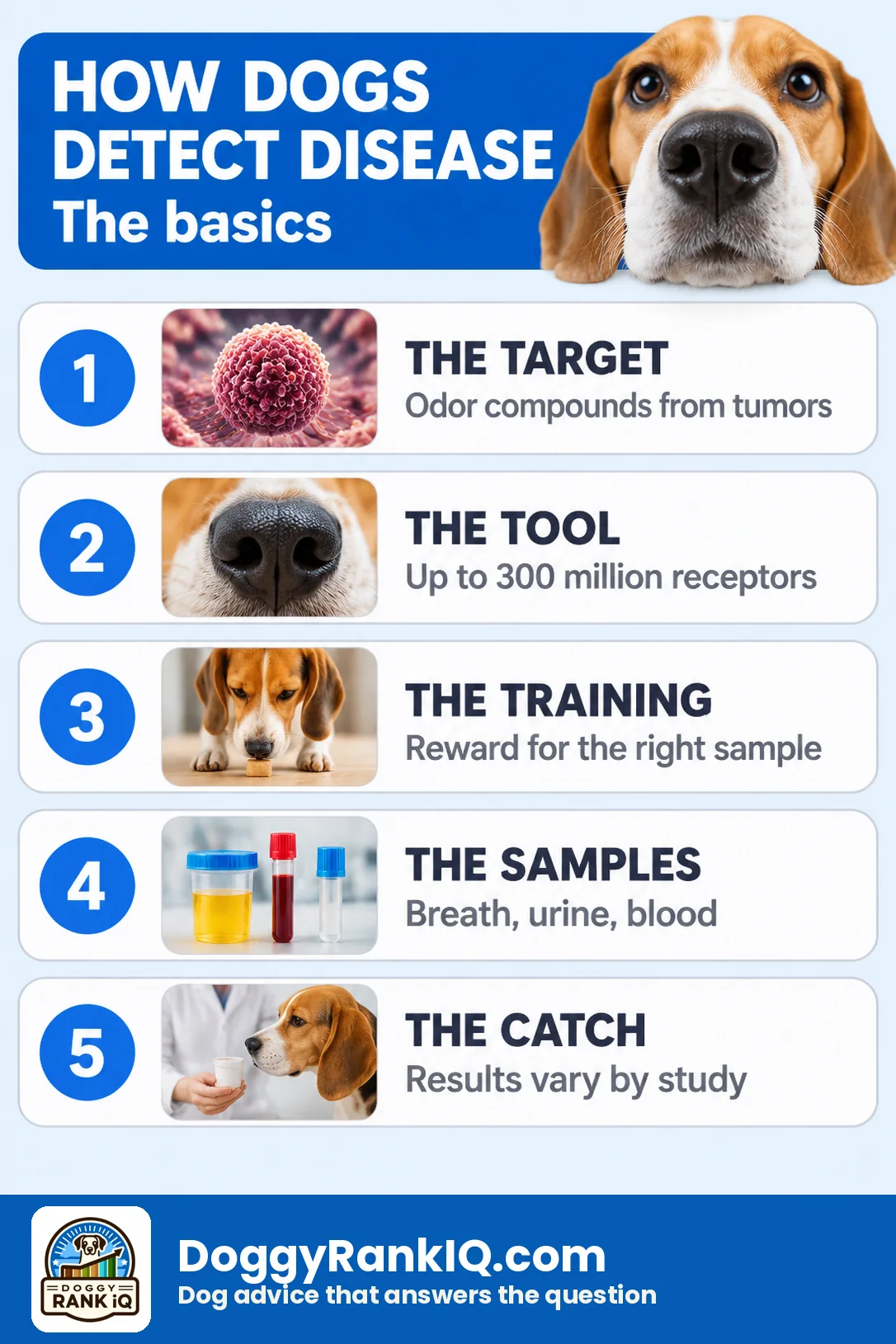
Dogs smell cancer, when they do, by detecting volatile organic compounds, or VOCs, chemicals that tumors release into breath, skin, urine, and other biological material. A dog’s nose has roughly 220 million scent receptors compared to about 5 million in a human, which is part of why this idea has real scientific footing rather than being pure folklore.
A 2026 review in Neuroscience and Behavioral Physiology summarized the field’s thinking on VOCs: dogs clearly have the raw olfactory capability, but turning that capability into a reproducible, standardized diagnostic method is a substantial methodological problem, not just a training problem (Springer). Cancer cells have different metabolism than healthy cells, which changes the mix of compounds a body gives off. Dogs are trained to recognize that mix through repeated exposure to confirmed positive and negative samples, usually using reward-based scent work similar to detection training used for drugs or explosives.
For readers curious about the underlying biology, our guide to dog sense of smell breaks down how airflow and nasal structure shape what a dog can detect at all.
Can untrained dogs smell cancer, and what do dogs do when they smell cancer in humans?
Untrained dogs have not been shown in any study to reliably detect cancer. What exists instead is a collection of anecdotal reports, like the 1989 mole case, where a pet dog’s unusual behavior toward one spot prompted an owner to get checked out.
What do dogs do when they smell cancer in humans, according to these reports? Owners describe repeated sniffing, nudging, licking, or even gentle nipping at one specific area, sometimes returning to it over days or weeks when the dog otherwise ignores it. This behavior shows up in informal reports and single case studies, not in trials that confirm a causal link between the sniffing and the diagnosis. Can dogs detect cancer by licking, specifically? There is no controlled study isolating licking as a detection behavior separate from general scent investigation, so it is folded into the broader “odd fixation” pattern rather than its own proven mechanism.
A dog is not a diagnostic device. A fixation is a prompt to ask a doctor, nothing more. Dogs also pick up on changes in a person’s scent, movement, or routine tied to illness in general, which overlaps with the broader research on how dogs read human emotions and physical states, not necessarily cancer specifically.
Can dogs smell cancer in other dogs?
Yes, in at least one controlled study. The Penn Vet hemangiosarcoma trial found dogs could distinguish blood-serum samples from dogs with that cancer from samples of healthy dogs and dogs with other diseases, at a 73.4% alert rate versus 17 to 21% for controls (Ecancer). Hemangiosarcoma is notoriously hard to catch early in dogs because it often shows no symptoms until it ruptures internally, so a scent-based early warning tool would matter a great deal to veterinary medicine if it can be refined.
The researchers were clear that this is proof of an odor signature, not a finished diagnostic. Penn Vet’s working dogs are also involved in training on ovarian cancer samples for humans, with the goal of using the dogs’ responses to help build electronic sensors rather than replacing the dogs with a permanent screening team (The Daily Pennsylvanian). The dog’s nose, in that project, functions as a biological template for an engineered device.
🔬 How a cancer detection dog is tested fairly
A dog who wants a reward watches the handler closely, and a handler who knows which sample is positive can give it away with a glance or a held breath. Researchers call this the Clever Hans problem, after a horse in early 1900s Berlin who seemed to do arithmetic and was reading his owner’s posture.
Good studies answer the question “can dogs smell cancer” with double-blind line-ups. Nobody in the room knows which container holds the cancer sample, the positions are shuffled by someone who then leaves, and fresh samples from patients the dog has never smelled are used for the final test. When you read a headline with a 97 percent success rate, look for those three details. Results from tests without them tend to shrink when another lab repeats the work.
⭐ Top 5 Features We Love
- Multi-sample cross-checking. The best studies, like the 2026 Indian trial, use multiple dogs per sample rather than trusting one animal’s call, which reduces individual error.
- Non-invasive sample collection. Breath and urine samples are far less invasive to collect than tissue biopsies, which matters for large-scale research.
- Early-stage sensitivity. Several studies, including the colorectal and 2026 multicancer trials, reported strong performance even on early-stage cancer, the stage where catching it matters most.
- Cross-species insight. The hemangiosarcoma work shows the same scent-detection concept applies to veterinary medicine, not just human oncology.
- A path toward electronic sensors. Programs like the Penn Vet Working Dog Center are using dog responses to help engineers design VOC sensors that could eventually scale beyond what any kennel of dogs could handle.
⚠️ Things to Look Out For
A few cautions for anyone asking “can dogs smell cancer”:
- Results vary a lot by cancer type. Bladder cancer detection sat at a 41% success rate in the founding study, far below lung or colorectal results.
- No clinical approval exists. As of 2026, no regulatory body has approved a dog-based cancer detection system as a replacement for standard screening.
- Company-funded results need outside confirmation. Coverage of Dognosis specifically flagged that promising numbers from a company tied to the study still require independent replication (Euronews).
- “Dog detection” sometimes means “dog plus algorithm.” The 2026 Indian study’s reported accuracy came from a Bayesian model combining multiple dogs, not raw canine judgment alone.
- Sample handling and training quality change outcomes. The same cancer type produced sensitivity numbers ranging from 71% to 99% across different lung cancer studies.
- A pet’s behavior is not a test. An untrained dog sniffing a spot is a prompt to see a doctor, never a diagnostic signal on its own.
What to do if your dog keeps sniffing one spot
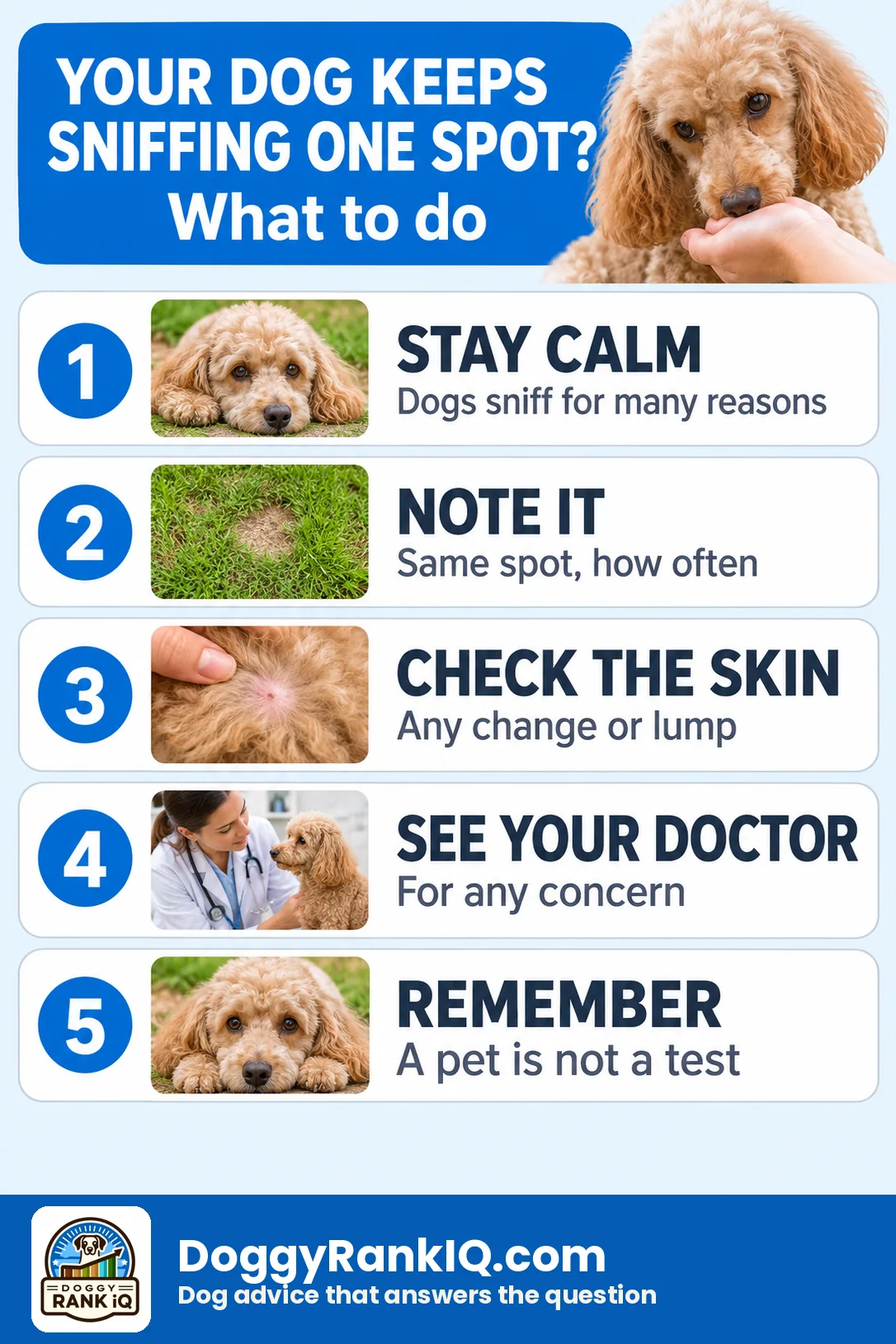
The direct answer: get the spot checked by a doctor, and do not wait on the dog for confirmation either way. A dog’s sustained interest in one area of your body is not evidence of cancer, but it also is not nothing, since the 1989 case and similar anecdotal reports show it has occasionally preceded a real diagnosis.
Practical steps:
- Note where the dog focuses, how often, and for how long. Specific detail helps a doctor evaluate a vague concern.
- Check the spot yourself for changes in size, color, shape, or texture, the same markers used in skin self-exams.
- See a doctor regardless of what you find. Dogs can be wrong, and dogs can also be right about something you have not noticed yet.
- Do not delay a medical appointment because a dog has not reacted. Absence of canine interest is not evidence of absence of disease.
This is informational content, not medical advice. Any concerning symptom belongs in front of a doctor, not a search engine.
Helpful scent games for your own dog
A pet dog cannot be trained at home into a cancer detector, but scent games are still a legitimate form of enrichment that taps into the same olfactory system researchers study. Nose work gives dogs a job, tires them out mentally, and strengthens the kind of focus that makes training easier across the board.
A few accessible options for owners who want to try structured scent games:
- Dog Scent Work Tins Training Kit (rel=”sponsored”), $19.99 (price checked 2026), uses scented tins to teach a dog to identify a target odor, similar in concept to how detection dogs are introduced to target samples. Check the current price.
- Dog Scent Training Kit, Hide and Seek Nosework (rel=”sponsored”), $16.98 (price checked 2026), is built around hide-and-seek style searches that build a dog’s confidence working a scent trail indoors. Check the current price.
- For readers who want the science behind why this works, Inside of a Dog (rel=”sponsored”), $11.21 (price checked 2026), explains canine perception in plain language. Check the current price.
- The Genius of Dogs (rel=”sponsored”), $12.75 (price checked 2026), covers the cognitive research behind detection work more broadly. Check the current price.
None of these kits teach a dog to detect cancer. They teach the underlying skill, following a target scent, that professional detection programs build on with years of additional training and verified samples.
Quick gut check:If you are buying a scent kit hoping it will train your dog to detect illness, pause. These kits build enrichment and focus skills. Clinical detection training involves hundreds of verified positive and negative samples under veterinary and laboratory supervision, something a home kit cannot replicate.
FAQ: can dogs smell cancer
The bottom line: can dogs smell cancer?
Can dogs smell cancer? The honest answer is yes, under laboratory conditions, with trained dogs, verified samples, and often a statistical model helping interpret the results. The 2026 Indian multicancer study and the Penn Vet hemangiosarcoma work both show real, measurable detection ability tied to volatile organic compounds that cancer cells release. What the evidence does not show is that any dog, trained or not, can replace a CT scan, a biopsy, or a doctor’s exam in 2026. If your own dog keeps returning to one spot on your body, treat it as a nudge to get checked, not a verdict either way.
Doggy Rank IQ is reader supported. As an Amazon Associate we earn from qualifying purchases, at no extra cost to you.