
Quick Answer: Is a Poodle Right for You?
A poodle suits owners who want a clever, affectionate dog and can budget for grooming every four to eight weeks. The breed comes in three sizes (Standard, Miniature, Toy), all sharing the same low-shedding, continuously growing coat and the same appetite for mental work. Skip the breed if nobody is home much, or if the grooming bill would hurt. Choose it if you want a dog who learns fast, swims, sticks close, and leaves very little hair on the sofa.
Key Takeaways: Poodle
- Three sizes, one breed standard. The AKC Poodle standard sets Standards at over 15 inches at the shoulder, Miniatures at over 10 up to 15 inches, and Toys at 10 inches or under.
- Grooming is the real line item. Published U.S. estimates run roughly $50 to $120 or more per visit, every 4 to 8 weeks, with Standards and fancy clips at the top end (PawPrices, 2026).
- Low shedding, not allergy-proof. Allergens live in dander and saliva too, so the coat reduces loose hair without guaranteeing an allergy-free home (AKC).
- Sixth most popular U.S. breed in the AKC’s 2025 registration rankings released in 2026, down one spot from fifth (AKC).
- Smart means demanding. Dognition’s summary of data from 468 poodles showed above-average group scores for memory, reasoning and empathy, and near-average results on some communication tasks.
- Health screening is size-specific. The Poodle Club of America recommends different test panels for Toys, Minis and Standards.
- Bloat is a Standard-sized concern. A Dog Aging Project analysis published December 2025 found poodles had the highest recorded number of GDV events among purebreds in that cohort (PubMed).
Where Does the Poodle Come From?
The poodle started as a water retriever, most likely in Germany, and the haircut you think is silly was a job uniform. The name traces to the German pudeln, meaning to splash in water. French breeders later refined the dog and claimed it hard enough that most Americans still assume Paris.
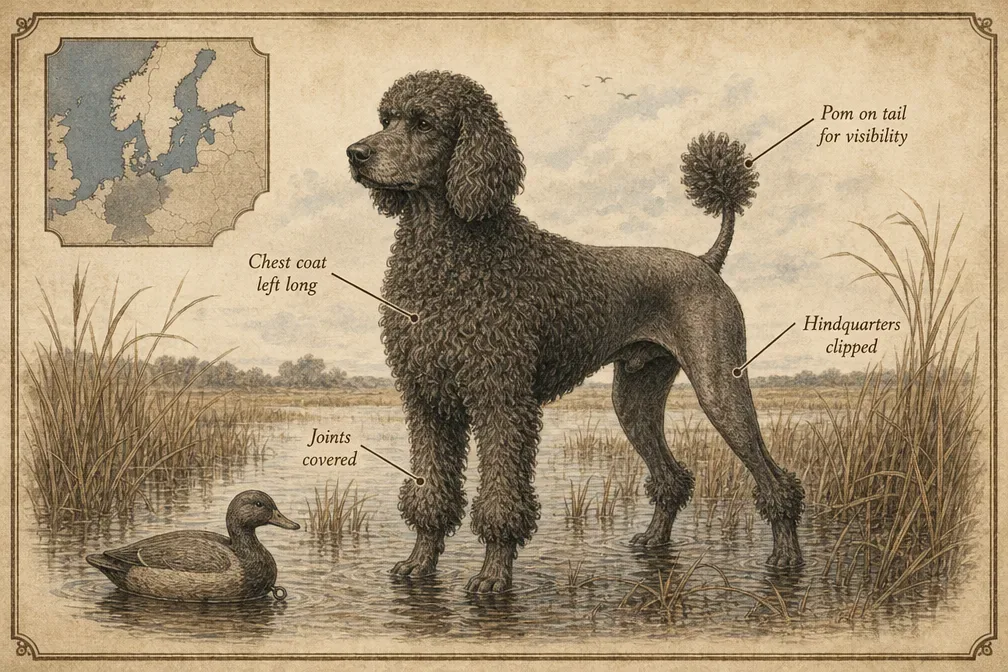
The classic clip made sense in cold water. Hunters left coat over the chest, ribcage and joints to keep vital areas and working hips warm, and shaved the rest so the dog was not dragging ten pounds of wet wool through a marsh. The pom on the tail helped a handler see the dog in reeds. Function first. Fashion arrived later and refused to leave.
Standards came first and did the retrieving. Miniatures and Toys were bred down for companionship, truffle hunting and, in the case of circus work, a genuinely large amount of applause. That history explains a lot about the modern dog: a poodle in your kitchen still wants a task, still likes water, and still assumes an audience is nearby.
What Makes the Poodle So Special (and So Cute)?
What sets the poodle apart is the combination of a working retriever’s drive with a coat that barely sheds and a brain that solves problems you would rather it did not. Few breeds offer all three.
Owners consistently mention the same things. The learning speed, first. Teach a trick on Tuesday, get it offered unprompted on Wednesday, usually while you are on a work call. The closeness, second. Poodles tend to follow you room to room, which reads as devotion until you try to shut the bathroom door. And the coat, third, because a dark sweater survives the week.
The cuteness is partly structural. Big dark eyes set in a narrow muzzle, a slightly domed head, ears that frame the face, and a coat that holds whatever shape a groomer gives it. Then there is the expression. Poodles watch you. Not vaguely. They track your hands, your keys, your shoes, and they draw conclusions. If you want more on what that watching actually means, our guide to how smart dogs really are according to brain research covers what the studies can and cannot show.
Poodle Size, Weight and Lifespan
Height at the shoulder defines the three varieties, not weight and not temperament. Weight ranges below are typical published figures rather than part of the breed standard, and males usually sit at the heavier end of each range.
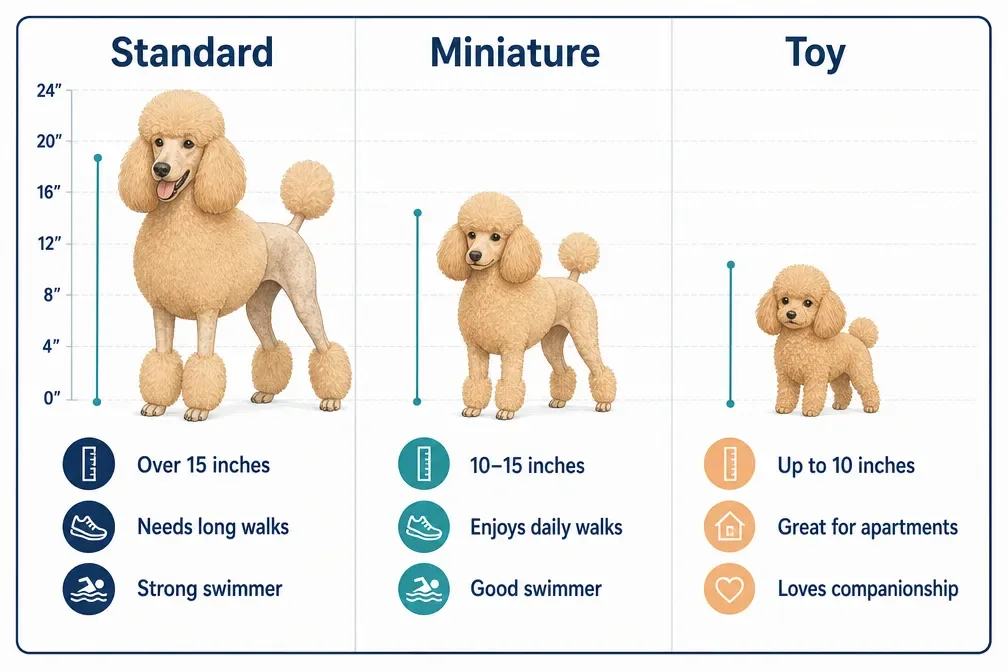
| Variety | Height (AKC standard) | Typical weight, male | Typical weight, female | Typical lifespan |
|---|---|---|---|---|
| Standard Poodle | Over 15 inches | 60 to 70 lb | 40 to 50 lb | 10 to 13 years |
| Miniature Poodle | Over 10 up to 15 inches | 10 to 15 lb | 10 to 15 lb | 12 to 15 years |
| Toy Poodle | 10 inches or under | 4 to 6 lb | 4 to 6 lb | 12 to 16 years |
A few practical notes. A Standard is a large dog with a large dog’s grooming surface area and a large dog’s food bill; if you are weighing that, our large and giant breed size guide sets expectations. A Miniature is often the sweet spot for apartments: portable, sturdy enough for real hikes, cheaper to groom than a Standard. A Toy is fragile around toddlers and prone to dental crowding.
Individual variation is real. Breeders sometimes advertise “medium” or “moyen” poodles, which is a size recognized in some European registries but not a separate AKC variety.
Which Poodle Size Fits Your Home?
All three poodle sizes share one breed standard and one very busy brain. What changes is how the dog fits your space, your budget and the people in your house.
- Standard Poodle (over 15 in, roughly 40 to 70 lb): the best match for active families with kids old enough to respect a big, bouncy dog. Plan on daily exercise, the highest grooming bills of the three, and a deep chest that makes bloat awareness part of your feeding routine.
- Miniature Poodle (10 to 15 in, roughly 10 to 15 lb): the middle ground. Small enough for apartments and travel, sturdy enough for hiking and dog sports, and a popular pick for first-time owners who still want an athletic dog.
- Toy Poodle (10 in or under, roughly 4 to 6 lb): a devoted companion for adults or quiet homes. Small bones and a small mouth mean extra care around toddlers, stairs and daily dental hygiene.
If allergies drive the choice, spend time with adult poodles of the size you want before you commit, because low shedding does not mean allergy free. Whichever size you choose, budget for professional grooming every 4 to 8 weeks or learn to clip at home.
What Is the Poodle Temperament Like?
Expect a people-oriented, highly trainable dog with a sense of humor and a short tolerance for boredom. The AKC’s breed guidance describes poodles as intelligent, adaptable, eager to listen and capable in retrieving, swimming, obedience and agility. All three sizes need stimulation, including the small ones.
Three traits catch new owners off guard.
Velcro behavior. Many poodles want physical proximity at all times. Lovely most days. Harder if your work pattern involves leaving. Build alone-time tolerance early with short, boring departures rather than emotional goodbyes, and read up on the signs of separation anxiety in dogs before it becomes a crisis.
Sass. A bored poodle does not switch off. It experiments. Owners describe dogs that learn to open bins, fake a potty request to get outside, or offer every trick they know instead of the one you asked for. That is not disobedience so much as a dog testing which behavior pays.
Sensitivity and barking. Poodles read household mood quickly and often announce visitors. Heavy-handed corrections backfire. Reward-based training works better and holds up longer.
Are Poodles Good With Kids and Other Pets?
Well-socialized poodles usually do well with children and other dogs, with size being the deciding factor. Standards tend to be the most tolerant of family chaos. Toys are too small for rough handling and can snap when frightened, which is a safety issue for the dog first.
Practical rules that work:
- Teach children to approach a resting dog, not grab one. Most bites in family homes follow a surprise.
- Give the poodle an off-limits retreat: a crate, a bed behind a gate, a quiet room.
- Supervise all toddler and Toy Poodle contact. A four-pound dog can be injured by a fall from a couch.
- Introduce cats slowly. Poodles have retriever instincts, which means interest in movement rather than aggression, but a chase is still a chase.
If you are choosing a first family dog, our roundup of family-friendly breeds for kids compares poodles against the usual contenders.
Who Is the Poodle Made For, and Who Should Skip It?
Choose a poodle if you want a trainable dog, you do not want hair on everything, you enjoy teaching things, and the grooming budget is genuinely fine. Active owners, dog-sport people, and empty nesters with time at home tend to thrive with this breed.
Think harder if you are out ten hours a day, your household is loud and unpredictable, or you want a dog who entertains itself in the yard. A poodle left alone with nothing to do invents projects. Your baseboards are a project.
Quick decision rules:
- Allergy-conscious family, active, two walks a day available: Miniature Poodle.
- Hikers, swimmers, agility or retrieving ambitions, house with space: Standard Poodle.
- Apartment, lower exercise capacity, careful adult household: Toy Poodle.
- Want the look with less grooming: consider a Bichon Frise, Portuguese Water Dog, Lagotto Romagnolo or Soft Coated Wheaten Terrier. All still need regular clipping. None of them are “wash and go.”
On doodles. A Goldendoodle or Labradoodle is a poodle crossed with another breed, not a standardized breed with a written standard. Coat type varies litter to litter, and a doodle can inherit a shedding coat, a non-shedding coat, or the one that mats fastest of all. Grooming is often harder than a purebred poodle, not easier, because a cotton-textured mixed coat tangles close to the skin. If low shedding is the goal and predictability matters, the purebred is the safer bet.
How Much Exercise Does a Poodle Need?
Plan on 60 minutes or more of daily activity for a Standard, 30 to 60 for a Miniature, and 20 to 40 for a Toy, plus mental work every single day in all three sizes. The mental half is not optional padding. It is the part that prevents barking, chewing and the 9 p.m. zoomies.
What works for this breed:
- Retrieving games. Built in. A tennis ball down a hallway beats a three-mile march for tiring a clever dog.
- Swimming. Most poodles take to water with embarrassing ease. Easy on joints for seniors.
- Scent games. Hide treats in a towel, under cups, around a room. Ten minutes of sniffing does real work.
- Trick training in short sets. Five minutes, three times a day.
- Food puzzles. A lick mat or frozen stuffed toy covers the gap when you need twenty quiet minutes.
Edge case: puppies under a year, especially Standards, should not be doing forced long-distance running. Keep exercise self-paced while growth plates close.
Poodle Grooming and Shedding
Poodle hair grows continuously instead of shedding out, so it must be cut, and the undercoat that would otherwise fall out stays in the coat and mats. That is the whole deal in two facts. The AKC lists the poodle among breeds requiring a lot of grooming, and that is accurate.
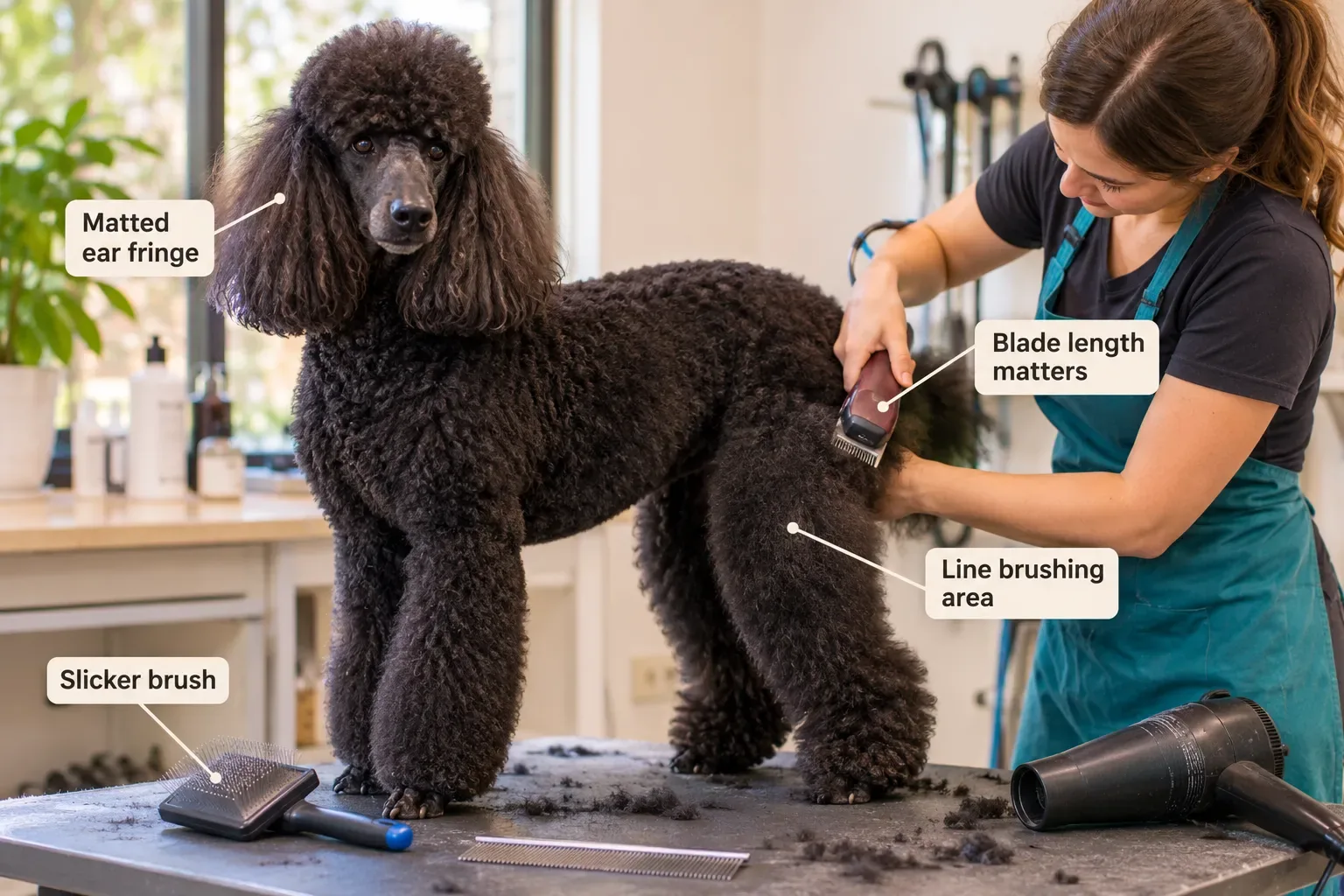
What a realistic routine looks like:
- Brush and comb to the skin every 2 to 3 days, minimum. Line brush in sections. A surface brush that misses the base of the coat creates a mat mill.
- Comb test with a metal comb afterward. If the comb does not reach skin, the brushing did not work.
- Professional groom every 4 to 8 weeks.
- Trim nails every 2 to 4 weeks. Our comparison of a dog nail grinder versus clippers covers which suits a wiggly dog.
- Check and clean ears regularly. Hair grows in poodle ear canals and moisture gets trapped.
Cost, plainly. Published 2026 U.S. estimates sit around $50 to $120 or more per visit (Zarla). Actual quotes run higher in some markets: one VCA grooming price sheet from March 2026 listed Standard Poodle grooming starting at $136.65. At six-week intervals that is roughly nine visits a year, so a Standard can realistically cost $900 to $1,400 annually, and a Toy perhaps $450 to $700.
Grooming mistakes to avoid: letting the coat go eight weeks without home brushing then asking for a fancy clip (the groomer will shave it, correctly, and charge you for dematting); bathing a matted dog, which tightens the mats into felt; skipping ear care; and clipping at home with a dull blade, which drags and burns.
Can you do it at home? Partly, yes. Face, feet and sanitary trims are learnable, and they stretch the time between full grooms. Full body scissoring is a skill. Start with our beginner’s guide to dog grooming and budget for proper clippers that handle thick coats if you go this route.
On hypoallergenic claims: poodles shed very little, which helps many allergy sufferers. Allergens also come from dander, saliva and skin oils, so no dog is allergy-proof. Spend time with adult poodles before committing.
Common Poodle Health Problems
Poodles are generally long-lived, with the main concerns differing by size. The Poodle Club of America recommends size-specific screening rather than one generic panel, which is the single most useful thing to ask a breeder about.
| Variety | PCA-recommended screening |
|---|---|
| Toy Poodle | prcd-PRA DNA test, annual eye exam by an ophthalmologist, patella evaluation |
| Miniature Poodle | Same as Toy, plus hip evaluation |
| Standard Poodle | Hip evaluation, annual eye exam, plus at least one of thyroid, sebaceous adenitis or cardiac evaluation; DNA screening including neonatal encephalopathy with seizures and von Willebrand disease |
Conditions worth knowing:
- Progressive retinal atrophy (prcd-PRA), leading to vision loss. DNA testable.
- Patellar luxation in Toys and Minis.
- Hip dysplasia in Standards.
- Sebaceous adenitis, a skin condition affecting hair follicles, more common in Standards.
- Addison’s disease and thyroid disease, both reported in Standards.
- Bloat (GDV). A Dog Aging Project analysis published December 2025 reported a lifetime prevalence of 0.23% and 1.74 cases per 1,000 dog-years across the cohort, with poodles recording the highest number of GDV events among purebreds (26 cases). Risk tracked with larger body size, male sex and low body condition. Diet type and anxiety were not significant factors in that analysis.
Emergency note, no hedging: a dog with a swollen, hard belly, unproductive retching, drooling and restlessness may have bloat. That is a call-the-vet-now situation, not a wait-and-see one. Same for breathing trouble, collapse, heatstroke signs, or sudden hind-limb weakness with pain. Call. Do not search first.
Given Standard Poodle surgery costs, this is a breed where running the pet insurance math before the first vet emergency is worth an evening.
What Do Poodles Love to Eat? Favorite Foods and Feeding
Feed a complete diet that meets AAFCO standards for your poodle’s life stage and size, and expect some negotiation. Picky eating is one of the most common complaints in poodle owner forums, and most of it is a training problem wearing a nutrition costume.
How picky eating starts: dog ignores bowl, owner panics, owner adds chicken, dog learns that waiting produces chicken. Fix it by putting food down for 15 minutes, lifting it, and offering nothing until the next meal. Healthy adult dogs do not starve themselves over one skipped meal. Sudden appetite loss in a dog who normally eats well is different and warrants a vet call.
Treats poodles tend to love:
- Small pieces of plain cooked chicken or turkey
- Carrot sticks, green beans, cucumber slices
- Blueberries and apple slices (no seeds or core)
- Plain unsweetened pumpkin puree, frozen into a lick mat
- Freeze-dried single-ingredient protein treats for training
Always off the list: grapes and raisins, onions, garlic, chocolate, macadamia nuts, xylitol (check peanut butter labels), cooked bones, alcohol, anything heavily salted.
Portion guidance: Toys typically eat around a quarter to half a cup of dry food daily, Miniatures roughly three quarters to one cup, Standards around two to three cups, split into two meals and adjusted for activity and body condition. Weigh portions instead of eyeballing them. For Standards, feeding twice daily from a floor-level bowl and skipping hard exercise around meals is sensible given bloat risk, though evidence on specific prevention measures is mixed. Our guide to reading a dog food label and what AAFCO means covers how to compare brands without marketing noise.
How to Train a Poodle
Train in short, varied sessions with reward-based methods, and keep raising the difficulty, because this breed gets bored before it gets tired. The AKC’s poodle puppy training timeline is a good framework for the first year.
What actually matters:
- Socialize hard between 8 and 16 weeks. Surfaces, sounds, people in hats, car rides, the vet’s waiting room.
- Teach grooming handling from day one. Paws, ears, muzzle, tail, standing still on a raised surface. A poodle who hates being handled makes every future groom harder and more expensive.
- Keep sessions to 5 minutes. Three short sets beat one long one.
- Change the criteria often. Same cue, new room, new distraction, longer duration.
- Build alone-time tolerance deliberately. Start at 30 seconds. Leave without ceremony.
- Skip aversive methods. Sensitive dogs shut down, and a shut-down poodle stops offering behavior, which is the trait you wanted.
If anxiety or reactivity goes past normal training, a veterinary behaviorist is the right referral, not another training app.
Try It: Poodle Grooming Planner
Poodle hair keeps growing, so grooming is a recurring bill rather than an occasional one. Pick your poodle’s size and clip style, enter your local groomer’s price, and see your realistic schedule and annual cost before you commit.
Doggy Rank IQ Tool
Poodle Grooming Planner

Poodle hair keeps growing, so grooming is a real line item. Pick your Poodle's size and clip, enter your local groomer's price and see your schedule and yearly cost.
How Much Does a Poodle Cost?
Expect roughly $1,500 to $3,500 for a well-bred poodle puppy from a health-tested breeder, with Toys and rare colors often higher and Standards from proven working or show lines at the top. Rescue adoption typically runs $150 to $500.
First-year total, realistic range: $3,500 to $6,500. That covers purchase price, vaccinations and spay or neuter, crate and gear, puppy classes, food, and six to nine grooming appointments.
Ongoing yearly cost after that: roughly $2,000 to $4,000, depending on size and region. The breakdown:
- Grooming: $450 to $1,400 (the biggest variable)
- Food: $300 to $900
- Routine vet and preventives: $400 to $800
- Insurance: $300 to $900
- Toys, replacements, boarding, training: $300 plus
Cheap puppies usually cost more later. Ask any breeder for the specific PCA-recommended test results for that size, in writing, with registry numbers.
Poodle Puppy Tips for the First 90 Days
The first three months set grooming tolerance, alone-time tolerance and house manners, and all three are easier to build than to repair.
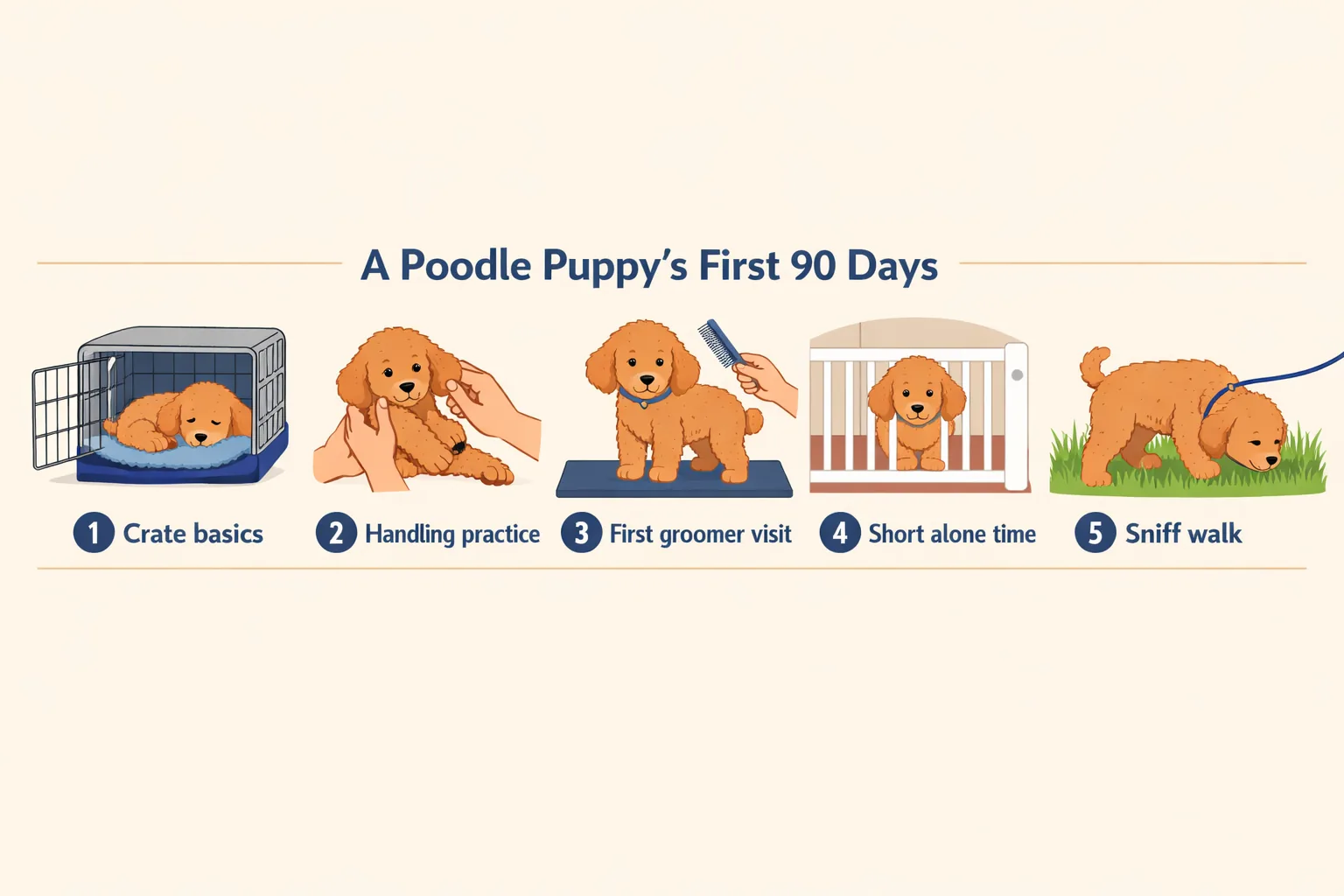
Weeks 1 to 2: Keep the world small. Crate introduction with food. Same potty spot every time. Handle paws and ears daily for ten seconds, then treat.
Weeks 3 to 6: Start socialization properly. New surfaces, car rides, umbrella sounds, people of different ages. Book a “puppy visit” at the groomer: no clipping, just a table, a dryer on low, a treat, out. That visit is worth more than any toy you buy.
Weeks 7 to 12: Introduce a real brushing routine, two minutes a day. Begin short solo periods behind a gate while you are still in the house. Add puzzle feeding so the dog learns to work for food. Book the first full groom around 16 weeks.
Common first-90-days mistake: carrying the puppy everywhere and never leaving it alone, which produces a dog who has never practiced being by itself. Practice absence while it is still boring.
What Poodle Owners Say
Owner reports fill the gaps that breed standards leave. Two from Reddit, quoted exactly.
“She is a real problem solver and learns tricks quickly.”
That comes from a first-time Toy Poodle owner on Reddit (r/poodles). Problem-solving cuts both ways. A dog who learns tricks in two sessions also learns that the bin lid lifts and that whining at 6:40 a.m. once produced breakfast. Put the brain to work on purpose: rotate three puzzle feeders, teach named toys, and run five-minute trick sets instead of waiting for the dog to pick its own hobby.
“Why do people discourage a poodle?”
That question was posted on Reddit (r/StandardPoodles). The honest answer is usually grooming and attention needs, not temperament. People who regret a poodle tend to be people who underestimated the brushing or the velcro behavior. Before buying, price three local groomers, book a trial brush-out with an adult poodle if a breeder will allow it, and be realistic about how many hours the dog will be alone.
Poodle FAQ
Do poodles shed? Very little. Poodle hair grows continuously rather than falling out, so loose hair stays in the coat. That means less hair on furniture and more brushing to prevent mats.
Are poodles truly hypoallergenic? No dog is. Poodles are low-shedding, which helps many allergy sufferers, but allergens also come from dander and saliva. Spend extended time with adult poodles before deciding.
How often does a poodle need professional grooming? Every 4 to 8 weeks for most clips, plus brushing to the skin every 2 to 3 days at home. Longer styles need more frequent visits, not fewer.
Are poodles good for first-time dog owners? Yes, with conditions. They are trainable and willing, which helps beginners, but the grooming commitment and need for mental work are real. A Miniature often suits a first-time owner better than a Standard.
Which poodle size is best for apartments? Miniature or Toy, with daily walks and indoor enrichment. Standards can live in apartments too, but they need genuine daily exercise and take up a lot of hallway.
Poodle versus Goldendoodle, what is the difference? A Goldendoodle is a poodle crossed with a Golden Retriever, so coat type, size and temperament vary within a litter. A purebred poodle gives you predictable coat and a written breed standard. Doodle coats often mat more, not less.
How long do poodles live? Typically 10 to 13 years for Standards and 12 to 16 for Miniatures and Toys, with dental care, weight control and screening affecting the outcome.
What should I ask a poodle breeder? Ask for the Poodle Club of America recommended tests for that specific size, with results you can look up, plus the chance to meet the dam and see where puppies are raised.