
Quick Answer
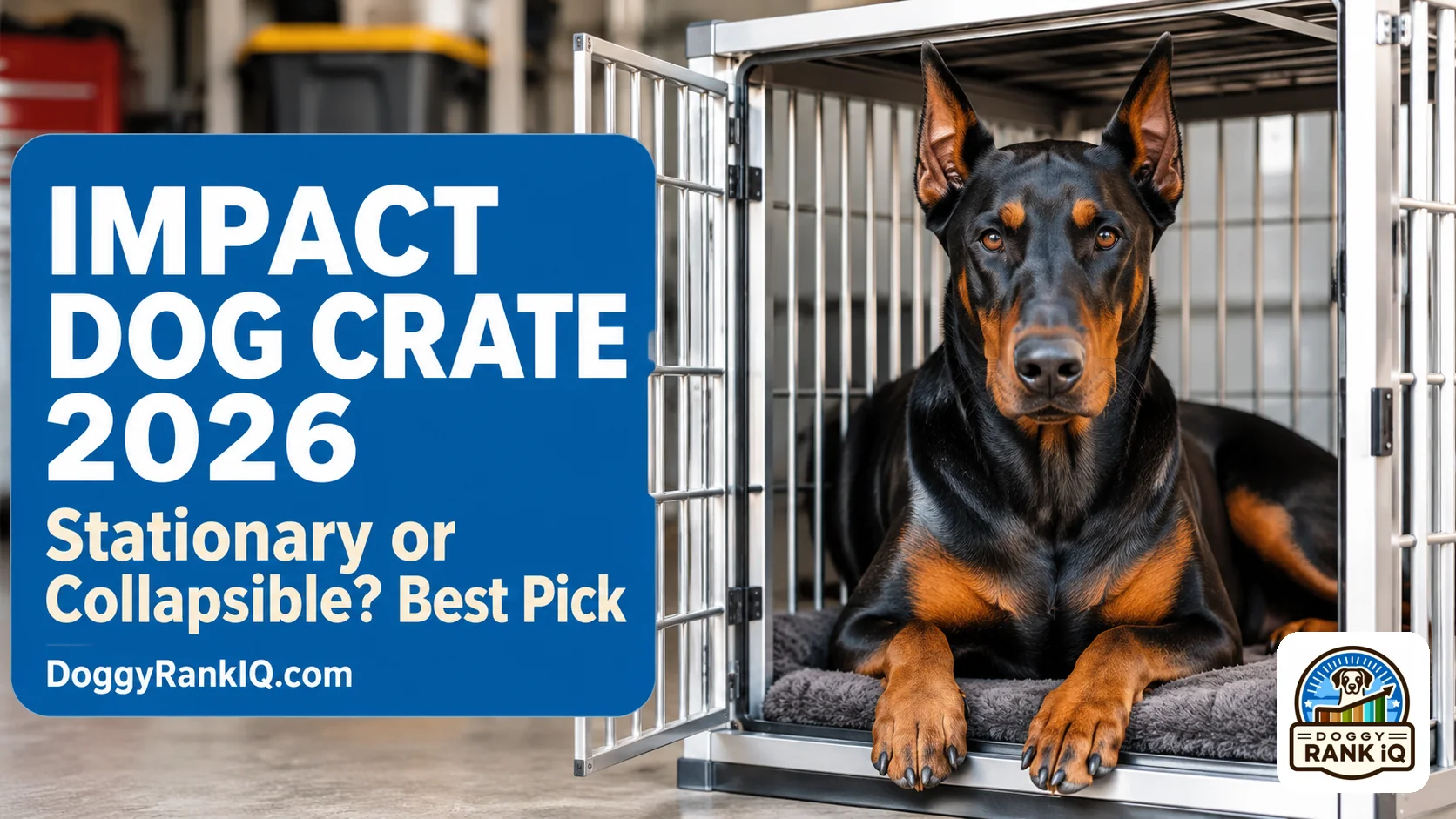
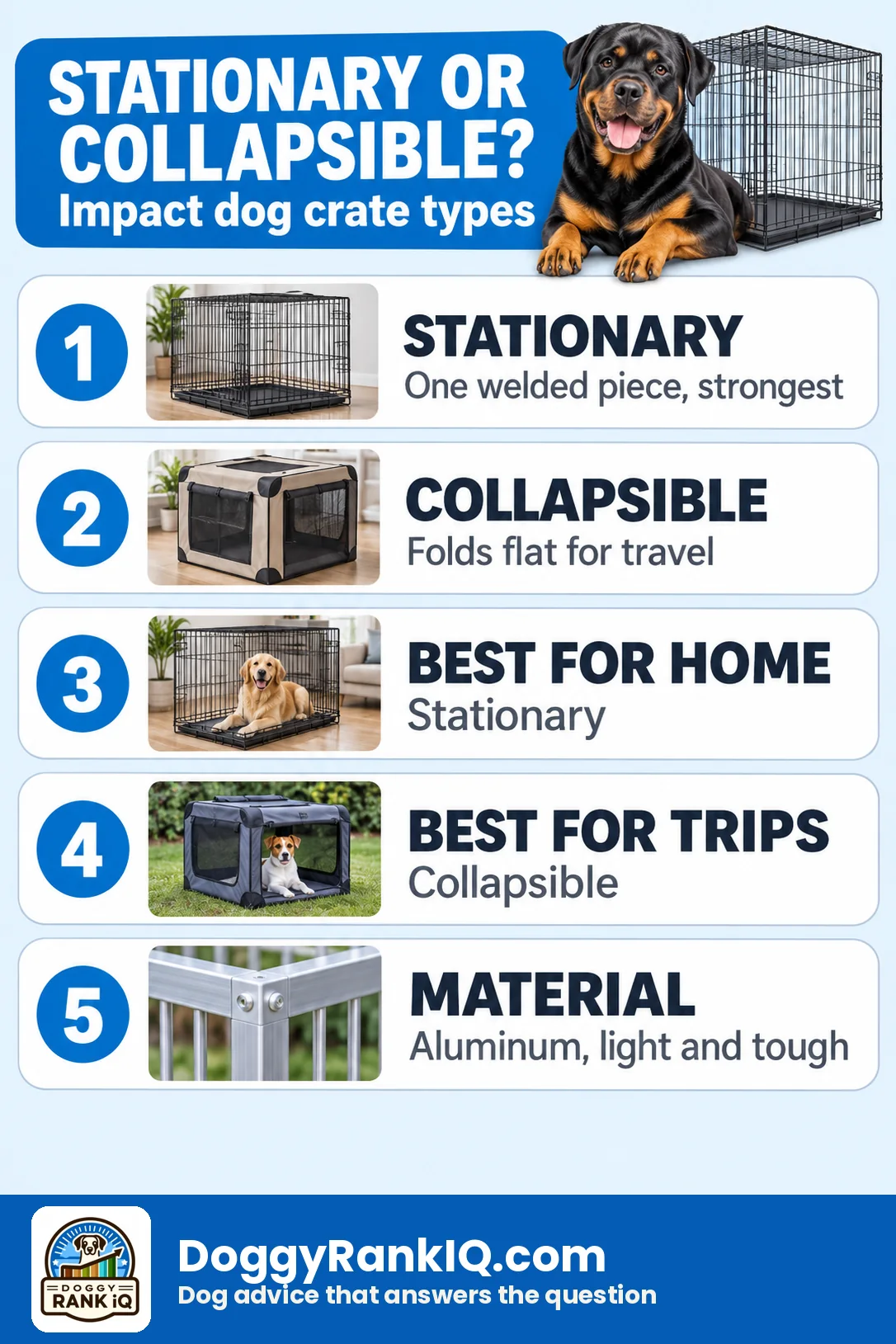
An impact dog crate comes in two builds: Stationary, which bolts together into a fixed aluminum box, and Collapsible, which folds flat like a suitcase. The Stationary suits dogs who need the strongest possible enclosure and a crate that never moves once assembled. The Collapsible suits owners who travel, move apartments, or need to store the crate flat between trips. Neither is officially rated escape-proof, and both cost far more than a wire crate, usually $590 to $860 depending on size.
Key Takeaways: impact dog crate
- An impact dog crate is a heavy aluminum crate built for dogs who bend, chew, or pry open standard wire crates.
- The Stationary model bolts together permanently. The Collapsible model folds flat and now ships with eight stationary screws for a steadier setup.
- Prices run from about $592.80 for a small Collapsible to $857.22 for the XXL Stationary.
- Neither crate is marketed as 100% escape-proof. Impact directs serious escape risks toward its separate High Anxiety model.
- Collapsible assembly is faster for one person. Stationary assembly often needs two sets of hands and more patience.
- An independent review found quality control issues on one tested Stationary unit, including bent panels and loosening bolts.
- An impact dog crate is not a guaranteed fix for destructive chewing or severe separation anxiety. It is a tougher container, not a training replacement.
- Rental and trial options exist, starting around $49 a month, if buyers want to test an impact dog crate before committing to the full price.

How will you use the crate?
Check the current price
Check the current price
Tap an option to see the answer.
 What is an impact dog crate?
 What is an impact dog crate?
An impact dog crate is a travel and containment crate built from welded or bolted aluminum panels, designed for dogs that can bend, chew, or work loose a standard wire or plastic crate. The name comes from the brand Impact Dog Crates, which makes both the Stationary and Collapsible lines reviewed here.
Think of it as the step above a wire crate and below a true vehicle-crash-rated crate. It’s heavier, costs more, and is built to survive paws, teeth, and body weight that would warp thinner metal. Impact’s own crate comparison page lays out the differences between its Stationary, Collapsible, and Airline models side by side, which is worth a look before you commit to one line.
What makes an Impact dog crate different from a wire crate?
An Impact crate is built from welded or bolted aluminum panels instead of thin wire bars, which is why it resists bending, chewing, and prying far better than a standard crate. The material itself is the whole pitch. Wire crates flex under pressure from a determined 70-pound dog. Aluminum mostly does not.
That difference matters most for:
- Dogs who have already bent or escaped a wire crate
- Owners who crate a dog in a vehicle during travel
- Dogs recovering from surgery who need a crate that cannot be pawed open mid-healing
An Impact crate is heavier, pricier, and overbuilt for a dog who naps quietly through thunderstorms. That dog does not need $700 of aluminum. A dog who has already turned a wire crate door into modern art might.
Choose an Impact crate if your dog has a documented history of bending metal, slipping latches, or working a crate door loose. Skip it if your dog has never tested a standard crate’s limits. GearJunkie’s review of Impact crates describes the aluminum panels as noticeably stiffer under hand pressure than a typical wire crate, which lines up with why owners of strong chewers reach for this category in the first place.
Impact dog crate vs regular crate: what actually changes
The core difference is material and rigidity, not features. A regular wire or plastic crate relies on thin bars or molded plastic that can bend, crack, or pop a latch under repeated pressure. An Impact crate uses thicker aluminum panels and heavier hardware, so the same pressure that bends a wire crate door barely dents an aluminum one.
That doesn’t mean a regular crate is a bad choice for most dogs. Most dogs never test the limits of a $100 wire crate in their entire lives. The upgrade to an Impact crate makes sense only once a dog has shown a pattern of escape attempts, not as a precaution for a calm dog. Weight is another practical difference: a regular wire crate in the 30 inch range might weigh 15 to 20 pounds, while a comparable Impact crate can run closer to 30 pounds or more, which affects how easily one person can move it in and out of a vehicle.
Stationary vs Collapsible at a glance
Both lines share the same aluminum build quality. The difference is mostly logistics: does the crate need to travel, or does it need to disappear into a permanent spot and never budge.
| Model | Dimensions | Weight | Price (checked 2026) |
|---|---|---|---|
| [Collapsible 24″](https://www.amazon.com/dp/B0H92PY6L9?tag=coffeerank-20) | 24″ class, compact | ~23.25 lb | $592.80 |
| [Collapsible 30″](https://www.amazon.com/dp/B0CV64FPB5?tag=coffeerank-20) | 30.5 x 20.5 x 26 in | ~28.5 lb | $631.80 |
| [Collapsible 34″](https://www.amazon.com/dp/B0CV63BQBG?tag=coffeerank-20) | 34″ class, medium-large | ~32-35 lb | $670.80 |
| [Stationary 40″ Large](https://www.amazon.com/dp/B0CTJ25YLS?tag=coffeerank-20) | 40.5 x 23 x 29 in | ~38 lb | $780.00 |
| [Stationary 48″ XXL](https://www.amazon.com/dp/B0CTHZ8VNQ?tag=coffeerank-20) | 48″ class, extra-extra-large | ~50+ lb | $857.22 |
Dog Gear Review’s 2026 head-to-head found the Stationary Medium around $900 against roughly $980 for a comparable Collapsible, an $80 gap in the Collapsible’s favor, while the Collapsible also wins on storage and transport (Dog Gear Review, Impact Stationary Dog Crate Review). Pricing and promotions change often, so compare the dimensions and warranty from the manufacturer’s pages before buying.
How much does an impact dog crate cost?
An Impact crate typically costs between $590 and $860, depending on the size and whether you pick the Collapsible or Stationary line. Small Collapsible crates sit near the bottom of that range, while the XXL Stationary model, built for giant breeds, runs closest to the top.
For comparison, a standard wire crate in a similar size might cost $60 to $150, so an Impact crate usually runs four to six times more. That gap is the main reason this category makes sense only for dogs who have a documented history of escaping or damaging cheaper crates, not as a default first purchase. Budget-conscious owners can also look at rental programs, which start around $49 a month and let a dog try the crate before the owner commits to the full retail price.
Best impact dog crate for large dogs
For large and giant breeds, the Stationary 48″ XXL and the Stationary 40″ Large are the two sizes built to hold weight and body length without flexing. A dog in the 90 to 150 pound range, think Mastiffs, Great Danes, or large Shepherd mixes, generally needs the 40″ or 48″ option rather than anything in the 24 to 34 inch Collapsible range.
Large dogs put more sustained pressure on panels and latches simply from their size and strength, so the thicker gauge aluminum and bolted construction of the Stationary line tends to hold up better long term in a fixed spot like a mudroom or garage. If the dog also travels frequently, the Collapsible 34″ can work for medium-large breeds, but check the weight rating against your specific dog before assuming it fits. Always measure the dog’s shoulder height and body length first, since “large dog” covers a wide range of actual dimensions.
Are impact dog crates safe for dogs?
An Impact crate is generally considered safe for everyday containment, but it is not rated as escape-proof and is not automatically certified for vehicle crash protection. Safety depends on correct sizing, proper assembly, and realistic expectations about what the crate can and cannot prevent.
Impact’s own FAQ for the Stationary line states plainly that the crate is strong but not escape-proof, and notes that its roughly 0.817 inch ventilation holes may still give a determined dog a tooth or paw grip (Impact Dog Crates, Stationary Aluminum Dog Crate). For vehicle travel specifically, independent crash testing from the Center for Pet Safety has shown that many crates marketed as heavy-duty still fail under crash conditions, and the organization’s cargo area advisory recommends checking for actual certification rather than assuming weight or material alone guarantees safety. If vehicle safety is the main concern, look for models on the CPS Certified list rather than relying on marketing language.
When do you need an impact dog crate?
You need an Impact crate when a dog has already damaged, bent, or escaped a standard wire or plastic crate, not before. Buying one preemptively for a dog that has never tested a cheaper crate usually wastes money that could go toward training or enrichment instead.
Common situations where an Impact crate makes sense:
- A dog has bent wire bars, popped a latch, or chewed through a plastic crate door more than once.
- A dog needs confinement in a vehicle and a standard crate has already shown signs of flexing during travel.
- A dog is recovering from surgery and a family member worries a wire crate door could be pawed open mid-recovery.
- A dog has a bite history or strength level that makes a thin crate a genuine containment risk for itself or others.
If none of those apply, a reinforced wire crate is almost always the more sensible purchase.
How to pick the right size
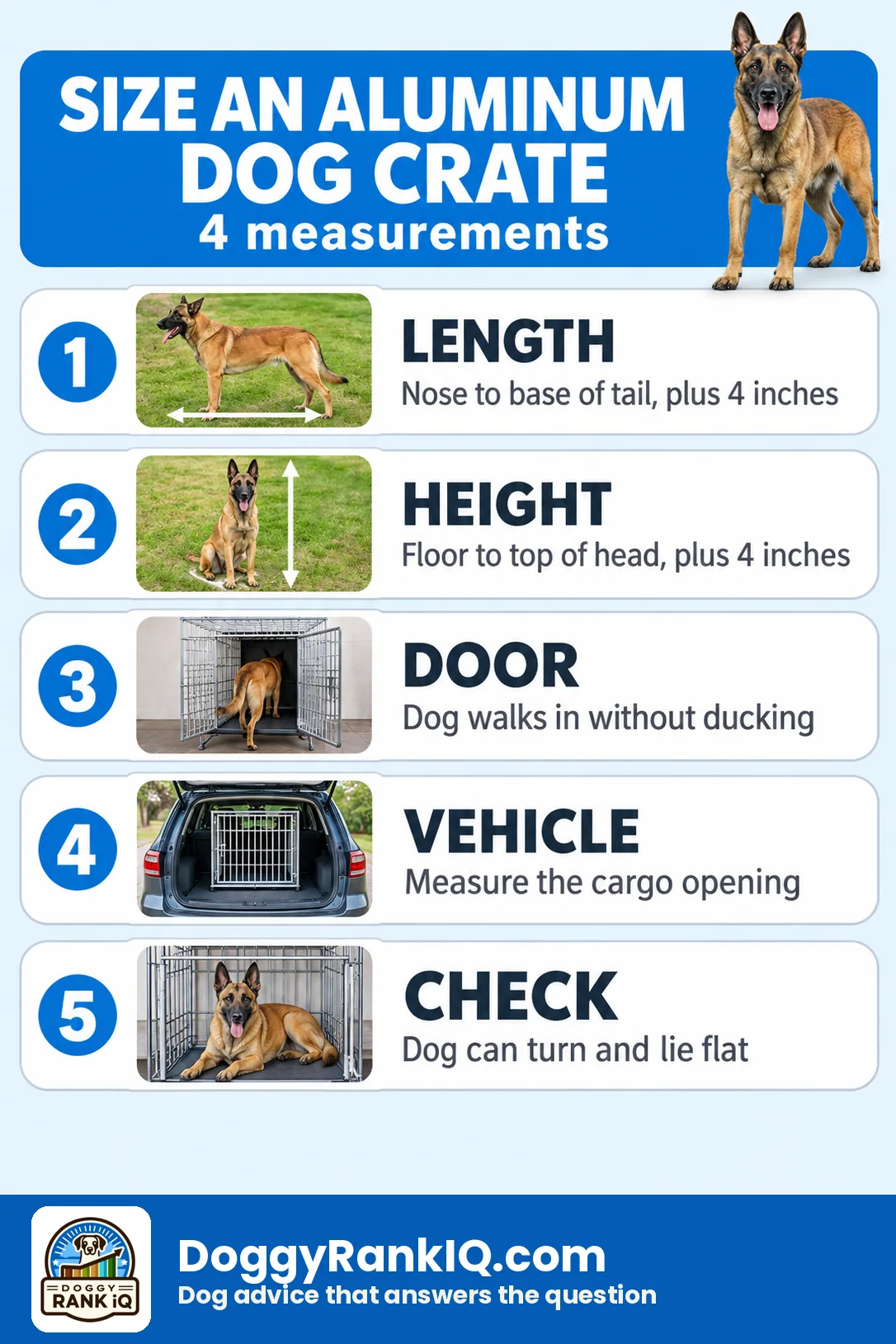
Measure your dog standing and lying down before picking a size, since an Impact crate that’s too small defeats the purpose of buying a crate built to last. Add 3 to 4 inches to your dog’s length and height for comfortable turning room.
Then measure your car.
A crate that fits the dog but not the trunk is a crate that stays in the garage. Check the cargo opening width, not just the cargo floor length. Impact’s current Collapsible range runs about 24 to 54 inches and 23.25 to 70 pounds, so there’s room between “barely fits a beagle” and “built for a mastiff” (Impact Dog Crates, Collapsible Aluminum Dog Crate).
Check the dimensions twice. (Yes, including the car’s back door clearance.) A crate that’s two inches too wide for your trunk door is still too wide, no matter how good the aluminum is.
If you need a soft surface inside once the aluminum box is set up, our best dog crate pad guide covers floor fit, seams, and wash care for exactly this use case.
Impact dog crate sizes and weight limits
Impact’s lineup spans roughly 24 inches to 54 inches across the Collapsible line, with the Stationary line topping out around 48 to 54 inches for giant breeds, and listed weight capacities running from about 23 pounds up to 70 pounds or more depending on the exact model (Impact Dog Crates, Collapsible Aluminum Dog Crate). Weight capacity on the product page usually refers to the crate’s own hardware limits, not a guarantee of comfort for a dog near that upper limit.
As a rule of thumb, a dog should be able to stand fully upright, turn around in a full circle, and lie flat with legs extended inside the crate. If a dog is near the top of a size class’s listed weight range, sizing up one tier usually gives more usable room and reduces stress on the latches over time.
Setup: what folding and unfolding involves
Collapsible setup is closer to opening a large suitcase: unfold the panels, lock the latches, and the crate is upright in a few minutes for one person. Stationary setup is a genuine assembly project, with bolts, panels, and a door that needs squaring up before anything latches properly.
The independent Dog Gear Review test documented a two-person job for the Stationary model: one person holding the bolt head steady while another tightened the acorn nut from inside the crate (Dog Gear Review, Impact Stationary Dog Crate Review). That’s not a weekend project killer, but it’s not a solo Saturday morning task either. Impact offers factory assembly for an extra charge if that sounds like a better use of your afternoon.
The Collapsible line was updated in early 2026 with built-in stationary brackets and eight stationary screws, aimed at reducing the rattle and shift that folding crates sometimes develop over time (Impact Dog Crates, Collapsible Aluminum Dog Crate).
Common mistake: skipping the post-assembly bolt check. The same independent review found bolts loosening within the first weeks of regular use on the tested unit, so a monthly tightening pass is worth the five minutes.
How to get your dog used to an impact crate
Introducing a dog to an Impact crate works the same way as introducing any new crate: slowly, with positive associations, and without forcing the door shut on day one. Rushing this step is the most common reason dogs resist a new crate, aluminum or otherwise.
A simple approach:
- Set the crate up with the door propped open and let the dog investigate on its own for a few days.
- Feed meals near the crate, then gradually move the bowl just inside the doorway.
- Toss treats inside and let the dog walk in and out freely, without closing the door.
- Once the dog enters calmly, close the door for a few seconds while you’re in the room, then open it before the dog shows stress.
- Extend the closed-door time gradually over one to two weeks, always pairing the crate with something the dog likes, such as a stuffed chew.
Dogs new to crates in general do better starting with routine and comfort before upgrading hardware. Our guide on puppy crying in crate at night covers the early adjustment period that applies regardless of crate material.
Impact dog crate training tips
Training a dog to settle in an Impact crate relies on the same basics as any crate training, with a bit more patience because the crate’s size and weight make it harder to move around during the adjustment period. Keep sessions short, consistent, and low pressure.
Practical tips:
- Place the crate in a part of the house where the dog already spends time, not an isolated room.
- Avoid using the crate as punishment; it should be a neutral or positive space.
- Use a consistent cue word, like “crate” or “kennel,” every time the dog enters.
- Start with door-open sessions during the day before trying any overnight closed-door time.
- Pair a lick mat or stuffed chew with crate time to build a calmer association, especially useful for dogs who were pushed into an Impact crate after already struggling with a wire crate.
Can puppies use impact dog crates?
Puppies generally do not need an Impact crate, since the behaviors that justify the upgrade, like bending bars or breaking latches, are rare before a dog has adult strength and teeth. A standard wire or plastic crate sized correctly for a growing puppy is almost always the more practical and affordable choice.
An exception might be a large-breed puppy with a known family history of destructive chewing, where a parent dog has already destroyed multiple crates. Even then, many owners find a reinforced wire crate with secure clips handles a puppy’s chewing phase without the expense of an Impact crate, saving the upgrade for if problems persist into adulthood.
Impact dog crate for aggressive dogs
An Impact crate can offer sturdier containment for a dog with a bite history or aggression toward other dogs during transport or confinement, but it should not be treated as a stand-alone solution for aggression. Impact also markets a separate High Anxiety model specifically aimed at dogs who pose a more serious containment risk (Impact Dog Crates, High Anxiety Crate).
For a dog with aggression concerns, the crate is one part of a larger management plan that should also include a veterinary behaviorist or certified trainer. A crate, however strong, does not address the underlying cause of aggression, and relying on hardware alone can create a false sense of security.
⭐ Top 5 Features We Love
- Aluminum panel construction. Resists bending and chewing far better than wire, which is the entire reason owners pay the premium.
- The new Collapsible stationary screws. Eight screws added in the 2026 update cut down on wobble when the crate stays in one spot.
- 30-day trial window. Impact’s current page lists a 30-day trial, which takes some of the risk out of a $600-plus purchase.
- Flat storage on the Collapsible line. Folds down for closets, trunks, and apartment storage between trips.
- Lifetime defect warranty. Covers manufacturing defects, which matters for a product meant to last years, not seasons.
⚠️ Things to Look Out For
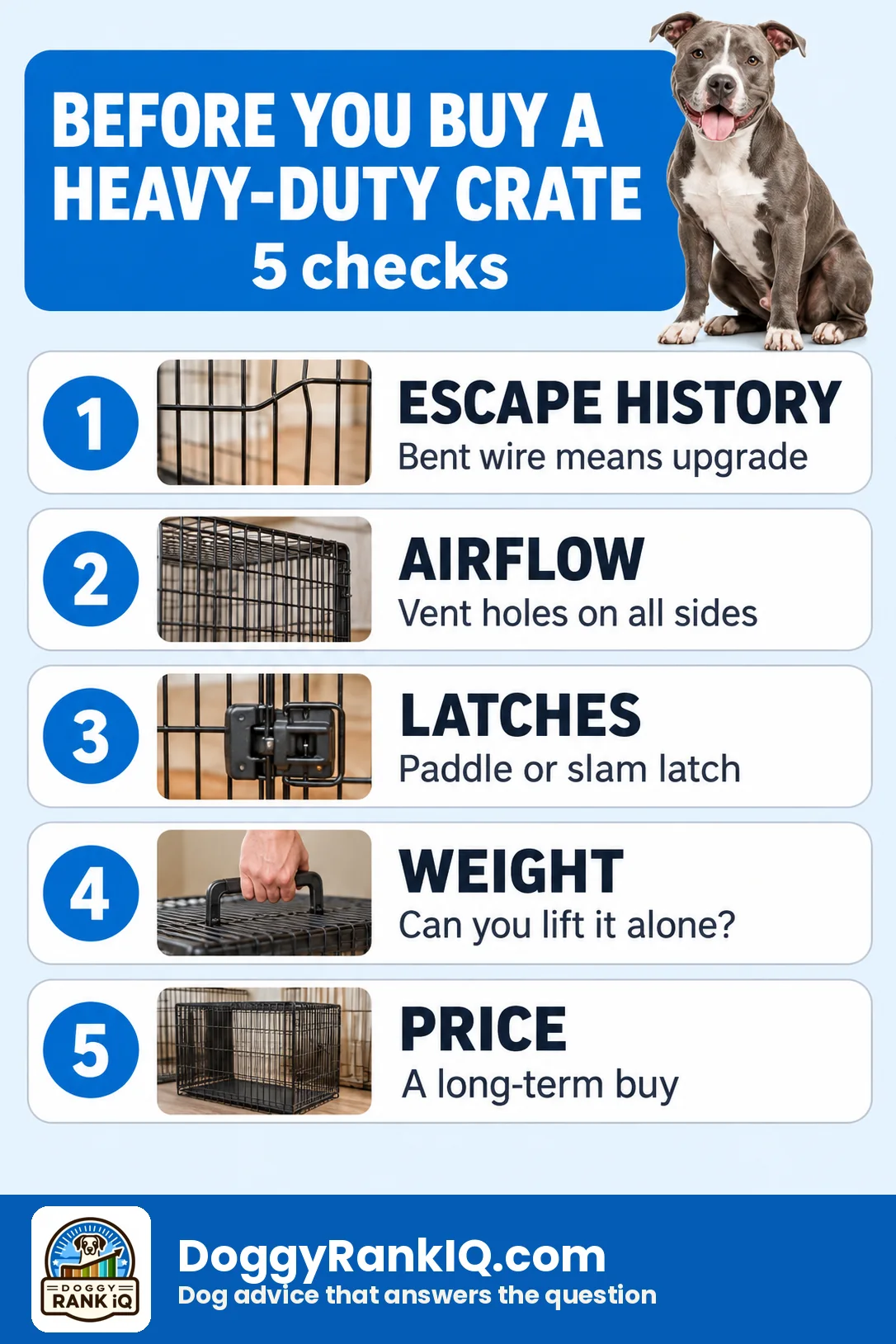
- Neither crate is advertised as escape-proof. Impact’s own FAQ says the Stationary is strong but not escape-proof, and notes that 0.817-inch ventilation holes may give a determined dog a tooth or paw grip (Impact Dog Crates, Stationary Aluminum Dog Crate).
- Airline-approval language has softened. Impact’s current FAQ says it no longer advertises the standard Collapsible as airline-approved, despite past traveler reports of success. Confirm requirements directly with your airline before booking a flight (IATA, Traveler’s Pet Corner). Impact does sell a dedicated Airline Dog Crate built to a different spec if flying is a regular need.
- Quality control can vary by unit. One independently tested Stationary crate arrived with a bent side panel and misaligned holes. This appears to be a unit-specific issue rather than proof every crate ships this way, but it’s worth an inspection the day it arrives.
- Price range is wide and promotion-dependent. Impact currently lists sale pricing alongside a higher regular price, so confirm the exact configuration and size before checkout.
- Not a behavior fix. A crate this sturdy will not resolve separation anxiety or destructive chewing on its own. It contains the behavior. It doesn’t treat it.
Do impact dog crates reduce anxiety?
An Impact crate does not reduce anxiety on its own. It only contains a dog more securely, which can reduce the owner’s worry about escape but does nothing to address the dog’s internal stress response. In some cases, a very rigid, unfamiliar crate can actually increase short-term stress if introduced too quickly.
If a dog’s crate struggles come from anxiety rather than a physical ability to escape, the better first step is usually behavioral work, not a hardware upgrade. Our guide on separation anxiety in dogs covers signs that point to anxiety rather than an escape habit, which is worth reading before spending $600 or more on an Impact crate that won’t solve the actual problem.
Who should buy the Stationary, who should buy the Collapsible, who should skip both
Buy the Stationary if the crate will live in one permanent spot, like a mudroom or a bedroom corner, and portability isn’t a priority. Buy the Collapsible if you travel with your dog, move apartments, or need to store the crate flat when it’s not in use. Skip both if your dog has never challenged a standard wire crate, since an Impact crate solves a problem your dog may not actually have.
- Choose Stationary if: the dog is large, strong, and the crate stays put; you want maximum rigidity and don’t mind a longer setup.
- Choose Collapsible if: you need to pack the crate for a move, a road trip, or seasonal storage; you want a faster solo setup.
- Choose neither if: your dog is calm in a standard crate, your budget tops out well under $500, or your dog’s real issue is anxiety rather than escape attempts, in which case training support and enrichment matter more than aluminum thickness.
Common mistakes people make with impact crates
The most common mistake is buying an Impact crate before trying a cheaper reinforced option, which means spending $600 or more to solve a problem that a $150 secured wire crate might have handled. Other recurring mistakes include skipping the bolt check after assembly, assuming the crate is airline-approved without confirming with the airline, and buying a size based on the dog’s breed name rather than actual measurements.
A few more worth flagging:
- Not measuring the car’s cargo door width before buying a Collapsible for travel.
- Assuming “impact” in the name means certified crash protection, when that claim should come from independent testing like the Center for Pet Safety’s crash test results, not the product name alone.
- Leaving a dog in a brand-new crate for a full day on the first try, instead of building up gradually.
- Ignoring loose bolts or rattling panels for months, which the Dog Gear Review test flagged as a real issue on at least one Stationary unit.
Cheaper alternatives worth a look
A heavy-duty wire crate with added security clips covers most dogs who chew or paw at latches without the four-figure aluminum price tag. For dogs with genuine anxiety rather than an escape habit, the fix is often behavioral, not structural.
Consider:
- A reinforced wire crate with carabiner-style clips on every latch point, often under $200.
- A lick mat paired with crate time to build a calmer association before upgrading hardware.
- A slow feeder used as a pre-crate routine to settle a dog before the door closes.
- Working with a trainer on separation anxiety if the dog’s crate struggles are rooted in distress rather than a desire to roam.
A $700 crate won’t out-engineer genuine panic. Check with your veterinarian before assuming any crate, however strong, is the right first step for a dog showing signs of severe anxiety.
Best alternatives to impact dog crates
Beyond reinforced wire crates, a few other options cover specific needs that an Impact crate also addresses, often at a lower cost. For vehicle travel, an airline-approved dog carrier sized for the dog can be a better fit for flights, since Impact’s standard Collapsible is no longer marketed as airline-approved. For owners mainly worried about crash protection in a car, checking the Center for Pet Safety’s certified product list points toward crates specifically tested for that purpose, which is a different standard than general chew and bend resistance.
For dogs that mostly need mental stimulation to settle down rather than a tougher box, puzzle toys used before crate time can reduce the restless energy that often drives escape attempts in the first place.
FAQ
The bottom line
An Impact crate earns its price through aluminum that doesn’t bend the way wire does, not through any promise of total escape prevention. Pick Stationary for a crate that never moves once built, pick Collapsible for one that travels and folds flat, and skip both if your dog has never actually tested a cheaper crate’s limits. Compare the options, check the dimensions against your car and your doorway, and confirm the current price before checkout since promotions shift often.
Doggy Rank IQ is reader supported. As an Amazon Associate we earn from qualifying purchases, at no extra cost to you.