
Quick Answer
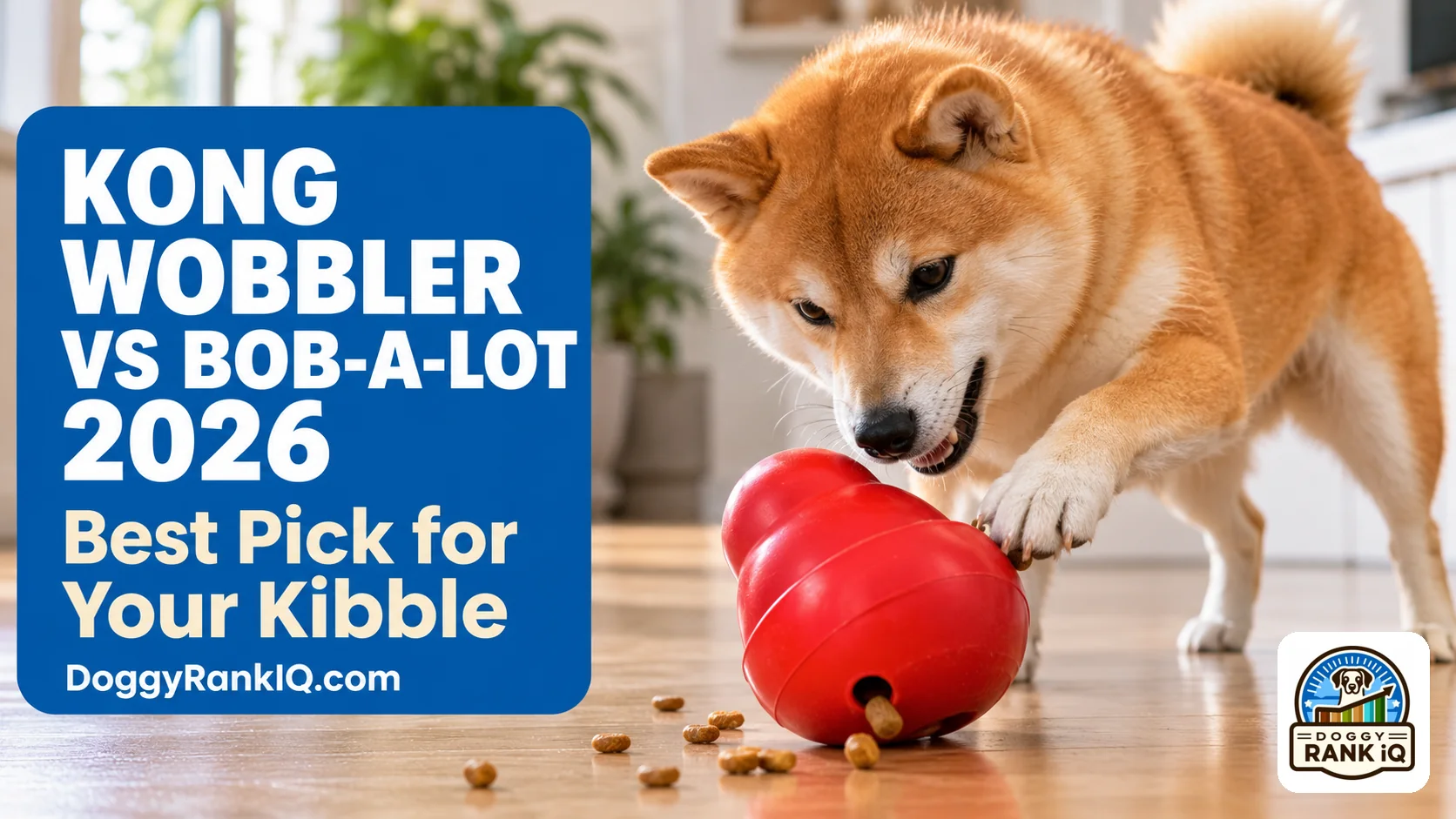
A kong wobbler suits dogs new to food puzzles, nervous eaters, and owners who want a simple toy that unscrews for cleaning. The Starmark Bob-A-Lot suits dogs who get bored fast, because its adjustable openings let you raise the difficulty as your dog gets better at it. Both hold roughly a cup or more of dry kibble, both wobble and roll on hard floors, and both cost under $25. The right pick depends on your dog’s patience level more than its size.
Key Takeaways: kong wobbler
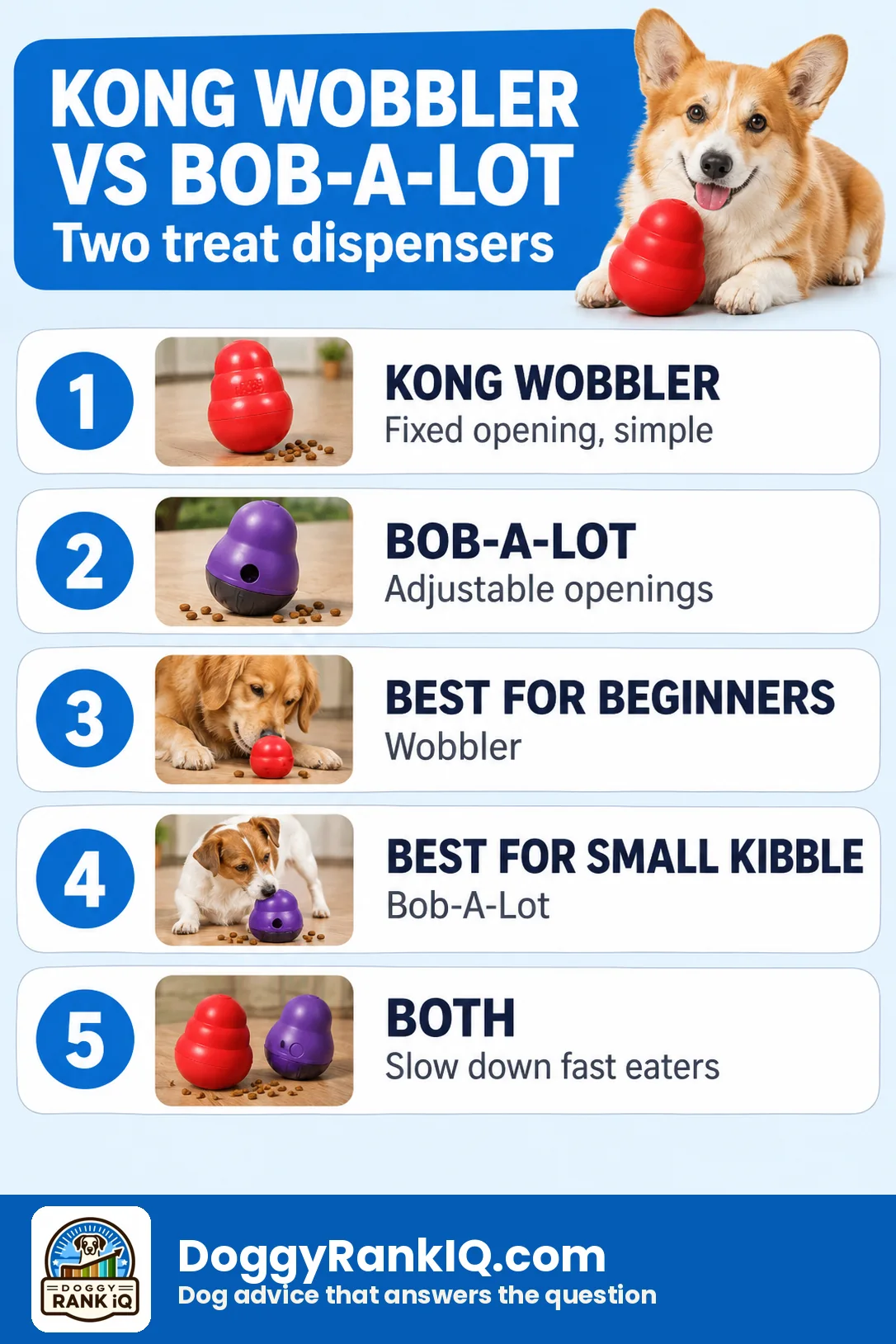
- The Wobbler has one fixed opening and unscrews into two pieces, which makes it dishwasher safe and simple to fill, according to KONG Company.
- The Starmark Bob-A-Lot has an adjustable opening on top and bottom, so owners can control how fast kibble falls out.
- KONG recommends the small Wobbler for dogs up to 20 lb and the large for roughly 30 to 65 lb, per KONG’s official product page.
- KONG’s fill instruction caps each Wobbler load at about 1 cup of kibble, while Bob-A-Lot capacity is commonly listed near 1.5 cups small and 3 cups large by retailers.
- A review from Pet Science Review notes that dogs tend to get faster at emptying the Wobbler with repeated use, which matches the general pattern of dogs mastering single-mechanism puzzles.
- Rover’s comparative review named the Bob-A-Lot “Best Overall” and the Wobbler “Best for Beginners.”
- Both toys are manufactured in China, so neither brand’s reputation guarantees domestic manufacturing.
- Owner reviews on Chewy mention chewed tops, kibble jamming near the opening, and noise on hard floors, so plan to supervise the first few sessions.

What kibble do you feed?
Check the current price
Tap an option to see the answer.
 How the KONG Wobbler and Bob-A-Lot work
 How the KONG Wobbler and Bob-A-Lot work
Both toys work the same basic way: load dry kibble inside a weighted, bottom-heavy shell, and the dog has to nose or paw the toy around until kibble falls out through an opening. Neither toy requires batteries or an app. The difference lies in how much control the owner has over the opening.
The Wobbler is a two-piece capsule that unscrews at the middle. You twist it open, drop in kibble, twist it shut, and set it down. There’s one fixed-size opening near the top. KONG states the body is made from a dense base material and polypropylene shell, which gives it the weight to wobble instead of rolling away flat, according to KONG’s product description. That weighting is also why the toy tends to self-right after a push, similar to a weeble.
The Starmark Bob-A-Lot works on the same wobble principle, but Starmark built in an adjustable dial on both the top and bottom chambers. Turning the dial widens or narrows the opening, which changes how much kibble spills per nudge. A wide-open setting works for a dog on day one. A narrower setting makes a dog work harder once the easy version gets boring.
Neither design is meant to be chewed directly, and neither manufacturer markets these as chew toys. KONG specifically instructs supervision and tells owners to stop use if the toy becomes damaged, per KONG’s FAQ page. If your dog treats toys as something to destroy rather than solve, check our guide to chew toys for aggressive chewers before buying either feeder.
What does a kong wobbler do?
A Wobbler is a weighted, egg-shaped food puzzle that dispenses dry kibble or small treats as a dog pushes, noses, or paws it around the floor. It turns a fast two-minute bowl meal into a 10- to 20-minute activity, which slows down gulping and gives a bored dog something to work on.
The bottom-heavy design means the toy wobbles and rights itself instead of rolling flat like a ball, so it stays in play longer without sliding under furniture. This also means it makes noise on hard flooring, which some owners don’t expect the first time they fill it. Dogs that eat too fast, pace before meals, or get anxious during the owner’s cooking routine are good candidates for this kind of feeder, since it gives them a job instead of just waiting.
How do you fill a kong wobbler?
Filling a Wobbler takes about 30 seconds: unscrew the two halves at the middle seam, pour in up to about 1 cup of dry kibble (per KONG’s fill guidance), screw the halves back together, and set the toy upright on the floor.
A few practical tips make this easier:
- Measure kibble by your dog’s regular meal portion first, then split it between the Wobbler and a bowl if the full amount doesn’t fit comfortably.
- Avoid overfilling. A toy packed to the brim won’t let kibble shift and fall, which frustrates the dog instead of rewarding effort.
- Mix in a few smaller, odd-shaped treats sparingly. Treats that are too big can jam right at the opening.
- Check the opening for leftover kibble dust before refilling, since buildup can affect flow over several meals.
What size kong wobbler should I get for my dog?
Choose the small Wobbler for dogs up to about 20 lb and the large size for dogs in the roughly 30 to 65 lb range, based on KONG’s sizing guidance. Dogs that fall between these weights, or that eat unusually large or small kibble for their size, should match the opening to the kibble first and the dog’s weight second.
A 15-pound dog eating standard small-breed kibble fits the small Wobbler easily. But a 15-pound dog eating large-breed kibble (which does happen in mixed-dog households that share one food) may need the larger opening even though the body size matches a smaller dog. When in doubt, pour a handful of your dog’s actual kibble through the display model’s opening at the store, or check the listed opening diameter against your kibble bag before ordering.
Opening size and which kibble fits
The opening size decides whether your dog’s actual kibble pieces will fall out at a usable rate, so check this before ordering either toy, not after.
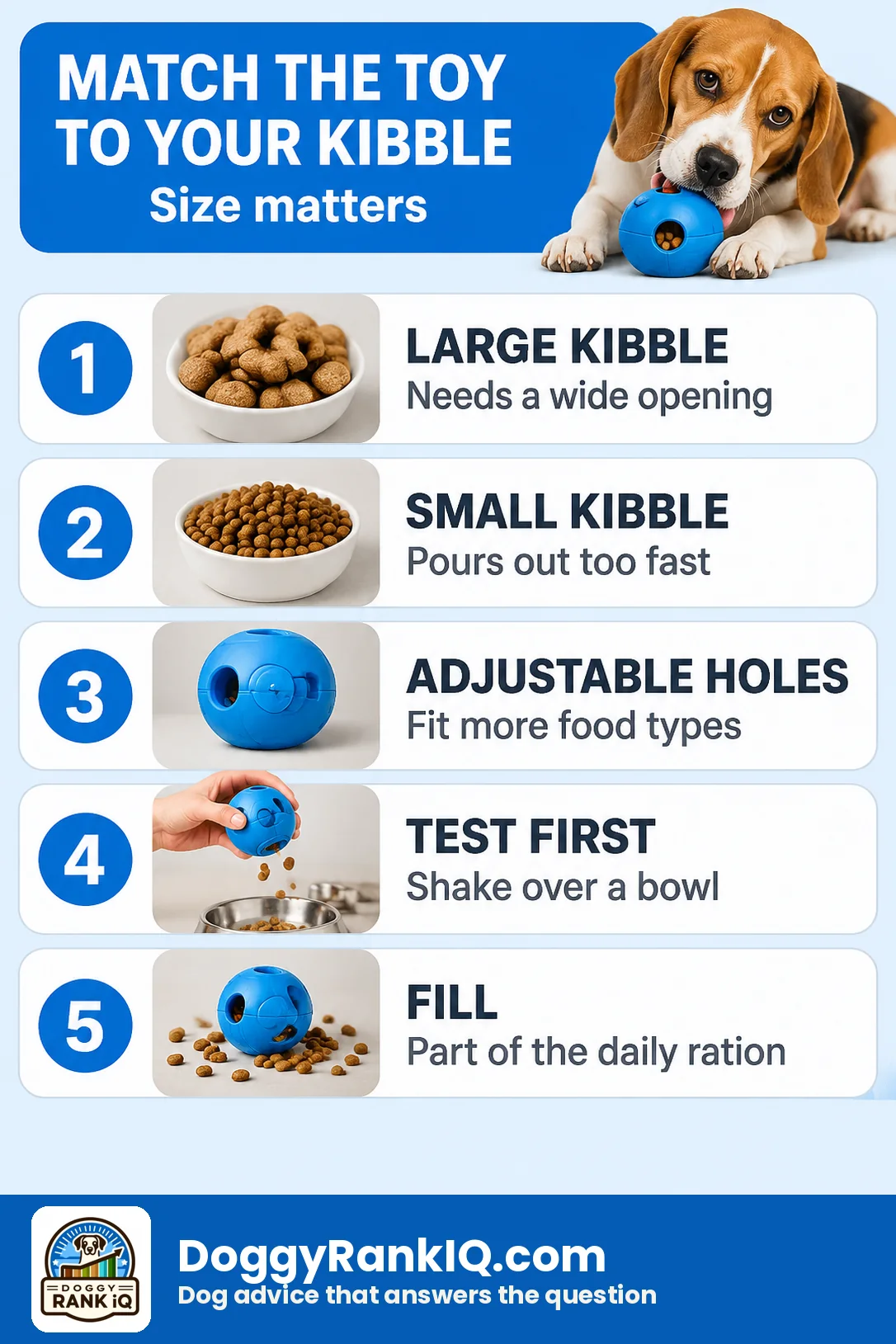
Decision rule: if your dog eats small-breed kibble (the tiny pellet size), lean toward the Bob-A-Lot, since you can dial the opening down so pieces don’t pour out in a dump. If your dog eats standard or large kibble, either toy’s fixed opening on the matching size should work fine without adjustment.
A common mistake is buying the Wobbler size based on the dog’s weight alone and ignoring kibble size, as described above. Always cross-check both factors.
Capacity, cleaning and noise compared
Price and upkeep matter as much as the puzzle mechanism, especially if you’re feeding full meals from the toy rather than just training treats.
Price checked 2026. Capacity figures vary with kibble shape, since round kibble settles differently than triangular or odd-cut pieces, so treat these numbers as estimates rather than exact measurements.
How much does a kong wobbler cost?
A Wobbler typically runs under $25, with the small/medium size listed around $17.96 and the medium/large size around $24.96 (price checked 2026). That places it in the same budget range as the Bob-A-Lot and well below most battery-powered treat dispensers.
For comparison, if you’re weighing a food puzzle against a powered option, our automatic dog feeder guide covers units that cost significantly more but add scheduling features neither wobble toy offers. For a one-time purchase with no moving electronic parts, the Wobbler remains one of the cheaper enrichment options on the market.
Is a kong wobbler safe for dogs?
A Wobbler is generally safe for supervised use with dogs that treat it as a puzzle rather than a chew target, according to KONG’s FAQ, which recommends stopping use once the toy shows cracks or damage. It is not marketed as a chew toy, so dogs that bite down hard on the twist-cap seam can eventually crack the plastic.
Safety tips worth following:
- Supervise the first several sessions with any new dog, especially puppies or dogs that haven’t used a food puzzle before.
- Inspect the twist seam periodically for hairline cracks.
- Stop use immediately if a piece chips off, since a hungry, excited dog may try to swallow fragments.
- Avoid leaving the toy with dogs who guard food aggressively around other pets, since the rolling motion can trigger chasing between multiple dogs.
Pete the Vet notes that most dogs do well with the toy when introduced gradually and supervised, which lines up with the manufacturer’s own guidance.
Best Wobbler for large dogs
The medium/large Wobbler, built for dogs roughly 30 to 65 lb, is the right choice for most large dogs, and it costs around $24.96 (price checked 2026). Larger dogs tend to push the toy harder and farther, so give them room away from walls, glass doors, and stairs.
Large dogs that play rough with toys may empty the Wobbler faster than expected, sometimes within a few minutes once they’ve learned the single mechanism, based on observations summarized by Pet Science Review. If a large dog masters the Wobbler too quickly and loses interest, the Bob-A-Lot’s adjustable dial offers a next step without buying a different brand altogether.
Wobbler vs Kong Classic: which is better?
The Wobbler and the KONG Classic solve different problems: the Wobbler is a rolling food dispenser for dry kibble, while the Classic is a stuffable rubber chew toy meant to hold wet fillings like peanut butter or canned food and to double as a durable chew item. Neither replaces the other.
Choose the Wobbler if you want to slow down meals or add movement-based enrichment. Choose the Classic if you want a chew-resistant toy that can be frozen with stuffing for longer-lasting engagement, or if your dog is a more determined chewer. Many households use both: the Classic for solo chew time and the Wobbler for mealtime enrichment. For a closer look at the Classic against another competitor, see our KONG Classic versus PetSafe Chilly Penguin comparison.
Wobbler not rolling: what should I do?
If a Wobbler isn’t wobbling or rolling properly, check the fill level first, since an overfilled or underfilled toy changes the internal weight balance that makes it self-right. An overloaded Wobbler can sit too heavy on one side and simply tip over instead of rocking back up.
Steps to troubleshoot:
- Empty the toy and refill to the recommended roughly 1 cup level rather than packing it full.
- Check the twist seam is fully closed and aligned, since a loose seam can throw off the weight distribution.
- Test on a hard, flat floor first. Carpet and thick rugs absorb the wobble motion and can make the toy seem stuck.
- Inspect the base for cracks or chips, since damage to the weighted bottom section affects the self-righting mechanism.
If the toy still won’t wobble correctly after these checks, it may be a manufacturing defect worth raising with the retailer or KONG directly.
Wobbler alternatives and similar toys
The Starmark Bob-A-Lot is the most direct alternative to the Wobbler, offering adjustable openings instead of a fixed one. Beyond that single comparison, there’s a wider field of puzzle feeders worth knowing about if neither wobble-style toy fits your dog.
- Rotating puzzle feeders with multiple compartments, which require a dog to spin or flip sections rather than roll the whole toy.
- Slow feeder bowls with raised ridges, which address fast eating without any rolling or noise.
- Snuffle mats, which use scent work instead of mechanical dispensing.
For a broader list organized by difficulty, see our dog puzzle toy picks by skill level. If the core issue is a dog eating too fast rather than boredom, a dedicated slow feeder bowl may solve the problem more directly and without the floor noise.
Can puppies use a Wobbler?
Yes, puppies can use a Wobbler once they’re eating solid kibble, but introduce it gradually and supervise closely, since puppies are more likely to chew on the toy itself rather than solve the puzzle. Start with the smallest size appropriate for the puppy’s current weight, not their expected adult weight.
For a puppy still learning basic food-motivated behaviors, pair the Wobbler introduction with the three-session method described below. Puppies that are still teething may also gnaw on the twist-cap seam more aggressively than adult dogs, so check the seam for damage more frequently during the puppy stage. If your puppy is also working through foundational obedience, our guide to essential commands every puppy should learn covers skills that pair well with food-based enrichment training.
How long do kong wobblers last?
A Wobbler can last months to years with normal use, but the actual lifespan depends heavily on whether your dog treats it as a puzzle or a chew target. Dogs that nose and paw the toy gently tend to keep the same Wobbler intact far longer than dogs that bite down on the seam or drop it repeatedly on concrete.
Signs it’s time to replace the toy:
- Visible cracks anywhere on the shell, especially near the twist seam.
- A seam that no longer closes flush, which can let kibble leak out too fast or let the halves separate during play.
- Chewed divots deep enough to expose rough plastic edges.
Owner reviews on Chewy include a mix of toys that lasted years and toys that cracked within weeks, largely tied to individual dog chewing habits rather than manufacturing defects.
Do dogs actually like kong wobblers?
Most dogs engage well with a Wobbler once they learn that pushing it produces food, though a small number of dogs show little initial interest and need encouragement. Reviews across Chewy and Zooplus generally describe dogs as enthusiastic, particularly food-motivated breeds and dogs that already enjoy nose-work games.
Dogs less likely to take to it immediately include very food-indifferent dogs, dogs with existing anxiety around loud or rolling objects, and senior dogs with joint discomfort that makes pushing a weighted toy uncomfortable. For those dogs, a quieter, stationary puzzle feeder may be a better starting point than a rolling design.
Wobbler vs puzzle feeder toy: what’s the difference?
The Wobbler is one specific style of puzzle feeder, built around rolling and wobbling rather than lifting flaps, sliding drawers, or spinning discs. “Puzzle feeder” is the broader category, and it includes stationary designs that don’t move around the floor at all.
Choose a rolling design like the Wobbler if your dog enjoys physical, whole-body play and you have space (hard floor, open room) for the toy to travel. Choose a stationary puzzle feeder, like a flip-lid or sliding-drawer design, if you have a small space, downstairs neighbors sensitive to noise, or a dog that prefers precise paw movements over full-body pushing. Our dog puzzle toy picks by skill level breaks down several non-rolling formats for comparison.
Common mistakes when using a Wobbler
The most common mistake is overfilling the toy past the recommended roughly 1 cup level, which jams the internal mechanism and stops kibble from falling at all. A close second is skipping the introduction period entirely and expecting a dog to understand the toy on the first try.
Other frequent mistakes:
- Using kibble that’s too large or an odd shape for the fixed opening, causing repeated jams.
- Leaving a new dog alone with the toy before confirming they won’t chew the seam.
- Assuming the toy replaces all mental enrichment, when in practice it works best as one part of a rotation with chew toys, walks, and training.
- Ignoring floor type. A Wobbler used on hardwood near a glass cabinet can knock items loose if a large dog plays with enough force.
⭐ Top 5 Features We Love
- One-piece simplicity on the Wobbler. Twist, fill, twist shut. No dials to fuss with during a busy morning.
- Dishwasher-safe cleaning on the Wobbler. The two halves separate completely, so kibble dust and oily residue actually come out instead of hiding in a seam.
- Adjustable openings on the Bob-A-Lot. You can start wide for a nervous dog and narrow it later as confidence builds, which matches the toy to your dog’s skill instead of the other way around.
- Dual chambers on the Bob-A-Lot. Loading two sections means a dog has to work through the toy twice, which stretches out meal time longer than a single-opening design.
- Both toys are budget-friendly. Under $25 for either brand, which is less than most powered treat dispensers and a fraction of the cost of an automatic feeder. If an automatic option interests you instead, see our automatic dog feeder guide.
⚠️ Things to Look Out For
Owners report a handful of recurring complaints on both toys, and it’s worth knowing them before you order.
- Chewed tops. Some dogs treat the twist-cap or dial section as a chew target, which can crack plastic over time. Supervise new dogs closely during the first sessions.
- Kibble jamming. Odd-shaped kibble or treats that are slightly too big for the opening can wedge and stop dispensing, which frustrates a hungry dog fast.
- Noise on hard floors. Both toys rattle and roll on tile, hardwood, or laminate. If you have downstairs neighbors or a dog that startles at noise, test on a rug first.
- Fixed difficulty on the Wobbler. Since there’s no dial, a Wobbler that’s too easy stays too easy. A clever dog figures out the single mechanism fast and the puzzle stops being much of a puzzle.
- Not a chew toy. Neither brand markets these for aggressive chewing, and manufacturer guidance says to stop use once damage appears.
Which one for which dog
Choose the Wobbler if your dog is new to food puzzles, is anxious around complicated toys, or belongs to a household that wants the simplest possible cleaning routine. Choose the Bob-A-Lot if your dog gets bored of easy toys within days and you want a feeder that can grow in difficulty.
- Puppies and first-time puzzle dogs: start with the Wobbler. One opening means no confusion, and the fixed design is forgiving for a dog still learning that nosing the toy produces food.
- Fast eaters who inhale meals: either toy slows eating down compared with a bowl, but the Bob-A-Lot’s dual chamber and adjustable openings stretch the meal out longer for dogs that need more friction.
- Small dogs under 20 lb: the small Wobbler or small Bob-A-Lot both fit. Check actual kibble size against the opening before buying, not just the dog’s weight.
- Medium to large dogs, 30 to 65 lb: KONG’s own sizing guidance points to the large Wobbler here. The large Bob-A-Lot works for the same range, with more control over difficulty.
- Dogs who destroy toys fast: neither feeder is built for determined chewers. Pair feeding puzzles with a separate dedicated chew item, and review our aggressive chewer toy picks for something sturdier.
If your dog’s real problem is eating too fast rather than boredom, a slow feeder bowl might solve it more directly than either wobble toy. Our slow feeder guide covers bloat-related feeding concerns in more detail, and our bloat symptoms guide is worth reading for larger, deep-chested breeds prone to the condition.
How to introduce a wobble feeder in 3 short sessions
Dogs don’t automatically know that nudging a plastic capsule produces food. A short introduction period prevents frustration and toy avoidance.
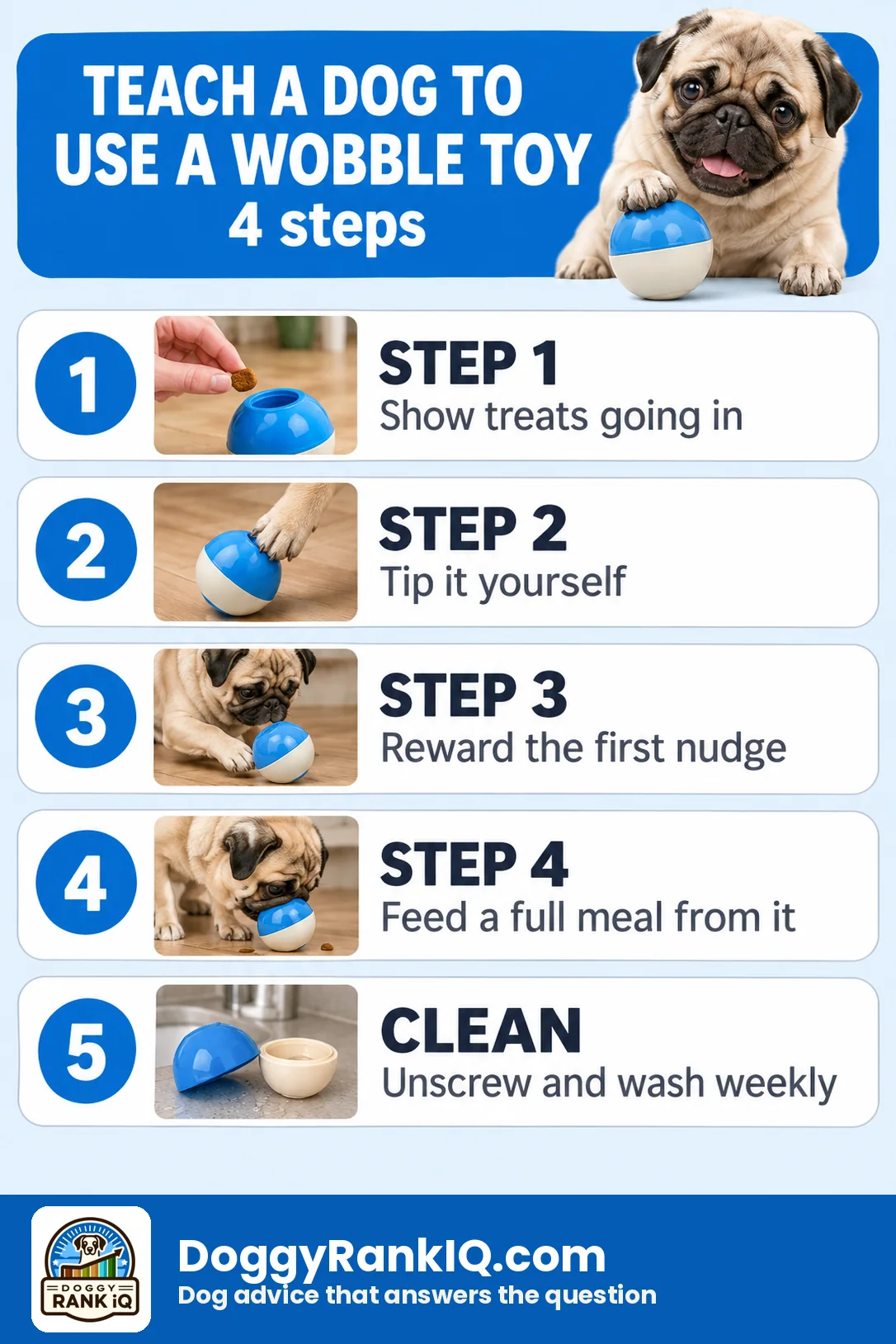
- Session one: wide open, easy win. Fill the toy about half full and, if using the Bob-A-Lot, set the dial to its widest setting. Let kibble spill out with minimal effort so the dog connects the toy with food fast.
- Session two: full load, same setting. Fill to the recommended capacity (about 1 cup for the Wobbler, per manufacturer guidance) and keep the easy setting. Watch for signs of frustration, like pawing aggressively at the seam or giving up after 30 seconds.
- Session three: raise the difficulty. On the Bob-A-Lot, narrow the dial slightly. On the Wobbler, since there’s no dial, difficulty stays constant, so this is the point where you decide if your dog needs the adjustable model instead.
Edge case: if a dog shows no interest after three sessions, try a stronger-smelling kibble or mix in a few soft treats to build initial motivation. A dog that still ignores the toy after a week likely needs a different enrichment format; our dog puzzle toy picks by skill level list several alternatives.
FAQ
The bottom line
The Wobbler wins on simplicity: one opening, dishwasher-safe cleaning, and an easy learning curve for puppies or first-time puzzle dogs. The Bob-A-Lot wins on staying power, because its adjustable dial lets the toy grow harder as your dog gets smarter, which matters for dogs that solve easy puzzles in days. Either option costs under $25 (price checked 2026) and beats letting a fast eater finish a bowl in under a minute. Check your dog’s actual kibble size against the opening dimensions before ordering, since that detail decides whether the toy frustrates your dog or actually works.
If portion control and bloat prevention matter more than entertainment, pair either feeder with guidance from our beginner’s guide to choosing dog food to make sure the total daily amount still lines up with your dog’s needs.
Doggy Rank IQ is reader supported. As an Amazon Associate we earn from qualifying purchases, at no extra cost to you.