
This post contains affiliate links. If you buy through one we may earn a commission at no extra cost to you. As an Amazon Associate I earn from qualifying purchases.
Quick answer
The best automatic dog feeder is the one that keeps the correct portion schedule running through a power outage, a dropped Wi-Fi connection, and whatever odd-shaped kibble your dog actually eats. For most single-dog households, that means a unit with a built-in rechargeable battery rated for at least 24 hours, a portion dial that steps in small increments rather than rounded cups, and a chute wide enough for the largest piece in the bag, not the average one.
Key takeaways
- PETLIBRO’s Granary 2 line advertises up to 24 hours of backup power from its built-in rechargeable battery, with the Vision model rated up to 48 hours (Good Housekeeping).
- A Wirecutter test found a Pawsync feeder switched to three D-cell batteries during an outage but lost Wi-Fi logging and stopped sending alerts.
- Wirecutter also documented repeated jamming with larger kibble in a PETLIBRO Granary 2 unit, even within the brand’s own stated size range.
- PETLIBRO reportedly had an August 2026 service outage that interrupted some scheduled feedings despite smart-connectivity marketing.
- One PETLIBRO portion equals roughly 20 mL, 10 grams, or 1/12 cup, with up to six portions stacked per dispense.
- Dr. Lisa Lippman, DVM of Bond Vet, notes that automatic feeders help with consistent meal timing and portion control for dogs on irregular schedules or weight management plans (The Strategist).
- A Dogness feeder using Google Gemini for behavior recognition was announced in October 2026, but no price or ship date has been confirmed, so it is not yet a buyable option.
- The PetSafe Best automatic dog feeder remains one of the most reliable options under $100, with a 40-ounce hopper split across 5 meals.
Doggy Rank IQ Tool
Automatic Dog Feeder Fit Check

Kibble size, portions and days away decide whether a feeder works or jams. Check before you buy.
Best automatic dog feeder: what actually answers the search
The phrase “best automatic dog feeder” gets typed by two different people, and both need the same three facts confirmed before they buy. One is shopping for a weekend-trip gadget. The other wants a daily portion-control tool for a dog who treats food like it might get repossessed. Either way, the hopper has to fit the kibble size, the portion dial has to match the actual meal rather than a rounded guess, and the unit has to keep working when the power or the internet goes down.

Check the dimensions of the dispensing chute against your kibble’s largest piece, not the average one. Large triangular kibble, dental-formula shapes, and freeze-dried toppers are the usual jam culprits. If a feeder’s spec sheet lists a kibble diameter limit, measure three pieces from the actual bag before trusting it. A feeder rated for “up to 1.5 cm kibble” that jams on a 1.4 cm piece is not a defect. It is a design margin nobody mentioned on the box.
Backup power changes what “automatic” really means. A feeder that only runs while plugged in is a timer, not insurance. A feeder with a charged internal battery or a disposable battery backup keeps the schedule alive through a tripped breaker, a dead outlet, or the day the dog finally wins its standoff with the power cord.
For readers comparing bowl shape and eating pace rather than timed dispensing, a separate guide on slow feeder bowl designs covers bloat-reduction shapes on their own. This article stays focused on scheduling, portions, and outage behavior, which is where most buyers actually get burned.
How does an automatic dog feeder work
An best automatic dog feeder stores dry kibble in a hopper above a motorized auger screw or rotating tray, then releases a programmed portion into a bowl at set times through a timer chip or a connected app. Most mid-range models let you schedule two to six meals a day and adjust portion size in cup fractions or gram increments.
The mechanism matters more than the branding. Auger-style feeders push kibble through a horizontal screw, which works well for round or small kibble but can jam on oddly shaped pieces that wedge sideways. Rotating-tray feeders use a spinning disc with portioned compartments, which tends to handle mixed kibble shapes better but caps the number of meals at however many compartments the tray has, often four to six.
Smart feeders add a Wi-Fi chip that syncs the schedule to an app, logs each dispense, and in camera models streams video of the bowl area. The core feeding mechanism, however, is supposed to run on the device’s internal clock even if the Wi-Fi connection drops. Whether it actually does is worth testing at home before you travel, since cloud dependency has tripped up more than one “smart” model during real outages.
Feeder Fit Check
Use the tool below to estimate the hopper size you need and whether battery backup matters for your situation.
Feeder Fit Check
function cgCalc(){ var meals=parseFloat(document.getElementById(‘cg-meals’).value)||1; var portion=parseFloat(document.getElementById(‘cg-portion’).value)||1; var days=parseFloat(document.getElementById(‘cg-days’).value)||1; var dogs=parseFloat(document.getElementById(‘cg-dogs’).value)||1; var kibble=document.getElementById(‘cg-kibble’).value; var totalCups=meals*portion*days*dogs; var minLiters=Math.ceil(totalCups*0.24*1.15); var battery=days>1||kibble==’large’?’Yes, battery backup matters for this plan’:’Optional, but still useful’; var jamNote=kibble==’large’?’Confirm the chute width against your largest kibble piece before buying.’:’Most hoppers handle this size without issue.’; document.getElementById(‘cg-result’).style.display=’block’; document.getElementById(‘cg-result’).innerHTML=’Minimum hopper size: about ‘+minLiters+’ litersBattery backup: ‘+battery+’
Jam risk note: ‘+jamNote; }
Backup power and portions: what happens when the power goes out?
What happens if the power goes out with an automatic feeder depends entirely on whether it has a backup power source, and manufacturers do not make this equally clear. Some units rely on a built-in rechargeable battery that kicks in automatically. Others take standard disposable batteries as a backup, and a few have no backup at all, meaning a power blip simply erases the schedule and the dog waits.
PETLIBRO’s Granary 2 uses a built-in rechargeable battery rated for up to 24 hours without separate disposable cells, with the Vision variant rated up to 48 hours, according to the manufacturer’s product pages as reported by Good Housekeeping. That is a real upgrade over older D-cell backup systems, but PETLIBRO itself notes the figure is a lab estimate that shifts with real operating conditions, not a guarantee you can bank a weekend trip on.
Wirecutter’s testing of the Pawsync Smart Pet Feeder found a more complicated outcome. During a power outage, the unit switched to three D-cell batteries and kept dispensing on schedule, which sounds like a win. But it disconnected from Wi-Fi, failed to log the battery-powered feedings in the app, and sent no alerts. So the dog got fed. The owner had no record of it. That gap matters if you are checking the app from a hotel room assuming everything is fine.
There is also a connectivity risk that has nothing to do with batteries. Wirecutter reported an August 2026 PETLIBRO service outage during which some users said their feeding schedules were interrupted, even though local schedules are supposed to run independent of the cloud. A feeder with a dead internet connection should still fire on its internal clock. Whether it actually does depends on firmware, not marketing copy.
Before trusting any feeder for a trip, run a simple test at home: set a schedule, then physically unplug the unit mid cycle and watch whether it dispenses the next scheduled portion. Weigh the result. This two-minute check catches the gap between the spec sheet and the actual hardware, and it is the single best thing you can do before leaving a dog with a feeder and no human backup.
For portion size, the issue is not just whether it dispenses, it is whether it dispenses the right amount. PETLIBRO defines one portion at roughly 20 mL, 10 grams, or 1/12 cup, letting owners stack up to six portions per dispense. That is a fine step size, useful for small dogs or weight management, but coarser dial-based feeders round to the nearest quarter or half cup, which is a meaningful miss for a 10-pound dog on a vet-prescribed diet.
Automatic dog feeder vs manual feeding
An best automatic dog feeder beats manual feeding on consistency and precision, but manual feeding wins on real-time judgment, like noticing a dog that suddenly won’t eat. Choose automatic feeding if your schedule is unpredictable or your dog needs strict portion control; choose manual feeding if your dog has a medical condition that needs daily hands-on monitoring.
Dr. Lisa Lippman, DVM of Bond Vet, notes that automatic feeders help with consistent meal timing and portion control for dogs on irregular schedules or weight management plans, according to The Strategist. That consistency is the main argument for switching: a feeder does not forget, run late because of traffic, or eyeball a scoop differently on a tired evening.
The trade-off is observation. A human feeding by hand notices if the dog hesitates, vomits shortly after eating, or seems unusually hungry or disinterested. A feeder just dispenses on schedule regardless of how the dog is doing that day. Camera-equipped models narrow this gap by letting you watch mealtimes remotely, but they still cannot smell spoiled food or notice a limp the way a person standing in the kitchen can.
Decision rule: if your dog is on a strict veterinary diet, has a history of bloat, or is elderly with changing appetite, keep at least one manually observed meal per day even if the rest run on an automatic feeder.
Best automatic dog feeder under $100
For buyers who want a reliable best automatic dog feeder without paying for a camera or app subscription, the PetSafe Best automatic dog feeder is the clearest budget pick, typically priced in the $40 to $60 range. It holds 40 ounces of dry kibble across five programmable meals, runs on D-cell battery backup, and has no Wi-Fi dependency to fail during an outage.

This price band suits owners with one medium-to-large dog on a predictable eating schedule, not a dog needing gram-level portion precision. The mechanical simplicity is a feature here: there is less firmware to glitch and fewer app updates to manage. The trade-off is no remote monitoring and no alert if the hopper runs empty mid-trip, so it works best for trips of two to three days rather than a full week unattended.
Automatic dog feeder for small dogs
Small dogs need a feeder with fine portion steps, not just a smaller hopper. A chihuahua or toy poodle eating a quarter cup per meal gets a very different outcome from a feeder that rounds to the nearest half cup versus one that steps in roughly 10-gram increments like PETLIBRO’s Granary line.
Oversized dispensing chutes are less of a concern for small dogs since their kibble tends to run smaller too, but overfeeding risk goes up fast with coarse portion dials. A half-cup rounding error is trivial for a 70-pound dog and significant for a 9-pound one. Look for feeders that market gram-based or milliliter-based portions rather than cup fractions if your dog weighs under 15 pounds.
Automatic dog feeder for large dogs
Large dogs need hopper capacity and chute width more than fine portion steps. A Labrador or German Shepherd eating two to three cups per meal will drain a small hopper fast, so capacity planning matters: a 40-ounce hopper split across two daily meals for one 70-pound dog covers roughly three to four days before needing a refill, depending on the kibble’s density.
Chute width is the other variable that matters more as kibble size goes up. Large-breed kibble often runs larger in diameter specifically to slow down fast eaters, which is exactly the shape that jams narrower augers. Confirm the manufacturer’s stated maximum kibble size against your actual bag, and if your dog eats a large-breed dental formula, lean toward rotating-tray feeders, which tend to handle irregular shapes better than auger-style units.
Are automatic dog feeders safe for dogs
Automatic dog feeders are generally safe when sized correctly for the dog’s kibble and checked periodically for jams, but they are not a substitute for supervision in dogs with resource guarding, bloat history, or multi-pet food competition. The main safety risks are mechanical jams that stop feeding entirely and software failures that silently skip a scheduled meal.
A feeder that jams without an alert can leave a dog without food for a full day if nobody checks the app or the bowl in person. Wirecutter documented this exact failure mode with larger kibble in a PETLIBRO Granary 2 unit, even within the brand’s own stated size range. The fix is not avoiding automatic feeders altogether, it is choosing one with jam detection and running a test cycle before relying on it unsupervised.
For multi-dog households, feeders without RFID collar recognition create a different safety issue: a faster or more dominant dog can eat both portions before the slower dog gets a turn. If food guarding is already a behavior concern in your household, pairing a feeder with basic training resources, like the guide on essential commands every puppy should learn, can help establish separate feeding zones before the hardware takes over scheduling.
Automatic dog feeder for wet food
Most dry-kibble automatic feeders cannot handle wet food because the auger or rotating tray is built for solid, free-flowing pieces, not paste-like textures that stick to surfaces and spoil at room temperature. A small number of feeders are purpose-built with refrigerated compartments or ice packs specifically for wet food, and they cost more and need more frequent cleaning than dry-kibble models.
If your dog eats wet food exclusively or on a mixed diet, check specifically for a feeder marketed as wet-food compatible rather than assuming a dry-kibble unit will work with modifications. Spoilage risk is the real concern: wet food left out for more than two to four hours at room temperature can grow bacteria fast enough to cause stomach upset, which defeats the purpose of unattended feeding.
Automatic dog feeder for picky eaters
Picky eaters respond better to feeders with fresh-food delivery features and consistent timing than to feeders chosen purely for capacity. A dog that walks away from food left sitting in a bowl for hours benefits from a feeder that dispenses smaller, more frequent portions rather than one large daily dump.
The Granary 2’s Smart Refill feature, which tops off smaller amounts throughout the day rather than one big dispense, suits dogs who graze instead of eating everything at once. For a genuinely picky eater, pairing the feeder with a stainless steel tray instead of plastic also helps, since plastic retains odors that can make existing food taste stale to a dog with a sensitive nose. If pickiness seems tied to the food itself rather than the delivery method, a broader look at superfoods and topper options for dogs might solve the root problem faster than new hardware.
Why is my automatic dog feeder jamming
Jamming almost always comes down to kibble size exceeding the chute’s real-world clearance, not a defect in the unit itself. Manufacturers list a maximum kibble diameter, but that figure often assumes uniform, round pieces, not the irregular triangular or dental-formula shapes many brands use.
Common jam causes, in order of frequency:
- Kibble pieces larger than the stated maximum, especially large-breed or dental formulas
- Kibble dust and crumbs building up around the auger over weeks of use without cleaning
- Humidity causing kibble to clump, especially in homes without climate control near the feeder
- Overfilling the hopper past the manufacturer’s fill line, which adds pressure on the auger
Wirecutter’s testing found repeated jamming in a PETLIBRO Granary 2 unit with larger kibble even within the brand’s own stated size range, which suggests the stated maximum on the box should be treated as a ceiling to test against, not a guarantee. If jamming happens repeatedly with a kibble size inside the listed range, switching to a rotating-tray mechanism instead of an auger-style feeder usually solves it.
Automatic dog feeder wifi not connecting
A feeder that will not connect to Wi-Fi almost always has a band mismatch, meaning most smart feeders only support 2.4GHz networks and will silently fail to pair with a 5GHz-only or combined network. Checking your router settings for a separate 2.4GHz network name is the first troubleshooting step before assuming the feeder is defective.
Other common fixes, roughly in the order to try them:
- Confirm the router broadcasts a 2.4GHz band separately from 5GHz
- Move the feeder closer to the router during initial setup, then relocate after pairing
- Restart the feeder and the router, then re-run the app’s pairing sequence
- Check for a firmware update in the app before re-pairing
- Reset the feeder to factory settings if pairing fails three times in a row
Even after a successful pairing, keep in mind that local schedules should still run on the feeder’s internal clock if Wi-Fi drops later. The August 2026 PETLIBRO service outage is a reminder that cloud dependency can still interrupt scheduled feedings in some cases, so a Wi-Fi connection should be treated as a convenience for remote monitoring, not the thing keeping your dog fed.
Automatic dog feeder for multiple dogs
Feeding multiple dogs from one automatic feeder works only if the dogs eat at a similar pace and do not compete over food; otherwise, use one feeder per dog or a model with RFID collar recognition that only opens for the correct dog. Without that recognition feature, a faster eater can finish its portion and then push into the slower dog’s bowl before it clears.
For two dogs with different caloric needs, like different sizes or different activity levels, two separate feeders set to different portion sizes is more reliable than trying to split one hopper’s output. The Granary 2’s fine portion steps, around 10 grams per unit, make it easier to dial in two very different serving sizes if you do run two units side by side. Budget-focused households can also pair two PetSafe units rather than one premium RFID feeder, since the combined cost is often still lower than a single high-end multi-pet system.
Common mistakes with automatic dog feeders
The most common mistake is buying based on hopper capacity alone and skipping the jam test before a real trip. A feeder that holds five days of food is useless if it jams on day one and nobody is there to clear it.
Other frequent mistakes:
- Assuming a battery backup rating (24 or 48 hours) applies under all conditions rather than as a lab estimate
- Not weighing an actual scoop of kibble against the feeder’s portion setting before the first automated meal
- Placing the feeder somewhere direct sunlight or a heating vent can warm the kibble and encourage clumping
- Skipping the dishwasher-safe check and ending up hand-scrubbing a tray around a motor housing every week
- Relying solely on app notifications for alerts in households with spotty Wi-Fi, instead of doing a daily visual check
Automatic dog feeder reviews and ratings
Reviews from outlets like Wirecutter, Good Housekeeping, and Whole Dog Journal consistently flag the same two weak points across brands: jamming with larger kibble and inconsistent behavior during Wi-Fi outages. Reading reviews that specifically mention your kibble brand and size is more useful than a general star rating, since jam risk varies by kibble shape, not just feeder model.
Chewy’s buyer reviews and the aggregated best-sellers list on Chewy are worth checking for real owner photos of kibble sizes that worked or failed in a given unit, since manufacturer spec sheets rarely show the actual chute clearance in a way you can measure against your bag at home.
Best automatic dog feeder brands
PETLIBRO, PetSafe, and Pawsync currently dominate the automatic dog feeder market, each with a different strength. PETLIBRO leads on portion precision and camera integration, PetSafe leads on mechanical simplicity and price, and Pawsync has shown strong battery failover performance in third-party testing, though with gaps in app logging during outages.
A newer entrant worth watching rather than buying yet is Dogness, which announced a Google Gemini-powered feeder with behavior recognition in October 2026. No price or ship date has been confirmed as of this writing, so it is not yet a purchasable option, but it signals where the category is heading: feeders that can distinguish between a dog eating normally and one that seems distressed or is being pushed out by another pet.
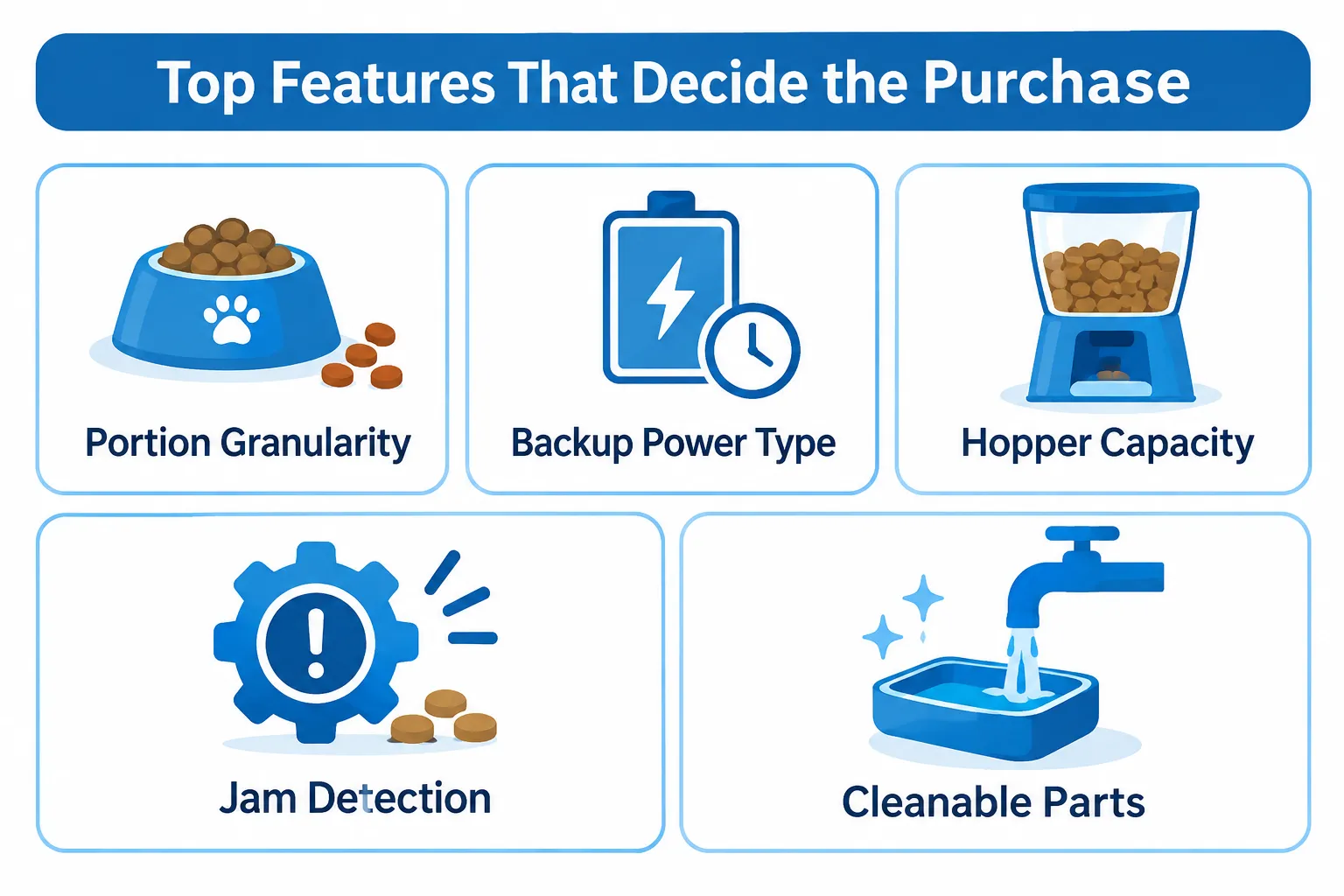
Top 5 Features That Decide the Purchase
1. Portion granularity. A feeder that only adjusts in half-cup jumps is unusable for small dogs on precise diets. The PETLIBRO Automatic Dog Feeder with Camera lets owners fine-tune portions in finer increments, which matters more for a 12-pound terrier than a 70-pound Labrador.
2. Backup power type. Built-in rechargeable batteries, like PETLIBRO’s Granary 2 line, avoid the hassle of stocking D-cells, but D-cell backups like the one Wirecutter tested in Pawsync are easier to replace anywhere, including a gas station at 11 p.m.
3. Hopper capacity versus trip length. The PetSafe Automatic Dog Feeder holds 40 ounces across 5 meals, which suits a medium dog for a long weekend but runs short fast for two large dogs sharing one unit.
4. Jam detection and kibble size limits. Wirecutter documented repeated jamming in the PETLIBRO Granary 2 with larger kibble, even within the brand’s own stated size range. A feeder without a jam alert just sits there empty while the app shows a cheerful “feeding complete.”
5. Cleanability of parts that touch food. Bowls and trays that pop off for the dishwasher beat ones that need hand-scrubbing around a motor housing. The PETLIBRO Automatic Dog Feeder with Camera uses a stainless steel slow-feed tray, which resists the staining and odor retention that plastic bowls pick up after a few months.
Things to Watch Out For
Even a well-reviewed automatic dog feeder can fail in ways that only show up after weeks of daily use, so treat the first month as a trial period rather than a one-time setup. Watch for these specific failure patterns:
- Portion drift, where the actual dispensed amount shifts slightly over time as the auger motor wears, is worth checking with a kitchen scale every few weeks.
- Battery backup ratings of 24 or 48 hours are lab estimates, not guarantees, and real performance drops in cold rooms or with an aging battery.
- Wi-Fi dependent alerts can fail silently during a service outage, as happened with PETLIBRO in August 2026, so do not rely on push notifications as your only check-in method while traveling.
- Plastic hoppers can develop a faint odor over months of kibble storage that stainless steel trays resist better.
- Multi-dog households without RFID recognition risk one dog eating both portions.
Who Should Skip This
Automatic dog feeders are not the right fit for every dog or household. Skip one if your dog has a medical condition requiring real-time monitoring, like a recent diagnosis of diabetes needing insulin timed precisely with meals, since a feeder cannot adjust for a missed dose or a dog that refuses to eat that day.
They also make less sense for households with aggressive food guarding between pets, since a feeder running on a timer cannot intervene the way a person standing nearby can. And for puppies still being house-trained or crate-trained, a predictable human feeding schedule tied to potty breaks is usually more useful than a machine-driven one, at least until the basics are solid. A primer on grooming and daily routine basics can help build that broader daily structure alongside feeding.
Budget Pick
For owners who want a reliable automatic dog feeder without paying for smart features, the PetSafe Automatic Dog Feeder remains the clearest choice in the $40 to $60 price band. It holds 40 ounces across five meals, runs on D-cell battery backup with no Wi-Fi dependency, and suits a single medium-to-large dog on a predictable schedule for trips up to three days.
Research into the VOLUAS Automatic Cat Feeder found it marketed specifically for cats, with dog compatibility mentioned only as a secondary use case for very small dry kibble. Because its own product listing does not clearly confirm suitability for typical dog kibble sizes or larger breeds, it is not included here as a dog-specific budget pick. Owners of small dogs looking for a cheaper alternative should research small-breed-specific listings directly on Chewy rather than repurpose a cat feeder.
Comparison Table
| Model | Price Band | Backup Power | Best For |
|---|---|---|---|
| PetSafe Automatic Dog Feeder (5 Meals, 40 oz) | Around $40 to $60 | D-cell battery backup | Budget-minded owners, medium dogs, short trips |
| PETLIBRO Automatic Dog Feeder with Camera | Around $100 to $150 | Rechargeable battery, app alerts | Owners who want to watch mealtimes remotely |
| PETLIBRO Granary 2 Series | Around $100 to $150 | Built-in rechargeable, up to 24 hrs (Vision up to 48 hrs) | Owners who want scale-based intake tracking |
| PetSafe Automatic Dog Feeder (linked model) | Around $40 to $60 | D-cell battery backup | Multiple pets, simple daily routines |
Comparison table: the best automatic dog feeder choice depends on budget, backup power needs, and number of dogs in the household.
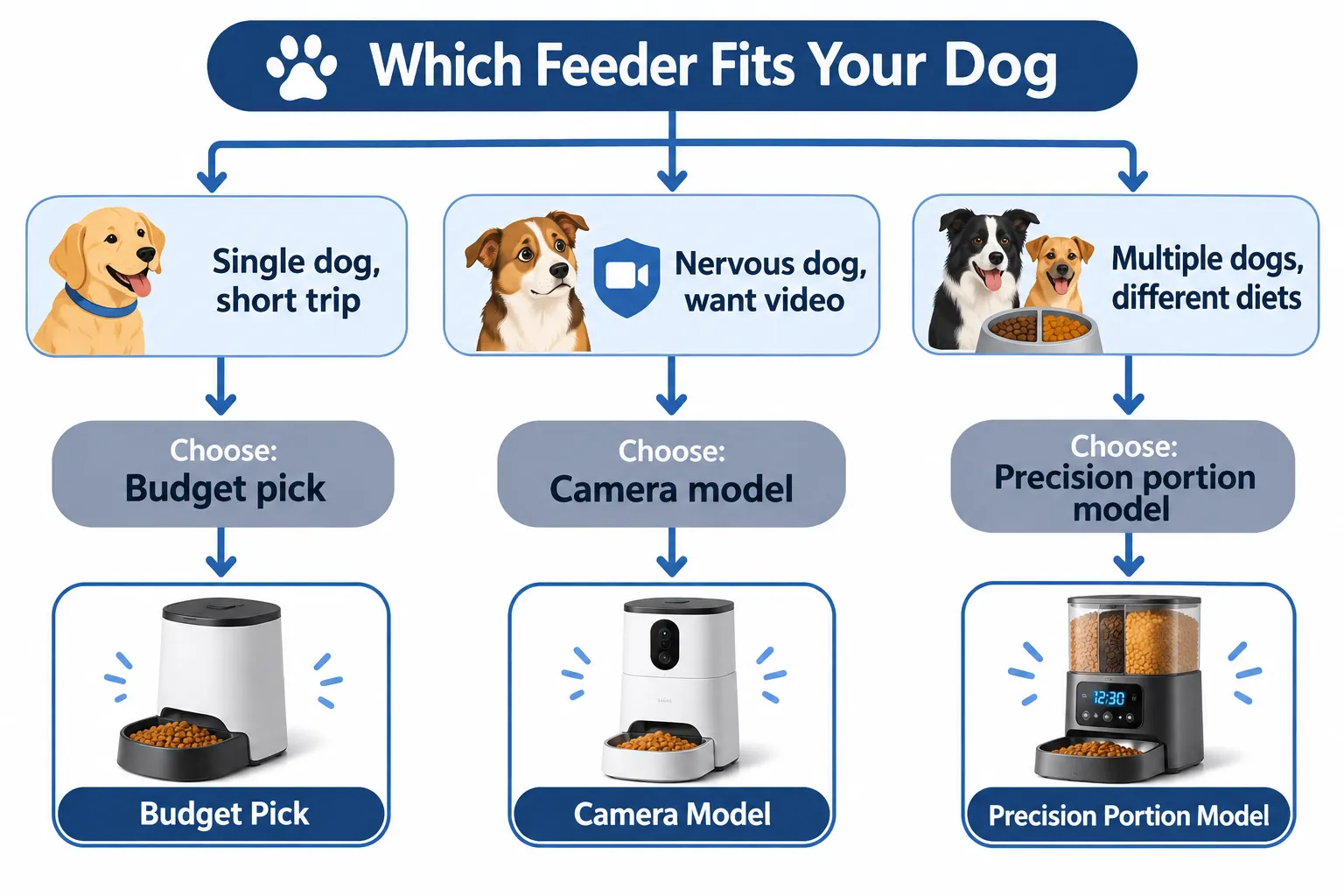
Which Pick Fits Which Dog and Owner?
A single large dog with a predictable appetite does well with the PetSafe Automatic Dog Feeder. It holds 40 ounces across five programmable meals, which covers a 2-to-3 day trip for one medium-to-large dog without a refill, and the D-cell backup means you can grab replacement batteries from any drugstore on your way out the door. This is also the budget pick: the price band sits well under feeders with cameras and apps, and the mechanism is simple enough that there is less to break.
A household wanting remote visibility, maybe a nervous first-time owner checking in from work, fits the PETLIBRO Automatic Dog Feeder with Camera. The 1080P night vision and two-way audio let you confirm your dog actually walked over and ate, not just that the motor turned. That reassurance has real value for separation-anxious dogs, though it adds a recurring dependency on Wi-Fi stability, worth weighing against the connectivity issues reported in PETLIBRO’s August 2026 outage.
For picky eaters or multiple dogs sharing a feeding station, portion precision and fresh-food delivery matter more than camera features. The Granary 2’s Smart Refill and fine portion steps, around 10 grams per unit, suit a household managing two dogs with different calorie needs, provided you are comfortable running the jam test described earlier before trusting it unsupervised. For broader food quality questions beyond the dispensing hardware, a guide on choosing the best food for your dog is a useful next read.
FAQ
What is the best automatic dog feeder for a single medium dog? For a single medium dog on a predictable schedule, the PetSafe Automatic Dog Feeder is a solid, affordable choice with 40 ounces of capacity across five meals and D-cell battery backup.
Does the best automatic dog feeder need Wi-Fi to work? No. Core scheduling runs on the feeder’s internal clock, and Wi-Fi is only needed for remote monitoring, app alerts, and camera streaming, not for the basic dispensing function.
How long does battery backup last on a smart feeder? PETLIBRO’s Granary 2 is rated up to 24 hours on its built-in rechargeable battery, with the Vision model rated up to 48 hours, though these are lab estimates that can shift with real conditions like cold rooms or an aging battery.
Can an automatic dog feeder handle wet food? Most dry-kibble feeders cannot handle wet food safely because of spoilage risk and mechanism design. Look specifically for feeders marketed as wet-food compatible, which usually include refrigeration or ice pack compartments.
Why does my feeder keep jamming on the same kibble? Jamming usually means the kibble’s largest pieces exceed the feeder’s real-world chute clearance, even if the size falls within the manufacturer’s stated range. Measuring actual kibble pieces against the spec sheet, and switching to a rotating-tray design if jamming persists, usually solves it.
Is the best automatic dog feeder safe for multiple dogs? Only if the dogs eat at a similar pace and do not compete over food, or if the feeder includes RFID collar recognition. Without that feature, a faster eater can take both dogs’ portions.
What should I do if my feeder’s Wi-Fi won’t connect? Confirm your router broadcasts a 2.4GHz network separately from 5GHz, since most feeders only support 2.4GHz. Moving the feeder closer to the router during setup and restarting both devices resolves most connection issues.
Are automatic dog feeders worth it for picky eaters? Yes, especially models with fresh-food delivery features that dispense smaller amounts more often rather than one large daily portion, which better matches how picky eaters tend to graze.