
Quick Answer
Rin Tin Tin was a German Shepherd puppy pulled from a bombed kennel in France during World War I and raised into one of Hollywood’s first animal movie stars. He appeared in roughly 27 films for Warner Bros., and the studio’s own staff reportedly called him the mortgage-lifter because his films kept it financially afloat during the silent era (nprillinois.org). No verified 2026 film or documentary carrying the exact title “Rin Tin Tin: The Real War Puppy Who Saved a Studio” turned up in recent coverage; current 2026 activity is mostly historical journalism and archival screenings, not a new release (people.com, shc.stanford.edu). If you came here hoping to stream that title tonight, the honest answer is there’s no confirmed 2026 release to point you toward yet.
Key Takeaways: rin tin tin
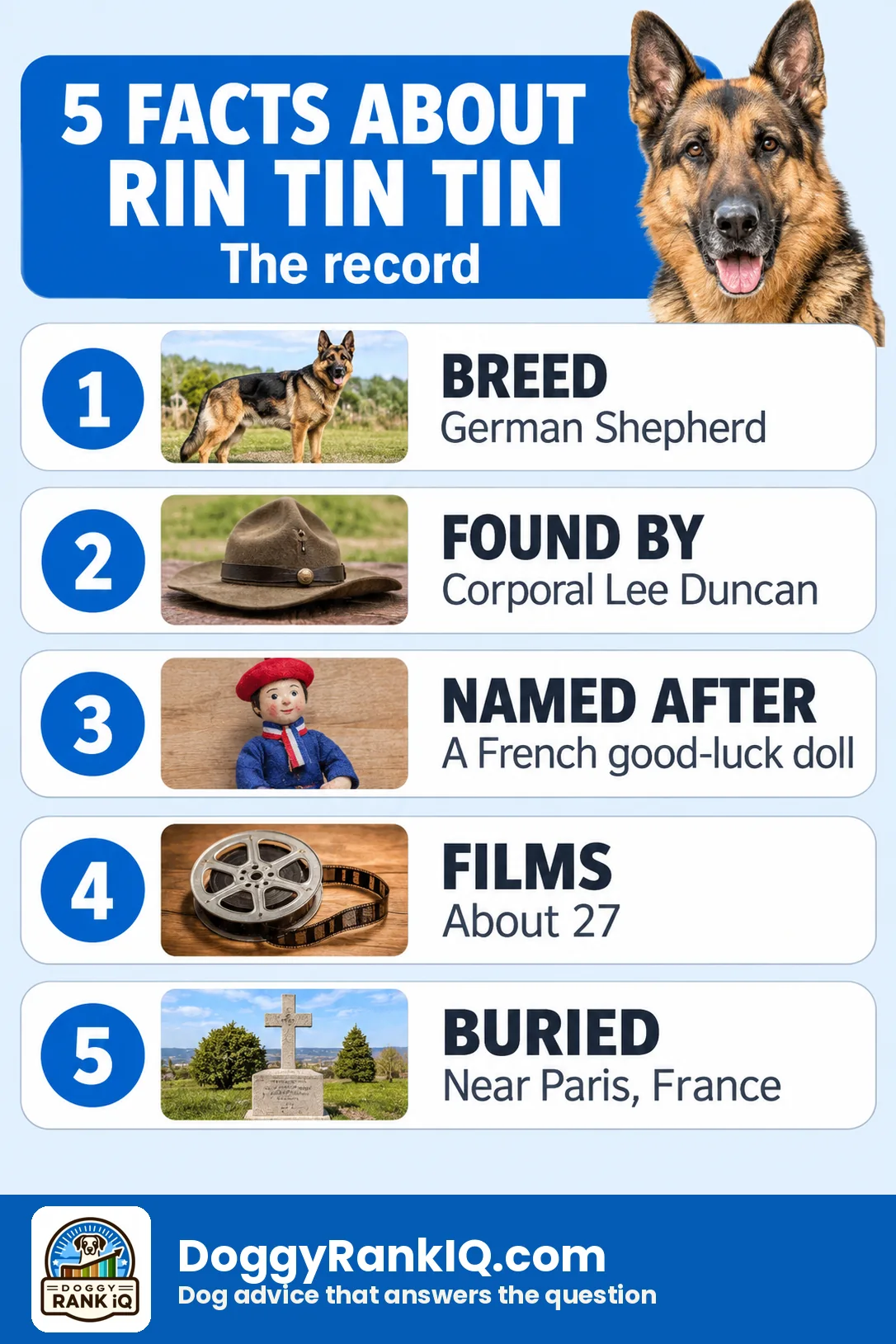
- Corporal Lee Duncan found Rinty and a litter of German Shepherd puppies near a bombed kennel in Lorraine, France, in 1918, during World War I (en.wikipedia.org).
- Rinty and his sister Nanette were named after small French good-luck dolls soldiers carried; Nanette died shortly after arriving in the United States (en.wikipedia.org).
- A famous jump at a 1922 dog show reportedly got Rinty noticed by Warner Bros., and Where the North Begins (1923) made him a star (en.wikipedia.org, military.com).
- Warner Bros. was a struggling studio in the 1920s, and insiders credited Rinty’s films with keeping it solvent, earning him the nickname “mortgage-lifter” (nprillinois.org).
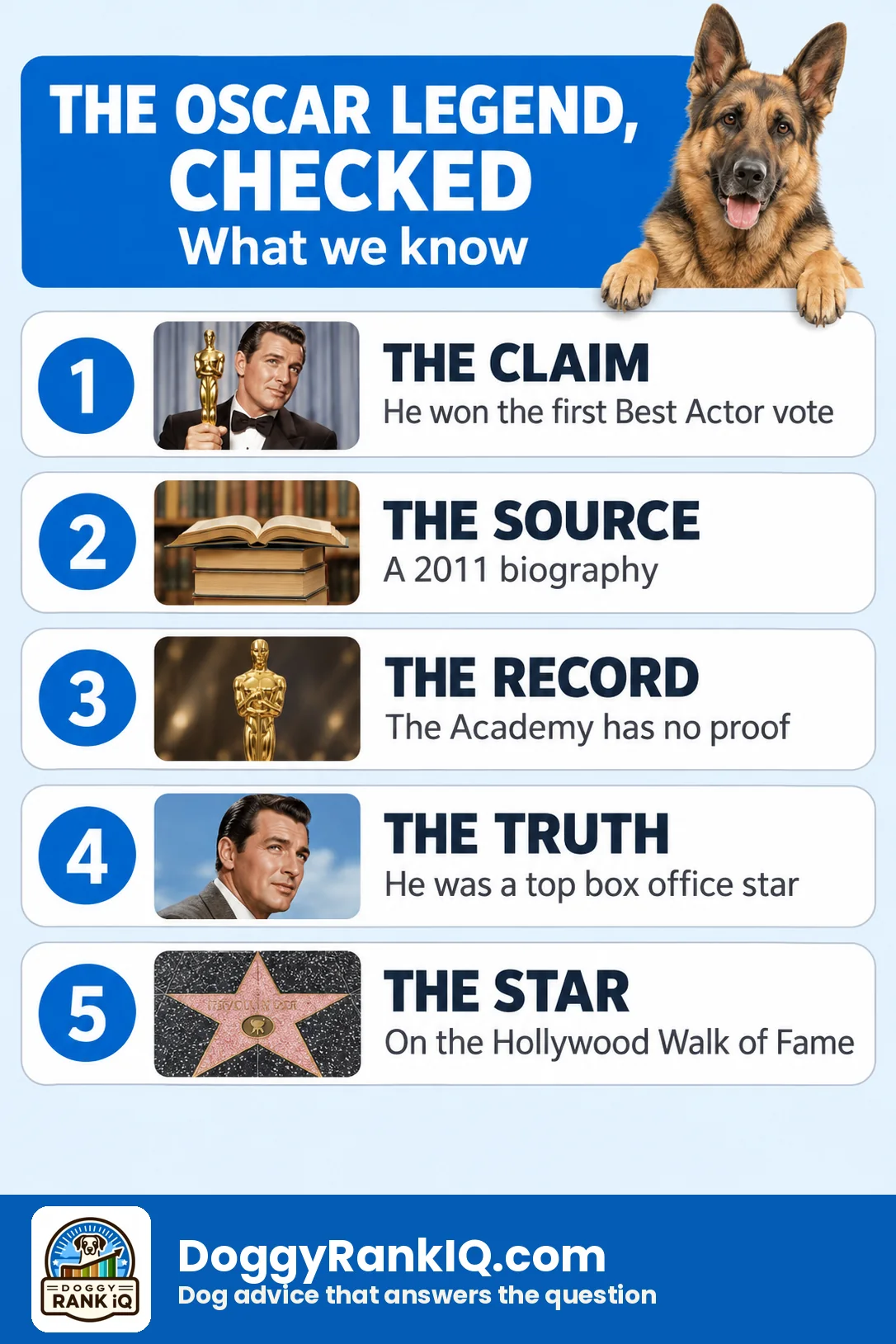
- The claim that Rinty received the most votes for the first Best Actor Oscar is widely repeated but not confirmed by Academy records (en.wikipedia.org).
- Rinty died in Los Angeles on August 10, 1932, and was later reburied at the Cimetière des Chiens near Paris (en.wikipedia.org).
- The Adventures of Rinty ran on ABC from 1954 to 1959, and the original dog has a star on the Hollywood Walk of Fame (en.wikipedia.org).
- No confirmed 2026 film titled “Rinty: The Real War Puppy Who Saved a Studio” exists in available records; recent coverage is historical, not a new production (people.com, shc.stanford.edu).
What do you want to know?
Tap an option to see the answer.
The short answer: who Rin Tin Tin was
Rinty was a German Shepherd rescued as a puppy during World War I who became one of the first dogs to carry a Hollywood studio on his back. He wasn’t a prop or a mascot. He was, by most accounts, the reason a shaky young studio kept its lights on through the 1920s (nprillinois.org, military.com).
The short version people repeat at dinner parties goes like this: soldier finds puppy in a war zone, puppy grows up to be a movie star, movie star saves a company. Each piece of that sentence holds up reasonably well under scrutiny, though film historians note that the specific details of the rescue have been retold differently across decades, shaped in part by studio publicity departments that had every incentive to make a good story better (shc.stanford.edu).
What’s solid: a German Shepherd born in a conflict zone in France ended up making roughly two dozen films for Warner Bros., reportedly pulled in thousands of fan letters a week, and became wealthy enough (on paper) that some accounts say he earned more than many of his human co-stars (people.com). For readers who already live with a German Shepherd, the breed’s working intelligence and handler loyalty go a long way toward explaining how a scared, abandoned puppy became trainable enough to hit marks on a silent film set.
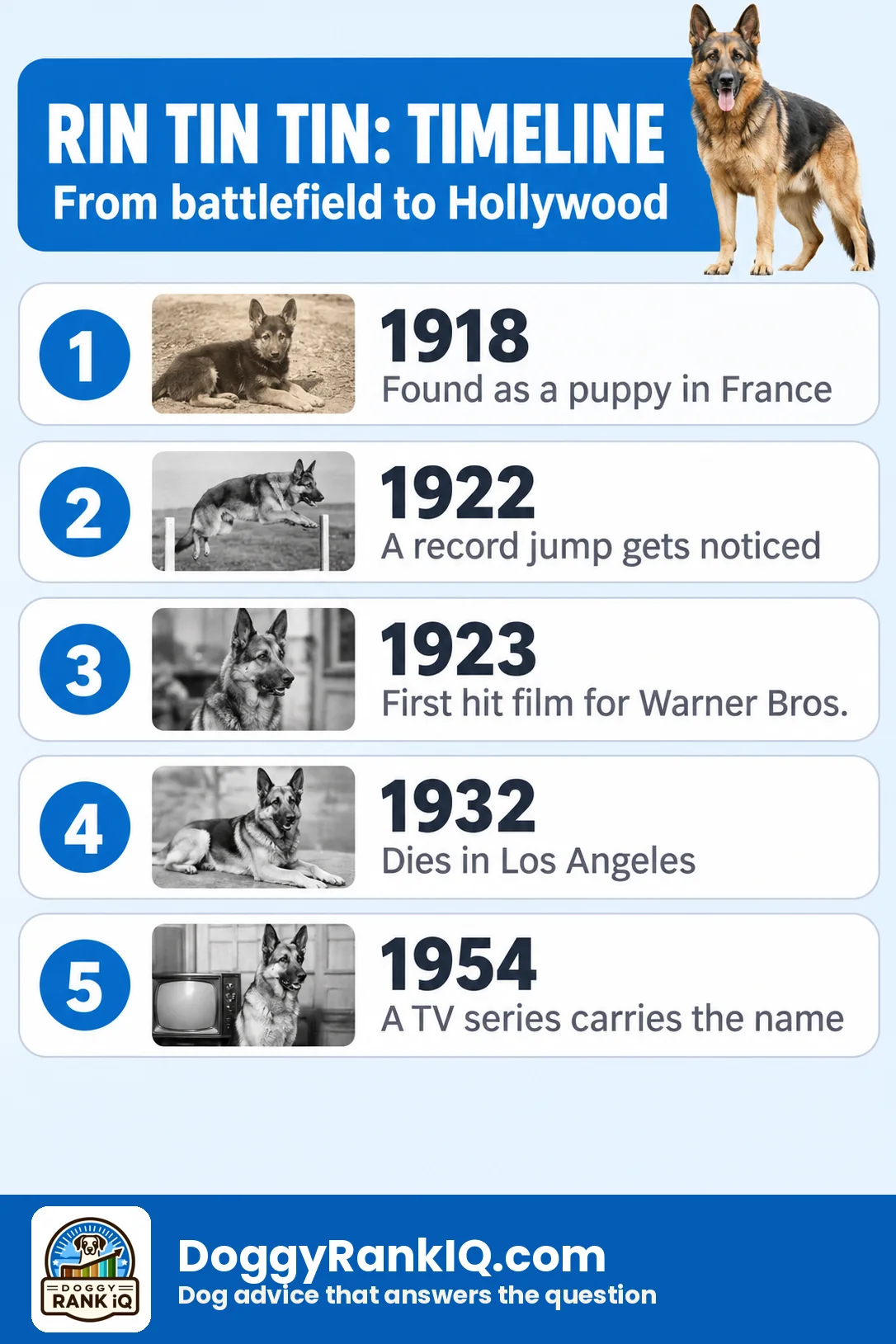
Timeline table: Rin Tin Tin’s life in dates
The real war puppy: found on a battlefield in 1918
Rinty’s origin story starts in a war zone, and that part is well documented even if the exact wording has shifted over time. In September 1918, Corporal Lee Duncan found a German Shepherd mother and a litter of newborn puppies near a bombed kennel close to Flirey, in the Lorraine region of France (en.wikipedia.org). He kept two of the puppies.
Stanford’s cinema history researchers caution that “every single fact” about his early life got tangled up with studio publicity over the decades, and that some retellings describe a dog named Fritz found wounded beside dead military dogs, which later versions folded into the Rinty story (shc.stanford.edu). That doesn’t mean the rescue didn’t happen. It means the version that survived into popular memory was polished for maximum heartstring pull, which is pretty normal for anything a publicity department touches.
A French regional paper revisited the story in late 2026, framing Rinty as the only actor from Lorraine to earn a star on the Hollywood Walk of Fame, and repeating the account of Duncan rescuing the mother and five puppies from a German military kennel [source: estrepublicain.fr, 2026]. The war puppy framing isn’t marketing fluff. It’s the actual starting point of the story, even if some texture got added along the way.
Common mistake: assuming the rescue story is pure Hollywood invention because parts of it were embellished. The core event, a soldier rescuing German Shepherd puppies in a WWI combat zone, holds up across multiple independent sources (en.wikipedia.org, shc.stanford.edu).
Why was he named Rin Tin Tin?
Duncan named the puppy and his sister after Rintintin and Nenette, small French good-luck dolls that soldiers carried and handed to each other during the war (en.wikipedia.org). The dolls were a known wartime comfort object, so naming two rescued puppies after them was a fitting, human gesture from a soldier who’d just lived through a bombed kennel and plenty else.
Nanette didn’t make the transition well. She died shortly after reaching the United States, leaving Rinty as the one Duncan trained and eventually brought to Los Angeles (en.wikipedia.org). It’s a detail that gets lost in the triumphant version of the story, and it’s worth sitting with for a second: Duncan’s famous Hollywood dog was the survivor of a pair, not a solo rescue from the start.
The dog who saved a studio: Warner Bros. and the silent films
Rinty didn’t just appear in movies, he reportedly kept a studio solvent during a rough financial stretch. Warner Bros. in the early 1920s was a small, struggling outfit, and insiders are said to have nicknamed Rinty the “mortgage-lifter” because his films’ box office repeatedly pulled the studio out of trouble (nprillinois.org).
Susan Orlean, who researched the dog extensively for her biography, described this dynamic directly in a 2012 interview: Warner Bros. was a small studio whose Rinty pictures helped it through financial difficulty more than once, not just a single lucky hit (nprillinois.org).
The 1922 jump at a dog show is the moment most retellings point to as the door-opener. Film of Rinty clearing nearly 12 feet reportedly got him noticed enough to land studio work (military.com). Where the North Begins (1923) followed and became his first real hit (en.wikipedia.org). From there, he went on to make around 27 films for Warner Bros. (en.wikipedia.org).
How big a hit was he really?
Figures describing his fan mail vary by source. One recent account puts it at up to 10,000 fan letters a month (people.com), while other long-circulating claims describe thousands per week. The specific weekly-versus-monthly figure isn’t nailed down consistently across sources, but the volume was clearly enormous for any film star, human or otherwise, in that era.
Was it really one movie that saved the studio?
Probably not, and the strongest sources are careful about this. The Library of Congress describes him as having “reportedly” saved Warner Bros. from bankruptcy, a deliberate qualifier that distinguishes reputation from a confirmed accounting fact [source: loc.gov]. Britannica similarly credits him with helping save the studio “in the latter days of silent films,” language that points to a cumulative effect across many films rather than one bailout picture [source: britannica.com]. EBSCO frames the series as Warner Bros.’ first truly successful franchise, tied to staff writer Darryl F. Zanuck’s scripts, which helped build the studio’s broader production system [source: ebsco.com]. The honest takeaway: Rinty’s films were a dependable revenue engine across multiple years, not a single movie miracle.
Did Rin Tin Tin win an Oscar? The legend checked
No, and this is worth saying plainly: there’s no Academy record confirming that Rinty received the most votes for the first Best Actor Oscar in 1929. The claim is widely repeated, including in Susan Orlean’s 2011 biography, but it isn’t something the Academy itself has verified (en.wikipedia.org).
Here’s why the legend persists anyway. The story is good. A dog nearly winning the first-ever Best Actor award, only to be passed over for a human because the Academy supposedly wanted to be taken seriously, is the kind of detail that spreads regardless of documentation. It fits neatly into the larger narrative of Rinty as an underappreciated genius who carried a studio and got snubbed for his trouble.
Decision rule for readers: treat the Oscar claim as popular legend worth mentioning, not as a sourced fact. It’s fine to repeat with a caveat. It’s not fine to state as settled history.
Rin Tin Tin on TV and the dogs that followed
Rinty the original dog died on August 10, 1932, in Los Angeles (en.wikipedia.org). Duncan later had him reburied at the Cimetière des Chiens in Asnières-sur-Seine near Paris, a cemetery for animals that remains a pilgrimage spot for fans of the dog (en.wikipedia.org).
The name didn’t die with him. Descendants and namesake dogs carried the Rinty name forward for decades, and The Adventures of Rinty ran on ABC from 1954 to 1959 (en.wikipedia.org), introducing an entirely new generation to the character through a Rinty series built for television rather than silent film. The original dog also has a star on the Hollywood Walk of Fame (en.wikipedia.org), a rare honor for an animal performer from that era.
Beyond the TV show, the Rinty name has shown up in a Rinty comic, at least one Rinty cartoon adaptation, assorted Rinty photo collections from film archives, and even unexpected cultural corners like a Rinty song reference and a winery that borrowed the name for a Rinty wine label. There’s also been chatter online about a Rinty rap reference in hip hop lyrics, which says something about how deep the name sank into American pop culture across nearly a century.
As for whether there’s a confirmed new Rinty movie titled “Rinty: The Real War Puppy Who Saved a Studio” streaming somewhere in 2026: no verified production, distributor, or streaming listing for that exact title turned up in recent searches. What does exist is steady archival interest. The Library of Congress ran a 2026 program pairing Clash of the Wolves (1925) with Tracked by the Police (1927), describing Rinty plainly as “the dog who saved Warner Brothers” [source: loc.gov, 2026]. That’s film preservation and historical programming, not a new theatrical release. If you’re hoping to watch something, your realistic 2026 options are the surviving silent films through archival screenings and streaming libraries, plus documentaries and books about his life, rather than a confirmed new biopic.
For families wondering if this story is appropriate for kids: the core narrative (a rescued puppy becomes a beloved movie star) is gentle and kid-friendly. The parts worth previewing first are the wartime setting and the dog’s eventual death, which are handled matter-of-factly in most retellings but might need a sentence of context for younger viewers.
If you’re drawn to the idea of famous dog stories on screen more broadly, other options people compare Rinty to include Lassie Come Home, Old Yeller, and Hachi: A Dog’s Tale, each built around a dog’s loyalty and a human bond strong enough to carry a whole film.
Who came first, Lassie or Rin Tin Tin? Facts table
Rinty came first by a wide margin. He started his film career in the early 1920s, while Lassie’s first film, Lassie Come Home, arrived in 1943, roughly two decades later.
⭐ Top 5 Features We Love
- A rescue, not a breeding program. He wasn’t bred for stardom, he was pulled from a wrecked kennel in a war zone and happened to have the temperament and intelligence to be trained (en.wikipedia.org).
- The studio-saving arc. Few animal stories have a documented financial stake attached, and the “mortgage-lifter” nickname gives this one real texture beyond sentiment (nprillinois.org).
- The fan mail numbers. Reports of thousands of letters a week, up to around 10,000 a month by one account, show the scale of his cultural reach in the 1920s (people.com).
- The honest uncertainty around the Oscar claim. It’s a better story because it isn’t fully confirmed, and good coverage says so plainly instead of pretending it’s settled (en.wikipedia.org).
- The long tail of the name. From the 1950s TV series to a Rinty comic, Rinty cartoon, and even a Rinty wine label, the name kept finding new audiences across generations (en.wikipedia.org).
⚠️ Things to Look Out For
- Working drive needs an outlet. German Shepherds were bred for herding and guarding, and a bored one will find its own job, usually one you don’t approve of. Daily structured exercise and enrichment like lick mats help channel that energy.
- Training has to start early. Rinty’s trainability wasn’t automatic, Duncan worked with him consistently. Pair this with our guide on training your puppy for a realistic starting plan.
- Shedding is a real commitment. German Shepherds have a dense double coat and shed heavily, especially seasonally.
- Protective instincts need direction. Their guarding tendencies are a feature, not a flaw, but they need socialization so protectiveness doesn’t turn into reactivity. Our breakdown of protection dog breeds covers what that instinct actually looks like day to day.
- Health screening matters. Hip and elbow dysplasia run in the breed, so ask breeders about hip scores and consider whether pet insurance makes sense for your budget before bringing a puppy home.
Rin Tin Tin books and dog history reads
For readers who want more than a web article, a few books dig into the dog history and the German Shepherd breed behind the legend.
Rinty: The Life and the Legend by Susan Orlean is the definitive biography, tracing both the dog and the decades of myth-making around him. Price checked 2026: $10.15. Check the current price.
The Dog Encyclopedia from DK gives broader breed context, useful if Rinty’s story sparked curiosity about German Shepherds and working dogs generally. Price checked 2026: $13.29. Check the current price.
The Invention of the Dog: 75 Breeds that Changed the World looks at how specific breeds, German Shepherds included, shaped human history well beyond the movie screen. Price checked 2026: $32.62. Check the current price.
FAQ
The bottom line
Rinty’s story holds up where it matters most: a German Shepherd puppy really was rescued from a war zone in 1918, really did become a major Warner Bros. star, and really was credited by studio insiders with keeping the company solvent through hard years (en.wikipedia.org, nprillinois.org). The parts worth holding loosely are the exact details of the rescue, which got polished by decades of publicity, and the Oscar legend, which no Academy record confirms (en.wikipedia.org, shc.stanford.edu). If you’re researching this for a classic film deep dive or because you just adopted a German Shepherd and want to know what you’re in for, start with Orlean’s biography, then take a look at our guide on dog body language to understand the breed’s signals before you bring one home. And if you’re curious how smart a dog like Rinty actually needed to be to pull off those silent film stunts, our piece on how smart dogs really are is a reasonable next stop.
Doggy Rank IQ is reader supported. As an Amazon Associate we earn from qualifying purchases, at no extra cost to you.