
Twelve years old, half blind in one eye by some accounts, and almost given away as a puppy because he wouldn’t stop chewing harnesses. That’s the togo dog who ran 261 miles through a whiteout so a town of children wouldn’t choke to death on diphtheria. The other dog, the one with the Central Park statue, ran about 55.
Quick Answer
The togo dog, a Siberian Husky owned by musher Leonhard Seppala, led the longest and most dangerous leg of the 1925 serum run to Nome, covering roughly 261 miles across the frozen Norton Sound (nationalgeographic.com, en.wikipedia.org). Balto led the final 55-mile leg into town with musher Gunnar Kaasen and got the press, the statue, and the fame (akc.org). Historians and the National Park Service now widely credit Togo as the actual hero of the relay, even though Balto’s name became the household one (en.wikipedia.org).
Key Takeaways: togo dog
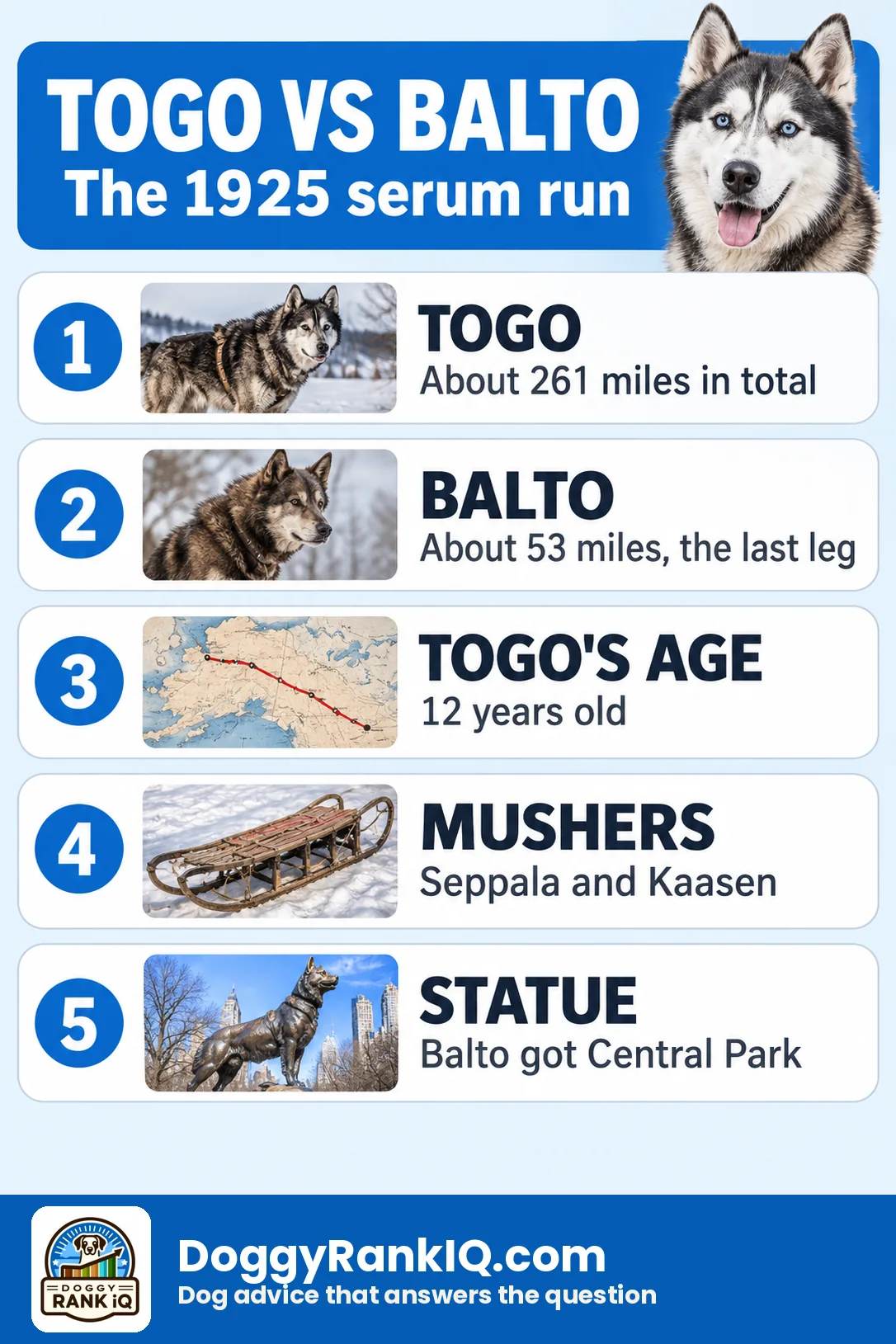
- The togo dog ran about 261 miles total, including the dangerous crossing of Norton Sound’s sea ice (nationalgeographic.com, en.wikipedia.org).
- Balto’s team covered the final leg into Nome, generally reported between 50 and 55 miles (akc.org).
- Togo was 12 years old during the run. Balto was around 3 (akc.org).
- A statue of Balto went up in Central Park in December 1925. Togo got a smaller, later recognition, including a statue in Seward Park, New York (en.wikipedia.org).
- Togo died in 1929 at age 16 in Poland Spring, Maine (en.wikipedia.org).
- In 2026, Togo’s skeletal remains were transferred from Yale’s Peabody Museum to the University of Alaska Museum of the North in Fairbanks, renewing public interest in his story (alaskasnewssource.com, alaskapublic.org).
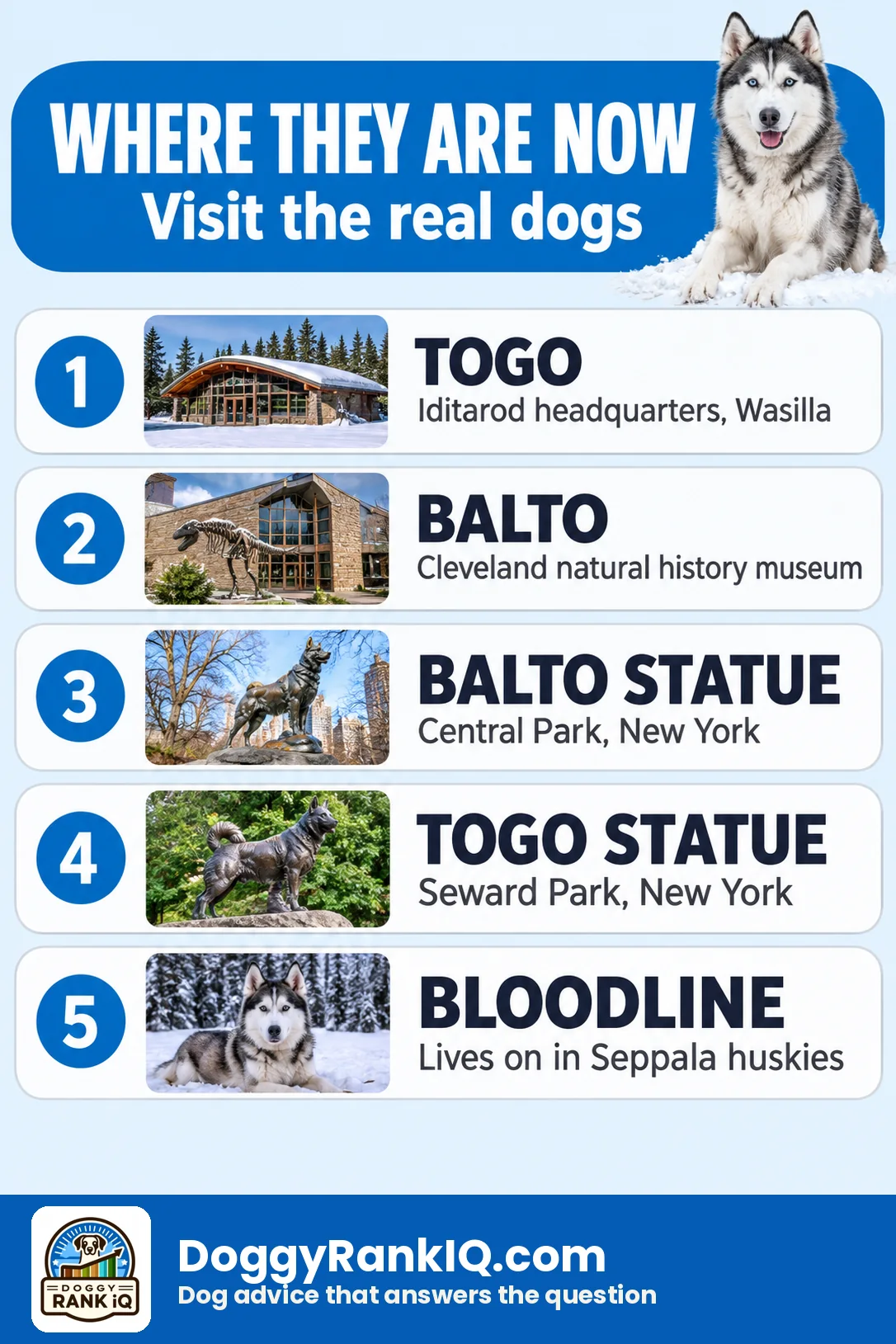
- Togo’s taxidermied mount still sits at the Iditarod Trail Committee headquarters in Wasilla (alaskapublic.org).
- Togo’s bloodline lives on in Seppala Siberian sled dogs and many modern Siberian Huskies (en.wikipedia.org).
- Disney’s 2019 film Togo, starring Willem Dafoe, dramatized the relay and used a descendant of Togo as the lead dog actor, Diesel.

What do you want to know?
Tap an option to see the answer.
The short answer: Togo dog vs Balto
Togo ran farther and through worse conditions. Balto finished the job in front of cameras.
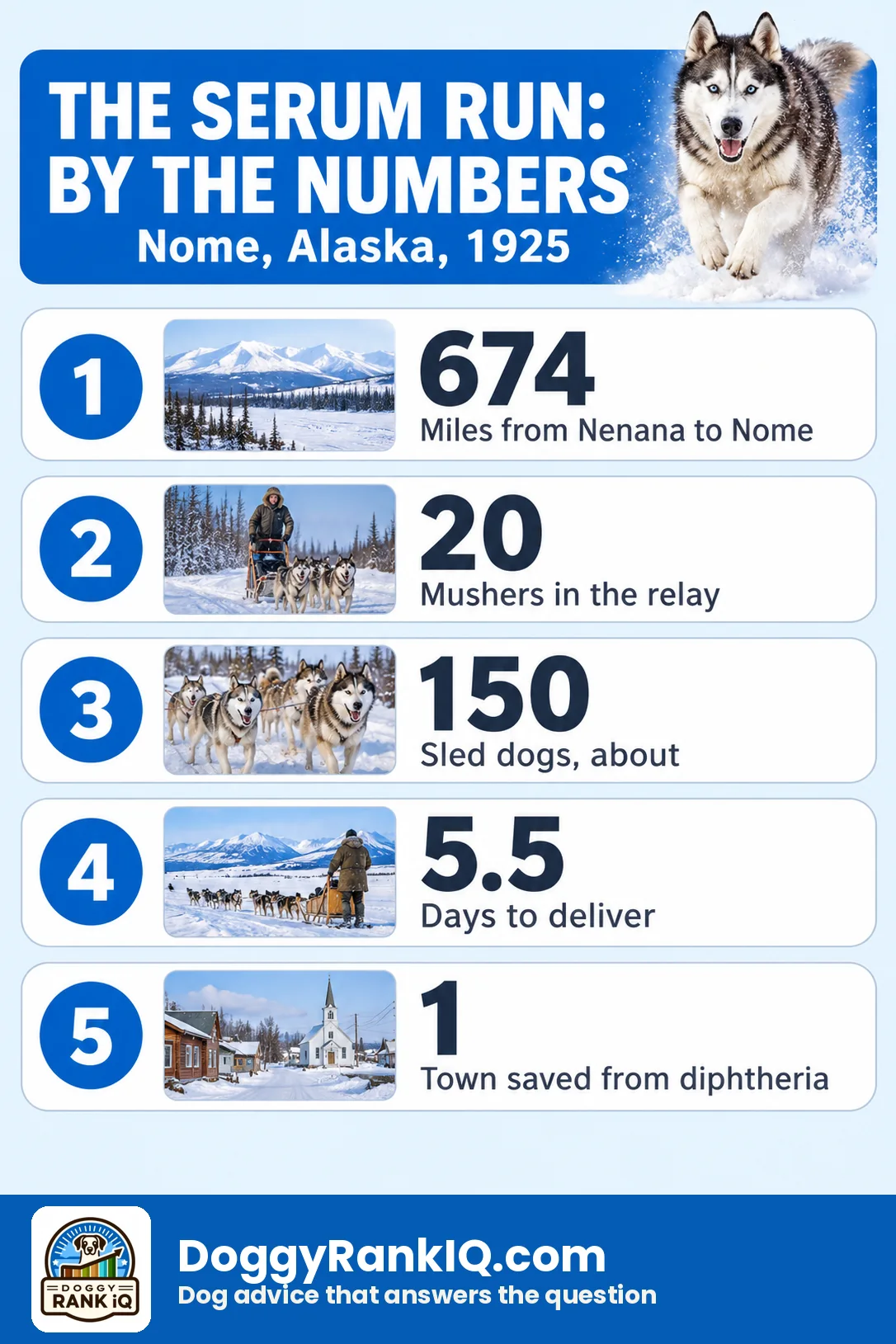
Both dogs belonged to the same kennel, run by Leonhard Seppala in Nome. During the January 1925 diphtheria crisis, roughly 20 mushers and about 150 dogs relayed antitoxin serum 674 miles from Nenana to Nome in about five and a half days (en.wikipedia.org, archives.alaska.gov). Seppala’s team, led by Togo, took on the outbound trip to meet the relay partway, crossed the ice of Norton Sound in gale winds, and covered the single longest and most hazardous stretch of the whole operation (nationalgeographic.com, en.wikipedia.org). Gunnar Kaasen’s team, led by Balto, carried the serum the last stretch into Nome on February 2, 1925, and delivered it without a single broken vial (archives.alaska.gov).
The difference between them isn’t really about who worked harder. It’s about who was standing in the finish-line photo. Kaasen’s arrival made morning headlines. Seppala’s team had already turned around and gone home, exhausted, with no reporters waiting.
Choose to remember Togo if you care about mileage and risk. Choose Balto if you’re grading on public relations. The historical record increasingly favors the first answer (en.wikipedia.org, akc.org).
Timeline table: the 1925 serum run in dates
Who Togo was: the undersized pup Seppala nearly gave away
Togo was born small and difficult, and Seppala almost didn’t keep him. As a puppy he chewed harnesses, jumped fences, and generally acted like a dog with no interest in sled work. Seppala gave him to a neighbor. Togo kept escaping and running back.
By the time of the 1925 crisis, Togo was 12 years old, an age where most sled dogs are retired, not leading a 261-mile emergency relay (akc.org). He’d already spent over a decade proving himself on Seppala’s team, including competitive distance races across Alaska.
What changed the math in 1925 was simple necessity. Seppala needed his most trusted lead dog for the hardest, most unpredictable section of trail, the part crossing the ice of Norton Sound, where a wrong turn could mean the whole team disappears into open water. He picked Togo because Togo had already earned it.
This is the part the Disney film leans into hardest, and it’s the part that history actually supports: an aging dog nobody would have bet on, doing the job that mattered most. If you’re weighing whether a working breed like a Husky fits your household, it helps to understand what these dogs were bred to do before you decide whether your home can match that drive; our guide on whether you should shave a husky covers a related misunderstanding about the breed’s coat and climate needs.
The real hero of the serum run: Togo’s 261 miles
Togo’s team covered approximately 261 miles total, more than any other team in the relay, and crossed the most dangerous terrain in the entire 674-mile route (nationalgeographic.com, en.wikipedia.org). National Geographic’s account, reported by historian Nina Strochlic, puts Togo’s serum-carrying portion at about 91 miles during the most hazardous outbound-and-return stretch, with the full round trip from Seppala’s push toward the oncoming relay adding up to the larger total (nationalgeographic.com).
The Norton Sound crossing deserves specific attention because it wasn’t simply a longer version of what Balto’s team did. Sea ice can shift and break apart under a team’s weight. Seppala made the decision to cross it anyway, in the dark, in temperatures that the Alaska State Archives records dropping to around negative 85 degrees Fahrenheit with gale-force wind during the relay (archives.alaska.gov). The National Park Service states plainly that Balto often gets the credit, but Togo led the team across the most dangerous section (en.wikipedia.org).
Owners who think a Husky’s cold tolerance means the breed can handle anything should look closely at what that tolerance actually covers; our piece on how cold is too cold for dogs breaks down the real limits, which still apply to modern Huskies even if their ancestors crossed ice in a historic storm.
Mileage figures vary slightly by source. Some put Togo’s total at 260 or 264 miles rather than exactly 261 (nationalgeographic.com, akc.org). The variation comes down to how different historians measured the outbound trip to meet the relay versus the return trip carrying serum. None of the figures come close to Balto’s share of the run.
Balto’s final leg and why he got the statue
Balto led the last leg into Nome, a stretch most commonly reported as 55 miles, though some sources list it closer to 50 or 53 depending on how the segment is measured (akc.org). That leg mattered because it was the one that physically delivered the medicine. Until Kaasen’s team crossed into town on February 2, 1925, the entire relay hadn’t technically succeeded (akc.org).
Reporters were waiting in Nome. Kaasen and Balto arrived to a town that needed good news and a dog that photographed well. A statue of Balto went up in New York’s Central Park by December 1925, less than a year after the run, and Balto’s body is now preserved at the Cleveland Museum of Natural History.
Balto got famous because he was the last dog standing when the cameras showed up. That’s not nothing, but it’s also not the same as running the hardest part of the trail. The American Kennel Club’s account of the run makes the comparison directly: Togo covered more distance through more danger, while Balto finished the final, highly visible stretch (akc.org).
Facts table: Togo vs Balto
How much of the movie Togo is true?
Disney’s 2019 film gets the core facts right: Togo was 12, Seppala doubted him as a puppy, and the team crossed Norton Sound’s ice under brutal conditions. The movie compresses some events and adds dramatic flourishes typical of a feature film, including invented dialogue and tightened timelines, but the central claim, that Togo ran the longest and most dangerous leg while Balto got the fame, matches the historical record (nationalgeographic.com, en.wikipedia.org).
Where the film takes liberties is mostly in scene construction rather than outcome. Historical accounts don’t support every specific moment shown (there’s no documented record of some of the more cinematic near-misses), but the overall shape of the story, an underestimated 12-year-old dog saving a town and getting overlooked for it, lines up with what museums and the National Park Service document (en.wikipedia.org). The lead dog actor in the film, Diesel, is a descendant of the original Togo, which is a detail worth knowing if you want to watch real footage versus dramatized scenes; archival Togo dog videos from Alaska historical societies show the actual team and terrain.
What species is the Togo dog? Breed and bloodline today
Togo was a Siberian Husky, specifically from the line Seppala developed and raced competitively across Alaska before 1925. His breeding emphasized stamina and trail judgment over size, which is part of why he was smaller and less imposing than people expect from sled-dog imagery.
Togo’s bloodline continues today through Seppala Siberian sled dogs, a recognized working line, and through broader Siberian Husky genetics more generally (en.wikipedia.org). If you’re considering a Husky because of the togo dog story, know that modern descendants carry the working drive but not automatically the trail judgment; that’s built through training and experience, not inherited wholesale. Owners planning active pursuits like canicross with a Husky-type dog should check fit and gear carefully; our review of canicross harness fit mistakes covers five common setup errors that apply directly to working-line dogs.
🛷 Before the serum run: how Seppala and Togo got that good
The 1925 relay was the hardest thing the Togo dog ever did. It was far from the first hard thing.
Siberian sled dogs reached Nome around 1908, brought across the Bering Strait from the Chukchi people of northeastern Siberia and entered in a new race, the All Alaska Sweepstakes. The course ran 408 miles from Nome to Candle and back. Locals laughed at the imports, which were far smaller than the freighting dogs they knew. Then the small dogs started placing.
Leonhard Seppala won the Sweepstakes three years running, in 1915, 1916 and 1917, with teams of Siberians. Togo, born in 1913, came up through those years. He was named after Admiral Togo Heihachiro, the Japanese naval commander famous since the Russo-Japanese War.
“By 1925, Togo was 12 years old with a full career of racing and freight runs behind him. Seppala picked him anyway.”
That background explains the choice that puzzles people who watch the movie. An old dog in lead on the most dangerous stretch looks like a gamble. For Seppala it was the safe bet. Togo had spent a decade running the coast, crossing sea ice and finding trail in whiteouts, and no younger dog in the kennel had a record close to it.
⭐ Top 5 Features We Love
- Age before glory. Togo was 12, an age most working dogs are retired, when he ran the hardest leg of the relay (akc.org).
- No appetite for fame. Togo retired quietly to Poland Spring, Maine, and lived until 16 with none of Balto’s spotlight (en.wikipedia.org).
- A bloodline that survived him. Seppala Siberian sled dogs trace directly back to Togo’s line and still work trails today (en.wikipedia.org).
- Overdue recognition. Time named Togo the most heroic animal of all time in 2011, decades after the run.
- A homecoming in 2026. Togo’s bones returned to Alaska this year through a museum specimen exchange, putting his story back in the news (alaskasnewssource.com, alaskapublic.org).
⚠️ Things to Look Out For
- Working drive doesn’t disappear in an apartment. Huskies bred from lines like Seppala’s expect real exercise, not a short walk around the block.
- Escape artistry is a documented trait, not a myth. Togo himself jumped fences as a puppy; many Huskies today do the same.
- Coat myths can hurt the dog. Shaving a Husky for summer heat can backfire; see our breakdown on whether you should shave a husky before making that call.
- Cold tolerance has limits. Even a breed built for Arctic trail work has a point where exposure becomes risky; our guide on how cold is too cold for dogs explains the warning signs.
- Loyalty runs deep but isn’t automatic obedience. If you’re drawn to the togo dog story because of loyalty, it’s worth separating devotion from trainability; our piece on what breeds rank highest for loyalty is a useful starting point.
If you’re bringing home a working-line dog with Togo’s kind of energy, watch for stress signals before they escalate; our guide to dog body language warning signals covers cues owners commonly miss.
Togo books worth reading
For readers who want more depth than a movie can offer, three books cover the serum run and Togo specifically.
The Cruelest Miles: The Heroic Story of Dogs and Men in a Race Against an Epidemic covers the full relay, not just Togo’s leg, and gives context on the other 19 mushers involved. Price checked 2026: $10.48. Check the current price.
Togo and Leonhard focuses specifically on the partnership between Seppala and his lead dog, drawing on Seppala’s own accounts. Price checked 2026: $12.63. Check the current price.
Togo of Alaska: The Life and Times of the Greatest Sled Dog is the most detailed single biography of Togo available, covering his life before and after the 1925 run. Price checked 2026: $30.00. Check the current price.
None of these claims replace a museum visit. If you’re near Wasilla, Alaska, the Iditarod Trail Committee headquarters displays Togo’s actual mounted remains, and the University of Alaska Museum of the North in Fairbanks now holds his skeleton following the 2026 transfer from Yale’s Peabody Museum (alaskasnewssource.com, alaskapublic.org).
FAQ
The bottom line
The togo dog ran farther, through worse terrain, at an age when most sled dogs are retired, and got almost none of the credit at the time. Balto finished the visible part of the job and became the household name. Both facts are true, and neither one cancels out the other. If you take one thing from this comparison, let it be this: the 2026 return of Togo’s bones to Alaska is a good excuse to finally give him the recognition the trail already proved he earned (alaskasnewssource.com, alaskapublic.org). For a deeper read, start with one of the books above, or plan a visit to see the actual remains in Wasilla and Fairbanks.
Doggy Rank IQ is reader supported. As an Amazon Associate we earn from qualifying purchases, at no extra cost to you.