
Quick Answer
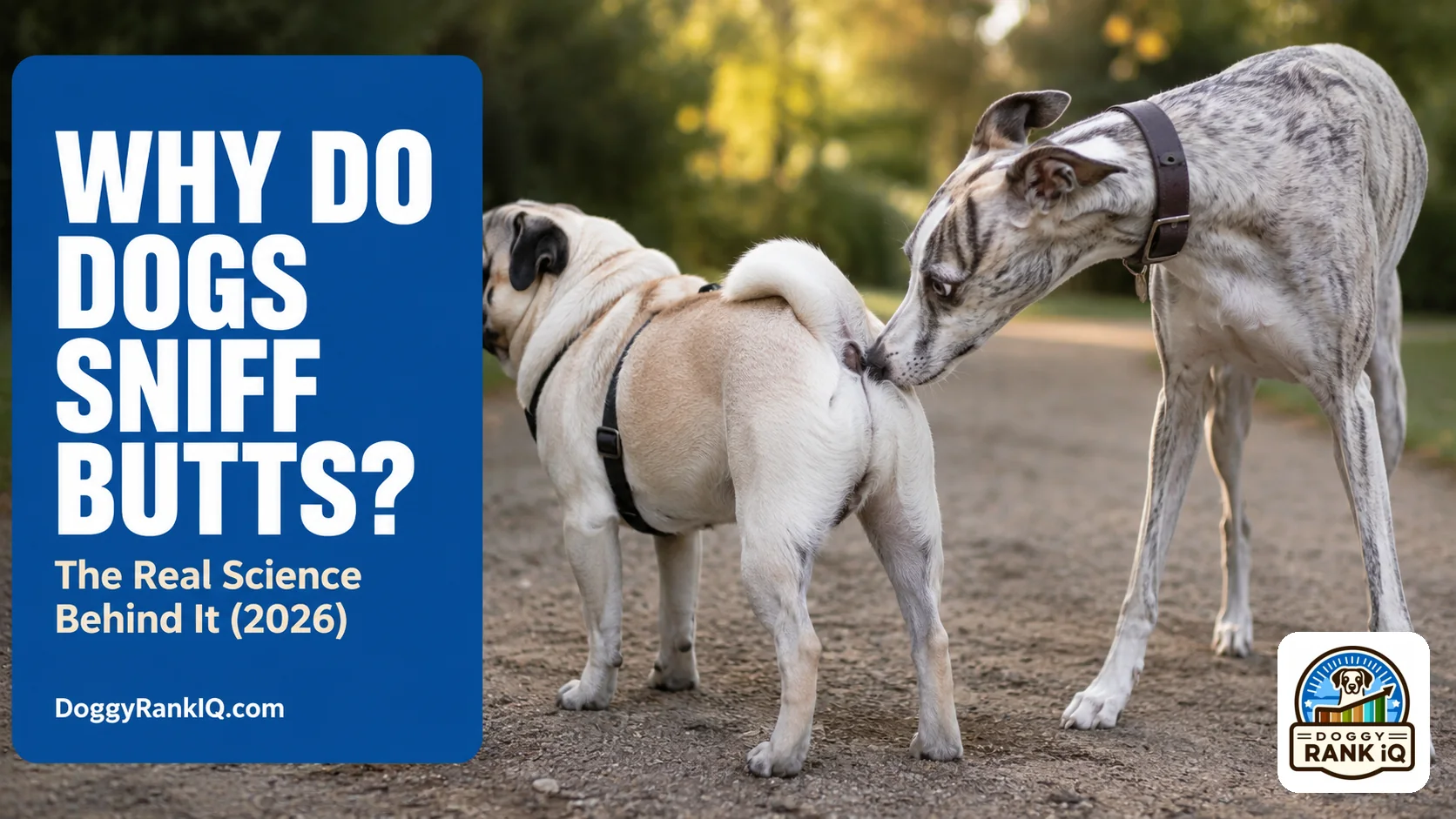
Dogs sniff butts because the anal sacs near the tail release a scent unique to each individual dog, and the vomeronasal organ in the roof of a dog’s mouth is built to decode it. One sniff can tell a dog another animal’s sex, reproductive status, general health, and whether they’ve met before. Why do dogs sniff butts instead of shaking paws? Because a dog’s nose carries far more scent receptors than a human’s eyes carry information, and this spot is the richest source of personal chemical data on another dog’s body.
Key Takeaways: why do dogs sniff butts
- Why do dogs sniff butts: two anal sacs near the anus release a scent signature unique to each dog (akc.org)
- The vomeronasal (Jacobson’s) organ detects chemical signals and routes them straight to the brain (akc.org)
- A single sniff can reveal sex, health status, stress, and familiarity (vcahospitals.com)
- Dogs have up to roughly 300 million scent receptors; people have around 6 million
- A 2026 study found dogs discriminate emotional odors between dogs, including signs of stress (nature.com)
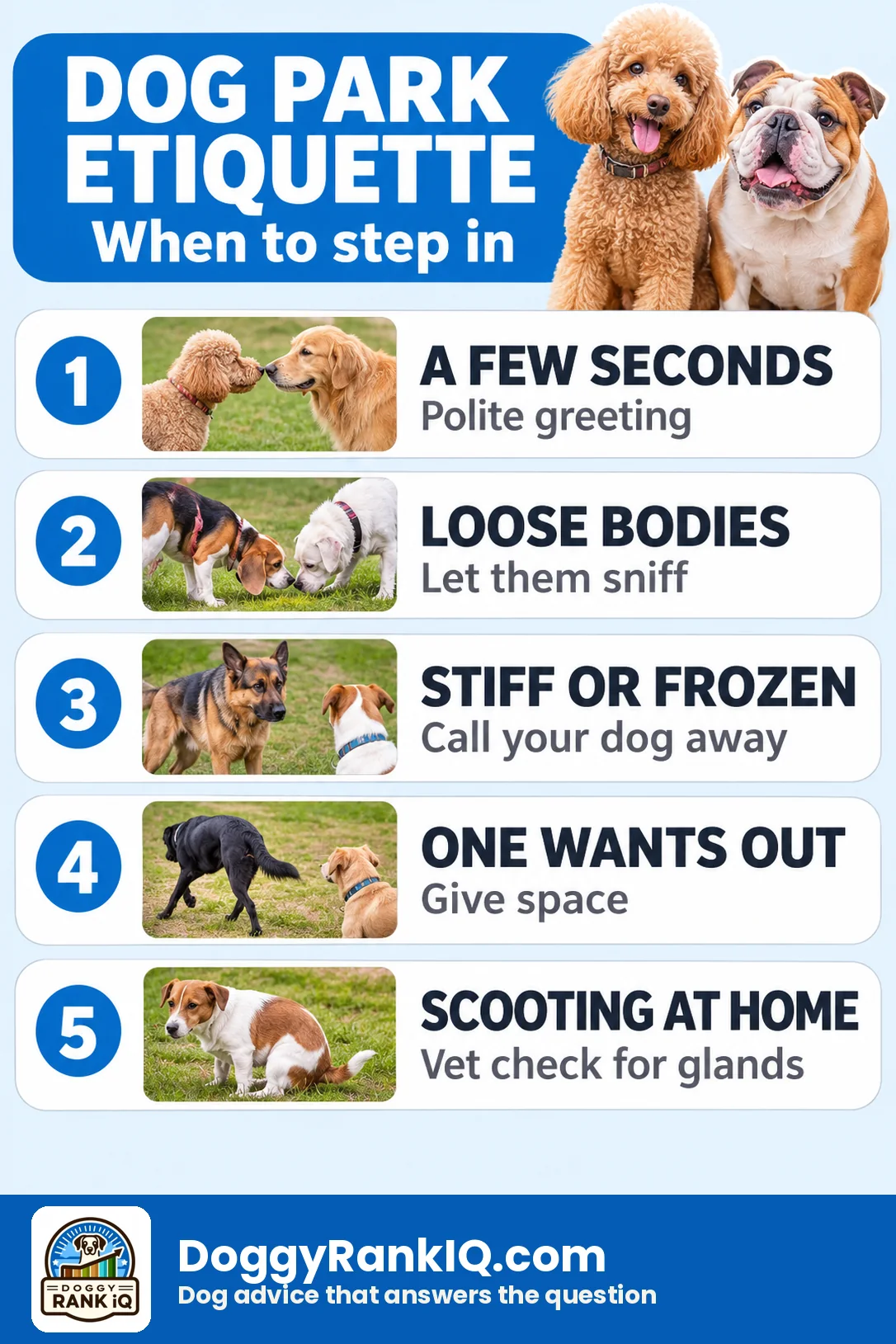
- Mutual sniffing lasting a few seconds is normal greeting behavior between dogs
- Stiff posture, freezing, or one dog trying to leave means it’s time to separate them
- Puppies sniff more while they’re still learning to read canine signals
- Scooting, a fishy smell, or constant licking near the tail suggests anal gland trouble, not curiosity
- Dogs sniffing a person’s crotch are reading sweat glands concentrated in that area, not being rude on purpose
What is happening?
Tap an option to see the answer.
The short answer: why do dogs sniff butts?
Dogs sniff butts because that’s where the most personal chemical information is stored. The area around a dog’s anus holds two small scent glands that release a secretion loaded with individual identifying information, and a dog’s nose and mouth are equipped to read it like a name tag.
This is the standard explanation offered by veterinary behavior sources: the behavior functions as a chemical greeting, not an act of dominance or an accident (vcahospitals.com). A dog meeting another dog for the first time doesn’t have a handshake or a business card. It has a nose that outperforms a human’s by a wide margin, and it uses the richest scent source available.
The short version also answers a common follow-up: is it normal for dogs to sniff butts when they meet? Yes. Veterinary behaviorists describe brief mutual sniffing as typical canine greeting etiquette, not a behavior that needs correcting (vcahospitals.com). The exception is when the sniffing turns into something longer, one-sided, or tense, which the etiquette section below covers.
The real science: anal sacs and a second nose
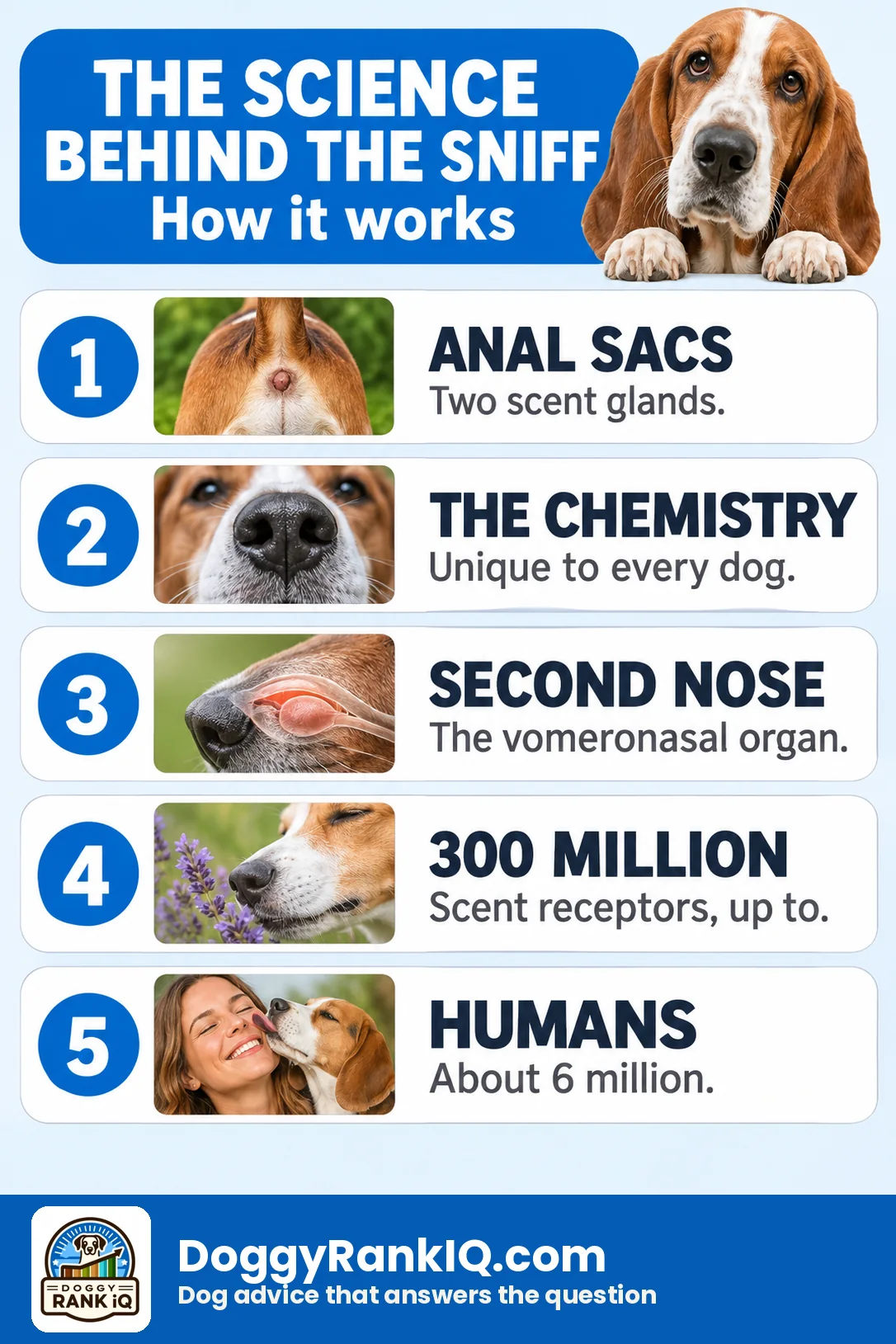
Two small sacs sit on either side of a dog’s anus, and they release a secretion with a scent that is particular to that individual dog (akc.org). This is the anatomy behind most butt-sniffing behavior, and it works alongside a specialized scent organ most owners never think about.
The anal sacs release their contents during normal bowel movements, and sometimes involuntarily during fear or stress (akc.org). The release isn’t random. Chemical analysis of anal sac secretions in dogs has identified dozens of distinct compounds. A commonly cited chemical study examined anal sac samples from five intact male and five female dogs and found 64 separate compounds, some shared across dogs and some that varied by sex or by the individual animal (akc.org). Earlier chemical work on anal sac secretions, published in the Journal of Chemical Ecology in 1976, identified trimethylamine and short-chain fatty acids as prominent components of the mixture researchers analyzed in dogs and coyotes.
A newer study adds a biological mechanism to the chemistry. Researchers examining canine anal sac glands found proteomic evidence, from 17 dogs, of three odorant-binding proteins present in consistently high amounts (ouci.dntb.gov.ua). These proteins may help carry or stabilize the odor molecules that make the secretion readable to another dog’s nose, a detail that moves anal gland secretion from “smelly byproduct” to “actual communication system.”
None of this would matter without a dog’s second nose: the vomeronasal organ, also called Jacobson’s organ, located in the roof of the mouth. The American Kennel Club explains that this organ detects chemical communication signals and sends that information along its own nerve pathway directly to the brain, separate from regular smell (akc.org). That’s why dogs sometimes freeze with their mouth slightly open after a deep sniff. They’re not confused. They’re processing.
Decision rule: if your dog pauses with a slightly open mouth and curled lip after sniffing (a behavior called the flehmen response), that’s the vomeronasal organ at work, not discomfort.
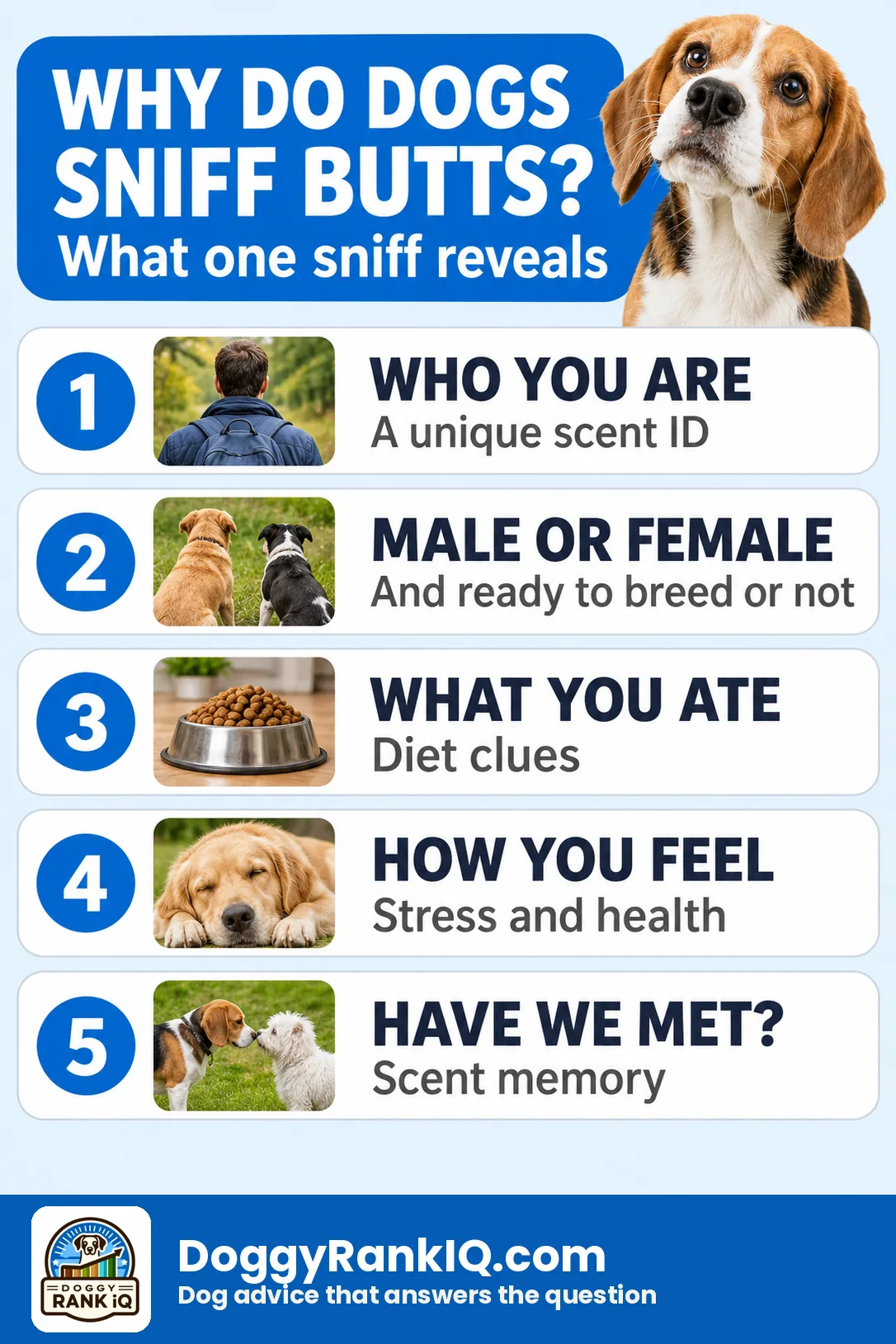
Facts table: what one sniff tells a dog
This table answers “why do dogs sniff butts” at a glance.
How good is a dog’s nose compared with ours?
A dog’s nose is built on a different scale than a human nose, and that difference explains why dogs read a greeting sniff the way people read a face. Dogs are commonly cited as having up to roughly 300 million scent receptors, compared with about 6 million in people, a gap wide enough that comparing the two senses barely feels fair.
The American Kennel Club notes that dogs rely heavily on scent to understand their surroundings and that the vomeronasal organ gives them a channel for chemical communication that humans simply don’t have (akc.org). That’s the mechanical answer to why do dogs sniff butts but humans don’t: our noses aren’t wired for it, and we don’t have the organ that reads it.
Recent research backs up just how specific this sense can get. A 2026 study in Scientific Reports tested 43 dogs with odors collected from a single donor dog during three states: resting, play, and a nail trim (nature.com). Dogs spent more time investigating novel odors than repeated ones, which showed they could tell odors apart. In several comparisons they reliably told “joy” odor apart from baseline, and in some trials told joy apart from stress (nature.com). That’s a real, measured ability to detect emotional difference through scent, not a guess about canine feelings.
The study has real limits worth naming. The discrimination test used 43 dogs, but the behavioral-response portion used only 24, and all the test odors came from one unfamiliar female donor dog (nature.com). The researchers did not find equally strong evidence that dogs told stress odor apart from baseline odor in every test (nature.com). So the finding is solid for “dogs can detect some emotional differences in scent,” and not yet solid enough to claim dogs read every emotion reliably from every dog. For readers curious how this fits into the bigger picture of canine senses, the full explainer on how dogs experience smell covers the mechanics in more depth.
A related 2026 study looked at urine marking instead of anal gland scent. Researchers linked 11 intact male dogs’ responses to unfamiliar female and male urine odors with measurable changes in urinary cortisol, oxytocin, testosterone, norepinephrine, and dopamine (link.springer.com). Dogs that placed their marks farther from the source, more than 2 meters away in some trials, showed higher cortisol, norepinephrine, and dopamine levels in certain comparisons (link.springer.com). That’s a small, specific study population and it covers urine marking specifically, not general butt-sniffing, but it supports the larger point: canine scent communication connects to real hormonal and emotional states, not just identification.
Dog park etiquette: when to allow it and when to step in
A few seconds of mutual sniffing between two dogs is normal and usually ends on its own. Owners should intervene when the body language shifts from relaxed to tense.
Decision rule: let it happen if both dogs have loose, wiggly bodies and the sniffing is brief and mutual. Call them apart if you see:
- Stiff, frozen posture in either dog
- A tail held high and rigid, not loosely wagging
- One dog repeatedly trying to walk away while the other follows
- A hard stare instead of a quick glance away
Is butt sniffing a sign of aggression or dominance? Generally no. Veterinary sources describe it as a greeting ritual, not a power move (vcahospitals.com). The exception is when one dog corners another and won’t let them leave, which is a boundary problem worth separating regardless of the sniffing itself. First meetings go more smoothly on neutral ground with both dogs on a longer leash rather than nose to nose at the door; the guide on how to introduce dogs walks through a calmer sequence for that.
Is it unhygienic when dogs sniff each other’s butts? It’s not the cleanest habit by human standards, but it isn’t the health risk owners sometimes assume from the behavior itself. The actual hygiene concerns around dogs, like parasite exposure, come from shared yards, water bowls, and fecal contact generally, not specifically from a few seconds of nose contact.
Do all dog breeds sniff butts, or just some? All dogs have the anatomy for it: the anal sacs and the vomeronasal organ are standard equipment across breeds. Individual variation shows up in how enthusiastically a dog investigates, which has more to do with personality, early socialization, and confidence than breed alone.
What does it mean when a dog sniffs your butt or crotch?
Dogs sniff human private areas for the same reason they sniff each other: it’s where the body concentrates sweat glands and personal scent information. Humans have a high density of apocrine sweat glands in the groin and underarm areas, and a dog’s nose finds that area just as informative as another dog’s rear end.
This also answers why puppies seem to do it more than adult dogs. Puppies sniff butts more because they’re still building their library of scent associations and learning social rules from experience, the same way they learn not to nip too hard during play. An older dog with more social experience often reads a quick sniff and moves on faster.
A related question owners ask: is it a medical concern if my dog won’t sniff other dogs at all? Usually not. Some dogs are simply less socially motivated or more anxious around new dogs, which is a training and confidence issue rather than a nose problem. If a dog that previously sniffed normally suddenly avoids it and also seems withdrawn or less interested in food, that pattern is worth mentioning to a veterinarian, since it could reflect pain, illness, or an anxiety issue separate from the sniffing itself. Dogs that seem unusually anxious in general, not just around sniffing, may be showing signs covered in the guide to separation anxiety in dogs.
⭐ Top 5 Features We Love
Five things worth knowing for anyone asking “why do dogs sniff butts”:
- The dual-detection system. A dog’s regular nose and its vomeronasal organ work as two separate channels, giving dogs a kind of stereo scent picture that people simply don’t have access to (akc.org).
- The individual scent signature. Because anal sac secretion varies by dog, each animal effectively carries a built-in name tag that other dogs can read instantly (akc.org).
- Emotional scent detection. The 2026 Scientific Reports study showing dogs can discriminate joy from baseline odor suggests scent communication carries more than just identity (nature.com).
- The receptor count gap. Up to roughly 300 million scent receptors versus about 6 million in people is a difference large enough to change what counts as “information” for a dog.
- Social calming through scent. In the 2026 study, dogs exposed to a calm, non-stressed odor behaved differently around strangers than dogs exposed to stress odor, hinting that scent can shape social comfort in real time (nature.com).
⚠️ Things to Look Out For
A few cautions for anyone asking “why do dogs sniff butts”:
- Scooting across the floor. Frequent dragging of the rear end on carpet or grass can signal irritated or impacted anal glands.
- A strong fishy odor. A persistent, sharp smell from the rear that doesn’t wash off is a common sign of gland issues, not normal scent.
- Constant licking or biting near the tail. This often points to discomfort in the same area the glands sit in.
- Visible swelling or redness near the anus.
- Sudden reluctance to let other dogs sniff that area, especially paired with any of the above.
If any of these show up, a veterinary visit is the right next step rather than home guessing. Anal gland problems are common, treatable, and not something to diagnose from an article.
Let them sniff: 4 nose games for home
Giving a dog’s nose a job indoors channels the same instinct that drives butt-sniffing outdoors, just pointed somewhere more convenient.
- Snuffle mat foraging. Hide kibble or small treats in the folds of a snuffle mat and let the dog work it out by scent alone. It’s a slow, calming activity that uses the same scent-processing skills as social sniffing.
- Scent tin discrimination. Set out a few scent tins with distinct smells and reward the dog for picking the correct one. This builds the kind of fine scent discrimination the 2026 odor study measured in a lab setting.
- Long-line sniff walks. Attach a long training lead and let the dog set the pace on a walk focused entirely on sniffing, not covering ground. This respects a dog’s need to gather information the way it naturally would at a dog park.
- Find-it games with household objects. Rotate a few familiar items and hide one with a treat under it. Simple, free, and it reinforces that using the nose is a rewarded activity.
Readers who want the deeper research behind why this kind of enrichment matters can check the piece on how smart dogs really are, which covers cognition research beyond the nose.
Helpful sniffing gear
None of these products change the science. They give a dog’s nose something structured to do, which can reduce the kind of frantic over-sniffing some owners see on leash.
The AWOOF Snuffle Mat for Dogs uses fleece strips to hide kibble or treats, turning mealtime into a scent puzzle. Price checked 2026: $11.98. Check the current price.
For walks that let a dog actually use its nose, the Hi Kiss 30 ft Long Line Training Leash gives enough range for sniff-focused walking without losing control on a busy sidewalk. Price checked 2026: $9.97. Check the current price.
The Dog Scent Work Tins Training Kit is built for the kind of structured scent discrimination described in nose-work training, with sealed tins that hold distinct scents for a dog to identify. Price checked 2026: $19.99. Check the current price.
For owners who want the deeper research behind canine olfaction, Alexandra Horowitz’s Inside of a Dog is a widely cited, readable account of how dogs experience the world through scent. Price checked 2026: $11.21. Check the current price.
For readers assembling a full enrichment setup, the dedicated reviews of the snuffle mat for dogs and the long line dog leash compare more options by size and price.
FAQ: why do dogs sniff butts
The bottom line: why do dogs sniff butts?
Why do dogs sniff butts? Because the anal sacs hold a chemical signature unique to each dog, and a dog’s nose plus its vomeronasal organ are built to read that signature like a detailed profile. Research through 2026 keeps adding detail to this picture, including evidence that dogs can tell emotional states apart through scent, not just identity (nature.com). The practical takeaway for owners is simple: a few seconds of mutual sniffing at the dog park is normal and worth allowing, stiff bodies and one dog trying to leave is the signal to step in, and sudden changes like scooting or a strong odor near the tail deserve a vet visit rather than a guess. Giving a dog’s nose a job at home, through a snuffle mat, a long sniff walk, or a scent tin game, respects the same instinct driving the behavior outside, just in a place that won’t make anyone at the park uncomfortable.
This article discusses general canine behavior and should not replace a veterinary evaluation for any dog showing signs of anal gland discomfort or sudden behavior change.
Doggy Rank IQ is reader supported. As an Amazon Associate we earn from qualifying purchases, at no extra cost to you.