
Quick Answer
Why do dogs yawn? Sleepiness is only one answer. Dogs also yawn to calm themselves during stress, to defuse tension with another dog or a person, possibly because they caught a yawn from someone nearby, and sometimes out of excitement right before play. A yawn paired with lip licking, turning away, or panting usually points to stress rather than tiredness, so the context around the yawn matters more than the yawn itself.
Key Takeaways: why do dogs yawn
- Why do dogs yawn covers at least five situations: tiredness, stress, social contagion, anticipation, and tension-easing communication.
- Turid Rugaas included yawning on her list of canine calming signals, body language dogs use to lower social pressure (vcahospitals.com).
- A 2008 study found dogs yawned after watching humans yawn, and a 2013 study found dogs yawned more at their owner’s yawn than a stranger’s (pubmed.ncbi.nlm.nih.gov, thesciencedog.com).
- A 2026 study in Frontiers in Ethology found only 4 of 35 dogs yawned at a stranger’s acted yawns, a much lower rate than earlier research, so contagious yawning is not a reliable stand-alone empathy test.
- The old idea that yawning raises blood oxygen has not held up; brain cooling is the leading hypothesis researchers currently discuss (phys.org).
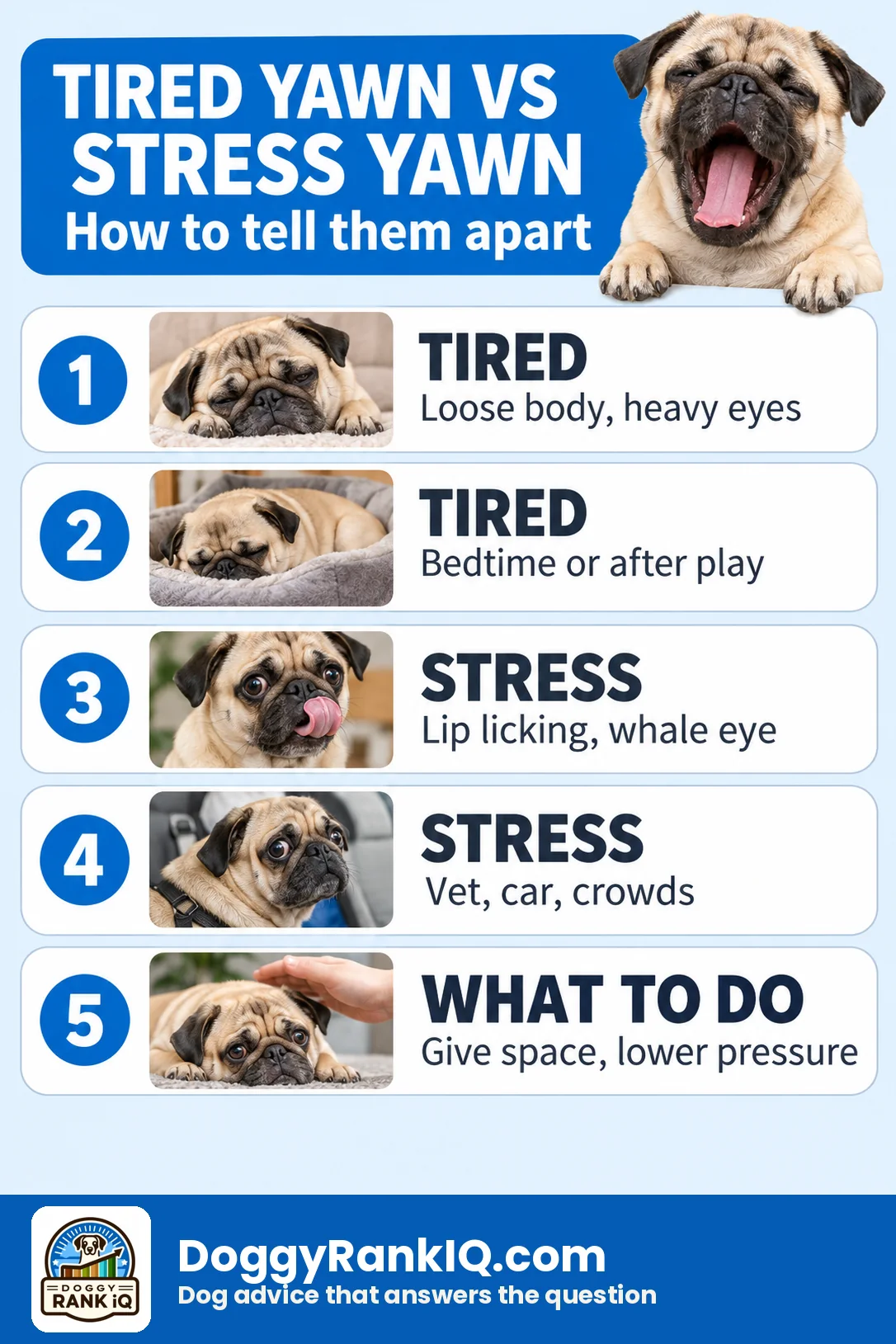
- Stress yawns tend to show up with lip licking, whale eye, turning the head away, or panting, so read the whole dog, not just the yawn (vcahospitals.com, spectrumcare.pet).
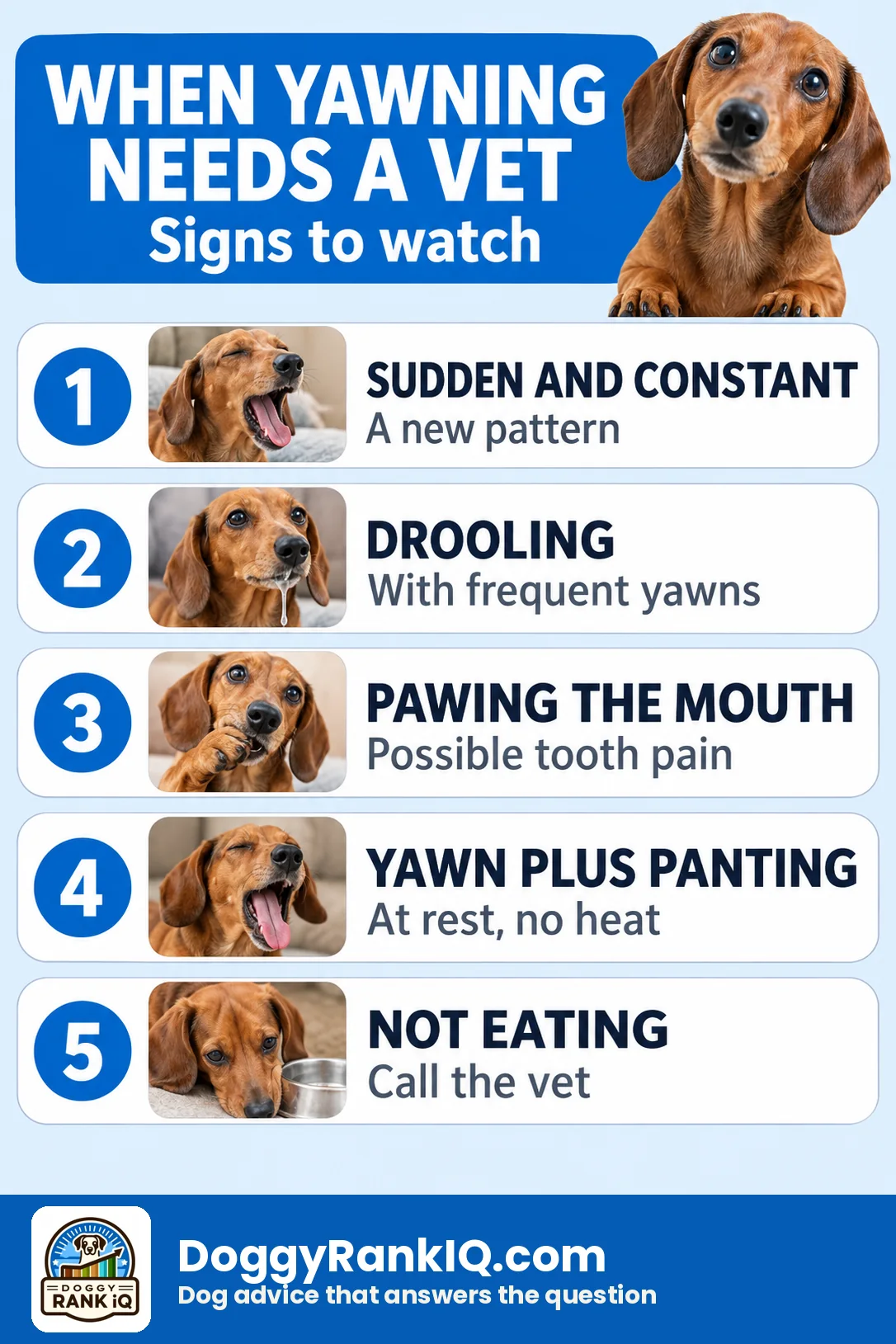
- Sudden, frequent yawning with drooling, pawing at the mouth, or signs of pain is a reason to call a vet, not a reason to assume your dog is tired.
When does your dog yawn?
Tap an option to see the answer.
The short answer: why do dogs yawn?
Why do dogs yawn is not a one-answer question, and that is the part most quick explanations skip. A yawn can mean “I’m sleepy,” but it can just as easily mean “I’m uneasy,” “I just watched you yawn,” or “I can’t wait for this walk to start.”
PetMD and VCA Animal Hospitals both describe yawning as a behavior with multiple possible triggers, including tiredness, stress, boredom, and social signaling (vcahospitals.com, petmd.com). The dog in front of you is giving you one piece of data. The rest of the picture comes from timing, body posture, and what happened right before the yawn.
A dog who yawns while curling up on the calming donut bed at 9pm is probably winding down. A dog who yawns while the vet tech reaches for a thermometer is telling you something else entirely. Same behavior, different meaning, and that gap is exactly what this article sorts out.
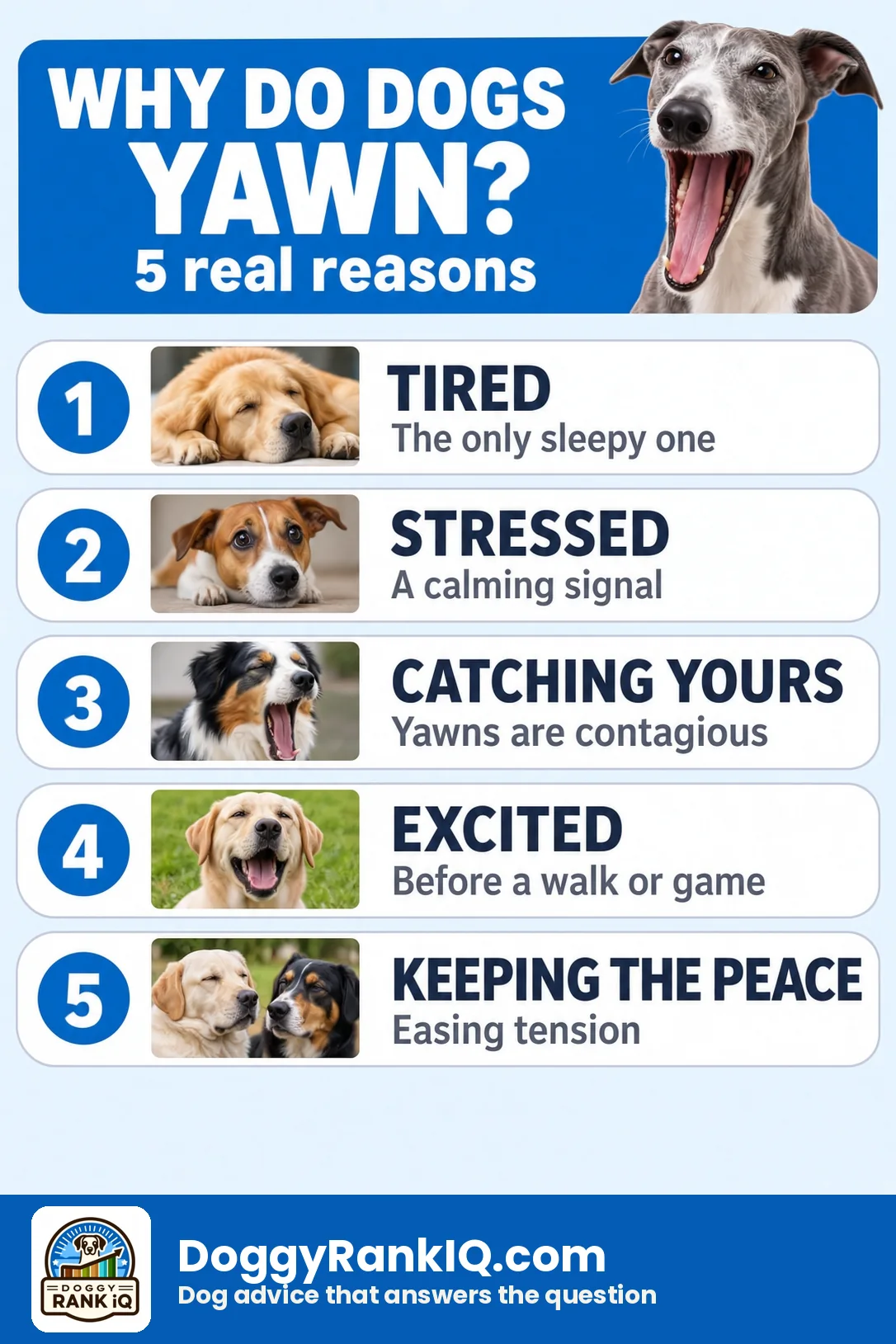
5 real reasons dogs yawn
1Tiredness (the one everyone already knows)
Dogs yawn when they are physically tired, waking up, or transitioning from activity to rest, much like people do. This is the explanation most owners reach for first, and it is correct often enough to stay the default assumption.
A relaxed yawn usually comes with loose body language: soft eyes, a slow stretch, settling onto a bed rather than pacing. If your dog yawns and then flops down with a sigh, tiredness is the reasonable read.
2Stress or a calming signal
Dogs yawn to self-soothe during stress, and the behavior shows up often enough during stressful handling that VCA lists it among common stress indicators (vcahospitals.com). Veterinary visits, nail trims, loud environments, unfamiliar dogs, restraint, and being leaned over by a person are common triggers.
Turid Rugaas’s calming signals framework places yawning alongside lip licking and head turning as behaviors dogs use to reduce tension in themselves or in a social interaction (vcahospitals.com). Under this model, a yawn is closer to “I’d rather not escalate this” than “I need a nap.”
3Contagious yawning (and why the evidence just got messier)
Dogs sometimes yawn after seeing or hearing a human yawn, a finding first reported by Joly-Mascheroni and colleagues in 2008 (pubmed.ncbi.nlm.nih.gov). A 2013 follow-up by Romero and colleagues at the University of Tokyo found dogs yawned more often at their owner’s yawn than at a stranger’s, which the researchers connected to the strength of the human-dog bond (pubmed.ncbi.nlm.nih.gov, thesciencedog.com).
That tidy story got more complicated in 2026. A study published in Frontiers in Ethology tested contagious yawning as a possible empathy marker and found only 4 of 35 dogs yawned in response to a stranger’s exaggerated yawns, a rate far below the roughly 30% to 72% reported in earlier work. The low response meant the researchers could not link yawning to other empathy measures in their dataset, and recent science coverage has framed contagious yawning as an unreliable stand-alone measure of canine empathy rather than settled proof of it.
The practical takeaway: contagious yawning in dogs is real in some cases, but it is not consistent enough across studies to treat as a guaranteed empathy test for an individual dog.
4Anticipation or excitement
Some dogs yawn right before something exciting happens: the leash comes out, a training session starts, or a car ride is imminent. This looks like a mismatch, since yawning is usually linked to low energy, but it fits a broader pattern where yawning appears during states of elevated or conflicting arousal, not only drowsiness.
A dog who yawns, then spins in a circle, then yawns again while staring at the door is not bored. That dog is wound up and doesn’t have a cleaner way to show it.
5Communication to defuse tension
Yawning can work as a signal dogs send to each other or to people, a way of saying “no conflict intended” during a tense moment. Two dogs meeting on a tight leash, a dog approached too quickly by a child, or a dog caught between wanting to greet someone and wanting space may yawn as a middle-ground response.
This overlaps with displacement behavior: when a dog faces two competing urges, approach versus retreat, it may perform a neutral action like yawning instead of committing to either. The yawn doesn’t reveal one precise emotion so much as it reveals that the dog is stuck deciding.
Facts table: tired yawn vs stress yawn
Why does my dog yawn so much when I pet him, talk to him or kiss him?
A dog who yawns while being petted, talked to, or kissed is often overstimulated or mildly uncomfortable with the closeness, not falling asleep. Dogs process direct face-to-face contact differently than people do, and many find a kiss or a long hug closer to pressure than affection.
Why do dogs yawn when you talk to them follows a similar pattern. A dog fixed with steady eye contact and a stream of baby talk may yawn as a release valve, especially if the tone is high-pitched and sustained. Our guide on talking to your dog covers how dogs actually respond to human speech, and the overlap with body language context matters here too: see our full breakdown of dog body language for the fuller picture.
Why does my dog yawn when I kiss him usually comes down to the same thing: a close face, held still, is mildly tense for a lot of dogs even when they tolerate it without complaint.
Dog keeps yawning and licking lips, stretching or panting: what it means
A dog keeps yawning and licking lips because that combination is a common stress cluster, not two unrelated habits happening at once. Lip licking with no food nearby, paired with yawning, is one of the more recognizable discomfort signals in dog body language (spectrumcare.pet).
Why does my dog keep yawning and stretching is a gentler version of the same question. Stretching after a yawn, especially a full body stretch with a relaxed tail, often does point to waking up or settling in, which circles back to the tiredness explanation. Why does my dog keep yawning and panting is more concerning when the panting isn’t tied to heat or exercise; that combination deserves a closer look at the surrounding situation, since panting can also signal pain or anxiety.
This is also a good moment to think about licking more broadly. If your dog’s yawning sits alongside a habit of licking you a lot, the two behaviors may share a root cause worth untangling together.
🥱 Do dogs catch yawns because they care? What the later studies found
The first contagious yawning results made a tidy story: dogs yawn back at their people, so dogs feel empathy. The follow-up work is messier, and more interesting.
In 2013, Elainie Madsen and Tomas Persson at Lund University tested 35 dogs between 4 and 14 months old. A person played with each dog, then yawned. Dogs older than 7 months yawned back. Younger puppies mostly did not, which matches human children, who start catching yawns around age four. The Lund team also found no difference between a familiar person and a stranger, the opposite of the Tokyo result where owners triggered more yawns. They noticed something else. About half the dogs got visibly calmer and sleepier after all that yawning.
Then in 2020, Patrick Neilands and colleagues at the University of Auckland ran their own test and pooled the data from earlier studies in Proceedings of the Royal Society B. Their conclusion: dogs do catch human yawns, but the pooled data showed no sign that familiarity made a difference. So the yawn spreads. Whether it spreads through empathy is still an open argument.
“A puppy under seven months who ignores your yawn is right on schedule.”
For an owner, the practical version is short. If you yawn on the couch and your adult dog yawns back, that is normal. If your 12-week-old puppy ignores your yawn completely, that is normal too.
🩺 Why do dogs yawn at the vet, in class and in the car?
These three places produce more yawns than any bedroom, and tiredness has little to do with it.
At the vet, the yawn usually comes with a lowered head and a look away from the person holding the thermometer. In a training class, it often shows up right after the third or fourth repetition of something the dog has not figured out yet. Trainers read that as pressure building. The fix is cheap: ask for one easy thing the dog knows cold, pay for it, and take a two-minute sniff break.
The car is the one to watch more closely. Repeated yawning with drooling, lip licking and swallowing is a common early sign of motion sickness, especially in young dogs. If the yawns in the back seat come with a wet chin, talk to your vet about nausea before you assume the dog is nervous.
One medical note, since “why do dogs yawn so much” is sometimes a health question. A dog who cries out mid-yawn, stops halfway, or has trouble opening the mouth wide needs an exam. Jaw joint problems, dental pain and a condition called masticatory muscle myositis can all make a full yawn hurt. That is a different situation from a stress yawn, and calmer greetings will not improve it.
⭐ Top 5 Features We Love
- It’s honest. A yawn is hard for a dog to fake, which makes it a useful read when other signals are ambiguous.
- It’s early. Yawning often shows up before more obvious stress signs like growling or hiding, giving owners a head start.
- It’s social. The contagious yawning research, even with 2026’s mixed results, shows dogs are tuned into human faces and behavior (pubmed.ncbi.nlm.nih.gov, thesciencedog.com).
- It’s low-stakes. Unlike a bite or a bolt, a yawn gives you room to adjust the situation calmly.
- It’s informative in groups. A yawn during a tense dog-to-dog greeting can flag a moment to step in before things escalate.
⚠️ Things to Look Out For
- Yawning that comes with drooling, pawing at the mouth, or visible discomfort around the jaw.
- A sudden spike in yawning frequency with no clear behavioral trigger.
- Yawning paired with lethargy, appetite changes, or vomiting.
- Repeated yawning that looks forced or incomplete, sometimes linked to oral pain or dental issues (our periodontal disease in dogs guide covers common mouth pain signs).
- Yawning alongside signs covered in separation anxiety in dogs, which can suggest a broader anxiety pattern rather than a one-off stress moment.
If any of these show up, a veterinary exam rules out a dental or medical cause before you assume it’s behavioral.
How to help a stressed dog settle
Start by removing or reducing whatever triggered the yawn: back off the hug, lower your voice, give the dog space from the new person or dog. Watch the dog’s whole body, not just the yawn, before deciding the stress has passed.
Give the dog a predictable, low-pressure recovery activity. A quiet spot to decompress, a chew, or a slow-paced sniff walk can lower arousal faster than more direct interaction. Consistency matters here more than any single trick, since dogs calm down faster when the pattern around them is familiar.
Helpful calming tools
A few products owners commonly reach for when a dog shows repeated stress signals like yawning, lip licking, or pacing:
- Doggie Language: A Dog Lover’s Guide to Understanding Your Best Friend ($8.99, price checked 2026) is an illustrated guide that walks through signals like yawning, lip licking, and whale eye side by side, which makes it easier to tell a tired yawn from a stress yawn in the moment. Check the current price.
- Calming Anxiety Vest for Dogs, Small ($38.99, price checked 2026) uses gentle, constant pressure, a method some owners report helps during grooming, vet visits, or thunderstorms. Check the current price.
- LUKITO Lick Mat for Dogs, 2 Pack ($8.99, price checked 2026) gives a dog a focused, repetitive task that some owners use to redirect pre-vet or pre-grooming jitters. Check the current price. Our lick mat guide covers fillings and safe use.
- Bedsure Calming Donut Dog Bed, Medium ($38.24, price checked 2026) gives a dog a defined, enclosed resting spot, which some owners find useful for settling an anxious dog after an overstimulating day. Check the current price.
None of these products are a substitute for addressing the actual trigger, and persistent anxiety is worth discussing with a veterinarian or a certified trainer. For a wider look at options, see our full calming products for dogs roundup.
FAQ
The bottom line
Why do dogs yawn comes down to five honest possibilities, and sleep is just one of them. Stress, social contagion, excitement, and tension-easing communication all show up often enough that a single yawn shouldn’t be read in isolation. The 2026 research actually makes the picture more careful rather than more certain: contagious yawning in dogs is real for some individuals but not reliable enough across studies to call it proof of empathy, and low yawn rates in formal stress testing mean a yawn works best as one clue among several, not a standalone diagnosis.
Watch the whole dog. A relaxed yawn at bedtime and a stiff, lip-licking yawn during a nail trim are not the same event wearing the same face. If the yawning turns sudden, frequent, or comes with drooling or pawing at the mouth, that’s a vet visit, not a guessing game.
Doggy Rank IQ is reader supported. As an Amazon Associate we earn from qualifying purchases, at no extra cost to you.