
Quick Answer
Why does my dog stare at me? Usually your dog is reading you for information, asking for something (food, a walk, the door), or settling into a relaxed, bonded moment with you. Soft, blinking eye contact tends to mean comfort or affection. A stiff, unblinking stare paired with a frozen body is a different signal entirely, and it means back off rather than lean in. Context, body language, and what happens right after the stare tell you which of the six real reasons applies.
Key Takeaways: why does my dog stare at me
- The main reasons why does my dog stare at me come down to six patterns: affection, requests, reading your cues, confusion, guarding, or cognitive change in older dogs.
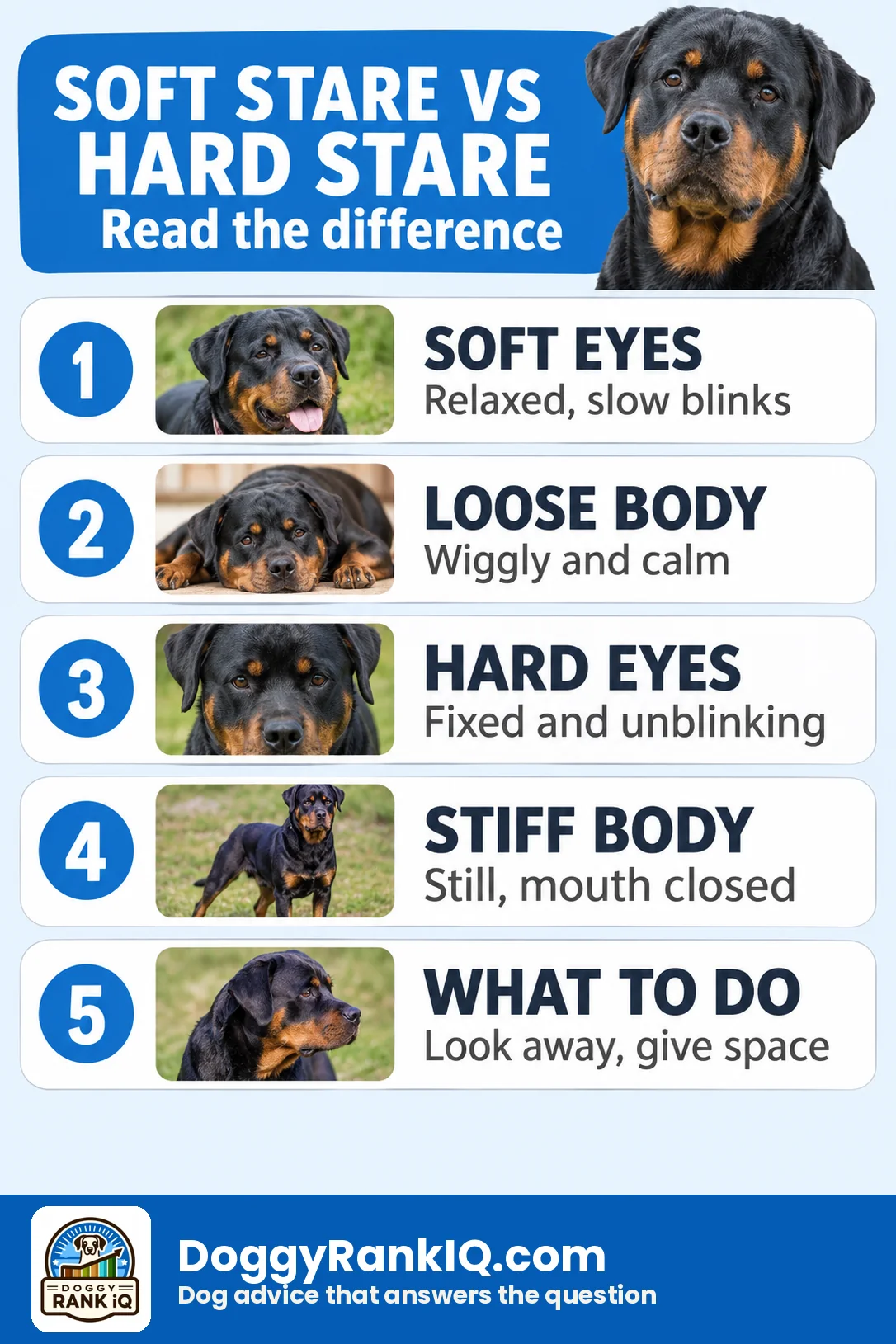
- A soft stare has relaxed eyes and a loose body. A hard stare has a stiff body, closed mouth, and fixed eyes, according to WebMD.
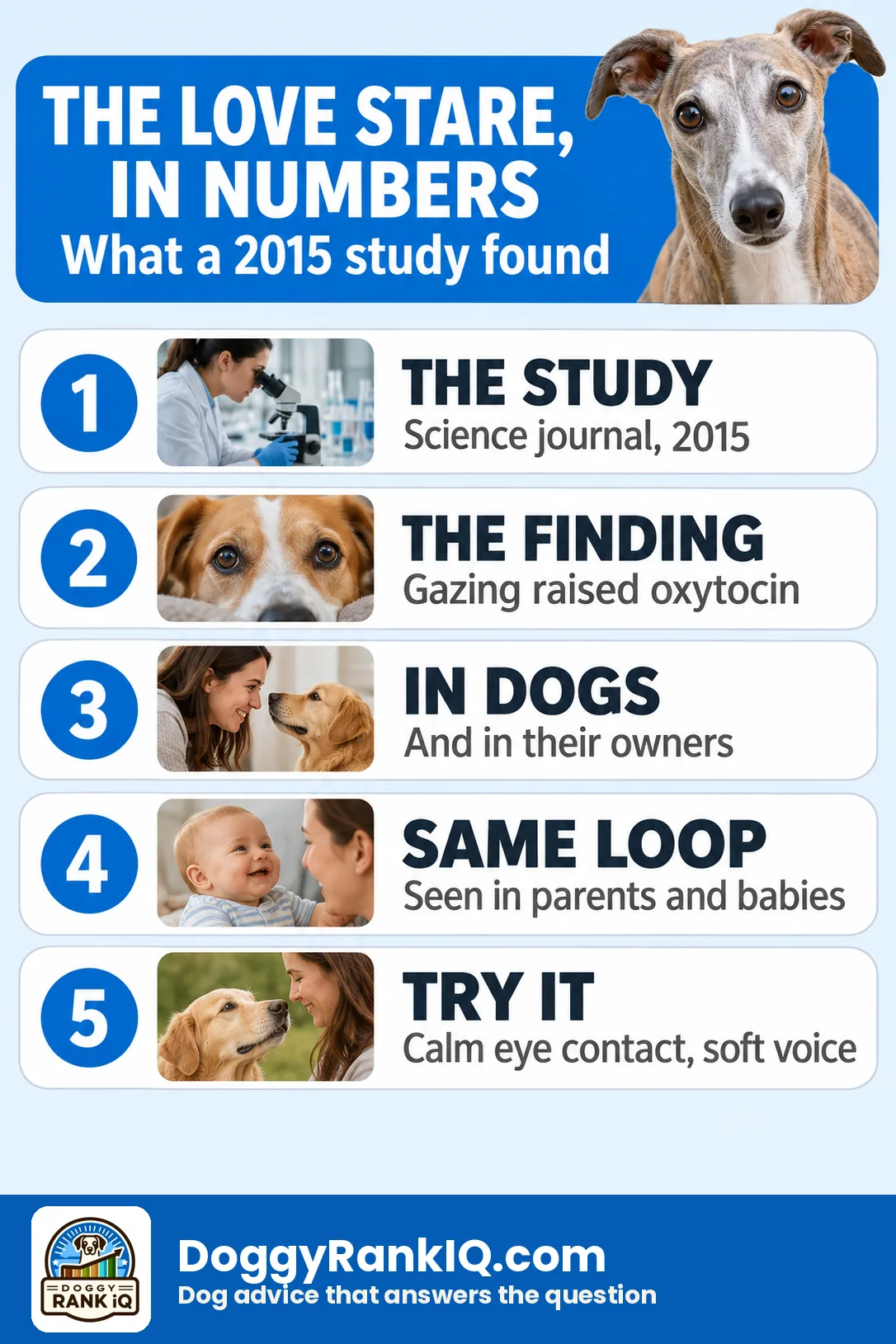
- Research on mutual gaze found oxytocin increases in both dogs and owners, similar to the bonding loop seen between parents and infants.
- Dogs quickly learn that staring gets results, so if staring is followed by food, play, or a walk, the behavior repeats.
- A hard, unblinking stare from an unfamiliar or stiff dog is a warning, not an invitation to stare back.
- Staring at walls, corners, or into space, especially with pacing or night waking in a senior dog, is worth a veterinary visit.
- Puppies and highly cooperative breeds often gaze at people more, but this varies a lot by individual dog.
What does the stare look like?
Tap an option to see the answer.
The short answer: why does my dog stare at me?
Dogs stare at their owners mainly to get information or to get something. Your dog’s eyes are doing two jobs at once: monitoring your face and body for clues about what happens next, and testing whether eye contact gets a reaction from you.
This is normal. The American Kennel Club notes that dogs generally stare either to communicate with people or to wait for information from them, including waiting for a walk, a meal, a command, or a reward. Is it normal for dogs to stare at their owners? Yes, in nearly every household context, staring is ordinary behavior rather than a red flag. The exception is a hard, frozen stare, which deserves a different response (covered in the facts table below).
A dog’s eyes are also simply built for watching people closely. Generations of domestication selected for dogs that read human faces well, which is part of why the question “why does my dog stare at me” comes up so often among new owners. If you’re building a foundation of communication with a new puppy, pairing eye contact with structured cues from basic commands every puppy should learn gives the staring a job to do instead of letting it turn into constant demanding.
6 real reasons your dog stares
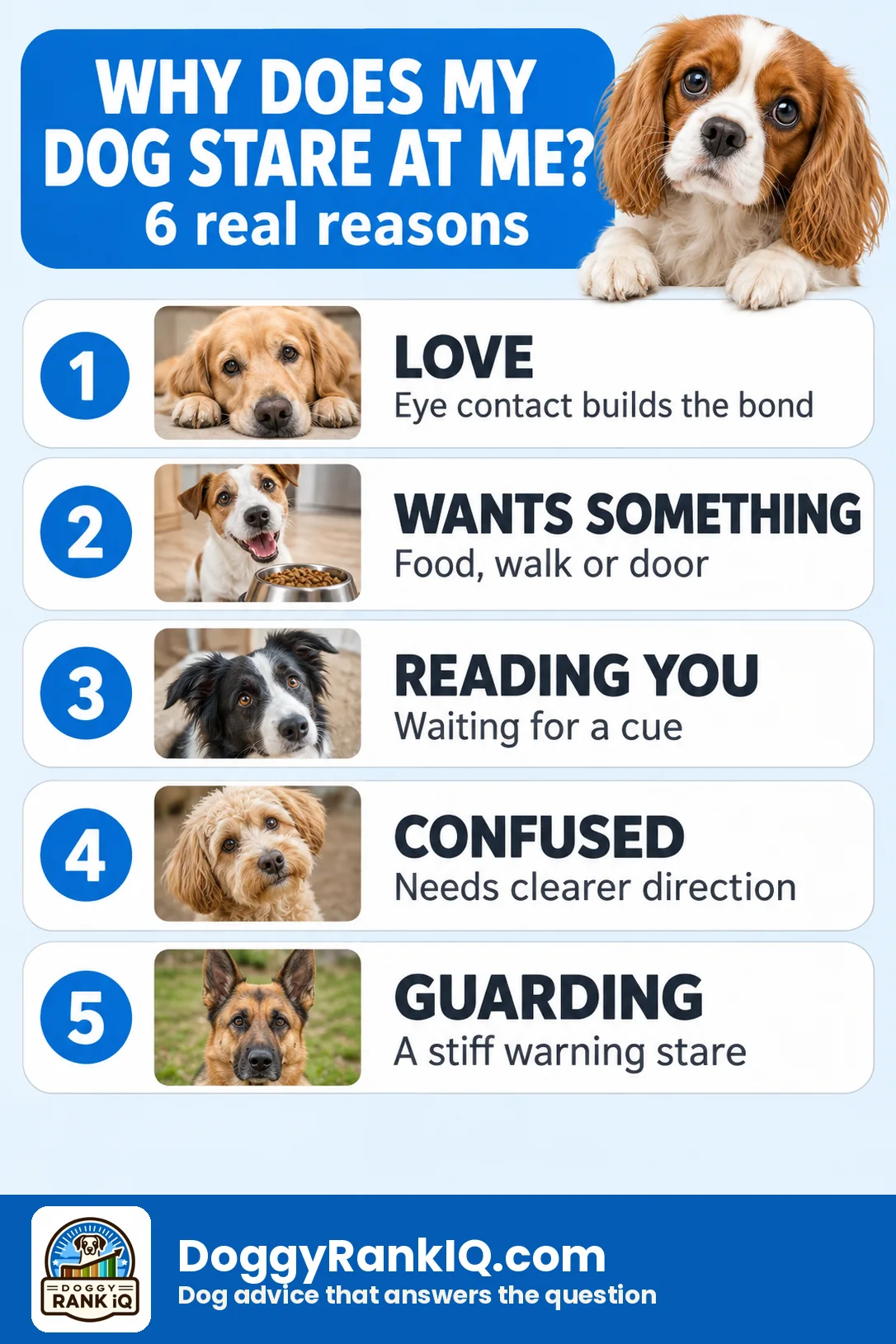
1Affection and bonding
A relaxed, soft gaze between you and your dog can be genuinely affiliative. Why does my dog stare at me with soft, half-closed eyes during quiet moments on the couch? That posture usually points to comfort, not a request. A widely cited study by Miho Nagasawa and colleagues, examining dog-owner pairs, found that mutual gazing raised oxytocin levels in both dogs and owners, a loop also documented between mothers and infants, as reported by PetMD.
Is dog staring a sign of affection or dominance? It can be either, and the difference sits in the dog’s posture, not the eye contact alone. A loose body, soft eyes, and slow blinking lean toward affection. A stiff body and fixed stare lean toward something closer to a warning. Example: a dog lying at your feet, tail loosely moving, eyes half shut and occasionally drifting to your face, is almost certainly in the affection category, not the guarding one.
2Wanting something
Why does my dog stare at me when I eat? Dogs learn fast that staring near food, leashes, or doors sometimes gets rewarded. If a stare has ever been followed by a dropped scrap, a walk, or being let outside, your dog has filed that away as Chewy’s behavior guide explains. This is simple learning, not manipulation.
Common mistake: owners often reinforce this stare by accident, giving in “just once” to stop the behavior, which actually teaches the dog that persistence works. A better move is to reward calm, non-staring behavior near the table or the leash hook, so the dog learns that sitting quietly, not staring, gets the response.
3Reading you for cues
Dogs watch human faces, hands, and posture to predict what happens next, whether that’s a meal, a departure, or a visitor at the door. This kind of attentiveness isn’t always about a reward. It is ordinary social monitoring, similar to how you might glance at a coworker’s face to gauge their mood before asking a question.
Dogs are remarkably good at picking up on small, repeated cues: picking up your keys, putting on shoes, or opening a specific cabinet. If your dog starts staring the moment you reach for a particular drawer, that is learned pattern recognition, not coincidence. This is one of the clearest everyday answers to why does my dog stare at me: your dog has simply learned your routine better than you have.
4Confusion or waiting for direction
During training, a dog that’s learned hand signals or verbal cues often keeps visual contact because your next move predicts a chance to earn reinforcement. If a cue was unclear or inconsistent, the stare can mean “I don’t know what you want yet,” not frustration.
Edge case: if a dog stares blankly during a familiar command it normally knows, check for outside distractions (new smells, noise, a visitor) before assuming confusion. Dogs under stress sometimes lose focus on well-practiced cues temporarily, which can look like staring but is really distraction.
5Guarding or a hard warning stare
A fixed, unblinking stare paired with a still body and a closed mouth is a different animal entirely. This is sometimes linked to resource guarding, where a dog stiffens over food, a toy, or a space, a pattern Newsweek has covered in reporting on dog body language. Learn more in our guide to resource guarding in dogs. This stare is a signal to give space, not a social invitation.
Decision rule: if the stare comes with a closed mouth, stiff tail, and the dog is positioned over an object (bowl, bone, bed), treat it as a guarding stare and step back rather than reaching toward the item.
6Cognitive changes in older dogs
In senior dogs, staring that looks blank, directionless, or fixed on walls rather than on you can point to canine cognitive dysfunction. Clinical guidance lists disorientation, getting physically stuck, failing to recognize familiar people, and staring at walls or into space as signs that warrant a veterinary assessment. Read more in our dog dementia guide.
This pattern is worth separating clearly from the other five reasons, because it is the one category where why does my dog stare at me has a medical rather than behavioral answer. A dog that used to make eye contact warmly and now stares blankly past you, especially paired with pacing, night waking, or house-soiling, should see a vet rather than get retrained.
Facts table: soft stare vs hard stare
| Trait | Soft stare | Hard stare |
|---|---|---|
| Eyes | Soft, slow blinking | Fixed, unblinking |
| Body | Loose, relaxed | Stiff, frozen |
| Mouth | Open, relaxed | Closed, tight |
| Likely meaning | Bonding, request, attention | Guarding, discomfort, warning |
| What to do | Blink slowly back, respond calmly | Do not stare back, give space, avoid approach |
Source behavior cues: WebMD, Purina New Zealand, Business Insider
Why does my dog stare at me lovingly, when I pet him, while lying down or without blinking?
A dog staring while you pet him, while lying across the room, or without blinking is usually comfortable rather than concerning, as long as the body stays loose. Why does my dog stare at me lovingly? Soft eyes, a relaxed jaw, and a gently moving tail support that reading, according to Business Insider’s coverage of dog behavior. Why does my dog stare at me when I pet him? Touch often produces a calm, fixed gaze because the dog is enjoying contact and monitoring your face for more.
Why does my dog stare at me while lying down? A dog resting with eyes locked on you, body slack, is often just keeping tabs on the person it trusts most, which is one of the quieter ways dogs show attachment, covered in our piece on how dogs show affection.
Why does my dog stare at me without blinking? Unblinking eye contact alone is not automatically a bad sign. Combine it with the rest of the body. A loose, slow-blinking dog staring at you from the couch is different from a stiff dog staring at you over a food bowl. For a wider read on posture, ear position, and tail signals, see our guide to dog body language.
Example: picture a dog lying on its side, eyes tracking you across the room, legs fully relaxed, breathing slow. That is a textbook loving stare. Now picture the same dog standing square over a bone, body rigid, eyes locked without blinking. Same eye contact, completely different message.
Why does my dog stare at me and look sad or creepy?
What looks sad or creepy in a dog’s stare is usually a human projection, though a few real patterns explain the effect. Why does my dog stare at me and look sad? Droopy facial features, slow movement, or a lowered head during a stare can mimic sadness in dogs, even when the dog isn’t distressed, since dogs don’t display emotion identically to humans, a point echoed in Elanco’s pet behavior resource.
Why does my dog stare at me creepy? A flat, unmoving stare often reads as unsettling to us specifically because it lacks the blinking and small movements we expect from a comfortable dog, which is the same stillness seen in a hard stare. Breeds with heavier brows or more visible sclera (like some hounds) can also look more intense simply because of facial structure, not because the dog feels differently than a dog with a softer expression.
Why does my dog stare at me and whine? Whining paired with a stare often signals a request, anxiety, or anticipation rather than sadness on its own, and it’s worth checking whether the whining started with a schedule change, a new noise, or separation. If whining and staring show up mainly when you leave, that pattern overlaps with topics covered in our guide to separation anxiety in dogs.
⭐ Top 5 Features We Love
- It’s honest. A dog’s stare changes instantly with context, giving you real-time feedback on comfort, interest, or discomfort.
- It’s trainable. Dogs maintain eye contact during training because it predicts reward, which owners can use for focus and recall work.
- It’s measurable. Soft versus hard stare signals are visible without guesswork once you know what to check (eyes, body, mouth).
- It’s bonding. Mutual gaze has been linked to oxytocin increases in both dog and owner, supporting the idea that eye contact builds attachment.
- It’s early. Puppies display human-directed, communicative gazing as young as 6 to 7 weeks old, including looking to humans and adjusting behavior based on human reactions, a finding discussed in canine cognition research.
⚠️ Things to Look Out For
- A frozen, unblinking stare from an unfamiliar dog. Do not approach or stare back. Back away slowly.
- Staring paired with a closed mouth and stiff tail over food or toys. This can be resource guarding, not curiosity.
- Staring at walls, corners, or into space. Especially in a senior dog, paired with pacing or disrupted sleep, this warrants a veterinary visit.
- Sudden new staring habits with no clear trigger. A change in a dog’s normal behavior deserves attention, not dismissal.
- Staring while pooping. This is commonly explained as a dog checking you for safety while vulnerable, not a behavior problem, a quirk mentioned by PetMD.
How to respond to each kind of stare
Should I stare back at my dog or look away? It depends on the type of stare. For a soft, relaxed gaze, a slow blink back is a comfortable, low-pressure response many owners use successfully. For a hard, stiff stare from an unfamiliar or anxious dog, look away and give space instead; staring back can escalate tension rather than defuse it.
Quick checklist for reading any stare:
- Check the mouth: open and loose, or closed and tight?
- Check the body: soft and wiggly, or stiff and still?
- Check the tail: loose wag, or held high and rigid, or tucked?
- Check the context: food, a stranger, a resting moment, or a wall?
- Decide: respond warmly to soft stares, give space for hard stares.
How to stop my dog from staring at me constantly: stop reinforcing the behavior with food or attention every time it happens, redirect to a toy or a trained cue like “settle,” and make sure physical and mental needs are met first. Is it bad if my dog stares at me intensely or aggressively? Intensity alone isn’t the deciding factor; a stiff body, closed mouth, and lack of blinking are the signals that matter more than duration.
When should I be worried about my dog staring too much? Worry when the stare is paired with wall-staring, disorientation, aggression toward familiar people, or a sudden change from your dog’s normal pattern. In all these edge cases, the question why does my dog stare at me stops being about affection or requests and starts being a prompt to check in with a vet.
Helpful tools for a dog that wants your attention
A dog that stares to ask for something often settles down once its actual needs, mental and physical, are being met consistently.
A Furbo 360 Dog Camera ($72.00, price checked 2026) lets owners check in on a dog that paces or stares at doors while they’re away, and some owners use the built-in treat toss as a distraction tool. Check the current price.
A Dog Puzzle Toy Adjustable Treat Dispensing Ball ($9.99, price checked 2026) gives a staring dog something to do with its attention instead of fixating on your dinner plate. Check the current price. Pairing a puzzle toy with a set feeding schedule can also reduce the kind of pleading stare that shows up at the dinner table, since the dog has an outlet for food-driven focus elsewhere.
For owners who want to understand the body language behind the stare in more depth, Doggie Language: A Dog Lover’s Guide to Understanding Your Best Friend ($8.99, price checked 2026) is a commonly recommended illustrated reference. Check the current price.
A heouvo Magnetic Dog Treat Pouch with Training Clicker ($9.99, price checked 2026) makes it easier to reward calm attention instead of a demanding stare during training sessions. Check the current price.
Do puppies stare at owners more than adult dogs? Puppies display social referencing and human-directed gaze quite early, and some owners notice more frequent, demanding stares before training builds other communication habits. Do all dog breeds stare or just some types? Research suggests breeds selected for cooperative work with people tend to gaze more than some independent working breeds, though individual variation is large within any breed.
Does staring mean my dog is trying to dominate me?
No, modern behavior guidance has largely moved away from the “dominance” framing of eye contact. Most staring, even prolonged staring, reflects attention-seeking, learned association, or simple curiosity rather than a bid for control.
The idea that dogs stare to assert dominance comes from older, now-disputed models of wolf behavior applied loosely to domestic dogs. Current guidance from sources like AKC frames eye contact mainly around communication and information-seeking. The one real exception is the hard, stiff stare described earlier, which is better understood as a warning about personal space or resources rather than a dominance display.
Why does my dog stare at other people or strangers the way he stares at me?
A dog that stares at strangers the same way it stares at its owner is usually running the same information-gathering process, just with less certainty about the outcome. Dogs that are well-socialized tend to give strangers a brief, curious glance rather than a sustained stare, since they already know what to expect from familiar routines.
A longer, stiffer stare directed at an unfamiliar person or dog deserves more caution than the same stare directed at you, because you lack the history that usually explains the behavior. If a dog stares hard at visitors, holds its body still, and does not relax within a few seconds, treat that as a signal to redirect the dog or create distance rather than letting the interaction continue. Owners working through this kind of reactivity may find it useful to review dog body language cues as a baseline before working with a trainer.
FAQ
The bottom line
Why does my dog stare at me comes down to six honest answers: affection, a request, information-gathering, confusion, guarding, or in older dogs, a cognitive change worth a vet visit. Check the eyes, body, and mouth together rather than the eye contact alone, and let the context, what happens right before and after the stare, guide your response. Most of the time, a dog staring at its owner is simply paying attention to the person it trusts most, and that is worth appreciating rather than worrying over.
Doggy Rank IQ is reader supported. As an Amazon Associate we earn from qualifying purchases, at no extra cost to you.