
Quick Answer
A dog cooling mat works by pulling heat away from a dog’s body, either through pressure-activated gel, water, or chill-rated fabric. Gel mats need no power or water and recharge in 15 to 20 minutes off the dog, water mats get colder but take more setup, and cooling fabric is lightest for travel. None of the seven dog cooling mat picks below treat heatstroke; they make a warm afternoon more comfortable for a dog that is already fine.
Key Takeaways: dog cooling mat
- A dog cooling mat cools by conduction, pulling body heat into the gel, water, or fabric surface, not by refrigeration or power in most models.
- Gel mats like the Green Pet Shop Cool Pet Pad need no water or electricity and recharge off the dog in about 15 to 20 minutes.
- Water-filled mats, like the K&H Cool Bed III style design, can get colder since you control the fill water temperature, but setup takes longer.
- A study of nine working dogs found a 4°C cooling mat brought core temperature down in an average of 36 minutes, slower than water immersion at 16 minutes.
- Chewers can puncture gel and water mats; check the maker’s non-toxic statement and supervise new mats.
- A dog cooling mat is comfort gear, not heatstroke treatment. Heavy panting, drooling, vomiting, or collapse means an emergency vet visit now.
- Shade, airflow, and fresh water matter more than any mat, and a parked car is never a cooling solution regardless of gear.
- Size the mat to the dog’s resting sprawl, not just body weight, since dogs flatten out wider when they’re trying to cool off.

Where will the mat go?
Tap an option to see the answer.
Do dog cooling mats really work?
Yes, within limits. A cooling mat lowers the surface temperature a dog rests on, and independent testing backs that basic mechanism, though it’s not the fastest way to cool an overheated dog.
A 2019 randomized study of nine working dogs compared natural cooling, a 4°C cooling mat, and five minutes of partial immersion in 30°C water. Dogs reached a gastrointestinal temperature of 39°C in an average of 36 minutes using the cooling mat, 48 minutes with no intervention, and just 16 minutes with water immersion [this and the figures above are drawn from the referenced randomized crossover trial].
That gap matters. The mat tested was chilled to roughly 4°C in a lab setting. Most self-cooling gel mats sold today work at room temperature and simply absorb a dog’s body heat until the gel warms up, then need time off to reset. PawBench frames this plainly: a mat cools the surface, it does not reliably treat a dog that’s already overheating (pawbench.com).
Decision rule: choose a mat if your dog is comfortable but warm during normal summer activity (napping, car rides, after a walk). Choose active cooling (water immersion, a vet visit, or a wet towel on the groin and armpits) if your dog is already showing distress.
A common mistake: buying a mat and assuming it replaces shade or water access. It doesn’t. Pair it with the basics covered later in this guide, and if you also use a cooling vest for walks, know that a mat and a vest solve different problems. One is for resting, one is for moving.
Gel or water (or cooling fabric)? How each dog cooling mat type cools
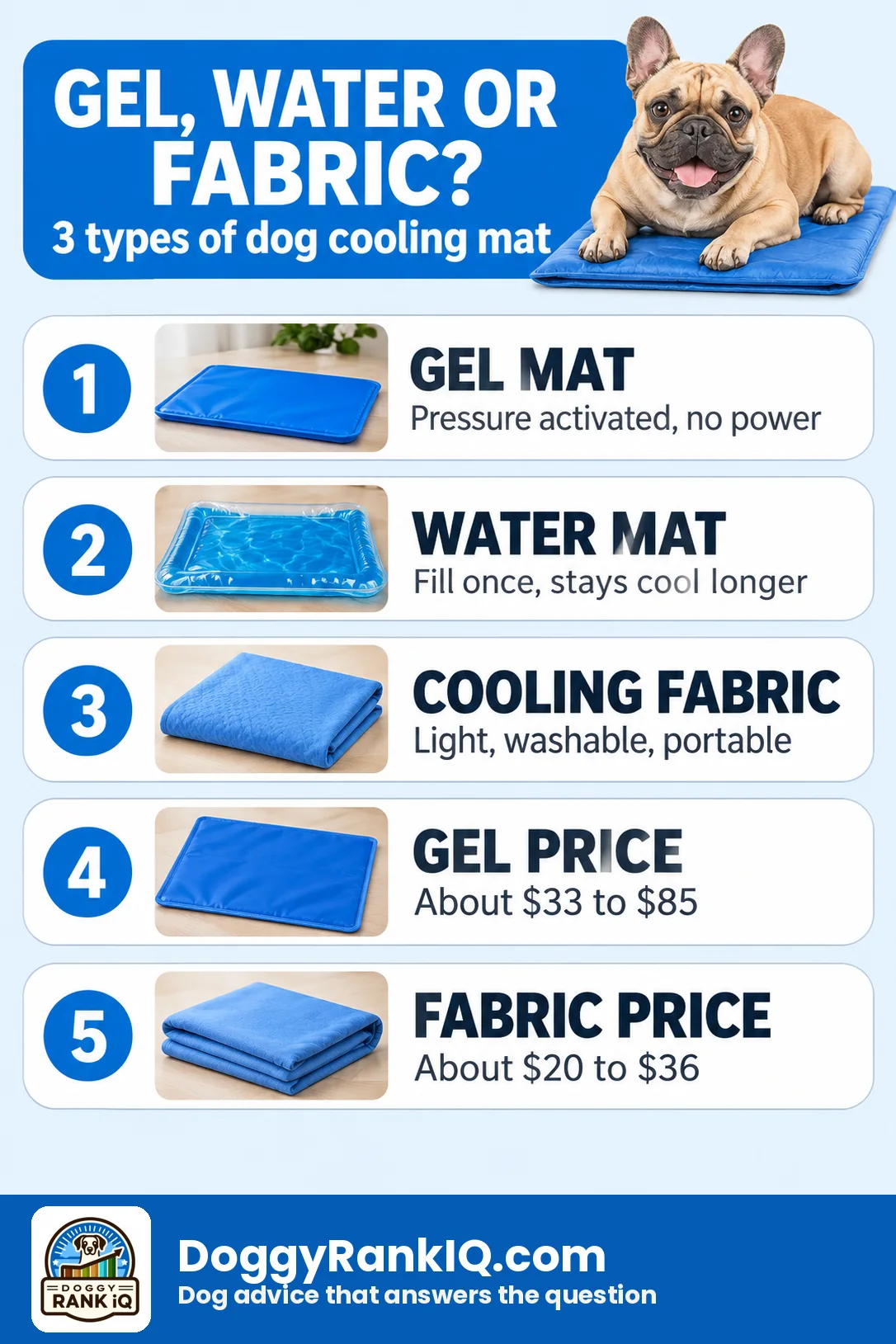
There are three real categories of cooling mat, and they trade off differently on power needs, chew resistance, and how cold they actually get.
Pressure-activated gel uses a gel pack that reacts to a dog’s weight and body heat. No plugging in, no filling, no freezer. The Green Pet Shop documents up to three hours of cooling with a 15 to 20 minute recharge once the dog gets off. Solid-gel construction, used by brands like Arf Pets, is marketed as an upgrade over older liquid gel because it can’t leak the way a punctured liquid pouch can, though the outer fabric can still be chewed through (pawbench.com).
Water-filled mats rely on water’s higher heat capacity. You fill them through a cap, sometimes with an air valve to help distribute the water evenly inside, and the mat gets as cold as the water you put in. CNN Underscored’s testing found water mats can run colder than gel because you control the fill temperature with cold tap water, but they take more setup time and effort than a gel mat you just unroll (edition.cnn.com).
Cooling fabric mats, rated by a Q-Max heat-transfer number, use a treated fabric (often marketed under names like Arc-Chill) that feels cool to the touch the moment a dog lies down. These are the lightest option for a crate or car and have nothing to puncture, but the cooling effect is milder and fades faster than gel or water.
A hybrid option, like the CoolerDog Hydro Cooling Mat, combines a waterbed-style cushion, foam insulation, and a removable ice sheet for a stronger chill. It sits at the premium end and is sold through the maker’s own site rather than Amazon.
Edge case: a dog that chews bedding is a poor fit for gel or water mats regardless of brand. A cooling fabric mat without an internal liquid pack is the safer call there.
Dog cooling mat comparison table
Prices checked 2026, subject to change.
The 7 best dog cooling mat picks
1 Best overall gel pick: Green Pet Shop Cool Pet Pad, Medium
 Best overall gel pick: Green Pet Shop Cool Pet Pad, Medium
The Green Pet Shop Cool Pet Pad, Medium uses the pressure-activated gel method that started this whole category. No water, no plug, no freezer bag that needs a dedicated shelf. The maker documents up to three hours of cooling with a 15 to 20 minute recharge once the dog steps off. That makes it a reasonable crate or living room pick for a 20 to 35 lb dog with a normal appetite for lying still.
Suits: medium dogs that nap often, owners who don’t want to deal with water or ice.
Skip it if: your dog is a known chewer, since the gel pouch inside is not designed to survive teeth.
2Best solid-gel option: Arf Pets Dog Cooling Mat, Solid Gel
 Best solid-gel option: Arf Pets Dog Cooling Mat, Solid Gel
Arf Pets Cooling mat, Solid Gel uses solid rather than liquid gel, which PawBench notes as an upgrade because solid gel can’t leak the way a punctured liquid pouch does, though the fabric shell is still vulnerable to a determined chewer (pawbench.com). At 20 x 28 inches it fits most dogs up to around 50 lbs comfortably.
Suits: owners who’ve had a liquid gel mat leak before and want the sturdier version.
Common mistake: assuming “solid gel” means indestructible. It means leak-resistant, not chew-proof.
3Best budget gel pick: Coleman Dog Cooling Mat 24 x 30 in
 Best budget gel pick: Coleman Dog Cooling Mat 24 x 30 in
The Coleman Cooling mat 24 x 30 in is pressure-activated gel at a lower price point than the Green Pet Shop option, with a similar size footprint suited to dogs up to about 50 lbs. For owners testing whether their dog even likes a cooling mat before spending more, this is the low-risk entry point.
Suits: first-time buyers, budget-conscious households.
Quick example: a 45 lb Labrador that sprawls rather than curls will use most of this mat’s surface.
4Best cooling-fabric mat for travel: Dog Cooling Mat 2.0 with Arc-Chill fabric
The Cooling mat 2.0 with Arc-Chill fabric, at 44 x 32 inches, is the lightest pick here and has no internal liquid or gel pack to puncture. That makes it a strong choice for the car or a crate where a leaking pouch would be a real problem. The tradeoff is a milder, shorter-lived cooling effect than gel or water.
Suits: car travel, dogs that chew bedding, households that want something machine washable.
Skip it if: you’re in triple-digit heat and need the strongest cooling effect available; fabric is the mildest of the three types.
5Best dog cooling mat for outdoors and large breeds: Bedsure ArcticMax Cooling Mat for Large Dogs
 Best dog cooling mat for outdoors and large breeds: Bedsure ArcticMax Cooling Mat for Large Dogs
The Bedsure ArcticMax Cooling Mat for Large Dogs, 41 in is built with chill-rated fabric and a larger footprint meant for dogs over 70 lbs. For a cooling mat outdoor use case, a fabric mat has an edge: no gel or water bladder to split if it’s dragged across a patio or gravel.
Suits: large breeds, decks, patios, outdoor kennel runs.
Decision rule: choose this over a gel mat if the mat will live outside and get moved around; fabric handles rough surfaces better than a sealed gel pouch.
6Best small or budget dog cooling mat nearby price point: Cooling Mat for Large Dogs with Chill Fiber
Despite the name, the Cooling Mat for Large Dogs with Chill Fiber, 39 x 28 in works fine for medium dogs too, and at under $20 it’s the cheapest pick in this roundup. It’s a reasonable answer to “how much should I spend on a cooling mat” if you just want to see whether your dog responds to a cool surface at all before buying something pricier.
Suits: owners testing the concept, apartment dogs, secondary mats for a second room.
7Best XL gel pick for crate or kennel: Green Pet Cool Pet Pad, X-Large
The Green Pet Cool Pet Pad, X-Large scales the same pressure-activated gel design up to 36 x 20 inches for dogs up to around 90 lbs. It’s the pick for a large-breed crate where a fabric mat alone doesn’t feel like enough.
Also worth naming: for a stronger, water-based option, the Cooler Dog Hydro Cooling Mat combines a waterbed cushion with a removable FlexiFreeze ice sheet. It isn’t sold on Amazon, so check the maker’s site directly for current specs and pricing.
How to size a dog cooling mat
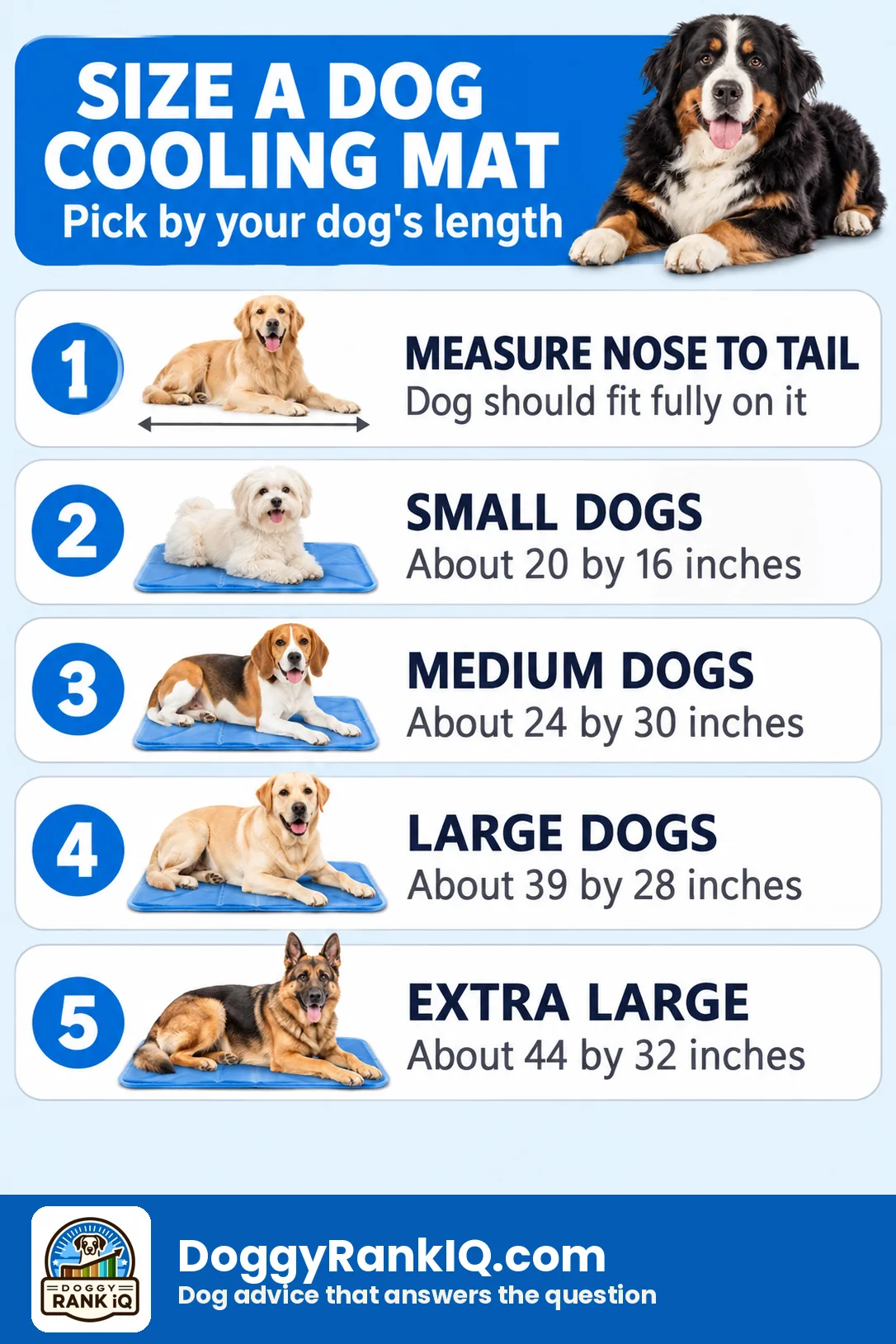
Size by your dog’s resting sprawl, not just its weight on a chart. A direct rule: measure your dog lying on its side with legs extended, then add two to three inches on each dimension.
- Small dogs (under 25 lbs): a 20 x 16 in mat is usually enough.
- Medium dogs (25 to 50 lbs): look for 24 x 30 in or similar.
- Large dogs (50 to 90 lbs): 36 x 20 in to 41 x 31 in mats fit better.
- XL and giant breeds (90+ lbs): check the dimensions carefully; several “large dog” mats top out around 90 lbs and won’t comfortably fit a Great Dane.
Common mistake: buying based on breed name rather than measured sprawl. A long-bodied dog like a Dachshund needs length over width, while a broad-chested Bulldog needs width. If you’re also shopping crate gear, this sizing logic carries over directly to a crate pad or an elevated dog bed, where airflow under the dog adds its own cooling benefit.
⭐ Top 5 Features We Love
- No power, no freezer gel mats that recharge just by sitting off the dog for 15 to 20 minutes.
- Solid-gel fill that resists the leaking liquid gel mats are known for (pawbench.com).
- Machine-washable covers on most fabric mats, which matters for shedding breeds.
- Portable sizes small enough to fold into a car trunk or carry-on for travel.
- Non-slip backing on several picks, which keeps the mat from sliding on hardwood or tile.
⚠️ Things to Look Out For
- Chew risk. Gel and water mats both have an internal bladder that teeth can puncture; a known chewer does better with a pure fabric mat.
- Limited cooling window. Gel mats document a few hours of effect before needing to recharge off the dog.
- Setup time for water mats. Filling and positioning a water mat takes longer than unrolling a gel one (edition.cnn.com).
- Mild effect in extreme heat. None of these mats reach the surface temperatures used in cold-water immersion studies for actual overheating dogs.
- Seams and zippers. Check the cover’s zipper placement; a dog that can reach it with a paw will eventually find it.
Heat safety a mat cannot replace
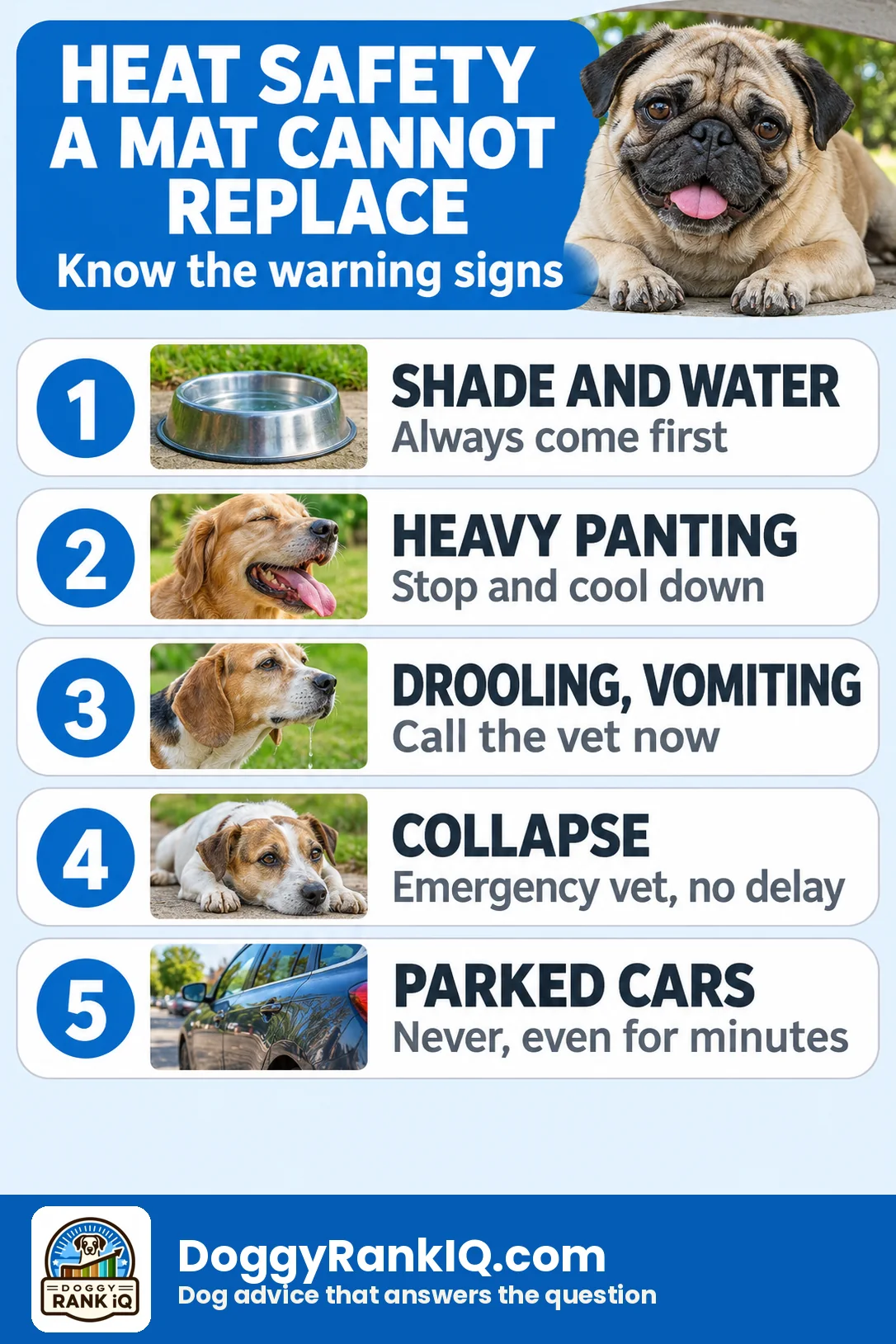
A cooling mat is comfort gear for a dog that’s already fine, not a treatment for a dog in trouble. Heavy panting that doesn’t ease up, drooling, vomiting, wobbling, or collapse means an emergency vet visit, not a mat.
Dogs rely mainly on panting, not sweating, to lose heat, and that mechanism loses effectiveness in high humidity[NIH/PMC review on canine thermoregulation]. That’s why a dry gel mat alone may do little in a humid heat wave even though it helps on a dry hot day. The American Kennel Club is explicit that cooling mats should never replace shade, hydration, rest, or a vet call when a dog is overheated[American Kennel Club].
For actual overheating, water does more work than a mat. A study of 12 working dogs found voluntary head immersion in roughly 22°C water produced lower early core temperatures than towels applied to the neck or armpits[JAVMA]. The AKC also flags specific temperature thresholds: above 104°F signals heat stress, above 105°F heat exhaustion, and around 106°F or higher is heatstroke requiring emergency care[American Kennel Club].
Who needs extra caution: flat-faced breeds (Bulldogs, Pugs, Boxers), overweight dogs, seniors, dogs with heart or respiratory conditions, and heavily coated breeds. If you’re wondering whether a thick coat is the problem rather than the solution, this applies directly to the husky shaving debate, where the honest answer is that the coat often insulates against heat rather than trapping it.
Never leave a dog in a parked car, with or without a cooling mat. That rule doesn’t bend for any product on this list.
If your dog has an existing joint, heart, or skin condition, confirm with your veterinarian before relying on any cooling product as part of a daily routine.
Who should buy which
A direct starting point: match the mat type to your dog’s main risk, not just your budget.
- Chewers: choose a cooling fabric mat with no internal liquid bladder.
- Big dogs with low tolerance for setup fuss: choose a gel mat sized XL.
- Outdoor or patio use: choose fabric or a solid-gel mat over a thinner liquid gel pouch, since rough surfaces are harder on seams.
- Senior or arthritic dogs: pair a mat with an orthopedic dog bed rather than using the cooling mat alone; joint support and cooling solve different problems.
- Anxious dogs: a cooling mat may help indirectly if heat is part of what’s driving restlessness, but it is not a treatment for separation-related anxiety; see our guide on separation anxiety in dogs for that question specifically.
- Dogs that ignore the mat entirely: some dogs simply prefer tile or a drafty corner. Try placing the mat where the dog already rests rather than introducing a brand-new spot, and pair it with a fan or enrichment toy like a frozen Kong-style puzzle to build positive association.
FAQ
The bottom line
A cooling mat is a real, modest tool: gel for no-fuss convenience, water for a colder surface with more setup, fabric for chewers and travel. Check the dimensions against how your dog actually sprawls, not just its weight, and compare the options against your dog’s real risk factors before buying. None of these seven picks replace shade, water, or a vet visit when a dog is genuinely overheated, so treat the mat as one part of a hot-weather routine, not the whole plan.
Doggy Rank IQ is reader supported. As an Amazon Associate we earn from qualifying purchases, at no extra cost to you.