
Quick Answer
A flirt pole for dogs is a pole, a cord, and a lure that lets a terrier, herding breed, or bully breed sprint, pivot, and tug within the space of a small yard. The best picks for 2026 range from the budget-friendly Outward Hound Tail Teaser (under $10 for replacement lures) to the heavy duty Whimsy Stick Rugged XL built for dogs 30 pounds and up. Four safety rules matter most: warm the dog up first, keep the lure low in straight lines, keep sessions short, and play on grass or another non-slip surface. Done right, ten minutes of flirt pole for dogs play can do what thirty minutes of fetch cannot: tire the brain along with the legs.
Key Takeaways: flirt pole for dogs
- A flirt pole for dogs mimics a fleeing prey animal, which taps into chase instinct that a tennis ball rarely triggers the same way.
- The Squishy Face Studio Flirt Pole V2 is the best overall pick for most households, priced at $29.99 (price checked 2026).
- Heavy duty flirt pole for dogs options like the Whimsy Stick Rugged XL use fiberglass poles and 800-pound Dyneema line for dogs that grab and shake.
- Flirt pole for large dogs models need a stronger line and a one-piece pole; thin telescoping poles can snap under a 70-pound Malinois.
- Four safety rules apply every session: warm up, keep the lure low and moving in straight lines or wide arcs, keep sessions short, and play on non-slip ground.
- Puppies with open growth plates and dogs with joint or back issues need a veterinarian’s okay before any flirt pole for dogs session.
- A flirt pole doubles as an impulse-control tool when the dog only chases after a release cue, not on its own timing.
- DIY flirt pole for dogs builds exist, but they skip the bungee give that protects a dog’s neck on a hard grab.

What size is your dog?
Tap an option to see the answer.
Why a flirt pole for dogs works so fast
A flirt pole for dogs works fast because it combines a predator’s two favorite ingredients: something that moves unpredictably and permission to chase it. Terriers, herding breeds, and bully breeds were bred for jobs built around exactly that combination, so a ten-minute session can produce the kind of tired that a half-hour walk does not touch.
The mechanism is simple. A pole, a cord, and a lure, usually fake fur or fleece, move across the ground in a way that triggers the same predatory sequence a dog would use on a rabbit: orient, stalk, chase, grab, bite, shake. CattleDog Publishing describes this chain of behaviors as the same one that shows up in herding and prey drive work, which is why herding breeds in particular take to a flirt pole almost instantly. Because the whole sequence happens in a small radius, a flirt pole session fits in a yard too small for real fetch. It also lets an owner control intensity by slowing the lure or stopping it entirely, which a thrown ball does not allow.
Flyball and agility trainers use flirt poles as a warm-up and a reward tool because the motion engages drive without requiring open space, according to Whole Dog Journal. For a reader whose dog gets the zoomies at 7 p.m. every night, a flirt pole session channels that burst of energy into something structured instead of a lap around the living room. For more on what triggers those sudden sprints, the dog zoomies explainer breaks down the behavior behind those frantic random bursts of activity.
Choose a flirt pole if: the dog chases laser pointers, squirrels, or the vacuum with real intensity, and the household has a small yard or limited time for long walks.
What dogs benefit most from a flirt pole?
Terriers, herding breeds, and bully breeds tend to get the most out of a flirt pole because their genetics are built around chase, grab, and tug behaviors. A Jack Russell Terrier, Border Collie, or American Pit Bull Terrier will usually orient to the lure within seconds of seeing it move.
That said, plenty of other dogs enjoy flirt pole play too, just with different intensity levels:
- High-drive working breeds (Belgian Malinois, German Shepherds, Australian Cattle Dogs): these dogs often need the heavy duty flirt pole category because of how hard they grab and how much body weight they put into a tug.
- Sighthounds (Whippets, Greyhounds): these dogs chase by sight more than scent, so a fast-moving lure in open straight lines suits them better than tight zigzag patterns.
- Small companion breeds: a lighter, budget flirt pole works fine here since the bite force and pull strength are much lower.
- Senior dogs or dogs with mobility limits: flirt pole play generally is not the best fit, since the sprinting and pivoting put real stress on aging joints.
Edge case: a dog with low prey drive, such as many livestock guardian breeds, might show little interest in a flirt pole at all. That is not a training failure. It just means the toy does not match that dog’s instincts, and a puzzle toy or scent game might be a better outlet. See the best dog puzzle toys guide for alternatives.
The 4 safety rules before the first session
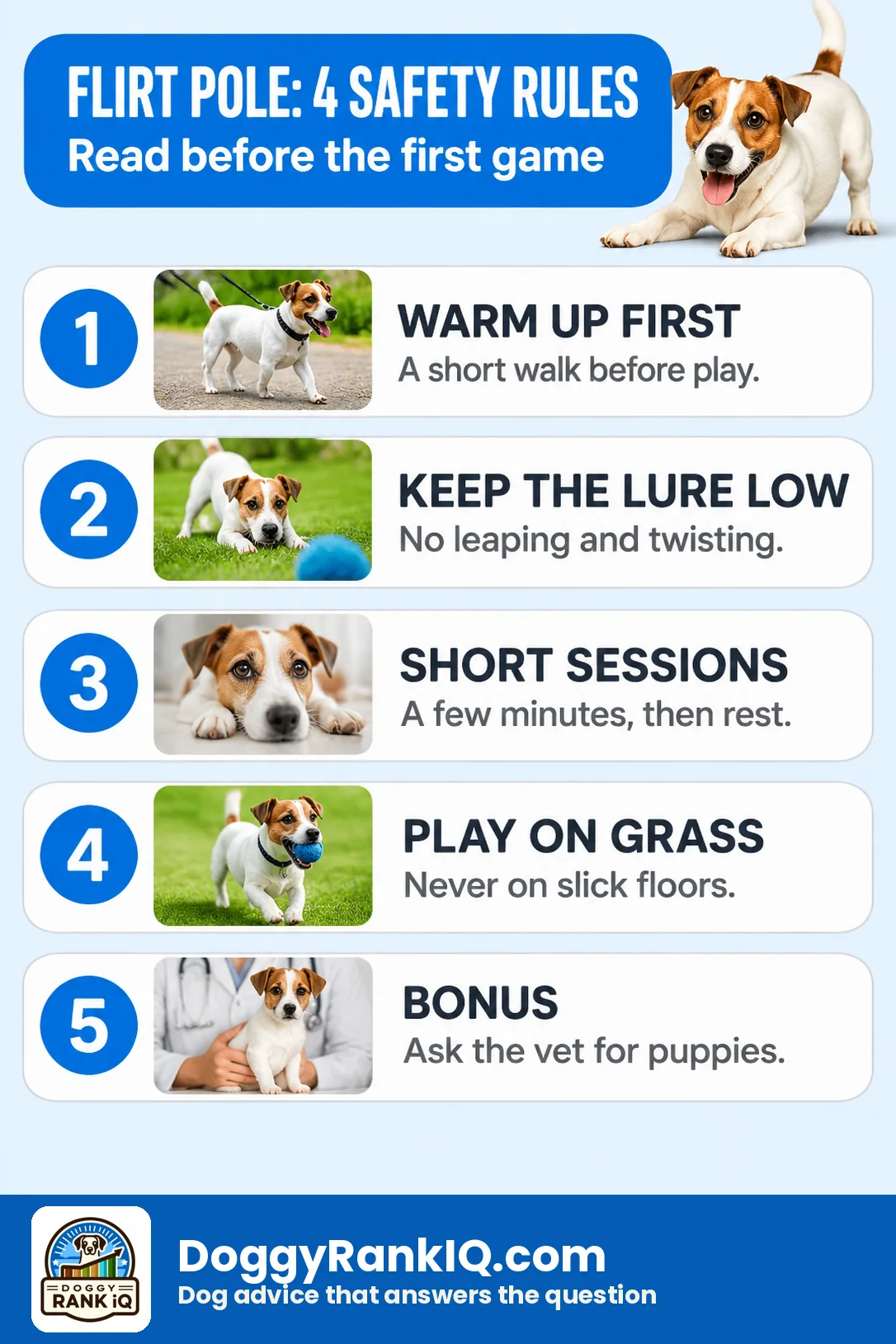
Four rules keep flirt pole sessions safe: warm up before sprinting, keep the lure low and predictable, keep sessions short, and play only on a surface with good traction. Skipping any one of these raises the risk of a pulled muscle, a twisted knee, or a slipped disc, especially in dogs with long backs or short legs.
- Warm up first. A cold dog launched straight into full-speed chasing is a dog at higher risk for soft-tissue strain. A few minutes of loose walking or gentle trotting gets blood into the muscles before the lure starts moving. Rover recommends treating a flirt pole session like any other sprint workout, with a proper warm-up and cool-down on both ends.
- Keep the lure low and moving in straight lines and wide arcs. Jerking the lure into sharp, unpredictable zigzags encourages a dog to leap and twist mid-air, which puts stress on knees and spines. Straight pulls and wide, sweeping arcs let the dog turn with its body instead of against it.
- Keep sessions short, with breaks. Five to ten minutes of active chasing, broken into shorter bursts with pauses, is plenty for most dogs. A flirt pole is intense exercise, not a toy meant to run continuously for twenty minutes.
- Play on grass or another non-slip surface. Concrete, tile, and hardwood let paws slide out from under a dog mid-turn. Grass, turf, or a rubber mat gives traction for the sudden stops and pivots a flirt pole session demands.
Puppies with open growth plates and dogs with existing joint or back problems need a veterinarian’s okay before starting. Whimsy Stick advises waiting until a puppy’s growth plates have closed, which for many medium and large breeds does not happen until somewhere between 12 and 18 months, before introducing full-speed chase and tug work. Breeds with long backs and short legs, and any dog recovering from an injury, carry extra risk during the twisting motions a flirt pole encourages. If there’s any uncertainty, a quick check-in with a vet costs far less than a torn ligament.
Common mistake: letting the dog “win” by catching the lure every single time at full speed. That teaches an all-or-nothing chase pattern instead of the controlled wait-and-release pattern covered later in this guide.
Is a flirt pole safe for puppies?
A flirt pole can be safe for puppies, but only in a modified, low-intensity form, and only once a vet has confirmed the puppy’s joints are developing normally. Full-speed sprinting and hard grabbing should wait until growth plates close.
For young puppies, trainers generally suggest:
- Short, slow-motion lure movement rather than fast sprints
- No sharp pivots or jumping for the lure
- Sessions capped at two or three minutes
- Soft lures only, nothing with rigid parts near the mouth
Whimsy Stick’s puppy guide notes that puppy joints and growth plates are still forming, which makes hard landings and twisting motions riskier than they are for an adult dog. For puppy training basics beyond the flirt pole, the essential commands every puppy should learn guide covers foundational skills like “wait” and “drop it” that transfer directly into flirt pole sessions later on.
Choose a modified puppy session if: the puppy is under a year old, shows interest in chasing, and has been cleared by a vet. Skip it entirely if: the puppy has any diagnosed joint condition or is recovering from surgery.
Flirt pole for dogs comparison table
| Product | Pole length | Cord type | Best dog size | Price |
|---|---|---|---|---|
| Squishy Face Studio V2 | 36 in (Regular) | Bungee | Small to medium | $29.99 |
| Tug-E-Nuff Whip It | 31 in | Bungee handle | Small to large | $50.90 |
| Whimsy Stick Rugged XL | 46 in, one-piece fiberglass | 800 lb Dyneema | 30 lbs and up | $74.95+ |
| Whimsy Stick Standard | Fixed pole | 450 lb Kevlar | Under 30 lbs | $55.95+ |
| SwiftPaws Flirt Pole | 16 to 48 in telescoping | Fixed cord | Small to medium | $49.99 |
| Outward Hound Tail Teaser | Telescoping wand | Fixed cord | Small to medium | $8.50 (lure) |
The 6 best flirt pole for dogs picks
Compare the options below by dog size, cord type, and how hard the dog actually grabs and shakes. A flirt pole built for a 12-pound terrier is not the same tool a 70-pound herding dog needs, and buying the wrong category is the most common mistake owners make with this toy.
1 Squishy Face Studio Flirt Pole V2, Regular 36 inch: best overall
 Squishy Face Studio Flirt Pole V2, Regular 36 inch: best overall
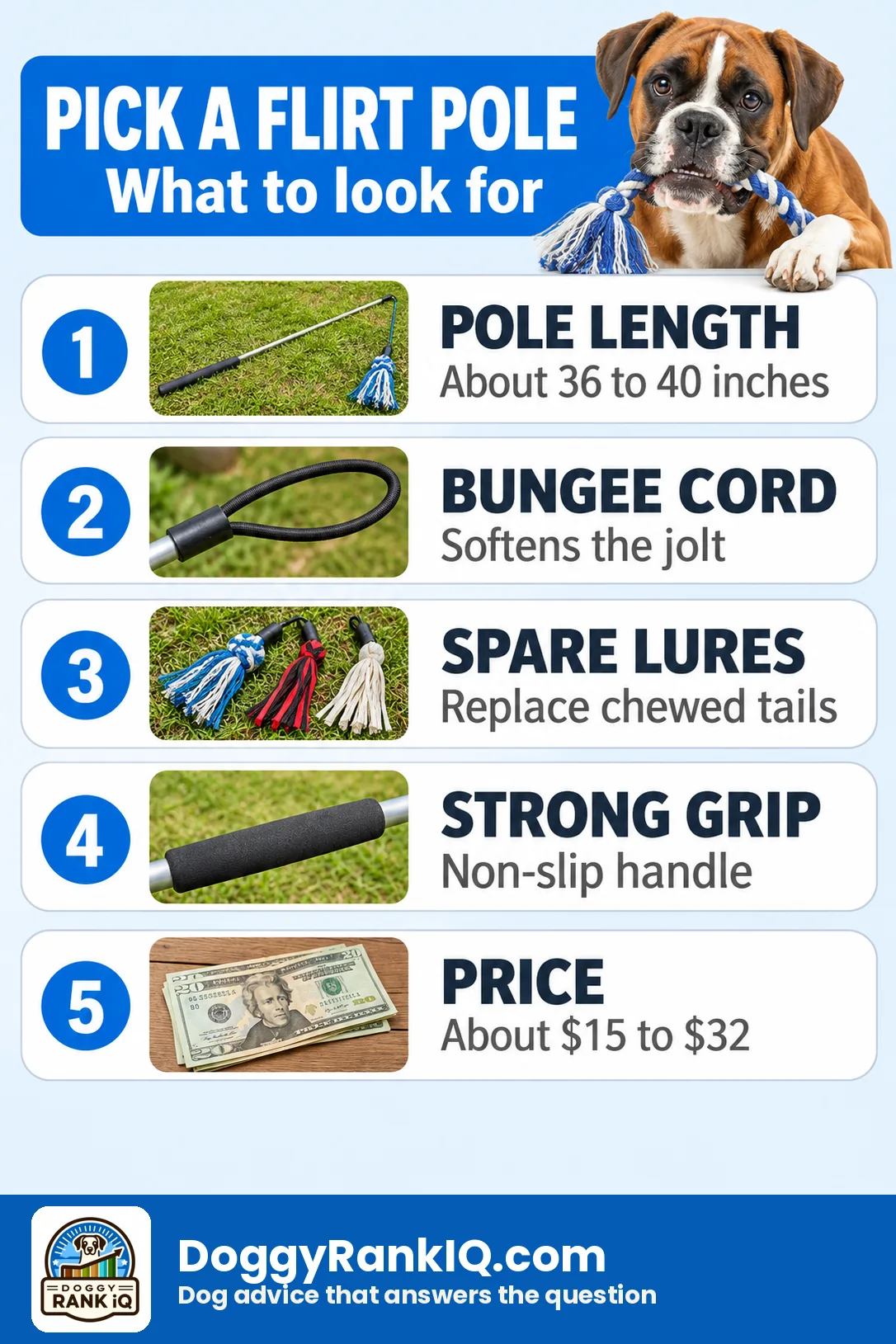
The Squishy Face Studio Flirt Pole V2 comes in Regular (36-inch pole, 52-inch cord) and Junior (24-inch pole, 42-inch cord) versions, and the manufacturer documents a bungee cord designed to absorb the jolt when a dog catches the lure at speed, according to Squishy Face Studio’s own instructions. Replacement lures attach without exposed fasteners near the dog’s mouth, and the whole unit weighs under a pound. Listed at $29.99 with replacement lures from $7.99 (price checked 2026).
This is the pick most households should start with, since it balances price, durability, and bungee protection without the bulk of the heavy duty flirt pole models further down this list.
2Tug-E-Nuff Whip It: best premium bungee option
The Whip It Flirt Pole uses a 31-inch pole with a shock-absorbing bungee handle, built to reduce impact on a dog’s neck and an owner’s shoulder during hard grabs. It was listed at $50.90 but marked out of stock in the latest check, so confirm availability before counting on it. Owners report it holds up well with dogs that bite and tug repeatedly, which makes it a reasonable alternative if the Squishy Face model sells out.
Manufacturer page: Tug-E-Nuff Whip It Flirt Pole
3Whimsy Stick Rugged XL: heavy duty flirt pole for dogs 30 pounds and up
For flirt pole for large dogs that grab, shake, and lean their full weight into a tug, the Whimsy Stick Rugged XL is built with a one-piece reinforced fiberglass pole and an 800-pound Dyneema static line, no bungee give but far less likely to snap on a hard pull. A second production run of 1,000 units launched in 2026 after the first batch sold out. Pricing ran from roughly $74.95 for one lure to $129.95 for five lures plus a spare line (price checked 2026).
This model suits working and sporting dogs that treat the flirt pole like a tug-of-war opponent rather than a toy to politely drop.
4Whimsy Stick Standard: best purpose-built option for smaller dogs
The Whimsy Stick Standard is marketed specifically for dogs under 30 pounds and uses a 450-pound Kevlar static line, lighter than the Rugged XL but still stronger than most bungee cords on the market. Pricing started around $55.95 for one lure, plus a $20 U.S. shipping charge (price checked 2026). A good match for terriers and smaller herding breeds that chase hard but don’t need the industrial-grade line.
5Flirt Pole Interactive Chase Toy for Large, Medium and Small Dogs: adjustable middle ground
The Flirt Pole Interactive Chase Toy covers a wide size range with a single design, which suits households with more than one dog of different sizes. Listed at $25.64 (price checked 2026).
6ASOCEA Extendable Teaser Wand Flirt Stick: budget entry point
For a reader who wants to test whether their dog even likes flirt pole play before spending more, the ASOCEA Extendable Teaser Wand is listed at $14.99 (price checked 2026). It’s a lighter build than the Whimsy Stick line, so it suits small dogs and casual sessions rather than daily use with a hard-biting breed.
Two more Amazon options worth a look: the Interactive Flirt Pole Toy for Dogs at $27.98, and the Heavy Duty 40 inch Extendable Aluminum Flirt Pole at $31.99, both price checked 2026.
How to use a flirt pole: wait, chase, drop it
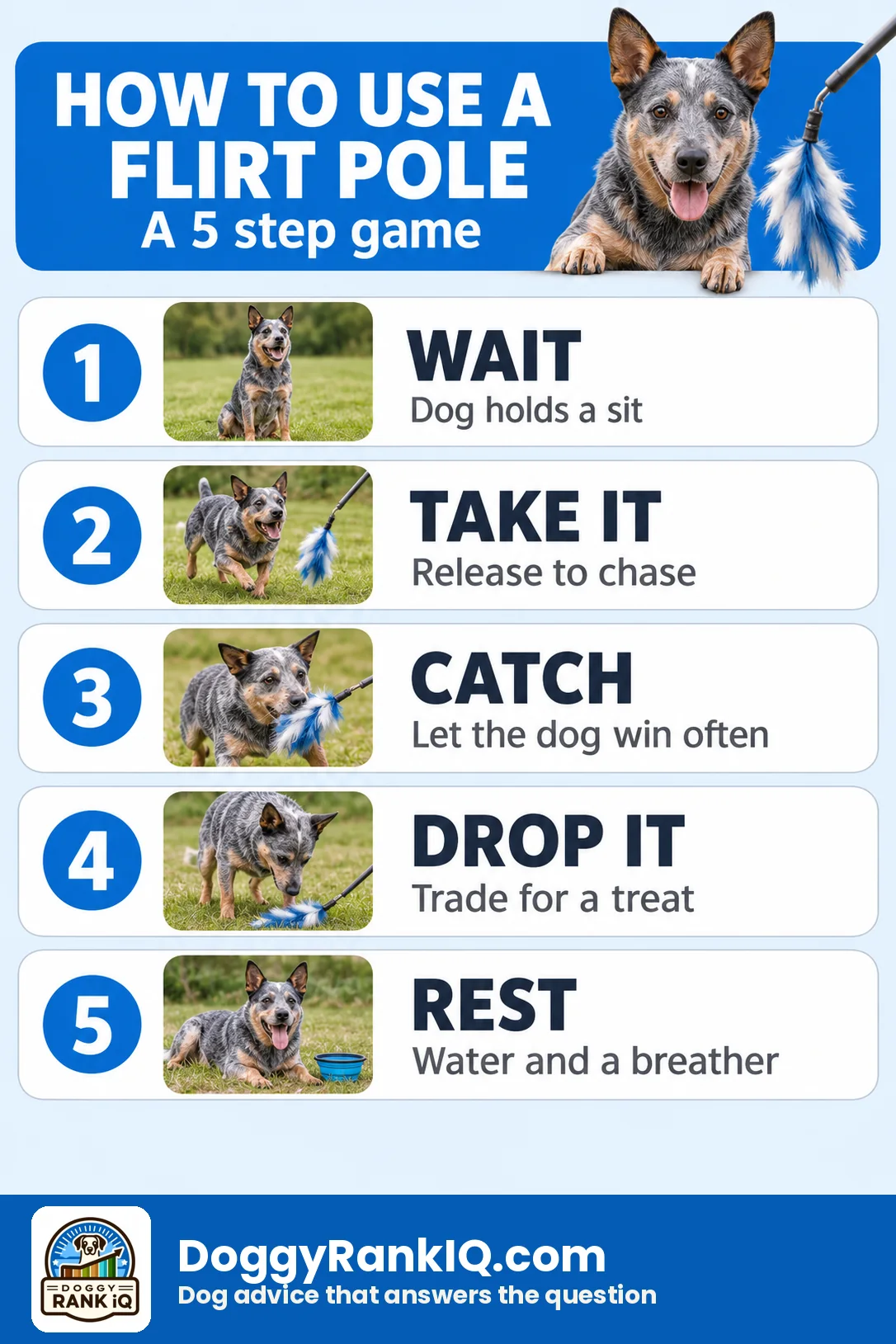
A flirt pole is a strong impulse-control tool because the dog only gets to chase after a release cue, not whenever it wants. That structure turns raw drive into a trained behavior instead of chaos on a leash.
The sequence looks like this:
- Wait. The dog sits or stands still while the lure is visible but not moving. No chasing until the release word.
- Chase. Say the release cue, then move the lure in a straight line or wide arc so the dog sprints after it.
- Take it. Let the dog catch and grab the lure for a few seconds of tug.
- Drop it. Cue a trade for a treat or a second toy, then reset to wait.
This loop builds the same “take it and drop it” pattern used in object-exchange training, and it transfers directly to real-life situations: a dropped sock, a grabbed shoe, a squirrel on a walk. Canine Journal points out that this structured version of flirt pole play does more for impulse control than unstructured chasing ever will, since the dog has to check in with the handler before every burst of speed. Dogs that practice waiting for a release cue during flirt pole sessions tend to generalize that patience elsewhere.
Example: a reactive-leash herding dog that lunges at joggers can practice the same wait-release pattern on the flirt pole first, then transfer the calmer start to actual walks.
Can you make a DIY flirt pole for dogs?
Yes, a DIY flirt pole can be built cheaply with a PVC pipe or dowel, a length of rope, and a fleece or fur lure, but a homemade version typically skips the bungee give that protects a dog’s neck and spine during a hard grab.
Blue Cross outlines a basic build: a sturdy pole roughly three to four feet long, a cord attached securely at one end, and a soft toy or fabric strip tied to the far end of the cord. The organization also stresses supervising every session closely, since homemade versions have not been tested for weak points the way commercial flirt poles have.
Reasons to go the DIY route:
- Cost: materials run a few dollars compared to $25 to $75 for commercial models
- Testing interest: a cheap build lets an owner see if the dog responds before investing in a sturdier model
- Customization: pole length and cord length can be adjusted for a specific dog’s size
Reasons to buy a commercial flirt pole instead:
- Bungee sections reduce jolt on a hard catch, protecting the dog’s neck and the handler’s shoulder
- Reinforced poles (fiberglass or aluminum) resist snapping under a large dog’s pull
- Lures are replaceable without rebuilding the whole toy
Decision rule: build a DIY flirt pole if the goal is a one-time test with a dog of unknown interest level. Buy a commercial one, especially a bungee or heavy duty model, for any dog that will use it regularly or that pulls hard.
What are common mistakes with flirt pole for dogs?
The most common mistakes with flirt pole are skipping the warm-up, moving the lure in sharp unpredictable directions, letting sessions run too long, and letting the dog win every single chase at full intensity.
- No warm-up: sprinting a cold dog raises the odds of muscle strain, especially in colder weather.
- Zigzag lure movement: sharp direction changes cause twisting jumps that stress knees and the spine. Straight lines and wide arcs are safer.
- Sessions that run too long: a flirt pole is high-intensity exercise. Twenty minutes of continuous chasing is excessive for most dogs; five to ten minutes with breaks is the better target.
- Always letting the dog “win”: this builds an all-or-nothing chase pattern instead of the structured wait-release pattern described above.
- Using it on hard ground: concrete and tile offer poor traction for the sudden stops a flirt pole demands.
- Ignoring joint and back conditions: dogs with existing injuries or long-back builds need a vet’s clearance first.
Edge case: a dog that becomes overly aroused or fixated during flirt pole play, growling or struggling to settle afterward, may need shorter sessions or a different outlet entirely, such as a scent-based puzzle toy. For general enrichment ideas beyond chase games, see the best dog puzzle toys guide.
⭐ Top 5 Features We Love
- Bungee cord sections on models like the Squishy Face V2 that absorb jolt on a hard catch, reducing strain on a dog’s neck.
- Replaceable lures that extend a flirt pole’s life well past the point a single fleece tail would wear out.
- One-piece fiberglass poles on heavy duty flirt pole models that won’t flex or snap under a large dog’s full-body pull.
- Telescoping designs like SwiftPaws that collapse for storage or travel, useful for apartment dwellers.
- Low-cost lure refills, such as the Outward Hound Tail Teaser’s $8.50 replacement, that keep ongoing costs down.
⚠️ Things to Look Out For
- Thin fixed cords with no bungee can transmit the full jolt of a hard grab straight into a dog’s neck and the handler’s wrist.
- Lightweight telescoping poles marketed for large dogs may flex or crack under repeated full-force pulling.
- Out-of-stock premium picks, like the Tug-E-Nuff Whip It at the time of this check, mean a backup option matters.
- Lures with exposed hardware near the bite zone can snag on teeth or gums during a hard grab.
- No size guidance on the packaging for some budget options, which makes it harder to know if a given flirt pole model will actually hold up to a specific breed’s bite and pull strength. When in doubt, size up to the next sturdiness category rather than down.
DIY flirt pole for dogs: is it worth it?
A DIY flirt pole build, usually a length of PVC pipe, a length of paracord, and an old sock, costs almost nothing and works for a casual test run. It is worth building if the goal is simply to see whether a dog enjoys the game before spending money on a manufactured version.
Where DIY falls short is the bungee or shock-absorbing section that commercial flirt poles build in specifically to reduce jolt on a dog’s neck. A rigid PVC pole with a non-stretch cord transmits the full force of a hard grab straight back through the line, which matters more for a 60-pound dog that hits the lure at full speed than it does for a 10-pound terrier with a gentle grab.
Decision rule: build a DIY version for a one-time test with a light or moderate chaser. Buy a bungee or Dyneema-line model for daily use with a strong, hard-gripping dog.
Who should buy which
A reader’s choice depends mostly on dog size and bite intensity, not on budget alone. The table above sorts by cord type and size, but the short version: small dogs with a gentle grab do fine on the Squishy Face Junior or the ASOCEA wand; dogs over 30 pounds that shake their catch need the Rugged XL’s reinforced line; and anyone unsure whether their dog will even engage should start with the Tail Teaser’s cheap replacement lure before investing further.
Flirt pole nearby options are limited outside specialty pet stores, so most of these picks ship directly. For households juggling chew-happy dogs alongside flirt pole sessions, pairing this tool with durable chew toys for aggressive chewers rounds out an enrichment routine. A frisbee works well as a secondary fetch-style game on days the flirt pole stays in the closet.
FAQ
The bottom line
A flirt pole turns a small yard into enough space for a real workout, as long as the four safety rules stay in place: warm up, keep the lure low and predictable, keep sessions short, and play on non-slip ground. For most households, the Squishy Face Studio V2 at $29.99 covers the basics well, while dogs over 30 pounds with a hard grab are better served by the reinforced line on the Whimsy Stick Rugged XL. Start with a short, slow session, watch how the dog turns and catches, and adjust the pace before building up to a full routine.
Doggy Rank IQ is reader supported. As an Amazon Associate we earn from qualifying purchases, at no extra cost to you.