
Quick Answer
The Garmin Alpha 300 and 300i track up to 20 dogs over the same roughly 9-mile VHF range, with identical GPS mapping and training features. The only real difference is that the 300i adds a built-in Iridium satellite radio for two-way texting, SOS, and weather, which needs a paid inReach subscription to work. If you hunt where cell service already covers you, or you carry a separate satellite device, the garmin alpha 300 saves you money. If you run dogs in dead zones with no backup communication, the 300i’s $50 hardware premium is cheap insurance.
Key Takeaways: garmin alpha 300
- The Alpha 300 and 300i share the same dog-tracking range, collar compatibility, and battery housing.
- The 300i’s only added hardware is an inReach satellite radio that requires an active Garmin subscription to send messages, trigger SOS, or pull weather.
- Dog tracking itself runs on direct VHF radio between handheld and collar, so it never needs a subscription, on either model.
- Both units track up to 20 compatible collars at once, with a stated range up to 9 miles in open terrain, according to Garmin’s own product listing.
- Battery life is rated up to 55 hours, dropping to about 50 hours with inReach features turned on.
- Garmin plans now range from pay-per-use Enabled coverage to the $64.99 Premium tier, and can be suspended for up to 12 months without a reactivation fee.
- The TT25 collar bundle pushes total cost well past $1,100, which matters more than the $50 handheld gap between models.

Where do you run your dogs?
Check the current price
Tap an option to see the answer.
 What is the garmin alpha 300 and how does it work?
 What is the garmin alpha 300 and how does it work?
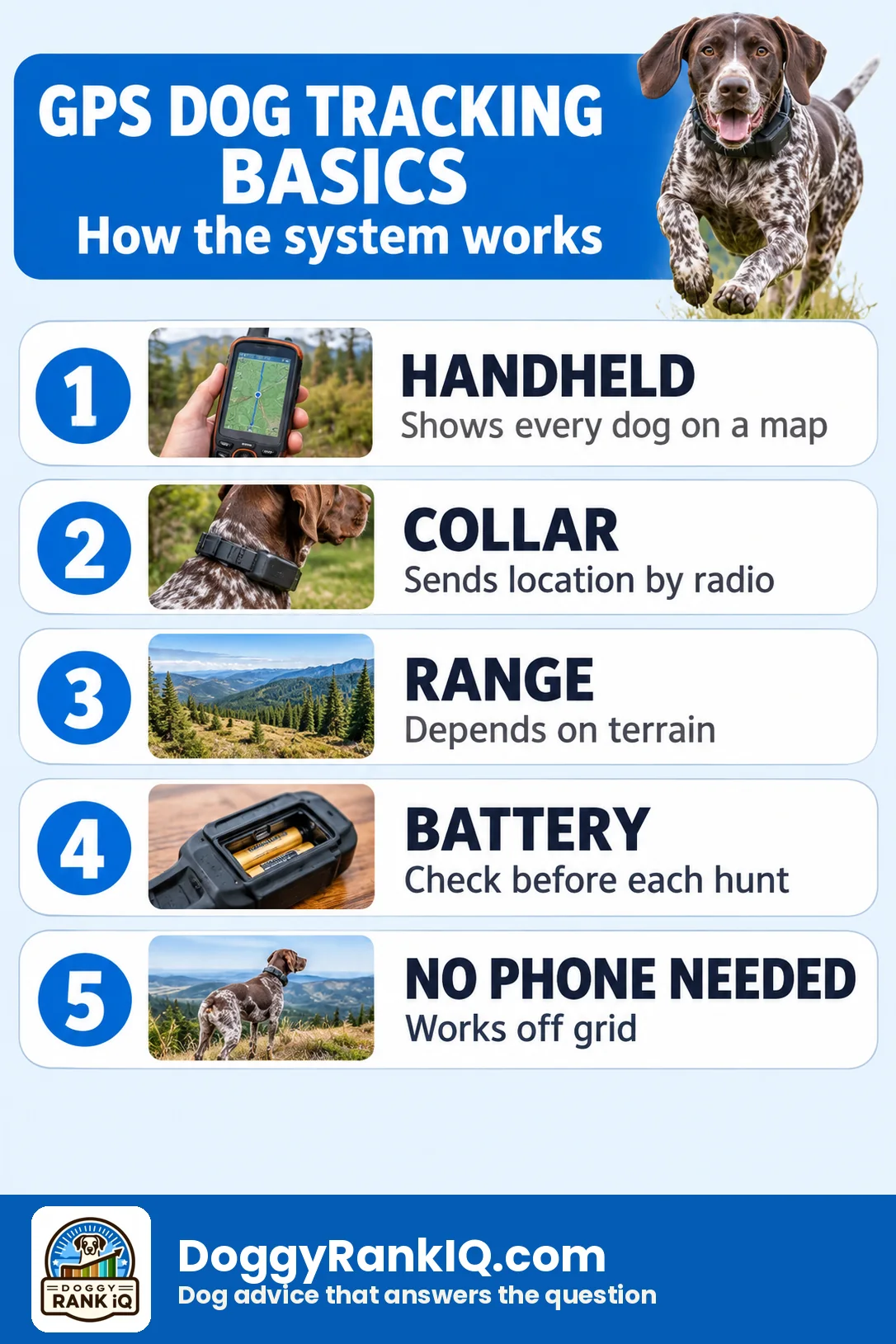
The Alpha 300 is a handheld GPS dog tracking and training device built for hunters who run multiple dogs in the field at once. It pairs with Garmin’s TT-series collars over a dedicated VHF radio channel and shows each dog’s location, direction, and pace on a topo map, all without needing cell service or wifi.
Under the hood, the system runs two separate radios. One is the VHF link between handheld and collar that handles tracking and e-collar training commands. The other, only present in the 300i, is the Iridium satellite radio used for messaging and SOS. According to the Alpha 300 owner’s manual, both devices pull GPS positioning from satellites for mapping, which is a separate function from the inReach satellite communication system.
In practice, that means a hunter glancing at the Alpha 300 screen sees a live map with dot icons for every collared dog, updated in near real time as long as the dogs stay within VHF range. No internet connection is required for any of this. The handheld stores topo maps locally, so it works the same in a cell dead zone as it does in town.
How much does the garmin alpha 300 cost?
The Alpha 300 handheld alone runs $799.99, while the 300i costs $849.99, a $50 gap for the same tracking hardware plus the inReach radio. Collar bundles push both prices well past $1,100.
Current pricing, checked in 2026:
- Alpha 300 handheld only: $799.99
- Alpha 300i handheld only: $849.99
- Alpha 300 + TT25 collar bundle: $1,121.98
- Alpha 300i + TT25 collar bundle: $1,189.95
None of those figures include an inReach subscription for the 300i, which adds a recurring monthly cost on top of the hardware price. Gun Dog Supply’s listing for the handheld-only unit is a useful place to compare pricing against bundle deals before buying.
Garmin Alpha 300 vs 300i: the one real difference
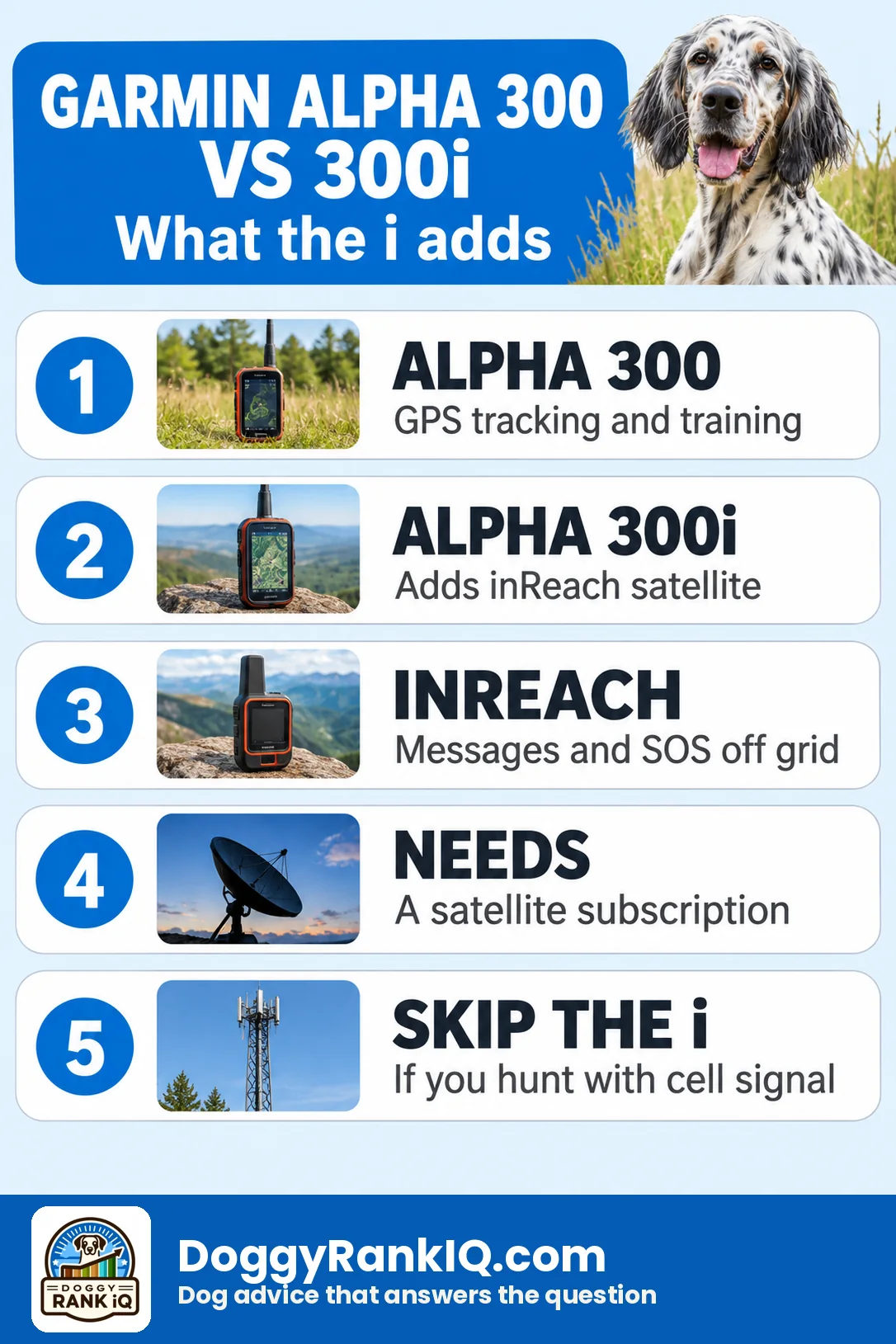
The Alpha 300 and the Alpha 300i run the same dog-tracking software, display the same maps, and pair with the same collars. The 300i adds one thing: an Iridium satellite communicator built into the housing.
That single addition changes what happens when you’re out of cell range and something goes wrong. Garmin’s own inReach materials describe handheld satellite devices as built for two-way messaging, SOS alerts, and weather pulled from the Iridium network, specifically for situations outside normal coverage. The 300i has that radio sitting inside it. The standard 300 does not.
Everything dog-related stays identical:
- Same VHF radio for collar tracking (up to 9 miles, conditions permitting)
- Same 20-dog tracking capacity
- Same screen, buttons, and mapping software
- Same TT25 and compatible collar lineup
So the decision isn’t really “which tracks dogs better.” Neither one does. It’s “do I want an onboard satellite texting device, or do I already have a plan for emergencies in the places I hunt.”
Garmin Alpha 300 vs Garmin Alpha 100: which is better?
The Alpha 100 was Garmin’s previous-generation handheld, and the Alpha 300 improves on it with a better screen, faster GPS lock, and updated mapping software, while keeping the same core VHF tracking concept. For most buyers shopping in 2026, the Alpha 300 is the better pick simply because it is the currently supported model.
Key differences worth knowing:
- The Alpha 100 lacks the touchscreen and refined interface found on the 300 series.
- Collar compatibility overlaps in places, but Garmin’s compatibility documentation should be checked before assuming an old TT collar pairs with a new 300-series handheld.
- Software updates and customer support, per Garmin’s support page, are active for the Alpha 300 line, while the older Alpha 100 receives less ongoing attention.
Choose the Alpha 300 over the Alpha 100 if you’re buying new in 2026. Choose a used Alpha 100 only if the price gap is large and you’ve already confirmed your collars are compatible.
What’s the range on a garmin alpha 300?
The Alpha 300 and 300i both reach up to 9 miles of VHF tracking range in open terrain, according to Garmin’s published device specifications. That figure assumes clear line of sight between handheld and collar, so real-world range in hilly or heavily wooded country will usually fall short of that maximum.
A few things that shrink effective range in the field:
- Dense timber, ridgelines, and valleys between you and the dog
- Low handheld battery, which can reduce radio output over time
- Collar antenna damage from brush or prior wear
Example: a hunter working rolling hardwoods in Missouri might see 3 to 5 miles of reliable tracking, while someone glassing open sage flats in Wyoming could approach the full 9-mile spec. Both situations use the exact same Alpha 300 hardware, the terrain is what changes the outcome.
Do I need a subscription for garmin alpha 300?
No. Dog tracking on the Alpha 300 works with zero subscription, since it runs on the VHF radio link between handheld and collar. A subscription only matters on the 300i, and only for satellite messaging, SOS, tracking over satellite, and weather.
The Alpha 300 owner’s manual is specific that these inReach features require an active satellite plan to function. Without one, the inReach radio inside the 300i sits idle while the dog tracking continues working normally.
Common mistake: buyers sometimes assume the plain 300 handheld needs a Garmin Connect subscription just because it syncs with an app. It doesn’t. Syncing tracks and training logs to a phone app is free; it’s only the satellite features on the 300i that carry a monthly cost.
How long does the battery last on garmin alpha 300?
Battery life on the Alpha 300 is rated up to 55 hours per charge, while the 300i runs up to 50 hours with inReach features active, per Garmin’s specifications. That five-hour gap comes from the extra power draw of the satellite radio running in the background.
Tips to stretch battery life in the field:
- Lower screen brightness when you don’t need to check the map constantly.
- Turn off inReach tracking intervals you aren’t using on the 300i.
- Carry a portable battery pack for multi-day hunts, since neither model swaps batteries in the field without a charging cable.
- Keep the unit warm in cold weather; lithium batteries lose capacity faster below freezing.
A hunter running a full weekend trip (roughly 16 hours a day over three days) will use close to the full rated capacity on either model, so starting each morning at full charge matters more than the small spec difference between the two.
Can garmin alpha 300 work with any dog collar?
No. The Alpha 300 only pairs reliably with Garmin’s own TT-series collars, with the TT25 being the most common bundle choice in 2026. Third-party or off-brand GPS collars are not part of Garmin’s supported ecosystem for this handheld line.
Before buying a collar separately:
- Check Garmin’s dog collar device specifications to confirm the specific TT model pairs with the 300 series.
- Older TT collars from a previous Alpha handheld generation may or may not be compatible, depending on firmware and hardware revision.
- Buying handheld-only and reusing an existing compatible collar is one of the easiest ways to cut the total cost of ownership.
Both the 300 and 300i support up to 20 collar pairings at once, which matters for guides and kennel operators running large groups of dogs, not just weekend two-dog hunts.
Garmin Alpha 300 not tracking dog: what should I do?
If the Alpha 300 stops tracking a collar, the most common causes are a dead or disconnected collar battery, the dog being out of VHF range, or a pairing that dropped after a software update. Start with the simplest fix first before assuming hardware failure.
Troubleshooting steps:
- Confirm the collar battery is charged and the collar is powered on.
- Check that the dog hasn’t moved beyond the realistic range for your terrain (often less than the full 9-mile spec in wooded country).
- Re-pair the collar through the handheld’s device menu if the connection dropped.
- Check for a pending firmware update; Garmin periodically releases updates for both handheld and collar, listed on its software update support page.
- Restart both the handheld and collar if a re-pair doesn’t resolve the issue.
Edge case: if multiple collars drop out at once but the handheld itself seems fine, suspect a handheld antenna or firmware issue rather than a collar problem, since it’s unlikely several collars would fail simultaneously.
Best alternatives to garmin alpha 300
Hunters who don’t need Garmin’s ecosystem, or who want a different feature mix, have a few realistic alternatives worth comparing before committing to the Alpha 300.
- Dogtra Pathfinder 2: a cellular and satellite-based tracker rather than pure VHF, with a different subscription model. Lion Country Supply’s comparison of the Dogtra Pathfinder 2 and Alpha 300 breaks down the tracking method differences in detail.
- Garmin Pro 550 Plus: Garmin’s own training-focused handheld with different e-collar stimulation options, better suited to buyers who prioritize training over long-range tracking of large groups.
- Standalone inReach Mini: a smaller, cheaper satellite-only communicator for hunters who want emergency messaging without any dog tracking features at all.
For a broader rundown of current Garmin tracking handhelds, Lion Country Supply’s guide to the best Garmin dog trackers for 2026 compares several models side by side, including where the Alpha 300 series fits against newer releases.
Is garmin alpha 300 waterproof and durable?
Yes. The Alpha 300 and 300i are built to Garmin’s standard outdoor handheld durability rating, designed to handle rain, mud, and the kind of rough handling that comes with field use. Both the handheld and TT-series collars are built for wet conditions, since dogs working in swamps, creeks, and wet brush are the normal use case.
Practical notes for owners:
- Rinse mud and debris off the collar and handheld after wet hunts to protect buttons and ports.
- Check the charging port cover seals properly after each use, since a loose cover is the most common way water gets into a handheld over time.
- Cold-weather durability matters as much as water resistance; battery performance drops in freezing temperatures even though the housing itself holds up.
Who needs a garmin alpha 300 really?
Hunters, guides, and kennel operators who regularly work with more than one or two dogs at a distance, in terrain without reliable line of sight, are the clearest fit for the Alpha 300. A single dog on a short lead in open fields doesn’t need this level of tracking hardware.
Good fits:
- Hog hunters and bird hunters running multiple dogs that range far out of sight
- Guides managing client dogs across large tracts of private or public land
- Kennel operators training and conditioning several dogs at once
Poor fits:
- Owners of a single backyard dog who just wants basic location checks (a simpler consumer pet tracker is cheaper and sufficient)
- Hikers wanting only personal satellite safety, who are better served by a standalone inReach Mini
- Anyone expecting cellular-based tracking with unlimited range, since this is VHF radio with a hard distance ceiling
Does Alpha 300 work without cell service?
Yes, dog tracking on the Alpha 300 works completely without cell service, wifi, or any internet connection, since it relies on direct VHF radio communication between handheld and collar. This is one of the main reasons hunters choose it over phone-app-based pet trackers that depend on cellular data.
The only feature that needs anything beyond that VHF link is the 300i’s inReach system, which uses the Iridium satellite network instead of cell towers, but even that bypasses cell service entirely. In short, neither model depends on a phone carrier’s coverage map at any point.
Feature comparison
| Feature | Alpha 300 | Alpha 300i | Price (checked 2026) |
|---|---|---|---|
| Dog tracking range | Up to 9 miles | Up to 9 miles | Same hardware |
| Dogs tracked at once | Up to 20 | Up to 20 | Same hardware |
| Built-in inReach satellite | No | Yes (needs subscription) | 300i only |
| Battery life | Up to 55 hours | Up to 50 hours with inReach on | Garmin data |
| Handheld only | Alpha 300 | Garmin Alpha 300i | $799.99 / $849.99 |
| Handheld + TT25 collar bundle | 300 + TT25 bundle | 300i + TT25 bundle | $1,121.98 / $1,189.95 |
Check the current price: Alpha 300 or Garmin Alpha 300i. Prices checked 2026 and can shift with Amazon’s own fluctuations.
What inReach does and what the subscription costs
inReach is Garmin’s satellite messaging system. It lets the 300i send texts, trigger SOS, and pull weather over the Iridium network when there’s no cell signal at all, but it only works with an active plan.
The owner’s manual for the 300i is specific about this: messaging, SOS, location tracking over satellite, and inReach Weather all require an active satellite subscription. Without a plan, the inReach hardware inside the 300i is mostly dormant. You still get full dog tracking, because that runs on a separate VHF radio link between handheld and collar that never needs a subscription on either model.
Garmin’s current U.S. consumer plans run month-to-month with a 30-day minimum commitment, spread across four tiers: Enabled, Essential, Standard, and Premium. Pricing varies by tier and by how many messages or tracking points you need. A useful detail for seasonal hunters: Garmin lets you suspend a consumer plan for up to 12 months at no monthly charge and without a reactivation fee. That means a hunter who only runs dogs three months a year isn’t stuck paying for satellite service in the off-season.
One more detail worth knowing before you travel with the 300i: Garmin’s regulatory notice lists countries including China, India, Iran, Myanmar, Russia, Thailand, and Vietnam where satellite communicators may be restricted or require government authorization. If your hunting trips cross borders, check that list before you pack the 300i.
Which collars pair with the Alpha 300 series
Both the Alpha 300 and 300i pair with Garmin’s TT-series collars, with the TT25 being the most common pick for new buyers. Garmin’s official comparison tool lists up to 20 compatible collar pairings per handheld, and that limit is identical across both models.
A few things owners should know before buying a collar separately from the handheld:
- The TT25 bundle adds roughly $320 to $340 over the handheld-only price, depending on which model you choose.
- Garmin’s compatibility chart is the source to check before buying an older or used TT-series collar, since not every past model pairs with the current Alpha 300 series.
- Third-party collars are not part of Garmin’s supported ecosystem for the Alpha 300 line. Owners researching mixed setups should expect to stay inside the TT collar family for reliable pairing.
If you already own a working TT-series collar from an earlier Garmin handheld, it’s worth checking Garmin’s compatibility page before assuming you need a new collar purchase. Buying handheld-only and reusing an existing collar is one of the more common ways owners trim the total cost. Owners new to tracking collars in general may also find it useful to review basic training fundamentals, such as the essential commands every puppy should learn, before pairing a collar with a young or untrained dog.
⭐ Top 5 Features We Love
- 20-dog tracking capacity. Useful for guides, kennel operators, and anyone running multiple dogs at once, not just a weekend two-dog hunt.
- 9-mile VHF range that needs no subscription. The core function, finding your dog, keeps working with zero monthly cost, on either the 300 or 300i.
- Suspendable inReach plans. Twelve months of pause time with no reactivation fee means seasonal hunters aren’t paying for satellite service they don’t use.
- Shared battery rating. Up to 55 hours (50 with inReach active) means fewer mid-trip charging scrambles.
- Single ecosystem for tracking and training. One handheld, one app, one collar family, instead of juggling separate GPS and e-collar systems.
⚠️ Things to Look Out For
- The $50 handheld gap isn’t the real cost. The subscription is. Budget for a monthly plan, not just the hardware difference, before deciding on the 300i.
- inReach features do nothing without an active plan. The hardware sits in the 300i regardless, but texting, SOS, and weather are locked behind a subscription.
- Collar bundles add real money. The TT25 bundle runs $1,121.98 for the 300 and $1,189.95 for the 300i, which is a bigger jump than the handheld price alone suggests.
- International travel has restrictions. Countries including China, Russia, and India regulate or restrict satellite communicators, and the rules can change without notice.
- No official hardware refresh announced. As of 2026, Garmin’s own support documentation still points owners to the existing Alpha 300 and 300i lineup for updates, not a new generation.
Who should buy the 300, who should buy the 300i
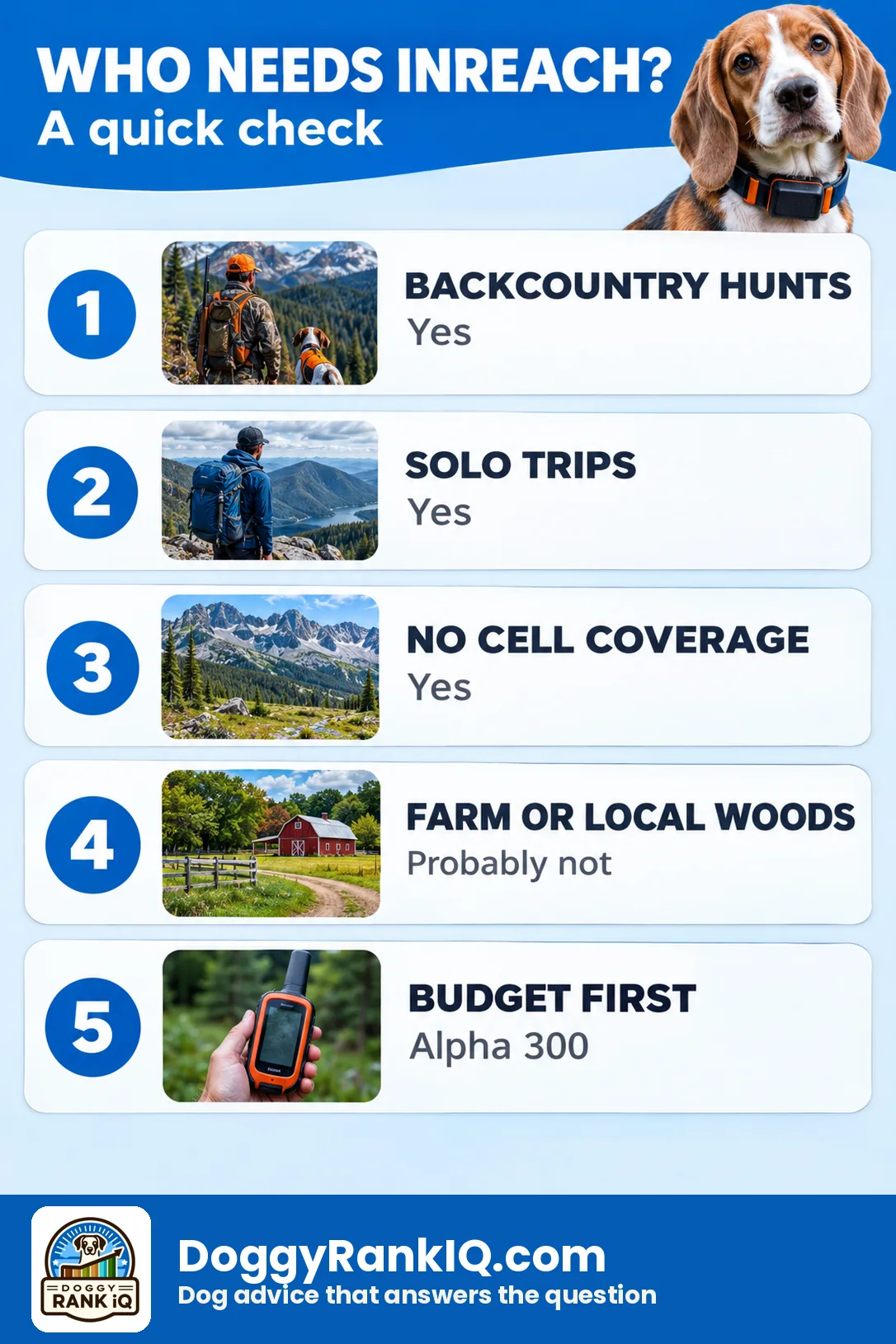
Choose the Alpha 300 if you hunt areas with reliable cell coverage, already carry a separate satellite communicator or inReach Mini, or want to keep costs down and skip a recurring bill entirely. The plain 300 does everything the 300i does for dog tracking, training feedback, and mapping, just without the built-in satellite radio.
Choose the 300i if you regularly hunt or run dogs in dead zones with no cell service and no backup device. The appeal isn’t dog tracking, since both models handle that the same way. The appeal is having one handheld that can also send an SOS or a text home if you’re injured or lost miles from a road.
A few decision rules worth applying directly:
- If you already own an inReach Mini or similar device: stick with the plain 300 and save the $50, since you already have satellite coverage elsewhere.
- If you hunt solo in remote country with no other communication backup: the 300i’s added safety margin is worth the subscription cost.
- If you’re upgrading from an older Garmin Alpha model: the real upgrade decision is about collar compatibility and screen features, not inReach. Check Garmin’s compatibility chart before assuming a forced 300i purchase.
- If budget is the deciding factor: the plain 300 handheld, paired with a collar you already own, is the cheaper functional setup.
Neither model is the right call for someone who wants a lightweight backcountry safety device without dog tracking at all. For that use case, a standalone inReach Mini is smaller, cheaper, and built specifically for that one job.
Handheld only or bundle? The math
The cheapest functional setup is a $799.99 Alpha 300 handheld plus an existing or separately purchased TT25 collar. The most complete out-of-box setup is the $1,189.95 Alpha 300i and TT25 bundle, which adds both the collar and satellite capability in one purchase.
Here’s the actual spread, prices checked 2026:
- Alpha 300 handheld only: $799.99 (check the current price)
- Alpha 300i handheld only: $849.99 (check the current price)
- Alpha 300 + TT25 collar bundle: $1,121.98 (check the current price)
- Alpha 300i + TT25 collar bundle: $1,189.95 (check the current price)
The gap between handhelds is $50. The gap between bundles is about $68. Neither number includes the inReach subscription, which is the part that actually adds up over a hunting season. A hunter who buys the 300i and runs Standard tier service for six active months, then suspends it, pays more in year one than the $50 hardware difference suggests, but far less than running the plan year-round.
If the dog is the whole reason you’re buying this device, the plain Alpha 300 bundle covers that job completely. The 300i is a safety purchase layered on top of a dog tracker, not a better dog tracker.
FAQ
The bottom line
The Alpha 300 and 300i are the same dog-tracking tool wearing two different safety profiles. If your hunting grounds have cell coverage or you already carry backup communication, the plain 300 does the job for $50 less and skips the subscription question. If you run dogs where there’s no signal and no backup plan, the 300i’s built-in inReach radio is a genuine safety upgrade, provided you budget for an active plan rather than assuming the hardware alone covers you.
Before buying either, check Garmin’s own compatibility chart against any collar you already own, and decide honestly whether you need satellite messaging or just want it. For readers comparing other pet gear and travel logistics, our guide to airline approved dog carriers and our breakdown of whether pet insurance is worth it cover two other big-ticket dog decisions worth the same kind of scrutiny.
Doggy Rank IQ is reader supported. As an Amazon Associate we earn from qualifying purchases, at no extra cost to you.