
Two tubs, two price tags, and one dog who has no idea either exists. That’s the honest starting point for comparing cosequin vs dasuquin: both are Nutramax joint supplements, both come in multiple sizes, and the “better” one depends on math more than marketing.
Quick Answer
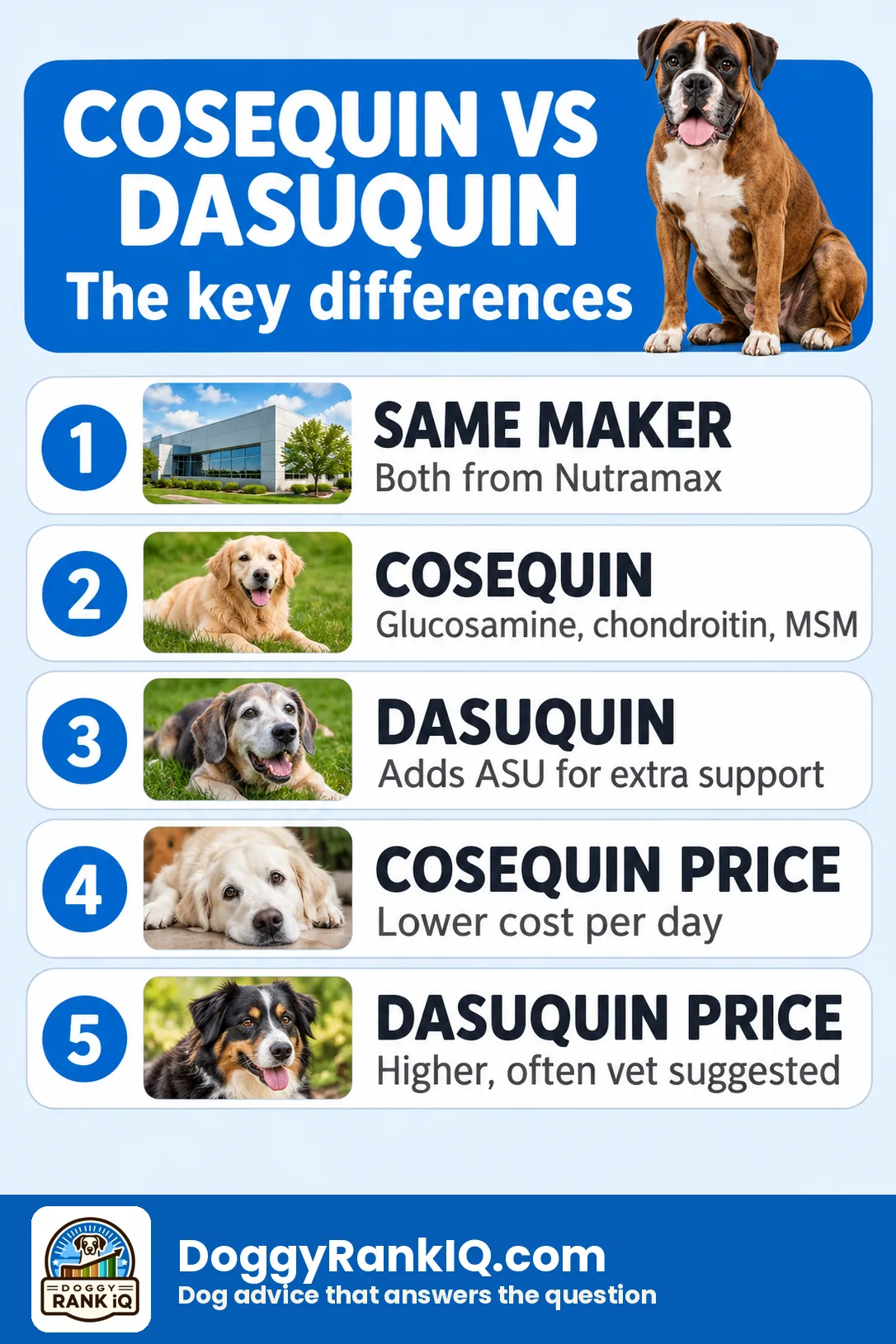
In the cosequin vs dasuquin comparison, the core difference is one ingredient: Dasuquin adds ASU (avocado soybean unsaponifiables), plus boswellia and green tea extract, on top of the same glucosamine and chondroitin base found in Cosequin. Dasuquin typically costs more per day, roughly $0.65 to $0.93 depending on dog size, compared to $0.33 to $0.80 for Cosequin. Neither product has strong clinical trial evidence proving it reduces dog joint pain better than the other, and a 2022 review found a “very marked non-effect” for glucosamine-chondroitin products generally, according to ConsumerLab’s joint supplement review. Choose Dasuquin if your dog hasn’t responded to Cosequin alone and budget allows; choose Cosequin as the reasonable first try.
Key Takeaways: cosequin vs dasuquin
- Cosequin contains glucosamine, chondroitin, and often MSM. Dasuquin contains the same base plus ASU, boswellia, and green tea extract.
- Cost per day for Cosequin Maximum Strength runs about $0.33 to $0.80; Dasuquin with MSM runs about $0.65 to $0.93, depending on dog size and bottle size.
- A 2022 meta-analysis found a “very marked non-effect” for chondroitin-glucosamine products in dogs and cats, and the Merck Veterinary Manual notes NSAIDs remain the most predictably effective OA treatment.
- ASU evidence is mixed, with some older cartilage benefits reported and newer long-term structural studies showing no improvement.
- Most vets today lean toward multimodal OA management, with weight control and omega-3s used more often than glucosamine-chondroitin products alone, per the COAST osteoarthritis consensus guidelines.
- Giving both products together is not recommended; it risks double-dosing the overlapping ingredients without added benefit.
- Nutramax continues to expand its joint supplement line rather than retiring either product, according to Nutramax’s product catalog.

What does your dog need most?
Check the current price
Check the current price
Check the current price
Tap an option to see the answer.
 What is the difference between Cosequin and Dasuquin?
 What is the difference between Cosequin and Dasuquin?
Cosequin is Nutramax’s glucosamine and chondroitin supplement, sometimes with MSM added. Dasuquin is the same base formula with ASU added, plus boswellia and green tea extract, making it the step-up product in the same product family.
Think of Cosequin as the foundation and Dasuquin as the foundation with extras stacked on. Both come from the same company, both are sold without a prescription, and both claim to support cartilage and joint comfort, though per FDA guidance on pet product regulation, products sold as supplements don’t go through the same premarket review as approved animal drugs.
A few practical distinctions:
- Cosequin comes in Maximum Strength tablets (with or without MSM) and sprinkle capsules for picky eaters.
- Dasuquin comes in chews, split specifically into small/medium dog and large dog formulas, each with different ingredient amounts.
- Dasuquin is Nutramax’s “if Cosequin alone isn’t enough” recommendation, according to Nutramax’s own FAQ page.
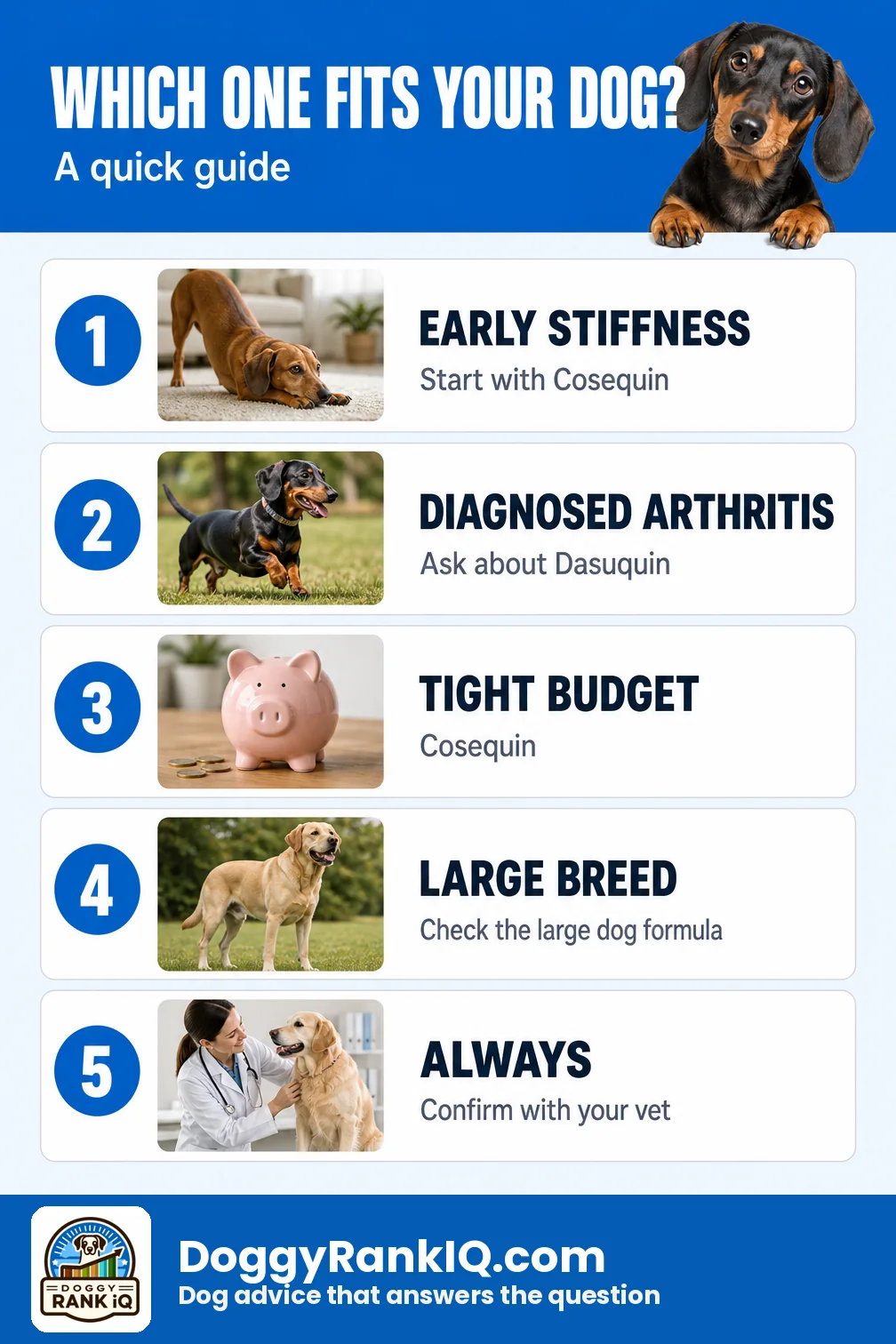
Decision rule: if your dog is newly diagnosed with mild stiffness, starting with Cosequin is the lower-cost, lower-complexity option. If a dog has already been on Cosequin for 8 to 12 weeks with no visible change, Dasuquin is the logical next step, not a guaranteed fix.
Which is better for dogs, Cosequin or Dasuquin?
Neither product has strong independent trial data proving it outperforms the other for pain relief. The practical answer is that Dasuquin adds ingredients that theoretically target inflammation and cartilage protection beyond what Cosequin offers, which is why vets often position it as a second step rather than a universal upgrade.
For a dog with mild, early stiffness, Cosequin alone is a reasonable starting point and costs less. For a dog that has been on Cosequin for two to three months with no visible change in mobility, Dasuquin is worth trying next, especially for larger or older dogs carrying more joint stress. A common mistake is assuming “more ingredients” automatically means “more effective.” In the cosequin vs dasuquin debate, the extra ingredients in Dasuquin (ASU, boswellia, green tea extract) have thinner research support than the glucosamine-chondroitin base both products share.
Edge case: a dog with advanced arthritis and an NSAID prescription already in place may see little added benefit from switching supplements at all, since the Merck Veterinary Manual notes NSAIDs are the more predictably effective treatment for diagnosed osteoarthritis. Talk to a vet before stacking supplements on top of prescription medication.
Cosequin vs Dasuquin ingredients, label by label
Cosequin Maximum Strength Plus MSM tablets typically provide about 600 mg glucosamine hydrochloride, 300 mg chondroitin sulfate, and 250 mg MSM per tablet. Dasuquin’s formula scales by dog size and adds ASU, boswellia, and green tea extract.
A common mistake: assuming a “tablet for tablet” comparison is fair. It isn’t. Large-dog Dasuquin chews are far more concentrated than a standard Cosequin tablet, which is part of why the price per day gap looks smaller than the price per bottle gap suggests. This is one of the trickiest parts of any cosequin vs dasuquin label comparison: the numbers on the front of the bottle don’t tell you the per-dose math.
What ingredients are in Cosequin vs Dasuquin?
Cosequin’s base ingredients are glucosamine hydrochloride and chondroitin sulfate, often paired with MSM. Dasuquin keeps that same base and adds ASU, boswellia serrata extract, and green tea extract, which is the entire ingredient-level story behind the cosequin vs dasuquin price gap.
Glucosamine and chondroitin are cartilage-building blocks believed to support joint cushioning. MSM is a sulfur compound often included for its anti-inflammatory reputation. ASU is derived from avocado and soybean oils and is marketed as a cartilage-protective compound. Boswellia (Indian frankincense) and green tea extract are both included in Dasuquin for their antioxidant and anti-inflammatory properties, though neither has dog-specific trial data as strong as the glucosamine-chondroitin research base itself, according to ConsumerLab’s pet joint supplement review.
What does ASU add, and what does the evidence support?
ASU (avocado soybean unsaponifiables) is Dasuquin’s defining ingredient, and Nutramax states it’s meant to work alongside glucosamine and chondroitin, though that’s a manufacturer claim, not independent proof of extra pain relief. The actual research record on ASU is mixed, not clearly positive.
Here’s what’s been studied so far:
- An older trial gave 16 dogs either 10 mg/kg/day of ASU or a placebo and found reductions in some cartilage and subchondral-bone lesions.
- A 2026 follow-up model study using long-term ASU treatment did not find improvement in several structural OA measures under the tested conditions. That doesn’t prove ASU does nothing in dogs, but it does weaken any claim that adding ASU automatically produces a disease-modifying advantage.
- A review covering a 40-dog study using amounts similar to large-dog Dasuquin (900 mg glucosamine, 350 mg chondroitin, 90 mg ASU) described the four-week results as inconclusive.
Edge case: dogs with more advanced joint changes may respond differently than the dogs in these smaller studies, which is exactly why label claims shouldn’t be read as guaranteed outcomes. Confirm any supplement plan with your veterinarian, especially for a dog already on NSAIDs or other medication.
Why is Dasuquin more expensive than Cosequin?
Dasuquin costs more because it contains additional ingredients (ASU, boswellia, green tea extract) and because its formulas are size-specific, which means manufacturing and dosing costs are higher per chew. The extra ingredients, not a fundamentally different glucosamine-chondroitin base, account for most of the price gap in any cosequin vs dasuquin cost comparison.
Dasuquin also comes almost exclusively in chew form, which generally costs more to produce than compressed tablets. Add in the fact that Dasuquin’s large-dog formula is more concentrated per chew (900 mg glucosamine versus 600 mg in Cosequin tablets), and the higher price reflects both more ingredients and more active material per dose, not just branding.
Cosequin vs Dasuquin cost per day by dog size
Cost per day depends on the label dose, which scales by weight, and the bottle size you buy. Here’s the actual math using 2026 Amazon prices.
Cosequin Maximum Strength MSM+HA, 250 count, $59.99 (check current price, rel=”sponsored”): label dose is roughly 2 tablets/day for dogs under 25 lbs, up to 4 to 6 tablets/day for dogs over 60 lbs.
Cosequin Maximum Strength, 75 count, $24.99 (check current price, rel=”sponsored”): same per-tablet cost, smaller bottle for smaller dogs or a trial run.
Dasuquin MSM Small/Medium Dogs, 150 count, $64.99 (check current price, rel=”sponsored”): label dose is typically 1 to 2 chews/day.
Dasuquin MSM Large Dogs, 150 count, $77.99 (check current price, rel=”sponsored”): label dose is typically 2 chews/day for dogs over 60 lbs.
Dasuquin MSM Large Dogs, 84 count, $54.99 (check current price, rel=”sponsored”): smaller bottle, same large-dog dose.
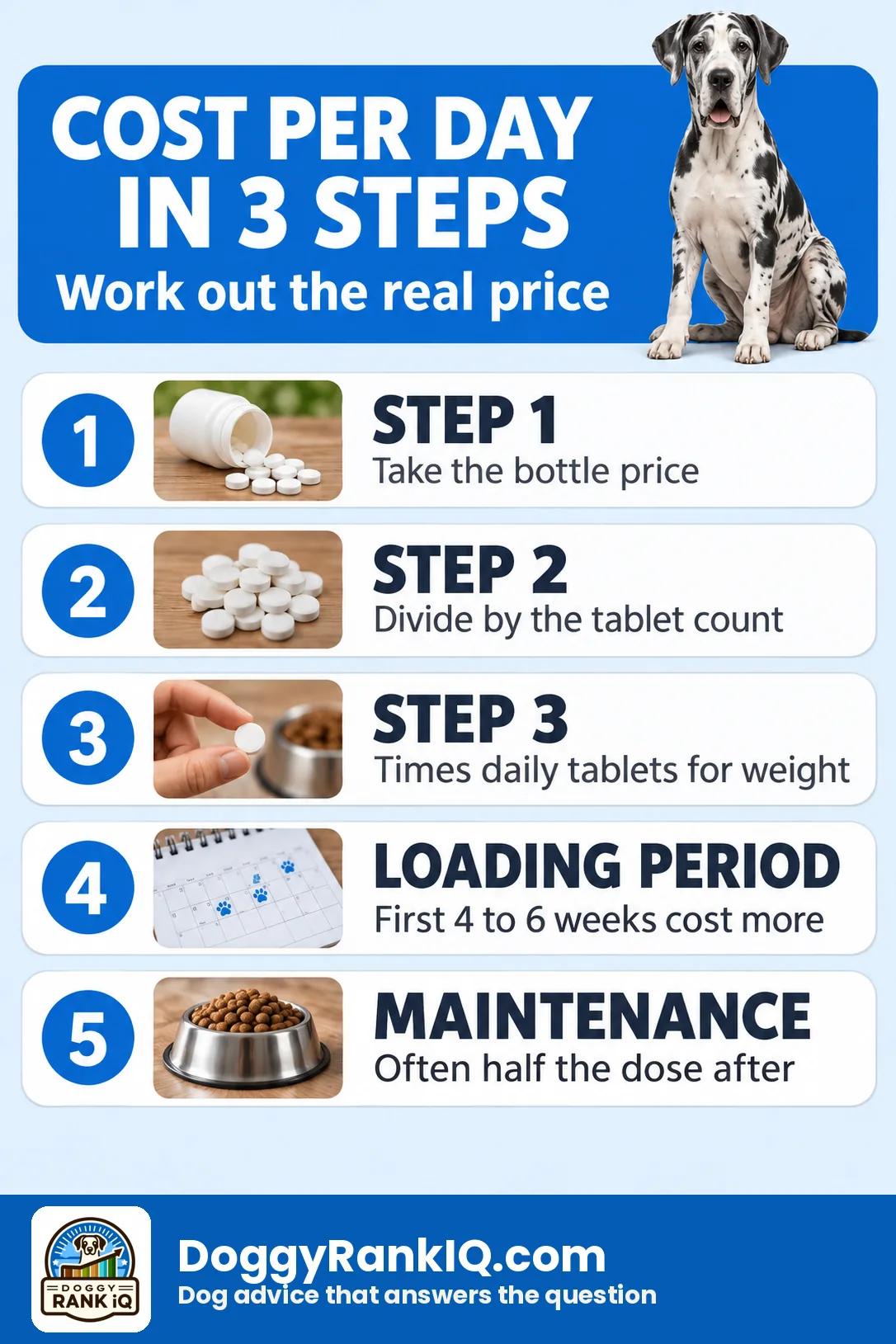
Math shown: price divided by count equals per-unit cost, then multiplied by the label dose. For example, Dasuquin Large 150ct: $77.99 / 150 = $0.52 per chew, times 2 chews/day = $1.04/day.
Common mistake: buying the small bottle “to try it out” without checking the per-chew cost. The 84-count Large Dasuquin costs $0.65 per chew versus $0.52 per chew in the 150-count bottle, about 25% more per dose for the smaller size.
How much does Cosequin cost?
Cosequin Maximum Strength costs roughly $0.33 to $0.80 per day depending on dog size, which works out to about $14 to $43 per month using current 2026 Amazon pricing. Smaller dogs on lower doses land at the bottom of that range, while large dogs needing 4 to 6 tablets a day sit near the top.
The 75-count bottle ($24.99) works well for a trial run or a small dog, while the 250-count bottle ($59.99) brings the per-tablet cost down for dogs that need higher daily doses. Always divide the bottle price by the tablet count first, then multiply by your dog’s label dose, rather than comparing sticker prices across bottle sizes.
How much does Dasuquin cost?
 How much does Dasuquin cost?
Dasuquin with MSM costs roughly $0.43 to $1.31 per day depending on dog size and bottle size, which is noticeably higher than Cosequin in most size brackets. Small and medium dogs on a single chew per day land at the low end, while large dogs on the smaller 84-count bottle land at the high end.
The 150-count bottles (Small/Medium at $64.99, Large at $77.99) offer better per-chew value than the 84-count Large bottle ($54.99), even though the smaller bottle has a lower sticker price. In any cosequin vs dasuquin shopping comparison, bottle size matters as much as brand.
Does Cosequin have side effects?
Cosequin is generally well tolerated, and reported side effects are mild and uncommon, mostly soft stool or mild digestive upset when a dog first starts the supplement. Severe reactions are rare, but any new or worsening symptoms after starting Cosequin should prompt a call to your veterinarian.
Dogs with shellfish allergies should be monitored, since glucosamine is often sourced from shellfish shells, and some dogs may react to that source material even in processed form. Starting with a lower dose for the first few days, as some owners do, can help identify mild digestive sensitivity before committing to the full label dose.
What are the side effects of Dasuquin?
Dasuquin’s side effect profile is similar to Cosequin’s, with mild digestive upset being the most commonly reported issue, since both products share the same glucosamine-chondroitin base. The added ingredients in Dasuquin (ASU, boswellia, green tea extract) have not been linked to major new side effect patterns in available product data, though boswellia and green tea extract are less studied in dogs than glucosamine and chondroitin individually.
Dogs on blood thinners or with sensitive stomachs should be discussed with a veterinarian before starting Dasuquin, since green tea extract has mild effects on clotting in some species. As with Cosequin, any unusual vomiting, diarrhea, or lethargy after starting Dasuquin warrants a vet call rather than waiting it out.
Does Cosequin actually work for joint pain?
The honest answer is that strong clinical trial evidence is lacking. A 2022 systematic review found a “very marked non-effect” for glucosamine-chondroitin products in dogs and cats, according to ConsumerLab’s review of joint health supplements, which has made some vets skeptical of the entire product category.
That said, plenty of owners report visible improvement, and some vets still recommend trying Cosequin as a low-risk first step before moving to prescription options, particularly for dogs with mild stiffness rather than diagnosed osteoarthritis. The VCA Canada overview of glucosamine-chondroitin notes that individual response varies widely and that the combination is generally considered low-risk even where evidence of benefit is mixed. A reasonable approach: track specific behaviors (stair use, time to stand, walk length) for 6 to 8 weeks rather than relying on a vague sense of “better.”
Can I give my dog both Cosequin and Dasuquin together?
No, combining Cosequin and Dasuquin is not recommended because both products share the same glucosamine and chondroitin base, and giving both would simply duplicate those doses rather than adding a therapeutic benefit. There is no established protocol or dosing guidance for stacking the two products.
If you’re trying to decide between the two, the better approach is a clean switch rather than overlap: finish out the current bottle of Cosequin, then start Dasuquin at its labeled dose rather than giving both at once. If your dog is already on NSAIDs or another joint medication, loop in your vet before adding either supplement, since overlapping ingredients across multiple products is a common and avoidable dosing mistake.
How long does it take for Cosequin to start working?
Most manufacturer guidance and owner reports suggest giving Cosequin 4 to 6 weeks before judging results, though some dogs take up to 8 weeks to show any visible change. This timeline applies to Dasuquin as well, since both products rely on the same glucosamine-chondroitin mechanism for any cartilage-level effect.
Track specific, observable behaviors rather than a general impression:
- Time to stand up after lying down
- Hesitation or avoidance on stairs
- Willingness to go on normal-length walks
- Stiffness after rest versus after exercise
If there’s no change by week 8, that’s a reasonable point to discuss switching from Cosequin to Dasuquin, or moving toward other management options, with your veterinarian.
Is Dasuquin better for senior dogs?
Dasuquin is often recommended for senior dogs with more established joint wear, mainly because of the added ASU, boswellia, and green tea extract, though it is not proven to outperform Cosequin in head-to-head trials. Senior dogs with diagnosed osteoarthritis are the population most studied in available joint health research overall, though that research base still centers more on weight management and omega-3 fatty acids than on any single glucosamine-chondroitin brand, according to the COAST osteoarthritis consensus guidelines.
A practical approach for senior dogs: start with Cosequin unless the dog already has a diagnosed, more advanced joint condition, in which case Dasuquin’s broader ingredient list and vet-recommended “step-up” positioning make it a reasonable first choice rather than a second step. For truly advanced OA, supplements of either kind are a supporting measure, not a replacement for a full veterinary mobility plan, as outlined in AAHA’s Mobility Matters guidance.
What are alternatives to Cosequin for joint health?
Alternatives to Cosequin include omega-3 fatty acid supplements, weight management programs, and prescription NSAIDs, all of which have stronger or more consistent evidence behind them than glucosamine-chondroitin products alone. Many vets today favor a multimodal approach over any single supplement.
- Omega-3 fatty acids (fish oil) are increasingly favored for their anti-inflammatory evidence base.
- Weight management is consistently cited as one of the most effective, lowest-cost interventions for canine joint pain.
- NSAIDs, prescribed by a vet, remain the most predictably effective treatment for diagnosed osteoarthritis, according to the Merck Veterinary Manual.
- Physical rehabilitation and controlled exercise plans are often paired with supplements rather than used alone.
For owners building a broader care routine, our guide on choosing the right food for your dog and our roundup of best orthopedic dog beds both support joint comfort alongside any supplement choice.
Can cats take Cosequin or Dasuquin?
Yes, Nutramax makes cat-specific versions of both Cosequin and Dasuquin, and cats should not be given the dog formulas, since dosing and ingredient ratios differ between species. Always check the label for “feline” or “for cats” formulations before giving either product to a cat.
Cat owners should also be aware that cats are far more sensitive to dosing errors than dogs given their smaller body size, so splitting a dog tablet or chew “to approximate” a cat dose is not a safe substitute for the cat-specific product line. If a cat shows stiffness or reduced jumping ability, a vet visit to rule out other causes is the right first step before reaching for any joint supplement.
⭐ Top 5 Features We Love
- Dasuquin’s size-specific dosing. Separate small/medium and large formulas mean dogs aren’t choking down six tiny tablets to hit a large-dog dose.
- Cosequin’s lower entry cost. The 75-count bottle is a reasonable trial size before committing to a bigger purchase.
- MSM in both lines. MSM is included across most Cosequin and Dasuquin formulas, giving a consistent anti-inflammatory ingredient base.
- Chew format on Dasuquin. Many owners report easier dosing with chews compared to tablets, especially for dogs who refuse pills.
- Nutramax’s manufacturing consistency. Both products come from the same company, which keeps sourcing and quality control standards aligned across the line.
⚠️ Things to Look Out For
- Neither product has strong trial evidence of pain relief. A 2022 systematic review and meta-analysis found a “very marked non-effect” for chondroitin-glucosamine nutraceuticals in dogs and cats.
- NSAIDs, not supplements, remain the most predictably effective OA treatment according to the Merck Veterinary Manual.
- ASU’s benefit is unproven at the structural level. A 2026 study found no improvement in several long-term joint measures with long-term ASU use.
- Giving both products together isn’t recommended. The overlapping glucosamine and chondroitin doses would simply duplicate, not multiply, without a documented reason to combine them.
- Bottle size changes your real cost per day. Always divide price by count before assuming the bigger number on the label means a better deal. Price checked 2026.
Which one fits your dog?
The fit depends more on your dog’s size and your monthly budget than on brand loyalty. Here’s a practical breakdown of the cosequin vs dasuquin decision by category.
By size:
- Small dogs (under 25 lbs) rarely need Dasuquin’s higher ASU dose; Cosequin’s lower cost per day often makes more sense as a starting point.
- Large and giant breeds, especially ones already showing stiffness, are the group most often moved to Dasuquin Large, since the concentrated dose means fewer chews per day.
By age:
- Senior dogs with diagnosed osteoarthritis are the population most studied in available research, though most of that research still centers on omega-3s and weight management rather than glucosamine-chondroitin brands specifically.
- Younger dogs with a joint injury or early stiffness may do fine on standard Cosequin while owners watch for change.
By budget:
- If $20 to $30 a month fits your budget, start with Cosequin Maximum Strength.
- If budget allows $30 to $45 a month and Cosequin hasn’t produced visible change after 8 weeks, Dasuquin with MSM is the documented next step Nutramax recommends.
For owners also weighing whether any pet health spending is worth it, our breakdown of whether pet insurance is worth it covers similar cost-versus-benefit math. And if your dog’s mobility issues are part of a broader senior care plan, our guide to superfoods for dogs may help round out the diet side of joint support.
How long until you see a change, and when to call the vet
Most manufacturer guidance and owner reports suggest giving either supplement 4 to 6 weeks before judging results, though some dogs may take up to 8 weeks to show any visible change. That’s a general guideline, not a guarantee, since the clinical trial evidence for both ingredient classes remains limited.
Signs that suggest the supplement may be helping:
- Easier time standing up after rest
- Less hesitation on stairs
- More willingness to go on normal-length walks
Call your veterinarian if:
- Your dog shows no change after 8 weeks on either product
- Limping, swelling, or reluctance to bear weight worsens
- Your dog is already on NSAIDs or other prescription medication (confirm supplement safety with your vet before combining)
Weight management and daily movement patterns matter here too. Owners tracking subtler behavior changes in aging dogs may find our guide to early signs of dog dementia useful for distinguishing joint pain from cognitive decline, since the two often get confused in senior dogs.
FAQ
The bottom line
Cosequin vs Dasuquin comes down to one added ingredient (ASU) and a price difference of roughly $0.30 to $0.50 per day, not a dramatic difference in proven effectiveness. The honest evidence picture: both products lack strong clinical trial support for pain relief, NSAIDs remain the more reliably effective option for diagnosed OA, and Nutramax continues to expand its product line rather than declaring a clear winner between the two.
Practical next step: start with Cosequin Maximum Strength for 6 to 8 weeks, track your dog’s stairs, stands, and walks, and loop in your veterinarian before switching to Dasuquin or adding any other joint product. The supplement aisle won’t replace a vet exam, but the cost-per-day math above should at least make the shopping part of the cosequin vs dasuquin decision easier.
Doggy Rank IQ is reader supported. As an Amazon Associate we earn from qualifying purchases, at no extra cost to you.