
Quick Answer: Is a Havanese Right for You?
A havanese suits you if someone is home most of the day. The breed is cheerful, bright, low-shedding and small enough for a studio apartment, which is why it climbed from 18th to 6th in the AKC’s 2025 U.S. breed rankings. The catch is right there in the AKC’s own breed guidance: Havanese “don’t fare well when left alone for long periods.” Plan the alone-time training before the puppy arrives, not after the neighbors complain.
Key Takeaways: Havanese
- Size: 8.5 to 11.5 inches tall and 7 to 13 pounds at maturity, per the AKC breed standard. Males and females overlap heavily.
- Lifespan: commonly 14 to 16 years, among the longer-lived toy breeds (VCA Animal Hospitals).
- Health screening: the Havanese Club of America asks breeders for four tests: BAER hearing, annual CAER eye exam, patella evaluation at 12 months or later, and hip evaluation.
- Alone time: the ASPCA’s desensitization protocol starts at absences of one to two seconds and builds from there. Around 90 minutes of calm is the turning point.
- Coat: silky, continuously growing, low-shedding, and demanding. Expect brushing most days or a professional trim every 6 to 8 weeks.
- Cost: puppies from health-tested parents commonly run $1,800 to $3,500 in the U.S., with first-year totals often exceeding the purchase price.
- History: Cuba’s national dog and the only breed native to the island, nearly lost after 1959 (AKC breed history).
Where Does the Havanese Come From?
The havanese is Cuba’s national dog and the only dog breed native to the island, descended from small bichon-type dogs brought over by Spanish settlers and shaped over centuries into the Blanquito de la Habana. Cuban town dog. Lap dog of the merchant class. Clown of the courtyard.
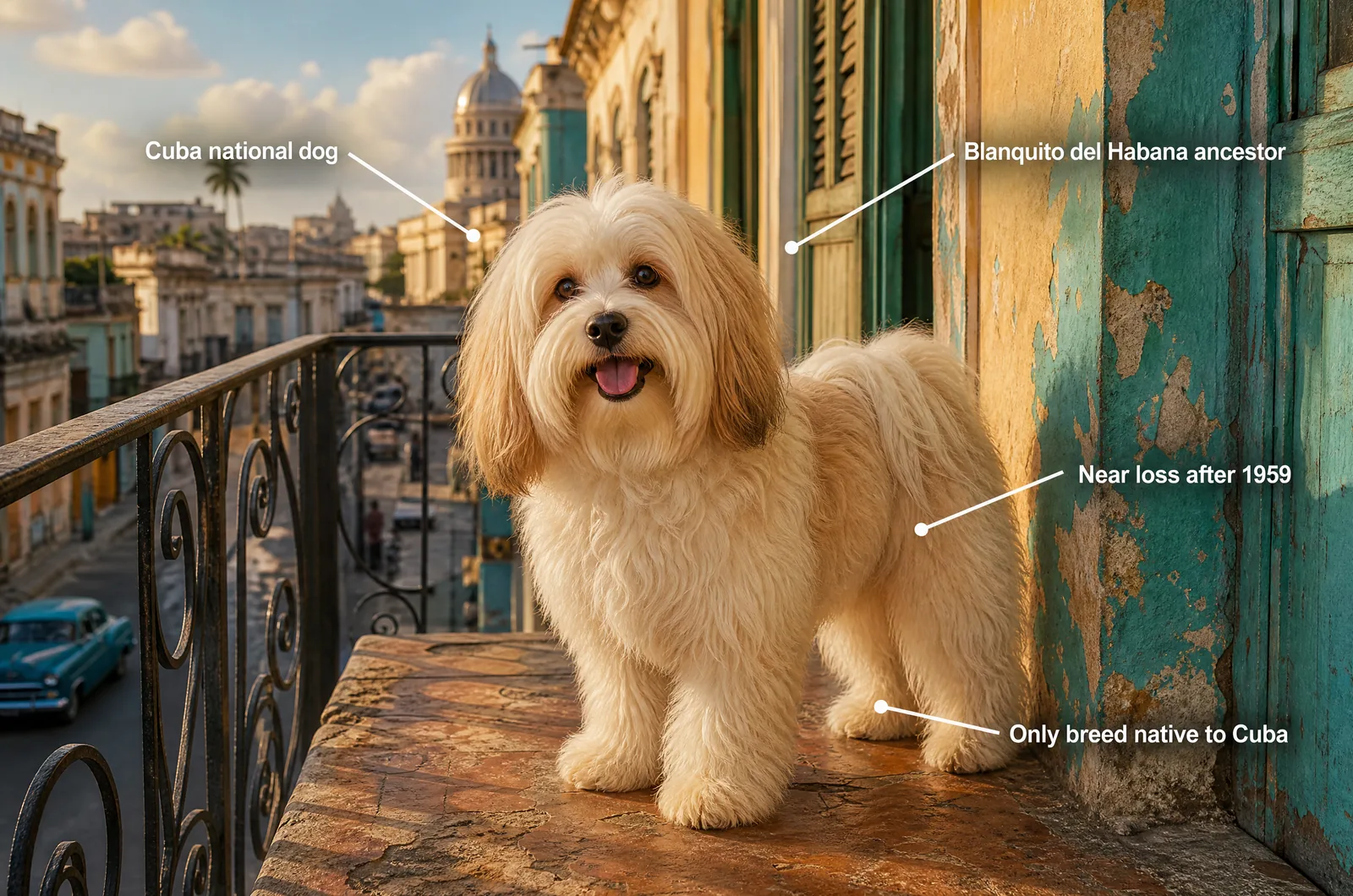
The breed nearly disappeared. After the 1959 revolution, families leaving Cuba could not bring much, and dogs were not a priority at an airport. A handful of Havanese made it to the United States with emigrating owners, and American breeders rebuilt the modern population from a very small founding group. That bottleneck matters for buyers today, because a narrow gene pool makes health testing more useful, not less.
The AKC recognized the breed in 1996. Despite the show-dog hairdo, the AKC’s breed history points out that Havanese are more athletic than they look, with records in obedience, agility, musical freestyle, therapy work and Canine Good Citizen testing.
Decision rule: if you want a toy breed with working-dog brains in a seven-pound body, this is the one. If you wanted a decorative dog who naps quietly all day, read on carefully.
What Makes the Havanese So Special (and So Cute)?
What owners love most is the proximity. A havanese does not lie across the room. It lies on your foot, then follows you to the kitchen, then supervises the shower. “Velcro dog” is the nickname the breed earned honestly.
The cuteness is structural. Large dark round eyes set in a short muzzle, a plumed tail carried over the back, a springy gait that looks faintly like a toy being wound, and a coat that moves like curtain fabric. People reliably find rounded faces and big eyes appealing, and this breed has both.
Three things owners name over and over:
- Affection without neediness in the aggressive sense. Havanese tend to lean, cuddle and bond hard with one household.
- Comic intelligence. Many learn tricks fast and then invent variations nobody taught them.
- A low-shedding coat. Hair stays in the coat rather than on the sofa, which is why allergy-aware households shortlist the breed. No dog is truly non-allergenic, since the usual triggers are proteins in dander and saliva, but shedding volume is genuinely low.
The trade is honest: the affection and the separation difficulty come from the same wiring.
Havanese Size, Weight and Lifespan
A full-grown havanese stands 8.5 to 11.5 inches at the shoulder and weighs roughly 7 to 13 pounds, with males and females overlapping almost entirely. Typical lifespan is 14 to 16 years.
| Measure | Male Havanese | Female Havanese | Notes |
|---|---|---|---|
| Height | 9 to 11.5 in | 8.5 to 11 in | AKC standard range for the breed |
| Weight | 8 to 13 lb | 7 to 12 lb | Body condition matters more than the number |
| Lifespan | 14 to 16 yr | 14 to 16 yr | Small breeds commonly outlive large ones |
| Adult size reached | ~10 to 12 months | ~10 to 12 months | Coat keeps changing until about 18 months |
Compared with two breeds people cross-shop: a Maltese is usually lighter (under 7 pounds) with a single white coat and a more delicate build. A Shih Tzu is heavier (9 to 16 pounds) with a flatter face and more breathing sensitivity in heat. The havanese sits between them on sturdiness and tends to be the most athletic of the three.
Common mistake: feeding a 9-pound dog like a 20-pound one. Three extra pounds on this frame is the equivalent of 40 on a Labrador, and it loads the knees that already worry this breed. Use a kitchen scale for food, not a scoop.
What Is the Havanese Temperament Like?
Havanese temperament is cheerful, social, alert and strongly people-oriented. The AKC describes the breed as bright, eager to be part of family life, and adaptable to urban or suburban homes.
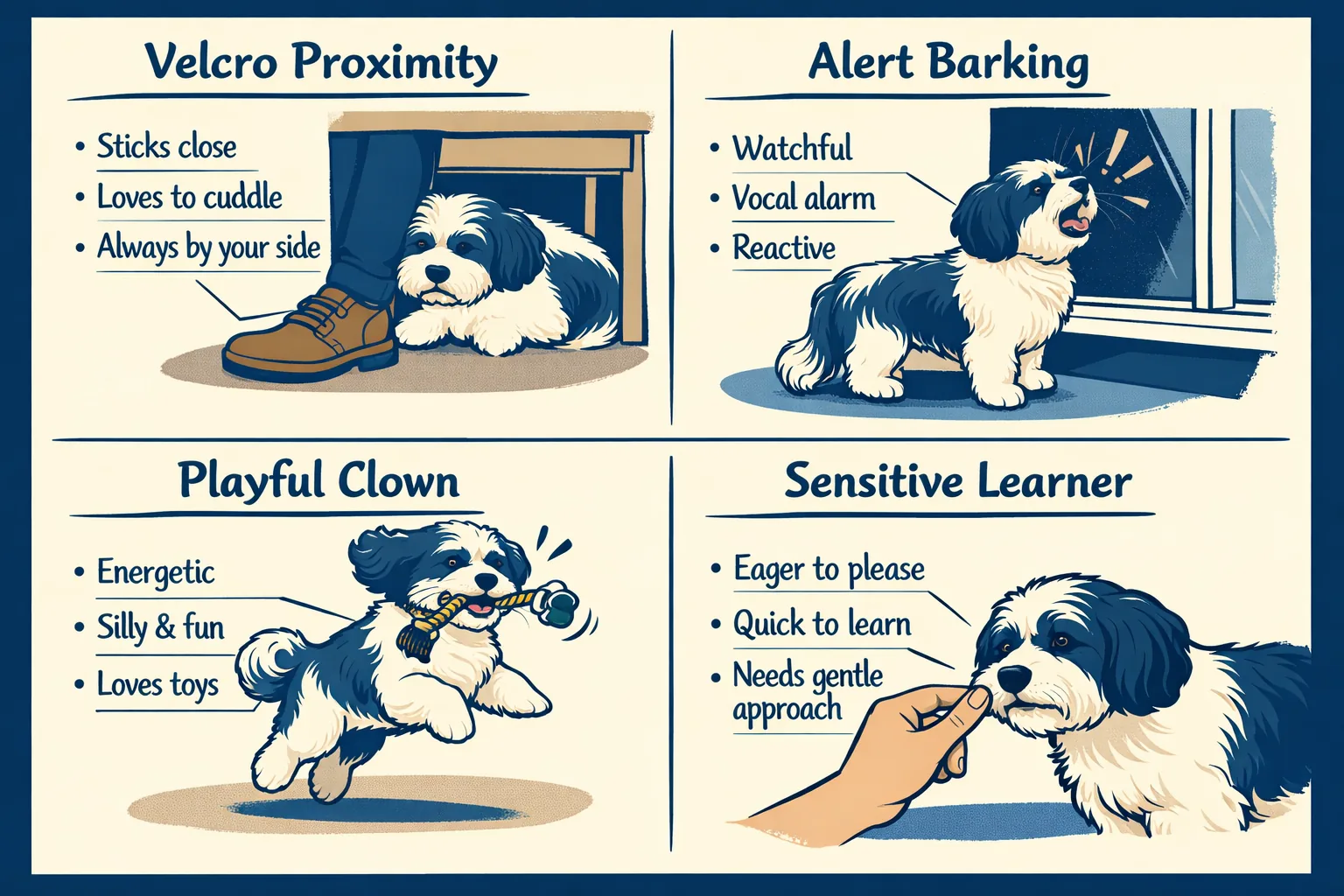
A few traits deserve plain description rather than brochure language:
They are watchful barkers. Small, alert, and positioned at the window. Barking at the elevator, the hallway, the delivery bag is normal breed behavior, not a defect. It is trainable, but it needs to be trained rather than waited out.
They are emotionally sensitive. Harsh corrections tend to produce more barking, more hiding and more clinging in this breed, not less. Reward-based training with early socialization is what the AKC recommends, and it fits the temperament.
Clingy is the default, not a diagnosis. Wanting to be near you is normal for the breed. Panicking when you leave is different and is covered below. A dog following you to the bathroom is a havanese. A dog clawing the door frame until its gums bleed is a dog that needs help.
Individual variation is real. Litters produce bold puppies and cautious ones. Meeting the parents tells you more than the breed page does.
Are Havanese Good With Kids and Other Pets?
Havanese are generally good with children who know how to handle a small dog, and they usually accept other dogs and cats when introduced properly. The limiting factor is size, not temperament.
A 9-pound dog with fine leg bones can be injured by a fall from a couch or an enthusiastic hug from a toddler. Most orthopedic emergencies in toy breeds are ordinary household accidents.
Practical rules that work in real homes:
- Children under 6 sit on the floor to hold the dog. No carrying while walking.
- Give the dog a crate or bed in a corner where kids do not follow. Protect it like a rule, not a suggestion.
- Teach the “leave the dog alone when it walks away” rule to kids before you teach anything to the puppy.
- With cats, use a baby gate for the first two weeks. Havanese tend to be curious rather than predatory, but cats need an exit route.
If you are still comparing options for a household with young children, our guide to family dog breeds and which one suits your household is a useful cross-check.
Who Is the Havanese Made For, and Who Should Skip It?
The havanese suits households where someone is home most of the day and where grooming is a planned expense. It is a poor match for a home empty from 8 to 6 with no midday help.
Good fit if you are:
- A remote worker or retiree. The breed thrives on company and this is the single best predictor of an easy life together.
- An apartment resident. Small, moderate exercise needs, no yard required. See our list of dog breeds that handle apartment living well.
- An allergy-aware household that can live with grooming instead of vacuuming.
- A first-time owner who wants a trainable, friendly dog and accepts that potty training will be slow. Compare against our picks for first-time dog owners.
Skip it if:
- Nobody is home for 9 hours a day and you cannot budget a walker or daycare.
- You want a dog that is fine being left in a yard.
- You dislike grooming and also dislike paying for it. Both of those together rule the breed out.
- You need a quiet dog by lease requirement and will not train an alert-barking breed.
Edge case: two Havanese do not reliably fix alone-time distress. Sometimes the second dog learns the first dog’s panic. Train the first dog before adding a second.
How Much Exercise Does a Havanese Need?
Most adult Havanese do well on 30 to 60 minutes of activity per day, split into two or three outings, plus daily mental work. They are small, not low-energy.
A realistic daily plan:
- Morning walk, 15 to 20 minutes. Let the dog sniff. Sniffing walks tire dogs more than brisk ones of the same length.
- Midday training or puzzle session, 5 to 10 minutes. Trick work suits the breed. Short sessions beat long ones.
- Evening walk, 15 to 25 minutes, plus indoor fetch or tug.
- One weekly novelty outing. A new street, a pet-friendly store, a friend’s garden.
Puppies need less structured walking and more rest. A common guideline among breeders is about five minutes of formal exercise per month of age, twice a day, until growth plates close. Free play on soft ground is fine.
Enrichment is where this breed shines. Snuffle mats, scatter feeding, a cardboard box with kibble inside, food-dispensing toys like the Pupsicle. A bored havanese barks. A mentally worked havanese sleeps.
Common mistake: skipping exercise because the dog is small and the apartment is carpeted. Under-stimulation is a top cause of the barking complaints owners post about.
Havanese Grooming and Shedding
Havanese shed very little, and that is exactly why grooming is demanding. The coat keeps growing instead of dropping, so loose hair tangles in place rather than falling out.
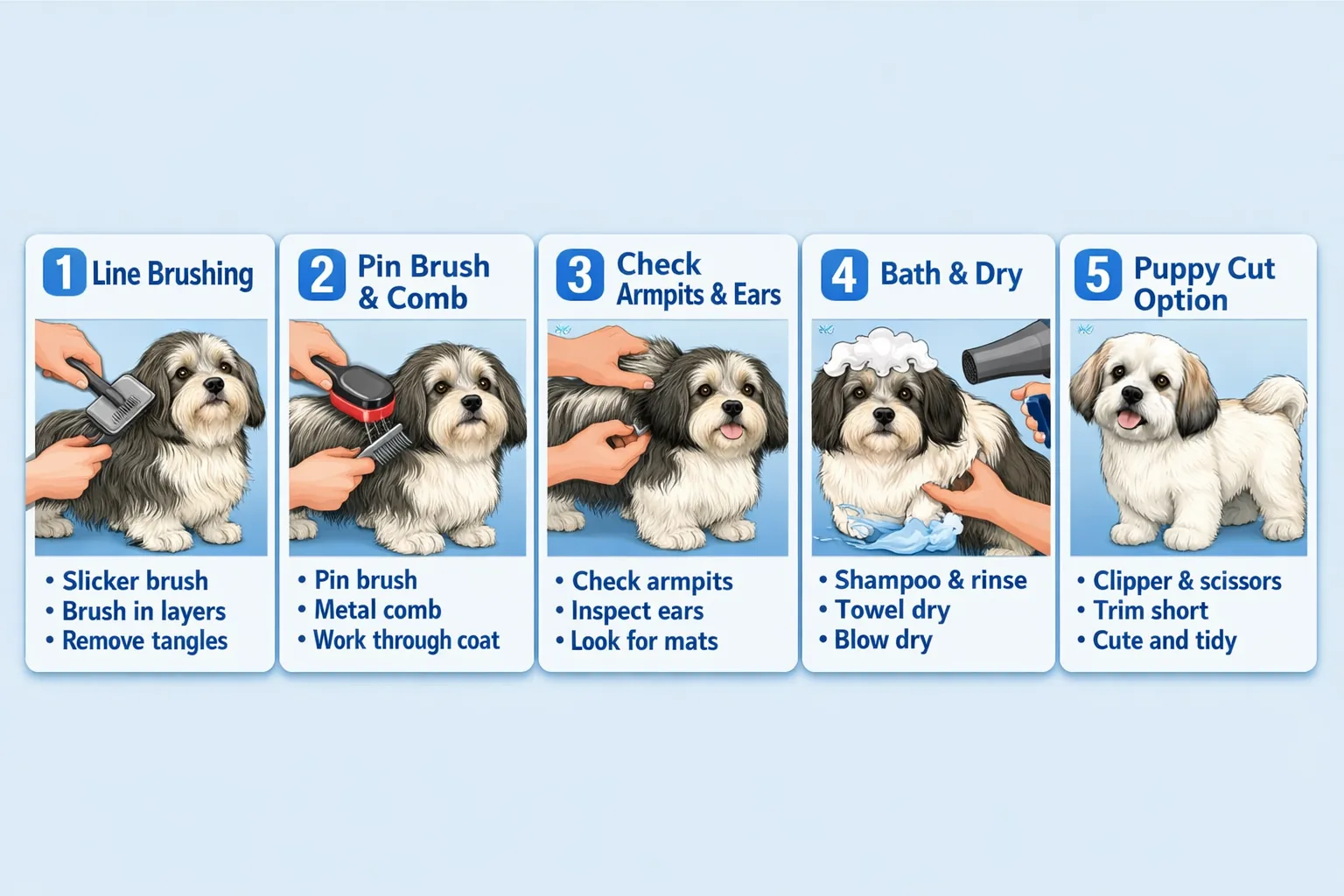
The full-coat routine: line brush every day or every other day with a pin brush, then follow with a steel comb to the skin. If the comb snags, the brush missed a mat. Check the armpits, behind the ears, the collar line and the back legs, which mat first.
The puppy cut routine: a professional trim every 6 to 8 weeks at roughly $60 to $100 per visit in most U.S. markets, plus brushing two or three times a week. Most owners land here by month nine, and there is no shame in it.
Also on the list: ear cleaning and hair checks, nails every 3 to 4 weeks, eye-area wiping to manage tear staining on light-coated dogs, and teeth brushing. Toy breeds get dental disease early, so brushing is real preventive care rather than a nicety.
Coats come in every color including havanese brown (chocolate), sable, cream, black, silver and parti-colors. Dark coats can lighten dramatically between 8 months and 2 years. New to the tools, see our beginner’s guide to dog grooming.
Budget note: grooming is the hidden recurring cost of this breed, often $500 to $900 a year.
Common Havanese Health Problems
Havanese are generally a healthy, long-lived breed, with knees, eyes, ears and hips the main screening targets. The Havanese Club of America asks breeders for BAER hearing testing, an annual CAER eye exam, patella evaluation at 12 months or older, and a hip evaluation through OFA or PennHIP.
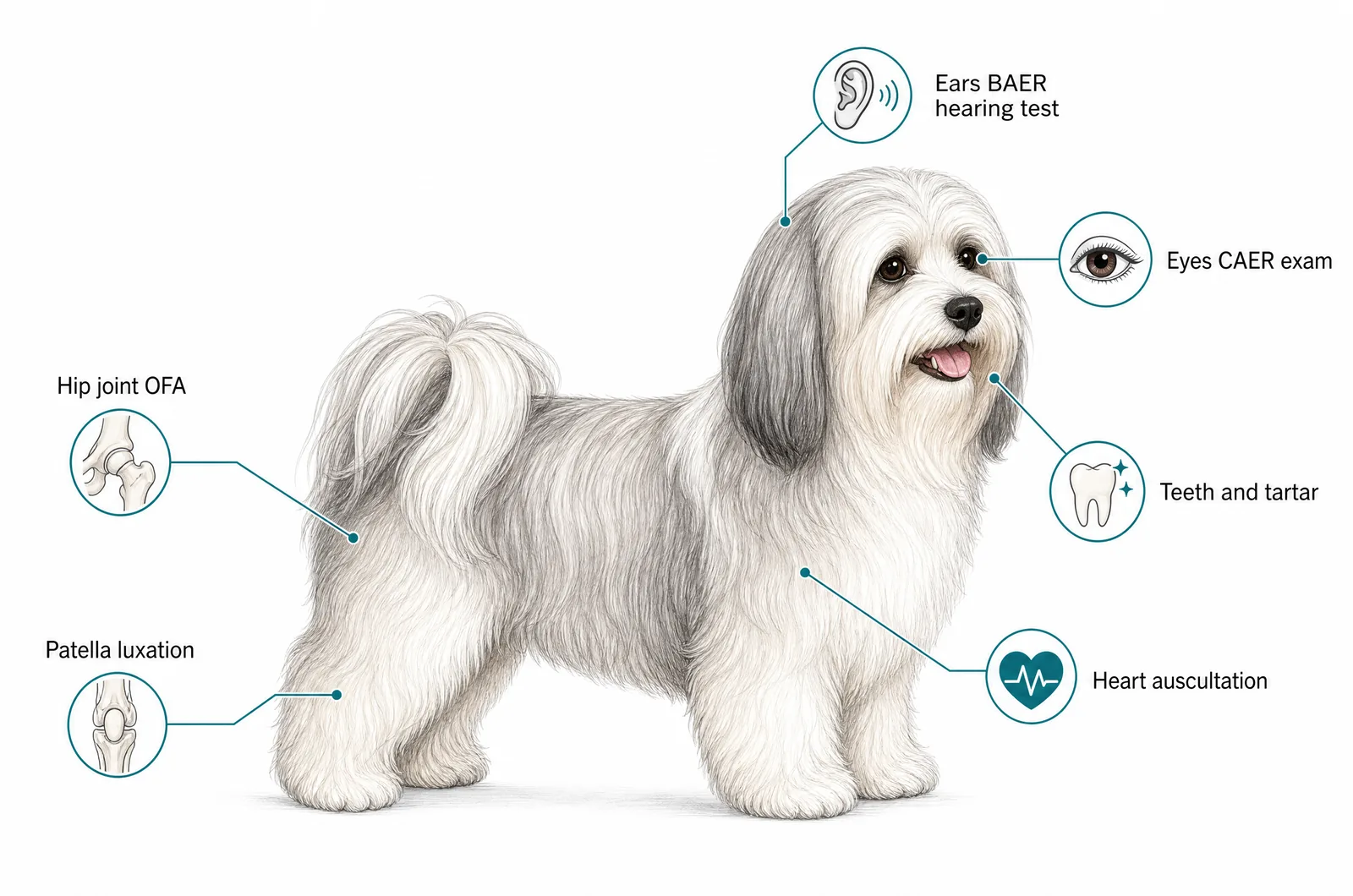
What to know about the main concerns:
- Luxating patella. The kneecap slips out of its groove. Signs include a skipping step or holding a back leg up briefly mid-run. Mild cases are managed, severe cases may need surgery.
- Eye disease. Cataracts and progressive retinal atrophy appear in the breed, which is why the annual CAER exam is on the list rather than a one-time test.
- Congenital deafness. Uncommon but real, which is what BAER testing screens for.
- Hip dysplasia and Legg-Calve-Perthes disease. Less common than in large breeds but documented.
- Dental disease, allergies and skin problems. The ordinary toy-breed trio.
- Chondrodysplasia. A skeletal condition in some lines affecting limb development.
Call a vet promptly for sudden back pain with weak or dragging back legs, breathing trouble, collapse, signs of heatstroke, or a bloated painful abdomen with retching. Those are emergencies, not wait-and-see situations.
Buyer rule: AKC guidance updated in 2026 notes that a CHIC number confirms the tests were done and recorded, not that every result was normal. Ask to see the actual OFA results.
What Do Havanese Love to Eat? Favorite Foods and Feeding
Feed a havanese a complete small-breed diet with an AAFCO statement for its life stage, measured by weight, usually around 1/3 to 1 cup of dry food daily split into two meals depending on the food’s calorie density and the dog’s size.
Most adult Havanese need somewhere near 250 to 400 calories a day. The reliable method is to feed to body condition: you should feel the ribs easily under a thin layer, and see a waist from above. Learn the label first with our guide on how to read a dog food label and what AAFCO means.
Treats this breed tends to go for: small freeze-dried single-ingredient meat pieces, plain cooked chicken, tiny cheese cubes used sparingly, green beans, blueberries, carrot sticks, plain pumpkin. Keep treats under 10 percent of daily calories, which for a 10-pound dog is roughly 30 calories. That is about four blueberries and a pea-sized piece of chicken, not half a biscuit.
Always avoid: grapes and raisins, xylitol (check peanut butter labels), chocolate, onions and garlic, macadamia nuts, cooked bones, alcohol, and anything heavily salted.
Small dogs can be fussy. Switch foods slowly over 7 to 10 days, and if appetite drops suddenly in a toy-breed puppy, call a vet, since low blood sugar moves fast in dogs this size.
How to Train a Havanese
Train a havanese with short, reward-based sessions and expect house training to take longer than average. The breed is smart and motivated, but it is also sensitive, and corrections tend to backfire.
Potty training, the honest version. Toy breeds commonly take 6 to 12 months to be reliable, and regression at 5 to 7 months is normal rather than a failure. What works: take the puppy out every 45 to 60 minutes while awake, reward within three seconds of finishing, use the same door and same patch of ground, confine with a crate or pen when unsupervised, and keep an enzymatic cleaner on hand. Rain is a real obstacle for a dog whose belly hair touches wet grass, so a covered spot or a dog coat helps more than people expect.
Barking. Teach a “quiet” cue by marking the pause between barks, manage the window view with film or furniture placement, and pay attention to the hallway sounds that set it off. Do not shout. To a havanese, shouting is barking back.
Session shape. Five minutes, three times a day, finishing while the dog still wants more. Tricks, scent games and obedience all land well with this breed.
Common mistake: buying more gear instead of more repetitions. The clicker is not the problem.
Try It: Havanese Alone-Time Planner
This planner asks where your havanese is today, then gives you a graduated plan for building calm alone time based on the ASPCA’s desensitization approach. Alone time is the single biggest predictor of whether this breed works in your household, so it is worth getting right in week one rather than month six.
Doggy Rank IQ Tool
Havanese Alone-Time Planner

Havanese are true velcro dogs, and many struggle when left alone. Tell us where your dog is today to get a step-by-step plan for building calm alone time.
Is a Havanese a Good Dog for Seniors and Apartments?
Often, yes. The Havanese is small (roughly 7 to 13 lb), cheerful with visitors and happy with moderate exercise, which makes it one of the easier companion breeds for apartment life and for older owners who are home most of the day.
- Exercise fits a gentle routine. Two short walks and some indoor play usually keep a Havanese content. It does not need a yard or long runs.
- Company matters more than space. This breed was bred to stay close to its people. A Havanese left alone for long workdays often struggles, so it suits homes where someone is around.
- Grooming is the real workload. A long coat needs brushing most days. Many owners keep a short puppy cut and book a groomer every 6 to 8 weeks to make care easier on the hands.
- Expect some alert barking. Hallway noises and doorbells can set it off, so start quiet training early in shared buildings.
One practical note for older owners: a small, devoted dog likes to be underfoot. A bell on the collar and a dog bed placed away from walkways help prevent trips and falls.
How Much Does a Havanese Cost?
A havanese puppy from a breeder doing the full health-testing panel typically costs $1,800 to $3,500 in the United States, with rescue or breed-club rehoming running $300 to $800. The purchase price is the smaller number.
Realistic first-year budget:
| Item | Typical range |
|---|---|
| Puppy from a tested breeder | $1,800 to $3,500 |
| Vaccines, exams, spay or neuter | $400 to $900 |
| Crate, pen, bed, bowls, leash, toys | $250 to $450 |
| Grooming (6 to 8 visits) | $400 to $800 |
| Food and treats | $300 to $500 |
| Puppy classes or a trainer | $200 to $600 |
First year commonly lands between $3,500 and $6,000. Ongoing years run roughly $1,500 to $2,500 with grooming, food, preventives, insurance and one annual vet visit, before any health surprise.
Where to buy. Start with the Havanese Club of America breeder referral list. A breeder worth your money will show OFA results for both parents, let you meet the dam, keep puppies until at least 8 weeks, ask you pointed questions, and offer to take the dog back at any age. Walk away from meet-in-a-parking-lot sellers, multiple breeds always available, and anyone who will not discuss patellas.
Havanese Puppy Tips for the First 90 Days
Spend the first 90 days on three things: alone-time practice, potty routine, and socialization. Everything else can wait.
Days 1 to 14. Set up a crate and pen before arrival. Keep the world small. Begin alone-time work on day two with absences of one to two seconds, exactly as the ASPCA protocol describes. Out every 45 minutes, after every nap, meal and play session. Handle paws and ears daily so grooming is never new.
Days 15 to 45. Socialization window. Aim for new surfaces, sounds, people and calm adult dogs, all at a distance the puppy chooses. Vaccination status matters, so carry the puppy in busy places and use clean private spaces for ground time. Book the first grooming visit now as a short, treat-heavy introduction, before the coat needs anything.
Days 46 to 90. Extend absences, in minutes rather than hours. Enroll in a reward-based class. Start brushing full sessions. Expect one potty regression and respond by tightening supervision rather than scolding.
Camera rule: owners routinely misjudge what happens after departure. A $30 camera tells you whether you have a clingy dog or a distressed one.
What Havanese Owners Say
Owner posts are useful because they show where the breed actually gets hard. Two lines from the same thread on r/Havanese say it plainly.
“I have invested thousands of dollars trying to train this adorable demon”
That one, from an owner on Reddit, describes a pattern worth naming: money spent on training is not the same as repetitions completed. Five minutes, three times a day, every day, beats a $900 package you attend weekly. If you are already paying a trainer, ask for a written homework plan with daily rep counts and check whether anyone in the household is undoing the work between sessions.
“My pup seems almost untrainable”
Also from an owner on Reddit. Three practical checks before accepting that conclusion: is the reward actually valuable to the dog (chicken, not kibble), is the session happening when the dog is overtired or over-aroused, and is the behavior a training problem or an anxiety problem. Anxious dogs cannot learn. If the dog only fails when alone or when a stranger is near, that is a feelings issue, and the fix starts below the panic threshold, not with more cues.
For persistent cases, the Havanese Club of Great Britain recommends a qualified clinical animal behaviourist. In the U.S., ask your vet for a referral to a veterinary behaviorist, and read our broader guide to separation anxiety in dogs. Medication exists as an adjunct: VCA notes fluoxetine and clomipramine are FDA-approved for canine separation anxiety. It supports training rather than replacing it. Over-the-counter calming products for dogs have thinner evidence and should not be the whole plan.
Havanese FAQ
Can you leave a havanese alone all day while you work? Not reliably, and not without preparation. The AKC states the breed does not fare well left alone for long periods. Eight hours is workable only with a midday walker or daycare plus months of graduated alone-time training.
Do Havanese shed a lot? No. Shedding is very low because hair stays in the coat. That reduces hair on furniture and raises grooming work, since trapped hair mats instead of falling out.
Is a havanese a good first dog? Yes for most households, with two caveats: house training usually takes longer than average, and grooming is a permanent cost. If you can accept both, the trainability and temperament suit beginners.
How long do Havanese live? Commonly 14 to 16 years, which is long even among small breeds. Dental care and keeping the dog lean are the two things most within your control.
Havanese vs Maltese vs Shih Tzu, which is best? Choose the havanese for the most athletic and trainable of the three. Choose the Maltese if you want the smallest dog. Choose the Shih Tzu for a calmer, heavier companion, accepting more heat and breathing sensitivity.
What health problems should I screen for in a havanese puppy? Ask for the parents’ BAER hearing test, annual CAER eye exam, patella evaluation at 12 months or later, and hip evaluation, as listed by the Havanese Club of America. Look at the actual OFA results, not just a CHIC number.
Why is my havanese so clingy? Proximity-seeking is normal breed behavior rather than a disorder. Distress is different: persistent vocalizing, pacing, drooling, escape attempts or accidents that happen only when alone. Film a departure to tell them apart.
How much exercise does a havanese need daily? About 30 to 60 minutes across two or three outings, plus 10 to 15 minutes of training or puzzle work. Mental work reduces barking more than extra walking does.