
Quick Answer
Most pet dogs live between 10 and 13 years, and the largest study of its kind puts the typical figure near 12.5 years. The answer to how long do dogs live depends heavily on three things researchers can measure: adult body size, skull shape, and whether the dog reaches middle age without a serious disorder. A 2024 analysis of 584,734 UK dogs led by Kirsten McMillan at Dogs Trust found median survival of 12.7 years for small purebreds, 12.5 for medium purebreds, and 11.9 for large purebreds. Flat-faced breeds did worse than long-nosed breeds of similar size.
Key Takeaways: How Long Do Dogs Live?
- The question of how long do dogs live has a measured answer for populations, not for individual dogs. Medians describe groups.
- In the 2024 Scientific Reports study, median life expectancy across all dogs was about 12.5 years.
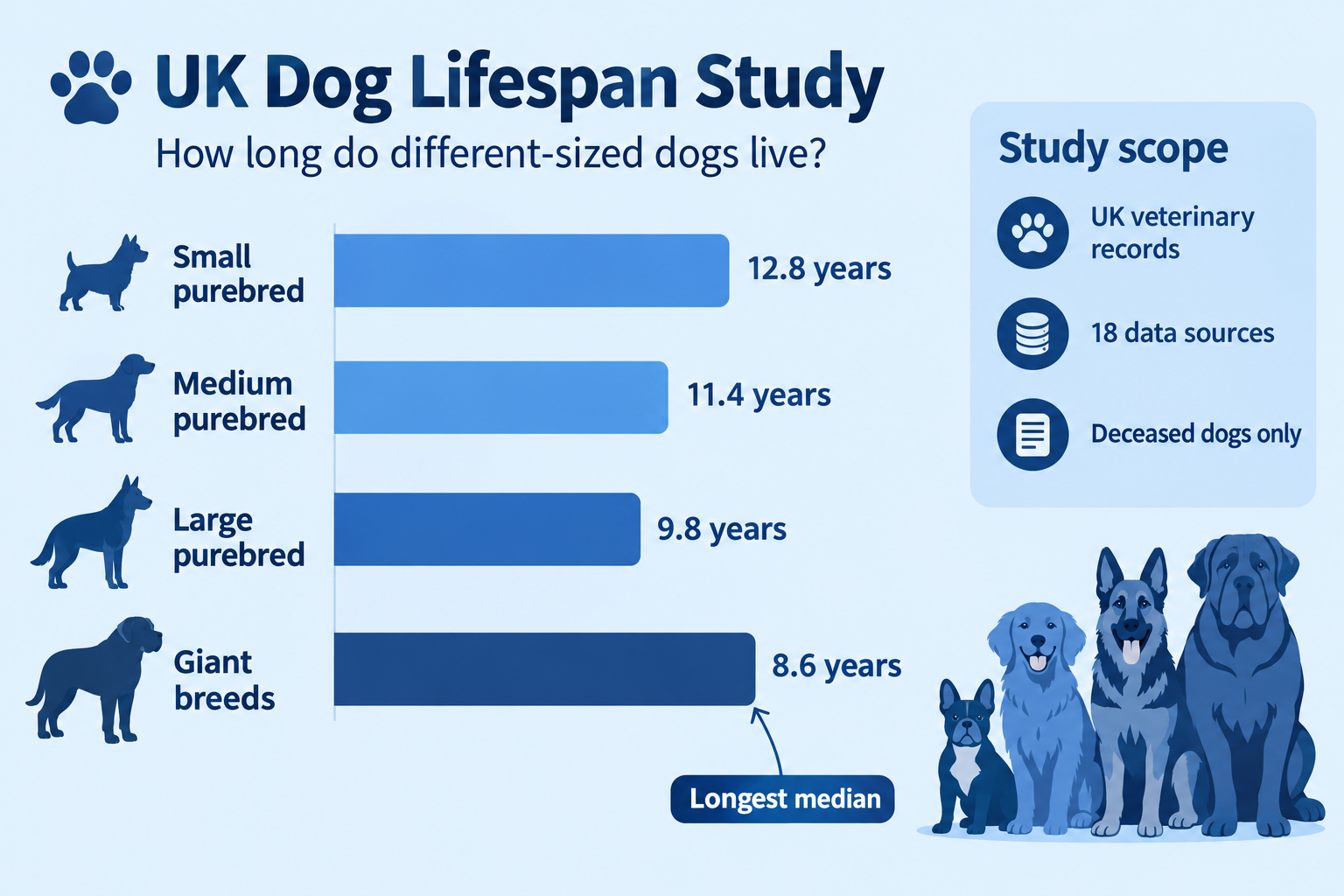
- Small purebreds: 12.7 years. Medium: 12.5 years. Large: 11.9 years. Giant breeds, in a separate 2026 analysis, had a median age at death of 8.94 years.
- Skull shape mattered on its own. Medium-faced purebreds reached a median of 12.8 years, long-nosed 12.1 years, and flat-faced 11.2 years.
- The shortest-lived combination was medium-sized, flat-faced dogs at roughly 9.4 years, against 13.3 years for small, long-nosed breeds.
- Purebreds in this UK dataset had a slightly longer median lifespan than crossbreeds, which contradicts the usual assumption about mixed breeds.
- Weight control, dental care, parasite prevention, and annual veterinary exams are the owner-side levers with the strongest support.
- No medication has been proven to extend canine lifespan. Trials are running. Results are not in.
- The longest verified lifespan belongs to Bluey, an Australian cattle dog, at 29 years and 5 months.
What did the 584,734-dog UK lifespan study find?
The study found that breed, body size, skull shape, and sex were all associated with how long dogs lived, and that the differences between groups were large enough to matter at the kitchen table. It was published in Scientific Reports in February 2024 by Kirsten M. McMillan of Dogs Trust with Joanna Bielby, Clare L. Williams, Matthew M. Upjohn, Rachel A. Casey, and Richard M. Christley.
Here is the part that makes it unusual. The team did not run one clinic’s records. They pulled data from 18 different organizations: breed registries, veterinary corporations, pet insurers, welfare charities, and academic archives. Then they built a survival table covering 584,734 dogs, both purebred and crossbred, across 155 breeds.
What the study reported
- Overall median life expectancy: about 12.5 years. That is the single best answer to how long do dogs live for a large UK pet population.
- Female dogs edged out males, roughly 12.7 years against 12.4 years.
- Lifespan clustered among related breeds. The phylogenetic analysis produced a Pagel’s lambda of 0.808, meaning closely related breeds tended to share similar lifespans. Longevity travels in family groups, not at random.
- Size and face shape interacted. The penalty for a flat face was worse in some size classes than others.
Where the facts end
This is the section most headlines skipped.
The dataset is UK dogs. Veterinary access, insurance uptake, neutering rates, and breed popularity differ by country, so the exact medians should not be copied onto Texas or Queensland without caution. The analysis also rests on records of dogs that had died, which means breeds that became fashionable recently are represented by younger deaths. Cause of death was not uniformly recorded. And a median is not a prophecy: half the dogs in any group lived longer than the figure shown.
A separate strand of research, the Royal Veterinary College’s VetCompass programme, works from primary-care clinical records and reports its own numbers. The two bodies of work agree on the big pattern and differ in the details, which is what honest datasets usually do.
Why do small dogs live longer than big dogs?
Larger dogs age faster and die younger within the domestic dog species, and the leading explanation is growth speed. A Great Dane puppy adds roughly the same mass in a year that a Chihuahua carries for life. Fast growth is linked to higher circulating growth factors, more cell division, and earlier onset of the diseases that end dogs’ lives, especially cancer.
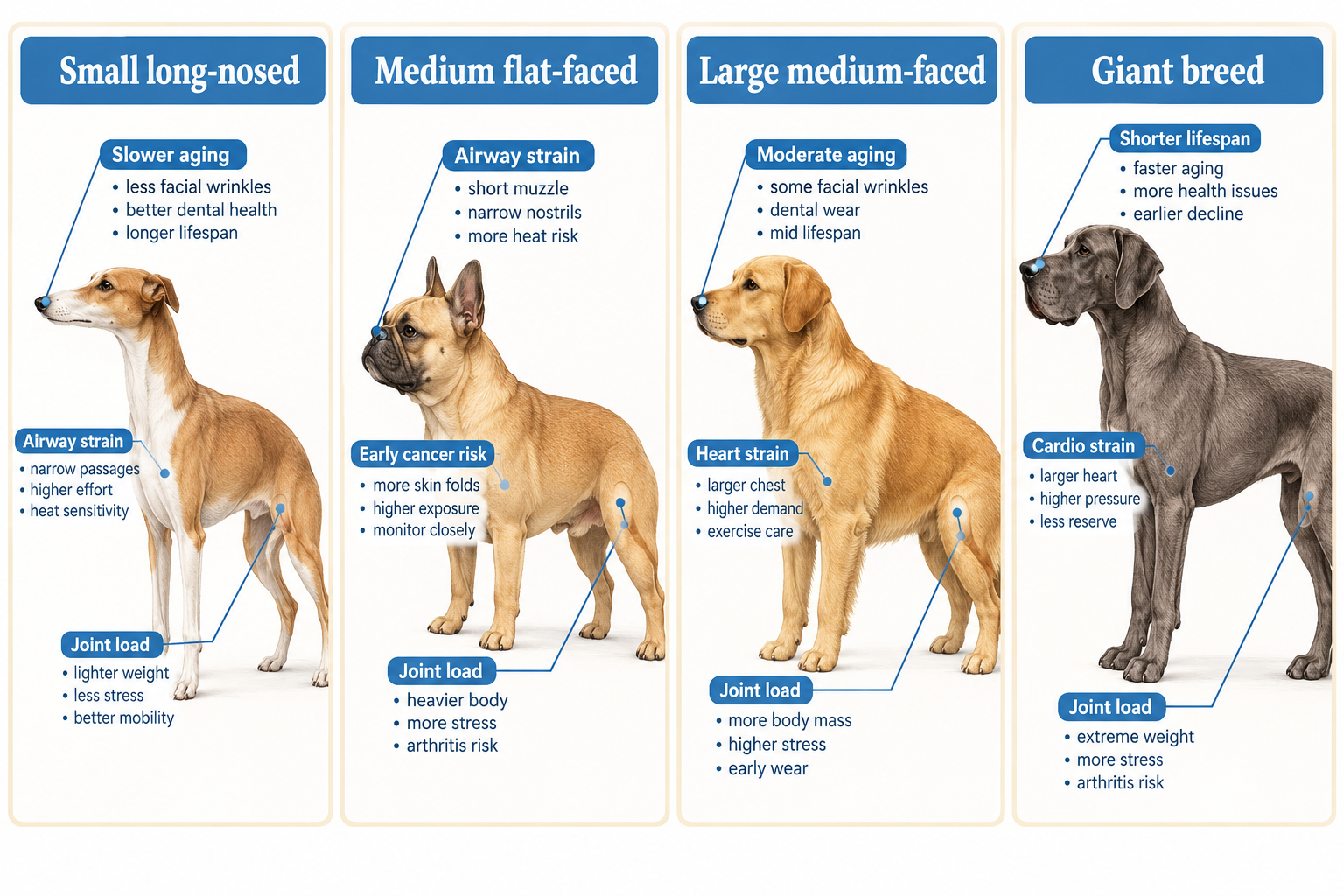
The 2024 study put numbers on it: 12.7 years for small purebreds, 12.5 for medium, 11.9 for large. A 2026 VetCompass analysis of 2,250,417 UK dogs, including 28,345 dogs from 29 giant breeds, extended the pattern. Among 1,068 recorded deaths in that giant-breed group, median age at death was 8.94 years. Tibetan Mastiffs came in lowest at 4.77 years. Black Russian Terriers came in highest at 12.7 years, though that estimate rested on three deaths and should be treated as unstable.
Giant dogs also carried more disease. 73.8% had at least one disorder recorded in a single year, against 65.8% in an earlier all-dog VetCompass analysis. The most common grouped problems were skin (15.9%), musculoskeletal (13.5%), and ear (12.0%). Among the 597 deaths where a cause was recorded, cancer accounted for 12.4% and collapse for 9.46%.
Skull shape is a second, independent factor. Flat-faced purebreds had a median of 11.2 years against 12.8 for medium-faced dogs. Combine a medium body with a flat face and the median fell to roughly 9.4 years, with a reported hazard ratio near 2.85 relative to small, long-nosed females.
If you are weighing up size, our explainer on small, medium, large and giant dog size categories covers what each bracket means in practice.
Median lifespan by group for ten common breeds
The table below shows where each breed sits in the study’s size and skull-shape groups, with the median for that group. These are group figures, not breed-specific lifespans, which keeps the numbers honest.
| Breed | Size group | Size median | Face shape | Face median |
|---|---|---|---|---|
| Labrador Retriever | Large | 11.9 yrs | Medium-faced | 12.8 yrs |
| German Shepherd | Large | 11.9 yrs | Long-nosed | 12.1 yrs |
| Golden Retriever | Large | 11.9 yrs | Medium-faced | 12.8 yrs |
| French Bulldog | Medium | 12.5 yrs | Flat-faced | 11.2 yrs |
| Chihuahua | Small | 12.7 yrs | Medium-faced | 12.8 yrs |
| Jack Russell Terrier | Small | 12.7 yrs | Medium-faced | 12.8 yrs |
| Beagle | Medium | 12.5 yrs | Medium-faced | 12.8 yrs |
| Border Collie | Medium | 12.5 yrs | Long-nosed | 12.1 yrs |
| Dachshund | Small | 12.7 yrs | Long-nosed | 12.1 yrs |
| Great Dane | Giant | 8.94 yrs (29 giant breeds) | Medium-faced | Not reported |
What breed of dog lives the longest?
Small, long-nosed breeds topped the 2024 analysis. At the breed level, Lancashire Heelers recorded the longest median lifespan at 15.4 years, while Caucasian Shepherd Dogs recorded the shortest at 5.4 years. Among the popular breeds most readers actually own, the small terriers and spitz-type dogs sit near the top and the giant and flat-faced breeds sit near the bottom.
Breed averages still do not predict your dog. Two Labradors from the same litter can differ by years, and individual variation is the rule rather than the exception.
Do mixed breeds live longer than purebreds?
Not in this dataset. The 2024 study found purebred dogs had a slightly longer median lifespan than crossbreeds, around 12.7 years against 12.0 years. That reverses a very common assumption, and the authors were careful about why.
Crossbreeds in UK records skew towards unknown early history, later first veterinary contact, and a wide mix of body types, including crosses of two breeds that each carry risk. “Mixed breed” is not a health category. A Goldendoodle and a street-sourced crossbreed share a label and almost nothing else.
12.5 yrs
Median life expectancy across all dogs, 2024 Scientific Reports study of 584,734 UK dogs
9.4 yrs
Median for medium-sized flat-faced dogs, the lowest group in the same breed-longevity analysis
73.8%
Of giant-breed dogs had at least one disorder recorded in one year, 2026 RVC VetCompass giant-breed study
29 yrs 5 mo
Longest verified canine lifespan, Bluey the Australian cattle dog, per records summarised in aging in dogs research
Decision rule: choose a dog by body size, face shape, and the health screening available for its parents, not by the purebred-versus-crossbreed label. If you are choosing your first dog, our guide to the best breeds for first time owners walks through temperament and care load alongside size.
Why do some dogs die younger than others?
Most dogs die younger than their breed median because of disease, injury, or a body shape that strains normal function. The 2026 giant-breed analysis recorded cancer as the most common grouped cause of death at 12.4% of the 597 deaths with a cause noted, followed by collapse at 9.46% and heart disorders at 4.12%.
The conditions that most often shorten a dog’s life:
- Cancer, especially in large and giant breeds, often appearing from middle age onward.
- Heart disease, including mitral valve disease in small breeds and dilated cardiomyopathy in some large ones.
- Airway and heat-regulation problems in flat-faced dogs, which also raise anaesthetic risk.
- Joint and spinal disease, which reduces activity and compounds weight gain.
- Dental disease, common, painful, and frequently left untreated for years.
- Kidney and endocrine disease, often picked up on routine bloodwork before symptoms show.
- Preventable accidents: road traffic, toxic foods, heatstroke, and escapes.
That last line is not filler. Toxic ingestion is one of the few causes an owner can eliminate almost entirely, and the list of foods dogs cannot eat is shorter than most people expect.
Do indoor dogs live longer than outdoor dogs?
Dogs who live indoors with their household generally face fewer fatal risks than dogs kept permanently outdoors, mainly through reduced exposure to traffic, fights, extreme temperatures, infectious disease, and theft. Direct lifespan comparisons from large studies are limited, so treat this as a risk argument rather than a measured number of extra years. Indoor living also means somebody notices the limp, the cough, or the new lump early, which is where most of the benefit probably sits.
How can you help your dog live longer?
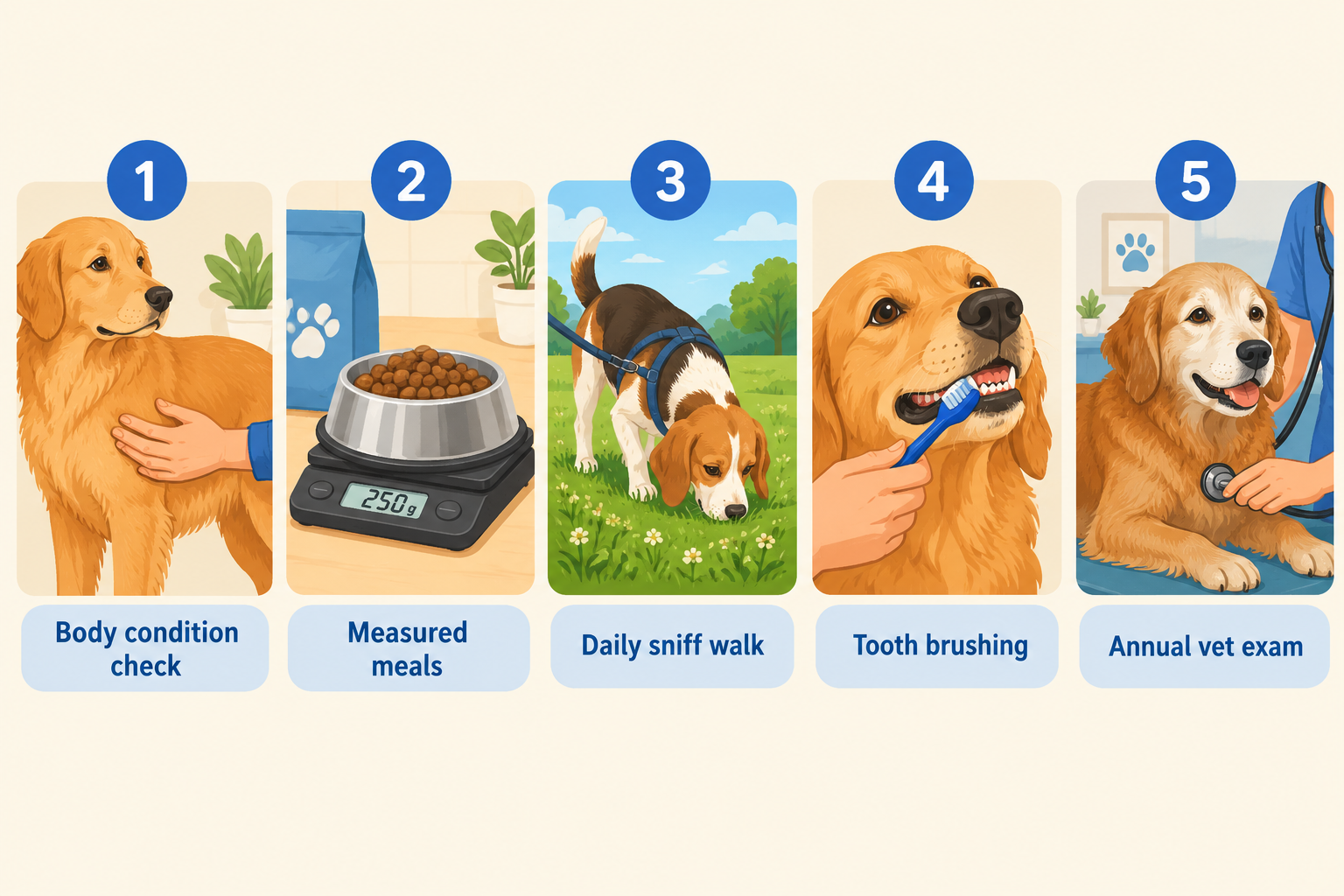
The strongest owner-side levers are weight control, dental care, regular veterinary exams, parasite prevention, and enough daily activity and enrichment to keep a dog moving and interested. None of these are glamorous. All of them beat supplements.
Can diet and exercise affect how long dogs live?
Yes, and the clearest evidence comes from a long-running Purina lifespan study (published by Kealy and colleagues) that followed Labrador Retriever littermates. One group was fed a measured ration, the other fed more freely. The leaner group lived meaningfully longer and showed later onset of chronic disease. That trial was one breed, one controlled setting, and a limited number of dogs, so the exact gain should not be copied onto every dog. The direction of the finding has held up well enough that body condition is now standard veterinary advice.
Practical version:
- Weigh the food. Scoops drift. Scales do not.
- Run a monthly rib check. You should feel ribs under light pressure, with a visible waist from above.
- Count the treats as part of the daily total, including chews and training rewards.
- Walk for sniffing, not distance. Scent work tires a dog in ways a brisk march does not. Our piece on why dogs sleep so much explains why a mentally tired dog rests differently.
- Keep the diet complete and life-stage appropriate. Puppies have different needs, covered in our guide to what growing dogs need in year one.
Extras can help at the margins. Whole-food additions such as blueberries or green vegetables are fine in small amounts, and our round-up of superfoods worth adding to the bowl is clear about where the evidence stops. No berry offsets 15% excess body weight.
What about the research on slowing aging?
Three programmes are worth naming, with neutral fit notes:
- Dog Aging Project. A large US research effort studying how dogs age. Its Test of Rapamycin in Aging Dogs (TRIAD) is a randomized, double-blind, placebo-controlled trial of low-dose rapamycin in middle-aged dogs. As of October 2026 the project describes TRIAD as ongoing. It tests an intervention; it has not reported definitive lifespan results. Suits owners who want to follow the science, not owners looking for a treatment today.
- Loyal (LOY-002). A company developing a longevity drug programme aimed at older dogs. Regulatory steps are in progress and no approved anti-aging medication for dogs exists based on completed lifespan evidence. Worth watching. Not worth planning around.
- Embark and Wisdom Panel DNA health screening. Consumer tests that report breed ancestry and genetic variants linked to specific conditions. Useful for flagging a known risk to discuss with a vet, and for crossbreed owners who want to know what body type they are managing. They do not predict lifespan, and a clear result is not a clean bill of health.
Guidance in this section was checked October 2026.
How old is my dog in human years?
Multiplying by seven is a rough shortcut that overstates early adulthood and understates old age. A one-year-old dog is closer to a human teenager than a seven-year-old child, because dogs do most of their developmental work in the first 18 months and then age more gradually.
A 2020 epigenetic study of DNA methylation in Labrador Retrievers proposed a logarithmic formula, roughly 16 times the natural log of the dog’s age, plus 31. It fits better than the seven-times rule, and it was derived from one breed, so treat it as a guide rather than a readout.
A practical translation most vets use:
| Dog’s age | Small breed | Large breed |
|---|---|---|
| 1 year | adolescent | adolescent |
| 2 years | young adult | young adult |
| 7 years | middle-aged | senior |
| 10 years | senior | geriatric |
| 13 years | geriatric | exceptional |
Edge case: giant breeds reach senior status earliest. A five-year-old Great Dane may warrant the same screening schedule as a nine-year-old terrier.
What is the oldest dog on record?
The longest verified canine lifespan belongs to Bluey, an Australian cattle dog who lived 29 years and 5 months and died in 1939. Guinness World Records has recognised that figure for decades, and it remains the benchmark.
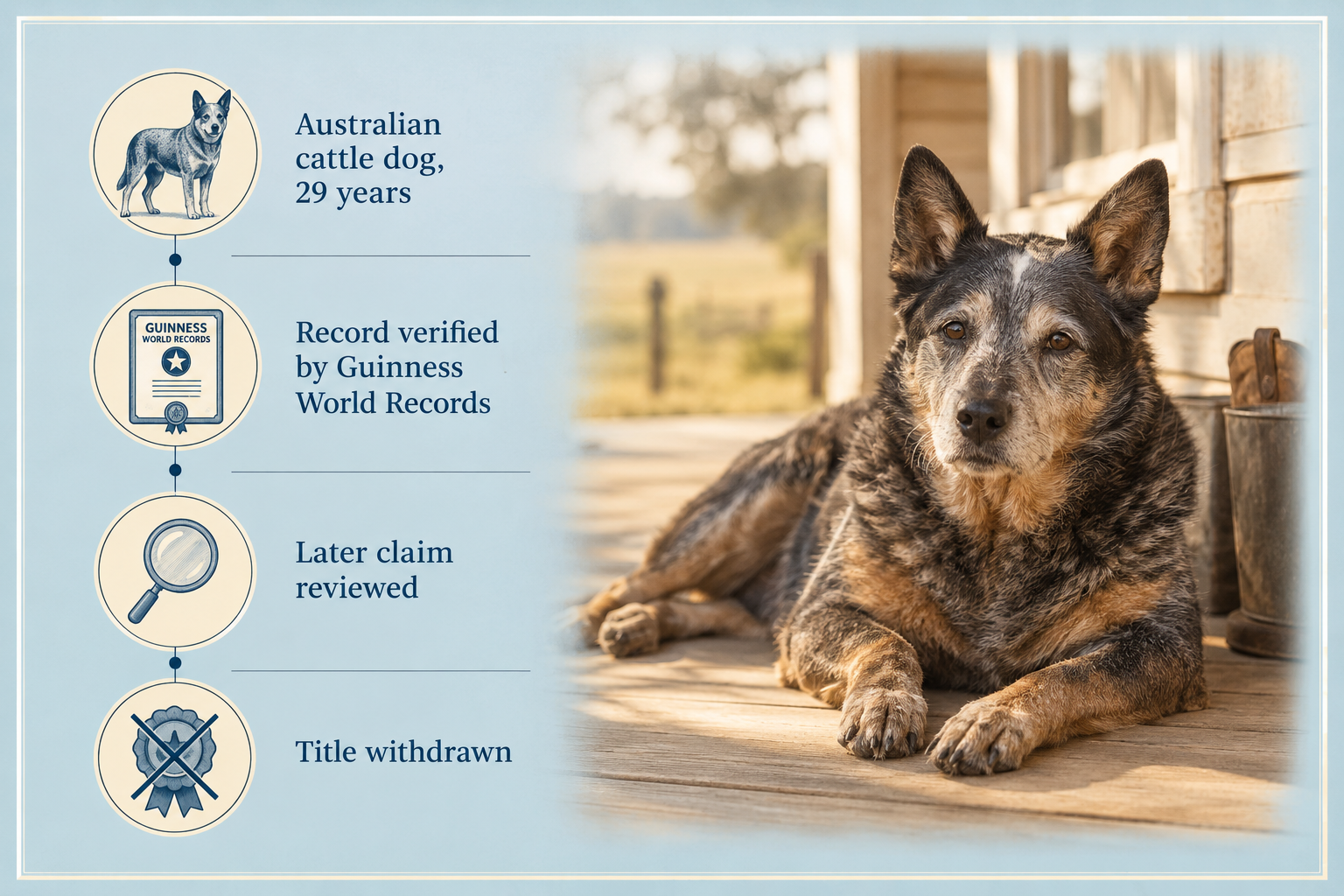
A more recent claim ran into trouble. A Portuguese dog named Bobi was awarded the title in February 2023 at a reported age above 31 years. After veterinarians publicly questioned the supporting evidence, Guinness World Records opened a review, paused the record, and the title is no longer recognised. Worth remembering when an eye-catching number arrives without a verification trail.
Do any dogs live to 20 years?
Yes, though it is rare and concentrated in small breeds. Dogs reaching 18 to 20 years tend to be small, long-nosed, lean throughout life, and under consistent veterinary care. Expecting 20 years is unrealistic planning. Hoping for 15 in a small breed is reasonable.
What signs show a dog is reaching end of life?
Common signs include lasting loss of appetite, difficulty standing or walking, laboured breathing, withdrawal from family routines, loss of bladder or bowel control, and a clear drop in interest in food, play, and greetings. One sign alone is not an answer. A cluster of them, holding for days and not improving, is a conversation with your vet rather than a search engine.
Points worth tracking in a notebook:
- Mobility: can the dog rise unaided, manage stairs, stay standing to eat?
- Appetite and hydration: refusing favourite food for more than a day or two.
- Breathing: effort at rest, open-mouth breathing, coughing when lying down.
- Engagement: does the dog still come to greet you, still respond to its name, still want contact?
- Comfort: restlessness at night, panting without heat, reluctance to be touched in one area.
Veterinary quality-of-life scales exist for exactly this. Ask your clinic for one and score the same questions weekly, since day-to-day impressions drift and written notes do not. Any sudden collapse, pale gums, repeated vomiting, a distended abdomen, or breathing distress is an emergency, not a wait-and-see.
How much does pet insurance cost for older dogs?
Premiums rise steeply with age, and many insurers either decline new policies above a set age or exclude pre-existing conditions, which by then usually means most of the dog’s actual problems. There is no reliable single figure to quote across markets, so get written quotes from two or three insurers and compare the options on upper age limits, annual caps, and what counts as pre-existing. If cover is unavailable or poor value, a dedicated savings account for veterinary costs is a legitimate alternative.
FAQ
So how long do dogs live on average?
About 12.5 years as a median across a large UK pet population, per the 2024 Scientific Reports study of 584,734 dogs. Small purebreds averaged 12.7 years, large purebreds 11.9 years.
How long do Labradors, German Shepherds and Golden Retrievers live?
All three sit in the study’s large-breed group with a median of 11.9 years. Most well-cared-for individuals land somewhere between 10 and 14 years.
How long do Chihuahuas live?
As a small breed, the relevant group median is 12.7 years, and many Chihuahuas reach 14 to 16. Dental disease and body weight are the practical watch points.
How long do Great Danes and other giant breeds live?
The 2026 VetCompass analysis of 29 giant breeds recorded a median age at death of 8.94 years. Giant breeds reach senior status by about five or six years old.
Do flat-faced breeds really live shorter lives?
In the 2024 study, flat-faced purebreds had a median of 11.2 years against 12.8 for medium-faced dogs, and medium-sized flat-faced dogs had the lowest median of any group at roughly 9.4 years.
Is there a drug that extends a dog’s life?
No approved medication has been shown to extend canine lifespan. The Dog Aging Project’s TRIAD rapamycin trial and Loyal’s LOY-002 programme are both still in progress as of October 2026.
Can a DNA test tell me how long my dog will live?
No. Embark and Wisdom Panel report ancestry and specific genetic variants, which can flag a condition to monitor. Neither predicts lifespan.
What is the single most useful thing an owner can do?
Keep the dog lean. The Purina Labrador feeding study found measured-ration dogs lived longer and developed chronic disease later than freely fed littermates.
Conclusion
The honest answer to how long do dogs live is a range with a shape: most dogs get 10 to 13 years, small long-nosed dogs often get more, giant and flat-faced dogs usually get less, and the median is a description of a crowd rather than a forecast for the dog asleep near your feet. The 584,734-dog study is the best population map available. It cannot tell you about one animal.
One clear next step: run a rib check this week, then weigh your dog’s next meal instead of scooping it. Write the number down and take it to the next vet visit. Weight control has better evidence behind it than anything you can buy, and it costs nothing but attention.