Quick Answer
Yes, with limits. The honest answer to can dogs see in the dark is that dogs see considerably better than people in dim light, thanks to wider pupils, a rod-heavy retina, and a mirrored layer behind the retina called the tapetum lucidum. They do not see in true darkness. No eye can. In a sealed, lightless room, a dog is as blind as you are, and the image they get in dim light is more “something is moving over there” than “I can read the label on that bag.”
Key Takeaways: Can Dogs See in the Dark?
- Dogs win in dim light, not in zero light. The tapetum lucidum reflects light back through the photoreceptors for a second chance at detection, as described by the American College of Veterinary Ophthalmologists.
- Three adaptations do the work together: bigger pupils (up to about 10 mm versus roughly 8 mm in people, per UK Dstl guidance on how dogs see), a retina whose central 25 percent is rod-dominated, and that reflective layer.
- Sensitivity costs sharpness. Reflected light scatters inside the eye, which helps detection and softens detail. Canine acuity is commonly estimated near 20/75.
- Eye shine in photos is the tapetum, not a camera fault and not a health problem by itself. Green, yellow, blue, and orange are all normal.
- Dogs are dichromatic, seeing blues and yellows reasonably well and struggling with red and green differences.
- Night vision is not evenly distributed. Individual variation, eye shape, coat and eye pigment, and eye health matter more than breed folklore.
- Older dogs often lose low-light vision first. Cataracts and inherited retinal disease can start as night blindness.
- Carrots will not give your dog night vision. Nothing on a shelf does.
- Your dog can see you at night far better than a driver can see your dog. That mismatch, not the dog’s eyesight, is the real safety problem.
How do dogs see in the dark? Rods, the tapetum lucidum, and pupil size
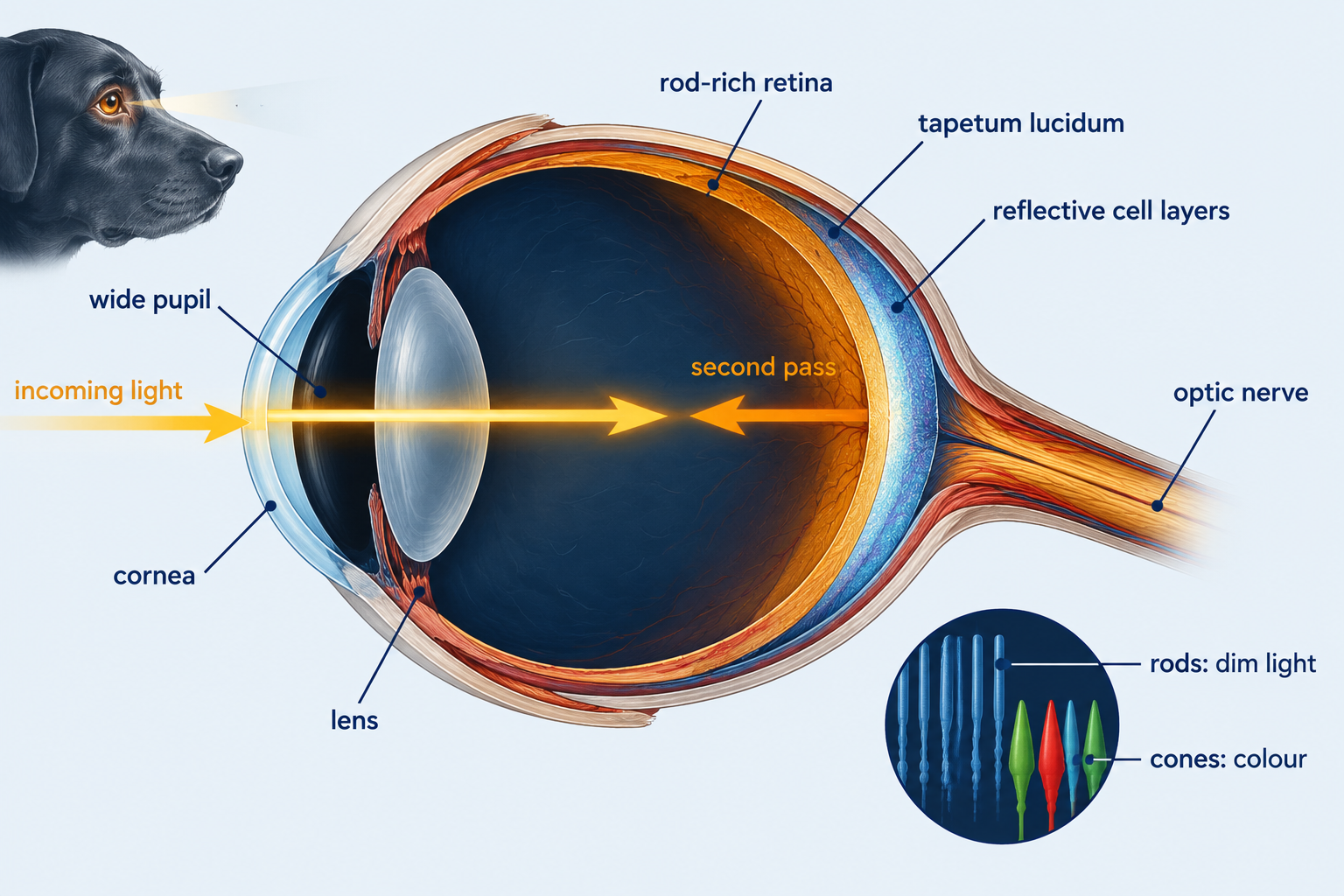
Dogs see in dim light by collecting more photons and then reusing them. More light gets in through a wider pupil, more of it lands on rod photoreceptors tuned for low light and movement, and whatever slips past the retina gets bounced back for a second pass by the tapetum lucidum. Three mechanisms, one result: a usable image at light levels where human vision has already given up.
What is the tapetum lucidum and how does it help dogs see?
The tapetum lucidum is a reflective layer sitting behind the retina in dogs, cats, deer, horses, and many other animals. Light that passes through the photoreceptor layer without being absorbed hits the tapetum and reflects forward again, giving rods and cones a second opportunity to catch it. The ACVO explains this reflective mechanism as a central reason pets handle dim conditions better than we do.
The structure itself is not a simple mirror. An anatomical study of canine eyes published in the Journal of Veterinary Medical Science and archived on PubMed Central found the dog tapetum is built from multiple layers of reflective cells, and noted that the scattered light it produces may reduce visual discrimination, especially in bright conditions.
So the tapetum is a trade. Your dog gets a brighter picture and a slightly blurrier one. Not a bad deal for an animal whose ancestors needed to spot movement at dusk rather than appreciate a crisp horizon.
How does a dog’s pupil size change in darkness?
A dog’s pupil dilates in low light to let more light reach the retina, and it can open wider than a human pupil can. Canine pupils expand to roughly 10 millimeters at full dilation, compared with about 8 millimeters in people, according to Dstl’s introduction to how dogs see. A couple of millimeters sounds like nothing. In light-gathering terms, area matters, so a wider aperture is a meaningful advantage.
That also explains the slow adjustment you may notice. Walk a dog from a bright kitchen into a black back garden and give them a beat before expecting confident movement. Pupils take time. So does the chemical adaptation happening inside the rods.
How well can dogs see in the dark compared to humans?
Dogs reliably outperform humans at detecting shapes and movement in dim light, and the gap is widest at the low end of the brightness scale. Most veterinary sources, including PetMD’s overview of canine night vision, describe dogs as needing substantially less light than people to form a usable image.
What the research found is narrower than the internet’s version of it. Comparing species precisely is hard: behavioral thresholds depend on the task, the target, the contrast, and the dog. A University of Wisconsin science explainer on how well dogs see at night walks through the same anatomy and reaches the same cautious conclusion. Better than us in the dark. Worse than us at detail in daylight.
Where the facts end: there is no clean, universally accepted multiplier for how many times better a dog’s night vision is than yours. Numbers like that circulate widely and rarely come with a traceable study attached.
Why do dog eyes glow in the dark when you shine a light?
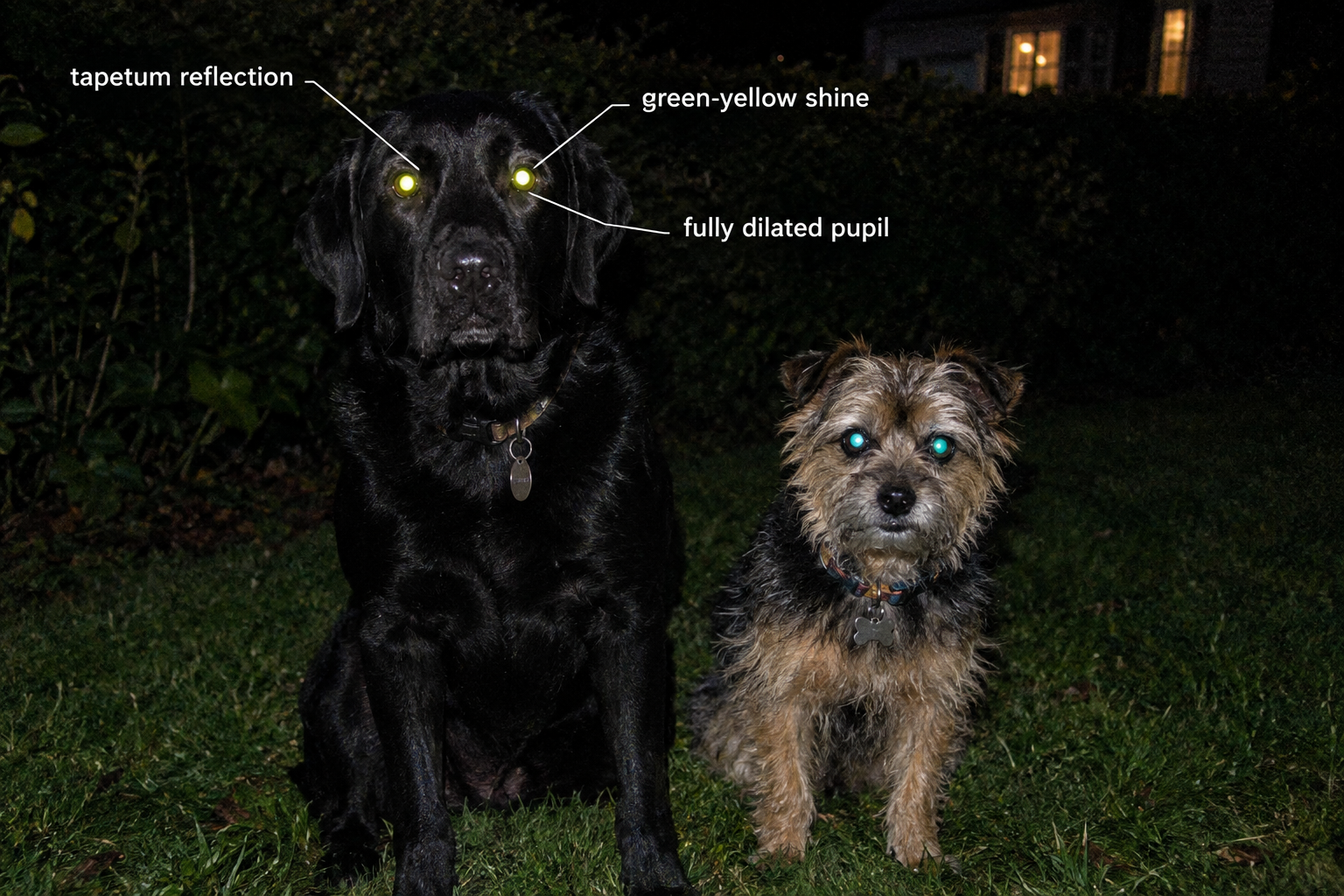
Dog eyes appear to glow because the tapetum lucidum reflects your light source straight back out through the pupil toward the camera or your face. The color you see, green, yellow, blue, or orange, depends on the tapetum’s structure and the pigment in that individual dog’s eye. It is normal anatomy, not a camera malfunction, and not evidence of anything wrong.
A few practical points owners ask about:
- Puppies and some blue-eyed dogs can show a reddish reflection instead, because less tapetal reflection means you are seeing the blood vessels of the retina, which is also what causes human red-eye in flash photos.
- Two different colors in two eyes can simply be pigment variation. Mention it to your vet at the next appointment rather than panicking at midnight.
- A sudden change in eye shine, cloudiness, or a white-grey reflection in one eye is worth a veterinary eye exam. That is an appearance change, not a lighting quirk.
Dog vs cat vs human vision at a glance
Dog and human figures come from the ACVO, Dstl, and the AKC’s summary of what dogs see. Cat entries are described qualitatively on purpose, since published feline numbers vary and this article is about dogs.
Can dogs see in the dark with no light at all?
No. Vision requires photons, and a dog’s eye has no way to create them. The tapetum recycles available light, so it only helps when some light exists: moonlight, a distant streetlamp, the standby LED on your router, the glow under a bedroom door. In a windowless basement with the lights off and the door shut, your dog is navigating by nose, ears, whiskers, memory, and the confidence of an animal who has walked that route 4,000 times.
That last part is why dogs look like they can see in the dark with the lights off indoors. They know where the sofa is. They know the floor plan. Sensory compensation makes the performance look visual when much of it is not, which is also why a dog in an unfamiliar dark room moves far more carefully than one at home.
~10 mm
Maximum canine pupil diameter, versus about 8 mm in humans. Source: Dstl guidance on how dogs see
25%
Share of the central canine retina that is predominantly rod-based, where the same human region is cone-based. Source: ACVO
~20/75
Commonly cited canine visual acuity estimate against a human 20/20 benchmark. Approximate and varies by dog. Source: ACVO
75+ breeds
Breeds affected by progressive rod-cone degeneration, which often shows first as night blindness. Reported May 13, 2026 by Penn Vet
Are dogs colorblind in low light situations?
Dogs are not colorblind in the sense of seeing only grey, and low light makes color matter even less for them than it already does. Dogs have two main cone types rather than our three, so they are dichromatic: blues and yellows are distinguishable, while red and green differences are largely lost, roughly comparable to human red-green color blindness as described by the ACVO.
In dim light, rods take over in any mammal, including us. Rods do not carry color information. So a dog moving across a dark park is working mostly in brightness, contrast, and motion, with whatever limited blue-yellow signal the remaining light allows.
The behavioral groundwork here is older than most owners realize. Vision scientist Jay Neitz, now at the University of Washington, ran color discrimination tests with dogs that helped establish the two-cone picture rather than the “dogs see black and white” myth that preceded it. If you want the fuller version with the actual color comparisons, read our guide to what colors dogs can see and what the research actually shows.
Practical upshot: a red ball on green grass is a genuinely difficult find for a dog, day or night. A blue or yellow toy is easier. This is also why a dog who seems to “smell” rather than see a thrown ball may simply be doing exactly that.
How far can a dog see at night?
There is no verified distance figure, and the honest answer depends on the target, not the dog. Published veterinary sources describe dogs as better at detecting moving objects than stationary ones, and better at detecting presence than identifying detail. Specific claims like “dogs can see a moving object at 900 meters” circulate constantly online without a traceable study behind them, so this article will not repeat them as fact.
What the evidence supports:
- Motion beats stillness. A rod-dominated central retina favors movement detection, per the ACVO.
- Contrast beats size. A pale dog on dark grass is spotted sooner than a black dog on tarmac, in either direction.
- Detail collapses with distance. At roughly 20/75-level acuity, an object your dog detects at 60 meters may not be identifiable until much closer.
- Recognition is multisensory. Dogs confirm with scent and sound, and may also use the head tilt you know well. Our piece on why dogs tilt their heads and what it can mean covers how dogs gather information when one channel is weak.
Edge case worth knowing: a dog who barks at a person 80 meters away in the dark is often reacting to gait and motion, not a clear picture. That is useful for training. You are competing with a detection system, not a recognition system.
Do all dog breeds have the same night vision ability?
Not exactly, and the differences are smaller and less predictable than breed marketing suggests. All domestic dogs share the same basic low-light equipment, including the tapetum lucidum and a rod-rich retina. Variation comes from eye shape and position, skull structure, eye and tapetal pigment, the amount of hair over the eyes, and most of all, eye health.
Things that do plausibly affect an individual dog’s dim-light performance:
- Eye position and head shape. Long-nosed dogs tend to have wider panoramic fields, flat-faced breeds a narrower field with more binocular overlap.
- Coat over the eyes. A Lhasa Apso or a shaggy terrier with hair curtaining the eyes loses light before the eye even gets involved.
- Inherited retinal disease risk. This is the biggest breed-linked factor. Progressive rod-cone degeneration affects more than 75 breeds according to Penn Vet’s 2026 mapping study, and night blindness is often the first sign.
- Size, loosely. Eye size and body size relate, although there is no published ranking of night vision by size. Our explainer on dog size categories from small to giant covers the proportions without pretending they predict eyesight.
What dog breeds have the best night vision?
No breed has a verified, measured night vision advantage over other breeds. Breeds historically used for dusk and night work, including German Shepherds, Belgian Malinois, hounds, and some terriers, are often described as having good low-light ability. That reputation comes from working history, drive, scent work, and training, not from a published comparison of retinal sensitivity. Our overview of German Shepherds, Rottweilers, and Malinois as protection breeds sets out what those jobs actually require.
Decision rule: choose a dog for temperament, exercise needs, and fit with your household. Do not choose one because a listicle ranked its night vision. Individual variation inside any breed outweighs the breed label here.
Do older dogs lose their night vision?
Often, yes, and it is frequently the first thing to go. Three age-related changes matter, and they are not the same condition.
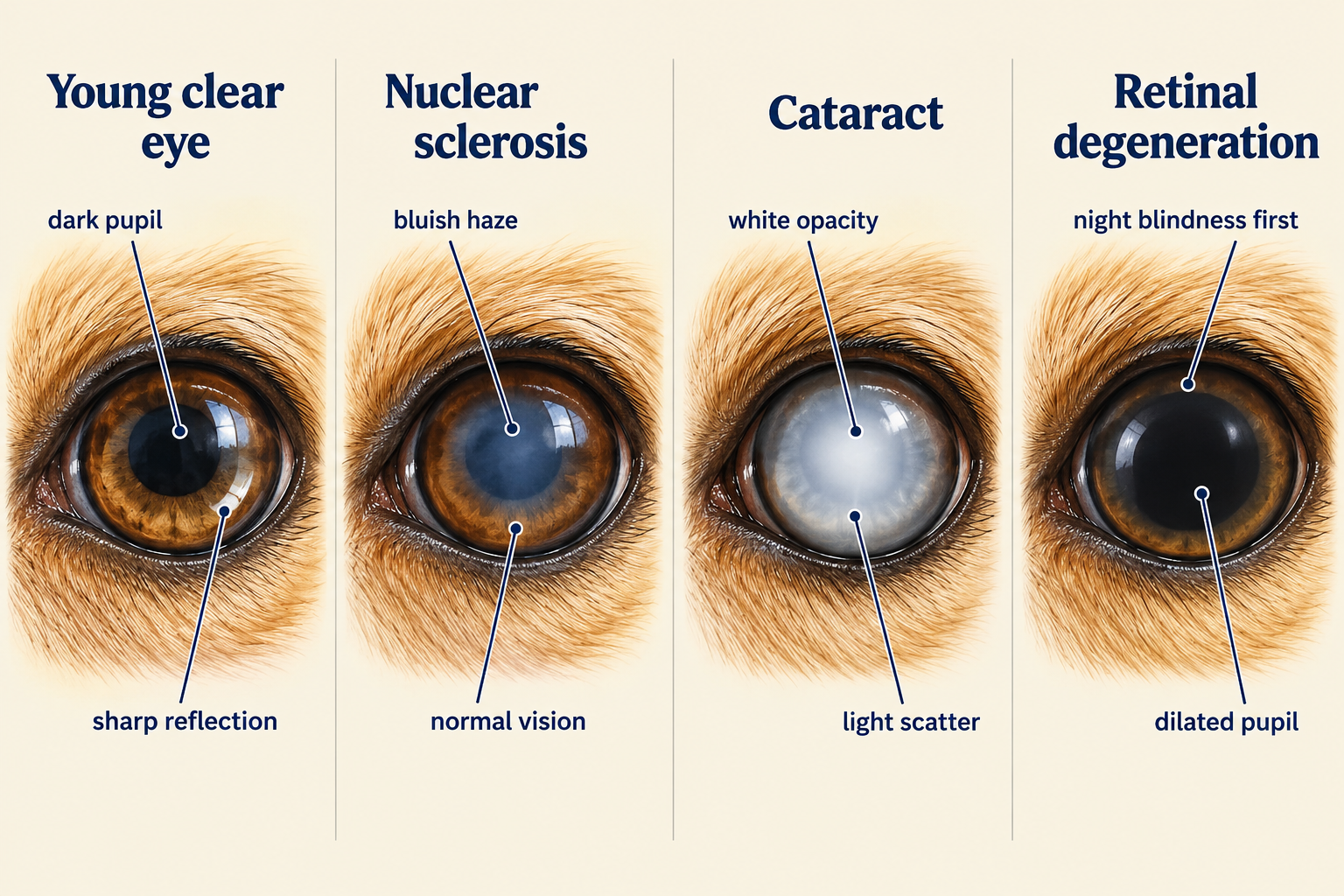
Nuclear sclerosis is a normal hardening of the lens that gives older dogs a bluish-grey haze in the pupil. It typically has little effect on functional vision and does not need treatment. Many owners see it and assume cataracts.
Cataracts are actual lens opacity that scatters and blocks light. They reduce vision in all conditions and commonly show up first in dim light. Cataracts can be surgically treated in dogs, and researchers at UW Veterinary Care have been studying cognition after cataract surgery and other canine eye conditions, including a 2026 study recruiting healthy dogs aged 1.5 to 8 years for visual response testing.
Inherited retinal degeneration affects the photoreceptors themselves. Because rods handle low light, rod loss shows up as night blindness before daytime vision changes. Penn Vet’s May 2026 work found that retinal thinning in progressive rod-cone degeneration begins in the periphery and advances toward the center, which gives vets a measurable trajectory to track. Penn Vet’s Retinal Health Clinic uses multimodal retinal imaging and functional testing to catch this earlier in client-owned dogs.
Signs worth a vet appointment rather than a wait-and-see:
- Hesitating at the back door after dusk when they never used to
- Bumping furniture in dim rooms but not bright ones
- Sticking unusually close to you on evening walks
- Startling when approached in low light
- Reluctance on stairs at night
- Eyes that look cloudy, or pupils that stay wide in normal light
Sleep changes alone are a separate question. If your older dog is simply resting more, our piece on why dogs sleep so much and what the research found is the better starting point.
Can you improve a dog’s ability to see in the dark?
You cannot make a healthy dog’s night vision better than it already is. The anatomy is fixed. What you can do is protect the vision they have, remove the obstacles you control, and treat disease early.
What actually helps:
- Annual eye checks, and twice yearly past about age eight. Early cataract and retinal disease detection changes options.
- Trim the hair around the eyes on long-coated dogs, carefully, or ask a groomer.
- Light the environment, not the dog. A low-wattage hallway light or a step light does more than any supplement.
- Keep furniture where it is. Dogs with reduced vision rely on a stable map.
- Ask about breed-specific genetic testing if your breed is on the inherited retinal disease list.
What does not help: carrots. Blueberries. Any over-the-counter “vision support” chew sold with a night vision claim. Antioxidant-rich foods have a reasonable place in a balanced diet, and our guide to superfoods for dogs, including broccoli and blueberries is clear about the evidence limits. No food on that list gives a dog night vision. Penn Vet’s gene therapy work has restored night vision in dogs with congenital stationary night blindness, which is a specific inherited condition, and that research should not be read as a treatment for ordinary age-related vision loss or a way to give a healthy dog an upgrade.
Is it safe to let dogs roam in the dark outside, and do dogs need night lights?
Letting a dog roam unsupervised in the dark is not safe, and the reason has almost nothing to do with their eyesight. Their vision is fine. Traffic, unfenced water, wildlife encounters, gates left open, and the simple fact that you cannot see them are the risks. A dog’s good dim-light vision does not make a car driver’s vision better.
As for night lights indoors: most healthy adult dogs do not need one. They know your floor plan and their rods are doing more than yours. A small, low light is genuinely worth adding for:
- Senior dogs with reduced vision or early cataracts
- Dogs recovering from eye surgery or injury
- Puppies in a new home during the first weeks, where a dim light helps them find water and the crate
- Any dog who has started hesitating at stairs or thresholds after dark
Keep it warm and dim, placed low, and aimed at the floor rather than at eye level. A bright light pointed at a dog with fully dilated pupils is unkind, and the tapetum means they are already getting a brighter version of whatever you installed.
For tracking peace of mind outdoors, a GPS tracker such as the Fi GPS collar suits owners with large properties or recall still in progress, and it replaces nothing about supervision. It tells you where a dog went. It does not stop them going.
How do you keep a dog safe on night walks?
Assume your dog can see and that nobody can see your dog. Visibility gear belongs on the dog and on you, because drivers, cyclists, and e-scooter riders are the actual hazard. Use the planner below to match gear to tonight’s conditions.
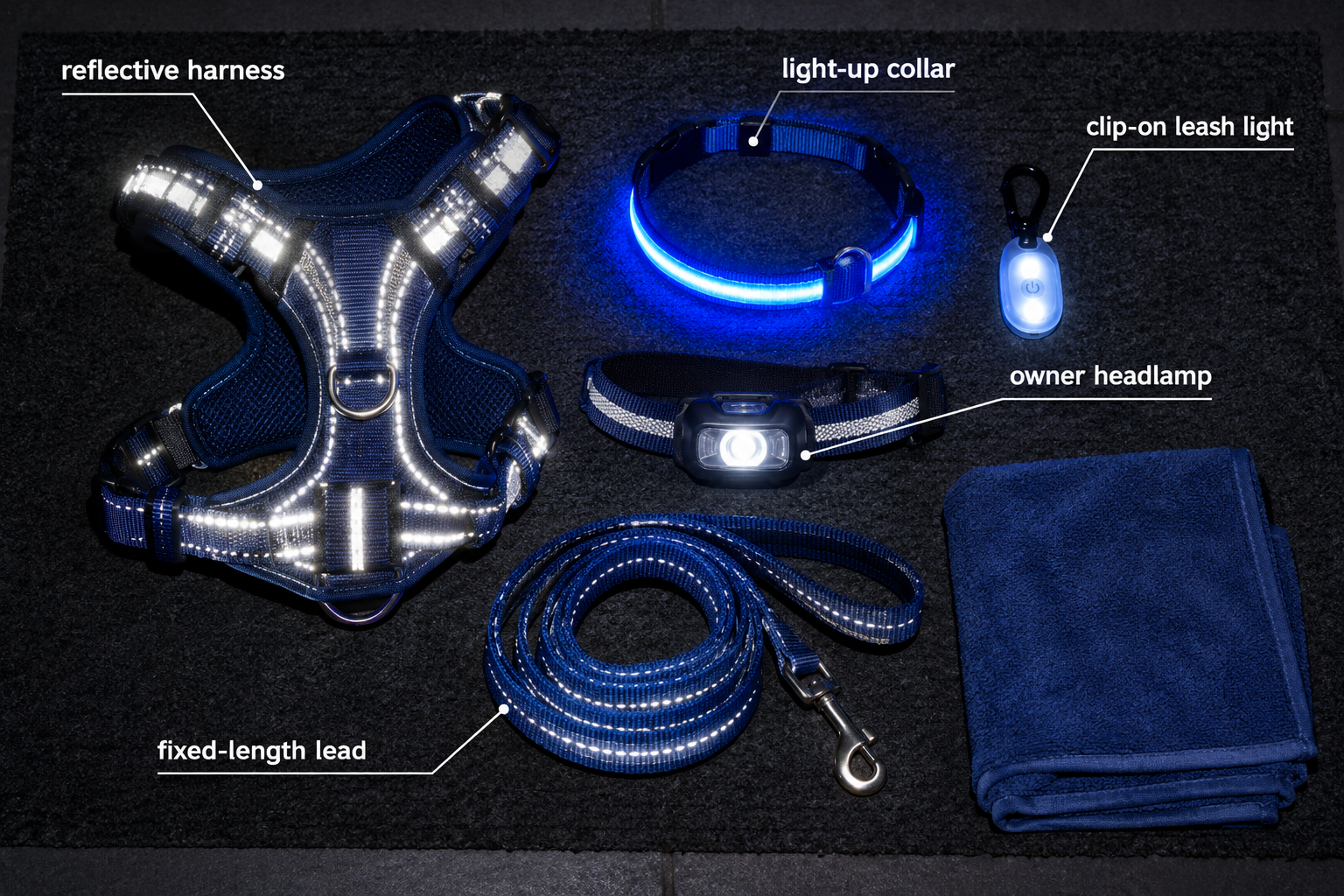
Gear worth comparing, and who it suits
Doggy Rank IQ has not bench-tested the items below. This is a specification and fit comparison based on how each product is designed to be used, so treat it as a shortlist to compare, not a verdict.
- Ruffwear Beacon light. A small clip-on LED designed to attach to a collar or harness. Suits owners who want one light that moves between a harness, a lead, and a jacket.
- Nite Ize SpotLit collar light. A carabiner-style light clip. Suits budget-conscious owners and multi-dog households who want a light on each collar.
- Noxgear LightHound vest. A fully illuminated vest rather than a single point of light. Suits dark trails, rural roads, and anyone walking a black-coated dog on unlit routes. Bulkier, and worth checking the dimensions against your dog’s chest measurement before buying.
- Fi GPS collar. A tracker, not a visibility product. Suits large properties and off-lead training in progress. Pair it with a light, because a tracker does not make a dog visible to traffic.
Price checked: not applicable, since no price claim is being made here. Compare the options against your actual route, your dog’s coat color, and whether you need one clip or a whole vest.
Common mistake: putting the light on the dog and nothing on yourself. A driver reacts to the larger, higher, more expected object first, and that is you.
FAQ
Can dogs see with the lights off?
Usually yes, if any light is getting into the room from a window, a doorway, or a standby LED. Their tapetum lucidum and rod-rich retina make that trace light usable. In genuinely total darkness, no dog can see, and they fall back on scent, hearing, and memory of the room.
Can dogs see glow in the dark toys?
Yes, and glow-in-the-dark toys that emit greenish or blue-green light are among the easier things for a dog to pick up at night, since dogs see blue and yellow wavelengths relatively well. Glow intensity fades quickly, so a battery-powered light-up ball usually stays visible longer than a phosphorescent one.
How do dogs see humans?
Less sharply than we see them. At a commonly cited acuity of roughly 20/75, your face is softer and less detailed to your dog than theirs is to you. Dogs compensate with scent, voice, posture, and gait, which is why a dog can recognize you across a dark car park before any facial detail is available.
Can dogs see in color, and what colors can dogs not see?
Dogs see color, just fewer of them. They are dichromatic, handling blues and yellows reasonably well, while red and green differences are largely indistinguishable to them. A red toy on green grass is effectively camouflage.
Do all dogs have night vision?
All domestic dogs have the same basic low-light anatomy, including the tapetum lucidum. Actual performance varies with eye health, age, eye shape, hair over the eyes, and inherited retinal disease, so two dogs of the same breed may differ noticeably.
Why do my dog’s eyes glow green in photos while my friend’s dog glows blue?
Both are normal. The color of eye shine depends on tapetal structure and the pigment in that individual dog’s eye, and green, yellow, blue, and orange are all seen in healthy dogs. A sudden change in the reflection, or a cloudy white appearance, deserves a veterinary eye exam.
Does a night light help a senior dog?
Often yes. Dogs with early cataracts or retinal degeneration lose dim-light vision first, so a small, warm, floor-level light in hallways and near stairs can reduce hesitation and stumbling. Keep furniture in familiar positions as well, since map memory matters more as vision drops.
Is it safe to walk a dog off lead in the dark?
Only in a fenced, familiar, hazard-free space, and only with reliable recall. Your dog’s dim-light vision is good. Your ability to see them, and a driver’s ability to see them, is the limiting factor, so lights and reflective gear belong on both ends of the lead.
Conclusion
Dogs are built for twilight, not for blackout. Wider pupils, a rod-dominated central retina, and the tapetum lucidum bouncing light back for a second pass add up to a real low-light advantage over human eyes, paid for with softer detail and a two-color view of the world. That package is impressive, fixed, and easier to lose than to improve.
One clear next step: on your next evening walk, watch how your dog handles the transition from your lit hallway to the dark street. If there is new hesitation at the door, the kerb, or the stairs, book an eye exam rather than adjusting the route around it. Night vision loss is usually the first symptom, not the last, and it is the one owners notice soonest.
Dog advice that actually answers the question, with the gaps in the evidence left visible where they belong.