A Labrador can land exactly inside the breed’s weight range and still carry too much fat. A whippet can alarm strangers at the park and be in textbook condition. That gap is why “is my dog overweight” is rarely answered by a bathroom scale, and why most vets reach for the rib cage first. The check takes about twenty seconds, costs nothing, and works on a fluffy Samoyed as well as it works on a short coated beagle.
Quick Answer
To check if your dog is overweight, use the same three-part body condition assessment vets use: feel the ribs with flat hands behind the front legs, look down at the waist from above, and look at the belly tuck from the side. At ideal condition the ribs are easy to feel under a thin layer of fat, the body narrows behind the rib cage, and the belly rises toward the hind legs. If you have to press to find ribs and the waist has gone straight, your dog is likely carrying excess fat, which maps to a body condition score of 6 or 7 out of 9. Guidance here was checked in October 2026.
Key Takeaways: Is My Dog Overweight?
- The scale alone cannot answer “is my dog overweight,” because frame size, muscle, coat and breed shape all change what a number means.
- The three steps are ribs by touch, waist from above, tuck from the side. All three, not just one.
- On the 9 point scale, 4 to 5 is ideal, 6 to 7 is overweight, and 8 to 9 is obesity range. On a 5 point scale, aim for 3.
- Ribs should be easy to feel and generally not conspicuously visible in most adult dogs with normal coats.
- Fat cover and muscle are separate things. Vets increasingly pair a body condition score with a muscle condition score, because an older dog can be overweight and losing muscle at the same time.
- “Overweight” describes body condition. It is not automatically a diagnosis of clinical obesity, a point the Association for Pet Obesity Prevention stressed in its September 2026 communication guidance.
- Yes, overweight dogs can lose weight, usually at around 1 to 2 percent of body weight per week under veterinary supervision.
- Treats, chews and food toppers should stay under roughly 10 percent of daily calories.
- Weighing food on a kitchen scale is more accurate than scooping with a cup, and it is the single easiest fix in most households.
- Get a vet calorie target before slashing portions. Rapid, unsupervised restriction risks nutrient shortfalls and muscle loss.
How do I check if my dog is overweight? The 3-step rib check (ribs, waist from above, tuck from the side)
Run all three steps in order, on a dog standing squarely on a non-slip floor, and judge by feel rather than by eye. Current owner guidance from the Association for Pet Obesity Prevention promotes this same three-part home assessment: palpate the ribs, inspect the waist from above, inspect the abdominal tuck from the side. The rib check is one component, not a standalone verdict.
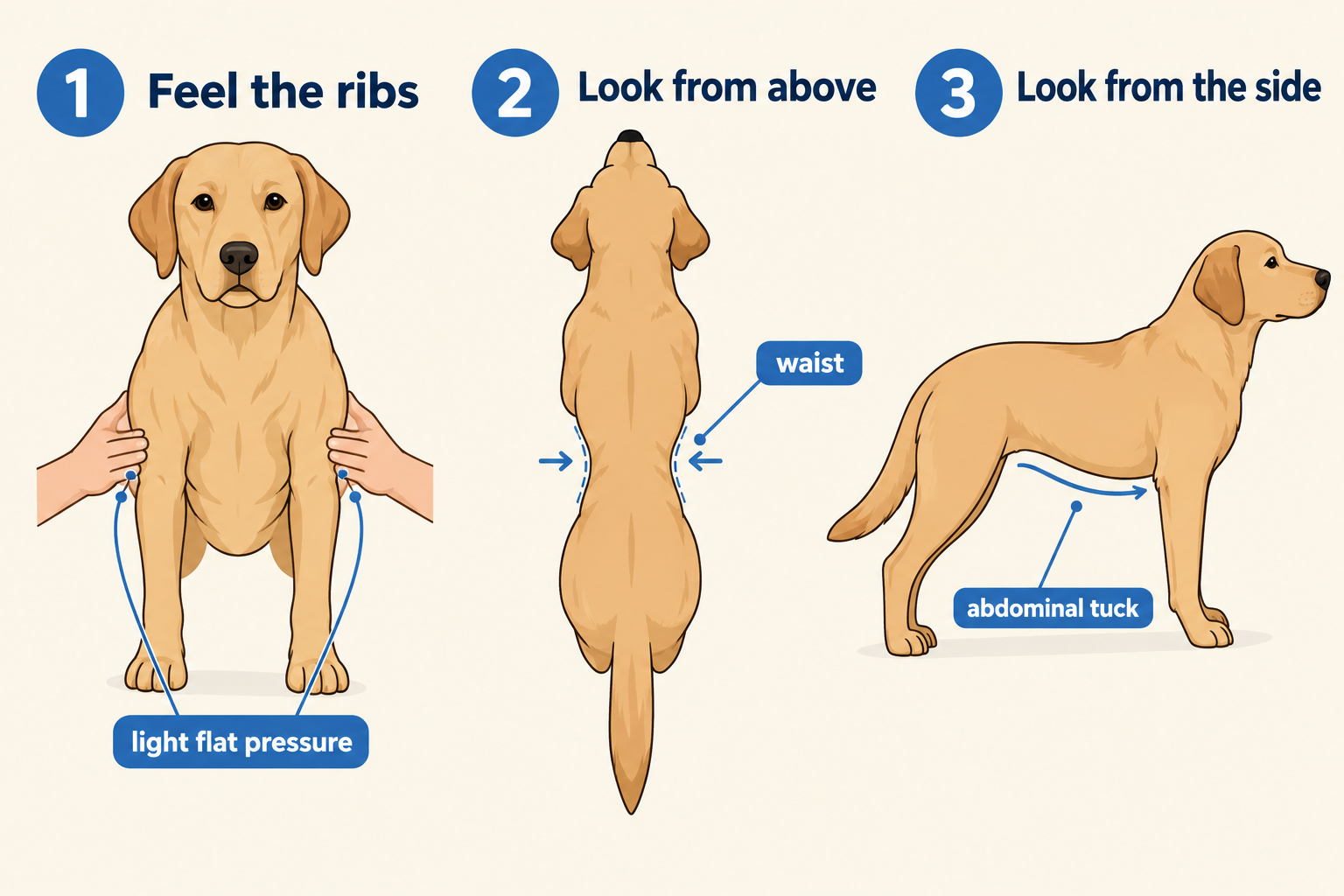
Step 1: Feel the ribs
Place both hands flat on your dog’s chest just behind the front legs. Use light pressure with flat fingers, the way you would smooth a bedsheet, not poking fingertips.
At ideal condition, the ribs are readily palpable under a thin, even layer of fat. They should not feel sharply exposed.
The most useful comparison in veterinary education is your own hand. VCA Animal Hospitals and Royal Canin both describe it this way:
Ribs that feel like the bones on the back of your hand are about right. Ribs that feel like your knuckles suggest too little fat. Ribs you can barely find, like the bones under the fleshy palm, suggest too much.
Try it on yourself first. It takes two seconds and it recalibrates your expectations faster than any photo chart.
One caution. A dog with thick fur, a deep chest, or a heavily muscled front end can feel different from what you expect. Go by pressure required, not by how padded the coat makes the dog look.
Step 2: Look at the waist from above
Stand over your dog, or squat behind them, and look straight down while they stand still.
You are looking for a narrowing behind the rib cage. A clear hourglass that pinches in at the waist and widens again at the hips. A straight-sided, broad, or outward-curving silhouette points toward increased fat cover, though breed shape can change the appearance.
Edge case worth knowing: barrel-chested breeds and pregnant dogs can read wider from above for reasons that have nothing to do with fat. So can a dog who has just eaten a large meal. Check before breakfast if you can.
Step 3: Look at the abdominal tuck from the side
Crouch down so your eye is level with your dog’s chest and look at the profile.
The belly line should rise from the deepest part of the chest upward toward the hind legs. That upward sweep is the tuck. A level, sagging, or outward-projecting abdomen is more consistent with excess fat than with ideal condition.
Puppies under about six months often have a shallower tuck. Very deep-chested breeds have a dramatic one by default. Both are normal, which is exactly why one step is never enough.
Putting the three steps together
Two useful decision rules:
- If all three steps agree, trust the result. Ribs easy to feel, visible waist, clear tuck equals ideal condition. Ribs hard to find, no waist, flat belly line equals overweight.
- If the steps disagree, go with the ribs and book a vet check. Conflicting signs often mean coat, conformation, muscle loss or fluid is confusing the picture, and those are things a professional should sort out.
A common mistake: checking only once, when you are already worried. Run the three steps on the same day each month. Change over time tells you far more than a single snapshot.
What is a dog body condition score, and what is ideal?
A body condition score, or BCS, is a standardized rating of a dog’s fat cover based on touch and shape. Most clinics use a 9 point scale where 4 to 5 is the target, 6 to 7 means overweight, and 8 to 9 means obesity-range condition. Some use a 5 point scale where 3 is the target. Both appear in the AAHA nutrition and weight management resources and in the widely distributed WSAVA body condition score chart for dogs.
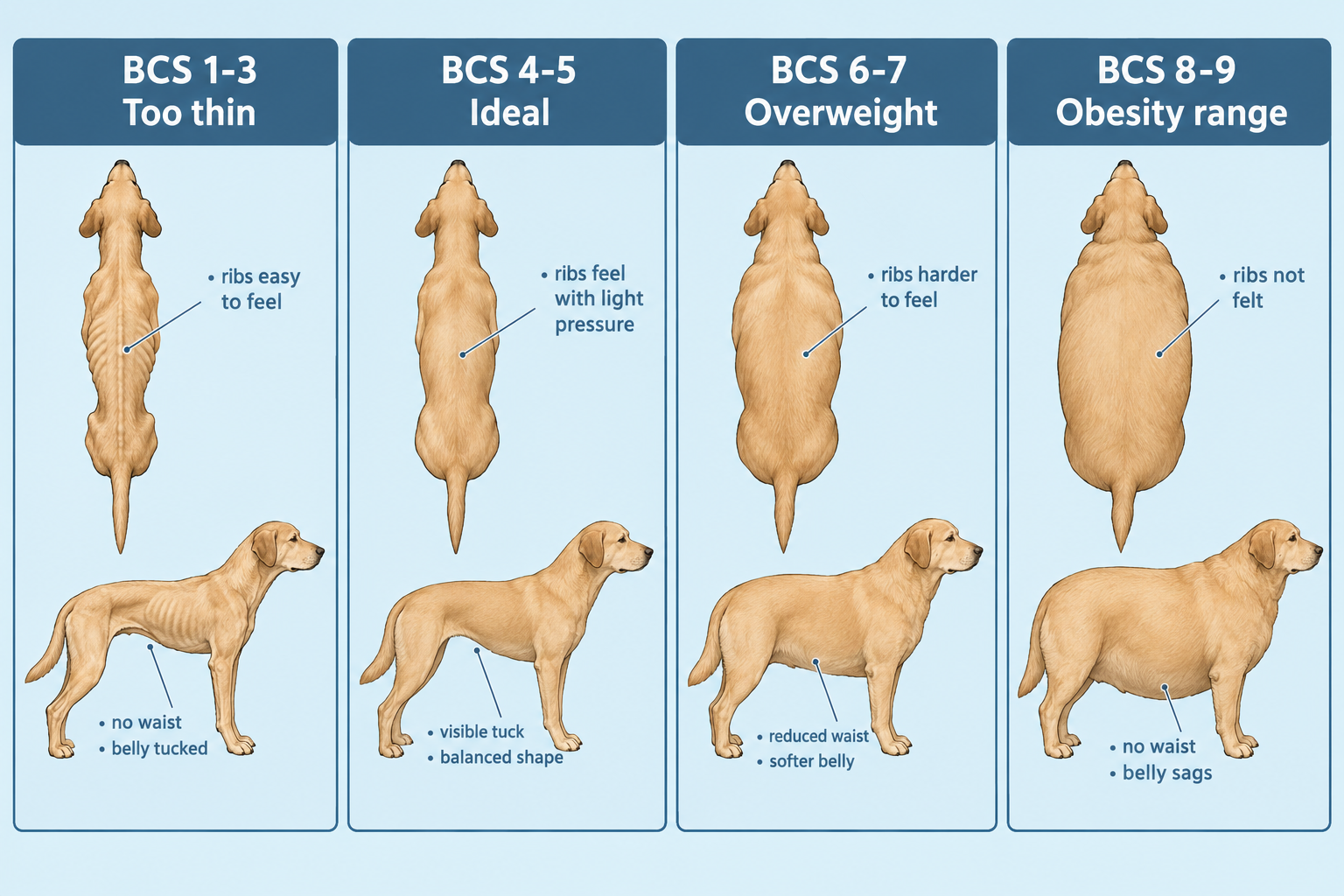
Healthy weight for dogs chart: what the bands actually mean
| Band | What you feel | What you see | What to do |
|---|---|---|---|
| BCS 1 to 3 Too thin | Ribs, spine and hips prominent with little or no fat cover | Sharp waist, steep tuck, bony outline at the hips | Vet visit. Rule out illness, dental pain, parasites or underfeeding |
| BCS 4 to 5 Ideal | Ribs easy to feel under a thin, even fat layer | Visible waist from above, clear upward belly tuck | Maintain. Monthly weigh-in and a repeat three step check |
| BCS 6 to 7 Overweight | Ribs need pressure to find, padded feel | Waist straight or barely there, tuck flattening | Ask for a target weight and daily calorie figure. Measure every meal |
| BCS 8 to 9 Obesity range | Ribs hard to locate, fat over spine and tail base | No waist, belly level or bulging outward | Supervised plan. Discuss bloodwork, mobility and pain |
How do vets measure dog body condition?
Vets combine three things: your dog’s weight in kilograms or pounds, a hands-on body condition score from 1 to 9, and increasingly a separate muscle condition score. The weight gives a trackable number. The BCS tells them what that number means on this particular frame.
The muscle score matters more than most owners expect. WSAVA’s nutrition toolkit separates fat stores from muscle mass precisely because an older or chronically ill dog can carry excess fat while losing muscle over the shoulder blades, skull and spine. Two dogs can both score BCS 7 and need different plans.
In clinic practice, scoring is done by palpation at the ribs, the lumbar spine, and the base of the tail, then checked against the overhead and side views. It is also why owner estimates and vet estimates often differ. The 2026 APOP prevalence survey, which opened on October 1, 2026 and runs to December 31, 2026, records both the owner’s estimate and the veterinarian’s 1 to 9 score for each dog, specifically to compare them with a standardized method rather than relying on perception alone.
What should my dog’s weight be by breed, and are some breeds naturally heavier?
Breed weight ranges are a starting reference, not a health target. Plenty of breeds have standards spanning 20 pounds or more between a small female and a large male, so a dog can sit inside the range and still carry excess fat, or sit above it with a big frame and good condition.
Some breeds really are built heavier. Mastiff types, Newfoundlands, Saint Bernards and other giant breeds carry serious bone and muscle, and judging them by a medium-breed mental image gets you nowhere. If you are trying to work out which category your dog belongs in before you start interpreting numbers, our guide to large versus giant breed weight ranges sorts the bands out, and the roundup of breeds that weigh 200 pounds or more shows how far the top end goes.
For mixed breeds there is no chart at all. The practical move: let your vet set an individual ideal weight for your dog based on body condition, then use that number as your reference forever. Individual variation is the rule, not the exception.
Is my dog overweight or just fluffy?
Coat volume changes how a dog looks and almost nothing about how a dog feels. If you can locate the ribs with light flat pressure and find a waist with your hands rather than your eyes, the fluff is doing the lying, not the fat.
Three quick tests for coat confusion:
- Hands, not eyes. Smooth both palms along the rib cage. Fur compresses under light pressure. Fat does not.
- Wet dog test. After a bath, while the coat is flat, take the overhead and side views again. Many owners find this is the moment the shape becomes obvious.
- Post-groom comparison. Weigh your dog before a full groom and after. Same weight, very different outline. That difference is the coat, which tells you how much to discount the visual.
The reverse confusion exists too. Visible ribs are not a fitness badge. For most adult dogs at ideal condition, ribs are easy to feel but not conspicuously visible, and prominent ribs can reflect low fat reserves, muscle loss, breed conformation, or illness rather than athleticism. Cornell’s Riney Canine Health Center makes that distinction clearly in its obesity and weight loss guidance.
Why does extra weight matter for dogs? (lifespan, joints, diabetes)
Excess body fat is linked with shorter life span, more orthopedic problems, reduced heat tolerance and higher anesthetic risk. The strongest single piece of evidence in dogs is still a long-running Labrador study, and it is worth knowing what it did and did not show.
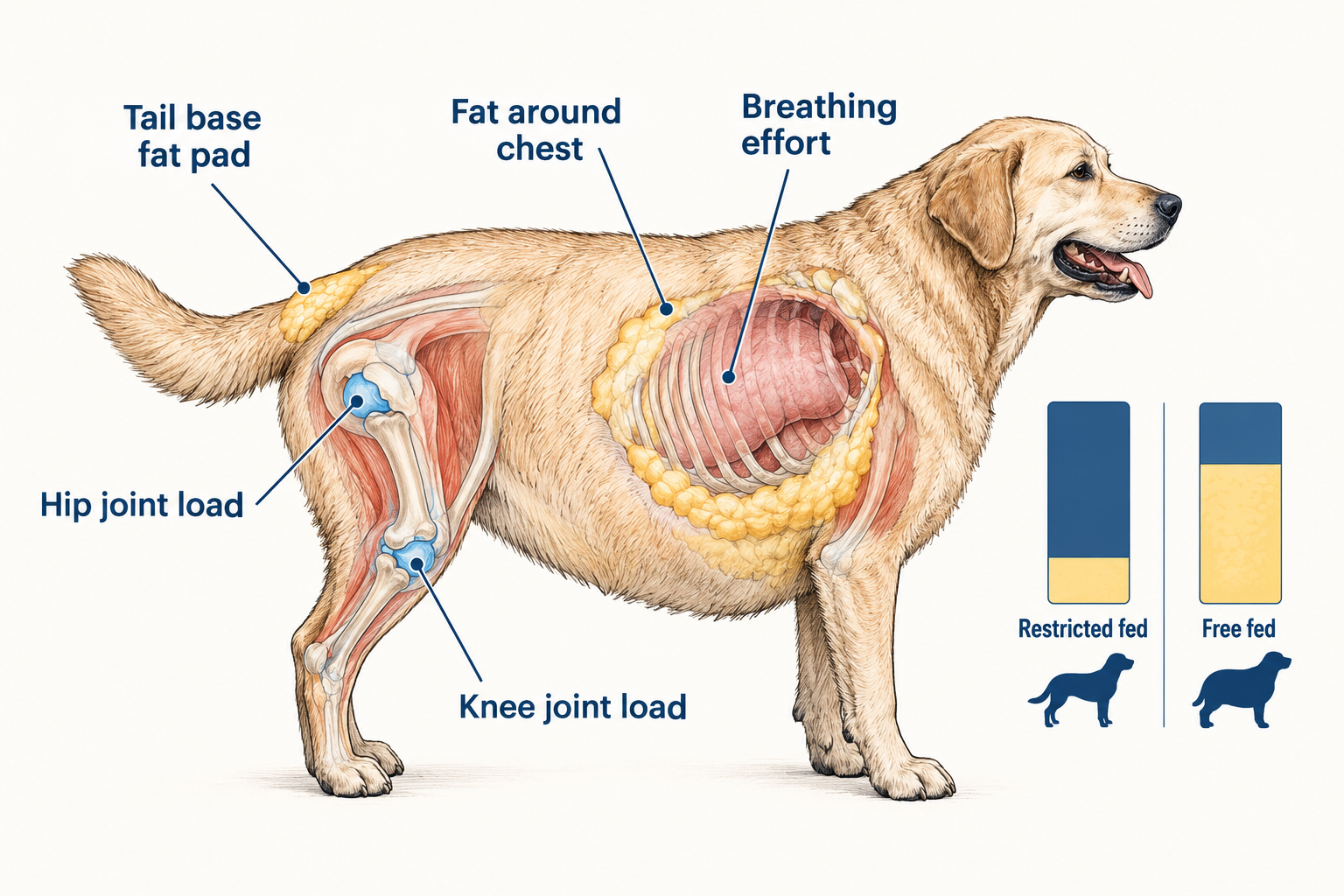
Kealy and colleagues, publishing in the Journal of the American Veterinary Medical Association in 2002, followed 48 Labrador Retrievers in paired littermates from puppyhood to the end of life. One of each pair ate 25 percent less food than its sibling. The restricted group had a median life span of 13.0 years versus 11.2 years in the control group, and showed later onset of chronic disease, including hip osteoarthritis.
What the study did not establish: that every breed responds the same way, that 25 percent restriction is the right number for your dog, or that you should cut food without veterinary input. It was one colony, one breed, one feeding protocol, with lean dogs compared against dogs fed generously from the start. The direction of the finding is consistent and well cited. The exact figures belong to those 48 Labradors.
Signs of obesity in dogs owners actually notice
Weight gain rarely announces itself. These are the everyday changes that bring dogs into clinics:
- Slowing down on walks, lagging behind, or sitting down to rest
- Reluctance to jump into the car, onto the sofa, or up stairs
- Heavy panting after mild activity, or poor tolerance of warm weather
- Difficulty reaching the back half of the body to groom
- A collar that needs letting out, or a step-in walking vest that stops fastening
- Sleeping more, playing less, and less interest in games that used to be favorites
Two important limits on that list. First, every one of those signs can also be caused by pain, heart disease, airway problems or endocrine disease, so they are a reason for a vet visit rather than a diet decision. Second, APOP’s updated September 2026 communication guidance makes the point that “overweight” is a body condition category and should not automatically be read as a diagnosis of clinical obesity. A dog can carry excess fat without a demonstrated obesity-related disease. The score starts the conversation. It does not end it.
What should I do if my dog is overweight?
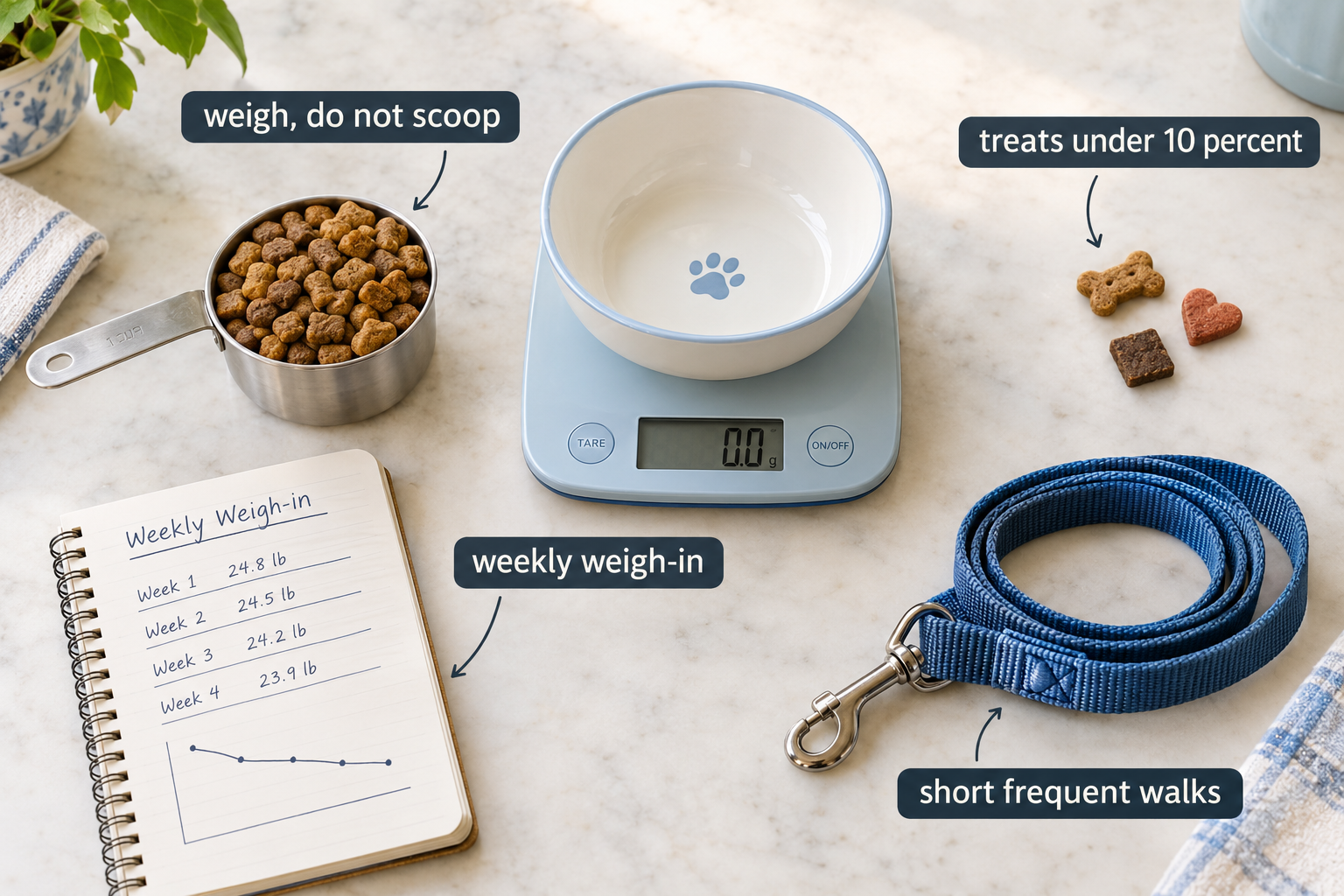
Start with a vet visit to get a target weight and a daily calorie number, then weigh food instead of scooping it, keep treats under 10 percent of calories, and reweigh your dog every two to four weeks. Overweight dogs can absolutely lose weight, and the typical safe rate is around 1 to 2 percent of body weight per week.
Step by step first month
- Book the vet check. Ask for three things written down: current weight, body condition score, and a goal weight. Ask about bloodwork if there has been rapid gain, hair loss, skin changes or lethargy.
- Get a calorie target. Vets usually start from a resting energy requirement calculation and then apply a factor for weight loss, which is why two dogs of the same weight can get different numbers. Online dog weight loss calculators can give you a rough starting figure, but they do not know your dog’s body condition, medications or neuter status.
- Weigh the food. A kitchen scale costs less than a bag of dental chews and removes the largest source of error in home feeding. Scooping with a cup can vary by a surprising margin depending on kibble shape and how hard you pack it. If portion sizing is where you keep getting stuck, our vet-informed guide to portions, timing and water walks through the mechanics.
- Audit the extras for one week. Write down everything. The dental chew, the crust, the cheese around the tablet, the training treats, the thing the toddler dropped. Most households find the gap between what they think the dog eats and what the dog eats.
- Set a weigh-in schedule. Same scale, same time of day, every two to four weeks. Clinics will usually let you use their scale for free.
- Reassess with the three steps monthly. Fat loss shows up at the ribs and waist before it shows on the scale in small dogs.
Best diet for overweight dogs
There is no single best food. What matters is a complete diet fed to a calculated calorie amount, with enough protein and nutrients at that reduced intake. Therapeutic weight management diets exist for a reason: they keep nutrient density high while calories come down, which plain portion cutting does not always manage.
Practical pointers:
- Choose by calorie density and portion practicality, not marketing language. More food volume for the same calories helps a hungry dog cope.
- Fiber and protein content are the levers vets usually pull for satiety and muscle preservation at reduced calories.
- Do not cut portions by more than your vet advises. Deep restriction of a standard maintenance food risks shortfalls in protein, vitamins and minerals.
- For how to read a label without being sold a story, see what vets actually look for in a dog food, and if joints are also part of the picture, dog food for weight, joints, skin and gut problems covers how those claims hold up.
- Budget is a legitimate constraint. Feeding the correct amount of a reasonably priced complete food beats feeding too much of an expensive one. Our budget picks that still hold up exist for exactly this situation.
How to exercise an overweight dog safely
Increase duration before intensity, and build up gradually. An overweight dog carrying extra load on sore joints, in a body that overheats faster, is not a candidate for sudden five mile hikes.
- Start with several short walks rather than one long one. Flat ground, cool part of the day.
- Swimming and controlled lead walking put less load through the joints than fetch, sprinting, or sharp turns.
- Watch for early stopping signs: heavy panting, lagging, lying down, limping, or refusing to continue. Stop then, not later.
- Brachycephalic breeds and dogs with heart or airway disease need a plan set with a vet. Heat and exertion are a genuine risk for them.
- Add enrichment that does not need athleticism: snuffle mats, scatter feeding part of the measured ration, food puzzles, scent games indoors. Calories come down and the dog still gets something to do.
Common mistake: starting diet and a big exercise push in the same week, then quitting both. Change food measurement first. Add activity second.
Why is my dog overweight when he does not eat much?
Usually because total daily calories are higher than they look, or because energy needs have dropped while the bowl stayed the same. Both are ordinary, and neither means you are a careless owner.
The usual causes, roughly in order of how often they turn up:
- Uncounted extras. Treats, chews, table scraps, food used for training, and the second dinner served by another household member. A small dog can hit a meaningful share of daily calories on three biscuits.
- Portion drift. Feeding guidelines on a bag cover a wide weight band and assume an average activity level. A cup that was right at eighteen months may be too much at six years.
- Neutering. Energy requirements commonly fall after spay or neuter while appetite does not, and the APOP survey records neuter status for each dog precisely because of that association.
- Age. Lean muscle declines with age and activity usually drops with it. Same food, less burn.
- Reduced activity. A house move, an injury, a new job, a cold winter. Dogs do not compensate by exercising themselves.
- Breed and individual metabolism. Some breeds, Labradors included, show a strong tendency toward food motivation and weight gain. Tendency is not destiny, but it changes how carefully you measure.
- Medical causes. Hypothyroidism, Cushing’s disease and certain medications can drive weight gain. Rapid gain, lethargy, hair coat changes or excessive drinking deserve bloodwork rather than another diet attempt.
The decision rule: if you have measured food accurately for four weeks, counted every extra, and the weight has not moved at all, that is a medical conversation, not a willpower problem.
If you are comparing foods while you sort out portions, our three-step method for comparing dog food brands keeps the calorie math in view instead of the packaging.
FAQ
Is my dog overweight if I cannot see the ribs?
Not necessarily. For most adult dogs in ideal condition, ribs are easy to feel under a thin fat layer but not clearly visible. Judge by the pressure needed to find them, along with the waist and tuck, rather than by sight alone.
What is the quickest way for a dog to lose weight?
The fastest safe route is a vet-set calorie target, measured by weight on a kitchen scale, with treats cut to under 10 percent of daily calories and activity increased gradually. Most veterinary plans aim for 1 to 2 percent of body weight per week. Faster loss risks muscle loss and nutrient shortfalls.
How often should I weigh my dog during weight loss?
Every two to four weeks on the same scale, at a similar time of day. For small dogs, use a scale with fine increments, because a loss of half a pound is significant on a 12 pound frame.
Do overweight dogs really live shorter lives?
The best dog-specific evidence comes from Kealy and colleagues (JAVMA, 2002), where 24 restricted-fed Labradors had a median life span of 13.0 years against 11.2 years in their 24 control littermates, plus later onset of chronic disease. It is one breed in one colony, so treat it as strong supporting evidence rather than a universal figure.
Can I use a dog weight loss calculator instead of asking my vet?
A calculator can give you a rough starting number, but it cannot score body condition, check muscle mass, review medications, or rule out hypothyroidism. Use it to prepare questions, then confirm the target with your vet.
Is my dog overweight or just big boned?
Frame size changes the healthy weight number, not the body condition check. A large-framed dog still needs palpable ribs, a visible waist from above, and an upward belly tuck from the side. If those three are present, the dog is probably just large.
Does my dog’s breed make a heavier weight normal?
Breed changes the expected weight range and the expected silhouette, not the ideal body condition score. Giant breeds weigh far more and still should score 4 to 5 out of 9. Mixed breeds have no chart, so ask your vet to set an individual target weight.
My old dog looks thin on top but heavy around the middle. What does that mean?
That pattern can indicate excess fat combined with muscle loss, which is why vets record a muscle condition score alongside the body condition score. It needs a clinical assessment rather than a simple diet cut, since reducing calories without enough protein can worsen muscle loss.
Conclusion
The honest answer to “is my dog overweight” lives in your hands, not on a chart. Flat palms behind the front legs. One look down. One look from the side. If the ribs take real pressure to find and the waist has gone straight, you have useful information worth taking to a vet rather than to a search bar.
Your next three steps, in order:
- Run the three-step check today and write down what you felt, not what you hoped.
- Book a vet appointment for a body condition score, a target weight, and a daily calorie figure. Ask about muscle condition too, especially for a dog over seven.
- Buy a kitchen scale and weigh the next meal. It is the cheapest and most effective change in this entire article.
Then set a reminder for four weeks from now and do the check again. Progress in dog weight management looks boring from week to week, which is exactly how you know it is working.