
Quick Answer
AKC Canine Partners costs $35 one time to enroll a mixed-breed dog, with a possible $10 extra name fee if the dog’s name runs long (apps.akc.org). That single payment gets the dog an AKC Canine Partners number, lifetime enrollment, and eligibility for sports like agility and rally. After that, the ongoing costs come from training, club dues, and event entry fees, not from the AKC itself.
Key Takeaways: akc canine partners
- AKC Canine Partners enrollment is $35, paid once, not yearly, as listed on the official program page (apps.akc.org).
- The program exists specifically for mixed-breed dogs and purebreds that cannot get full AKC registration (akc.org).
- Dogs must be spayed or neutered by adulthood, and wolf hybrids cannot enroll (apps.akc.org).
- The AKC Canine Partners number is what gets typed into every event entry form afterward.
- The program does not cover conformation (breed) shows. Mixed breeds compete in performance and companion events instead (akc.org).
- A 2026 brand refresh added a newsletter, 30 days of pet insurance, an initial vet visit perk, and AKC Family Dog magazine to the enrollment package (akc.org).
- Real costs add up outside the AKC fee: training classes, entry fees per event, and gear.
- Purebred dogs without papers have a separate option called the Purebred Alternative Listing (PAL).

What is your dog?
Tap an option to see the answer.
 The short answer: what AKC Canine Partners is
 The short answer: what AKC Canine Partners is
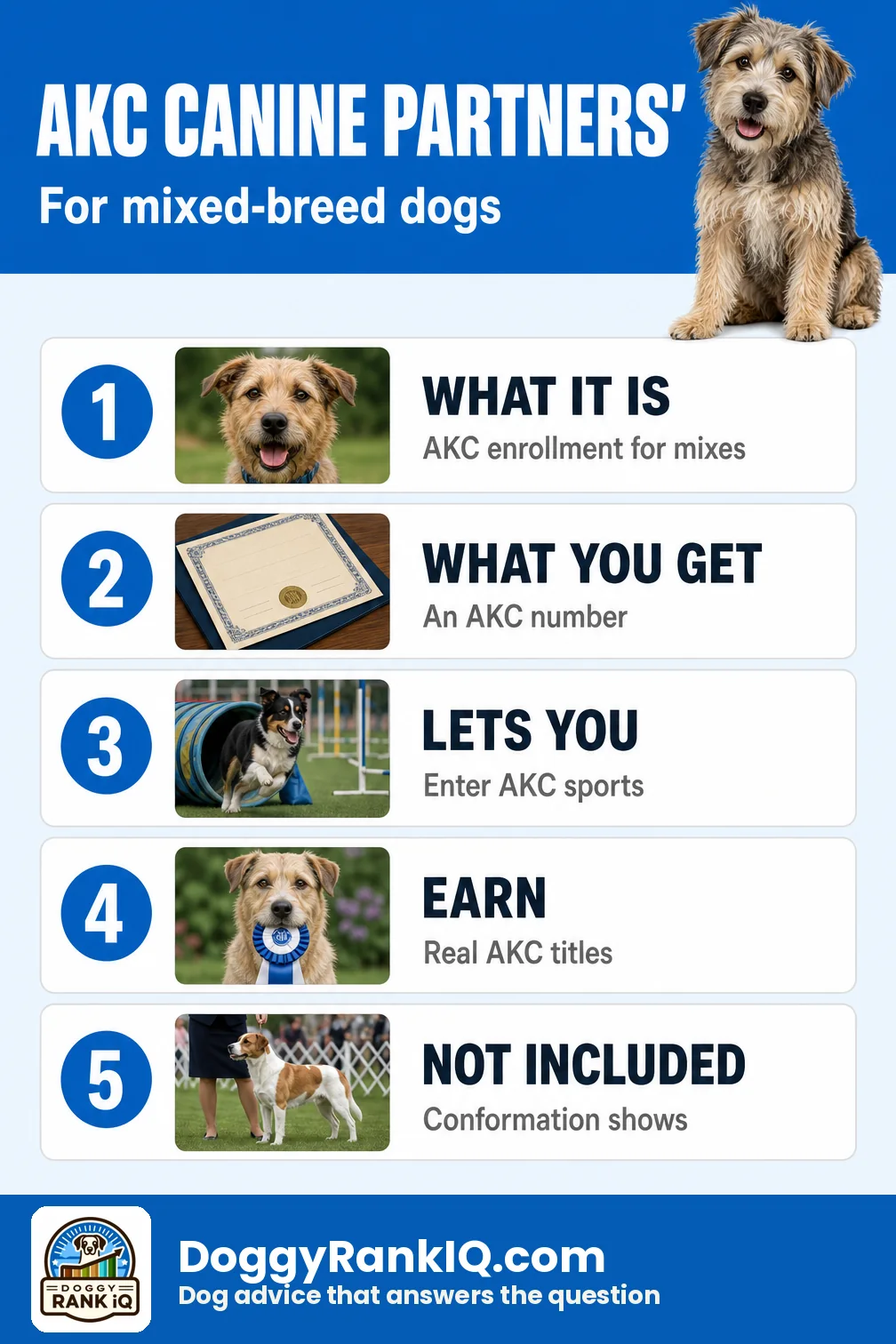
AKC Canine Partners is the American Kennel Club’s enrollment program built for dogs that cannot hold full AKC registration, mainly mixed breeds, plus purebreds missing paperwork. The program began accepting dogs in 2009, with competition starting the following year, and it has run continuously since.
Enrollment gets the dog a personal record: a name, a description, a photo, and an AKC Canine Partners number. That number functions like a membership ID. It goes on every entry form for agility, rally, obedience, scent work, and more.
The AKC refreshed the program’s branding in 2026, with a stronger emphasis on mixed-breed inclusion and a photo contest running through 2026 (akc.org). The refresh changed presentation and added benefits, not the base price. As of 2026, the enrollment page still lists the one-time fee at $35 (apps.akc.org).
Worth repeating: this is not a kennel club membership in the dues sense. It is a one-time listing that stays active for the dog’s life.
Real cost for a mixed breed: enrollment, entries and titles
The headline number is $35, paid once per dog, with the AKC describing the attached benefits as worth more than $100 (apps.akc.org). That is the entire required cost to get a Canine Partners number. Everything past that point depends on how far the owner wants to go.
A dog that never leaves the backyard agility course costs nothing beyond that $35. A dog entered in weekend trials across three sports racks up real money through entry fees, travel, and gear. The spread is wide, and it should be, because the program serves everyone from the owner who just wants a Trick Dog title for fun to the family chasing a Master Agility title.
Three categories make up the real total:
- The AKC fee. $35 flat, plus $10 if the dog’s name runs past 36 characters (apps.akc.org).
- Training. Group classes, private lessons, or self-taught practice at home using online resources. Costs vary widely by region and trainer.
- Competition costs. Entry fees per event, which differ by sport and club, plus any recording or service fees. The 2026 AKC National Championship premium list, for example, shows separate event recording and service charges layered onto entries (akc.org).
A decision rule worth keeping in mind: choose the $35 enrollment alone if the goal is just a Trick Dog title or casual scent work practice at home. Add a training budget only once the dog is working toward a title that requires a judged event, since many of those titles cannot be earned informally.
Facts table: what you pay and when
The pattern is simple. One AKC payment, then variable costs that scale with ambition.
How to enroll in 5 steps
Enrollment happens entirely online and usually takes less than 15 minutes once a photo is ready.
1Confirm eligibility
The dog must be a mixed breed, or a purebred that is not eligible for full AKC registration, AKC Foundation Stock Service, or PAL (akc.org). Dogs must be spayed or neutered upon adulthood, and wolf hybrids cannot enroll (apps.akc.org). A puppy too young for surgery can still enroll if the owner certifies future spay or neuter [per AKC listing procedures referenced in the brief].
2Gather the dog’s details
Have the dog’s name, birth date or approximate age, sex, color, and a clear photo ready. The photo becomes part of the official record.
3Submit the online application
Fill out the AKC Canine Partners enrollment form with the dog’s name and description, pay the $35 fee (price checked 2026), and add $10 if the chosen name is long (apps.akc.org).
4Receive the number by email
The AKC Canine Partners number and a personalized certificate arrive by email after processing. This number goes on every future event entry.
5Start training toward a sport
Pick a first sport, often Trick Dog or Rally, and begin practicing before entering a judged event.
What your AKC Canine Partners number lets you do
The number itself is an administrative key. It links the dog’s history, titles, and entries across every AKC event the dog ever enters. Without it, a mixed-breed dog cannot be entered in most AKC companion or performance events.
Owners sometimes assume the number works like a passport that automatically grants access to every sport. It does not. Each sport has its own eligibility rules, and some events require additional club memberships or qualifying scores before a dog can move up a level.
The 2026 program refresh bundled in a newsletter, 30 days of pet insurance, an initial veterinary visit benefit, and a subscription to AKC Family Dog magazine alongside the certificate and number (akc.org). None of those extras change what the number itself does. They are added value on top of the enrollment, not requirements for using it.
Which sports mixed breeds can enter
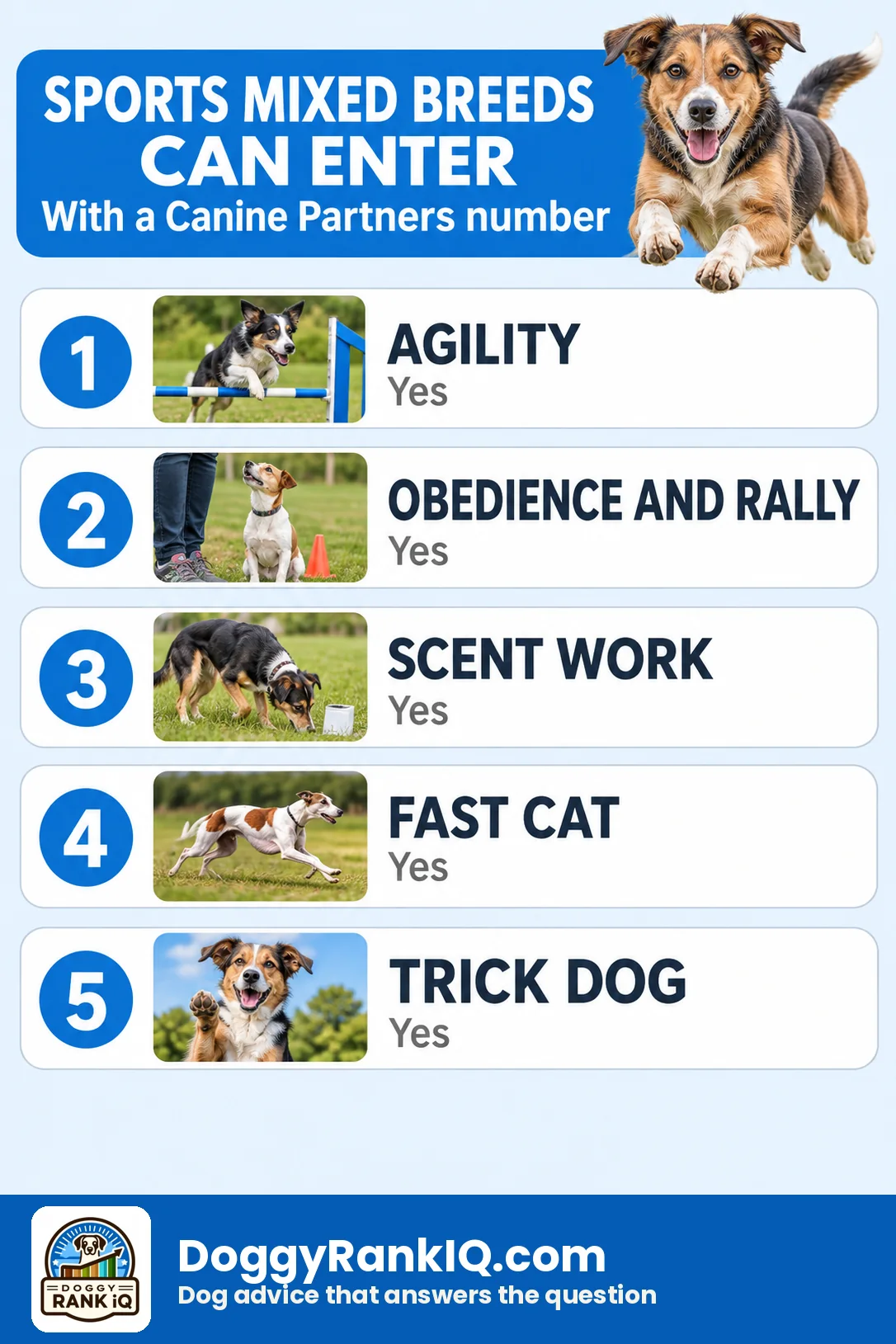
Mixed-breed dogs enrolled through Canine Partners can compete in agility, obedience, rally, scent work, Fast CAT, tracking, and trick dog events, among others [the eligible-sports list supplied in the research brief]. Conformation, the breed-standard ring shows, is not open to mixed breeds, since those events judge dogs against a specific breed standard.
That exclusion surprises some new owners who picture “AKC event” and think only of the big televised breed show. Performance sports are a different world entirely, and arguably a more forgiving one. Nobody is judging the dog’s ear set. They are timing a run or scoring an obedience exercise.
For a full breakdown of which sports fit a mixed breed best, including scent work and Fast CAT details, the dog sports guide for mixed breeds walks through each option by energy level and training time.
Decision rule: choose agility or rally if the dog is food or toy motivated and physically sound. Choose scent work or trick dog if the dog is older, has joint concerns, or the household wants something lower impact.
Canine Partners vs PAL vs full AKC registration
These three programs solve different problems, and mixing them up is the most common confusion owners hit.
- AKC Canine Partners fits mixed-breed dogs or any dog lacking a qualifying pedigree. Cost: $35 one time (apps.akc.org).
- Purebred Alternative Listing (PAL) fits purebred dogs that look and act like their breed but lack registration papers, often rescues. PAL allows entry into performance events and, after enough qualifying scores in some cases, limited paths forward.
- Full AKC registration fits purebred dogs with complete, verifiable lineage documentation from AKC-registered parents. Only these dogs can enter conformation shows.
A dog cannot be enrolled in Canine Partners if it already qualifies for full registration or PAL (akc.org). Choose Canine Partners if the dog’s breed mix is unknown or confirmed through a DNA test like those compared in the Embark vs Wisdom Panel comparison. Choose PAL if the dog is clearly one recognized breed but the paperwork trail is missing.
📋 Your first event day, start to finish
Enrollment gets you a number. Using it for the first time is where most new owners feel lost, so here is how a typical day goes.
It starts weeks earlier with a document called a premium list. The club hosting the trial publishes it online, and it gives the date, the location, the classes offered, the judges, the entry fee and the closing date. Entries usually close a couple of weeks before the event, and popular trials fill before that. On the entry form, your dog’s breed is written as “All-American Dog,” the AKC’s name for mixed breeds, and the registration number box takes your AKC Canine Partners number.
A few days before the trial the club sends a judging schedule with your class time. Arrive at least 45 minutes early. You will want time to find parking, set up a crate in the shade or in the crating area, walk the dog and check in at the table.
“Bring a crate, water, a chair and more treats than seems reasonable.”
Some sports add a step. In agility, dogs are measured at the shoulder to set jump height. In Fast CAT, there is a quick inspection where you trot the dog so officials can confirm they are moving soundly. Scent work asks you to keep the dog well away from the search areas until your turn.
Then you wait, compete for somewhere between 20 seconds and a few minutes, and wait again for results. Qualifying runs earn a ribbon and count toward a title.
🏅 What the letters after a name mean
Titles become part of your dog’s recorded name, and reading them is a small skill.
- CGC: Canine Good Citizen, a ten-step manners test.
- TKN: Trick Dog Novice.
- RN: Rally Novice, earned with three qualifying scores.
- BCAT: the first Fast CAT title, earned at 150 points. Points come from the dog’s speed over 100 yards, adjusted for height.
- SWN: Scent Work Novice.
- NA: Novice Agility.
A mixed-breed dog listed as “Biscuit CGC TKN BCAT” has passed a manners test, performed tricks for an evaluator and run enough timed sprints to bank 150 points. The AKC issues a certificate for each title, and the record stays with the dog for life.
🤝 Etiquette nobody tells first-timers
Keep your dog on a short leash in crowded aisles, and ask before letting them greet another competitor’s dog. Plenty of dogs at trials are working through nerves, and their handlers will thank you. Do not feed or train right at the ring entrance. Pick up after your dog everywhere, including the parking lot. Thank the volunteers, because clubs run on them, and offer to help set bars or time a class once you know your way around. It is the fastest way to learn the sport and to meet the people who will answer your questions next time.

⭐ Top 5 Features We Love
- One flat fee, lifetime access. $35 covers the dog permanently, with no renewal bill the following year (apps.akc.org).
- Mixed breeds get a real path to titles. Agility, rally, scent work, and trick dog titles are not locked behind pedigree.
- The 2026 benefits bundle. A newsletter, 30 days of pet insurance, and an initial vet visit perk now come standard with enrollment (akc.org).
- Broad sport access. Multiple disciplines open up with a single number, so owners are not re-enrolling per sport.
- AKC Reunite enrollment included. Lifetime enrollment in the lost-and-found recovery service rides along with no separate annual fee (apps.akc.org).
⚠️ Things to Look Out For
- The $35 is not the whole bill. Training classes and per-event entry fees are where real money gets spent.
- No conformation access. Owners hoping for breed-ring competition will need to look elsewhere; mixed breeds are not eligible for that ring.
- Spay/neuter is required by adulthood. A dog kept intact past that point may run into enrollment compliance issues (apps.akc.org).
- Wolf hybrids cannot enroll, full stop (apps.akc.org).
- Name length limits exist. Going over 36 spaces triggers the extra $10 fee (apps.akc.org).
- Extras in the 2026 refresh are not guaranteed forever. Bundled perks like the pet insurance trial can change between program updates, so confirm current inclusions on the official enrollment page before counting on them.
First titles to go after
New Canine Partners owners usually chase one of a few starter titles because they require minimal equipment and modest training time.
- Trick Dog titles (Novice through higher levels) are often the easiest entry point and can be practiced almost entirely at home. The AKC Trick Dog titles guide lays out which tricks count and how evaluation works.
- Canine Good Citizen (CGC) is not a sport title but a widely respected prerequisite many owners tackle first, covering manners and basic obedience. The Canine Good Citizen test guide breaks down all 10 test items.
- Rally Novice suits dogs with some obedience foundation and a handler who wants a judged event without the strict precision of formal obedience.
- Scent Work Novice fits dogs of any age or mobility level, since it rewards nose work over athleticism.
Choose Trick Dog first if training time is limited. Choose CGC first if the long-term goal is any AKC sport, since good manners make every later sport easier to teach.
Helpful starter gear
A few affordable tools make early training sessions smoother, whether the goal is a Trick Dog title or a first agility run.
- Dog Training Clicker with Wrist Strap marks the exact moment a dog does something right, which speeds up almost any title-track training. $4.99 (price checked 2026). Check the current price.
- heouvo Magnetic Dog Treat Pouch with Training Clicker keeps treats and a clicker on the handler’s hip during practice, useful for rally and obedience drills. $9.99 (price checked 2026). Check the current price.
- Adjustable Dog Agility Jump Set lets a mixed-breed dog practice jump height and footwork in a backyard before an agility trial. $49.99 (price checked 2026). Check the current price.
- Canine Good Citizen: The Official AKC Guide, 2nd Edition walks owners through each CGC test item with training tips from AKC evaluators. $14.06 (price checked 2026). Check the current price.
These are manufacturer-listed prices and specifications; owner reports on fit and durability vary, so check current listings before buying. If a dog has joint issues or any health concern that could affect jump training, confirm with a veterinarian before starting agility work.
FAQ
The bottom line
The real cost of AKC Canine Partners for a mixed breed is small up front and variable after that. $35 gets the number, the certificate, and lifetime eligibility for sports. The money that adds up later comes from training and entry fees, driven entirely by how many titles an owner wants to chase.
Start with the $35 enrollment, pick one low-cost title like Trick Dog or CGC, and only add paid classes once a specific sport goal is clear. That keeps the decision simple and the spending in the owner’s control from day one.
Doggy Rank IQ is reader supported. As an Amazon Associate we earn from qualifying purchases, at no extra cost to you.