
Quick Answer
Dog sports in 2026 include twelve competitive and at-home options, from scent work and agility to canicross and barn hunt, and most welcome mixed breeds through programs like AKC Canine Partners, UKC, NADAC, and NACSW. The right dog sports choice depends on your dog’s body, drive, and age: sniffers do well in scent work, sprinters suit Fast CAT, and ball-obsessed dogs take to flyball fast. A vet check before starting is non-negotiable, especially for puppies with open growth plates. Most beginners can start locally for under $250 and with gear that costs less than a vet visit.
Key Takeaways: dog sports
- Twelve dog sports covered here span scent work, agility, rally, obedience, Fast CAT, dock diving, flyball, disc dog, barn hunt, herding, lure coursing, and canicross, plus trick dog and parkour as home starters.
- Mixed breeds can compete through AKC Canine Partners, with more than 1 million mixed-breed dogs enrolled since 2009.
- Scent work is the most forgiving entry point for anxious, senior, or physically limited dogs.
- Agility competition eligibility generally starts around 15 months, after growth plates mature.
- A beginner six-week course often runs around $225, based in 2026 class listings.
- Fast CAT measures a 100-yard sprint and converts the result to miles per hour.
- A reactive dog can usually start with scent work or canicross before group classes.
- Most dog sports equipment for starting out costs under $40 per item.
What does your dog love?
Tap an option to see the answer.
The short answer: which dog sports can any dog try?
Scent work, rally, trick dog, and parkour are the most universally accessible dog sports because they do not require speed, jumping, or a specific body type. Any dog with a nose and a willingness to work, which is nearly every dog, can participate.
AKC says almost all of its sports accept purebred and mixed-breed dogs, with the main exceptions being conformation and certain breed-restricted events like herding tests and Earthdog trials (akc.org). That leaves a wide door open. Scent work in particular asks a dog to do something it already does for free: sniff. AKC Scent Work has dogs search for odors tied to birch, anise, clove, and cypress, and they signal a find by sitting, pointing, pawing, or barking AKC Scent Work. Competition starts at 6 months.
Choose scent work or rally if your dog is older, anxious, overweight, recovering from an injury, or simply new to structured activity. Choose agility, flyball, or dock diving once your dog is cleared for higher-impact movement and already shows obvious enthusiasm for jumping, chasing, or water.
Facts table: 12 dog sports at a glance
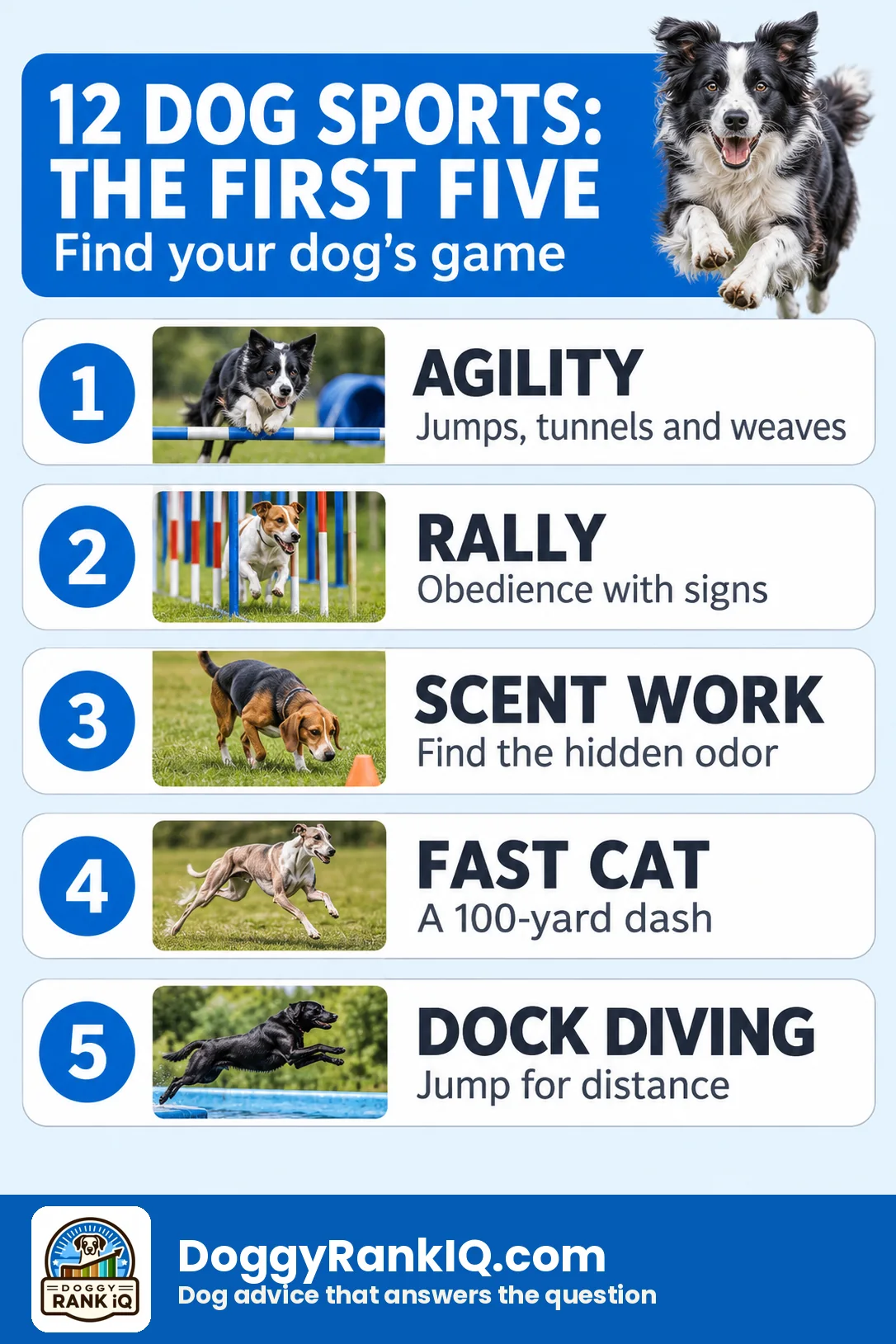
12 best options
1Agility
Agility asks a dog to run a timed obstacle course of tunnels, jumps, weave poles, and contact equipment while following handler cues. AKC’s 2026 Agility League national championship, held November 6 to 8 in Raleigh, North Carolina, drew more than 450 dogs and over 100 teams, a 15% jump in entries over the prior year (akc.org). The league’s team format lets beginners compete locally while still being part of a national standing, which softens the intimidation factor for new handlers.
All breeds and mixed breeds can participate, though competition eligibility typically begins around 15 months AKC Agility: Get Started. Foundation work, like simple tunnel play, can start earlier at a slow pace. For backyard practice, the 18 Ft Dog Agility Training Open Tunnel gives dogs a low-pressure way to get comfortable with equipment before a class ever starts. For a broader setup, our guide to dog agility equipment by budget breaks down what to buy first.
2Rally
Rally has teams move continuously through a course of 10 to 20 numbered signs, performing an exercise at each one AKC Rally. Unlike traditional obedience, rally allows more handler talk and encouragement, and the scoring is less rigid, which takes pressure off new teams.
It works well as a bridge sport: if your dog already knows sit, stay, and loose leash walking at home, rally gives that training a competitive outlet without the precision demands of formal obedience.
3Obedience
Obedience is the stricter, more precise cousin of rally, judging exact heel position, stays, and recalls with less handler interaction allowed during the run. It suits dogs who are biddable, food motivated, and comfortable with repetition. Our guide to the most obedient dog breeds is a useful read if you are still deciding whether your dog’s temperament fits this format, though individual variation always matters more than breed generalization.
4Scent work or nose work
Scent work is widely considered the strongest general-purpose dog sports pick for beginners because it has low equipment needs, works indoors or outside, and accommodates puppies, seniors, and timid dogs. AKC Scent Work’s second Master National, held October 18 to 21, 2026 in Branson, Missouri, drew nearly 150 dogs representing more than 33 states and 49 breeds, with the top 70 advancing to the final round AKC Scent Work Master National. That breed spread says a lot: this is not a sport that rewards one body type over another.
The Dog Scent Work Tins Training Kit, 6 tins is an easy way to start at home before signing up for a class. See our deeper comparison in nose work for dogs: AKC vs NACSW.
5Fast CAT
Fast CAT times a dog sprinting 100 yards and converts the result to miles per hour, giving even a backyard athlete a measurable, shareable number. It suits dogs with an obvious chase drive and sound joints, and it is one of the simplest sports to try once because there is no obstacle course to learn.
6Dock diving
Dock diving measures how far or how high a dog jumps into water off a dock, judged through North America Diving Dogs (NADD) and similar organizations. It is built for water-loving dogs and requires almost no training beyond building confidence near the dock edge.
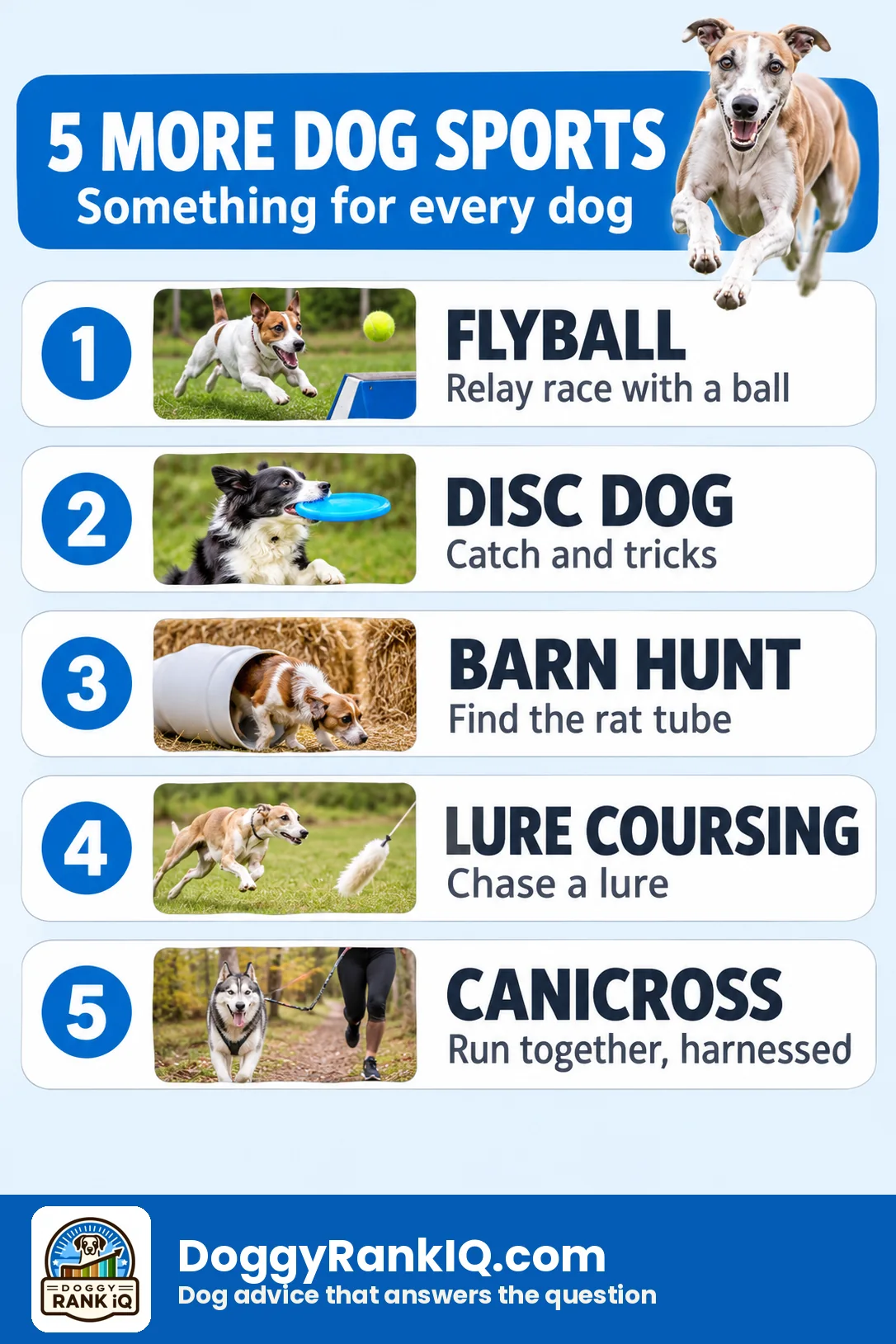
7Flyball
Flyball is a relay race where dogs run a lane, trigger a spring-loaded box to release a ball, and race back over four jumps. The North American Flyball Association governs most competitions. This sport rewards raw ball drive over precision, so a dog who treats every tennis ball like a personal insult if it rolls away is a strong candidate.
8Disc dog
Disc dog competitions judge a dog’s catches, distance, and freestyle routines with a flying disc. Organizations like UpDog and Skyhoundz run events for dogs with good body control and a strong retrieve instinct. Start with something durable like the KONG Flyer Flying Disc or the Chuckit! Paraflight Flying Disc, and see our full best dog frisbee comparison for rim grip and throw distance details.
9Barn hunt
Barn hunt has dogs locate rats (safely caged, never harmed) hidden in straw bales within a time limit, governed by the Barn Hunt Association. It suits curious, nose-driven dogs of any size, including small mixed breeds who might not have the build for agility.
10Herding
Herding tests and trials, run through AKC and the American Herding Breed Association, ask dogs to move livestock under handler direction. This is one of the few sports with real breed restrictions, generally limited to herding breeds, so it is not the open-door option others on this list are. Our Australian Shepherd profile covers a breed built for exactly this work.
11Lure coursing
Lure coursing has dogs chase a mechanically operated lure across a field in a simulated hunt, judged on speed, agility, and enthusiasm. It is traditionally a sighthound sport, but coursing ability tests through AKC are open more broadly, including to fast mixed breeds.
12Canicross
Canicross is cross-country running with your dog attached by a bungee line to a dedicated waist belt, governed internationally by organizations like CaniX and the International Canicross Federation. It needs real equipment investment up front: a proper canicross harness matters for both comfort and safety. Read our piece on canicross harness fit mistakes to fix before buying.
Bonus home starters: trick dog titling (AKC offers this with no in-person entry fee for early levels) and dog parkour (urban obstacle navigation, like climbing a low wall or balancing on a bench) both work as low-cost ways to build confidence before trying a club sport.
Mixed breeds welcome: how registration works
Mixed breeds are not shut out of competitive canine sports. AKC’s Canine Partners program has enrolled more than 1 million mixed-breed dogs since 2009, giving them access to titles in agility, rally, obedience, scent work, tracking, coursing ability tests, Fast CAT, and Farm Dog programs Does the AKC Accept Mixed-Breed Dogs?.
Beyond AKC, several organizations welcome mixed breeds without a separate registration track at all:
- UKC accepts mixed breeds in many performance events.
- NADAC and USDAA run agility for any dog regardless of papers.
- NACSW (National Association of Canine Scent Work) never required breed registration.
- North America Diving Dogs (NADD) and the North American Flyball Association judge performance, not pedigree.
- Barn Hunt Association is open to all dogs that fit size divisions.
Choose AKC Canine Partners if you want a title track and a national community. Choose UKC, NADAC, or sport-specific clubs if you just want to compete without the enrollment step.
Dog sports for beginners: how to pick by your dog’s body and drive
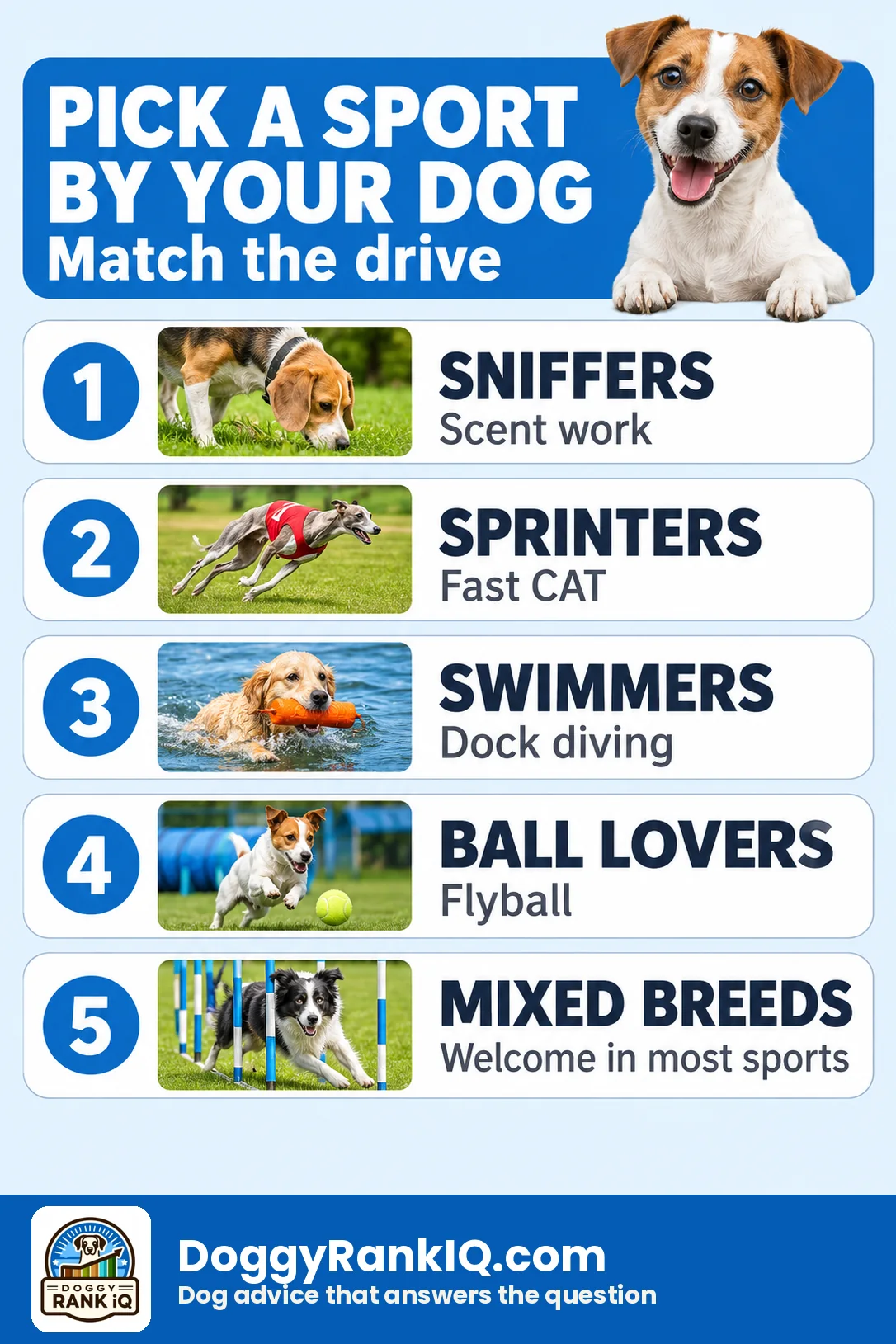
Pick a sport by watching what your dog already does for fun, not by what looks impressive on video. A dog who sniffs every blade of grass on a walk is telling you something. A dog who loses his mind over a tennis ball is telling you something else.
- Sniffer, cautious, or easily overwhelmed: scent work.
- Sprinter, chases squirrels at full speed: Fast CAT or lure coursing.
- Obsessed with water: dock diving.
- Will not let go of a ball, ever: flyball.
- Loves jumping and has steady joints: agility, once age-appropriate.
- Enjoys running alongside you on trails: canicross.
Common mistake: signing up for agility first because it is the most visible sport on social media, then discovering the dog finds it stressful or physically unready. Match the sport to the dog in front of you, not the dog you pictured.
Dog sports near me: finding clubs, classes and training
Start with a vet check, then search AKC’s club finder, local humane societies, and private training centers that list canine sports training. Many run beginner tracks with no prior experience required.
As one example of current pricing, the Humane Society of Silicon Valley listed six-week beginning scent work, flyball, and recreational agility classes at $225 per course in 2026 Humane Society of Silicon Valley. That is a reasonable benchmark for what a structured six-week introduction costs nationally, though your local price will vary.
When calling a club, ask: Is there a trial class? Are mixed breeds and rescue dogs welcome? What happens if my dog gets anxious mid-class? A good club answers all three without hesitation.
Dog sports for a reactive dog
A reactive dog can still take part in canine sports, usually starting with activities that avoid close contact with other dogs. Scent work and canicross (run solo or with distance from other teams) are the most common starting points.
Many trainers run “reactive dog friendly” scent work classes with staggered search times so dogs never cross paths. Rally can also work if the facility allows private or small-group lessons. Skip group agility classes and busy dock diving events until your dog has built confidence, since both put dogs in close proximity with little control over spacing.
🩺 Before the first class: age limits and a warm-up
Most canine sports set a minimum age, and the rule exists to protect joints. In AKC events a dog must be at least 15 months old to run agility and 12 months to run Fast CAT, while rally and obedience open at 6 months. Classes for younger dogs keep jumps on the ground and focus on handling.
Whatever the sport, borrow two habits from human athletes. Warm up for five minutes with a brisk leash walk, a few spins in each direction and some sit-to-stand repetitions before the first run. Cool down the same way afterward, then offer water. A dog who goes from a crate straight to a full sprint is the one who pulls a muscle.
Keep nails short and weight lean, too. Long nails change how the foot lands on a turn, and every extra pound is carried over every jump.
⭐ Top 5 Features We Love
- Scent work needs almost no gear, which makes it the cheapest sport to trial before committing money.
- Mixed breeds compete on equal footing in nearly every program listed here.
- Fast CAT gives an instant, shareable number (miles per hour) that beginners find satisfying fast.
- AKC’s team-based agility league format lets local beginners feel part of something bigger without traveling to nationals (akc.org).
- Most beginner classes run six weeks, a short enough commitment to test interest before buying competition-level gear.
⚠️ Things to Look Out For
- Puppies should avoid repetitive jumping until a veterinarian clears their growth plates. VCA notes maturity can occur just past 6 months in small dogs but closer to 18 months in giant breeds VCA.
- Agility competition eligibility generally starts at 15 months, even if foundation play can begin earlier AKC Agility.
- Brachycephalic and overweight dogs face higher heat risk during exercise, per AVMA guidance; scent work, rally, and trick training are gentler alternatives AVMA.
- Watch for lameness, heavy panting, or behavior changes during and after any session, and build activity gradually rather than all at once AVMA.
- Senior or injured dogs are not automatically excluded, but confirm with your veterinarian before starting any new sport, especially one involving jumping or sprinting.
Dog sports equipment to start at home
A few affordable items let you test interest before committing to a club membership.
- 18 Ft Dog Agility Training Open Tunnel, $34.50 (price checked 2026). Check the current price.
- KONG Flyer Flying Disc, $13.96 (price checked 2026). Check the current price.
- Chuckit! Paraflight Flying Disc, $12.94 (price checked 2026). Check the current price.
- Dog Scent Work Tins Training Kit, 6 tins, $19.99 (price checked 2026). Check the current price.
- Squishy Face Studio Flirt Pole V2, $29.99 (price checked 2026). Check the current price.
- heouvo Magnetic Dog Treat Pouch with Training Clicker, $9.99 (price checked 2026). Check the current price.
Manufacturer listings describe these as beginner-friendly, and owner reviews on the product pages generally echo that for dogs new to structured play. None of these replace a vet check before starting a new activity, and the flirt pole in particular should be used with care around a dog’s neck and joints.
Canine sports Quick Picker
Pick an option above to see a match.
FAQ
The bottom line
Canine sports work best when matched to the dog you actually have, not the one in a training video. Start with a vet check, try scent work or rally if you are unsure where to begin, and let your dog’s natural drive point you toward agility, flyball, dock diving, or canicross. Mixed breeds have a real seat at the table in nearly every program listed here, so registration status should never be the reason you do not try.
Doggy Rank IQ is reader supported. As an Amazon Associate we earn from qualifying purchases, at no extra cost to you.