
Quick Answer
Military working dog adoption is legal under federal law, open first to former handlers and then to qualified civilians when the Department of Defense determines a dog is suitable for transfer. The program is managed through the 341st Training Squadron at Joint Base San Antonio-Lackland, Texas, and there is no adoption fee, but adopters usually cover transport, which can reach thousands of dollars. Most civilian applicants wait a year or more, and the dogs available are typically either older field dogs with health needs or younger dogs that did not finish training. Nonprofits like Mission K9 Rescue offer a faster, parallel path for dogs that need homes outside the official base process.
Key Takeaways: military working dog adoption
- Military working dog adoption has no government adoption fee, but transport costs fall on the adopter and can run into the thousands.
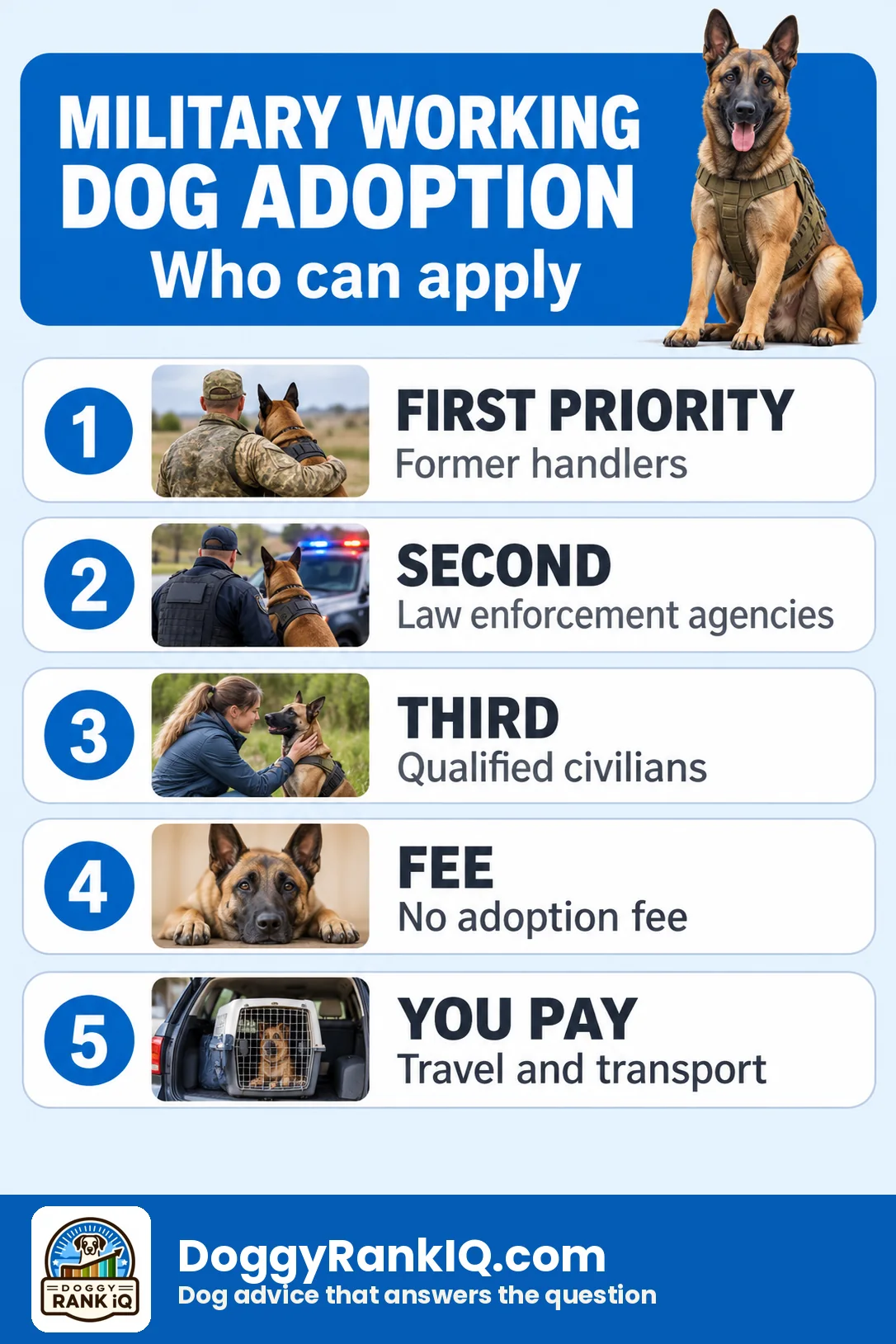
- Former handlers get first priority, then other qualified people, then law enforcement agencies under federal statute (uscode.house.gov).
- The 341st Training Squadron at JBSA-Lackland runs the main program (af.mil, army.mil).
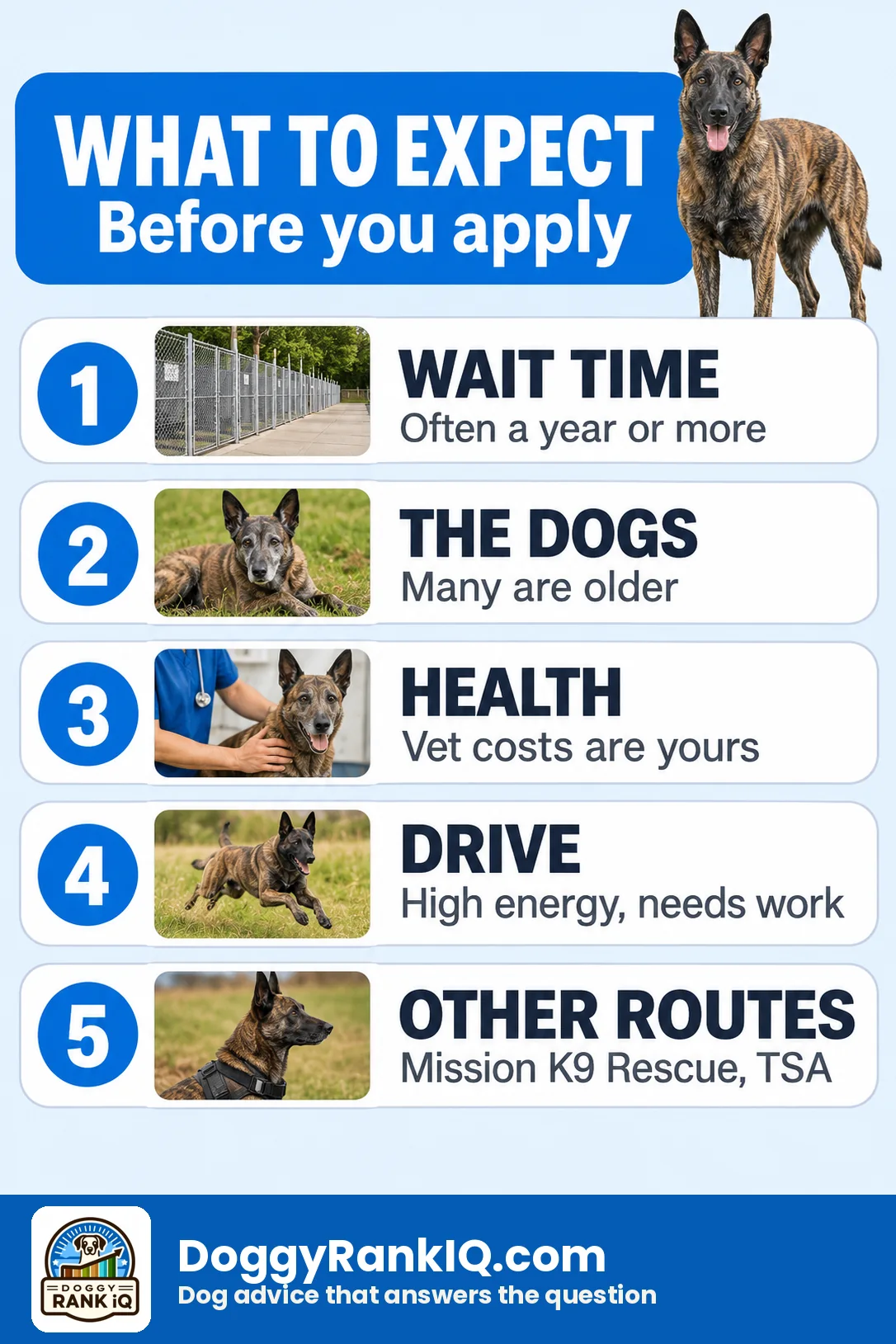
- Civilian wait times are commonly a year or longer, and availability depends on which dogs are deemed suitable for transfer.
- Common breeds include German Shepherd, Belgian Malinois, Dutch Shepherd, and Labrador Retriever.
- A 6-foot fence, a stable home, and veterinary references are typical application requirements.
- Nonprofits such as Mission K9 Rescue fill gaps the base program cannot, especially for contract working dogs.
- Retired dogs may carry high drive, noise sensitivity, or medical costs that new owners need to plan for before applying.

Who are you?
Tap an option to see the answer.
The short answer: how military working dog adoption works
Military working dog adoption runs through a federal process, not a shelter website. A dog’s last-unit commander decides whether the dog is fit for transfer, based on the unit veterinarian’s recommendation, and then the dog is offered in a set legal order (uscode.house.gov).
Here is the order that matters most:
- The dog’s former handler, if one is available and willing.
- Another person or organization capable of providing humane care.
- A law enforcement agency, often for continued working service.
This structure comes from 10 U.S.C. § 2583, the statute covering military working dogs and other military animals, current through Public Law 119-138 as of 2026 (uscode.house.gov). The law also covers contract working dogs that get folded into the 341st Training Squadron’s program, so not every available dog spent its whole career in uniform (uscode.house.gov).
A real example from 2026 shows how the priority order plays out. Military working dog Bingo, after seven years at Altus Air Force Base, was scheduled for adoption by his original handler, Technical Sgt. Deandre Turner, who had since moved to Sheppard Air Force Base (aetc.af.mil). That is the system working exactly as designed: the handler who trained with the dog gets first call, even years and a reassignment later.
Who can actually apply: the checklist
Civilians without a handler connection can apply, but only after former handlers and law enforcement agencies have had their shot, and only if the individual dog is judged suitable for a home instead of continued work (uscode.house.gov).
A typical applicant profile includes:
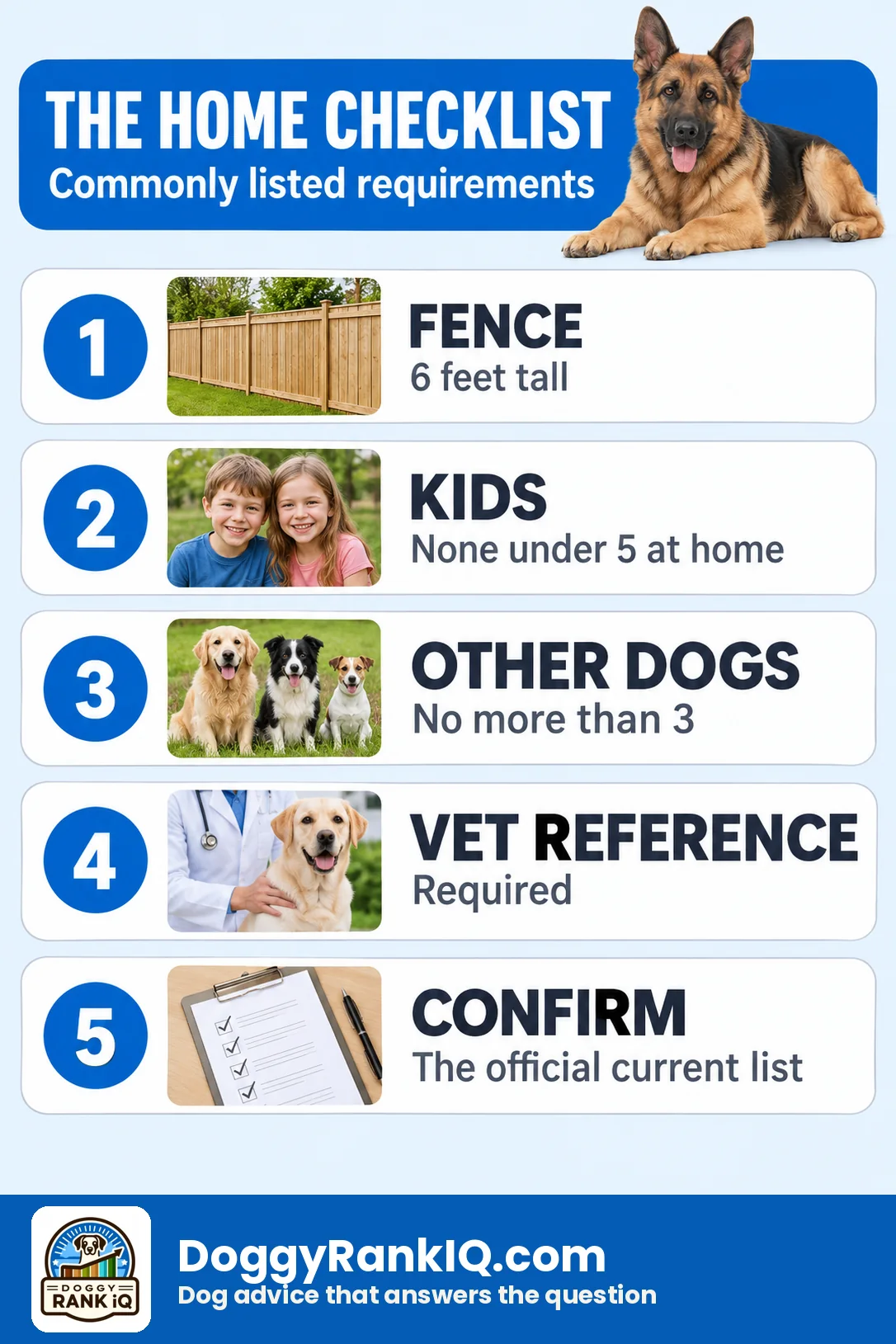
- A securely fenced yard, commonly 6 feet high, confirmed on the official adoption page before applying.
- No children under 5 in the home, a condition tied to bite risk with high-drive working breeds.
- No more than 3 dogs already living in the household.
- A veterinary reference confirming the applicant can provide ongoing medical care.
- A completed application through the 341st Training Squadron.
- Willingness to cover transport costs, which the adopter pays, not the government.
Choose this route if a stable, fenced, low-foot-traffic home with no young kids fits the household. Skip it, at least for now, if the home has a revolving door of visitors, small children, or an already full pack of dogs. The screening process specifically tests a candidate dog’s reactions to adults, children, and other dogs before any match is finalized [Joint Base San Antonio].
One common mistake: assuming “retired” means “calm.” A dog pulled from active duty for medical reasons can still have the drive of a dog half its age. Applicants who skip this reality often return dogs within months.
Facts table: 4 adoption routes
The application, step by step
1Confirm current eligibility rules
Check the official adoption page tied to the 341st Training Squadron before applying, since requirements like fence height and age restrictions can be updated without wide notice (army.mil).
2Submit the application and references
The application typically asks for a veterinary reference and household details. This is also where applicants disclose fence height, number of dogs, and children in the home.
3Wait for a suitability match
A unit veterinarian and the last-unit commander decide whether a specific dog is appropriate for adoption rather than continued service or law enforcement transfer (uscode.house.gov). This step is about the dog’s needs first, not the applicant’s preference.
4Complete veterinary screening at JBSA-Lackland
Retiring dogs generally go through the Veterinary Treatment Facility at JBSA-Lackland for a full exam, including treatment for dental issues, stress-related conditions, or other medical needs before travel (uscode.house.gov).
5Arrange and pay for transport
Transport is the adopter’s responsibility. Mission K9 Rescue founder Kristen Maurer has described transport costs reaching thousands of dollars, especially for dogs retiring overseas or far from the new owner (readelysian.com).
How much does it cost to adopt a retired military dog?
There is no adoption fee for a military working dog adoption through the official DoD program, but the real cost sits in transportation, which is not fixed and not small. Dogs retiring overseas or across the country from their adopter can push transport costs into the thousands of dollars (readelysian.com).
Budget beyond transport too:
- Veterinary exams and ongoing care after the dog arrives home, since any treatment needed after the initial military exam becomes the adopter’s expense.
- Gear suited to a large, strong dog: a proper crate, a bed that holds up to a working breed’s weight, and training tools.
- Possible behavioral support if the dog shows noise sensitivity or high arousal around strangers.
Decision rule: if transport alone would strain the budget, ask about local options first, including dogs retiring at a nearby base or a nonprofit placement, before committing to a dog stationed far away.
Retired military dogs for adoption near me: Texas, California and nationwide
Most military working dog adoption activity centers on Texas because JBSA-Lackland is the training and retirement hub for the entire program (af.mil, army.mil). A search for military working dog adoption near Texas will usually lead back to the 341st Training Squadron itself.
For military working dog adoption near California, options depend on where a dog’s unit was last stationed, since the last-unit commander, not a central shelter, makes the suitability call (uscode.house.gov). There is no dedicated statewide intake center in California comparable to JBSA-Lackland.
For readers searching military working dog adoption near me or retired k9 adoption near me anywhere else in the country, the practical answer is the same everywhere: apply through the national 341st Training Squadron program, and check nonprofit options like Mission K9 Rescue, which place dogs regardless of the adopter’s home state. Military working dog adoption USA applicants should expect a national waitlist, not a local shelter-style browse.
What do they do with retired military dogs?
Retired military dogs are either adopted out under the priority system, transferred to law enforcement for continued work, or in some cases kept at the last unit if no suitable placement exists yet (uscode.house.gov). The decision depends entirely on the individual dog’s health, temperament, and the commander’s judgment.
Age plays a real role here. Field dogs often retire around 8 to 12 years old, while dogs released from training programs for not completing the course are frequently 2 to 4 years old and in many cases physically capable of a full life as a working pet or sport dog (af.mil). That age gap explains why some “retired” dogs act nothing like a senior pet.
Robby’s Law, the 2000 legislation that first made this kind of adoption possible, set the legal foundation that later became 10 U.S.C. § 2583 (govinfo.gov, army.mil). Before that law, military working dogs that could not continue service had far fewer paths to a home.
🎖️ What a retired military dog is like in a house
The paperwork is the easy part. The first month at home is where military working dog adoption succeeds or struggles.
A lot of these dogs have never lived indoors. They know kennels, vehicles, training fields and a handler. Stairs, glass doors, a television, a vacuum cleaner and a slick kitchen floor can all be new. Expect a few days of pacing and checking every room. A crate or a gated corner with a bed gives the dog a place that resembles what they know.
Their relationship with toys is also different. For most working dogs a ball or a rubber Kong was the paycheck for every search and every bite sleeve session, and the drive to get it is intense. A dog who ignores your other pets and your visitors may lock onto a tennis ball like nothing else exists. Use that. Short retrieve games are the fastest way to bond, and putting the toy away between sessions keeps the dog from guarding it.
“You are adopting a retired professional. They will keep looking for the job.”
Health needs planning. Older patrol dogs often arrive with arthritis, worn or broken teeth from bite work, and old injuries. Once the adoption is final the vet bills are yours. Ask for the complete medical record before you sign, and book a visit with your own vet in the first two weeks. Nonprofits that support retired working dogs sometimes help with medications or surgery, and the adoption office can point you to current ones.
🏠 House rules that prevent the common problems
- Introduce other pets slowly, on leash, over days. Some of these dogs have high prey drive and no experience with cats.
- Hold off on the dog park. A dog trained to bite on command does not need crowds of unfamiliar dogs.
- Keep greetings boring. Ask visitors to ignore the dog for the first ten minutes.
- Give the brain a job: scent games, food puzzles and structured walks work better than long hours alone in the yard.
- Find a trainer with working-dog experience before you need one. Old cues can surface at odd moments, and you want someone who recognizes them.
Dogs released early from training are a different picture: young, healthy and energetic, let go for reasons like low drive or nerves around gunfire. They fit active homes that want a sport or hiking partner. They are also the dogs with the longest waiting lists.
⭐ Top 5 Features We Love
- Working-level obedience already in place. Most of these dogs know sit, stay, down, and heel at a level most pet dogs never reach.
- Breed consistency. German Shepherds, Belgian Malinois, Dutch Shepherds, and Labrador Retrievers make up the bulk of the program, so applicants generally know the general size and temperament range going in.
- Documented health history. Dogs pass through a full veterinary exam at JBSA-Lackland before transfer, giving adopters a real medical starting point (uscode.house.gov).
- Loyalty shaped by handler bonds. The priority given to former handlers under the law reflects how strong these attachments really are (uscode.house.gov).
- A structured match process. Testing for reactions to adults, children, and other dogs before placement reduces the odds of a bad fit [Joint Base San Antonio].
⚠️ Things to Look Out For
- High working drive without a job. A dog trained for detection or patrol work can become restless or destructive without enrichment. Readers dealing with related restlessness issues may find our guide on dog zoomies useful for separating normal energy bursts from a deeper need for structure.
- Noise sensitivity and startle response. Years around gunfire, aircraft, or combat environments can leave a dog reactive to loud, sudden sounds.
- Age-related medical costs. Older field dogs may arrive with joint pain, dental issues, or chronic conditions the adopter will manage long term.
- Separation struggles. A dog that worked side by side with a handler for years can develop real distress when left alone; see our breakdown of separation anxiety in dogs for signs and a practical plan.
- Not an apartment-casual pet. These breeds generally need secure, active homes, and the application’s fence and household rules reflect that reality, not bureaucracy for its own sake.
Preparing your home
A home ready for military working dog adoption needs physical security first and mental structure second. The fence requirement exists because these breeds can clear lower barriers that would stop an average pet dog.
Practical steps before the dog arrives:
- Confirm fence height and condition meets the published standard.
- Remove or secure anything the dog could ingest during the adjustment period.
- Set up a single, quiet space as the dog’s own, away from constant foot traffic.
- Research the specific breed’s needs; our guide to German Shepherd care and the broader look at protection dog breeds both cover traits common to military working dogs.
- Plan for muzzle training if the dog’s history includes any guarding or patrol work; our dog muzzle training guide walks through a humane, gradual approach.
Edge case: a rental property with a landlord-approved fence can still work, but the adopter should get written approval before applying, since the application may ask for proof of a secure yard.
Helpful gear for a working breed
A dog built for detection or patrol work needs gear that matches that history, not standard pet-store basics. These three items come up often in owner discussions about settling a military or police-trained dog into home life.
- The Humane Basket Muzzle for Large Dogs allows panting, drinking, and treats while supporting safe introductions in new environments. Price: $21.99, price checked 2026. Check the current price.
- The 48 inch Heavy Duty Dog Crate for Large Dogs gives a strong-chewing, strong-pulling breed a secure space during the adjustment period. Price: $129.99, price checked 2026. Check the current price.
- The EHEYCIGA Orthopedic Extra Large Dog Bed supports joints in older field dogs retiring with wear and tear. Price: $42.99, price checked 2026. Check the current price. Readers comparing joint support options can also see our best orthopedic dog bed roundup.
- For background on how these dogs are trained, The Official U.S. Military Working Dog Training Handbook documents the commands and methods adopters will likely already see at home. Price: $14.72, price checked 2026. Check the current price.
If a retired dog shows joint pain or chronic discomfort, confirm any bedding or supplement choice with a veterinarian before relying on it as a solution.
FAQ
The bottom line
Military working dog adoption is real, legal, and well documented, but it runs on a priority system built around former handlers first, not a first-come browsing experience. Civilians can get in line, provided their home meets the fence, household, and veterinary reference standards, and provided they can cover transport once a dog is matched. Start by checking the current 341st Training Squadron requirements directly, then compare that path against nonprofits like Mission K9 Rescue if the wait or location does not fit. A dog that spent years working for a living deserves a home that planned ahead for exactly that.
Doggy Rank IQ is reader supported. As an Amazon Associate we earn from qualifying purchases, at no extra cost to you.