
Quick Answer
Dog muzzle training works best when a dog voluntarily pushes its own nose into the muzzle for a reward, repeated until the behavior is automatic, before any strap gets fastened. Most comfortable dogs need about a week of short daily sessions, while fearful or previously muzzled dogs often need two to three weeks. A basket muzzle, not a soft fabric muzzle, is the right tool for this kind of conditioning because it lets a dog pant, drink, and take treats throughout the process.
Key Takeaways
- Cornell’s Riney Canine Health Center recommends sessions of roughly 1-2 minutes at the nose-entry stage, stretching to 5-10 minutes once the dog is comfortable, according to its canine basket muzzle training guidance.
- Veterinary Partner’s muzzle conditioning protocol has owners scatter treats several feet from the muzzle before any nose contact happens, not inside it right away.
- VCA Animal Hospitals flags restricted panting as a real physical risk of muzzle wear, especially in heat and after exercise.
- A properly fitted basket muzzle allows normal panting, drinking, and treat delivery; a soft fabric muzzle holds the mouth shut and should only be used briefly under supervision.
- Dog muzzle training is appropriate for nearly every dog as a safety skill, but dogs with a bite history or severe fear need a veterinarian or certified behaviorist guiding the plan, not a solo home schedule.
- A muzzle is management, not treatment, for fear, reactivity, or resource guarding. It reduces bite risk without resolving the underlying behavior.
- Common setbacks come from rushing the strap before nose entry is solid, or holding the muzzle up to the dog’s face instead of letting the dog approach it.
When to call the vet box
Stop solo sessions and call a vet or a certified behavior professional if the dog has bitten someone, freezes or stiffens at the sight of the muzzle, or shows escalating fear signals like whale eye, lip licking, or attempts to flee a closed room. A dog with a bite history, severe fear, or a medical condition affecting breathing needs guided support rather than a home schedule built from a blog post. This article covers reward-based conditioning for dogs starting from a neutral or curious baseline, not crisis intervention.
What is dog muzzle training and why do I need it
Dog muzzle training is the process of teaching a dog to accept a basket muzzle calmly, starting with the dog voluntarily pushing its own nose into the muzzle for a reward, then building toward longer duration and a fastened strap. The point is a dog that sees the muzzle as a signal for good things, not a trap that shows up right before something scary happens at the vet or on a trail.
Most owners meet this backwards. The dog needs a muzzle for a nail trim, a groomer visit, or after a scuffle at the dog park, and the muzzle appears for the first time during the stressful event itself. The dog panics, the straps feel like a trap, and every future muzzle sighting triggers the same fight. Dog muzzle training done ahead of time, during calm, low-stakes moments at home, avoids that pattern entirely.
The guidance from Cornell, Veterinary Partner, and the AKC’s muzzle use guide lines up on one idea: let the dog choose to put its nose in before anything is fastened. That single sequencing choice, nose first and strap later, is what separates a dog who walks calmly into a vet exam from one who needs two technicians and a towel.
You need muzzle training if your dog will ever need a muzzle, which covers more situations than most owners expect: emergency vet visits after an injury, grooming procedures on a dog that resents handling, air travel, certain dog parks and training facilities that require muzzles for unfamiliar dogs, and legal requirements in some places for specific breeds. Starting the groundwork now, while nothing is urgent, means the muzzle is already a familiar object instead of a new threat when it actually matters.
How long does it take to muzzle train a dog
Most dogs with a neutral or curious starting point can reach basic comfort with a basket muzzle in about 7 days of short daily sessions, while wary or previously traumatized dogs often need 10 to 14 days or longer. The real timeline depends on the dog’s starting fear level, session consistency, and how quickly the owner resists the urge to fasten the strap too soon.
A few variables shift that window in either direction:
- Dogs that already tolerate handling around the face (ear cleaning, teeth brushing) tend to move faster through nose-entry stages.
- Dogs with a prior bad muzzle experience, such as being forcibly muzzled at a clinic, often need to unlearn that association first, which adds days or weeks.
- Breed head shape matters for comfort, not speed of learning, but an ill-fitting muzzle will slow any dog’s progress because discomfort gets paired with the object.
- Session frequency matters more than session length. Five short sessions spread across a week beat one long session, since dogs learn better with repetition than duration.
Decision rule: if the dog is not consistently pushing its own nose in for a treat after 5 to 7 sessions, something in the setup is off (treat value too low, muzzle held toward the face instead of placed down, or sessions too long) rather than the dog being incapable.
Difference between basket muzzle and soft muzzle for training
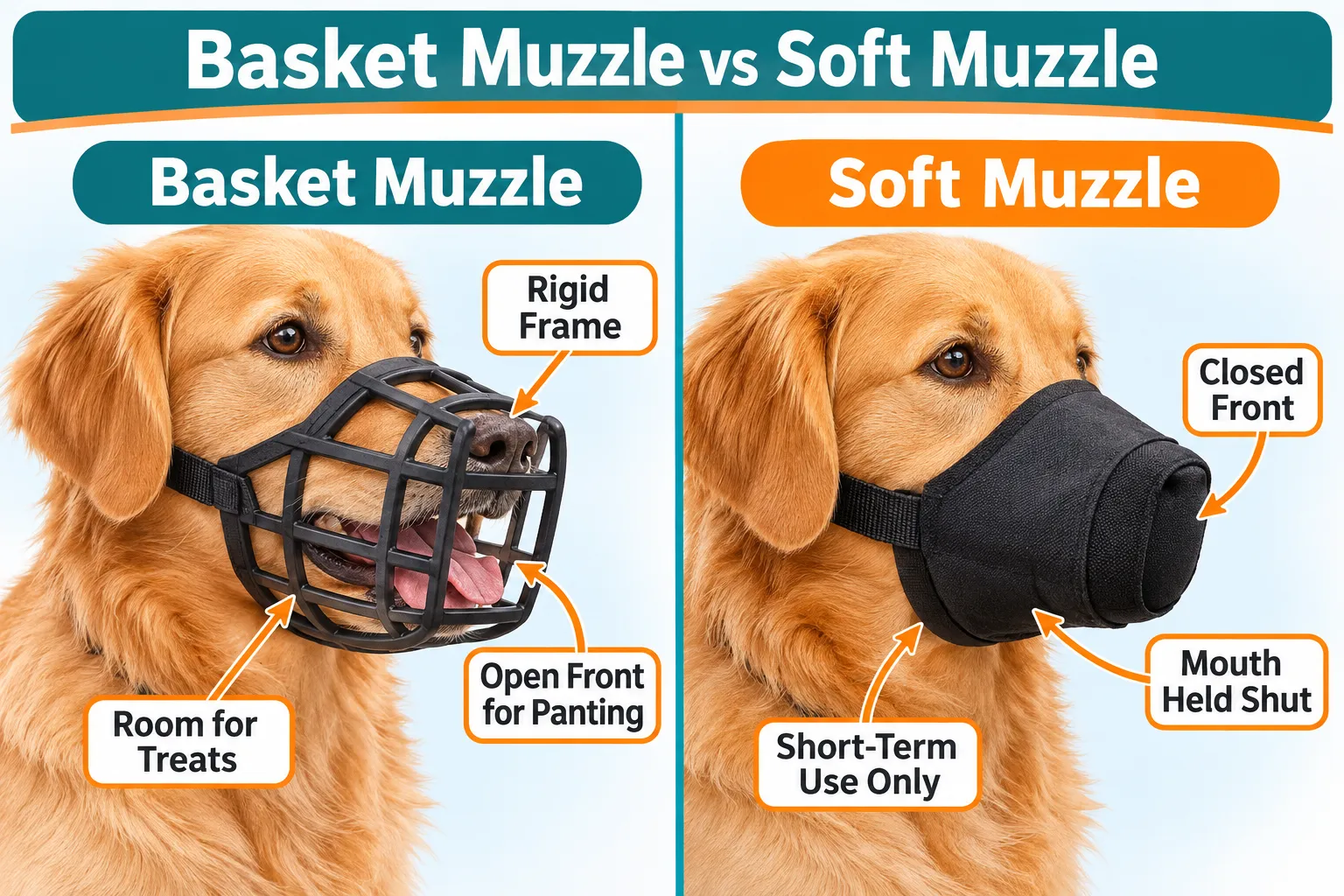
A basket muzzle is the right tool for dog muzzle training because its open front lets a dog pant, drink water, and accept treats while the rigid frame still blocks a bite. A soft muzzle, which wraps fabric around the jaw and holds the mouth shut, is meant for brief restraint, not conditioning, and should never be used for extended wear.
Key differences that matter for a buying decision:
- Basket muzzles (plastic, rubber, or metal) have an open or slatted front that leaves room for the tongue, so a dog can pant normally even on a warm walk.
- Soft muzzles clamp the jaw shut, which prevents panting and drinking entirely. Using one for more than a few minutes, especially in heat, risks overheating.
- Basket muzzles are reusable for daily training, vet visits, grooming, and travel. Soft muzzles are typically a one-time, short-duration tool for situations like a quick nail trim.
- Whole Dog Journal’s testing of training muzzles consistently favors basket designs for desensitization work because dogs tolerate them better over repeated sessions.
Choose a basket muzzle if the goal is ongoing dog muzzle training, vet visits, or any situation lasting more than a couple of minutes. Choose a soft muzzle only for a brief, supervised procedure where a vet or groomer specifically requests it, and never leave a dog unattended while wearing one.
Step by step how to muzzle train a dog at home
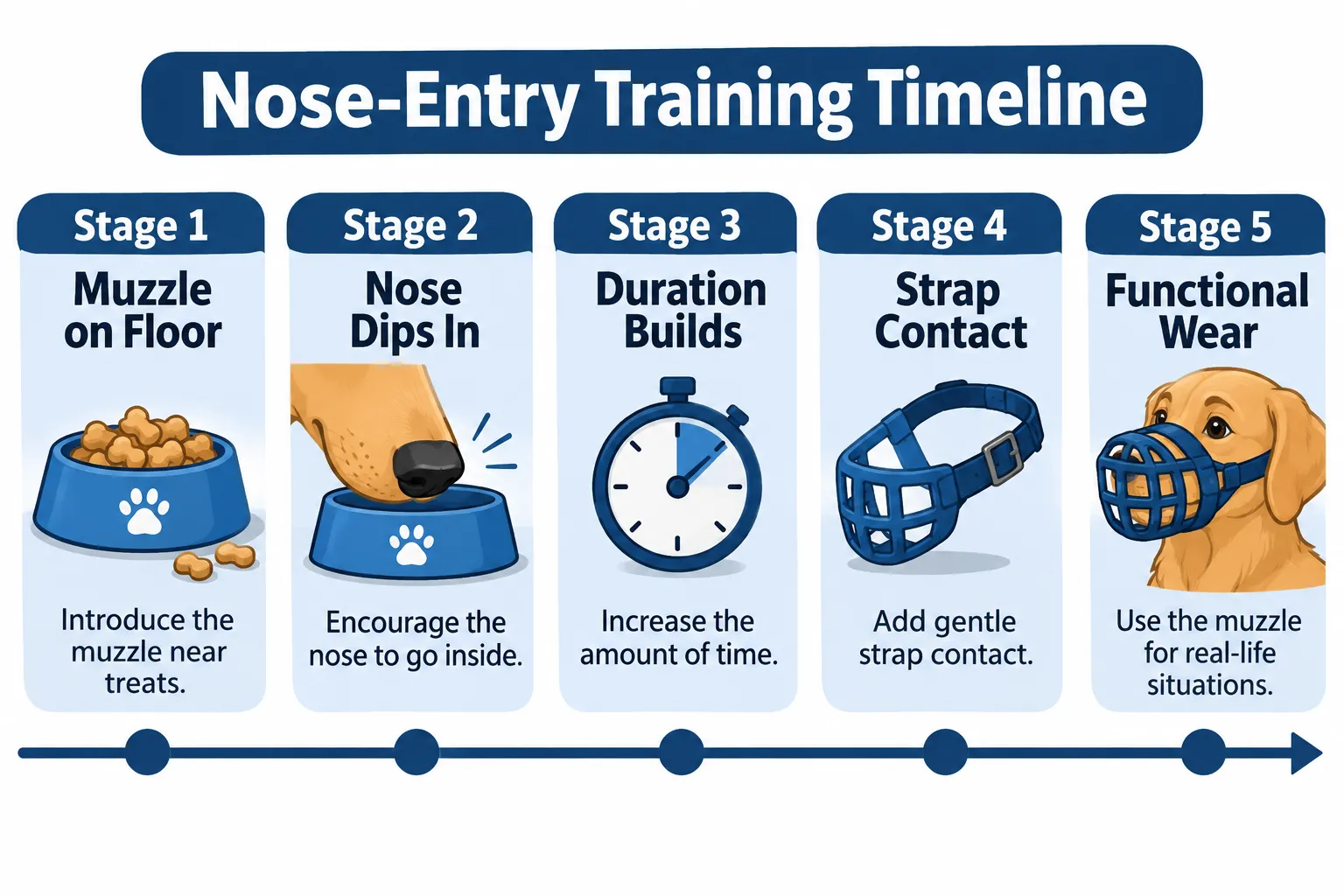
The home process moves through small stages so the dog is never asked for more than a slight increase in difficulty from the step before. Veterinary Partner’s protocol starts with treats scattered near the muzzle, not inside it, letting the dog approach and retreat freely before any nose contact happens.
- Set the muzzle on the floor or in a stationary open hand held low. Scatter a few treats near it, not inside. Let the dog investigate on its own terms.
- Once the dog is relaxed around the muzzle, start rewarding any voluntary glance, sniff, or nose dip toward the opening.
- Reward the dog the instant its nose touches the inside of the muzzle, then remove the muzzle so the dog is free to walk away. Repeat until the dog offers this without hesitation.
- Build duration. Ask for the nose to stay in 2 to 3 seconds before the treat, then gradually extend toward 10 seconds.
- Drape the strap near the dog’s face without buckling it. Reward calm acceptance.
- Let the strap touch both sides of the head briefly, then remove it. Reward again.
- Fasten the buckle for 1 to 2 seconds, deliver a treat through the front opening, then unbuckle immediately.
- Extend fastened time gradually during a normal activity, like a short walk around the yard, rewarding throughout.
Common mistake: holding the muzzle up to the dog’s face instead of placing it on the ground or in a stationary hand low enough for the dog to approach. Letting the dog move toward the muzzle, not the other way around, is what keeps the exercise voluntary in practice and not just in name.
Quick example: a two-year-old Labrador who already loves food can often go from Step 1 to Step 4 in two or three days of five-minute sessions. A rescue dog with an unknown history might need a full week just to reach Step 3 without flinching.
Doggy Rank IQ Tool
Dog Muzzle Training Day by Day Planner

Pick your dog's comfort level and how much time you have. You get a day by day schedule.
My dog refuses to wear a muzzle, what should I do
If a dog refuses the muzzle entirely, back up several stages rather than pushing forward. Refusal usually means a prior step was skipped or the treat value is too low, not that the dog is incapable of learning.
Troubleshooting checklist:
- Lower the criteria. If the dog won’t approach a muzzle on the floor, start by rewarding just being in the same room as the muzzle, no interaction required.
- Raise the treat value. Switch to something soft, smelly, and high value like small pieces of chicken, cheese, or hot dog instead of dry kibble.
- Shorten sessions. A 90-second session that ends on a success beats a 10-minute session that ends in frustration for both dog and owner.
- Check for pain. A dog that suddenly refuses a muzzle it previously tolerated may have a dental issue, ear infection, or other pain source worth a vet check.
- If refusal comes with growling, snapping, or freezing, stop and bring in a certified behavior professional rather than continuing to push through at home.
Edge case: some dogs tolerate the muzzle itself fine but panic specifically at the sound of the buckle clicking. In that case, practice clicking the buckle away from the dog’s head first, pairing the sound alone with treats, before reintroducing it near the face.
Is muzzle training cruel or harmful
A correctly fitted basket muzzle, introduced through reward-based conditioning, is not cruel. It allows normal panting, drinking, and treat-taking, and most dogs that go through gradual dog muzzle training show relaxed body language while wearing one. What causes genuine distress is a poorly fitted muzzle, or one forced onto a dog with no prior conditioning during an already stressful event.
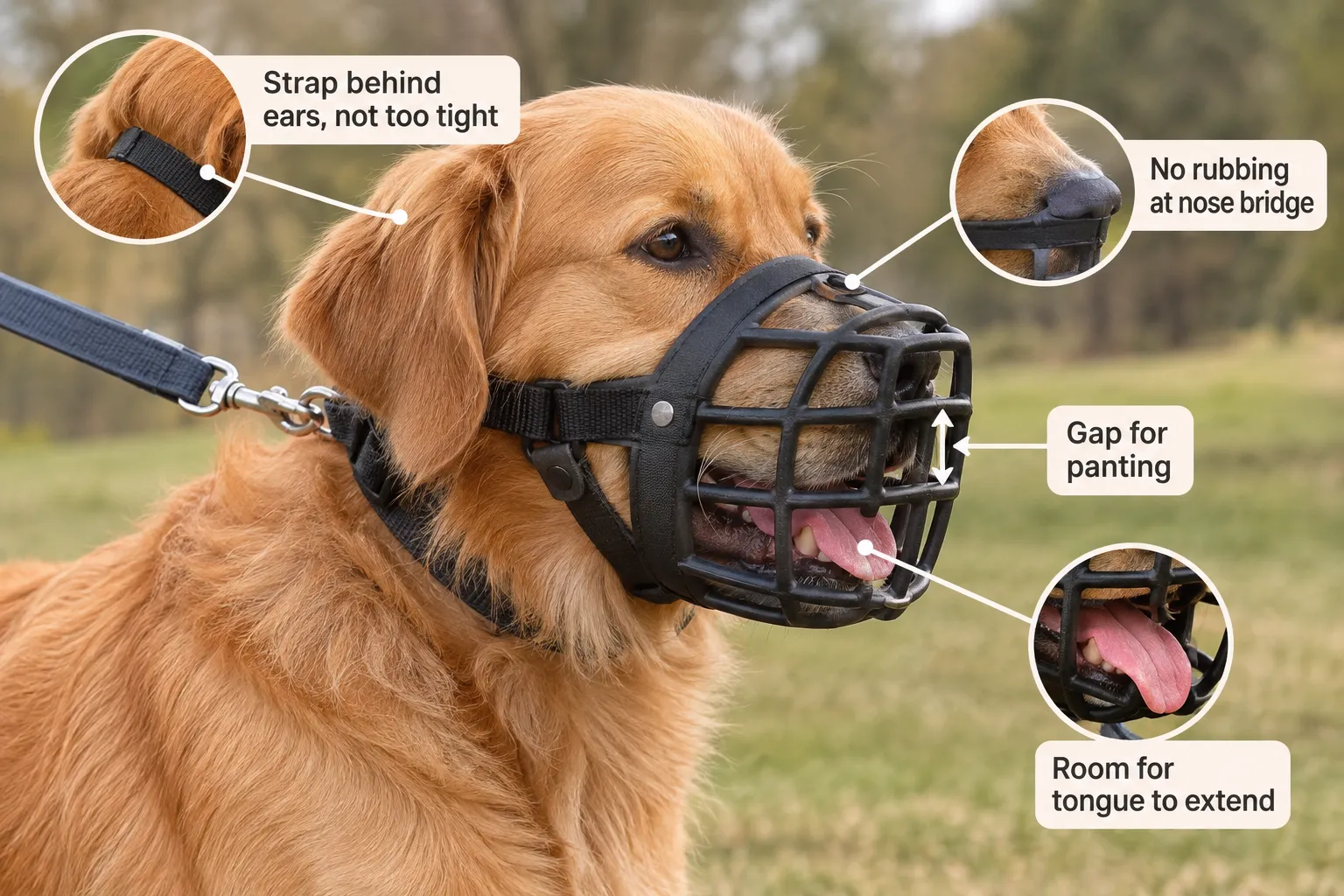
- An ill-fitting muzzle that presses the nose bridge, blocks the mouth from opening, or rubs behind the ears can cause pain and should be replaced or refitted.
- VCA Animal Hospitals notes that restricted panting is the main physical risk, which is a fit and heat issue, not an inherent flaw of muzzles as a tool.
- A muzzle used as a substitute for behavior work, with no conditioning and no plan to address the underlying fear or aggression, is a missed opportunity rather than cruelty, but it does nothing to resolve the root cause.
- Skip hard exercise or extended time in a fastened muzzle during hot weather, since restricted airflow combined with heat raises overheating risk.
Best dog muzzles for desensitization training
The best muzzles for dog muzzle training are basket-style designs with enough depth at the front for the tongue to extend fully and enough ventilation for airflow in warm weather. Shoppers browsing Amazon or Chewy should prioritize fit over brand reputation, since a muzzle built for the wrong head shape will undercut even a perfect training plan.
What to look for:
- Open basket design with slats or mesh, not a solid closed front, so the dog can pant and drink.
- Adjustable straps at both the back of the head and under the chin for a secure but not tight fit.
- Enough length and width to match the dog’s actual muzzle measurements rather than general breed sizing charts, since muzzle shape varies widely even within a breed.
- Material that can be reshaped with hot water for a custom fit, which several current basket muzzle models on the market offer.
- Flat-faced breeds like bulldogs and pugs need a shorter, wider basket shape; long-nosed breeds like greyhounds and collies need a narrower, longer basket.
Decision rule: if the dog’s nose length and width fall between two sizes on a manufacturer’s chart, size up rather than down. A slightly loose muzzle with a snug strap is safer and more comfortable than one that pinches the nose or blocks mouth opening.
Can you muzzle train an adult dog or is it too late
Adult and senior dogs can absolutely learn dog muzzle training, and age is rarely the limiting factor. What slows adult dogs down more often is an existing negative association with being restrained or handled around the face, not reduced learning ability.
- Older dogs with arthritis or joint pain may need shorter standing sessions, or training done with the dog lying down, to stay comfortable throughout.
- Adult rescue dogs with unknown histories benefit from extra time at the early, no-pressure stages, since past handling experiences are often unknown.
- Senior dogs with cognitive decline may need more repetition and shorter memory windows between sessions, but most still condition successfully with patience.
- There is no cutoff age for starting. A 10-year-old dog that has never worn a muzzle can still learn the same nose-entry sequence as a puppy, just possibly at a slower pace.
Common mistakes people make when muzzle training
The single most common mistake is fastening the strap before nose entry is completely voluntary and relaxed. Dogs that get strapped in too early often freeze or paw at their face, which sets the whole process back further than if the strap had never been introduced yet.
- Holding the muzzle up to the dog’s face instead of letting the dog approach it on the ground or from a stationary hand.
- Using low-value treats like plain kibble when the situation calls for something the dog finds genuinely exciting.
- Running sessions too long. Cornell’s guidance of 1-2 minutes at the nose-entry stage exists because short, successful reps beat long, draining ones.
- Skipping the unfastened strap stage and going straight from nose entry to a buckled muzzle.
- Only practicing in one quiet room, then expecting the dog to tolerate the muzzle at a noisy vet clinic without any generalization practice.
- Treating a single successful session as mastery and stopping training altogether, rather than maintaining occasional practice so the skill holds up over time.
Muzzle training for aggressive or reactive dogs
Dogs with a history of aggression or reactivity can and often should learn to wear a muzzle, but the training plan needs a veterinarian or certified behavior professional involved rather than a purely at-home approach. A muzzle protects people and other dogs during the window while the actual behavior issue is being addressed through a separate training or management plan.
- Muzzle training reduces bite risk during vet visits, walks near triggers, or situations where a reactive dog might be approached unexpectedly.
- It does not replace work on the underlying reactivity, fear, or aggression. Pair muzzle conditioning with guidance from the behavior and reactive-dog training resources rather than relying on nose-entry games alone.
- For dogs with a documented bite history, sessions should start under professional supervision, since misreading stress signals in an aggressive dog carries real risk.
- A muzzle on a reactive dog during a walk is a safety net, not a muzzle-and-forget solution. The dog still needs distance management and desensitization around its specific triggers.
How much does professional dog muzzle training cost
Professional help for dog muzzle training typically falls into two cost categories: a single consultation with a certified trainer or veterinary behaviorist, or ongoing sessions as part of a broader behavior modification plan. Exact pricing varies significantly by region and provider, so owners should contact local certified trainers or their veterinarian for a current quote rather than relying on a national average.
- A single in-person session focused specifically on muzzle conditioning is usually less expensive than a full behavior consultation, since it targets one discrete skill.
- Dogs with underlying aggression or severe fear often need a broader behavior plan, which costs more and takes longer than muzzle training alone.
- Many veterinary clinics and shelters, including resources from organizations like PAWS Chicago, offer free written guides that let owners handle basic nose-entry conditioning without professional fees.
- Budget-conscious owners can start with the free home protocol described in this article and only bring in a professional if the dog shows signs of fear, aggression, or a stalled plan after a week or two of consistent practice.
Alternatives to muzzles for dog behavioral issues
A muzzle manages bite risk, but it does not replace behavior-specific tools and training for issues like fear, reactivity, or resource guarding. Depending on the situation, other tools can reduce risk alongside or instead of a muzzle.
- Head halters can give more directional control on walks for dogs that pull or lunge, though they do not prevent a bite the way a basket muzzle does.
- Physical barriers and management, such as baby gates or separate feeding areas, reduce risk in specific triggering situations like resource guarding around food.
- Avoidance and distance management, simply keeping a reactive dog away from known triggers, reduces incidents without any equipment at all.
- Structured training programs addressing the root behavior, ideally guided by a certified trainer, work alongside a muzzle rather than replacing the need for one in higher-risk situations.
None of these alternatives fully substitute for a muzzle in situations where an actual bite risk exists, such as unpredictable reactions at a vet clinic. They work best as complements to dog muzzle training, not replacements for it.
How long can a dog safely stay in a muzzle
A basket muzzle, properly fitted, can typically be worn for short functional periods like a vet exam, a grooming session, or part of a walk, but it should not become a long-duration or all-day item. The leading physical risk, as VCA Animal Hospitals notes, is restricted panting, which becomes more dangerous the longer the muzzle stays on, especially in heat or after exercise.
- Avoid fastening a muzzle during strenuous exercise in warm weather, since restricted airflow combined with exertion raises overheating risk significantly.
- Remove the muzzle periodically during longer events, such as extended vet procedures, to let the dog pant freely and drink water.
- A soft fabric muzzle should be worn for minutes, not hours, and never left on an unattended dog.
- If a dog needs to wear a muzzle for an extended period regularly (for example, during supervised group play at a facility), check in frequently for signs of overheating: excessive drooling, lethargy, or labored breathing.
Muzzle training for dogs with resource guarding
A muzzle can serve as a temporary safety measure around a resource-guarding dog, but it addresses the symptom, not the guarding behavior itself, which needs its own desensitization plan. Owners dealing with guarding around food, toys, or found items should treat the muzzle as one piece of a larger management strategy.
- Use the muzzle during specific higher-risk moments, such as taking away a stolen item, while working separately on trade-up and desensitization exercises for the guarding itself.
- Resource guarding often responds well to counter-conditioning that teaches the dog a hand approaching its bowl predicts something good, which is a different skill set from muzzle conditioning.
- A muzzle does not resolve guarding around family members or other pets long-term. Combine it with professional guidance if guarding escalates to growling, snapping, or biting.
- Dogs that guard resources sometimes guard the muzzle itself at first if it is perceived as an unwanted object being forced on. The same slow, voluntary nose-entry approach described earlier in this guide still applies.
Voluntary muzzle practice ladder
The voluntary muzzle practice ladder moves a dog through eight small stages, each one only slightly harder than the last, so the dog never meets a jump big enough to cause fear.
- Stage 1-2: muzzle present in the room, no pressure to interact.
- Stage 3-4: nose dips in briefly, dog exits freely, reward every entry.
- Stage 5-6: strap introduced without buckling.
- Stage 7-8: brief fastened duration during a normal activity like a short walk.
Comparison table: 3+ named rows
This comparison table breaks down dog muzzle training by stage, what physically happens, and the signal that means it’s time to move forward.
| Stage | What happens | Signal to advance |
|---|---|---|
| Nose entry | Dog dips nose in for treat, exits freely | 5+ voluntary entries in a row |
| Duration | Nose stays in 2-10 seconds | Relaxed body, soft eyes |
| Strap contact | Strap touches head, not buckled | No pawing or head shaking |
| Short fasten | Buckled 1-5 seconds | Dog accepts treats through muzzle |
| Functional wear | Fastened during walk or vet visit | Normal panting, drinking, movement |
Sourced stat cards: 3 to 6 cited numbers
1-2 minCornell’s suggested session length during early nose-entry work 5-10 min
Cornell’s general short-session guidance once comfort builds 7-14 days
Typical range for dogs to reach basic muzzle comfort, depending on starting fear level 2-3 sec
Recommended starting duration for nose-in holds before extending further
H2 (question form): When should you add strap closure or get help with fit?
Add the strap only after the dog pushes its nose into the muzzle on its own, repeatedly and without hesitation, usually after several sessions of nose-entry practice. Get professional fitting help if the dog paws at its face once the strap goes on, if the muzzle rubs red marks behind the ears, or if the dog cannot fully open its mouth to pant.
- Fastening too early is the single most common setback in dog muzzle training. If the dog freezes when the buckle clicks, go back to unfastened practice for several more sessions.
- A muzzle that lets a dog pant and drink should have enough depth at the end for the tongue to extend fully.
- Check the dimensions against the dog’s muzzle length and width before buying. A model built for a flat-faced breed will not fit a long-nosed sighthound the same way.
- Decision rule: if the dog tolerates 10 seconds fastened with loose body language, add 5 seconds per session. If body language tightens, drop back a stage.
Things to watch out for
Watch for lip licking, yawning out of context, a tucked tail, or a dog that goes still instead of relaxed. Still is not calm. A dog that freezes rather than moves away may be shutting down, not accepting the muzzle.
- Heat and exertion: restricted airflow is a leading physical risk of muzzle wear, so skip hard exercise in a fastened muzzle during warm weather.
- Rushing straps before nose entry is solid is the most common reason this muzzle training stalls or reverses.
- Treats that are too small or too dry slow things down. Use something soft and high value, pushed through the front of the basket.
- A muzzle is management, not treatment, for fear or aggression. It reduces bite risk; it does not resolve the underlying behavior.
Editor’s take
This muzzle training earns its reputation as tedious because the useful version really is slow: five minutes a day, good treats, patience, no shortcuts. The shortcut version, strapping it on during a crisis, feels faster the first time and is slower every time after that. The nose-entry-first approach from Cornell and Veterinary Partner is not clever marketing. It applies the same cooperative-care logic used for nail trims and ear cleaning to a piece of equipment most owners only think about once they already need it. Start before the emergency, and the muzzle becomes a cue for snacks instead of a cue for a fight. Owners looking to build foundational skills before tackling muzzle work can also check the puppy command basics and the beginner’s guide to dog grooming, since both rely on the same gradual, reward-based mechanics.
FAQ
Q: How do you muzzle train a dog step by step? Start with the muzzle on the floor and treats scattered nearby, let the dog dip its nose in voluntarily for a reward, build duration, then introduce the strap unfastened before ever buckling it, and only fasten the buckle once the dog does the earlier steps without hesitation.
Q: Should every dog be muzzle trained? Most dogs benefit from basic muzzle comfort as a safety skill for vet visits, grooming, or emergencies, though dogs with severe bite history or fear need professional guidance alongside the home routine rather than a purely independent approach.
Q: How long does it take a dog to get used to a muzzle? Comfortable dogs may progress in about a week of short daily sessions, while fearful or previously muzzled dogs often need two weeks or more, depending on consistency and treat quality.
Q: What type of muzzle lets a dog pant and drink? A properly fitted basket muzzle with enough depth at the front allows panting, drinking, and treat-taking while still preventing a bite, unlike a soft fabric muzzle that holds the jaw closed.
Q: How do you muzzle train a dog that bites? Work with a veterinarian or certified behavior professional first. A dog with a bite history needs a supervised plan, not a solo home schedule, since misreading stress signals in an aggressive dog carries real risk.
Q: What can you use instead of a muzzle? Head halters, management tools like barriers, or avoiding trigger situations can reduce risk in specific settings, but none fully replace a muzzle for situations where an actual bite risk exists.
Q: How do you size a basket muzzle? Measure the length from the base of the nose to the tip, and the width at the widest part of the muzzle, leaving room for the mouth to open and pant freely, and size up if the dog falls between two chart sizes.
Q: Is it cruel to muzzle a dog? A correctly fitted basket muzzle used with reward-based conditioning is not cruel; it allows normal panting and drinking, while an ill-fitting muzzle or one forced on without conditioning can cause real distress.
Q: Can an adult or senior dog still learn to wear a muzzle? Yes. Age rarely limits learning ability for this muzzle training; past negative experiences with handling are usually the bigger factor, and older dogs may just need shorter, more frequent sessions.
Q: How much does it cost to have a professional handle muzzle training? Costs vary by region and provider, with a single consultation focused on muzzle conditioning generally cheaper than a full behavior modification plan. Contact local certified trainers or a veterinarian for current pricing.
Next step
Set a 5-minute timer, scatter a few treats near an empty muzzle on the floor, and let the dog approach on its own terms. For dogs who need a broader foundation first, the essential puppy commands guide and the dog behavior category use the same reward-based mechanics that make this muzzle training work.