
This post contains affiliate links. If you buy through one we may earn a commission at no extra cost to you. As an Amazon Associate I earn from qualifying purchases.
Quick answer: A dog advent calendar usually holds 24 or 25 daily treats, though some boxes mix in toys and only deliver 16 or fewer actual treats. Prices run from about $8 for a basic biscuit box to $65 or more for boutique bakery versions. What matters more than the countdown gimmick is whether the calories per treat fit your dog’s daily budget without you having to trim meals all month.
Key Takeaways
- PureBites’ 2026 Chewy launch packs 25 servings of six to nine ultra-low-calorie treats, each around one to two calories, for $15.99 according to The Oregonian/OregonLive
- Aldi’s Pure Being calendar returns for 2026 at $7.99 with 25 bone-shaped treats, though the full ingredient panel isn’t published online
- BARK’s mixed calendar delivers only 16 edible treats across 24 days, the rest are eight plush toys
- Butters Barkery’s 24-day boutique calendar ships starting November 16, 2026 at $65.99, with cavities sized at roughly 2.5 x 2.5 x 1 inch
- Pets at Home’s UK Giant Luxury calendar sells for £35 and claims over £60 in contents across treats, chews, and vouchers
- The FDA’s pet food handling guidance recommends checking storage instructions and expiration dates before feeding any commercial treat
- Country Kitchen’s Holiday Dual Bites calendar, around $8.89 on Chewy, is a 6.7-ounce chicken-only treat box with no clearly listed door count
- A dog advent calendar works best as a portion-controlled daily ritual, not as a nutrition upgrade
Dog advent calendar: what it actually is and who it’s for
A the calendar is a boxed countdown product, typically 24 or 25 numbered doors or bags, that releases one small treat portion per day in December. Some are pure biscuit assortments. Some mix treats with plush toys. A few, like Petco’s newer Lambchop release, skip food completely and hand out 12 mini plush toys instead.

The format solves a specific problem for owners juggling holiday guests, travel, and a dog who still expects a routine. You open one door, hand over one treat, and the ritual takes ten seconds. That’s the whole value proposition. The treats themselves are rarely special. What you’re buying is portion control dressed up as a tradition.
Here’s where the complaints online start making sense. Owners report treats arriving stale, repetitive flavors door after door, or biscuits too large for a 12-pound terrier. None of that is a defect exactly. It’s a mismatch between the calendar’s one-size design and a dog that weighs anywhere from 8 to 150 pounds. The box doesn’t know your dog’s weight. You have to do that math yourself, which is why a treat budget matters more than the festive packaging.
Before buying, decide which problem you’re actually solving: a daily ritual for a dog who likes routine, a stocking-stuffer substitute for visiting family, or genuine enrichment during a busier-than-usual month. The answer changes which calendar fits, and it also determines whether a the calendar is worth buying at all for your household (more on that below).
Treat Budget Calculator
Enter your dog’s weight, daily calorie need, and the calendar’s calories per treat to see a safe daily count under the 10 percent treat rule.
function calcCg(){ var cals=parseFloat(document.getElementById(‘cg-cals’).value)||0; var tc=parseFloat(document.getElementById(‘cg-treatcal’).value)||1; var budget=cals*0.10; var treats=Math.floor(budget/tc); var trim=Math.round(budget); return “Safe daily treats: “+treats+” | Calories to trim from meals that day: about “+trim+” kcal”; }Doggy Rank IQ Tool
Dog Advent Calendar Treat Budget Calculator

Enter your dog's weight and what the box says. We show how many calendar treats fit under the 10 percent treat rule and how much to trim from meals.
What’s in a dog advent calendar?
Most boxes contain small baked biscuits, freeze-dried single-ingredient pieces, soft jerky strips, or a mix of treats and plush toys behind 24 or 25 numbered doors. The exact contents vary a lot by brand, so the label on the box, not the picture on the front, tells you what you’re actually feeding.
Typical contents fall into a few categories:
- Baked biscuits: wheat- or oat-based, often shaped like bones or gingerbread men, usually the cheapest format
- Freeze-dried single-protein treats: chicken, duck, or tuna with no filler, common in premium low-calorie lines like PureBites
- Jerky strips: soft, higher-moisture treats, often multi-protein blends like Disney’s Table Scraps line
- Mixed treat-and-toy boxes: BARK and Barkbox-style calendars that swap some daily doors for small plush items instead of food
A box that says “25 treats” on the front should list 25 edible items inside. If it doesn’t, that’s usually buried in the fine print rather than the headline copy, which is why reading the back panel before purchase saves a surprise on day 10.
What should you check on the package before opening day one?
Flip the box over before December 1, not after. Four things on the label decide whether the calendar earns a spot on the counter or goes back to Chewy.
Check the expiration date first. Seasonal products sit on shelves for months before the holiday rush, and a the calendar bought in October may expire before day 24. The FDA’s guidance on pet food and treat handling recommends checking dates and storage instructions on any commercial treat, which applies directly here.
Second, count the actual treats against the door count. BARK’s calendar lists 24 daily surprises but only 16 are edible treats, the rest are toys. If you assumed 24 treats and planned meals around that, you’re off by a third.
Third, read the ingredient order, not just the marketing line. “Real chicken” on the front doesn’t tell you whether wheat flour or soy lecithin sits higher on the list. BARK’s frosted treats, for instance, include whole wheat flour, peanuts, dried whey, and soy lecithin alongside FD&C coloring, which rules the product out for dogs with grain or dairy sensitivity.
Fourth, check treat size against your dog’s mouth. A biscuit sized for a Labrador is a choking risk cut into a chihuahua’s day, and nobody prints “appropriate for 8 pounds and up” in large type.
Common mistake: buying the calendar in late November based only on the cover photo, then discovering on day 3 that the ingredient panel lists an allergen your dog can’t tolerate. Read the panel at the shelf or in the product listing photos before adding to cart.
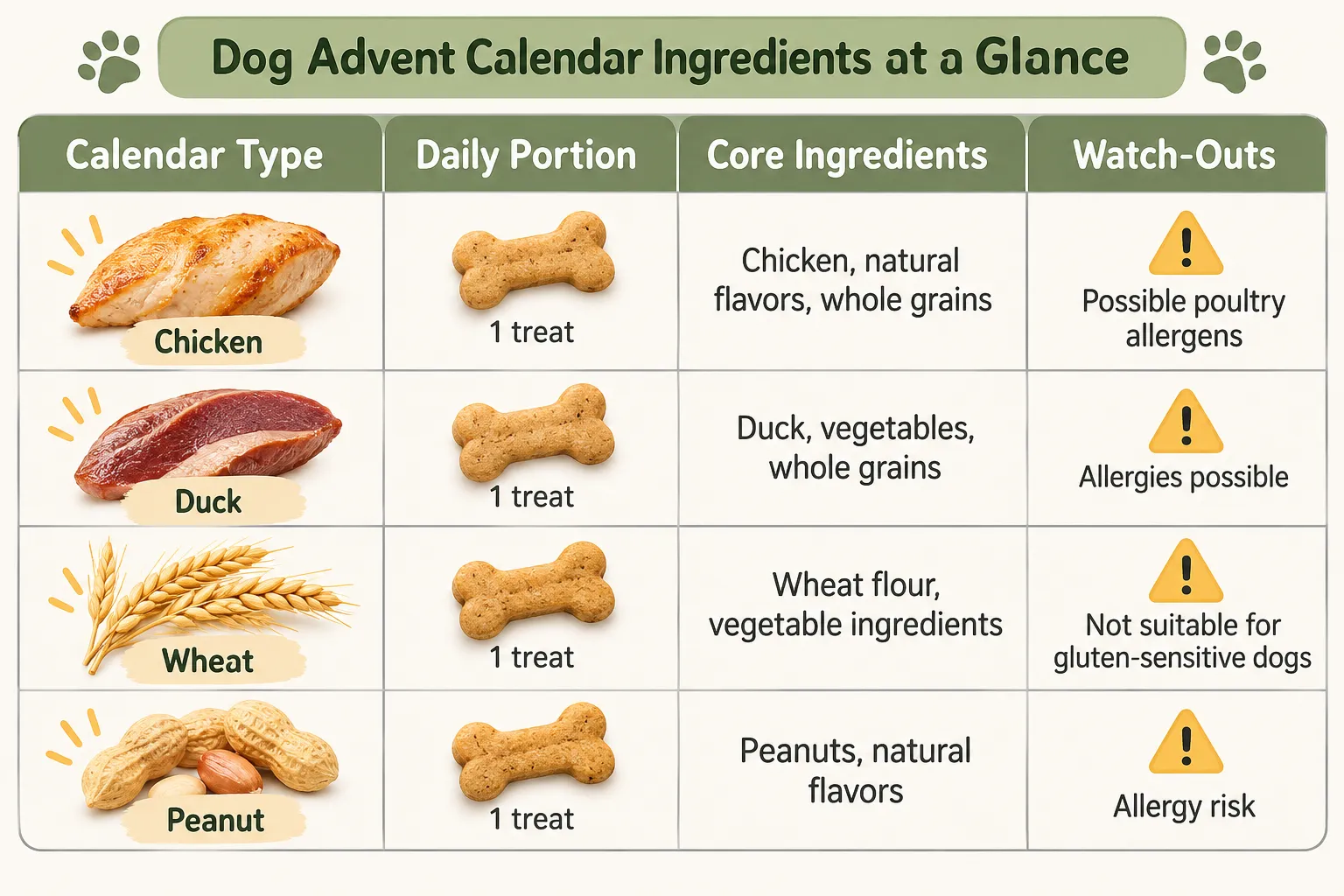
Advent calendar ingredients and daily portion table
Here’s what actually ends up in these boxes, based on published ingredient lists and serving counts for several 2026 the calendar options.
| Calendar | Daily portion | Core ingredients | Watch-outs |
|---|---|---|---|
| PureBites (2026) | 6 to 9 treats, 1 to 2 cal each | 100% chicken, duck, or tuna | Single-protein, verify fish sensitivity |
| BARK mixed calendar | 1 toy or 1 treat (16 of 24 days) | Whole wheat, spelt, applesauce, honey, peanuts, coconut | Wheat, peanut, soy, dairy in frosted varieties |
| Country Kitchen Dual Bites | Portion of 6.7 oz bag, count unclear | Real chicken | Chicken is a common allergen, confirm panel before buying |
| Disney Table Scraps | Portion of 7 oz jerky bag | Chicken, turkey, beef, duck | Multi-protein, hard to use in elimination diets |
Allergy-prone dogs do better with single-protein calendars like PureBites than mixed-ingredient ones like BARK. Dogs with no known sensitivities have more room to pick based on taste and format. Either way, compare the options against your dog’s actual food allergy history before checking out, not after the box arrives. For a wider look at how ingredient order affects a dog’s diet in general, the beginner’s guide to choosing the best food for your dog breaks down how to read a label beyond just the front claim.
Dog advent calendar ingredients to avoid
The ingredients worth avoiding in a the calendar are the same ones vets flag in any treat: artificial dyes, high sugar content (honey or molasses listed in the first few ingredients), and known allergens like soy, wheat, or dairy if your dog has a documented sensitivity. Chocolate, grapes, raisins, and xylitol should never appear in a dog product, and any calendar listing them anywhere in the panel should be returned immediately.
Specific red flags to scan for:
- FD&C color dyes: found in some frosted or decorated biscuits, purely cosmetic and offer no nutritional value
- Soy lecithin and dried whey: common in mixed-ingredient boxes like BARK’s frosted line, a problem for dairy- or soy-sensitive dogs
- Unclear “meat meal” or “animal digest” terms: vague sourcing language that doesn’t specify protein origin
- High fat content in rich jerky blends: multi-protein jerky bags like Disney’s Table Scraps can carry more fat per piece than a freeze-dried biscuit, which matters for dogs with pancreatitis history
The Spruce Pets’ guide to common pet poisonings is a useful reference for any owner unsure whether an ingredient on a treat label crosses into dangerous territory, and their breakdown of chocolate toxicity is worth bookmarking during the holidays specifically, since chocolate-adjacent gift boxes sometimes sit on the same store shelf as dog treat calendars and get mixed up in a rush.
How much does a dog advent calendar cost?
A the calendar typically costs between $8 and $66 depending on format, brand, and whether it includes toys. Basic biscuit-only boxes from grocery chains run $8 to $16, mid-range branded options land between $20 and $40, and boutique bakery or toy-plus-treat combos reach $45 to $66.
Here’s how the price bands break down based on current 2026 listings:
- Budget tier ($8 to $16): Aldi’s Pure Being calendar at $7.99 and Country Kitchen’s Dual Bites around $8.89 on Chewy fall here, along with basic bone-shaped treat boxes
- Mid tier ($16 to $40): PureBites at $15.99, SmartBones rawhide-free calendars, and most single-protein freeze-dried options
- Premium tier ($40 to $66): Barkbox’s treat-and-toy combo and Butters Barkery’s boutique calendar at $65.99, which ships starting November 16, 2026
Price alone doesn’t predict quality. A $66 bakery box isn’t automatically healthier than an $8 grocery store biscuit set, it’s just handmade and shipped fresh. Decide based on ingredient panel and treat count per dollar, not sticker price.
Where to buy dog advent calendars
The calendars are sold through pet specialty retailers, grocery chains, and general marketplaces, with Chewy and Amazon carrying the widest year-round selection and Aldi, Petco, and PetSmart running seasonal in-store drops starting in October or November. People magazine reported that PetSmart’s November sale windows tend to move stock fast, so waiting until December to shop in-store often means picking from a picked-over shelf.
Good places to check, in order of selection size:
- Chewy: largest online selection, autoship discounts available, Chewy’s own gift guide rotates seasonal picks each November
- Amazon: fastest shipping, widest price range, good for last-minute buys in early December
- Aldi, Petco, PetSmart in-store: limited seasonal stock, often the cheapest options, but inventory runs out by mid-December
- Boutique bakery websites: Butters Barkery and similar small-batch sellers, higher price, fresher ingredients, but longer shipping lead times (order by mid-November for guaranteed December 1 delivery)
Is a dog advent calendar worth it?
A the calendar is worth buying if you want a low-effort daily ritual for a dog that handles routine well and you’re prepared to track the extra calories against normal meals. It’s a weaker buy if your dog already eats a tightly managed therapeutic diet, has multiple food allergies, or doesn’t respond to treat-based rituals at all.
Run the math before buying: a 10-pound dog eating one 10-calorie biscuit daily on top of normal meals picks up roughly 240 extra calories over 24 days, which is a small but real addition for a dog whose entire daily intake might sit around 300 to 400 calories. For a 60-pound dog on 1,200 to 1,400 daily calories, the same treat is nutritionally invisible. Size matters more than the marketing admits.
Choose a the calendar if:
- Your dog already gets daily treats and this just organizes them
- You want a simple way to include a dog in family holiday traditions
- Your dog has no diagnosed food allergies or is on a single-protein diet that matches the calendar’s formula
Skip it if:
- Your dog is on a prescription or elimination diet
- Your dog is under 10 pounds and the calendar doesn’t list calories per treat
- You know your dog won’t tolerate 24 days of the same flavor without getting picky about meals afterward
Dog advent calendar for picky eaters
Picky eaters generally do better with single-protein, high-value treats like freeze-dried chicken or duck rather than baked biscuits, since the stronger smell and softer texture of freeze-dried meat tends to register as a real reward rather than a filler snack. PureBites’ format, built around pure meat pieces at one to two calories each, is a reasonable fit for a dog that turns its nose up at grain-based biscuits.

If your dog has already rejected plain biscuits in the past, don’t assume a prettier box will change that. Look specifically for:
- Single-ingredient meat or fish treats over wheat- or oat-based biscuits
- Soft or freeze-dried texture over hard baked texture, since many picky eaters are texture-sensitive rather than flavor-sensitive
- Smaller calendars (16 to 20 treats) if you’re not sure the dog will finish all 24 or 25 days, so you’re not wasting a full box
Dog advent calendar for large dogs
Large dogs (over 50 pounds) need calendars with bigger individual treat sizes or multiple pieces per day, since a single one-inch biscuit sized for a small dog barely registers as a reward for a Labrador or German Shepherd. Butters Barkery’s cavities, at roughly 2.5 by 2.5 by 1 inch, are closer to an appropriate single-piece size for a mid-to-large dog, while most grocery-store biscuit calendars are sized for an average 20 to 40 pound dog and may need two treats a day for a 70-pound dog to feel meaningful.
Calorie math also shifts in the other direction here. A 70-pound dog eating around 1,400 to 1,600 calories a day has far more room in its 10 percent treat budget (140 to 160 calories) than a small dog does, so an oversized or multi-piece daily portion is less of a risk. The bigger issue for large-breed owners is usually treat size relative to jaw strength, not calorie overload.
Dog advent calendar for senior dogs
Senior dogs benefit most from softer-textured, lower-calorie the calendar options, since dental wear, reduced jaw strength, and slower metabolisms make hard biscuits and calorie-dense treats a poorer match than freeze-dried or soft jerky formats. A senior dog on a weight management plan especially needs the per-treat calorie count checked against their vet-recommended daily allowance before starting a 24-day treat routine.
Practical adjustments for older dogs:
- Break hard biscuits into smaller pieces if the dog has lost teeth or has gum sensitivity
- Favor single-protein, low-fat options over rich jerky blends, since pancreatitis risk rises with age in many breeds
- Skip the countdown some days if the dog is already at its calorie ceiling for the day due to medication or supplement treats
Do dogs actually like advent calendars?
Most dogs respond to the daily treat itself, not the concept of a countdown, so what reads as “excitement for the calendar” is really excitement for a predictable daily reward at roughly the same time each day. Dogs that already respond well to routine, like a consistent walk time or feeding schedule, tend to pick up on the new daily ritual within a few days.
The format works less well for dogs that are food-motivated to the point of guarding or pestering, since a daily countdown treat can reinforce begging behavior if given at an unpredictable time. Pairing the daily treat with a basic cue, like a sit or stay command from early training, turns the moment into a small training rep instead of a handout.
Homemade dog advent calendar ideas
A homemade the calendar costs less than most store-bought versions and lets you control every ingredient, which matters for dogs with allergies or dogs on a vet-recommended elimination diet. The basic structure is simple: 24 small numbered bags, boxes, or envelopes, each holding one treat, one tiny chew, or one short play session marked on a card instead of a physical item.

A simple approach:
- Buy a single bag of trusted treats (the same brand and flavor your dog already tolerates)
- Portion them into 24 small bags or a muffin tin covered with cling wrap, one treat per slot
- Number each bag or slot 1 through 24
- Alternate every third or fourth day with a non-food reward, like five minutes of a favorite game or a new chew toy, to stretch the calorie budget
This approach also solves the stale-treat problem entirely, since you’re using treats you already know are fresh and well-tolerated rather than a mass-produced seasonal batch that may have sat in a warehouse since summer.
Alternatives to dog advent calendars
If a full 24-day calendar feels like more commitment or cost than you want, a few simpler alternatives deliver a similar daily ritual without the calendar format. A rotating single bag of treats portioned manually, a weekly puzzle feeder, or a single large chew that lasts several days all solve the “daily ritual” problem at lower cost and with less packaging waste.
- Puzzle feeders and enrichment toys: slower, more mentally engaging than a daily biscuit, good for dogs who get bored easily
- A single large bag of treats, self-portioned: cheaper per treat than a calendar and avoids the mismatched sizing issue entirely
- Monthly subscription boxes: less daily ritual, more variety, often better value per item than a 24-day calendar
- DIY frozen treat trays: useful in warmer climates, lower cost, and easy to control ingredients
How many treats are in a dog advent calendar?
Most the calendars hold 24 or 25 treats, one per day for the month of December, though some boxes advertise a higher door count while actually including fewer edible treats. BARK’s calendar is the clearest example: 24 total doors, but only 16 contain real treats, with the remaining 8 holding small plush toys instead.
Always check whether the advertised count refers to total doors or edible treats specifically. A calendar listing “25 treats” should have 25 edible items; one listing “24 surprises” might be mixing in toys, puzzle pieces, or accessories. CNN Underscored’s buying guide and Good Housekeeping’s annual roundup both note this distinction as one of the most common points of buyer confusion each holiday season.
Best dog advent calendar brands for 2026
The strongest the calendar brands for 2026 combine a clear ingredient panel, an accurate treat count, and a calorie figure printed somewhere on the box. PureBites, SmartBones, and Barkbox each solve a different problem: single-protein simplicity, small-dog safety, or variety through mixed treats and toys.
1. Treat count versus calendar days. BARK’s box advertises 24 surprises but only delivers 16 actual treats. If the number on the front doesn’t match edible treats, you’ve lost a third of your daily ritual without realizing it until mid-December.
2. Calories per treat. PureBites built its entire 2026 pitch around one-to-two-calorie treats, which matters enormously for small or overweight dogs who hit their daily treat ceiling fast. A biscuit-style calendar can run five to ten times that per piece.
3. Single protein versus multi-ingredient formula. The SmartBones Advent Calendar with Rawhide-Free Dog Treats for Small Dogs leans into a simpler recipe aimed at smaller breeds, which reduces the odds of an ingredient surprise mid-month.
4. Physical treat size relative to dog size. Butters Barkery’s cavities measure about 2.5 by 2.5 by 1 inch, workable for a mid-size dog but oversized for a toy breed without breaking the treat in half.
5. Treats-only versus toys-plus-treats format. The Barkbox The calendar – for Small to Large Dogs mixes in play items, which stretches the holiday budget further but means fewer actual food calories to track, a real advantage for owners worried about overfeeding during December.
Which pick fits which dog and owner?
Budget pick: the 24 Days of Christmas Dog 2026 Advent Calendar, Bone-Shaped Treat Collection, priced around $15 to $25, suits owners who want a straightforward treats-only box without researching a multi-protein formula. It fits a medium to large dog whose stomach tolerates standard biscuit ingredients fine.
Small-dog pick: the SmartBones Advent Calendar with Rawhide-Free Dog Treats for Small Dogs, typically priced in the $20 to $35 band, is sized specifically for dogs under 25 pounds and skips rawhide, which matters for owners nervous about choking risk in toy and small breeds.
Variety and play pick: the Barkbox The calendar – for Small to Large Dogs, generally in the $40 to $60 range, works for owners who want toys mixed with treats and don’t mind a higher price for the entertainment value. It fits households with one dog of any size, since the “small to large” labeling suggests a broader size range per unit than single-breed-targeted boxes.
If your dog has a documented food sensitivity, none of these three replace a conversation with your vet, and a single-ingredient option like PureBites deserves a look even though it’s not in this comparison set. Webvet’s holiday roundup also breaks down several vet-reviewed options worth comparing before you commit to a box.
| Model | Price band | Format | Best fit |
|---|---|---|---|
| 24 Days of Christmas Dog 2026 Advent Calendar | $15 to $25 | Bone-shaped treats only | Medium to large dogs, simple budget |
| SmartBones Advent Calendar | $20 to $35 | Rawhide-free chews | Small dogs, choking-risk conscious owners |
| Barkbox The calendar | $40 to $60 | Treats plus toys | Any size dog, variety-focused household |
Things to Watch Out For
Twenty-four extra treats sound harmless until you add up the calories across a month. A dog eating one treat per day from a biscuit-style calendar, on top of regular meals, can quietly pick up a meaningful calorie surplus by December 24, especially in a small dog whose entire daily allowance is a few hundred calories. Trim the equivalent amount from that day’s meal, which is exactly what the calculator above estimates.
Stale treats are a real complaint, not an exaggeration. Seasonal products get manufactured months ahead and sit in warehouses. Check the printed date, and if the box feels like it’s been sitting since summer, open day one before committing to the full 24-day plan.
Repetitive flavors are common in single-type boxes. If your dog gets bored of the same biscuit by day 10, that’s not a defect, it’s the nature of a 24-unit batch product. A mixed-format calendar, or one with rotating flavors, solves this at a higher price.
Choking risk deserves a separate mention. Biscuits shaped and sized for an average dog can be too large for a toy breed to chew safely. If your dog is under 15 pounds, break larger treats in half before handing them over, regardless of what the box recommends.
Who should skip a dog advent calendar
Owners managing a dog with multiple diagnosed food allergies, a dog on a prescription weight-loss or kidney diet, or a dog under a vet’s close dietary supervision should skip a the calendar unless the ingredient panel has been checked against that dog’s specific restrictions first. The same goes for dogs with a history of resource guarding around food, since introducing a new daily high-value treat ritual can reinforce the behavior rather than ease it.
Owners who travel frequently in December and won’t be home to give the treat at a consistent time each day may also find the ritual falls apart by day 5, at which point the calendar becomes a box of loose treats rather than a tradition. In that case, a single bag of the same treats, dispensed whenever convenient, achieves the same nutritional outcome without the pressure of a daily schedule. For broader guidance on matching treats and food choices to a dog’s needs year-round, the guide to choosing the healthiest dog food covers the same label-reading skills that apply here.
FAQ
How many treats come in a typical the calendar? Most the calendars include 24 or 25 treats, one per day in December. Some boxes, like BARK’s mixed calendar, advertise 24 total doors but only include 16 edible treats, with the rest holding small toys.
What’s the average cost of a the calendar? Prices typically range from $8 to $66. Grocery store biscuit boxes like Aldi’s Pure Being run about $8, mid-range single-protein options like PureBites sit near $16, and boutique or toy-plus-treat combos reach $40 to $66.
Are the calendars safe for small dogs? Many are, but treat size and calorie count matter more for small dogs than for large ones. Look for calendars specifically labeled for small breeds, like SmartBones’ rawhide-free line, and check that each treat falls well under 10 calories if your dog weighs less than 15 pounds.
Can I make a the calendar at home? Yes. Buy a single trusted bag of treats, portion it into 24 small bags or a covered muffin tin, and number each slot 1 through 24. This avoids the stale-stock and ingredient-surprise issues that come with mass-produced seasonal boxes.
Do the calendars expire? Yes, like any commercial pet treat. The FDA recommends checking expiration dates and storage instructions before feeding, and seasonal products manufactured months before the holiday rush are especially worth checking.
Is a the calendar worth buying every year? It depends on whether your dog responds to the daily ritual and whether the ingredient formula still matches their diet. Dogs with no allergies and a liking for routine tend to get consistent value; dogs on restricted diets or with picky eating habits may need a different approach each year.
What should I avoid in the calendar ingredients? Avoid artificial dyes, high sugar content near the top of the ingredient list, vague terms like “animal digest,” and any known allergens specific to your dog, such as wheat, soy, or dairy in frosted or multi-ingredient treats.
Do large dogs need a different the calendar than small dogs? Generally yes. Large dogs need bigger individual treats or multiple pieces per day to register as a meaningful reward, while small dogs need lower-calorie, smaller-sized treats to avoid exceeding their daily treat budget.