
Quick Answer
The bark ranger program is a National Park Service activity that swears dogs in as honorary park rangers after they follow four rules and complete a short task set by the individual park. Most parks charge nothing for the pledge itself, though the collar tag or bandana usually costs a small amount at the park store. Parks run their own version, so steps, prices and availability change from one unit to the next, and a handful are temporarily paused heading into 2026. Checking the specific park’s page before a trip is the only reliable way to know what to expect.
Key Takeaways: bark ranger program
- The bark ranger program asks dogs to follow four rules known as B.A.R.K. before earning a badge, tag or certificate (nps.gov).
- Each park designs its own version: some use a pledge, some use an activity booklet, some run almost entirely on an honor system (nps.gov).
- Leashes should be six feet or shorter at most sites, a rule repeated across multiple park pages (nps.gov, fs.usda.gov).
- Tags are specific to each park, which is why some owners collect one from every stop.
- Several parks, including New River Gorge, Jean Lafitte and Salinas Pueblo Missions, confirmed active bark ranger programs in 2026 (nps.gov, home.nps.gov).
- A few programs are paused. Hampton National Historic Site listed its program as currently unavailable in a 2026 update (nps.gov).
- Dog-friendly rules vary enormously by park. Some parks only allow dogs in developed areas, so “know where you can go” is a real instruction, not a slogan.
- The bark ranger program typically costs nothing to complete, with the collar tag or souvenir usually priced a few dollars at the visitor center.
Where are you in the process?
Tap an option to see the answer.
The short answer: what the BARK Ranger program is
The bark ranger program is the National Park Service’s answer to a question every dog owner asks at a trailhead: can my dog actually do something here besides wait in the parking lot? The answer, at participating parks, is yes.
Dogs who complete a park’s version of the program get sworn in, often by an actual ranger, and walk away with some combination of a badge, a tag, a bandana or a certificate. The National Park Service describes it as a way to recognize pets who follow the rules that keep wildlife, other visitors and the dog itself safe (nps.gov).
What makes the bark ranger program interesting, and occasionally confusing, is that there’s no single national version of it. The National Park Service sets the four core rules, but each park builds its own process on top of them. Indiana Dunes runs one version (home.nps.gov). New River Gorge runs another (nps.gov). Hampton National Historic Site ran one too, until it didn’t (nps.gov). That inconsistency is the whole story, and it’s why checking before you go matters more than memorizing a script.
What B.A.R.K. stands for: the 4 rules
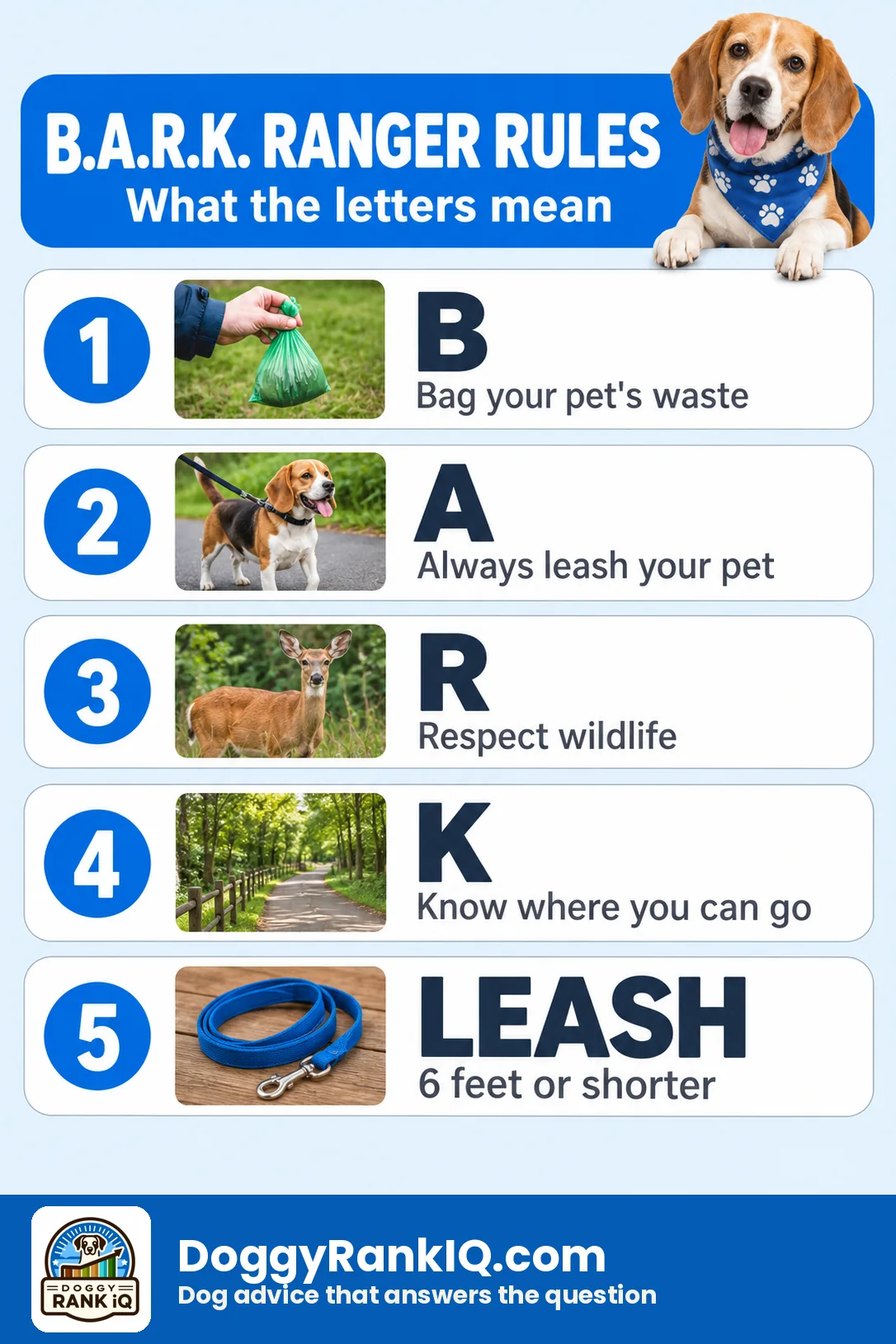
The National Park Service defines the bark ranger program around four letters, each one a rule a dog (and owner) has to follow (nps.gov).
Bag your pet’s waste
Pack it out. Every park that runs a bark ranger program expects owners to carry bags and use them, not leave a bag on the trail for pickup later.
Always leash your pet
Most parks hold dogs to a six-foot leash maximum, including Delaware Water Gap, Petroglyph National Monument and New River Gorge (nps.gov, fs.usda.gov). A retractable lead that extends past that length does not meet the rule, even if it clips down short in practice.
Respect wildlife
This covers more than staying quiet near elk. It includes keeping distance from nesting birds, not letting a dog chase anything, and accepting that “he’s friendly” doesn’t matter to a startled animal.
Know where you can go
This one has teeth. Capitol Reef limits pets to specified developed areas and a short list of trails (nps.gov). Yellowstone restricts dogs to developed areas and spots within 100 feet of roads, parking lots and campgrounds. A dog that’s great on leash still can’t go everywhere.
How to earn the tag in 4 steps
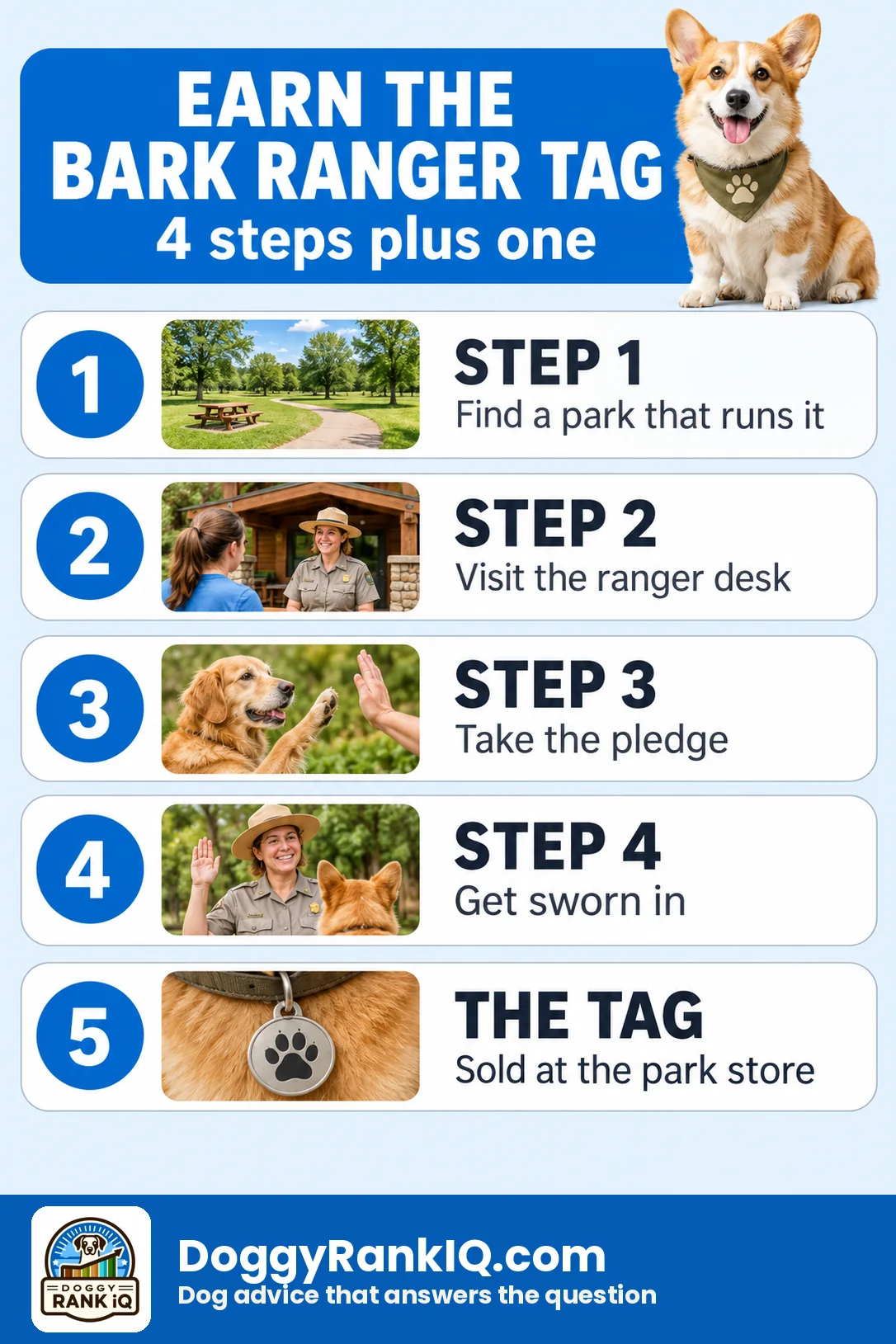
Earning a bark ranger tag generally follows a four-step pattern, though wording and extras differ by park.
Step 1: Find a participating park and check its current status
Search the park’s own nps.gov page for “bark ranger” before planning a visit. Some programs pause without much notice. Hampton’s page, updated 2026, states the program is currently unavailable and will return in a future update (nps.gov).
Step 2: Pick up the activity card or booklet
Many parks hand out a card or short booklet at the visitor center. Jean Lafitte’s updated process has participants collect an activity card at a participating visitor center (home.nps.gov). Ninety Six offers the same booklet from a visitor center or a bulletin board[source needed confirmation omitted].
Step 3: Complete the listed tasks while following the B.A.R.K. rules
Tasks vary: a short walk, a scavenger-style checklist, or simply a conversation with a ranger about the four rules. This is also a fair moment to brush up on loose leash walking, since pulling hard on a six-foot leash makes the whole outing harder than it needs to be.
Step 4: Take the pledge and collect the badge or tag
A ranger reviews the completed card, administers a short pledge, and issues the badge, tag, bandana or certificate. At many parks the ceremony itself is free, while the physical tag or bandana is sold separately at the park store for a few dollars.
Facts table: best parks for BARK Rangers
Which national parks have the BARK Ranger program?
Confirmed bark ranger national parks include Indiana Dunes (home.nps.gov), New River Gorge (nps.gov), Jean Lafitte National Historical Park and Preserve (home.nps.gov), Salinas Pueblo Missions National Monument (nps.gov), Ninety Six National Historic Site, Fort McHenry (nps.gov), Weir Farm National Historical Park (nps.gov), and Hot Springs (nps.gov). Hampton National Historic Site has run one historically but currently shows it as paused (nps.gov).
The list keeps growing, and it isn’t limited to National Park Service land. A 2026 report from Northern Virginia Magazine documented B.A.R.K. programs at multiple Virginia state parks, including Fairy Stone, First Landing, Grayson Highlands, Natural Bridge, Natural Tunnel, New River Trail, Pocahontas, Sky Meadows, Sweet Run, Twin Lakes and York River (northernvirginiamag.com). That matters for anyone searching bark ranger locations near a state line, since a state park pledge may be easier to reach than the nearest federal unit.
There’s no single, complete bark ranger map published by the Park Service covering every active site. Each park’s own page is still the most reliable source, which is a gap worth knowing about before you build a whole trip around collecting tags.
Bark ranger program cost and the BARK Ranger badge
The bark ranger program is generally free to complete. The pledge, the ranger review and the certificate typically cost nothing beyond any standard park entrance fee, as confirmed at Jean Lafitte (home.nps.gov).
Where cost shows up is the physical badge, tag or bandana. Fort McHenry sells its official badges in the park store rather than handing them out automatically (nps.gov). At New River Gorge, the certificate is free but the tag is a separate purchase at the visitor-center bookstore (nps.gov). Expect a small, store-level price for the keepsake item rather than a program fee charged up front. Since every park prices this differently and prices change, confirm the current amount at the visitor center on the day of your visit rather than relying on an old blog post, including this one.
Bark ranger program near me: how to check a park
Search the specific park’s nps.gov page for “bark ranger” or “B.A.R.K.” before a visit, since that page is updated far more often than third-party lists. Parks have added, paused and relaunched the program throughout 2026, so a page from last year may not reflect what’s happening now.
A few practical checks:
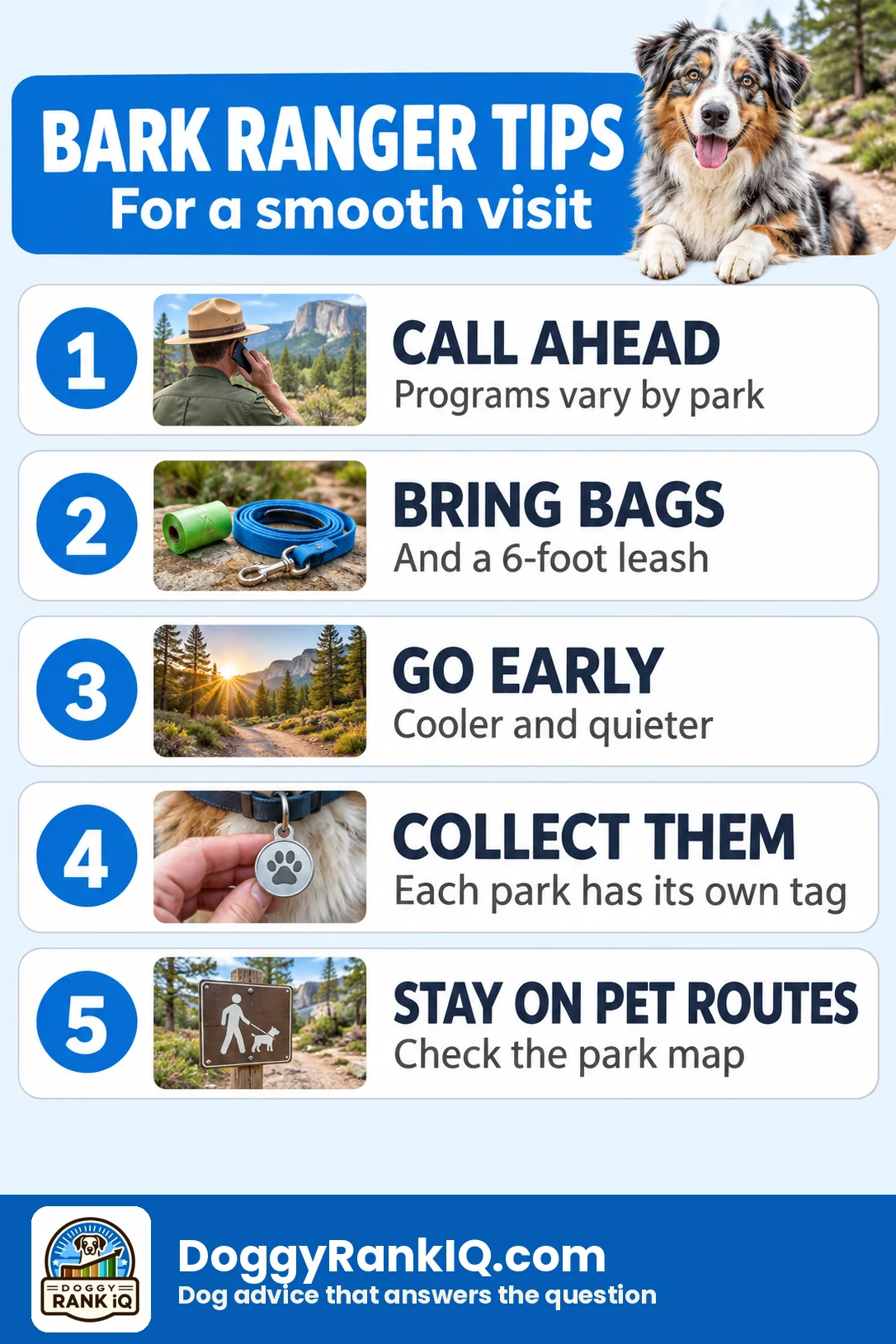
- Call or check the website the week of your trip, not months ahead.
- Ask at the first visitor center you reach if the website gives no clear answer.
- Confirm whether tags are in stock. Weir Farm had a limited tag supply as of 2026, and did not mail them out (nps.gov).
- Check leash and area rules for that specific park before arriving, since dog-friendly rules differ sharply from one unit to the next.
Choose a park with a confirmed, currently active program if your dog needs the full experience in one visit. If the nearest park’s page is vague or outdated, a phone call to the visitor center settles it faster than guessing.
🏞️ Where the BARK Ranger program started
The idea is younger than most people guess. The first B.A.R.K. Ranger program began in 2015 at Olympic National Park in Washington State, as a friendly way to explain pet rules that visitors kept breaking. Other parks copied it, and it now runs at dozens of National Park Service sites, each with its own version.
That history explains why the bark ranger program feels different from park to park. Nobody wrote one manual and handed it down. A ranger at one park wrote a pledge card, another park added a walk, a third printed an activity sheet, and the collar tag became the common thread.
“It is a rules talk with a souvenir at the end, and it works better than a sign.”
🐕 Practice the four rules before you go
A dog who has rehearsed at home makes the swearing-in easy and the rest of the visit easier.
Bag: clip bags to the leash handle now, and practice the full routine of pick up, tie and carry. Parks often have no trash can at the trailhead, so bring a hard-sided container or a spare zip bag for the walk back.
Always leash: measure yours. The limit is 6 feet, and a retractable leash locked at 6 feet still tends to creep. A fixed leash is simpler. Practice walking past another dog at that length without tangling.
Respect wildlife: teach “leave it” on squirrels in your own neighborhood before you ask for it around elk. Reward the look away.
Know where you can go: pull up the park’s pet page the night before and screenshot the map. Cell service is unreliable inside a lot of parks, and “I couldn’t load the page” will not persuade a ranger.
⭐ Top 5 Features We Love
- The four rules are genuinely useful, not just a pledge. B.A.R.K. doubles as a real behavior checklist for any park visit, the program or not (nps.gov).
- Tags are park-specific. Visitors can build a small collection across trips, since no two parks issue the same design.
- Most of it is free. The core activity, from pledge to certificate, rarely carries a fee beyond standard park admission (home.nps.gov).
- It gives dogs an actual job. Completing an activity card turns a walk into something with a clear beginning and end, which helps restless dogs and restless kids alike.
- It reinforces real safety habits. The leash-length and wildlife-distance rules matter well beyond the ceremony itself, protecting both the dog and the park’s animals (nps.gov).
⚠️ Things to Look Out For
- Availability changes without much warning. Hampton’s program is paused as of 2026, and other parks could follow (nps.gov).
- Tag supply can run out. Weir Farm limited its tags and did not offer mail delivery once they were gone (nps.gov).
- “Dog friendly” doesn’t mean “dog everywhere.” Yellowstone and Capitol Reef both restrict pets to specific areas, so a bark ranger pledge doesn’t open every trail (nps.gov).
- Leash length actually gets checked. A retractable leash extended past six feet does not meet most parks’ posted rule (nps.gov, fs.usda.gov).
- Prices and process details vary by park and change over time. What one park charges for a tag has no bearing on the next park down the road.
Tips for a smooth swearing-in
Bring the dog’s basic manners, not just the leash. A dog who can hold a sit while a ranger talks, or come back when called near a group of strangers, makes the whole process faster. If recall is shaky, a quick refresher using our guide on how to teach a dog recall before the trip pays off at the visitor center and on the trail.
Visit during a quieter hour if the park allows it. Midday in peak season means more dogs, more noise and a longer wait for a ranger’s attention. Early morning or late afternoon usually means a calmer line and a calmer dog.
Keep waste bags on hand the entire visit, not just during the pledge portion. A best dog poop bags comparison can help if the roll in your pocket keeps tearing at the perforation, which happens more than anyone admits.
Helpful gear for the pledge
A bark ranger visit usually means a full day outdoors, so a few basics make the walk and the ceremony easier on both ends of the leash. None of this gear is required by any park. It’s just what tends to come up in practice.
A sturdy leash under six feet keeps you compliant everywhere from New River Gorge to Delaware Water Gap. The Taglory 6 FT Rope Dog Leash with Padded Handle{rel=”sponsored”} sits right at the standard limit and has a padded grip for longer walks between visitor centers. Price seen: $8.99 (price checked 2026). Check the current price{rel=”sponsored”}.
Bagging waste is rule one of B.A.R.K., so having bags within reach matters. The Earth Rated Dog Poop Bag Holder and Leash Dispenser{rel=”sponsored”} clips onto most leashes and keeps a roll on hand without a separate bag to carry. Price seen: $5.98 (price checked 2026). Check the current price{rel=”sponsored”}.
Trail water sources aren’t always dog-safe or available. The Kalimdor Portable Dog Water Bottle, 19 oz{rel=”sponsored”} gives a dog a drink without needing a bowl in hand. Price seen: $9.99 (price checked 2026). Check the current price{rel=”sponsored”}.
For a longer park day, the Collapsible Dog Bowls, 2 Pack with Carabiners{rel=”sponsored”} fold flat for the car or the pack and clip right onto a bag. Price seen: $6.98 (price checked 2026). Check the current price{rel=”sponsored”}.
These are owner-reported conveniences based on manufacturer listings and product descriptions, not a park requirement or a lab test.
FAQ
The bottom line
The the program rewards dogs for doing what good park visitors already do: staying leashed, picking up after themselves, and giving wildlife space. The ceremony is usually free, the tag is usually a few dollars, and the real value is a dog that leaves the trail with better habits than it started with. Pick a park with a confirmed active program, bring a leash under six feet, and call ahead if a tag is the whole point of the trip.
Tags
the program, national park dogs, B.A.R.K. rules, dog friendly national parks, bark ranger badge, leashed hiking with dogs, pet travel tips, New River Gorge, Jean Lafitte National Historical Park, dog hiking gear, national park leash laws, bark ranger tag
Doggy Rank IQ is reader supported. As an Amazon Associate we earn from qualifying purchases, at no extra cost to you.