
A dog at the vet’s office can wag so hard its whole back end shakes, and still bite the tech two minutes later. If you’ve seen that happen, you already know the old rule is wrong. Wagging does not mean happy. It means something is happening inside that dog, and the direction, speed, and height of the wag tell you which something.
Quick Answer
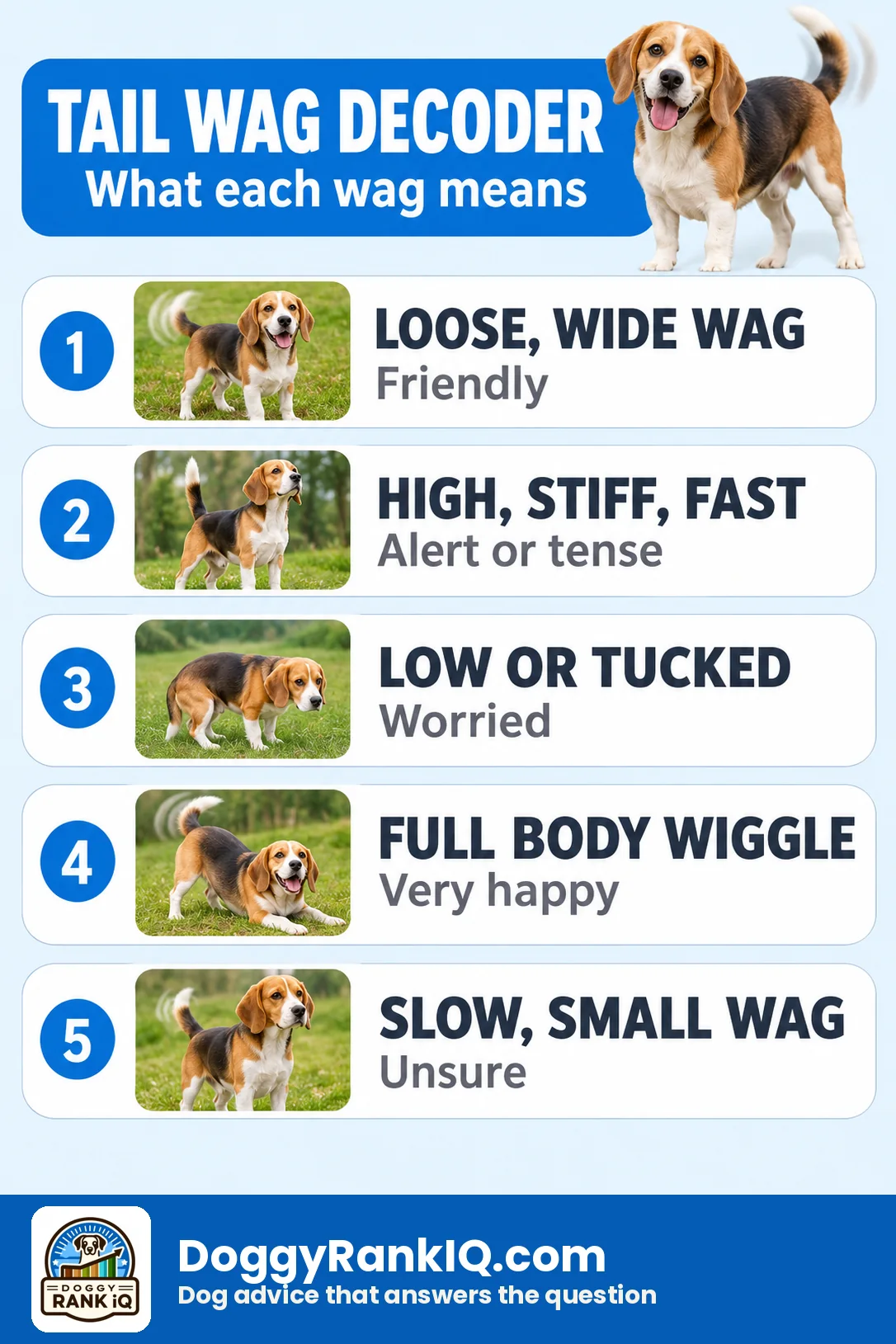
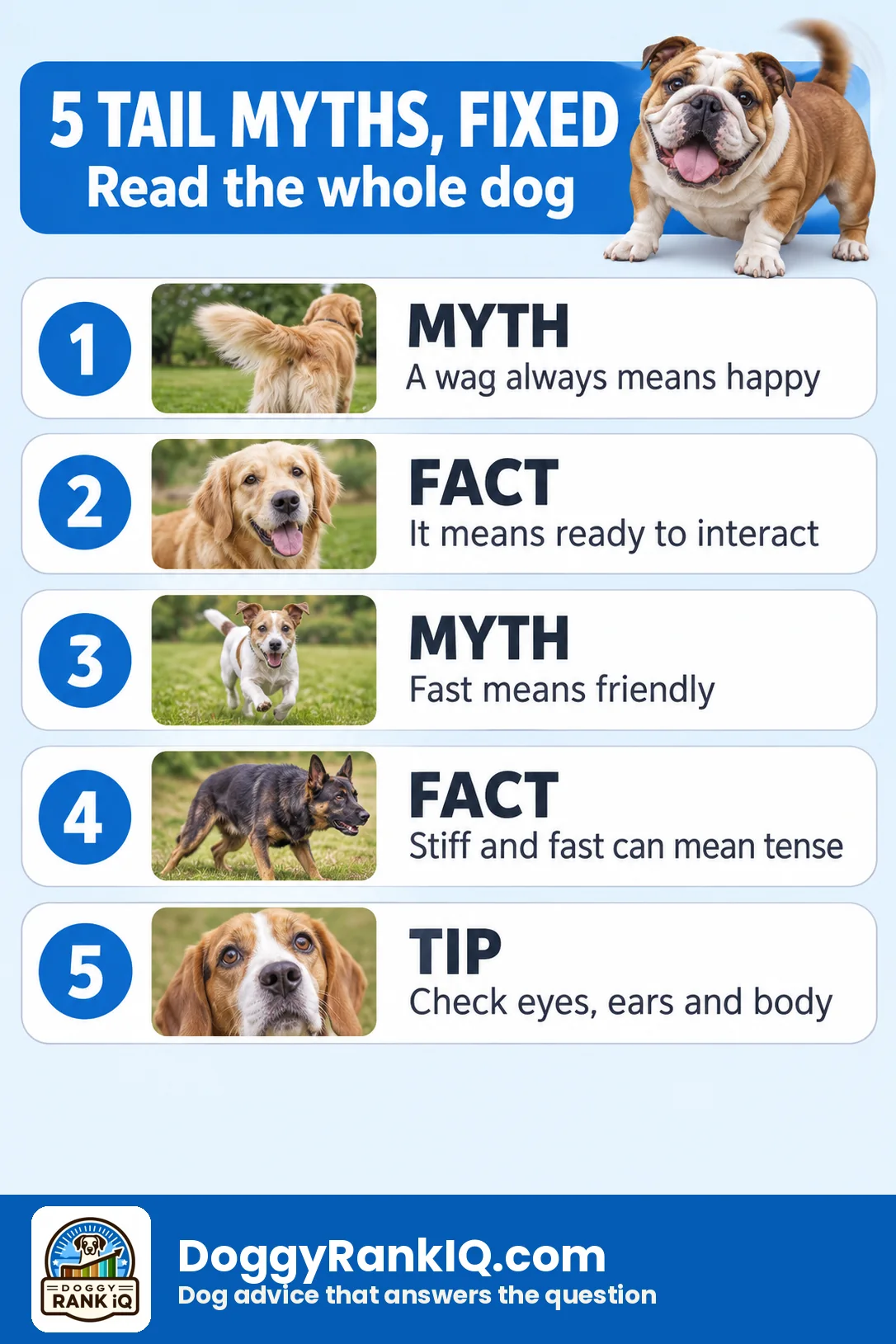
Dogs wag their tails to communicate arousal and intent, not just happiness. Research on why do dogs wag their tails shows the direction matters: more wag toward the dog’s right side tends to appear during approach-related, positive states, while more wag toward the left appears during withdrawal-related or wary states. (science.org, vcahospitals.com) Speed and height add more information: a loose, wide, mid-height wag usually signals friendliness, while a high, stiff, fast wag signals alertness or tension. (science.org) A newer 2026 preprint found no left-right pattern at all in a food-based task, which means the asymmetry research applies mainly to social encounters, not every situation.
Key Takeaways: why do dogs wag their tails
- Why do dogs wag their tails? Mostly to signal arousal and a willingness to interact, which can be positive or negative. (science.org)
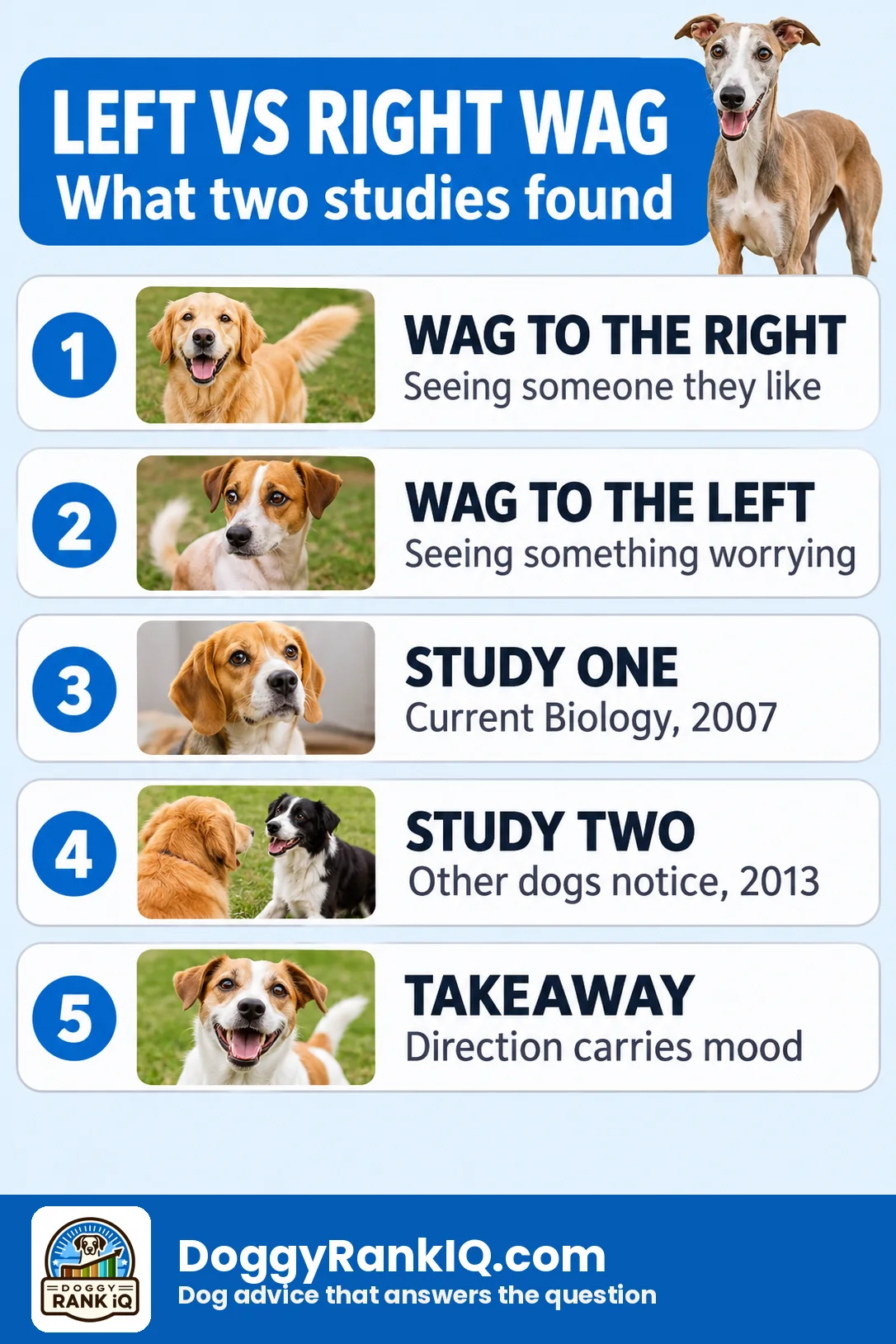
- A 2007 study found dogs wagged more to the right when seeing their owner and more to the left when seeing an unfamiliar dominant dog. (science.org, chewy.com)
- A 2013 study found dogs watching left-biased wags on video showed higher heart rates and more anxious behavior than those watching right-biased wags. (science.org, the-scientist.com)
- Height and speed usually matter more day to day than left versus right, which most owners cannot reliably spot in real time.
- A high, stiff, fast wag is a warning sign, not a greeting, especially around unfamiliar dogs and kids.
- A 2024 review in Biology Letters found tail wagging is multidimensional: carriage, speed, amplitude, direction, symmetry, and rhythm all carry separate information. (science.org)
- A 2026 preprint found no significant left-right asymmetry in a non-social food task, suggesting asymmetry may depend heavily on social context. (biorxiv.org)
- Happy tail syndrome is a real injury from repeated wagging against hard surfaces, mostly in large, short-coated dogs. (vcahospitals.com)
- Do dogs control their tails wagging? Partly. Tail movement is tied to the autonomic nervous system, so a lot of it runs on autopilot.
- Reading the tail alone is not enough. Ears, mouth, weight shift, and eyes change the meaning of the exact same wag.
What does the wag look like?
Tap an option to see the answer.
The short answer: why do dogs wag their tails?
Why do dogs wag their tails? Because the tail is a visible readout of arousal, the general state of “something is happening and I’m reacting to it.” That reaction can be good news or bad news, which is exactly why “wag equals happy” keeps getting dog owners into trouble.
A relaxed wag during a belly rub and a stiff wag at a stranger on a hiking trail both involve a moving tail. They are not the same message. The dog’s nervous system ramps up in both cases, approach and avoidance both count as arousal, and the tail reflects that ramp-up before the rest of the dog’s behavior catches up. (science.org)
Why do dogs wag their tails when happy? Loose muscles, a wide sweeping motion, and often a full-body wiggle that pulls the hips along with the tail. Why do dogs wag their tails when you talk to them? The same arousal system kicks in for anticipation: your voice predicts something, a walk, dinner, attention, and the tail starts moving before the dog knows exactly what’s coming.
Researchers at UC San Diego and elsewhere have studied how much dogs track verbal patterns and names, which connects to a broader point about how much dogs anticipate from us. For more on that, see this breakdown of what word studies show about dogs recognizing their names.
Left vs right: the truth from two studies
The short version: in 2007, dogs wagged more toward their right side around a liked person and more toward their left around an unfamiliar dominant dog. (science.org, chewy.com) But a 2026 preprint found no such pattern in a non-social food test, so the asymmetry rule applies more narrowly than most pet blogs suggest.
The original study, led by Angelo Quaranta, Marcello Siniscalchi, and Giorgio Vallortigara and published in Current Biology, used motion-tracking cameras on dogs watching their owner, an unfamiliar human, an unfamiliar cat, and an unfamiliar dominant dog. The right-side bias showed up with the owner. The left-side bias showed up with the dominant, unfamiliar dog. (science.org, chewy.com)
The proposed explanation involves which side of the brain is doing the work. Approach-related responses are linked more to the brain’s left hemisphere, which controls the right side of the body, while withdrawal-related responses are linked more to the right hemisphere, which controls the left side. (science.org, vcahospitals.com) So more right-side wag correlates with “I want to move toward this,” and more left-side wag correlates with “I’m keeping my options open.”
A 2013 follow-up by Marcello Siniscalchi and colleagues tested whether other dogs pick up on this. Dogs watched video or silhouettes of other dogs wagging left-biased versus right-biased, and the dogs watching left-biased wags showed higher heart rates and more anxious behavior than those watching right-biased wags. (science.org, the-scientist.com) That’s a real finding worth sitting with: dogs appear to read each other’s tail asymmetry without any training, which argues this isn’t a human-invented pattern laid on top of dog behavior. It’s something dogs already use with each other.
Then 2026 complicated the tidy story. A 2026 bioRxiv preprint by Ouchi, Glynn, Canori, Marshall-Pescini, Range, and Monteiro ran 23 pet dogs through a computer-controlled food task, rewarded and unrewarded, and tracked tail kinematics in detail. This was a preprint, not yet peer reviewed as of this writing, so treat it as an early signal rather than settled science. (biorxiv.org)
Two things stood out. First, 48% of the dogs (11 of 23) wagged in fewer than a quarter of trials, which tells you tail wagging frequency varies a lot by individual dog, not just by situation. (biorxiv.org) Second, and more important for the left/right question: the study found no significant left-right asymmetry in this non-social, food-based setup. (biorxiv.org)
The researchers’ interpretation, carefully stated, is that left-right asymmetry may depend heavily on social context, meaning another dog, person, or audience in the room, rather than appearing automatically whenever a dog feels good or bad about something. A solo food puzzle apparently isn’t social enough to trigger it.
Practical translation: left-right wag reading is a real, documented phenomenon backed by two studies, but it is hardest to use reliably in casual, non-social moments, and even trained observers need slow-motion video to catch it consistently. Don’t build a safety plan around spotting it from across the room.
Facts table: tail wag decoder
The left and right rows need an asterisk: the asymmetry is genuinely hard to see with the naked eye and was measured in studies with cameras and frame-by-frame analysis. (science.org, the-scientist.com) Height and speed are the signals an owner can actually use on a sidewalk.
Why do dogs wag their tails when happy and when you talk to them?
Dogs wag when happy because the arousal that happiness produces still runs through the same tail-wagging machinery as every other strong feeling. There is no separate “happy-only” wag circuit. The tail just reflects that the dog’s system has switched on.
A happy wag usually comes bundled with other relaxed signals: soft eyes, an open mouth, loose shoulders, a lowered front end during play bows. Why do dogs wag their tails when you talk to them specifically? Three likely reasons layer together here:
- Anticipation. Your voice often predicts something good, a walk, a treat, a greeting, so the wag starts before the event even happens.
- Social engagement. Dogs are highly tuned to human voices and faces, and a 2026 University of Vienna study found smiling human faces activated reward-linked brain regions in awake dogs, which supports the idea that human expressions carry real weight for dogs.
- Habit and pattern recognition. If talking has reliably led to good outcomes, the dog’s body responds to the pattern, not just the specific words.
This connects to a bigger question some owners ask directly: can dogs smile? Dogs don’t form a human-style smile with raised cheeks, but many show a relaxed, open-mouth expression that people read as a smile, and it often shows up alongside a loose wag. It’s a useful visual cue, just not proof of an internal emotional state identical to human happiness.
If you want more ways dogs show attachment beyond the tail, this guide to how dogs show affection covers behaviors that tend to appear alongside a relaxed, happy wag.
Do dogs control their tails wagging?
Partly, but not fully. Tail wagging is tied closely to the autonomic nervous system, the same system that controls heart rate and breathing, so a meaningful portion of it happens automatically rather than as a deliberate choice. (science.org)
That doesn’t mean dogs have zero influence. Dogs can hold their tail still, tuck it, or wag it in a controlled, slow sweep during deliberate greetings. But the fast, high, stiff wag that shows up during genuine arousal is closer to an involuntary reflex than a performance. This matters for interpretation: a dog is not “faking” a tense wag to manipulate you, and a dog is not always choosing to wag at a stranger it actually likes. The tail is leaking real-time nervous system activity, which is exactly why it’s worth learning to read.
Decision rule: if the wag looks stiff and automatic rather than loose and voluntary, treat it as an arousal signal first and a friendliness signal second. Confirm with the rest of the body before assuming either way.
Why do dogs have tails at all?
Tails exist first for balance and movement, helping dogs shift weight while running, turning sharply, or swimming. Communication came later as a secondary, extremely useful function layered on top of a structure built for locomotion.
A 2024 review in Biology Letters by Silvia Leonetti, Giulia Cimarelli, Taylor A. Hersh, and Andrea Ravignani, which synthesized more than 100 studies, discussed how domestication may have increased tail wagging specifically as a communication tool between dogs and humans, beyond whatever function it served for balance alone. (science.org) Wolves wag less frequently and in narrower contexts than domestic dogs, which supports the idea that thousands of years of living alongside people shaped this behavior into something more expressive.
This is a good moment to mention when dogs were actually domesticated, based on ancient DNA evidence, since tail communication is one of several traits that appears to have been shaped by that long relationship rather than existing in its current form from the start.
⭐ Top 5 Features We Love
- It’s honest, most of the time. Unlike a trained “sit,” wagging is largely involuntary, so it gives owners a real-time, hard-to-fake window into arousal level.
- It works across species lines. Dogs read each other’s tail asymmetry without training, based on the 2013 heart-rate study, and humans can learn the same cues with practice. (science.org, the-scientist.com)
- It layers with other signals. Combined with ear position, mouth tension, and weight distribution, the tail turns a single signal into a fuller picture.
- It’s visible from a distance. Unlike a lip curl or a side-eye, a tail position can be read across a yard or a street, useful for deciding whether to let your dog approach another one.
- It changes fast. A tail can shift from loose to stiff within a second or two, giving owners an early warning before a growl or snap, if they’re watching for it.
For owners who want a structured way to build this skill, Doggie Language: A Dog Lover’s Guide to Understanding Your Best Friend ($8.99, price checked 2026) is an illustrated reference covering tail position alongside ears, eyes, and posture. Check the current price.
⚠️ Things to Look Out For
- Stiff, high, fast wagging around unfamiliar dogs or kids. This is the pattern most likely to precede a tense interaction, not a friendly one. Give the dog space rather than encouraging contact.
- A wag paired with a frozen body. If the tail moves but the rest of the dog is still and staring, that mismatch is a warning sign, not a contradiction to ignore.
- Growling with a wagging tail. Yes, this happens, and it does not cancel out the growl. A growling dog with an active, aroused tail is still communicating discomfort. Treat the growl as the primary message.
- A tail that suddenly stops wagging. Sudden stillness in a normally expressive dog can signal discomfort, pain, or heightened focus on something concerning. It’s worth checking the context immediately.
- Happy tail syndrome. This is a documented injury pattern: repeated, forceful wagging against hard surfaces like walls, furniture, or crate bars causes the tail tip to split open from trauma, not disease. (vcahospitals.com) It shows up more in large, short-coated, exuberant breeds (Labradors, Pointers, and similar dogs are commonly mentioned by veterinary sources) because their tails move with more force and have less fur padding at the tip. (vcahospitals.com) A bleeding, swollen, or repeatedly re-injured tail tip, or any limp tail that hangs instead of moving, needs a veterinary visit. Always confirm any tail injury or sudden limpness with your veterinarian rather than treating it at home.
For dogs recovering from a tail injury or any painful condition, understanding broader pain signals matters too. Here’s how to spot signs of arthritis in dogs before a vet visit, since pain can also change how and whether a dog wags at all.
How to read the whole dog, not just the tail
A tail wag means more once you check it against ears, mouth, eyes, and weight distribution together, because any single signal in isolation can mislead you.
A quick checklist for a dog you’re meeting or watching from a distance:
- Ears: forward and relaxed versus pinned back or rigid
- Mouth: loose and slightly open versus tightly closed or lips pulled back
- Eyes: soft, blinking normally versus hard stare with visible whites
- Weight: shifted forward toward you versus leaning back or frozen
- Tail: height, speed, and looseness, cross-checked against everything above
Common mistake: assuming a wagging tail means it’s safe to approach a dog you don’t know, especially with kids nearby. A stiff, high wag combined with a hard stare is a clear “not now” signal, regardless of motion.
If you’re introducing two dogs for the first time, this full-body reading skill matters even more than usual. This guide to introducing dogs safely walks through parallel walks and controlled first meetings where tail and body language both get checked before contact.
Reading dogs well also benefits from understanding related behaviors like head tilting, which often signals focused attention rather than confusion. Here’s what head tilting can really mean, and it pairs well with tail-reading as part of a bigger behavior vocabulary.
For owners who want a deeper reference shelf, Canine Body Language: A Photographic Guide ($42.50, price checked 2026) by trainer Brenda Aloff is a widely cited professional reference with extensive photos across hundreds of behavior examples. Check the current price. It’s a bigger investment than a pocket guide, so it suits trainers, fosters, and owners of reactive dogs more than a casual first-time reader.
Helpful body language guides
A single KONG Tug Toy ($15.96, price checked 2026) is a genuinely useful tool for practicing this skill at home, since tug play produces a wide range of arousal levels in a safe, controlled setting, letting owners watch tail height and speed shift in real time as play gets more or less intense. Check the current price.
For the cognitive side of why dogs respond so strongly to human cues and voices, The Genius of Dogs ($12.75, price checked 2026) by Brian Hare and Vanessa Woods covers the research on dog social cognition that underlies a lot of the anticipatory wagging discussed earlier in this article. Check the current price.
Beyond the tail, owners curious about the bigger picture of canine intelligence and emotion might also want a look at what brain research actually shows about how smart dogs are, which covers cognition research adjacent to the arousal and communication systems behind tail signals.
FAQ: why do dogs wag their tails
The bottom line: why do dogs wag their tails?
Why do dogs wag their tails? To signal arousal, not a guaranteed good mood, and the honest reading requires height, speed, and context together rather than motion alone. Left versus right asymmetry is real and backed by two separate studies, but a 2026 preprint found it disappears in non-social settings, so treat it as a research finding worth knowing rather than a trick you’ll reliably spot on a walk. (science.org, biorxiv.org) The practical skill that actually protects kids and strange dogs around your own dog is reading the whole body: ears, mouth, eyes, weight, and tail together. Start practicing that combination this week, during ordinary moments like feeding time and doorbell greetings, so you recognize the pattern before you need it in a tense one.
Doggy Rank IQ is reader supported. As an Amazon Associate we earn from qualifying purchases, at no extra cost to you.