

Quick Answer
Are dogs self aware? The honest answer is partly. Dogs fail the classic mirror test because that test measures vision, and a dog’s strongest sense is smell, not sight. When researchers swapped the mirror for a modified version of a dog’s own urine, dogs noticed the change and investigated it longer, which suggests a form of self-recognition built on scent. Dogs also show body awareness, moving off a mat they are standing on when the mat becomes an obstacle, but no study has shown dogs reflecting on their own thoughts the way adult humans do.
Key Takeaways: are dogs self aware
- Are dogs self aware? Current research says yes for body awareness and scent-based self-recognition, no for mirror self-recognition, and unproven for deeper reflective thought.
- The mirror test, created by psychologist Gordon Gallup in 1970, was built for primates and relies on vision, a sense dogs use less than smell.
- Alexandra Horowitz’s 2017 “olfactory mirror” study found dogs spent more time sniffing their own urine once it had been altered with an added scent, as described by The Pet Times.
- Roberto Cazzolla Gatti proposed a “sniff test of self-recognition” as an alternative measure built around smell instead of sight, covered in detail by Phys.org.
- A 2021 Scientific Reports study from Eötvös Loránd University found dogs stepped off a mat when the mat itself was the obstacle, showing they understand their own body as a physical object, as reported in Nature’s Scientific Reports.
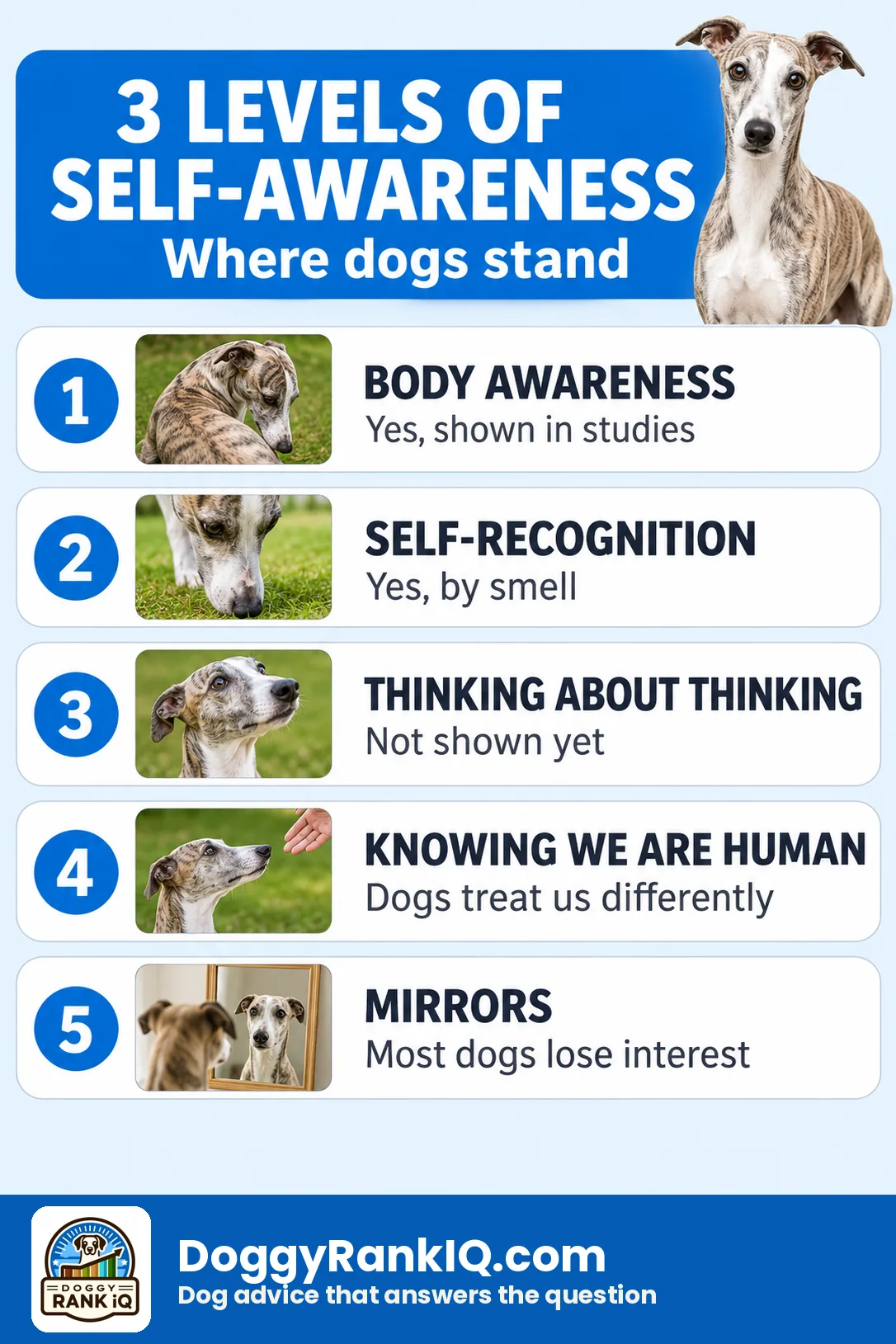
- Self-awareness is not one skill. Researchers now split it into body awareness, self-recognition, and reflective thought about one’s own mind, and dogs show real evidence for only the first two.
- Are dogs self aware of their existence in the way adults are? No controlled study supports that level of reflection in dogs.
- Are dogs self aware of humans as separate beings with their own goals? Dogs track human attention and intent closely, which is a related but different question from self-awareness.
- Dogs also show signs of episodic-like memory of their own actions, a finding that supports at least a basic sense of self over time, according to a 2020 Scientific Reports study.

What made you wonder?
Tap an option to see the answer.
The short answer: are dogs self aware?
Are dogs self aware? Based on current published research, dogs show partial self-awareness: real evidence for body awareness and scent-based self-recognition, but no confirmed evidence for mirror self-recognition or for reflecting on their own thoughts.
That split answer frustrates people who want a single yes or no. But self-awareness was never one clean switch that flips on. It is a set of separate skills, and dogs appear to have some of them and not others. A dog knowing where its own paws are is a different mental skill from a dog wondering what it looked like yesterday. The research so far speaks mostly to the first kind.
No major peer-reviewed study published in 2026 has shown dogs passing the traditional visual mirror test. Online coverage in 2026 has mostly revisited older findings rather than reporting a new breakthrough, and recent discussion has shifted toward whether the test itself is the problem. The American Kennel Club has pointed out that self-awareness exists on a spectrum, and dogs may simply sit somewhere other than where the mirror test expects them to.
That shift matters more than any single new headline. When a test fails across species after species that are known to be intelligent, the smarter move is to question the test, not the animal. This is exactly the argument made in Whole Dog Journal’s analysis of mirror self-recognition in dogs.
For a broader look at how dogs process information day to day, see our guide on how smart are dogs.

Why dogs fail the mirror test
Dogs fail the mirror test mainly because the test was designed around vision, a sense that matters less to dogs than smell. A dog looking at a mirror sees an image but gets almost none of the scent information it normally relies on to identify another animal or itself.
The mirror-mark test was created by psychologist Gordon Gallup Jr. in 1970. A researcher secretly places a mark on part of an animal’s body that it cannot normally see, then sets the animal in front of a mirror. If the animal touches or investigates the mark on its own body, rather than acting as if another animal is in the mirror, that is counted as mirror self-recognition. Chimpanzees, some elephants, a handful of corvids, and a few other species have passed versions of it.
Dogs typically do not pass. A dog in front of a mirror might bark at the “other” dog, try to play, check behind the glass, or simply lose interest after a few minutes. None of those responses show the dog connecting the reflection to its own marked body. Dogster has documented this exact pattern across many pet dogs: curiosity at first, then indifference, rarely any sign the dog links the image to its own body.
That does not mean dogs lack a sense of self. It means the test asks a question dogs are poorly built to answer. Dogs identify individuals mainly through scent, the same way most people would struggle to recognize a friend from smell alone. Asking a dog to solve an identity problem using eyesight is a little like asking someone to identify a song using only their sense of touch. For more on why scent dominates a dog’s world, see our guide on a dog’s sense of smell.
A few other reasons dogs struggle with the mirror itself, beyond the smell problem:
- Dogs rely heavily on movement and shape at a distance, and a still reflection does not behave like a real animal would.
- Puppies and adult dogs both tend to habituate quickly, meaning they stop reacting to the mirror once it stops seeming novel, which cuts the window researchers have to observe meaningful behavior.
- Breed and individual temperament affect how long a dog even bothers investigating a mirror before walking away.
Decision rule: if you are evaluating a claim about animal intelligence that rests only on mirror behavior, treat it as incomplete. A failed mirror test tells you about vision-based recognition, not about the animal’s full mental life. Are dogs self aware in ways a mirror simply cannot capture? Current research says yes.
The sniff test: how dogs recognize themselves by smell
The sniff test replaces the mirror with a dog’s own scent, and it is the strongest evidence so far that dogs recognize something as belonging to themselves. Researcher Alexandra Horowitz argued that a test built around canine ecology should use smell, since dogs use odor constantly to identify individuals and gather social information.
In her 2017 study, published in Behavioural Processes, Horowitz recruited 36 dogs, with usable data from 35 dogs across 109 trials in the first experiment. Dogs were presented with samples of their own urine, sometimes unmodified and sometimes modified with an added odor. The dogs spent noticeably more time investigating their own urine once it had been altered than when it was left alone. This detail is covered thoroughly in Faunalytics’ breakdown of the study, which also discusses how this reframes self-awareness research for non-primate species.
A follow-up experiment used a less biologically interesting scent, anise, with 11 dogs analyzed. The dogs still investigated their modified own-odor sample longer than the unmodified one, and they also spent more time on the modified own-odor sample than on the marker scent by itself. That second comparison matters. It weakens the simpler explanation that dogs were just drawn to a new smell in the room, since the dogs reacted more strongly when that new smell was mixed with their own odor specifically.
Horowitz was careful about what this does and does not prove. She did not claim her dogs showed full human-style self-awareness. Her conclusion was narrower: dogs appear to recognize their own scent as theirs and notice when it changes. Separately, researcher Roberto Cazzolla Gatti proposed a formal “sniff test of self-recognition” (STSR) as a standardized alternative to the mirror test, built around the same idea that scent, not sight, is the right channel for testing a dog’s sense of self. Phys.org’s coverage of the STSR work notes that dogs in Gatti’s trials spent more time sniffing their own scent when it was altered compared to when it was left alone, which lines up with Horowitz’s separate findings.
Why does the sniffing duration matter so much to researchers? Dogs allocate their attention based on novelty and relevance. A scent sample that is entirely new gets investigated out of simple curiosity. A sample that is mostly familiar but altered in one specific way gets investigated differently, because the dog appears to be comparing the altered version against an internal reference of “what I smell like.” That comparison process is the part researchers point to as evidence of self-recognition, not just curiosity.
Common mistake: treating the sniff test as proof dogs are “as self-aware as humans.” The study measured recognition of an odor as self-generated, not reflection on one’s own existence. Are dogs self aware in the full human sense? Not based on this data. Are dogs self aware of their own scent as distinct from another dog’s? That is what the sniff test actually supports.
What does episodic memory tell us about dog self-awareness?
Dogs that remember their own recent actions, even without being trained to do so, show a basic form of self-related memory that supports some level of self-awareness. This comes from research on episodic-like memory, the kind of memory tied to a specific personal event rather than a learned command.
A 2020 study published in Scientific Reports tested whether dogs could recall their own past actions using a “do as I did” style setup, where dogs were trained to repeat a behavior on command and then unexpectedly asked to repeat something they had done moments earlier, without warning that a memory test was coming. Dogs performed well above chance, suggesting they held a mental record of their own recent behavior rather than relying only on habit or immediate cues.
Why this matters for the self-awareness debate:
- Remembering “what I just did” requires some representation of oneself as the actor in that memory, not just a memory of an event happening nearby.
- This is a different skill from mirror self-recognition and from scent-based self-recognition, which adds a third data point to the picture rather than repeating the same test in a new form.
- It still falls short of proving dogs reflect on their identity or future, since remembering a recent action is not the same as reasoning about oneself as a continuous being over time.
Are dogs self aware enough to hold a memory of their own behavior? The 2020 findings suggest yes, at least for short-term recall of recent actions.
Facts table: 4 self-awareness studies
| Study / Year | Test used | What it measured | Result |
|---|---|---|---|
| Gallup, 1970 | Mirror mark test | Visual self-recognition | Dogs generally do not pass |
| Horowitz, 2017 | Olfactory mirror test | Recognition of own scent | Dogs investigated altered own-urine samples longer |
| Cazzolla Gatti, 2016 | Sniff test of self-recognition (proposed) | Scent-based self-recognition framework | Proposed alternative to mirror test |
| Lenkei et al. (Eötvös Loránd University), 2021 | Mat obstacle task | Body awareness | Dogs stepped off the mat they were standing on to retrieve an object |
These four rows cover different questions. None of them, alone or together, proves dogs think about their own existence the way an adult human does. Are dogs self aware across all four categories equally? No. The evidence is strongest for body awareness and scent recognition, and weakest for anything resembling reflective thought.
Body awareness: the mat experiment
The mat experiment shows dogs understand their own body as a physical object that can get in the way, which is a basic but real form of self-awareness. Researchers Péter Pongrácz, Rita Lenkei, and colleagues at Eötvös Loránd University published the study in Scientific Reports in 2021, with the full methodology available through Nature.
Dogs were asked to retrieve an object. Sometimes the object was attached to the ground. Sometimes it was attached to the mat the dog was standing on, which meant the dog’s own body weight was the thing preventing success. Dogs in the second condition needed to step off the mat to free the object and succeed.
Many of the dogs did exactly that. They moved their own bodies off the mat once their body became the obstacle, without being taught that specific solution. That is a meaningful result, because it shows the dog is not just reacting to the object, it is tracking the relationship between its own body and the task.
This is a quieter, less headline-grabbing finding than the mirror test, but arguably more solid. It does not rely on interpreting ambiguous mirror behavior. It is a direct, repeatable physical test: does the dog treat its own body as a variable it needs to manage? The answer, in this study, was yes.
This result also lines up with something most dog owners already notice in daily life. A dog that backs out of a doorway because its leash got caught, or repositions itself to avoid stepping on its own tail, is doing a version of the same thing the researchers measured in a lab setting. Are dogs self aware of their body in ordinary moments like these? The mat study suggests the answer is yes, even outside a formal test.
Edge case: a dog that fails to move off the mat is not automatically lacking body awareness. Individual variation, training history, and how comfortable a dog is with the test setup all affect performance, same as with any cognition task. Older dogs, dogs with joint pain, and dogs that are anxious around new objects may all score differently on this kind of task without that reflecting a real gap in body awareness.
Are dogs self aware of their existence, of humans, and of death?
Dogs show no confirmed scientific evidence of self-awareness in the deep philosophical sense of understanding their own existence or mortality, but they do show strong, well-documented awareness of human attention and intent. These are separate questions and get mixed together often.
Are dogs self aware of their existence? No study supports that dogs reflect on their own life, future, or mortality the way humans do. This is the hardest level of self-awareness to test in any animal, and claims about it tend to outrun the evidence. The American Kennel Club is direct about this gap, noting that while dogs show real cognitive sophistication, that is not the same as proof of existential reflection.
Are dogs aware of death? There is no confirmed scientific framework for testing this directly. Owner stories about dogs reacting to a companion’s death are common and often moving, but grief-like behavior is not the same as an abstract understanding of death, and no controlled study has separated the two in dogs.
Are dogs self aware of humans? Here the evidence is much stronger, though it is a different capacity from self-awareness. Dogs are unusually skilled at reading human pointing gestures, gaze direction, and attention, and they adjust their own behavior based on whether a person is watching. That is social awareness of another being’s mental state, not proof the dog is reflecting on its own.
Do dogs have consciousness like humans? Most researchers avoid a flat yes or no here, since consciousness itself resists a single agreed test even in humans. What the current evidence supports is narrower: dogs process information, track their own bodies, recognize their own scent, and respond to human mental states, without confirmed evidence of human-level reflective thought. For a related look at how dogs experience time passing, see our piece on whether dogs have a sense of time.
How does dog self-awareness compare to other smart animals?
Dogs fall into an odd middle category compared to other animals tested for self-awareness, mainly because most self-awareness tests were built for species that rely on vision, which puts scent-driven animals like dogs at a disadvantage from the start.
A quick comparison of how different animals have performed:
- Chimpanzees and orangutans: pass the visual mirror test reliably, consistent with their heavy reliance on vision and manual dexterity similar to humans.
- Asian elephants: some individuals have passed versions of the mirror test, touching a mark on their own head using their trunk.
- Magpies and a few other corvids: some individuals have shown mirror self-recognition, which was surprising given how different bird brains are from primate brains.
- Dogs: fail the standard visual mirror test, but show scent-based self-recognition and body awareness through alternative testing methods.
- Cats: have not shown clear mirror self-recognition either, and have been studied far less than dogs on this topic specifically.
The pattern across these species suggests that the mirror test measures something closer to “does this animal rely on vision for individual recognition” than “is this animal self-aware.” Species built around smell, hearing, or other senses may simply need different tests, which is exactly the argument behind Horowitz’s olfactory mirror work and Gatti’s sniff test.
Try it at home: 3 safe mind games
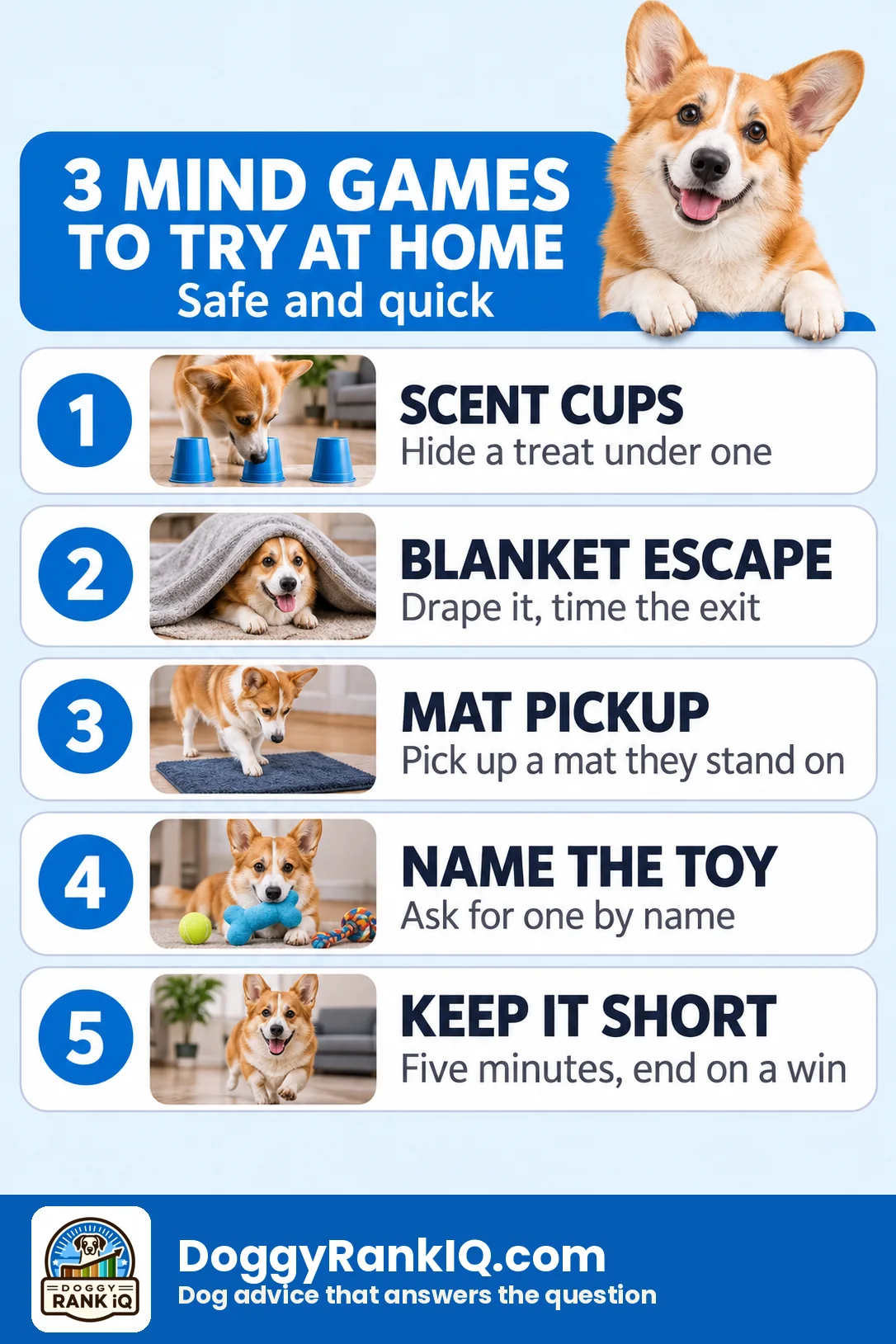
- The mat test, gently. Sit with your dog on a small mat or towel and place a favorite toy just out of reach, attached loosely to the mat’s edge. Watch whether your dog repositions its body to free the toy. This is not a lab-grade test, but it is a safe, low-stakes way to watch body awareness in action.
- The changed-scent check. Let your dog sniff a cloth that carries its own scent, then offer a second cloth with the same scent plus a mild, dog-safe addition like a drop of diluted vanilla extract. Note whether your dog spends noticeably longer with the altered cloth. Keep sessions short and never use anything irritating to a dog’s nose.
- The memory recall game. Teach a simple “do it again” cue after your dog performs a trick, then ask for it again a few minutes later in a different context. Dogs that respond correctly without a fresh demonstration may be drawing on the same kind of self-related memory documented in the 2020 Scientific Reports study on episodic-like memory in dogs.
These games are meant for curiosity and enrichment, not as scientific proof of anything. For more structured ways to challenge a dog’s mind day to day, see our guide on the best dog puzzle toys, and for foundational training that builds on a dog’s awareness of its own actions, check out 5 essential commands every puppy should learn.
⭐ Top 5 Features We Love
- Scent-based self-recognition. Horowitz’s olfactory mirror work shows dogs notice when their own scent changes, a real and measurable form of self-recognition.
- Body awareness in action. The mat study shows dogs treat their own body as something to manage during a task, not just a passive object.
- Attention-reading with people. Dogs track human gaze and pointing with real skill, letting them pick up on cues most animals miss entirely.
- Individual variation. Not every dog performs tasks the same way, and that variation itself is interesting data about personality and learning history.
- Honest uncertainty in the research. Scientists studying this topic are unusually careful to say what their data does and does not show, which is a feature of good science, not a weakness.
⚠️ Things to Look Out For
- No study has shown dogs passing the traditional visual mirror test in a reproducible way.
- No study has shown dogs reflecting on their own thoughts or future the way adult humans do.
- Grief-like behavior around a companion’s death has not been shown to include an abstract understanding of mortality.
- A single small study should never be read as proof about every dog or every breed. Individual variation is large.
- Viral claims about a dog “proving” self-awareness almost always describe anecdotal behavior, not a controlled test.
- EEG work on canine self-control, including a 2026 report using 14 dogs and 226 recorded segments, found increased frontal brain activity while dogs waited for rewards. The researchers were careful to note this could reflect attention or expectation rather than self-awareness.
Helpful books and games
Two books cover this topic in far more depth than any single article can, written by researchers who have spent careers on dog cognition.
Inside of a Dog, by Alexandra Horowitz, the same researcher behind the olfactory mirror study, walks through how dogs actually experience the world through smell, sound, and vision ($11.21, price checked 2026). Check the current price{rel=”sponsored”}.
The Genius of Dogs, by Brian Hare and Vanessa Woods, covers broader canine cognition research, including social intelligence and problem-solving ($12.75, price checked 2026). Check the current price{rel=”sponsored”}.
For readers who want to put scent-based cognition into practice at home, a Dog Scent Work Tins Training Kit ($19.99, price checked 2026) gives dogs a structured way to use the sense they rely on most. Check the current price{rel=”sponsored”}.
The Barkwhiz Dog Puzzle Toy mentioned above ($17.99, price checked 2026) is a reasonable next step once a dog has mastered simpler enrichment. Check the current price{rel=”sponsored”}.
None of these products have been lab-tested by Doggy Rank IQ. Pricing and availability reflect manufacturer and Amazon listings checked in 2026 and can change.
FAQ
The bottom line
Are dogs self aware? The fair answer, based on what has actually been published, is yes in specific, measurable ways and not yet in the deeper sense people usually mean. Dogs recognize their own scent, track their own bodies as physical objects, and read human attention with real skill. They have not been shown to reflect on their own existence or pass a vision-based mirror test, and claiming otherwise outruns the data.
The practical takeaway: judge any claim about your dog’s mind by which specific skill it tests, not by a single viral video. If you want to see body awareness for yourself, try the mat exercise above. If you want to support the sense dogs actually lean on, a scent-based enrichment game will do more for your dog’s mind than another trip in front of the hallway mirror. For more on how dogs take in the world around them, see our guides on dog dreaming during sleep and what colors dogs can actually see.
Self-Awareness Skill Checker
Pick a skill to see what the research actually found.
Doggy Rank IQ | based on cited studies above
Doggy Rank IQ is reader supported. As an Amazon Associate we earn from qualifying purchases, at no extra cost to you.