
Quick Answer
A dog toy basket only works if the front edge sits lower than your dog’s chest, typically 5 to 8 inches for small dogs and up to 10 inches for larger breeds. The 9 picks below range from a $14.98 collapsible bin to a $44.99 metal basket, sorted by material, rim height, and who actually gets to use it: the dog or the shelf. Woven rope looks good and muffles noise but chewers can shred it, while metal and hard plastic resist teeth but cost more. Check the dimensions before buying, because a dog toy basket that’s technically “low” on the label can still be taller than your terrier.
Key Takeaways: dog toy basket
- A toy basket needs a front rim below the dog’s chest height, not just a low overall silhouette, or the dog will ignore it.
- Woven cotton rope and seagrass are quiet and attractive but get shredded by committed chewers.
- Metal dog toy baskets, like the BREKX copper bin, resist teeth and wipe clean but cost more upfront.
- Toy rotation, swapping half the toys weekly, keeps a basket interesting without buying new toys.
- Large dog toy baskets (35 to 75 liters) suit households with multiple dogs or a lot of plush and rope toys.
- A toy basket with a lid works for keeping cats or toddlers out, but a lid defeats the “dog can reach in” goal for most dogs.
- Price for a usable basket runs from about $15 to $45, prices checked 2026.
- Puppies can use baskets safely once they’re past the mouthing-everything stage, supervised at first.

What is your dog like with baskets?
Tap an option to see the answer.
What is a dog toy basket
A toy basket is a container, usually made of rope, canvas, metal, or molded fabric, built specifically so a dog can retrieve its own toys without help. It differs from generic home storage bins in one key way: the front wall is lowered or scooped so a dog can reach in with its paw or nose rather than climbing over a tall rim.
The category grew out of general pet organization products, but by 2026 most retailers separate “dog toy baskets” from plain storage bins because of that access feature. Chewy’s toy storage category lists dozens of options that vary mostly on this single dimension: whether a dog can actually use it or whether it’s really a shelf for the owner.
A basket that’s labeled “toy basket” but has 12-inch walls on all sides is functionally no different from a laundry hamper. The real test isn’t the name on the listing, it’s whether the front edge clears your dog’s chest while standing.
What makes a dog toy basket one your dog can actually reach into
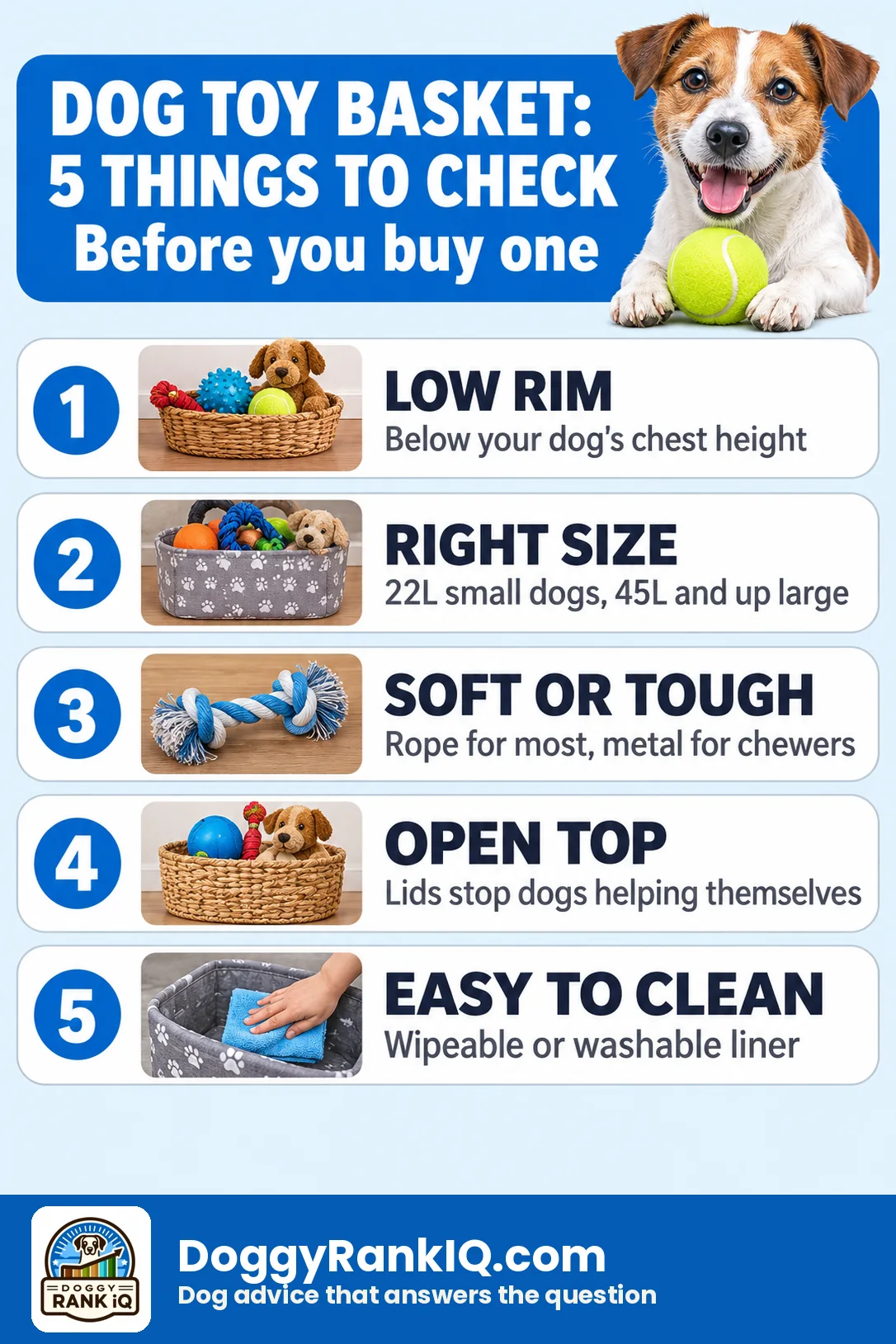
A toy basket only earns its name if the dog, not the owner, is the one taking toys out of it. The deciding measurement is the front rim height compared to the dog’s chest.
Industry comparisons published in 2026 increasingly rank baskets by front-edge height instead of total capacity. One comparison from K9 of Mine lists a basket with a 5.1-inch front edge as its lowest-access pick, with another measuring 5.9 inches. That’s a meaningful difference if your dog is a dachshund rather than a Labrador.
Several newer designs use a slanted or scooped front panel instead of a straight wall on all four sides. The Kaiferty basket, for example, uses a lowered front specifically so dogs of different sizes can retrieve toys without climbing in. Compare that to a standard laundry-style bin with 10 to 13-inch walls on every side, which functions as storage for the owner and nothing more for the dog.
Decision rule: if your dog’s chest sits lower than the basket’s front edge, the basket is a shelf, not a toy basket. Measure your dog standing, not sitting, and measure the actual lowest point of the basket’s opening, not the tallest side.
A common mistake: buying based on the product photo, where a basket often looks low because of camera angle. Check the dimensions listed in inches or centimeters, not the thumbnail.
Dog toy basket comparison table
Heights are manufacturer-listed approximations. Always verify against the current listing before buying, since suppliers occasionally update dimensions.
The 9 best dog toy basket picks
135L Woven Rope Toy basket, White and Brown
A mid-size woven basket that works as living room decor first and dog storage second. At $15.99, it’s one of the cheaper options here, and the 35-liter capacity fits a decent rotation of plush and rope toys.
- Who it suits: Medium to large dogs that don’t actively chew baskets, owners who want a neutral farmhouse look.
- Drawback: The 11-inch rim is too tall for most small dogs to self-serve without help.
- Check the current price
2OIAHOMY 22L Toy basket with Woof Embroidery
A smaller canvas basket with a printed “woof” design, priced at $17.09. The 22-liter size suits apartments or single-dog households that don’t accumulate a mountain of toys.
- Who it suits: Small apartments, single small or medium dogs.
- Drawback: Canvas sides can sag once loaded, which lowers effective capacity over time.
- Check the current price
345L Extra Large Woven Rope Toy basket
This is the large toy basket pick for households with multiple dogs or a big breed that collects oversized toys. At $19.99 for 45 liters, it holds considerably more than the 35L version above.
- Who it suits: Multi-dog homes, large breeds, owners who want fewer basket trips during cleanup.
- Drawback: At roughly 13 inches tall, this is storage for most dogs under 20 pounds, not a self-serve basket.
- Check the current price
4Foldable Dog Toy Bin with Handles, Grey
A soft-sided folding bin at $14.98, the lowest price on this list. The felt-style lining is quiet, and the collapsible design means it stores flat when guests come over.
- Who it suits: Renters, owners who want something that disappears into a closet, budget shoppers.
- Drawback: Fabric walls can flop inward when half-empty, narrowing the opening a dog needs to get a paw in.
- Check the current price
5BREKX Copper Metal Pet Storage and Dog Toy Bin
The toy basket indestructible pick for a household with a committed chewer. Metal construction means no fabric to shred, and the open design at $44.99 is the most expensive item here, but it’s also the one least likely to need replacing in a year.
- Who it suits: Dogs that destroy fabric and rope baskets within weeks, owners who want something wipeable.
- Drawback: Metal edges can be sharp at low-quality seams; check the manufacturer’s finish details before buying, and ask your veterinarian about any dog with a history of mouth injuries around hard materials.
- Check the current price
6Boho Cotton Rope Toy basket with Handles
A decorative rope basket at $27.99 with sturdy carry handles, useful for moving toys between rooms. The 30-liter size sits between the small and large options on this list.
- Who it suits: Owners who move the basket between the living room and bedroom, dogs that are gentle with fabric.
- Drawback: Rope handles are often the first part a chewer destroys.
- Check the current price
7Woof Dog Basket Cotton Rope Pet Storage Bin
A compact, labeled basket at $21.99 that works well as a toy basket with name stand-in, since the embroidered “woof” text does some of that personalization work without a custom order.
- Who it suits: Small to medium dogs, owners who want a labeled basket without paying for monogramming.
- Drawback: 25-liter capacity fills fast with squeaky toys and rope tugs combined.
- Check the current price
8OIAHOMY 75L Blanket and Toy basket
The biggest capacity on this list at 75 liters, priced at $20.99. This one doubles as blanket storage, which matters if your dog has three “special” blankets that no longer fit anywhere else.
- Who it suits: Large dogs, multi-pet households, anyone combining toy and blanket storage in one spot.
- Drawback: At roughly 14 inches tall, almost no dog self-serves from this one; it’s organizational storage for the owner.
- Check the current price
9Large 28.5 inch Foldable Dog Toy Box with Hard Board
A structured box with hardboard support panels, priced at $24.99. This is the closest thing on this list to a toy basket plastic alternative in rigidity, minus actual plastic walls.
- Who it suits: Owners who want a box shape that holds its form, not a floppy fabric bin.
- Drawback: The rigid panels make this one awkward to fold flat compared to softer bins.
- Check the current price
Best dog toy basket brands
The most commonly recommended brands in 2026 comparisons include HOMAGICO, Park Life Designs, Hanamya, OIAHOMY, and BREKX, each covering a different niche of price, material, or rim height. There isn’t one “best” brand across every household; the right choice depends on chewing habits and dog size.
- HOMAGICO makes a popular extra large storage basket and a cotton rope bin often recommended for medium dogs that like a soft, quiet material.
- Park Life Designs sells the Sienna cotton basket, a decorative option marketed more for style than heavy-duty chewing resistance.
- Hanamya offers a 40-liter basket that lands in the mid-capacity range, useful for medium dogs or light multi-dog households.
- OIAHOMY and BREKX, both featured in the picks above, split the difference between affordable canvas/rope options and a pricier metal option for chewers.
Choose a brand based on documented durability for your dog’s chew level, not reputation alone. A brand that works well for a senior Shih Tzu may fail within a week for a six-month-old Labrador puppy.
How do I get my dog to use their toy basket
Most dogs start using a basket once it’s placed at floor level in a room they spend time in, loaded with a few toys they already like. Dogs rarely need formal training for this; they need the basket to be physically reachable and worth investigating.
Steps to encourage use:
- Place the basket at floor level in a high-traffic room, not tucked in a corner.
- Drop a few high-value toys in loosely so they’re visible from a standing position.
- Encourage the dog toward the basket and let it discover toys on its own; avoid forcing a nose into the basket.
- Praise calmly when the dog retrieves a toy, without turning it into a formal trick.
- Leave the basket in the same spot consistently, since dogs build location habits quickly.
If a dog ignores the basket entirely after a week, the rim height is the first thing to re-check, not the dog’s interest level. According to the American Kennel Club, matching toy type to a dog’s play style also affects whether toys get used at all, which indirectly affects whether the basket gets visited.
Dog toy storage ideas besides a basket
A toy basket isn’t the only option, and some households are better served by a toy chest, a wall-mounted bin, or simply a designated open bin under furniture. Alternatives matter most when floor space is limited or when a dog won’t use a basket regardless of rim height.
- Toy chests or boxes, like the hardboard box in pick 9 above, hold more volume but usually require the owner to retrieve toys rather than the dog.
- Under-furniture bins slide under a couch or bed, useful for small apartments where floor space is scarce.
- Wall-mounted hooks or nets work for rope toys and tugs that don’t need to sit flat.
- Decorative baskets doubling as blankets-and-toys storage, like the OIAHOMY 75L pick, consolidate two storage needs into one spot.
- Open floor piles, admittedly not organized, but some dogs genuinely prefer toys scattered rather than contained, and forcing containment can reduce play interest.
Choose a toy chest if you mainly need organized storage for the owner’s convenience. Choose a basket if the goal is specifically letting the dog retrieve its own toys.
Dog toy basket for small dogs
Small dogs under 15 pounds need a front rim under about 6 inches to comfortably reach in without climbing. Most baskets on general retail sites are built around medium or large dog proportions, so small-dog owners often need to check dimensions more carefully than the category suggests.
- Look for baskets specifically marketed with a slanted or scooped front, not a straight-walled bin relabeled as “small.”
- A 15 to 22-liter capacity is usually enough for one small dog’s rotation of toys.
- Avoid rope handles positioned low on the basket, since small dogs can chew through them quickly out of curiosity even if they’re not destructive with the toys themselves.
Edge case: a small dog living with a large dog in the same house typically needs its own lower basket, since a shared basket sized for the large dog will usually be too tall for the smaller one.
How much does a dog toy basket cost
A usable toy basket in 2026 typically costs between $15 and $45, depending mainly on material and size rather than brand name. Fabric and rope baskets sit at the lower end, while metal or reinforced designs cost more.
- $14.98 to $21.99: foldable fabric bins and smaller rope baskets, suitable for light chewers.
- $22 to $30: mid-size rope or canvas baskets with handles, often 25 to 35 liters.
- $44.99 and up: metal baskets built for durability, like the BREKX copper bin, aimed at dogs that destroy softer materials.
Decision rule: if you’ve replaced two fabric baskets in under six months, the $44.99 metal option is usually cheaper long-term than repeatedly buying $15 to $20 replacements.
Why does my dog destroy the toy basket
Dogs typically destroy toy baskets because the material feels similar to a chew toy, because the basket smells like other dogs’ scent markers, or because boredom and under-stimulation push a dog toward whatever’s reachable. Rope and canvas are the most commonly destroyed materials since their texture resembles rope toys dogs are already encouraged to chew.
- Texture similarity: cotton rope baskets look and feel like rope tug toys, so some dogs can’t tell the difference.
- Boredom or excess energy: a basket near a dog’s resting spot can become a convenient outlet if the dog isn’t getting enough mental or physical exercise.
- Teething in puppies: puppies destroy nearly everything within reach during the mouthing stage, and a basket is no exception, according to AKC’s puppy toy guidance.
If your dog destroys fabric or rope baskets repeatedly, switch to a metal or hardboard design rather than continuing to replace the same material. Pairing the switch with more mental stimulation, such as the best dog puzzle toys roundup, can also reduce the urge to chew the storage itself.
Washable dog toy basket
A washable toy basket matters most for households with drool-prone breeds, dogs that chew damp toys, or homes where the basket sits near a food or water bowl. Fabric liners that are removable and machine-washable hold up better long-term than baskets with fixed, non-removable linings.
- Check the listing for “machine washable liner” specifically; some baskets only allow spot cleaning.
- Metal baskets, like the BREKX pick, are wipeable rather than washable, which works fine for dry debris but less well for anything sticky.
- Canvas baskets with a removable fabric insert are a middle ground: the structure stays rigid while the liner goes into the wash.
Choose a washable option if your dog’s toys regularly get slobbery, muddy, or left outside before being put away.
Large dog toy basket vs low dog toy basket: sizing by dog
A large toy basket solves a capacity problem. A low toy basket solves an access problem. Most households need both qualities at once, and that combination is rarer than it should be.
For what size toy basket you need for your dog, use chest height as the starting measurement, not breed stereotypes:
- Small dogs (under 15 lbs, like Chihuahuas, dachshunds): front rim under 6 inches, 15 to 22 liters.
- Medium dogs (15 to 50 lbs, like beagles, corgis): front rim 6 to 9 inches, 25 to 35 liters.
- Large dogs (50+ lbs, like Labradors, shepherds): front rim up to 10 to 12 inches is often still workable because of their height, 35 to 75 liters.
A toy basket low enough for a dachshund will look almost comically shallow to an owner of a Great Dane, and that’s fine. The basket is sized to the dog, not the room.
Edge case: a mixed household with one small and one large dog usually needs two baskets at two heights, or one basket low enough for the smaller dog, accepting that the larger dog will tower over it.
Indestructible, plastic, with lid or outdoor: which dog toy basket material fits your dog
Material choice decides whether the basket survives your dog’s chewing habits, not just its looks. Match material to documented chewing behavior rather than guessing from breed alone, since individual variation is significant even within a breed.
- Cotton rope and seagrass: quiet, attractive, and gentle on teeth and floors. Chewers can unravel these within days.
- Metal (the toy basket indestructible option): resists teeth and wipes clean, an approach several 2026 product lines use with an open or slanted metal front rather than a tall wall.
- Toy basket plastic: easy to hose off, useful outdoors, but hard plastic edges can be uncomfortable for a dog to nose into compared to a softer fabric lip.
- Toy basket with lid: useful for keeping a basket out of reach of cats, toddlers, or a resource-guarding dog, but a lid generally removes the “dog can reach in” feature this whole roundup is built around.
- Toy basket outdoor use: look for weather-resistant metal or treated plastic rather than cotton rope, which molds when left damp.
Choose metal if your dog has already destroyed two fabric baskets. Choose rope or canvas if your dog ignores the basket itself and only wants the toys inside it.
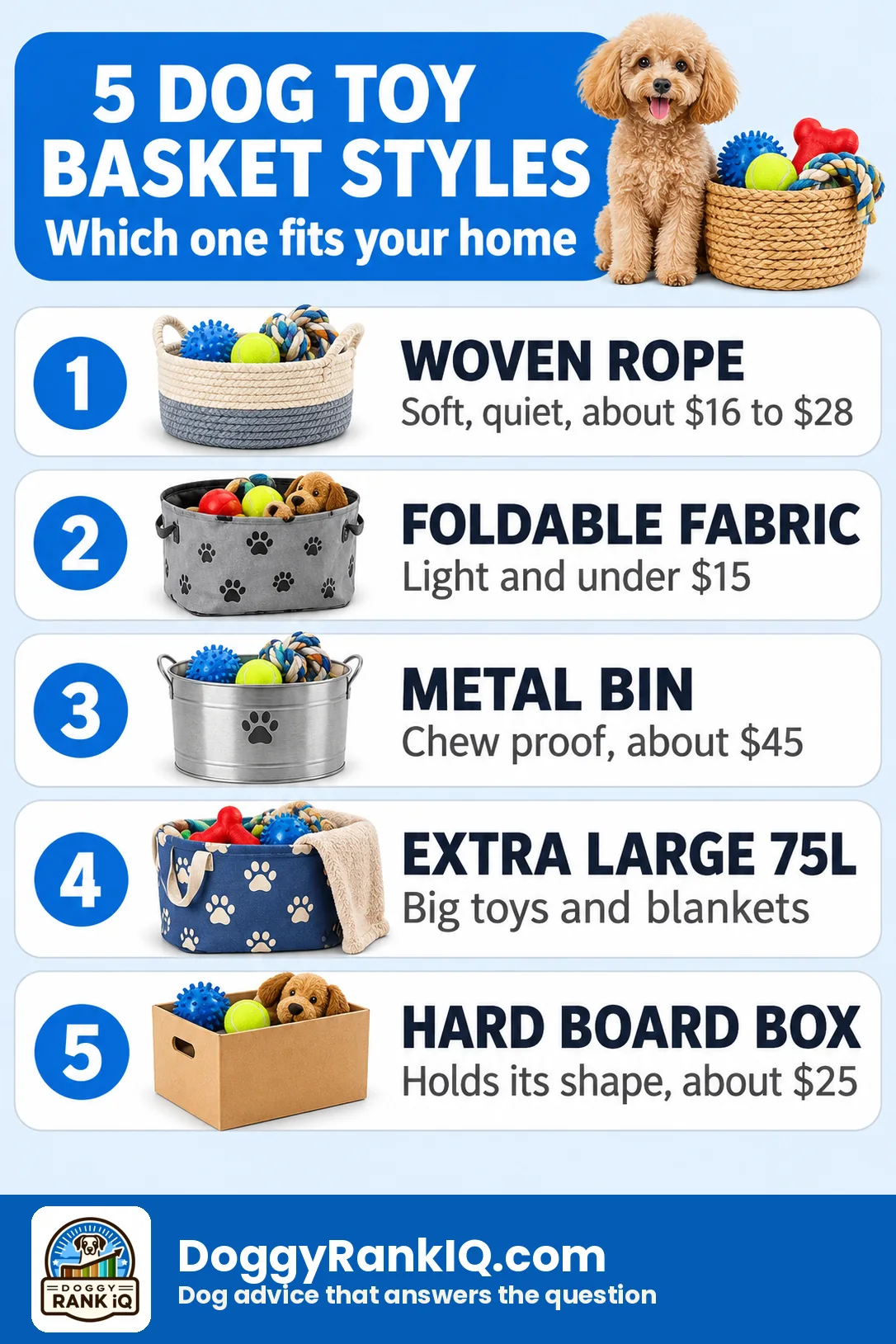
⭐ Top 5 Features We Love
- Low, slanted front edges that let a dog paw a toy out instead of leaning over a wall, a design trend highlighted across multiple 2026 product comparisons, including ClutterScience’s organizer roundup.
- Machine-washable liners, which matter more than most buyers expect once a basket has lived under a food bowl spill or two.
- Reinforced handles for carrying a full basket between rooms without the bottom giving out.
- Fold-flat storage for baskets that need to disappear when company visits.
- Wipeable metal or treated surfaces for dogs with a documented history of chewing fabric storage.
⚠️ Things to Look Out For
- Marketing photos that exaggerate low access. A basket photographed at an angle can look lower than its actual listed height.
- Rope handles on chew-prone dogs. They’re often the first part destroyed, even if the body of the basket survives.
- Lids on baskets meant for self-serve use. A toy basket with lid is a different product for a different goal.
- Vague “large breed” labeling with no inches listed. Always check the dimensions in writing, not the category name.
- Sagging fabric walls that narrow the usable opening once the basket is half-loaded.
How to teach a dog to put toys away and how toy rotation works
Most dogs don’t need formal training to use a basket, but they do need the basket itself to be genuinely reachable, plus a reason to care about what’s inside it. If your dog won’t use the toy basket, the first thing to check is rim height against chest height, not the dog’s intelligence or interest.
Steps to get a dog using a basket on its own:
- Place the basket at floor level in a high-traffic room, not tucked in a corner.
- Drop a few high-value toys in loosely so they’re visible from a standing position.
- Encourage the dog toward the basket and let it discover toys on its own; avoid forcing a nose into the basket.
- Praise calmly when the dog retrieves a toy, without turning it into a formal trick.
- Leave the basket in the same spot consistently, since dogs build location habits quickly.
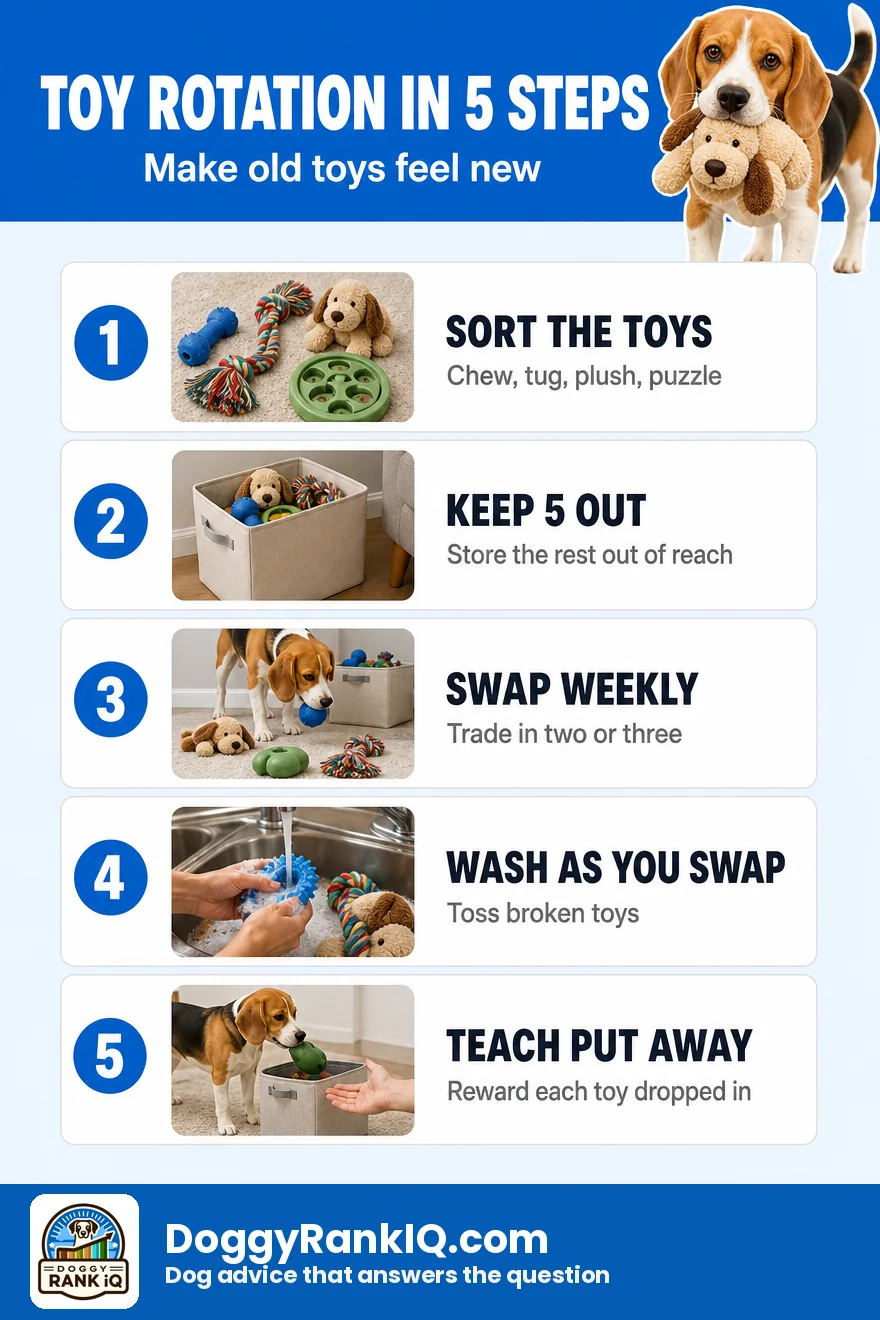
Toy rotation is a commonly cited trainer tip: keep half the toy collection put away out of sight and swap it into the basket weekly. This keeps a three-month-old chew toy feeling new again without buying anything, and it’s a cheap fix if a dog has stopped bothering with the basket altogether. For more structured engagement ideas, the no-stuffing dog toys guide and best dog puzzle toys roundup pair well with a rotation schedule, and a reliable classic like the Kong Classic is worth keeping in the rotation pool.
Puppies can use toy baskets safely once they’ve moved past the stage of mouthing everything indiscriminately, generally with supervision until an owner is confident about what the puppy will and won’t chew. According to AKC’s puppy toy timing guidance, toy needs shift as puppies age, which means the basket’s contents, not just the basket itself, should change over the first year. If a dog eats basket material rather than just chewing it, remove that basket immediately and consult a veterinarian, since ingested fabric or rope can cause a blockage.
Who should buy which basket
Matching a basket to a specific household avoids the most common mistake: buying the prettiest option and discovering the dog never touches it.
- Small dog, apartment: the OIAHOMY 22L basket or the foldable grey bin for compact storage with reasonable access.
- Committed chewer: the BREKX metal bin, since fabric options will not survive.
- Multi-dog household: the 75L OIAHOMY basket or the 45L rope basket for volume.
- Budget-first shopper: the foldable grey bin at $14.98 is the cheapest usable option on this list.
- Decor-focused living room: the Boho cotton rope basket looks intentional rather than functional-first.
Whether a basket is worth it at all depends on whether toys currently end up scattered across the floor daily. If a dog already keeps its toys in one general area without prompting, a basket is a convenience upgrade, not a necessity. Dog toy storage alternatives to baskets exist too: a low open crate, a shallow dish, or simply a dedicated corner of a rug work fine for dogs that don’t need a defined container at all.
The bottom line
A toy basket earns its keep when the front rim sits lower than the dog’s chest and the material matches how that specific dog treats fabric and rope. Spending more doesn’t automatically solve the access problem; a $44.99 metal bin with a 10-inch wall helps a chewer less than a $15 basket with a 5-inch slanted front. Measure the dog, compare the options against actual listed dimensions, and rotate the toys weekly so the basket stays interesting instead of becoming furniture. Pick the one pick from above that matches your dog’s size and chewing habits, and check the current listing before buying since dimensions and stock change.
Doggy Rank IQ is reader supported. As an Amazon Associate we earn from qualifying purchases, at no extra cost to you.