
A 20-pound dog slumped sideways in a backpack can feel like 30 pounds by the time you hit mile two. That is not a weight problem. That is a fit problem, and it is the single most common complaint buried in owner reviews of the k9 sport sack line.
Quick Answer
A k9 sport sack is sized by your dog’s back length, collar to tail base, not by body weight, and buying based on weight alone is the sizing mistake that puts pressure on your back and shoulders instead of your dog’s body. Measure the back first, then match that number to the brand’s chart (XS at roughly 9 to 12 inches up through Knavigate and Kolossus for the largest dogs). Owners who skip this step end up with a dog slumped sideways in an oversized pack, which shifts the load and strains the wearer’s spine. The fix is simple: measure before you buy, and choose the model built for your dog’s actual carry weight, not just its upper limit.
Key Takeaways: k9 sport sack
- A Sport Sack is sized by back length (collar to tail base), not weight. Check the dimensions before adding to cart.
- The Air 2, Plus 2, Urban 3, and Knavigate serve different jobs: short errands, compact forward-facing carry, structured day trips, and heavier dogs or longer outings.
- Oversizing a Sport Sack to “fit” a heavier dog usually backfires. A properly sized pack with better hardware beats a bigger soft pack.
- Shoulder and back pain complaints usually trace to one of three causes: wrong size, no hip belt, or a dog sitting crooked inside the bag.
- Prices for the Sport Sack line range widely, roughly $30 to $260, depending on model and where you buy (price checked 2026).
- No independent certification currently verifies Sport Sack spinal ergonomics for dogs or wearers; claims about vet involvement are not backed by a published study, according to the brand’s own safety page.
- The Knavigate’s internal frame and padded hip belt make it the more sensible pick for dogs near the upper weight range.

What did you measure?
Check the current price
Tap an option to see the answer.
 What is a k9 sport sack and how does it work?
 What is a k9 sport sack and how does it work?
A Sport Sack is a front- or back-worn carrier backpack built to let small to medium dogs ride at the owner’s chest, back, or hip level during walks, bike rides, or short hikes, instead of walking the whole distance themselves. The dog sits or stands inside a padded pouch with its legs tucked in and head typically poking out the top, while the wearer carries the combined weight on shoulder straps and, in higher-end models, a hip belt.
The design goal is simple: take weight off a tired, injured, or small dog’s joints and put it on a human frame built to carry a pack. According to the brand’s own sizing guide, the pouch is meant to cradle the dog’s torso so the spine stays in a neutral, supported position, similar to how a baby carrier supports an infant. That only works if the pouch matches the dog’s back length. A too-large pouch lets the dog slide or twist, which defeats the purpose.
Models differ mainly in three things: how the dog faces (forward or inward), whether there’s an internal frame, and whether a hip belt exists to move weight off the shoulders. The Sport Sack FAQ page confirms that all models are intended for dogs capable of sitting calmly inside an enclosed space, not for dogs who struggle with confinement.
Are K9 Sport Sack carriers good for dogs?
A Sport Sack can work well for small to medium dogs who tire on long walks, have joint limits, or need to be carried through crowded or hot areas, provided the size and model actually match the dog. It is not automatically good or bad. The outcome depends almost entirely on fit, weight, and how long the dog stays inside.
Owner feedback collected on retail sites shows a split pattern. Some dogs settle in within minutes and seem to enjoy the elevated view. Others shift, slump, or sit crooked, which creates uneven pressure for the dog and an awkward pull on the wearer’s shoulders, a pattern described directly in a 2026 Dogster review of the Sport Sack line. A 2026 review of the Air 2 reported a tester’s dog sitting slightly off-center, which placed extra strain on the person carrying the pack.
Decision rule: choose a Sport Sack if your dog is calm in enclosed spaces, within the model’s stated weight range, and the outing is a walk, bike ride, or short hike rather than an all-day trek. Skip it if your dog resists confinement or weighs near or above the model’s upper limit, where a frame-supported carrier does a better job.
For background on reading your dog’s comfort signals while testing any gear, our guide to dog body language covers the signs that a dog is stressed rather than settled.
The sizing mistake: measure back length, not weight
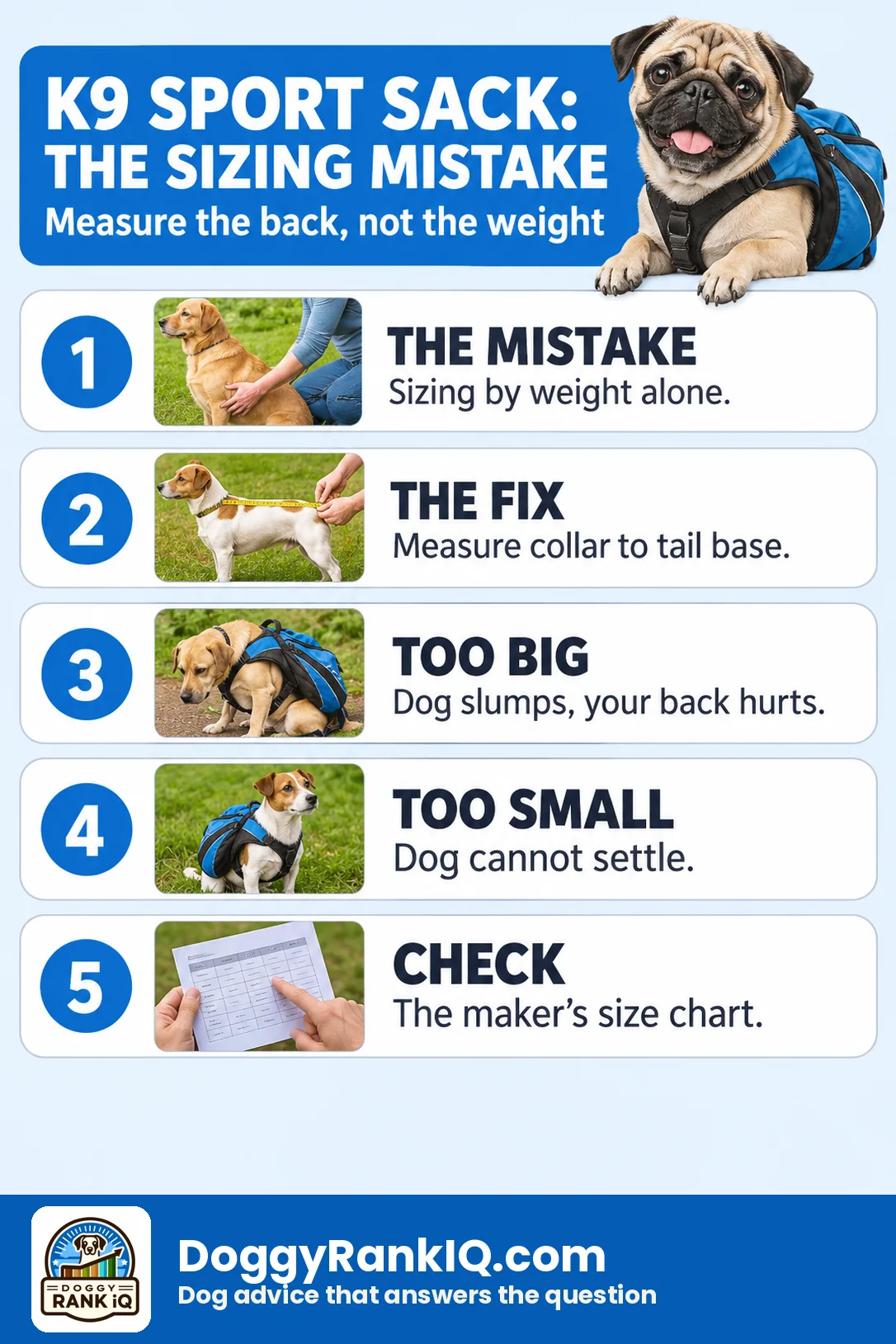
The sizing mistake is simple to state and easy to make: owners shop by their dog’s weight on the scale instead of measuring the dog’s actual back length, then wonder why the “right size” carrier still pulls sideways on a walk.
Weight tells you whether a model’s capacity is sufficient. It does not tell you whether the bag’s internal pouch will fit your dog’s frame. A 22-pound dachshund and a 22-pound corgi do not share a back length, and a pack sized for one will sag or pinch on the other.
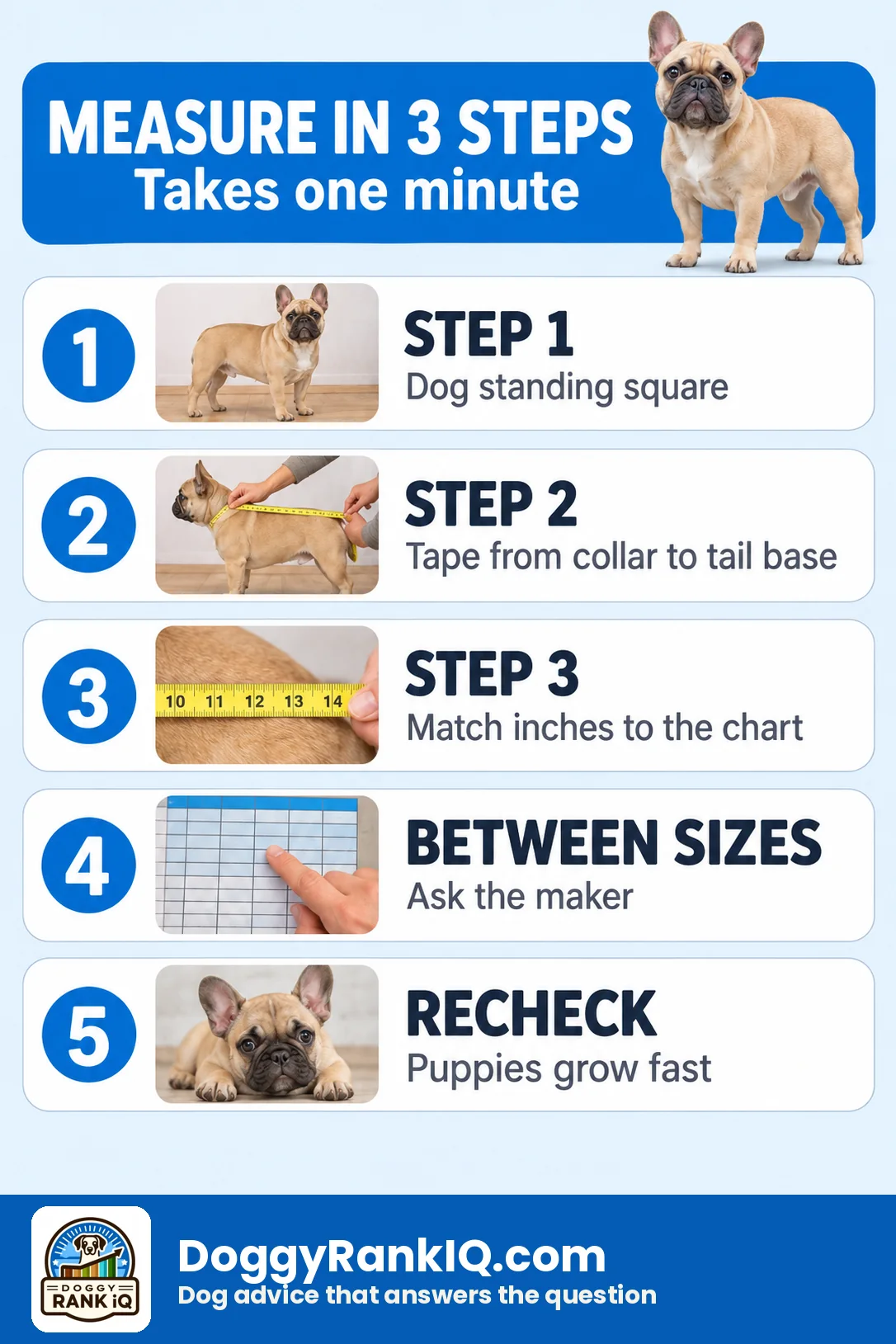
1. Measure collar to tail base. With your dog standing normally, run a soft tape from the base of the neck (where a collar sits) to the base of the tail. This single number is the one the brand’s sizing guide actually uses.
2. Match the number to the size chart, not the weight chart. Published ranges commonly run XS at roughly 9 to 12 inches, S at 13 to 16 inches, M at 17 to 19 or 20 inches, and L at 20 to 22 or 23 inches, with Knavigate and Kolossus extending beyond that for bigger dogs.
3. Check girth and chest depth second. Back length picks the size bracket. Girth confirms the pouch will close comfortably without compressing the ribs.
4. Weigh the dog last, and compare to the model’s carry limit, not just the size chart. A dog can be the “right” back length and still be too heavy for a lightweight model’s intended use.
5. Watch for the oversizing trap. A common mistake is buying one size up “for safety” on a heavier dog. This lets the dog slump or shift sideways instead of sitting supported, which increases use on the wearer’s lower back.
Common mistake: sizing up because a dog is near a weight cutoff. The better move is sizing correctly by back length, then stepping up to a model with a frame and hip belt, such as the Knavigate, if the dog’s weight calls for it.
Related reading on the broader category: our dog backpack carrier comparisons cover fit checks across several brands, not just K9’s own lineup.
How to measure your dog for a k9 sport sack
Measuring takes about two minutes and needs nothing more than a soft fabric tape measure and a dog standing in a normal relaxed stance, not sitting or stretching. Getting this number right before you shop prevents most of the common fit complaints owners report after purchase.
- Stand the dog on a flat surface in a natural posture, not hunched or stretched.
- Place the tape at the base of the neck, roughly where a flat collar sits.
- Run the tape along the spine to the base of the tail, where the tailbone starts, not the tip of the tail.
- Record the number in inches and round down rather than up if it falls between two sizes.
- Measure chest girth (the widest part of the ribcage) as a second check once you know the size bracket.
Example: a 16-inch back length paired with a 24-inch girth points to a Small in most Sport Sack models, assuming the dog’s weight also falls within that size’s carry range. If weight runs heavier than the size chart average for that bracket, step up to a model with a frame rather than a bigger size in the same soft-bottom line.
K9 Sport Sack sizing chart and fit guide
The sizing chart uses back length as the primary measurement, with weight listed as a secondary reference range per size, not the deciding factor. XS typically covers roughly 9 to 12 inches, S covers 13 to 16 inches, M covers 17 to 19 or 20 inches, and L covers 20 to 22 or 23 inches, with Knavigate and Kolossus extending further for larger breeds.
A proper fit means the dog’s legs tuck comfortably without the pouch gaping open at the top or pinching at the sides. The dog’s head and neck should clear the top opening without the chin resting directly on the fabric edge. If the fabric puckers or bunches at the bottom seam, the pack is too big; if the zipper strains to close around the dog’s middle, it’s too small.
Decision rule: if your dog’s back length lands exactly between two sizes, choose the smaller size for an actively calm dog and the larger size only if your dog is still growing, such as a puppy under a year old.
K9 Sport Sack models compared: Air 2, Plus 2, Urban 3, Knavigate
Each model solves a different problem, and the price gap between retail and discount channels in 2026 is wide enough to shop around before buying.
| Model | Best for | Key feature | Price (2026) |
|---|---|---|---|
| Air 2 | Short errands, light dogs | Lightweight, soft bottom, less rigid support | $29 to $75 |
| Plus 2 | Small to medium dogs, forward-facing | Compact, upright position, no major hip belt | $39 to $100 |
| Urban 3 (Large) | City walks, structured day use | Fits 20 to 22 inch back length | $99.95 |
| Knavigate | Heavier dogs, hikes, longer outings | Internal frame, padded hip belt | $29 to $195 |
Prices checked 2026. Discount retailers such as Sierra have listed clearance pricing well below list price, while Chewy carries current list pricing.
The Sport Sack Urban 3 Large fits a 20 to 22 inch back length at $99.95. Check the current price.
A Sport Sack on Amazon is listed at $59.95. Check the current price.
A larger Sport Sack on Amazon runs $200.00. Check the current price.
K9 sport sack price and where to buy
Prices across the Sport Sack line generally run from about $30 for smaller or clearance-tagged models up to roughly $260 for the largest frame-supported designs, with most popular sizes landing between $60 and $200 depending on the model and retailer. Buying direct from the brand usually means full list price but guaranteed current stock, while third-party retailers sometimes run deep clearance discounts on discontinued colorways.
- Brand website: full catalog, current sizing guidance, and warranty support.
- Amazon: frequent in-stock availability, user reviews visible before purchase, and the specific listings linked above.
- Chewy: list pricing with reliable restocking.
- Sierra and similar discount retailers: clearance pricing, but inconsistent size and color availability.
Tip: check back length against the chart before clicking buy on a clearance listing, since returns on discount sites can be slower than on the brand’s own store.
How much weight you can carry comfortably, and for how long
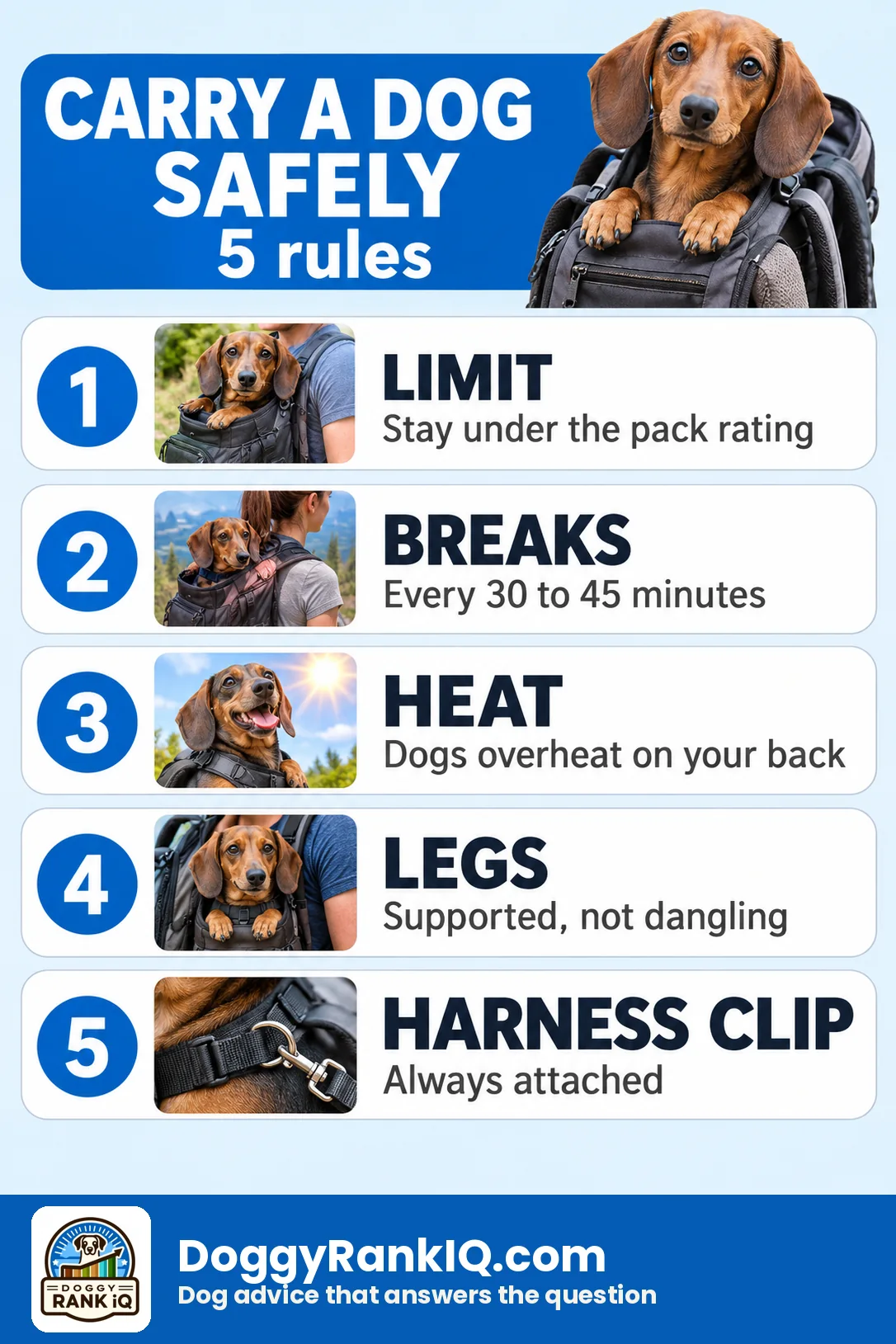
Comfortable carry weight depends on the model’s hardware, not just its stated maximum, and duration matters as much as pounds. A soft-bottom bag that technically holds 25 pounds for a 20-minute errand is a different experience than carrying that same weight on a 90-minute hike.
The Air 2 was rated 7.1 out of 10 for hiking in independent testing from Bike Magazine, with its fabric bottom noted as offering less rigid support than carriers built on a firm base. That is fine for a quick trip around the block. It becomes a problem on uneven terrain or longer distances, where the dog’s weight shifts without a structured floor to stop it.
Owner reviews of the Plus 2 describe shoulder pain even with a roughly 20-pound dog, partly because the design lacks a substantial waist-support system to move weight off the shoulders and onto the hips. That detail matters more than the number on the weight tag. A hip belt moves load to stronger muscle groups. Without one, the shoulders absorb nearly everything.
Decision rule: for carries under 30 minutes with a dog under 15 pounds, a basic model is usually fine. For longer outings or dogs above 15 to 20 pounds, prioritize a frame and hip belt over a lower price.
Edge case: a dog that is restless or repositions often effectively adds weight through motion, even if the scale number stays the same. If your dog fidgets, size down the trip length before you size up the pack.
How much weight can a k9 sport sack hold?
Stated weight limits vary by model, with lighter builds like the Air 2 intended for smaller dogs on short trips and frame-supported models like the Knavigate rated for heavier dogs over longer distances. The number printed on a product page is the upper limit for the pouch’s stitching and zippers, not necessarily a comfortable carry weight for the wearer over an hour-long walk.
A dog near a model’s stated maximum should generally move up to the next size or a frame-supported model rather than ride at the very top of that range for extended periods. This matters most on bike rides and hikes, where sustained vibration and uneven ground place repeated stress on seams and straps that a short errand never tests.
K9 Sport Sack vs Ruffwear or other dog backpack brands
 K9 Sport Sack vs Ruffwear or other dog backpack brands
A Sport Sack carries the dog fully inside a pouch, while brands like Ruffwear typically make harness-style backpacks the dog wears and walks in in themselves, carrying its own gear rather than being carried. These are different categories solving different problems, so the comparison depends on whether the goal is to carry the dog or to let the dog carry its own supplies.
- Choose a Sport Sack if the dog cannot or should not walk the full distance, due to age, joint issues, or size.
- Choose a wearable dog backpack (Ruffwear-style) if the dog is fit, mobile, and simply needs to carry its own water or gear on a hike.
- Some owners use both: a wearable harness pack for the healthy miles and a Sport Sack in a bike basket or car for breaks.
Spots’ 2026 roundup of the best dog backpack carriers places the Sport Sack line alongside frame-based hiking carriers, noting that fit and hip support separate the comfortable options from the ones that cause owner fatigue.
Best k9 sport sack for small dogs
For small dogs under about 15 pounds with a back length in the 9 to 16 inch range, the Air 2 or a smaller Plus 2 generally fits best, since both keep total pack weight low for short errands and quick walks. Small dogs rarely need the internal frame or hip belt that heavier dogs benefit from, since the combined pouch and dog weight stays light enough for shoulder straps alone.
Example: a 10-pound Yorkie with a 12-inch back length is a reasonable fit for an XS Air 2 on neighborhood walks, but would still do better in a Plus 2 for longer outings where a forward-facing view keeps the dog calmer.
Do dogs actually like wearing a k9 sport sack?
Dog response to a Sport Sack varies by temperament, not breed, and some dogs settle within minutes while others show signs of stress the entire time. There is no universal answer, which is why a short test carry around the house or yard before a real outing matters more than any marketing claim.
Signs a dog is comfortable include a relaxed body, normal breathing, and a dog that stops moving after the first minute or two. Signs a dog is not comfortable include panting that doesn’t match the temperature, repeated attempts to climb out, or a stiff, braced posture. Our guide to dog body language walks through these signals in more detail for owners testing any kind of carrier for the first time.
K9 Sport Sack reviews and ratings
Review patterns across retail sites and independent outlets show a consistent split: owners who sized correctly report positive experiences, while owners who guessed by weight report shoulder pain or a dog that slumps. Dogster’s 2026 review of the Sport Sack line notes that fit, more than any single feature, determines whether a tester rated a model highly or poorly.
Independent testing from Dogster’s hiking backpack roundup places frame-supported models ahead of soft-bottom bags for trail use specifically because of load distribution, not brand loyalty. This lines up with owner complaints collected on retail sites, where shoulder strain shows up repeatedly on lighter models without a hip belt.
K9 Sport Sack alternatives that work for hiking
For dogs that need real trail support rather than a short walk option, a frame-based carrier or a wearable harness backpack (where the dog walks and carries its own light gear) tends to outperform a soft-bottom carrier on uneven terrain. Dogster’s best hiking backpack carriers list for 2026 covers several frame-supported options worth comparing against the Knavigate specifically.
- Choose a frame-supported carrier (such as the Knavigate) if the dog needs to be carried for more than 30 to 45 minutes on uneven ground.
- Choose a wearable harness-style backpack if the dog is mobile and just needs to carry its own water and treats.
- Choose a soft-bottom carrier only for flat, short-distance trail sections where the dog otherwise walks the rest of the route.
Is a Sport Sack worth the money?
A Sport Sack is worth the cost when the size matches the dog’s measured back length and the model fits the activity, since a correctly sized pack genuinely reduces strain on both the dog and the wearer compared to an oversized or mismatched one. It is not worth the cost if bought on weight alone, oversized “for safety,” or used well past a model’s intended duration or terrain.
Decision rule: budget around $60 to $100 for a correctly sized Plus 2 or Urban 3 for typical walks and errands, and budget closer to $150 to $195 for a Knavigate if the dog is heavier or outings run longer than 30 minutes.
⭐ Top 5 Features We Love
- Collar-to-tail sizing charts. Measuring back length instead of guessing from weight gives owners a repeatable, objective number to shop with.
- Forward-facing designs on Plus 2 and Urban models. Many dogs seem calmer when they can see ahead rather than facing backward into the wearer.
- Internal frame on Knavigate. A built structure holds the dog’s position steady instead of letting the pouch collapse under movement.
- Range of entry prices. Discount listings have put some models under $40, making the line accessible for owners testing the idea before committing to a $200 model.
- Washable fabric options. Multiple models use removable or wipeable liners, which matters given how often a dog in a bag ends up drooling, shedding, or worse.
⚠️ Things to Look Out For
- No published safety certification. K9 reportedly consulted a veterinarian on ergonomics, but no independent, peer-reviewed study verifies the upright carry position for extended use, according to the brand’s own safety page.
- Shoulder strain on lighter models. Reviewers and owners report shoulder pain on the Plus 2 even at modest dog weights, largely tied to the lack of a hip belt.
- Crooked seating. A dog that sits off-center inside the pouch shifts weight unevenly onto the wearer’s back, a pattern noted directly in a 2026 Air 2 review.
- Oversizing temptation. Buying a bigger size to accommodate a heavier dog, instead of a better-built model, tends to make the fit worse, not safer.
- Inventory gaps on clearance pricing. Discount-channel prices can be excellent, but specific sizes and colors sell out fast, so the lowest price is not always available in your dog’s size.
If your dog has any joint, spine, or mobility condition, confirm with your veterinarian that carrying in any backpack position is appropriate before regular use.
Which model for biking, hiking and city errands
The right Sport Sack depends on the activity more than the dog’s breed. Biking calls for a stable, close center of gravity. Hiking calls for structure and a hip belt. City errands call for something light enough to carry without a second thought.
- Biking: choose a snug, forward-facing fit with a sternum strap that keeps the dog from swaying as you pedal. The Plus 2 or Urban 3 suit short to medium rides for smaller dogs, correctly sized.
- Hiking: the Knavigate is generally the better match for longer trail time or heavier dogs, since its internal frame and padded hip belt move weight off the shoulders. Travel and Leisure named it a top pick specifically for larger dogs.
- City errands: the Air 2’s lighter build fits quick trips, elevators, and stores where a dog needs to be off the ground briefly rather than carried for miles.
Example: a 12-pound senior dog going on 15-minute neighborhood walks is a reasonable fit for the Air 2 or a compact Plus 2. A 24-pound dog joining a two-hour trail hike is a better match for the Knavigate, where the frame and belt do the work the dog’s own posture can’t.
FAQ
The bottom line
A Sport Sack earns its price when the size matches the dog’s measured back length and the model matches the job, not when it’s picked off a weight chart alone. Measure collar to tail base first. Compare that number against the brand’s chart. Then choose hardware, a hip belt and frame for longer or heavier carries, a lighter build for short trips, before worrying about color or price. Check the dimensions one more time before you check out, and your back will thank you on mile two.
Doggy Rank IQ is reader supported. As an Amazon Associate we earn from qualifying purchases, at no extra cost to you.