
Quick Answer
A gentle leader is a head collar that steers your dog by the muzzle, giving you the most control over a strong puller or a reactive dog. The Easy Walk harness redirects pulling from the chest, which most owners find easier to introduce. Choose the gentle leader if your dog pulls hard enough to hurt your shoulder; choose the Easy Walk if your dog mostly just tugs and you want a fast, no-fuss fix. Neither tool trains loose leash walking on its own; both work by changing where the pressure lands when your dog pulls.
Key Takeaways: gentle leader
- A head collar redirects your dog’s head, not just the body, which makes it the stronger option for very strong pullers or reactive dogs PetSafe.
- The Easy Walk harness uses a front martingale loop that tightens gently across the chest and turns the dog back toward you.
- PetSafe’s own 2026 comparison recommends the Easy Walk first for ordinary pulling and saves the head collar for dogs who need maximum control PetSafe.
- A 2026 review found dogs may pull just as hard in a back-clip harness as on a collar, so the clip position matters more than the word “harness” on the label Frontiers in Veterinary Science.
- Fitting mistakes, not the tool itself, cause most of the complaints about a head collar rubbing or riding up PetSafe Support.
- Never jerk a leash attached to a head collar; a sudden sideways pull can strain the neck VCA Animal Hospitals.
- A PetSafe Head collar Headcollar runs about $16 to $18, and the Easy Walk harness runs about $18.99 to $22.99, price checked 2026.
- Both tools are management equipment, not a replacement for teaching your dog not to pull in the first place.

How does your dog pull?
Tap an option to see the answer.
 What is a Gentle Leader and how does it stop pulling?
 What is a Gentle Leader and how does it stop pulling?
A head collar is a head collar with a strap that sits high on the nose and a loop behind the ears, with the leash clipping under the chin. When your dog pulls forward, the head collar turns the head back toward you, and the body naturally follows because a dog cannot easily keep walking forward with its nose pointed sideways PetSafe.
This is the same principle used on horses for centuries, and it works on the same logic here: control the head, and you control a surprising amount of the body. PetSafe’s product documentation describes the leash attachment under the chin as the mechanism that redirects the dog’s forward movement, letting a smaller or weaker owner manage a much stronger dog PetSafe Support.
The head collar is not a muzzle. The dog can open its mouth, pant, drink, and take treats normally. What it restricts is the forward lunge, which is exactly the behavior that turns a walk into a shoulder injury.
Decision rule: if your dog is strong enough to pull you off balance, or reactive enough to lunge at other dogs, the head collar’s steering advantage usually outweighs the learning curve.
Gentle Leader vs Easy Walk harness
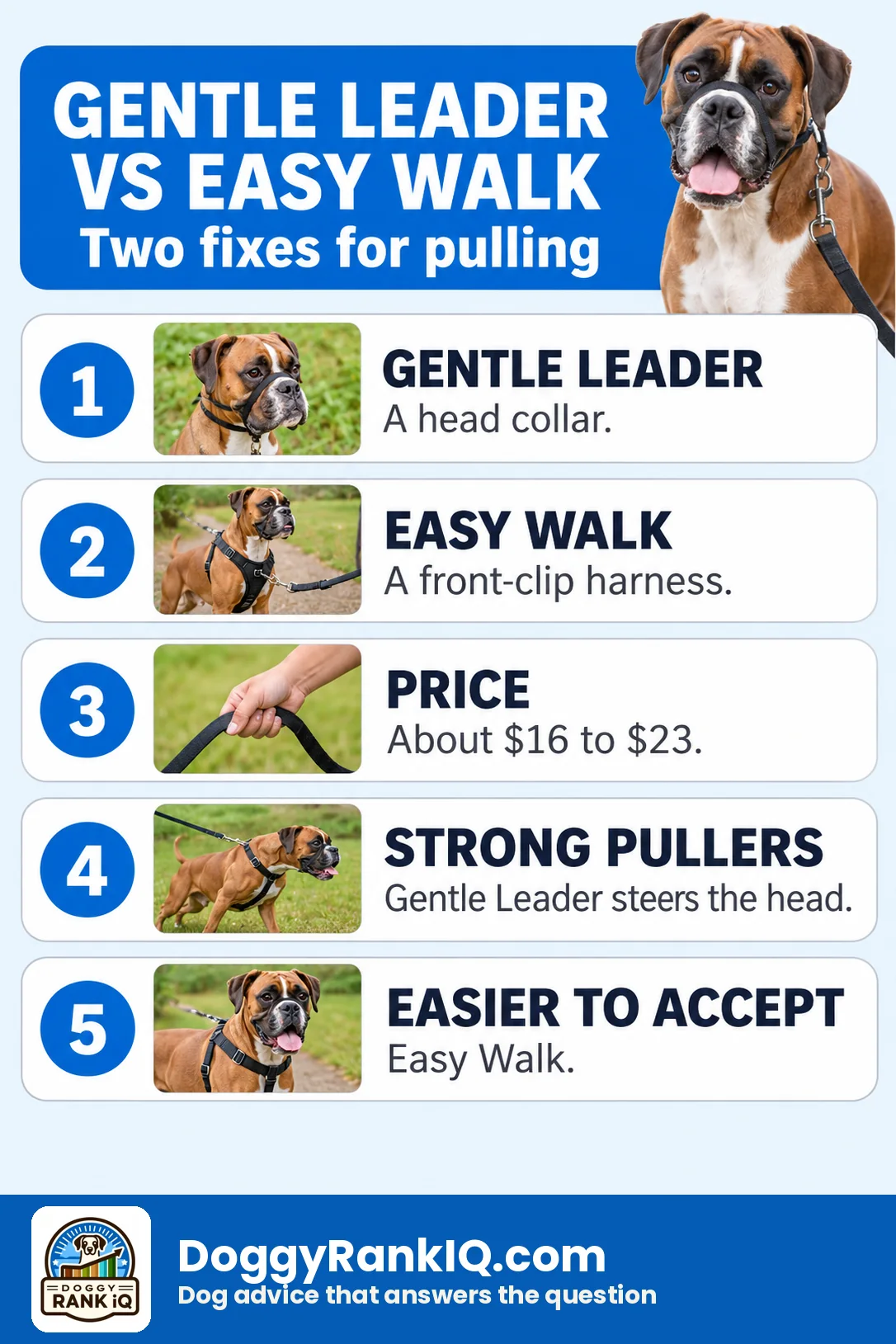
A headcollar steers the head. A front-clip harness redirects the chest. That one-sentence difference explains almost every other difference between these two products.
| Feature | Head collar Headcollar | Easy Walk Harness | Price (checked 2026) |
|---|---|---|---|
| Where pressure lands | Nose and behind the ears | Chest, via a tightening front loop | – |
| Best for | Very strong pullers, reactive dogs | Ordinary pulling, first-time fix | – |
| Learning curve | Higher, needs introduction period | Lower, most dogs adjust fast | – |
| Medium size | PetSafe Head collar Headcollar Medium | PetSafe Easy Walk Harness Medium | $18.00 / $18.99 |
| Large size | PetSafe Head collar Headcollar Large | PetSafe Easy Walk Harness Large | $16.00 / $22.99 |
PetSafe’s own 2026 comparison recommends the Easy Walk when pulling is the main issue and an easy introduction matters, and recommends the head collar for very strong pullers or reactive dogs needing the most control PetSafe. Both are marketed as keeping pressure off the throat, which is the shared selling point against a flat collar.
A relevant wrinkle: a 2026 review in Frontiers in Veterinary Science found dogs may pull just as hard, or harder, in a back-clip harness compared to a plain collar Frontiers in Veterinary Science. That does not knock the Easy Walk, since its clip sits at the front, not the back. It does mean “harness” alone is not a magic word. The clip location is what matters more than the fabric or the brand name on the packaging.
If you want more options beyond these two, the best no pull dog harness guide breaks down front-clip picks by chest shape.
How do I put a gentle leader on my dog?
Fitting a head collar correctly is the single biggest factor in whether your dog tolerates it. A loose or crooked fit is the usual cause of rubbing, slipping, or a dog pawing at its face.
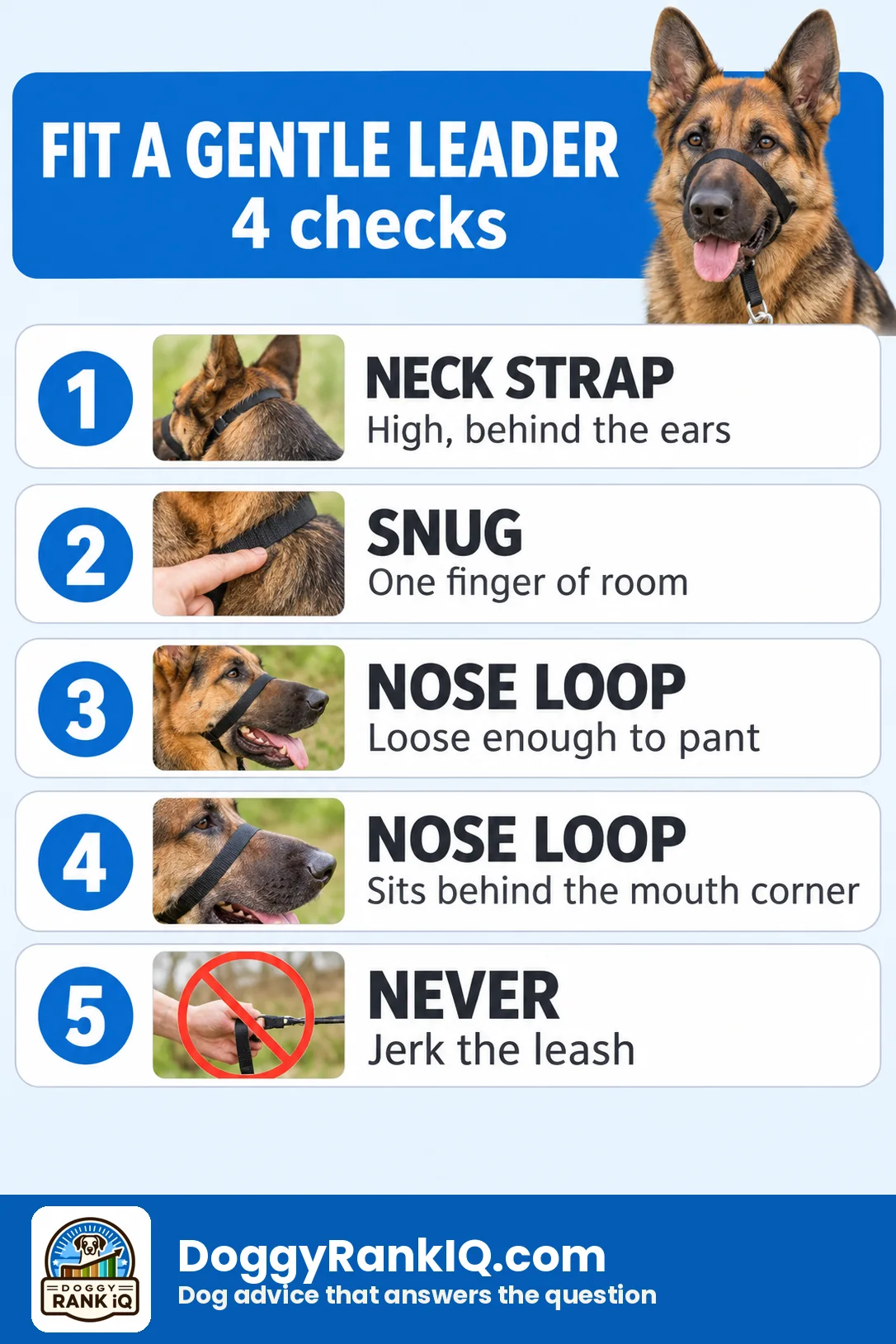
- Measure the muzzle. The nose loop should sit about one finger-width below the eyes, loose enough to fit one finger underneath PetSafe Support.
- Slide the nose loop on gently. Use a treat to encourage your dog to push its nose through rather than forcing the strap over the muzzle.
- Clip the neck strap behind the ears, adjusted snug enough that it won’t slip off but loose enough to fit two fingers underneath.
- Attach the leash under the chin, not to the neck strap. The leash clip belongs on the ring under the jaw PetSafe Support.
- Reward immediately with a few treats while the head collar is on, before attempting to walk anywhere.
- Check the fit after five minutes of wear; straps can shift slightly as your dog moves.
Common mistake: attaching the leash to the wrong ring. PetSafe support notes that a leash clipped to the neck loop instead of the chin ring causes rubbing and loses the steering effect entirely PetSafe Support.
How to fit and use a gentle leader properly day to day
Using a head collar correctly on every walk, not just the first fitting, is what keeps a dog comfortable long term. The fit should be checked every time you put it on, not assumed from the last walk.
- Walk with a loose leash whenever possible. A head collar works best as a steering tool for the occasional pull, not as something pulled tight continuously.
- Use treats during the first several walks so the dog associates the straps with good things happening, not just restriction.
- If your dog paws at the nose loop constantly after two weeks, recheck the fit before giving up on the product. A strap sitting too low, near the mouth, is a frequent culprit PetSafe Support.
- Short training sessions work better than long forced walks during the first week. Five to ten minutes around the yard beats a full walk around the block on day one.
Example: a 60-pound Labrador that lunges at squirrels on a flat collar often calms within two or three short sessions once the head collar is introduced gradually with treats, according to PetSafe’s own training guidance PetSafe Support.
Are Gentle Leaders bad? The fair answer
A head collar is not inherently harmful when it is sized correctly and introduced slowly, but it is not stress-free for every dog, and the fair answer includes both sides. Some dogs adapt within days. Others paw at their face for a week and need a slower introduction schedule.
RSPCA Australia’s updated 2026 guidance says head collars have largely been replaced by front-attach harnesses in many training programs, because some dogs find them uncomfortable or distressing, and because a sudden sideways jerk on the leash can cause discomfort or injury RSPCA Australia. VCA Animal Hospitals agrees on the mechanics: never jerk the leash when a headcollar is worn, since the force lands on the neck through the strap VCA Animal Hospitals.
That is a real caution, not a reason to rule it out. VCA also notes a headcollar gives a genuine safety advantage for a smaller or physically limited owner walking a strong dog VCA Animal Hospitals. The tool works. The handling has to be gentle, which is, fittingly, the whole point of the name.
Safety backup both sources agree on: attach a second leash or safety clip to a flat collar or harness whenever a head collar is worn, in case the head collar slips off mid-walk VCA Animal Hospitals.
Is a gentle leader safe for dogs, and can it hurt or choke them?
A head collar is generally considered safe when fitted correctly and used without leash jerking, but it carries a real risk of neck strain if a sudden sideways pull happens on a tight leash. It does not work like a choke collar, since it sits on the nose and behind the ears rather than around the throat, but force applied incorrectly can still cause discomfort.
- It cannot “choke” a dog the way a slip collar can, since there is no tightening loop around the windpipe.
- A sharp sideways jerk, however, can strain the neck muscles, which is why VCA specifically warns against any jerking motion on a head collar leash VCA Animal Hospitals.
- Dogs with existing neck or spinal issues should not wear a head collar without a veterinarian’s input first.
- Short-term pawing or rubbing at the nose is common in week one and usually settles once the dog gets used to the sensation, according to PetSafe’s fitting troubleshooting PetSafe Support.
Edge case: a dog recovering from a neck injury, or an older dog with cervical arthritis, should stick to a front-clip harness instead, since any pressure near the head and neck could aggravate the condition.
Gentle leader vs no pull harness: which is better?
Neither option is universally “better”; the head collar gives stronger steering control for big, strong, or reactive dogs, while a no pull harness like the Easy Walk is gentler to introduce and works well for everyday pulling. The right pick depends on how hard your dog pulls and how quickly you need control.
- Choose the head collar if your dog is strong enough to pull you off balance or lunges hard at triggers.
- Choose a no pull harness if your dog mostly just leans into the leash and you want something your dog accepts almost immediately.
- A head collar offers more precise redirection in an emergency, since turning the head turns the whole dog.
- A harness is generally viewed as less invasive to introduce, since it doesn’t touch the face at all.
For a wider lineup of no pull harness options sorted by chest shape and breed, the best no pull dog harness guide is a useful next stop.
Gentle leader vs prong collar comparison
A head collar and a prong collar solve the same pulling problem through very different means: the head collar steers the head gently from the nose and ears, while a prong collar applies pinching pressure around the neck when the dog pulls. Veterinary sources generally favor head collars and front-clip harnesses over prong or choke-style tools because they avoid direct pressure on the throat VCA Animal Hospitals.
- A head collar redirects the head; a prong collar corrects through pinch pressure on the neck when the dog pulls.
- A prong collar can be misused more easily if the owner yanks the leash, since the correction is physical rather than directional.
- Most modern trainers and veterinary sources recommend starting with a head collar or front-clip harness before considering a prong collar, particularly for reactive dogs where steering matters more than correction VCA Animal Hospitals.
- A head collar also works on the same leash-and-treat training approach used in basic obedience work; pairing it with the steps in the 5 essential commands every puppy should learn guide builds faster progress than gear alone.
How much does a gentle leader cost, and where to buy a gentle leader
A PetSafe Head collar Headcollar generally costs about $16 to $18 depending on size, while the comparable Easy Walk harness runs roughly $18.99 to $22.99, with prices checked in 2026. Both products are widely stocked online and at most pet supply retailers, so pricing rarely varies by more than a couple of dollars between sellers.
- Medium head collar headcollars typically run close to $18.
- Large head collar headcollars often run slightly cheaper, around $16, depending on current retailer stock.
- Easy Walk harnesses run a bit higher across both sizes, from about $18.99 up to $22.99.
- Buying directly from PetSafe’s own site guarantees the current official sizing chart, while marketplace listings like the ones linked in the comparison table above offer faster shipping in many cases.
Decision rule: if budget is the deciding factor between the two tools, the head collar is usually the cheaper of the two at every size, though the difference is small enough that fit and dog behavior should still drive the choice.
Why won’t my dog keep the gentle leader on?
Dogs that paw, rub, or flip the head collar off repeatedly are almost always reacting to fit problems or a rushed introduction, not rejecting the concept of a head collar outright. PetSafe’s support documentation ties most complaints directly to sizing and attachment mistakes rather than the product itself PetSafe Support.
- Check that the nose loop sits a finger-width below the eyes, not down near the mouth where it feels more restrictive.
- Confirm the leash clips to the ring under the chin, since a leash clipped elsewhere causes pulling and discomfort that encourages pawing.
- Slow down the introduction. A dog that was put straight into a full walk on day one often fights the gear; a dog introduced with treats indoors for a few days usually settles faster PetSafe Support.
- If pawing continues after a proper refit and a slower introduction over one to two weeks, switching to a front-clip harness is a reasonable next step rather than forcing the issue.
Best alternatives to head collar
The Easy Walk front-clip harness is the most common alternative to a head collar, and it is worth trying first for dogs with ordinary pulling rather than reactive lunging. Other alternatives depend on the specific problem being solved.
- Easy Walk harness: best general alternative for everyday pulling, covered in detail in the comparison table above.
- Dual-clip harnesses with front and back rings: useful for dogs that need some front-clip redirection but also benefit from a back ring for everyday clipping.
- Basic obedience training: pairing any gear with loose leash practice addresses the root behavior rather than only managing the symptom.
- Prong or slip collars: generally a last resort compared to head collars and harnesses, and best used under guidance from a trainer given the risk of misuse described above.
See the full best no pull dog harness comparison for more harness-specific alternatives sorted by chest shape and pulling style.
Head collar for puppies: is it safe?
A head collar can be used on some puppies once they are old enough for a correctly sized small head collar, but most trainers suggest starting young puppies on a harness while they are still learning basic leash skills. Puppies have smaller, more sensitive faces, and a head collar introduced too early or fitted poorly can create more frustration than benefit.
- Wait until a puppy is comfortable walking on a leash at all before adding a head collar to the mix.
- Use the smallest properly measured size, and check the fit weekly since puppies grow fast.
- Pair any gear with basic training from early on; the 5 essential commands every puppy should learn guide covers the leash fundamentals most puppies need before gear can do its job.
Can you leave a head collar on all day?
No. A head collar is designed for active walks and training sessions, not for all-day wear. It should come off once the walk is finished, the same way a harness or leash would.
- Leaving any head collar on unsupervised risks snagging on furniture, crates, or outdoor objects.
- The nose strap can also cause irritation if worn for extended periods without a break.
- Treat the head collar the same way you would treat a leash: on for walks and training, off the rest of the time.
Do vets recommend head collar use?
Many veterinary sources, including VCA Animal Hospitals, acknowledge that head collars like the head collar offer a real safety benefit for owners managing strong or reactive dogs, while also cautioning that the leash should never be jerked VCA Animal Hospitals. Recommendations generally come with the same caveat: correct fit and gentle handling matter more than the tool itself.
- Veterinary behaviorists tend to favor head collars or front-clip harnesses over prong or choke collars for everyday pulling and reactivity.
- Some veterinary sources, including RSPCA Australia, now lean toward recommending front-attach harnesses first in many cases, reserving head collars for dogs that need stronger steering RSPCA Australia.
- No major veterinary body recommends prong or choke collars as a first choice for ordinary leash pulling.
What size dogs can use a head collar?
A head collar is made in sizes ranging from small to large, generally covering dogs from around 8 pounds up through large breeds over 60 pounds, depending on the specific product line and muzzle shape. Sizing by muzzle length and head shape matters more than weight alone.
- Small sizes fit toy and small breeds with narrower muzzles.
- Medium sizes fit most mid-size breeds like spaniels, retrievers on the smaller end, and similar builds.
- Large sizes fit bigger dogs such as Labradors, German Shepherds, and other large breeds with longer muzzles.
- Short-nosed breeds such as pugs, French bulldogs, and boxers often fit poorly in any size of head collar because of their flat muzzle shape, and a front-clip harness is usually the more practical choice for these dogs.
⭐ Top 5 Features We Love
- Chin-ring leash attachment on the head collar. Clipping under the chin, not the neck, is what gives the steering effect instead of just another collar PetSafe Support.
- Front martingale loop on the Easy Walk. It tightens gradually across the chest rather than choking, and loosens again once the dog stops pulling.
- No-tool adjustment straps. Both products use standard slide buckles you can resize without extra hardware, useful for a growing puppy or seasonal coat changes.
- Dual-size options under $25. Medium and large covers most households, and both products stay well under budget compared to pricier training harnesses.
- Manufacturer fit guides built for self-service. PetSafe publishes step-by-step fitting and training instructions for both products, so there’s a documented reference instead of guesswork PetSafe Support PetSafe Support.
⚠️ Things to Look Out For
- Pawing and rubbing at the nose strap. This is the most common head collar complaint, and PetSafe’s own troubleshooting page ties it directly to a loose or shifted fit PetSafe Support.
- The “chest tighten” on the Easy Walk needs checking for short-nosed or barrel-chested breeds. A poorly adjusted loop can sit too high and ride into the armpit.
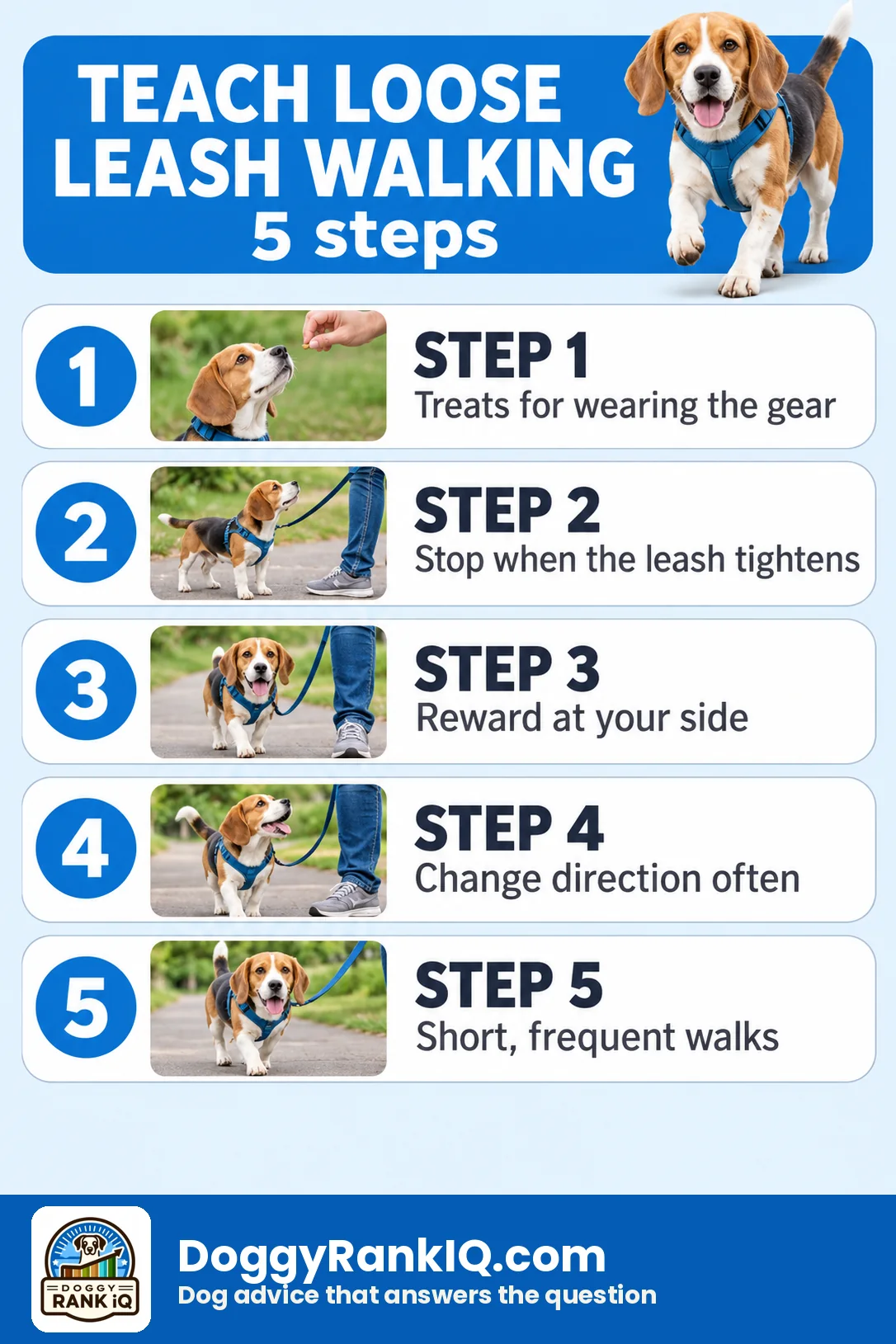
- Neither tool teaches loose leash walking by itself. Both manage the pull in the moment; the actual behavior change still needs training repetition PetSafe Support.
- A sudden leash jerk on a head collar is a real risk, not a theoretical one, according to VCA’s warning about neck strain VCA Animal Hospitals.
- Sizing charts vary slightly by breed shape. Measure your own dog’s muzzle and chest rather than guessing from breed alone; a Frenchie and a Lab labeled “medium” are not built the same.
Which one for which dog
The right pick depends on the specific pulling behavior, not the dog’s size alone. A steady tugger needs different handling than a dog who lunges at the mail carrier.
- The steady puller who leans into the leash on every walk: start with the Easy Walk. It’s the gentler introduction and solves ordinary pulling for most dogs PetSafe.
- The lunger or reactive dog who bolts at triggers: the head collar gives more precise head control in a sudden lunge, which matters more for safety than comfort during the adjustment period.
- Short-nosed breeds (pugs, French bulldogs, boxers): a head collar fits awkwardly on a short muzzle and can be harder to size correctly. A front-clip harness is usually the more practical starting point for these dogs.
- Puppies and small dogs: PetSafe markets smaller head collar and Easy Walk sizes, but a young or very small dog often does better starting with a harness alone while basic leash manners are still being taught. Pair either tool with basic leash fundamentals from the 5 essential commands every puppy should learn guide for the training side, not just the gear side.
Edge case: dogs with neck or spine conditions should avoid pressure near the throat or cervical spine; ask a veterinarian which tool fits the dog’s specific medical history before buying either product.
FAQ
The bottom line
A head collar steers the head; an Easy Walk harness redirects the chest. Pick the head collar for a strong puller or a reactive dog that needs real steering control, and pick the Easy Walk for ordinary tugging where an easy, low-stress introduction matters more than maximum control. Either way, treat the tool as management gear, not a substitute for teaching your dog to walk politely, and check the fit every single time before heading out the door.
Doggy Rank IQ is reader supported. As an Amazon Associate we earn from qualifying purchases, at no extra cost to you.