
Quick Answer
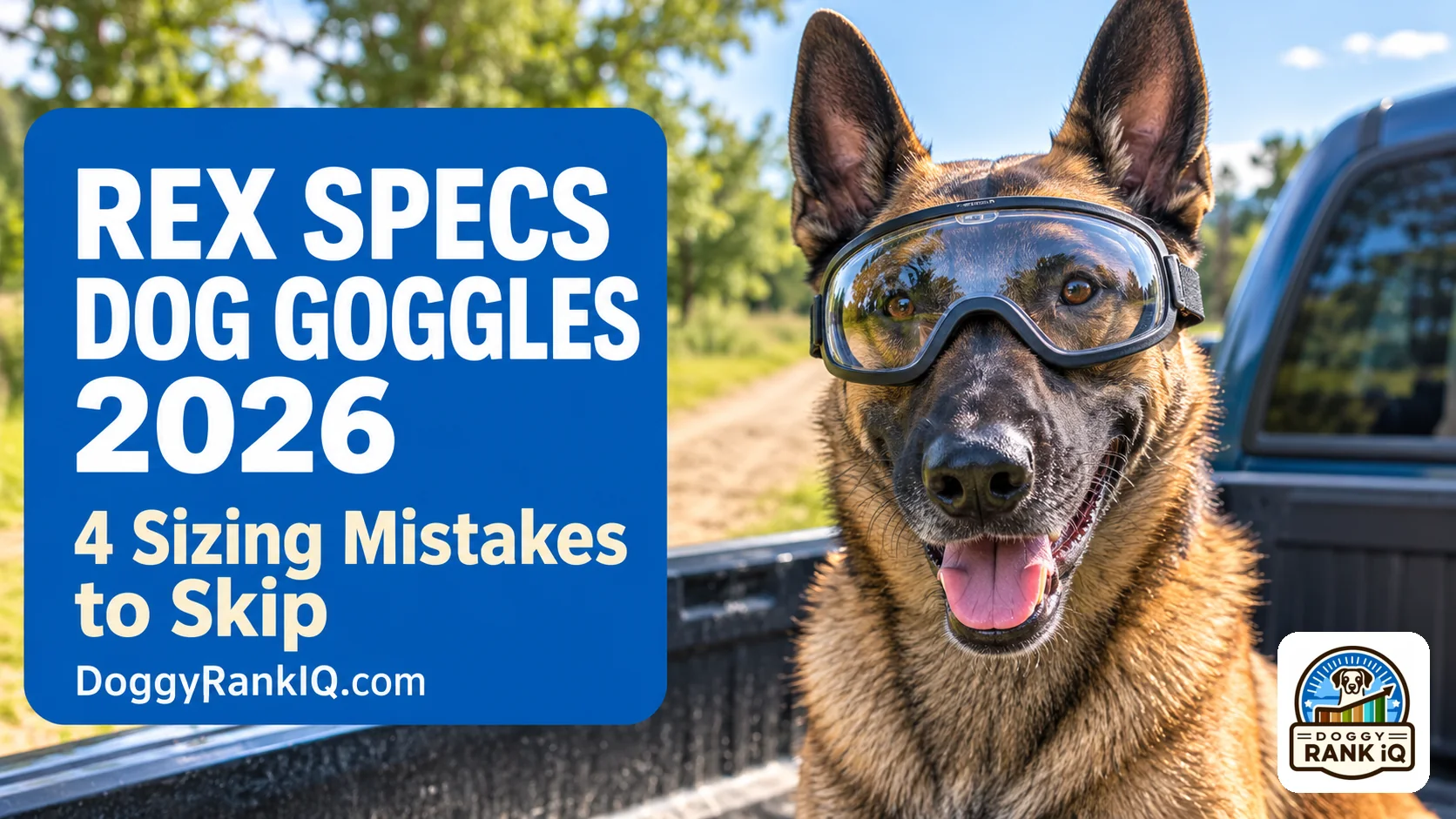
Rex specs dog goggles run $88.99 to $92.99 for the V2 model and come in six fit categories: XS, S, M, L, XL, and Small-Wide according to Rex Specs. The brand sizes by two measurements, muzzle circumference and the distance between eyes, not by breed or weight, and most returns trace back to owners guessing instead of measuring according to the Rex Specs size guide. The four sizing mistakes below (sizing by breed, skipping the muzzle measurement, ignoring eye placement, and assuming all puppies need XS) cause most of the fit complaints you’ll find in reviews. Get the tape measure out before you order.
Key Takeaways: rex specs dog goggles
- Rex specs dog goggles come in six sizes (XS, S, M, L, XL, Small-Wide) and the V2 version costs $88.99 to $92.99, price checked 2026.
- The brand’s own chart uses muzzle circumference and inter-eye distance, not breed name or weight.
- Small-Wide was built for short-nosed dogs like French Bulldogs, but the company still expects a nose around 1 inch long.
- Treeline Review named the V2 its Best Overall pick in 2026, citing secure straps, ventilation, and field of view.
- A loose fit lets in debris and dust, while a tight fit can press into the eye socket.
- Vets generally advise against leaving goggles on a dog overnight or unattended for long stretches.
- The V2 package includes one clear lens and one smoke lens, both UV400 and swappable.
- Most owner complaints about fit mention the same four mistakes, all avoidable with a tape measure and five minutes.

Which sizing mistake are you about to make?
Check the current price
Check the current price
Check the current price
Tap an option to see the answer.
 What are Rex Specs dog goggles and what do they do?
 What are Rex Specs dog goggles and what do they do?
Rex specs dog goggles are protective eyewear built by Rex Specs, a company that originally designed the product for working and military dogs before selling to pet owners according to Rex Specs. The current model, V2, uses a flexible vented frame, a single spherical lens, and adjustable straps meant to stay put through running, swimming, and impact.
The goggles aren’t sunglasses with a strap glued on. The frame flexes around the dog’s face, the lens sits away from the eye on a raised bridge, and side vents keep fog from building up during exertion. That lens spacing matters because it keeps the lens surface from touching the eyelid or lashes, which is a common complaint with cheaper goggles that use a flat lens pressed close to the face.
Who actually needs rex specs dog goggles: dogs who hike at altitude, ride on boats or motorcycles, run through brush, or have had eye surgery and need UV and debris protection during recovery. A dog who naps in the yard and walks around the block twice a day probably doesn’t need $90 eyewear. Confirm any post-surgery eye protection plan with your veterinarian before buying.
Owners researching recovery gear alongside eye protection might also want our piece on separation anxiety in dogs, since recovering dogs often need both calm routines and new gear introduced slowly. If you’re also shopping for other weather gear, our guide to the best dog winter coats covers a similar fit-first approach.
V1 vs V2: what changed
The V2 replaced V1 as Rex Specs’ current flagship, and the documented changes center on stability and visibility rather than a full redesign. V2 is described as having greater stability, a wider field of view, a lower profile, and better range of motion compared to the earlier version, according to Rex Specs’ own fit guide.
Choose V2 if you’re buying new in 2026. V1 units still circulate through secondhand gear sites and some retailers clearing stock, and the lens is often still compatible, but Rex Specs’ current fit chart and replacement lenses are built around V2’s frame geometry. Retailers like REI and Ray Allen now only stock V2.
How to measure your dog for Rex Specs
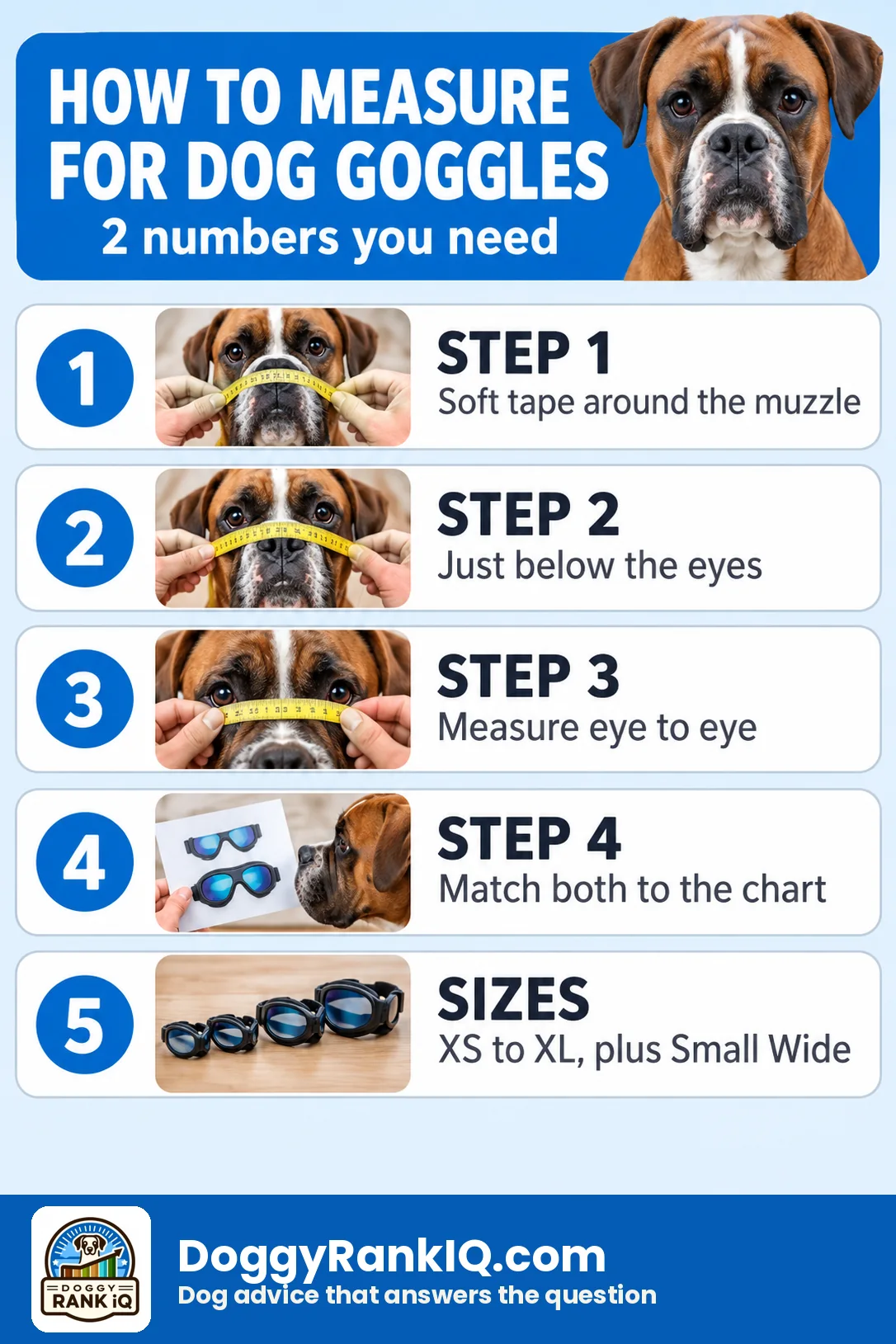
Measuring takes two numbers: muzzle circumference and the distance between the eyes, taken with a soft tape measure, not a guess based on the dog in the next aisle at the pet store, per the Rex Specs size guide.
- Measure muzzle circumference. Wrap the tape around the muzzle at the point where the goggle frame will actually sit, usually just behind the nose bridge and in front of the eyes.
- Measure inter-eye distance. Measure from the outer corner of one eye to the outer corner of the other.
- Check both numbers against Rex Specs’ size chart on the product page rather than rounding to the nearest size you’ve seen on a similar-looking dog.
- Note nose length for Small-Wide. Rex Specs still wants roughly a 1-inch nose length even for flat-faced breeds in this category.
- Write down both numbers before you order. If your dog falls between two sizes, sizing up usually trades a snugger seal for comfort, while sizing down tends to fail faster during activity.
Decision rule: if your dog’s muzzle circumference lands exactly on a size line, choose the larger size for high-motion activity like trail running, and the smaller size for calmer, shorter-duration wear.
What size dog goggles do I need for my dog?
The right size for rex specs dog goggles depends entirely on muzzle circumference and inter-eye distance, not on your dog’s weight or breed label. A 20-pound French Bulldog and a 20-pound Beagle can land in completely different size categories because their face shapes differ so much.
Use this quick logic when you’re staring at the chart:
- If your dog is short-nosed and wide-faced (French Bulldog, Boston Terrier, pug), start by checking Small-Wide even if the circumference number matches a regular Small.
- If your dog is long and narrow-muzzled (Greyhound, Collie, Doberman), you’ll likely land cleanly in one size with little ambiguity.
- If your dog is between two sizes on paper, think about the activity. Trail running and swimming call for sizing up for a tighter seal. Short, calm walks tolerate the smaller size fine.
A common mistake here is assuming a “medium dog” needs a Medium goggle. Rex Specs doesn’t size by overall dog size, it sizes by the two measurements above, and that disconnect is the root of most fit complaints found in customer reviews on Chewy.
The 4 sizing mistakes owners make
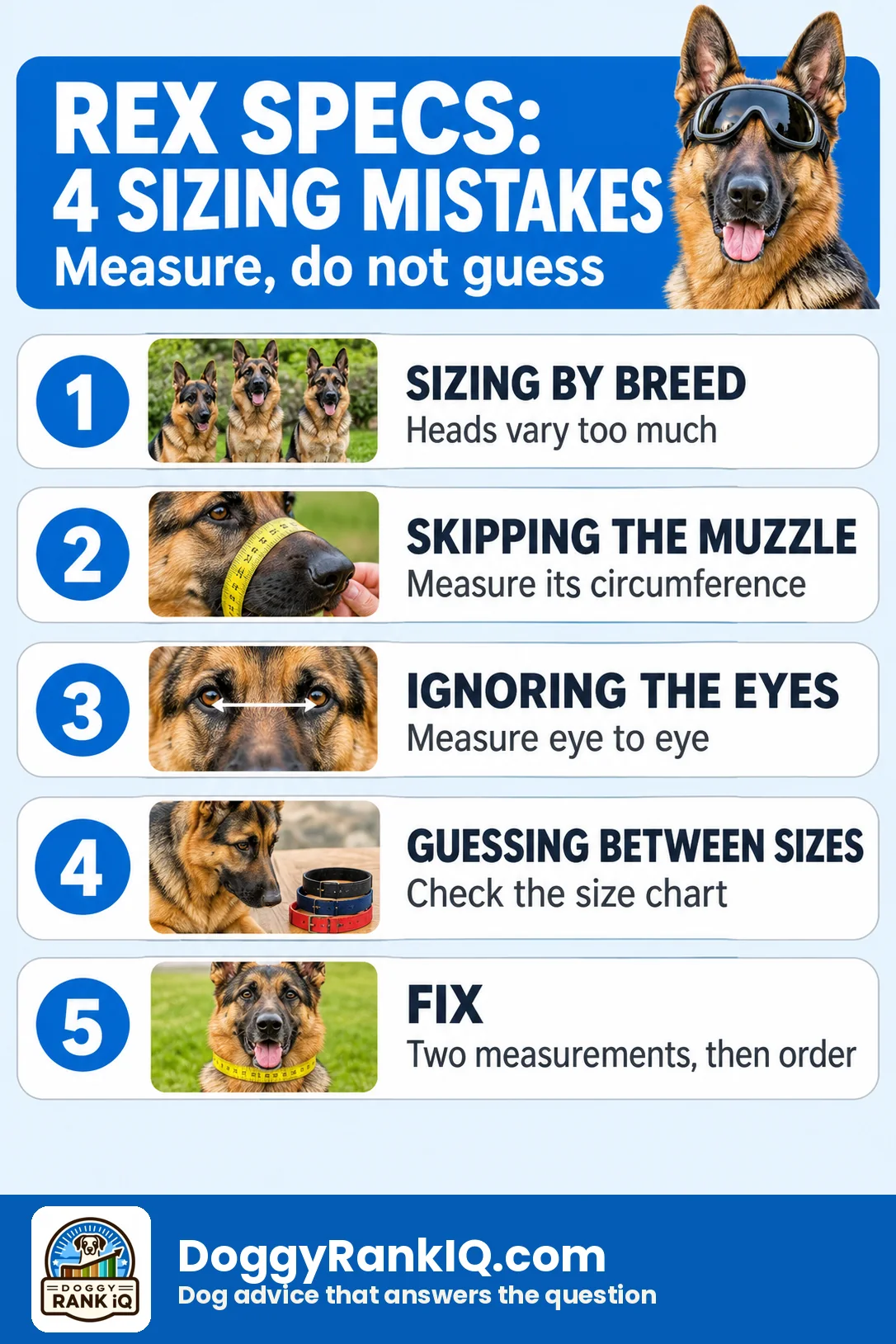
Most fit complaints in reviews trace back to four repeatable habits, and all four are avoidable with the measuring steps above.
Mistake 1: Sizing by breed or weight instead of measurements. Rex Specs’ chart runs on two circumferences, and independent testers specifically recommend following the manufacturer’s measurements rather than breed assumptions, according to Treeline Review. Two dogs of the same breed can have noticeably different forehead width, muzzle circumference, and eye placement. A 60-pound Lab mix and a 60-pound Pit mix are not the same muzzle circumference, full stop.
Mistake 2: Skipping the muzzle measurement and eyeballing it. Eyeballing a goggle fit is, unhelpfully, how you end up with a goggle that doesn’t seal around the eyes at all. Take the tape measure out. It takes thirty seconds and saves a return shipment.
Mistake 3: Ignoring eye placement and lens clearance. A goggle can have the right circumference and still press into the eye if the inter-eye distance measurement was skipped. Veterinary guidance is direct here: no part of the frame or lens should touch the eye itself, and a too-tight fit is a comfort and safety issue, not just an annoyance.
Mistake 4: Assuming every puppy needs XS, or that growth doesn’t matter. Puppies grow fast, and a goggle bought for a 4-month-old muzzle may be obsolete by month seven. Measure again before a growing dog’s first warm-weather season, and expect to size up at least once during the first year for medium and large breeds.
Edge case: brachycephalic dogs (Frenchies, Boston Terriers, pugs) often need Small-Wide rather than Small, even if their muzzle circumference matches Small on paper, because the face shape is wider and flatter, per Rex Specs’ fit guide.
Can puppies wear dog goggles?
Puppies can wear rex specs dog goggles once they’re done with the bulk of their facial growth, usually somewhere past six to eight months for most breeds, but sizing has to be revisited as the muzzle fills out. Buying XS for a young puppy and expecting it to last a year is a common and avoidable mistake.
A few practical notes for puppy owners:
- Measure every two to three months during the first year if you plan to keep goggles in rotation.
- Expect to move up at least one size category for medium and large breed puppies before their first birthday.
- Keep sessions short and positive at this age, since puppies who have a bad first experience with goggles tend to generalize that dislike to other gear, including harnesses and boots.
- If your puppy is still learning basic obedience, pairing goggle training with foundational cues from our guide to essential puppy commands can make the process smoother, since a dog that already knows “stay” and “leave it” tolerates new gear more easily.
Which lens tint to pick
The V2 ships with two lenses in the box, clear and smoke, both rated UV400, so most owners don’t need to buy an extra tint right away.
Choose clear if your dog’s vet has recommended UV and wind protection after an eye procedure. Choose smoke for daytime trail runs, beach days, or snow. If your dog spends time in both, the included two-lens kit already covers the common cases without an extra purchase.
Are Rex Specs dog goggles waterproof?
Rex specs dog goggles are not fully waterproof in the sense of forming a watertight seal, but the V2 frame and lens are built to handle swimming, splashing, and boat spray without fogging or leaking debris into the eye. The vented frame design is meant to manage moisture and airflow together rather than seal the eye off completely.
What this means in practice:
- A dog swimming in a lake or pool can wear the goggles without water pooling against the eye, since the vents let water drain rather than trap it.
- Submersion for long stretches (diving, extended underwater retrieval) is not what the product is built for.
- After water activity, dry the foam padding and straps before storage to prevent mildew buildup on the foam liner, which is one of the more common long-term wear issues owners report.
- If your dog mostly needs rain and weather protection rather than eye protection, a dog raincoat addresses a different problem and isn’t a substitute for goggles.
How much do Rex Specs dog goggles cost?
Rex specs dog goggles cost between $88.99 and $92.99 for the V2 model directly from the manufacturer, with some retailer listings and color variants priced closer to $99.99, price checked 2026. That price sits well above budget dog goggle options, which commonly run $15 to $35.
The price difference generally reflects:
- UV400-rated lenses on both included tints, rather than one uncertain tint.
- A frame built for impact and secure strap retention during real activity, not just sun blocking while standing still.
- A two-lens kit in the box, which avoids a second purchase for most owners.
- Recognition from independent reviewers, including Treeline Review’s Best Overall pick for 2026.
Decision rule: pay the Rex Specs price if your dog is active outdoors regularly or needs documented eye protection. Skip it for occasional, low-stakes sun exposure where a scratched lens or a loose seal isn’t a real safety concern.
Rex Specs vs other dog goggle brands
Rex specs dog goggles are generally considered the top-tier option in the dog goggle category because of lens quality, strap stability, and field of view, but they are not the only brand making functional eyewear for dogs. Budget brands exist, and some mid-tier options split the difference on price and build quality.
What separates Rex Specs from most competitors:
- UV400 lenses included standard, rather than offered as an upsell.
- A documented size chart based on measurements rather than vague small/medium/large labels.
- Independent recognition, with Treeline Review naming the V2 its top overall pick in 2026.
- Wider distribution through specialty retailers like REI and working-dog suppliers like Ray Allen, which suggests adoption among professional and working-dog handlers, not just casual pet owners.
Choose a competing brand if your dog only needs occasional, low-intensity sun protection and you’re not willing to pay close to $90. Choose Rex Specs if the goggles need to hold up to repeated outdoor use, water exposure, or post-surgical care where fit precision actually matters.
⭐ Top 5 Features We Love
- UV400 protection on both included lenses, relevant for dogs with light sensitivity or post-surgical eyes, per the manufacturer’s spec sheet.
- Two lenses included in the box, clear and smoke ship standard, so owners aren’t buying a second lens immediately.
- Wider field of view on V2, documented as an improvement over V1, which matters for dogs that rely on peripheral vision during off-leash play.
- Six fit categories, including Small-Wide, gives flat-faced breeds an actual option instead of forcing a standard Small onto a wider face.
- Treeline Review’s Best Overall pick in 2026, evaluated for strap security, ventilation, and fit adjustability.
⚠️ Things to Look Out For
- Lenses reportedly scratch relatively easily, based on reviewer feedback; a microfiber bag is included, so use it.
- Price sits at the top of the dog goggle market, around $88.99 to $92.99, price checked 2026, which is a real factor if you’re buying for a dog who wears goggles occasionally rather than daily.
- Color and size availability varies by retailer. Some Amazon listings for specific V2 variants shift in and out of stock even while other sizes and colors remain available elsewhere, so check before assuming a size is unavailable everywhere.
- Not designed for unattended or overnight wear. Veterinary guidance specifically cautions against leaving goggles on a dog without supervision for extended periods.
- Small-Wide still requires a roughly 1-inch nose, so extremely flat-faced dogs may not get a secure fit even in that category.
Do dogs actually like wearing goggles?
Most dogs don’t like goggles immediately, but the majority tolerate them well once introduced gradually, and a smaller number genuinely seem comfortable within the first few sessions. Reaction varies by individual temperament more than by breed.
Common signs a dog is adjusting well:
- Normal gait and head movement within a few minutes of putting goggles on.
- No persistent pawing at the face after the first couple of sessions.
- Willingness to take treats or play with a toy while wearing them.
Signs the fit or introduction needs adjustment:
- Repeated pawing or rubbing the face against furniture or ground.
- Visible redness or hair loss at the foam contact points.
- Refusal to move or frozen body language, which usually means the dog needs a slower introduction, not a different product.
Do dog goggles actually protect dogs or are they just for fun?
Dog goggles, including rex specs dog goggles, serve a real protective function for dogs exposed to UV light, dust, debris, and high-speed wind, rather than being a novelty accessory. Veterinary ophthalmologists commonly recommend UV-blocking eyewear for dogs recovering from certain eye surgeries or dealing with chronic light sensitivity.
Real protective use cases include:
- Working and search-and-rescue dogs exposed to debris and dust in the field.
- Dogs who ride on motorcycles, ATVs, or in open vehicles where wind and road debris hit the eyes directly.
- Post-surgical recovery, where a veterinarian has specifically recommended UV and impact protection.
- High-altitude hiking, snow, and water sports where glare and reflected UV light are intense.
A dog that spends most of its day indoors or in a shaded yard isn’t getting meaningful benefit from goggles, and that’s a fair reason to skip the purchase.
Which dog breeds are best suited for wearing goggles?
Breeds that do high-motion outdoor work, like working and sporting breeds, tend to adapt best to Rex Specs, while brachycephalic and toy breeds need more careful size selection but can still wear them successfully. Breed alone doesn’t determine suitability, but it does affect which size category fits.
- Working and herding breeds (German Shepherds, Malinois, Border Collies): typically size into Medium or Large and tolerate goggles well given their trainability and field use history.
- Sporting breeds (Labradors, Spaniels): generally straightforward fits, common for swimming and retrieving use cases.
- Brachycephalic breeds (French Bulldogs, Boston Terriers, pugs): need Small-Wide in most cases, and fit success depends heavily on following the measurement steps above.
- Toy and small breeds: fit into XS or Small, and short acclimation sessions matter more since smaller dogs sometimes startle more easily at face-mounted gear.
How long do dog goggles last before needing replacement?
Rex Specs typically last multiple seasons of regular use before the frame needs replacing, though the foam lining and lenses often need attention sooner. Lens scratching is the most commonly reported wear issue, followed by foam compression from repeated wear.
Practical lifespan factors:
- Lenses: replace when scratches start affecting visibility or when UV coating appears worn, which some owners report within a year of frequent outdoor use.
- Foam padding: compresses over time and may need replacement parts sooner for daily-wear dogs than occasional-wear dogs.
- Straps: generally the most durable component, though UV exposure and saltwater use can degrade elastic over multiple years.
- Frame: the most durable part of the product, and the part least likely to need replacement under normal conditions.
Store goggles in the included microfiber bag between uses and rinse off dirt, sand, or saltwater after outdoor sessions to extend lens and foam life.
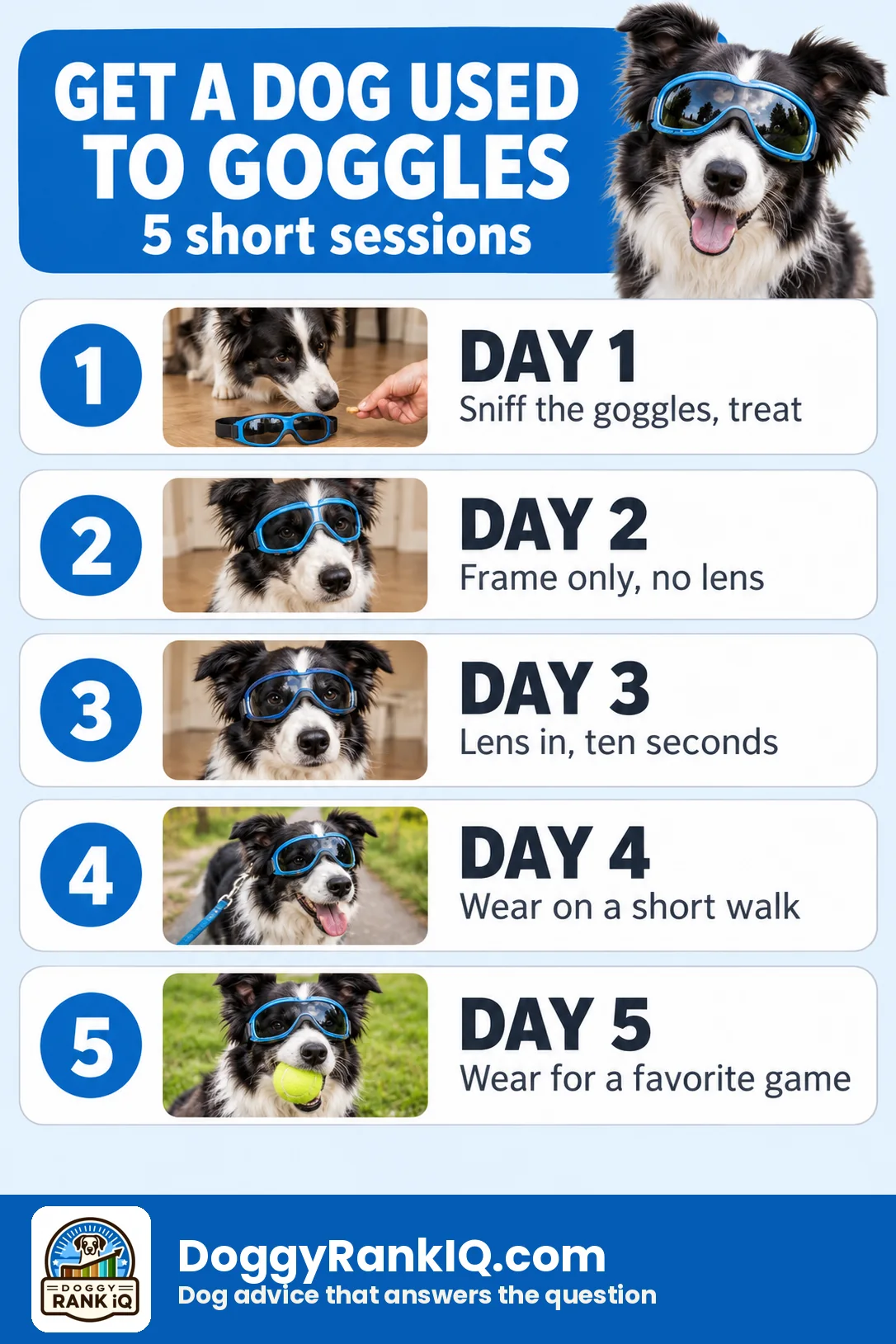
How to get a dog used to goggles
Most dogs need a short acclimation period before goggles feel normal, and rushing straight to a run or hike on day one is the most common reason dogs paw at their face or refuse to wear them.
- Start indoors, short sessions. Put the goggles on for two or three minutes at a time in a calm room, paired with a treat or a favorite toy.
- Build up gradually. Add a minute or two each session over several days before trying a walk.
- Use positive association, not force. Treat delivery the moment the goggles go on, and remove them calmly rather than letting the dog paw them off, which teaches pawing works.
- Watch for rubbing or redness after each session and adjust the strap tension before the next wear.
- Move to real conditions last. Once a dog tolerates ten to fifteen minutes indoors without pawing, try a short walk, then eventually the activity the goggles were bought for.
A dog who’s anxious about new gear in general may benefit from the same patience used for other triggers; our guide on separation anxiety in dogs covers gradual desensitization approaches that apply here too. For dogs who communicate stress through licking rather than pawing, see why dogs lick you for context on what that behavior usually means.
How to get your dog to wear goggles without freaking out
A dog that “freaks out” over goggles usually needs a slower introduction and a better-fitting frame, since panic responses are more often a fit or pacing problem than a temperament problem. Dogs rarely reject goggles outright if the process is broken into small enough steps.
Troubleshooting steps if your dog is struggling:
- Check the fit first. A too-tight strap or pinched ear flap can cause genuine discomfort that reads as refusal.
- Go back a step in training. If a dog panics at full wear, return to simply touching the goggles to the dog’s face without securing the strap.
- Pair every session with high-value treats, not regular kibble, during the first week.
- Keep early sessions under five minutes, even if the dog seems calm, since fatigue and frustration tend to build gradually.
- Avoid practicing right before a stressful event (vet visits, car rides), since dogs generalize stress across contexts.
Rex Specs vs cheaper dog goggles
The decision usually comes down to use case: working and high-activity dogs justify the Rex Specs price, while casual sun protection for a backyard dog may not need it.
Check the current price: Rex Specs V2 Medium Black, Rex Specs V2 Small Black, Rex Specs V2 Medium Bandit Orange.
Choose Rex Specs if your dog does search and rescue work, motorcycle or boat rides, trail running, or needs documented UV protection after eye surgery (confirm with your vet). Choose a budget pair only for occasional, low-stakes sun exposure where a scratched lens or a loose seal isn’t a safety issue.
Where can I buy Rex Specs dog goggles online?
Rex Specs are sold directly through the Rex Specs website and through established retailers including REI, Chewy, Amazon, and working-dog gear suppliers like Ray Allen.
Tips for buying online:
- Buy directly from Rex Specs or an authorized retailer to ensure you get the current V2 frame and matching replacement lenses.
- Compare sizes across retailers if your preferred size or color shows as out of stock in one place, since availability varies.
- Check the return policy before ordering, since fit issues are the most common reason for returns, and a flexible return window matters more here than with most pet gear.
FAQ
The bottom line
Rex Specs solve a real problem for dogs who run, hike, ride, or recover from eye surgery, but the $88.99 to $92.99 price only pays off if the fit is right. Measure muzzle circumference and inter-eye distance before ordering, skip the breed-chart shortcut, and give your dog a short acclimation period indoors before the first real outing. Check the dimensions against the official chart one more time before you check out. For more gear guidance beyond eyewear, browse the full Doggy Rank IQ blog for related product breakdowns.
Doggy Rank IQ is reader supported. As an Amazon Associate we earn from qualifying purchases, at no extra cost to you.