
Quick Answer: Is a German Shorthaired Pointer Right for You?
A german shorthaired pointer suits active homes that can give one to two hours of hard exercise plus daily brain work, every day, for about 12 years. This is a versatile German gundog built to point, track and retrieve on land and in water, and that engine does not switch off because you had a long week. At home, most GSPs are affectionate to the point of leaning on your shins while you cook. If your idea of a big weekend is a movie marathon, pick a different breed and nobody will judge you.
Key Takeaways: German Shorthaired Pointer
- Ranked No. 9 in the AKC’s 2025 breed registration rankings, published August 2026, up one spot from 2024.
- Typical lifespan is 10 to 12 years, according to PetMD, with Dogs NSW reporting 11 to 12.
- Males run about 23 to 25 inches tall and 55 to 70 pounds; females about 21 to 23 inches and 45 to 60 pounds per the AKC breed profile.
- Expect 60 to 120 minutes of real exercise daily, plus scent games or training. The AKC states plainly that people with inactive lifestyles should reconsider this breed.
- The hardest stretch is roughly 6 months to 3 years, when adult muscle arrives before adult self-control, per AKC training guidance.
- Cone degeneration is the main AKC-recommended DNA test for the breed, alongside hip and eye screening from the parent club.
- Grooming is easy. Containment is not. GSPs climb, dig and bolt after prey, so fencing and recall matter more than a brush.
Where Does the German Shorthaired Pointer Come From?
The german shorthaired pointer was developed in 19th century Germany as a single dog that could do the whole hunt: find birds, hold a point, track wounded game, and retrieve from water. German breeders were after versatility rather than specialization, which is why the breed carries pointer, scenthound and water-dog influences in its working style.
That history explains almost everything annoying and wonderful about the dog in your living room. The webbed feet and water-resistant short coat came from retrieving in cold marshes. The nose came from trailing deer and fox through timber. The stamina came from a hunter who expected the dog to work from dawn until the light went.
You are not adopting a hobby. You are adopting a job applicant.
The American Kennel Club recognized the breed in 1930, and it has climbed steadily in popularity since, reaching No. 9 in the 2025 rankings. That climb is mostly driven by trail runners, bird hunters and outdoorsy families, which is a good match. It is also driven by Instagram, which is a worse one. Plenty of GSPs end up in breed rescue because the photos sold the athleticism and skipped the 6am obligation.
What Makes the German Shorthaired Pointer So Special (and So Cute)?
The appeal is a rare combination: a serious working athlete that wants to sleep pressed against your spine. GSP owners talk about “velcro dogs” constantly, and the stereotype holds up in practice. This is not a breed that occupies the far corner of the room.
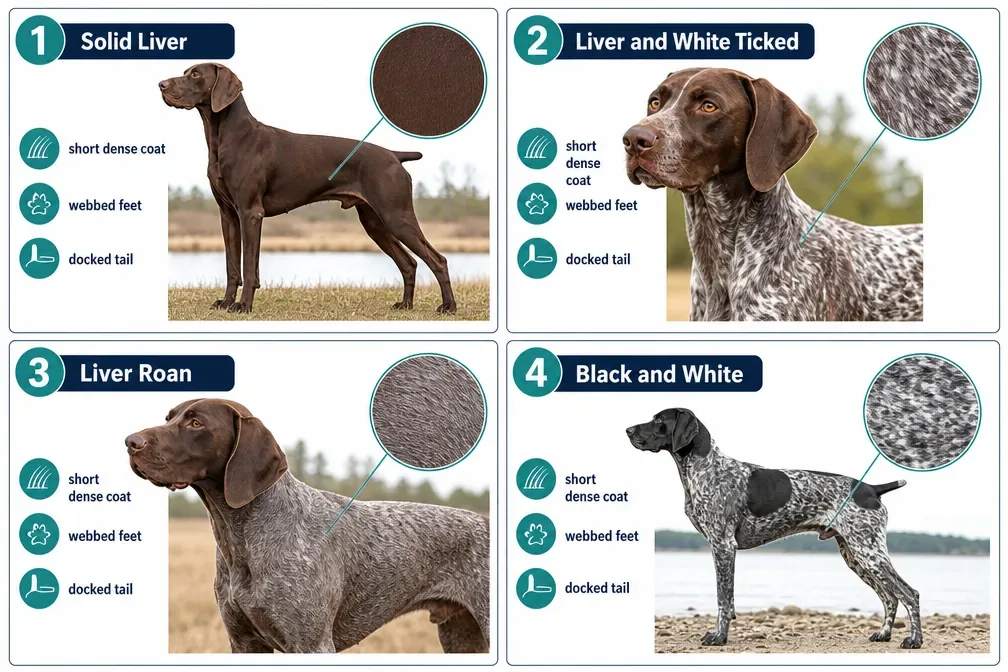
Physically, the charm is in the contradictions. A lean, deer-like body with a goofy face. Amber eyes that look like they are doing math. Ears that flop while the rest of the dog stays coiled. And the coat: liver, liver and white, liver roan, black and white, black roan, with ticking and patches that make every individual look hand-speckled. There is no true “blue” GSP in the breed standard, despite listings that claim otherwise, and a solid black german shorthaired pointer is accepted in AKC but not in some European registries.
Then there is the point itself. A young GSP will freeze on a pigeon in a parking lot, one foreleg lifted, tail rigid, entirely certain that this moment matters. Nobody taught it that.
The cuteness peaks when the engine stops. A tired GSP folds into a ridiculous shrimp shape on the sofa and becomes, briefly, a blanket.
German Shorthaired Pointer Size, Weight and Lifespan
German shorthaired pointers are a medium to large breed with clear size differences between the sexes, and a typical lifespan of 10 to 12 years. They are built light for their height, so a 60 pound GSP looks smaller than a 60 pound Labrador and moves very differently.
| Measure | Male GSP | Female GSP | Vizsla (comparison) |
|---|---|---|---|
| Height at shoulder | 23 to 25 in | 21 to 23 in | 21 to 24 in |
| Weight | 55 to 70 lb | 45 to 60 lb | 44 to 60 lb |
| Lifespan | 10 to 12 yr | 10 to 12 yr | 12 to 14 yr |
| Coat | Short, dense, slight shed | Short, dense, slight shed | Short, very light shed |
Sources: AKC breed profile and PetMD.
On the german shorthaired pointer vs vizsla question: Vizslas tend to be slightly softer in temperament, more sensitive to harsh handling, and more prone to separation distress. GSPs are generally tougher in cold water and rough cover, with a heavier build and more bone. Both need enormous exercise. Choose the Vizsla if you want a more sensitive dog for a warmer climate. Choose the GSP if you want a hunting partner that will crash through brambles and swim in November.
If you are unsure where your dog lands on the scale, our guide to large versus giant breed sizing explains how the categories work.
What Is the German Shorthaired Pointer Temperament Like?
The official AKC breed standard describes the german shorthaired pointer as friendly, intelligent and willing to please, with enthusiasm for work and no nervous or flighty character. A shy, fearful or mean-spirited GSP is a departure from the working temperament breeders aim for.
What that looks like day to day:
- Biddable. They want instructions. Training is usually fast because the dog is paying attention anyway.
- Aroused easily. Excitement escalates quickly. A doorbell can become a ten minute event.
- Prey-driven. Squirrels, rabbits, cats in the next yard. The chase is self-rewarding.
- Clingy. Many GSPs follow owners room to room and dislike being left behind.
- Vocal when bored. Barking at windows is one of the most common owner complaints.
Aggression is not the breed’s problem. Overarousal is. A GSP that bites a sleeve, body-slams a toddler or scales a fence is usually not angry. It is under-exercised and under-taught, with no off switch installed. The off switch is a skill you train, not a trait you wait for.
Individual variation is real. Field lines tend to run hotter than show lines. Meet the parents if you can, and ask the breeder about off-leash reliability and settling at home.
Are German Shorthaired Pointers Good With Kids and Other Pets?
Yes, with supervision and a size caveat. GSPs are typically affectionate and patient with children, and many owners describe them as the gentlest member of the household. The risk is physics, not temper. A 60 pound dog sprinting past a three-year-old does not need bad intentions to knock them flat.
The AKC notes that some breed experts suggest caution in homes with children under about seven, particularly where adults do not yet have dog-management experience.
Practical rules that work:
- Teach “four on the floor” before the puppy weighs 40 pounds. Greetings get rewarded only when all paws are down.
- Manage mouthing with a tug toy, not a scolding. Puppy GSPs grab hands. Redirect onto something legal every single time.
- Use baby gates during toddler play. A separated dog is a safe dog, and a resting dog learns to rest.
With other dogs, GSPs are usually social and enjoy a running partner. With cats, it depends entirely on early exposure and the individual dog’s prey drive. A GSP raised with a cat from eight weeks often does fine indoors and still chases the neighbor’s cat outside. Birds, rabbits and hamsters are a harder ask. If you have small pets, plan on permanent physical separation rather than trust.
For broader comparisons, see our roundup of family-friendly breeds for kids.
Who Is the German Shorthaired Pointer Made For, and Who Should Skip It?
The german shorthaired pointer suits people who already exercise hard and want company doing it. Everyone else should think twice, and the AKC says as much in its own owner guidance.
Good fit if you:
- Run, hike, bike, ski or hunt several times a week, in most weather
- Have a securely fenced yard at least six feet high, with no climbing aids
- Work from home, work flexible hours, or can arrange midday activity
- Enjoy training as a hobby, not a chore
- Want a dog for field work, dock diving, agility, rally, scent work or canicross
Skip it if you:
- Travel often and would need frequent boarding
- Have a very young toddler and no second adult to help
- Want a calm first dog that settles after a 20 minute walk
- Live somewhere with no safe off-leash access and no fenced space
- Are gone ten hours a day with no dog walker
Apartment question: a GSP can live in an apartment, but only if the owner treats exercise as non-negotiable and the dog has learned to settle indoors. The failure mode is noise. Window barking carries through walls, and a bored GSP will find the window. If you are apartment-bound, read our apartment-friendly breed picks before committing. Similar alternatives worth considering: Vizsla, Weimaraner, Brittany, English Pointer, and for a calmer option, a Labrador from show lines.
How Much Exercise Does a German Shorthaired Pointer Need?
Plan on 60 to 120 minutes of genuine exercise per day, split across at least two sessions, plus 15 to 30 minutes of mental work. A leash walk around the block does not count as exercise for this breed. It counts as a bathroom trip with scenery.

What actually tires a GSP:
- Free running in a secure area or on a 30 foot long line, 20 to 40 minutes
- Scent work, either formal nose work classes or scattering kibble in long grass
- Retrieving games with rules, including a sit before each throw
- Water swimming in warm months, which is low-impact and burns energy fast
- Training sessions of 5 to 10 minutes, several times a day
Here is the part most new owners get backwards. Running a GSP for two hours a day without training builds a fitter dog with the same impulse control. Conditioning raises the ceiling. Brain work lowers the demand. The research-backed principle from working-dog handling is that structured, cognitively demanding activity produces more settling than distance alone.
Why is my GSP so hyper all the time? Usually one of three things: not enough sniffing, not enough sleep, or a day that is all arousal and no decompression. Adult dogs need roughly 12 to 14 hours of sleep. A GSP woken constantly by household traffic becomes a wired toddler. Crate naps are not cruelty. They are maintenance.
Puppies under 12 months need restraint, not marathons. The old rule of five minutes of formal walking per month of age, twice daily, remains a sensible ceiling while growth plates close.
German Shorthaired Pointer Grooming and Shedding
Grooming is the easiest part of owning this breed, and yes, german shorthaired pointers do shed. The short, dense coat drops hair year-round, with heavier periods in spring and fall. The hairs are short, stiff and excellent at weaving into upholstery.
A workable routine:
- Brush twice weekly with a rubber curry or grooming mitt. Five minutes.
- Bathe every 6 to 10 weeks, or after swamp swims. Over-bathing dries the skin.
- Clean ears weekly. Drop ears plus water work equals ear infections. This is the single most-skipped task.
- Trim nails every 2 to 3 weeks. Long nails change gait and stress joints in a running dog.
- Check paw pads and armpits after field work for burrs, cuts and grass awns.
Low grooming effort is not low ownership effort. The brush takes five minutes. The fence, the recall training and the daily hour do not. If you are new to the basics, our beginner’s dog grooming guide covers technique, and a decent couch hair remover earns its place in a GSP household faster than almost any other purchase.
One cold-weather note: that thin coat offers very little insulation. GSPs genuinely need a jacket below freezing, especially on slow walks. Working hard in the cold is fine. Standing around in it is not.
Common German Shorthaired Pointer Health Problems
German shorthaired pointers are a generally healthy breed, with the main concerns being hip dysplasia, bloat, eye conditions and certain cancers. Typical lifespan is 10 to 12 years.
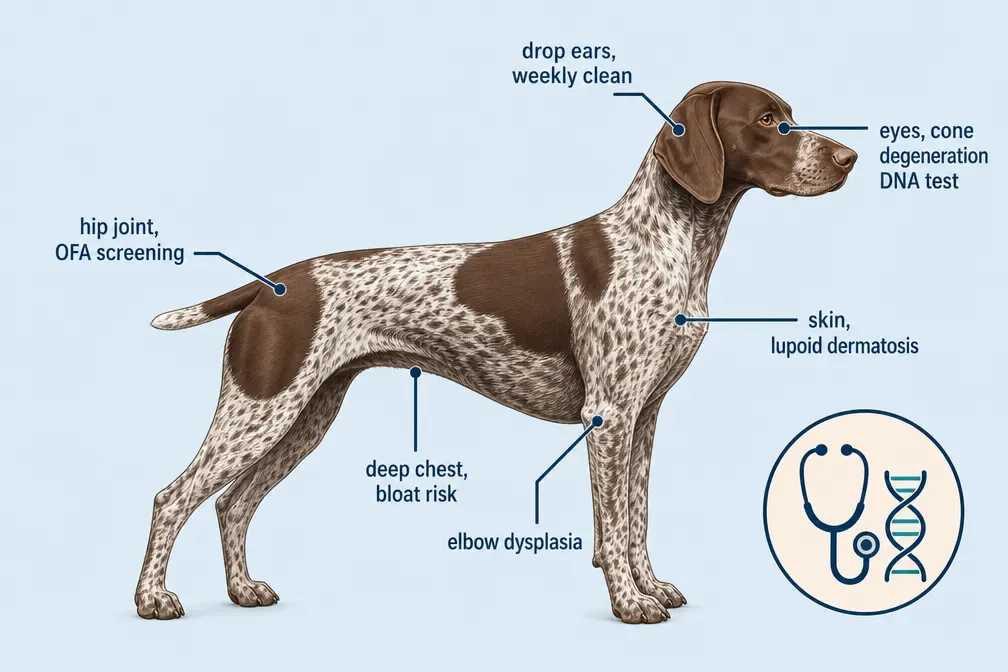
Screening to ask a breeder about:
- Hip dysplasia: OFA or PennHIP evaluation on both parents
- Cone degeneration (CD): the principal AKC-recommended DNA test for this breed
- Eye exam: annual ophthalmologist certification
- Cardiac evaluation: on breeding stock
- Optional DNA panels recognized for the breed include von Willebrand disease type II, factor VII deficiency, degenerative myelopathy, hyperuricosuria and lupoid dermatosis
Conditions to watch for across life:
- Gastric dilatation-volvulus (bloat). Deep-chested breeds carry elevated risk. Signs include a swollen hard abdomen, unproductive retching, drooling, restlessness and pale gums. This is an emergency. Call a veterinarian or emergency clinic immediately. Do not wait to see if it passes.
- Ear infections, from the drop ears and water work
- Hypothyroidism, often showing as weight gain, coat loss and lethargy
- Mast cell tumors and other cancers, which appear in older GSPs
- Exercise-related injuries, especially torn toenails, pad lacerations and soft tissue strain
Other red flags that mean a same-day call: labored breathing, collapse during exercise, sudden hind-limb weakness, or heat stress signs such as bright red gums and frantic panting that does not ease in shade. A lean, fit GSP in hot weather can still overheat because it will not quit on its own.
If you are curious about genetic screening for an adopted dog, our Embark vs Wisdom Panel comparison explains what each test actually reports.
What Do German Shorthaired Pointers Love to Eat? Favorite Foods and Feeding
Feed an adult german shorthaired pointer a complete, AAFCO-compliant diet with moderate to high protein, split into two meals a day, adjusted for workload. A hunting GSP in October eats considerably more than the same dog in February.
Rough starting amounts (always adjust to body condition, not the bag):
| Dog | Activity level | Typical daily food |
|---|---|---|
| 45 lb female | Moderate | About 2 to 2.5 cups |
| 60 lb male | Moderate | About 2.5 to 3.5 cups |
| 60 lb male | Working or hunting season | 4+ cups, often split into 3 meals |
Treats GSPs tend to love: freeze-dried liver, plain cooked chicken, sardines in water, frozen green beans, blueberries, carrot sticks, and a frozen stuffed toy for crate time. High-value scent-strong treats work best for recall training, because you are competing with a pheasant.
Avoid entirely: grapes and raisins, onions and garlic, xylitol, chocolate, macadamia nuts, cooked bones, and alcohol. Also skip heavy fatty table scraps, which can trigger pancreatitis.
Bloat precautions worth taking: feed two or three smaller meals rather than one large one, use a slow-feeder bowl if your dog inhales food, and avoid hard exercise for about an hour either side of meals. Evidence on raised bowls is mixed, so there is no confident recommendation there.
For label literacy, start with how to read a dog food label and what AAFCO means, and for life-stage changes see our breakdown of puppy, adult and senior formulas.
How to Train a German Shorthaired Pointer
Train early, train short, train often, and expect the hardest stretch between six months and three years. The AKC’s breed training guidance flags that window specifically: adult strength arrives well before adult judgment.
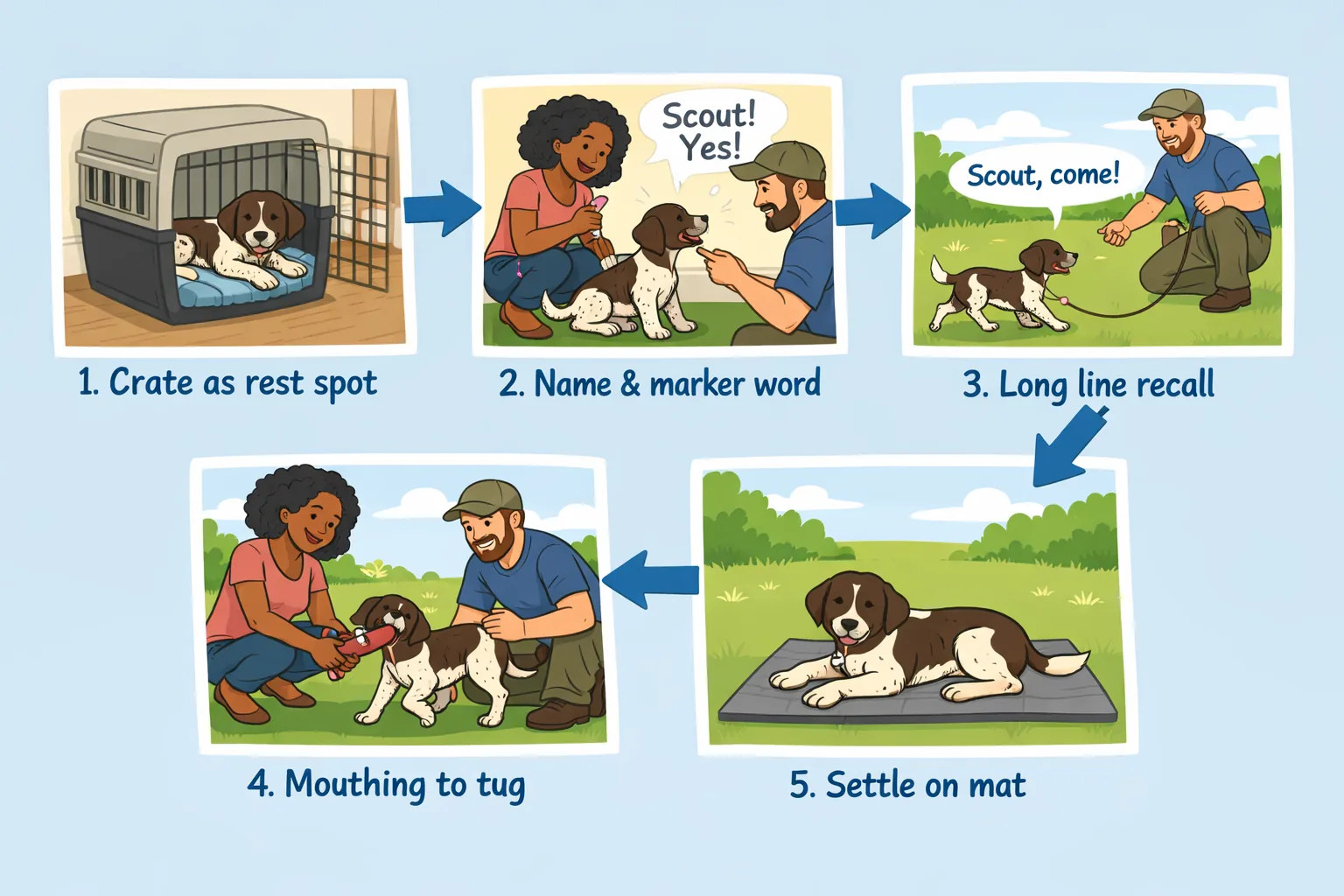
The five things to prioritize, in order:
- Recall. Non-negotiable in a breed that will chase a deer across a highway. Build it on a long line for months before trusting it. Our recall training guide covers the progression.
- Loose leash walking. GSPs pull because pulling works. Stop-and-reset plus front-clip equipment beats correction. See loose leash walking.
- Settle on a mat. The off switch. Reward stillness deliberately, daily.
- Bite inhibition and mouthing control. Redirect to tug, end play when teeth hit skin, repeat for months.
- Alone-time tolerance. Short departures from day one, built gradually, long before you need it.
Common training mistakes with this breed:
- Using exercise as the only solution and skipping impulse work
- Heavy-handed corrections, which make a sensitive GSP shut down or get frantic
- Allowing off-leash freedom before recall is reliable under distraction
- Training only when the dog is already wound up
- Punishing barking instead of removing the window access that triggers it
For window barking specifically: block the view with frosted film, move the dog’s resting spot, and reward quiet check-ins. Managing the environment solves faster than any correction.
If a GSP routinely escapes, a tracking collar such as a GPS dog collar is a backup, not a fix. Fix the fence first.
Try It: GSP Daily Energy Budget
German Shorthaired Pointers were bred to hunt all day, so a single walk rarely covers the bill. Add up today’s exercise and brain work below to see whether your GSP’s needs are actually met.
Doggy Rank IQ Tool
GSP Daily Energy Budget

German Shorthaired Pointers were bred to hunt all day. Add up today's exercise and brain work to see whether your GSP's needs are covered.
How Much Does a German Shorthaired Pointer Cost?
Expect $1,200 to $2,500 for a well-bred german shorthaired pointer puppy from a health-tested breeder in the U.S., with proven field or show lines running higher. Breed rescue adoption typically costs $200 to $500.
Estimated first-year costs (these are ranges based on common U.S. pricing, not a published study):
| Item | Typical range |
|---|---|
| Puppy purchase | $1,200 to $2,500 |
| Vaccines, exams, spay or neuter | $500 to $1,200 |
| Crate, long line, bowls, bedding, toys | $300 to $600 |
| Puppy class and basic obedience | $200 to $600 |
| Food, year one | $500 to $900 |
| Fencing upgrade (common, often forgotten) | $0 to $4,000 |
Ongoing annual costs usually land between $1,200 and $2,500, covering food, preventives, an annual vet visit, dental care and replacement gear. GSPs destroy toys. Budget for that honestly.
Two line items people underestimate. First, fencing. A six foot fence with no climbing aids is the realistic standard for a dog that can clear four feet without trying. Second, dog walking or daycare if you work full days away from home, which can add $150 to $500 monthly.
A cheap puppy from an unscreened litter is the most expensive version of this breed. Hip surgery alone can run several thousand dollars.
German Shorthaired Pointer Puppy Tips for the First 90 Days
The first 90 days set the off switch, the recall and the bite inhibition. Everything else can be fixed later. Those three are far harder to rebuild.
Days 1 to 14: structure and sleep
- Crate beside your bed. Short, frequent naps enforced, roughly 18 hours of sleep daily.
- Potty out every 60 to 90 minutes while awake, and immediately after naps, meals and play.
- Start name recognition and a marker word (“yes”) with the first meal.
Days 15 to 45: socialization window
- Aim for new surfaces, sounds, people and calm dogs several times a week, at the puppy’s pace.
- Begin recall on a 15 foot line in the yard. Pay generously, every time, no exceptions.
- Handle ears, paws and mouth daily so vet visits stay boring.
Days 46 to 90: impulse control
- Teach settle on a mat. Reward lying down and doing nothing.
- Add short alone-time departures, starting at 30 seconds.
- Build the mouthing routine: teeth on skin ends the game, tug toy resumes it.
- Start formal loose leash walking before the pulling habit sets.
Things to decide early: whether the dog will be allowed on furniture, whether the yard is genuinely escape-proof, and who covers the midday walk on your busiest day. Write that last one down. It is the one that quietly breaks households.
What German Shorthaired Pointer Owners Say
Owner reports line up closely with breed guidance, which is reassuring and a little alarming.
“He is the most loving, caring, and compassionate dog.”
That comes from an owner on Reddit reflecting after a year with their first GSP. This is the common thread in nearly every positive review of the breed. The practical note: that affection has a flip side, because a dog this attached is more likely to struggle alone. Build alone-time tolerance deliberately in the first year, even if the puppy is currently fine, because separation problems are much easier to prevent than to treat.
“all he does all day is bark out the window”
Posted by an owner on Reddit asking for help. Window barking is the breed’s most reported nuisance behavior, and it is mostly an environment problem. Block the view with frosted film at dog height, move the dog’s daybed away from the front window, add a mid-morning scent activity, and reward voluntary quiet. Shouting adds to the noise and teaches nothing.
“well aware of their high energy levels and need for constant engagement”
From a first-time owner on Reddit who still felt lost. Knowing the breed is high energy does not tell you how to structure a day. The fix is scheduling, not willpower: two fixed exercise blocks, three short training sessions, one enforced nap period, and a frozen chew for the evening. Routine does more than enthusiasm.
German Shorthaired Pointer FAQ
Do german shorthaired pointers shed a lot? They shed moderately year-round and more heavily in spring and fall. The hairs are short and stiff, so they embed in fabric. Brushing twice a week with a rubber curry keeps most of it off the furniture.
What is the average lifespan of a german shorthaired pointer? Typically 10 to 12 years. PetMD lists 10 to 12, and Dogs NSW reports 11 to 12 years.
Can a german shorthaired pointer live in an apartment? Yes, if the owner commits to one to two hours of outdoor exercise daily and trains a reliable settle. Barking at hallway noise is the main obstacle in shared buildings.
Are german shorthaired pointers good family dogs? Generally yes. They are affectionate and tolerant with children, though their size and speed can overwhelm toddlers. The AKC notes some experts advise caution with children under about seven.
Is there such a thing as a blue german shorthaired pointer? No. The recognized colors are liver, liver and white, liver roan, black, black and white, and black roan with ticking and patching. Listings advertising “blue” GSPs are describing a color outside the standard or a mixed-breed dog.
Why does my german shorthaired pointer escape the yard? Prey drive plus athleticism. They climb, dig and jump after scent. Six foot fencing, no climbing aids near the fence line, buried wire at the base, and a trained recall are the practical answer.
Which breeds are most similar to a german shorthaired pointer? Vizsla, Weimaraner, Brittany, English Pointer, German Wirehaired Pointer and Wirehaired Pointing Griffon. All share high exercise demands and strong bird instincts.
At what age does a german shorthaired pointer calm down? Many owners report a noticeable change around three years. AKC guidance identifies roughly six months to three years as the most challenging stretch. Calmer does not mean calm, and structured rest helps more than waiting.
Next step: before you contact a breeder or a rescue, write out a realistic weekday schedule showing who walks the dog at 6am and who covers midday. If that schedule holds up on your worst week, a german shorthaired pointer could be the best dog you ever have. If it does not, the breed will tell you so, loudly, through the front window.