
This post contains affiliate links. If you buy through one, we may earn a commission at no extra cost to you. As an Amazon Associate, we earn from qualifying purchases.
Quick answer
A dog hair remover for couch fabric works best when the tool’s mechanism matches the weave, not when it has the most views online. For most woven and microfiber couches, a reusable rubber or electrostatic roller (around $20 to $30) outperforms a vacuum alone and lifts embedded fur in one or two passes. Velvet, leather, and car upholstery each need a different approach, covered section by section below.
Key takeaways
- Good Housekeeping’s Home Care & Cleaning Lab tested 26 best-selling tools and named the ChomChom Roller its overall pick after it removed all visible test fur in a single pass.
- Reusable rollers in this category generally run $18 to $30, based on current listings for ChomChom, BLACK+DECKER, and similar models.
- A dog hair remover for couch fabric should be tested on a hidden spot before a full pass, especially on velvet or loose-weave material.
- Metal-toothed removers performed well on deep carpet pile in Good Housekeeping’s test but are flagged as a snag risk on polyester knits and loose weaves.
- The ChomChom Roller works through friction and static pickup rather than adhesive, so it does not lose grip the way a sticky sheet does after a few swipes.
- The American Kennel Club recommends matching tool choice to fabric type rather than relying on one all-purpose roller.
- Sticky lint rollers lose most of their grab after two or three uses, so they work better for quick touch-ups than for a full couch clean.
- Leather and vinyl couches generally need a damp cloth instead of any roller, since rubber and static tools add little and can dull the finish.
As noted above, this article contains affiliate links, and purchases made through them may earn a commission at no added cost to you, under the Amazon Associates program.

Dog hair remover for couch: answering the main search intent in full
The short answer: for most upholstered couches, a reusable rubber or electrostatic roller lifts embedded dog fur better than a vacuum alone, and it costs less than $30.
A dog hair remover for couch fabric generally falls into one of three mechanical categories. Adhesive rollers (sticky paper sheets) grab loose surface fur fast but lose effectiveness once the sheet fills up, often within a few swipes on a heavily shedding couch. Rubber or static rollers, the category Good Housekeeping tested most closely, use friction to lift fur that’s worked into the weave and collect it in an internal chamber you empty later. Rubber brooms and squeegees push fur into a pile you then vacuum up, which works well on carpet and car seats but turns a couch cleanup into a two-step process.
The useful distinction isn’t roller versus vacuum. It’s matching the tool’s mechanism to how your couch fabric holds fur. Tight, woven upholstery (cotton-poly blends, for example) responds well to rollers because the fibers don’t grab hair as aggressively as loose knits do. Microfiber carries its own static charge, which can make lightweight fur cling harder, so a static roller sometimes competes with the fabric instead of helping it. Velvet and other pile fabrics need gentler pressure, since brushing against the nap can crush or visibly discolor it.
For owners who groom at home and don’t want to guess, the practical move is to buy one reusable roller built for furniture, test it on a hidden section of the actual couch fabric, and keep a sticky lint roller in a drawer for quick touch-ups before guests arrive. That combination covers almost every situation a typical family room sees in a week.
Related reading: if shedding feels constant no matter which tool you try, a look at grooming basics for cutting down loose fur at the source is worth a few minutes before buying anything else.
Doggy Rank IQ Tool
Couch Fabric and Dog Fur Tool Matcher

The viral roller does nothing on half the fabrics out there. Match tool to fabric and fur.
What’s the best dog hair remover for couches?
The best dog hair remover for couch fabric, by most independent testing, is a reusable rubber or electrostatic roller rather than a disposable sticky sheet or a metal comb. Good Housekeeping’s lab tested 26 tools across carpet, clothing, velvet, polyester-knit pillows, and upholstery simulations, and its top overall pick was the ChomChom Roller, which removed all visible test fur in a single pass using back-and-forth friction instead of glue.
For couch-specific use, the deciding factors are:
- Reusability. A roller that empties and refills without buying sheets saves money over a year of regular shedding season cleanups.
- Head width. A wide head clears a cushion fast but struggles in piped corners and tufted seams.
- Mechanism fit. Rubber and static tools work on woven and microfiber surfaces; they do less for pile fabrics like velvet, where a soft rubber glove with light pressure is safer.
Decision rule: choose a rubber or electrostatic roller if your couch is woven cotton blend or microfiber. Choose a sticky lint roller only for quick, light touch-ups on delicate or pile fabric like velvet, since full passes with a roller there risk crushing the nap.
How does a pet hair remover actually work?
Most reusable pet hair removers work through a combination of friction and static electricity, not adhesive. As the roller moves across fabric, the textured rubber surface grips fur fibers and friction builds a light static charge that pulls additional loose fur toward the roller’s head. The fur collects on the roller’s exterior until you either peel it off by hand or, with chamber-style models, press a release button that pushes the collected fur into an internal compartment for disposal.
This is mechanically different from a sticky lint roller, which relies purely on an adhesive layer that degrades sheet by sheet. It is also different from a rubber broom or squeegee, which uses stiff rubber bristles to physically agitate fur out of carpet pile or seat fabric, pushing it into a pile for a vacuum to finish the job.
Edge case: on fabrics that already carry a strong static charge, like some microfiber blends, a static roller can sometimes compete with the material instead of pulling fur free. In that case, a plain rubber roller without the static boost, or a slightly damp cloth pass first, often performs better.
Can you use a lint roller on couch instead?
Yes, a sticky lint roller can be used on a couch, but it works best for light touch-ups rather than a full deep clean. The American Kennel Club notes that lint rollers are convenient for quick fixes before guests arrive, but their adhesive sheets fill up fast on a heavily shedding cushion, often losing most of their grip within two or three passes.
Compared with a reusable rubber roller, a sticky lint roller has clear tradeoffs:
- Pros: cheap, portable, works on nearly any fabric including velvet with light pressure, no cleaning or emptying required.
- Cons: sheets run out quickly, cost adds up with frequent use, less effective on fur worked deep into a tight weave.
Common mistake: using an already-overloaded sheet and assuming the tool has failed. Tear off a fresh sheet the moment the current one looks dull or streaked, usually well before it looks fully covered.
Dog hair remover for couch: how much does it cost?
A dog hair remover for couch fabric typically costs between $15 and $30 for a reusable roller, and $10 to $20 for a multi-roller pack of disposable sticky sheets. Based on current Amazon listings, the ChomChom Roller and BLACK+DECKER Pet Hair Remover both sit in the $20 to $30 range, while a five-pack of sticky lint rollers with roughly 450 total sheets runs closer to $15 to $20.
Over a year, the cost math tends to favor reusable rollers for households that clean more than once a week. A sticky roller pack that gets used three times a week can run out in a month or two depending on how much fur it’s pulling, while a reusable rubber roller has no ongoing sheet cost at all, just an occasional wipe-down of the collection chamber.
Budget pick: for owners who groom at home regularly but don’t want to commit to a reusable tool yet, the PetLovers Extra Sticky Lint Roller set (around $15 to $20 for 5 rollers and 450 sheets) is a low-commitment option for between-roller touch-ups, especially on velvet or delicate pillow covers.
Does a rubber broom work for pet hair on furniture?
A rubber broom can work on furniture, but it performs better on flat, firm surfaces like car seats and low-pile carpet than on soft couch cushions. The stiff rubber bristles agitate fur loose from fibers, which then needs a second step, usually a vacuum pass, to actually remove it from the room.
On a couch, this two-step process is less convenient than a roller that collects fur directly. Bissell’s cleaning guidance points out that tools suited for carpet don’t always translate well to upholstery, since cushion fabric is thinner and more prone to snagging under aggressive bristle pressure. A rubber broom is a reasonable choice if you already own one for car detailing and want to use it occasionally on a firm, flat-weave couch, but it is not the first tool to buy for a cushion-heavy sectional.
Decision rule: choose a rubber broom if you’re also cleaning car upholstery or low-pile rugs regularly and want one tool for both. Choose a roller if the couch is the primary target.

Will a pet hair vacuum damage my couch fabric?
A standard vacuum with the right attachment generally will not damage couch fabric, but using the wrong attachment or too much suction pressure on delicate material can. Popular Mechanics’ couch cleaning guide recommends using a soft upholstery brush attachment rather than a bare hose nozzle, since the brush distributes suction across a wider area and reduces the risk of pulling threads on loose weaves.
Fabrics most at risk from vacuum damage include:
- Velvet and other pile fabrics: direct hose suction can pull and distort the nap.
- Loose-weave linen blends: aggressive brush attachments can snag loose threads.
- Delicate antique upholstery: repeated vacuuming can thin already-worn fibers.
A pet hair vacuum attachment is a reasonable complement to a roller rather than a replacement for one. Vacuums are good at pulling up loose surface fur and dust; rollers are better at lifting fur that’s physically worked into the weave. Using both, roller first to loosen embedded fur, vacuum second to collect it, tends to get a cleaner result than either tool alone.
Most effective way to remove dog hair from upholstered couch
The most effective method for most upholstered couches combines a reusable rubber or electrostatic roller with a short vacuum pass afterward. Southern Living’s pet hair removal guide recommends working in one direction across the cushion first to loosen embedded fur, then switching directions for a second pass to catch what the first pass missed.
A practical step-by-step approach:
- Vacuum the couch lightly first to remove loose surface debris.
- Run a dog hair remover for couch fabric (rubber or static roller) across the cushions in overlapping strips, working in one direction.
- Repeat the pass in the opposite direction to catch fur the first pass missed.
- Empty the roller’s collection chamber or peel off the gathered fur.
- Vacuum once more with an upholstery attachment to pick up any loosened fur that didn’t stick to the roller.
- Spot-check seams, piping, and tufted buttons by hand or with a smaller sticky roller.
Common mistake: skipping the final vacuum pass and assuming the roller caught everything. Loosened fur that isn’t picked up tends to resettle into the cushion within a day.
Are rubber pet hair removers worth the money?
For most households with a shedding dog and a fabric couch, yes, rubber pet hair removers are worth the $20 to $30 cost, based on their reusability and the testing results from Good Housekeeping. A single reusable roller replaces what would otherwise be months of sticky lint roller sheets, and it performs better on embedded fur in woven fabric.
The value case is strongest for:
- Households that clean couch fur more than once a week.
- Owners with short-coated or double-coated dogs that shed fine, embedded fur.
- Woven or microfiber couches, where rubber and static mechanisms work well.
The value case is weaker for:
- Leather or vinyl couches, where a damp cloth works just as well for less money.
- Households that only deal with occasional, light shedding and rarely need a full couch clean.

Why isn’t my pet hair remover working on my couch?
A pet hair remover usually fails on a couch for one of three reasons: fabric mismatch, an overloaded tool, or technique. If a rubber roller feels like it’s just pushing fur around instead of lifting it, the fabric may be too loose a weave for the roller to grip properly, or the roller itself may be overdue for cleaning.
Troubleshooting checklist:
- Check the fabric. Loose knits and some linen blends don’t hold fur the way tight weaves do, so a roller built for upholstery may slide over the surface instead of catching fibers.
- Check the roller’s static charge. Static rollers lose some effectiveness in humid conditions, since static builds less easily in moist air.
- Check for buildup. A roller clogged with old fur, dust, or lint loses grip. Clean or empty it before assuming it’s broken.
- Check your stroke direction. A single direction often misses fur lying against the grain. Cross-hatching two directions picks up more.
Edge case: dried, matted fur that’s been pressed into a cushion for weeks behaves differently than fresh shedding. See the dried fur section below for a specific approach.
Can you use the same tool on different couch materials?
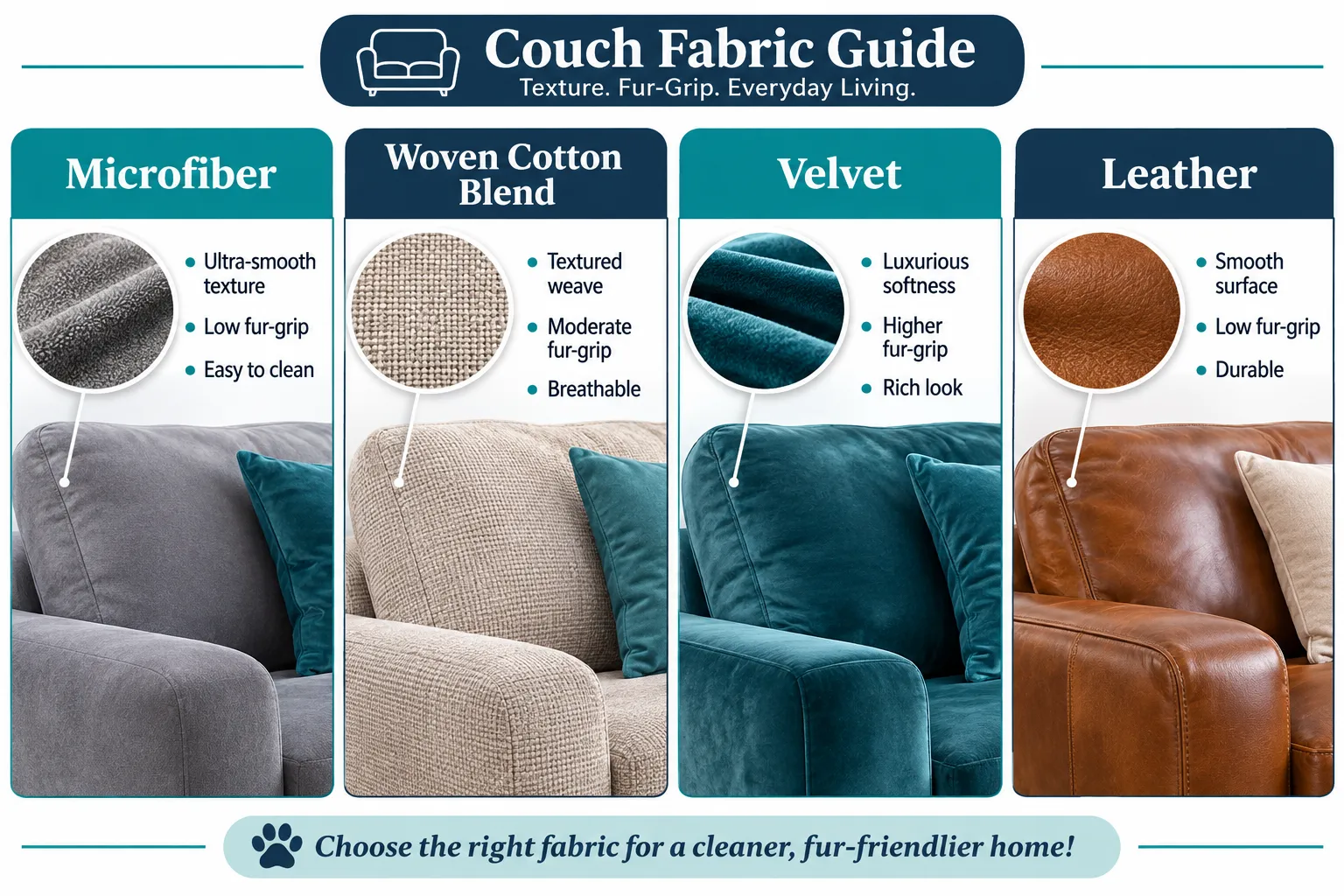
Generally no, not without adjusting pressure and technique, since couch materials respond very differently to the same mechanical action. A rubber roller that works well on a cotton-poly blend can snag a loose linen weave or crush velvet pile if used the same way.
Rough compatibility guide:
- Woven cotton blend: rubber or electrostatic rollers work in any direction without much risk.
- Microfiber: rubber or electrostatic rollers work, but short strokes reduce the static competition some microfiber blends create.
- Velvet: a soft rubber glove with light pressure, moving only in the direction of the nap, is safer than a standard roller.
- Leather: skip rollers; a damp microfiber cloth lifts fur without adding friction to the finish.
- Car upholstery: rubber squeegees or stiff brushes followed by a vacuum pass tend to outperform rollers on textured car seat fabric.
Decision rule: if you own multiple pieces of furniture in different materials, keep at least two tools on hand: one reusable roller for woven and microfiber pieces, and a soft cloth or glove for leather and velvet.
What removes dog hair better, lint roller or pet hair remover?
For a single light pass, a sticky lint roller and a reusable pet hair remover perform similarly on surface fur. For fur worked into the weave, a reusable rubber or electrostatic roller generally performs better, since Good Housekeeping’s testing found the top-rated reusable roller removed all visible test fur in one pass, something sticky sheets struggle to match once they’ve filled up.
The practical split many owners settle into:
- Sticky lint roller: quick touch-ups on clothing, light surface fur, or velvet where pressure needs to stay gentle.
- Reusable pet hair remover: full couch cleanups, embedded fur in tight weaves, repeated use without buying refills.
Quick example: a household with a shedding Labrador and a woven sectional will likely reach for a reusable roller weekly and keep a sticky roller in a drawer for a five-minute touch-up before company arrives.
How do you get stubborn dried dog hair off couch?
Dried, matted dog hair that’s been pressed into cushion fabric for days or weeks usually needs a damp approach before a roller will work well. Cozey’s upholstery cleaning guidance suggests lightly dampening a rubber glove or cloth with water before running it across the fabric, since moisture helps loosen fur that’s become statically bonded to the material over time.
A practical sequence for dried-in fur:
- Lightly dampen a rubber glove, sponge, or microfiber cloth; it should feel damp, not wet.
- Rub the damp surface across the cushion in short strokes, which loosens embedded fur and gathers it into small clumps.
- Let the fabric air dry for a few minutes.
- Vacuum or roll the now-loosened fur with a dry roller.
Common mistake: going straight to a dry roller on dried-in fur without a damp pass first. Dry fur that’s been pressed into fabric for a long time resists dry friction tools far more than fresh shedding does.
Do I need a special tool for leather vs fabric couches?
Yes, leather couches need a different approach than fabric ones. Rubber and electrostatic rollers are built to grip and lift fur from fibrous weaves; leather has no weave for them to grip, and the friction from repeated rolling can dull or scuff a leather finish over time.
For leather and vinyl couches:
- Use a slightly damp microfiber cloth, wiping in one direction to gather fur into a small pile.
- Avoid bristle brushes or rubber tools that apply pressure, since these can scratch or dull the surface finish.
- Dry the leather afterward with a separate dry cloth to prevent moisture sitting on the surface.
For fabric couches (woven, microfiber, velvet), a dog hair remover for couch use built around rubber or static mechanisms is the better fit, as detailed throughout this guide. Southern Living and Rowenta’s furniture care guidance both separate leather care from fabric care for this reason.
How often should you remove pet hair from furniture?
For households with a shedding dog, once or twice a week is a reasonable baseline, with more frequent touch-ups during spring and fall shedding seasons when double-coated breeds blow their undercoat. Rowenta’s furniture care guidance suggests more frequent light passes prevent fur from working deep into cushion fibers, which makes each individual cleaning session faster and easier.
A simple frequency guide:
- Short-coated dogs, light shedding: once a week is usually enough.
- Double-coated or heavy shedders: two to three times a week during shedding season, once a week otherwise.
- Multi-dog households: daily quick touch-ups with a sticky roller, plus a full roller pass once or twice weekly.
Decision rule: if fur is visibly resettling into the cushion within a day of cleaning, increase frequency rather than switching tools; the issue is usually buildup, not tool choice.
Rollers and Fabric-Safe Tools
Reusable rollers and rubber tools outperform disposable sticky sheets on most couch fabric because they don’t run out of adhesive halfway through a cushion. This is the core reason a dog hair remover for couch fabric built around rubber or static mechanisms tends to be the better long-term buy over sticky sheets alone.
Good Housekeeping’s lab tested 26 tools across carpets, clothing, velvet, polyester-knit pillows, and upholstery fiber simulations, and its top overall recommendation was the ChomChom Roller, which removed all visible test fur in a single pass using back-and-forth friction instead of glue. Multiple cleaning guides, including Anker’s furniture care notes, back a layered approach: sticky rollers for clothes, electrostatic rollers for couches and rugs, rubber blades for car carpet, and a grooming glove to catch loose fur before it lands on furniture at all.
Why fabric-safe matters here: metal-toothed removers did well on deep carpet pile in testing but are flagged as a snag risk on polyester knits and loose weaves. A couch cushion cover is closer to a garment than a carpet, so the gentler tool usually wins.
The ChomChom Roller Pet Hair Remover works through friction and static pickup rather than adhesive, which means it doesn’t lose power the way a sticky sheet does after the first few swipes.
Decision rule: choose a rubber or electrostatic roller if your couch fabric is woven or microfiber. Choose a sticky lint roller only for quick, light passes on delicate or pile fabric like velvet.
Top 5 Features That Decide the Purchase
The five features below decide whether a dog hair remover for couch fabric actually earns its spot in the cleaning closet.
- Reusability. The ChomChom Roller empties with a button and refills with zero sheets, which matters for owners cleaning several times a week.
- Head size. A wide roller head covers a couch cushion fast but struggles in corners and on collars, a tradeoff Good Housekeeping noted directly.
- Adhesive strength and sheet count. The PetLovers Extra Sticky Lint Roller set ships with 450 sheets across 5 rollers, which matters for households going through sheets fast.
- Grip and handle comfort. The BLACK+DECKER Pet Hair Remover uses a textured handle designed for repeated back-and-forth strokes across a cushion.
- Fabric compatibility. This is the feature most buyers skip checking, and it’s the one that causes the most returns and snagged covers.
Common mistake: buying based on video views instead of checking whether the roller is rated for upholstery at all. Not every pet hair tool on a shelf is built for couch fabric; some are made only for clothing.
Comparison table: dog hair remover for couch options
| Model | Price band | Mechanism | Best fabric fit |
|---|---|---|---|
| ChomChom Roller Pet Hair Remover | around $20 to $30 | Friction and static, reusable chamber | Woven upholstery, bedding, carpet |
| BLACK+DECKER Pet Hair Remover | around $20 to $30 | Rubber roller, hand pressure | Microfiber, flat-weave couches |
| PetLovers Extra Sticky Lint Roller (5-pack, 450 sheets) | around $15 to $20 | Adhesive sheets | Velvet, delicate pile, quick touch-ups |
Which pick fits which dog and owner?
The right pick depends on fur type and fabric more than on the dog’s breed. A dog hair remover for couch fabric that works well for a short-haired breed may underperform for a double-coated one, so matching fur type matters as much as fabric type.
- Short-coated dogs on woven couches: the ChomChom Roller handles the embedded, needle-like fur that works into tight weave.
- Long or soft fur, microfiber couch: the BLACK+DECKER Pet Hair Remover rolls surface fur off without fighting the fabric’s own static.
- Budget pick: the PetLovers Extra Sticky Lint Roller set, useful for owners who groom at home regularly and want a cheap, low-commitment option for between-roller touch-ups, especially on velvet or delicate pillow covers.
- Undercoat-heavy breeds: expect two passes with any tool. No single roller lifts a double coat’s undercoat in one swipe.
Primary action: check current availability for the best-fit model before assuming the viral option works on your exact fabric.
Things to Watch Out For
The most common mistake is buying the most-recommended roller without checking its fit for your actual fabric.
- Snagging on loose weaves. Good Housekeeping specifically flags metal-toothed tools as a risk on polyester knits and open weaves.
- Overloaded sticky sheets. A lint roller that’s been used twice loses most of its grab; swap sheets more often than feels necessary.
- Pressing too hard on velvet. This crushes the nap and leaves visible pressure marks that don’t recover.
- Skipping the test patch. Always run any tool on a hidden section of cushion first, especially on dyed or textured fabric.
- Expecting one pass to finish the job. Undercoat fluff almost always needs a second or third pass.
Who Should Skip This
Owners with leather or vinyl couches can mostly skip rollers altogether. A slightly damp microfiber cloth lifts fur off leather fine, and a rubber or electrostatic roller adds nothing there and risks scuffing the finish.
Households with very delicate antique upholstery should skip DIY tools entirely and have the piece professionally cleaned, since even a rubber roller’s friction can wear thin, aged fabric.
Drawback honesty: the ChomChom’s wide head is clumsy in tight corners and on throw pillows with piping, so owners with heavily tufted furniture may need a smaller sticky roller for detail work.
FAQ
Does a dog hair remover for couch fabric work on car seats too? Some do, especially rubber roller and squeegee styles, but car upholstery often has a tighter, more textured weave than couch fabric, so a rubber squeegee followed by a vacuum pass tends to outperform a couch-style roller in a car.
How long does a reusable roller last? Most reusable rubber and static rollers last one to two years of regular use before the surface wears down enough to lose grip, though this varies by how often it’s used and how it’s cleaned.
Can I wash a fabric couch cover instead of using a roller? Yes, if the cover is removable and machine washable, washing removes fur more completely than any roller, but most couches don’t have fully removable covers, which is why spot tools remain the practical daily option.
Is a vacuum with a pet hair attachment enough on its own? For light, surface-level fur, often yes. For fur worked deep into a tight weave, a roller pass before vacuuming usually picks up more than a vacuum alone, based on testing from Good Housekeeping.
Do static rollers work less well in humid weather? Yes, static buildup is reduced in humid air, so electrostatic rollers can feel less effective during muggy months. A plain rubber roller or a slightly damp cloth pass can help in that situation.
What’s the fastest way to clean fur off a couch before guests arrive? A quick pass with a sticky lint roller on visible cushion surfaces, focused on seat edges and arm rests where guests actually sit, covers most of what’s noticeable in a five-minute cleanup.
Can metal-toothed combs be used on a couch? Generally not recommended. Good Housekeeping’s testing flagged metal-toothed tools as a snag risk on polyester knits and loose weaves, both common in couch upholstery.
Does the type of dog breed change which tool I should buy? Fur type matters more than breed directly. Short, needle-like fur from breeds like Labradors behaves differently than the soft undercoat fluff from double-coated breeds like Huskies, and tool choice should follow fur type and couch fabric rather than breed name alone.
If shedding management feels like an ongoing project rather than a one-time fix, broader resources on dog care basics and grooming fundamentals can help address the root cause alongside the right couch tools.