
This post contains affiliate links. If you buy through one we may earn a commission at no extra cost to you. As an Amazon Associate I earn from qualifying purchases.
Quick Answer
A dog bath sprayer is a hose-and-wand attachment that connects to a faucet, shower arm, or garden spigot to rinse a dog during bathing. The right choice depends on matching the adapter to your fixture’s thread type, picking a hose long enough to reach around your tub, and choosing a valve (diverter or splitter) that will not crack after months of daily on/off use. Most buyers pay between $15 and $40, and the biggest source of complaints is a mismatched adapter rather than a weak spray head.
Key Takeaways
- North American shower arms commonly use ½-inch NPT thread, while handheld shower hoses typically use G1/2 connections, a mismatch that causes most fitment complaints.
- A November 2026 Amazon kit bundled a 6.7-foot hose, three-way splitter valve, metal adapter, and PTFE tape to cover both shower and garden hose threads in one box.
- The Rinseroo slip-on attachment is built for tub spouts, not showerheads, and Chewy reviews from 2026 describe slipping, leaking, and hose separation within a year for some buyers.
- VCA Animal Hospitals notes a spray nozzle or hose attachment mainly helps with rinsing control, not medical treatment.
- AKC and veterinary groomers recommend a soft stream around the ears and face because trapped water in a dog’s L-shaped ear canal can contribute to infections.
- All-metal diverter valves, like the brass diverter used in The Home Depot’s cordless dog shower kit, held up better under repeated use than plastic ones in late 2026 reviews.
- Flow rate matters more than spray pattern for thick-coated dogs; a sprayer rated near 1.8 GPM, similar to the Waterpik Pet Wand, clears shampoo faster than a low-flow misting nozzle.
Affiliate disclosure line
This article contains affiliate links to Amazon. Purchases made through these links may earn a small commission at no extra cost. Products are selected and described based on specifications and published listings, not commission size.
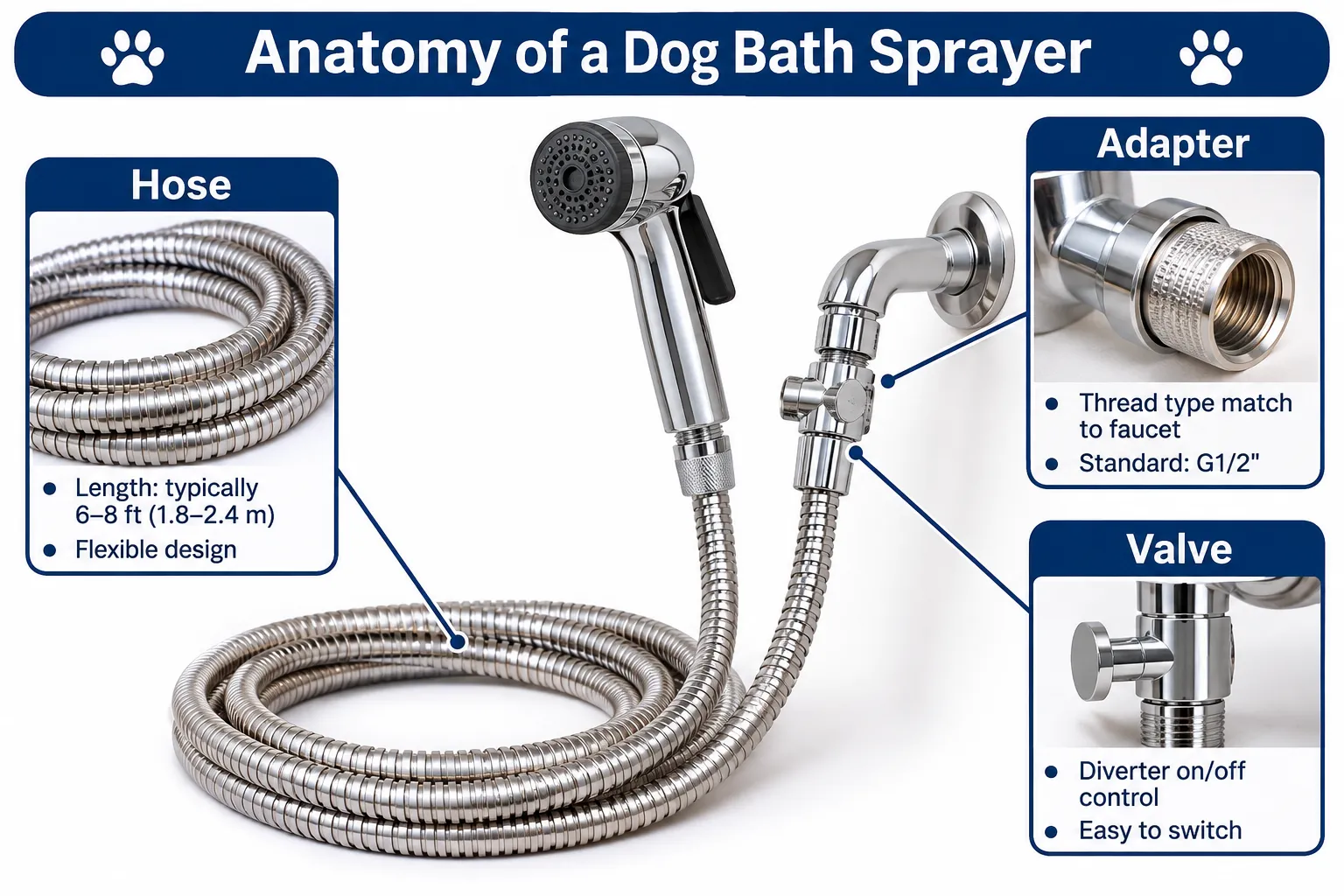
What is a dog bath sprayer and how does it work
A dog bath sprayer is a hose attachment that connects to a faucet, shower arm, or garden spigot and sends a controlled stream of water over a dog during bathing. Water enters through the adapter, travels down the hose, and exits through a handheld wand that the owner aims directly at the dog’s skin, which gets shampoo out faster than pouring water from a cup.
The job is simple: get water to the skin fast, rinse shampoo out completely, and do it without soaking the bathroom floor or forcing water into a dog’s ears. Most kits include three parts that matter more than the spray pattern on the box: the hose, the adapter, and the valve. The hose carries water from the source to the wand. The adapter is the threaded or slip-on piece that connects the hose to a specific faucet or shower arm, and it is where most returns happen because North American plumbing uses several incompatible thread standards. The valve, sometimes a simple on/off trigger and sometimes a diverter that splits water between the tub spout and the sprayer, controls flow and pressure at the wand.
Owners grooming at home to save on salon visits usually care about three things: will it fit without extra hardware, will it rinse a thick double coat in a reasonable time, and will it survive more than one season. A dog bath sprayer earns its price by solving the first two problems. The third depends heavily on whether the hose and valve are rubber-reinforced or thin vinyl, a detail worth checking in the product description before adding anything to the cart. For owners just starting a home grooming routine, a beginner’s guide to dog grooming covers the basics that pair well with any sprayer setup.
Doggy Rank IQ Tool
Dog Bath Sprayer Fitting Finder

Most returns are a thread mismatch. Pick your fixture and coat and get the attachment type and adapter.
Check the Hose, Adapter and Valve
The honest answer: measure the fixture thread before ordering any dog bath sprayer, because “universal” on the box rarely means universal in practice. A hose that is too short, an adapter that does not match the home’s thread family, and a valve that sticks are the three failure points owners report most often.
Hose. Length determines reach around a tub or into a shower stall. An 8-foot hose, like the one on the Aquapaw Dog Bath Brush Pro, lets most owners stand outside the tub while rinsing a large dog. Shorter hoses under 6 feet work fine for a sink setup but feel cramped in a full bathtub, especially with a dog that moves around during rinsing. Some stainless steel models, including the one in The Home Depot’s sink faucet sprayer attachment, run closer to 59 inches, which is fine for sink use but short for a standing adult dog in a tub.
Adapter. This is where returns happen most. Showerhead arms in the U.S. generally use ½-inch NPT pipe thread, while the hose side of handheld shower attachments usually uses G1/2, a different standard that needs its own adapter. Garden hose connections use ¾-inch garden-hose thread, which is why a kit built for outdoor use often needs a separate ¾-inch-to-½-inch adapter to work indoors. A November 2026 listing addressed this directly by bundling a metal adapter, PTFE tape, and a three-way valve to cover both standards in one box.
Valve. A diverter valve lets water flow to the tub spout or the sprayer, not both at once. Reviewers checking metal versus plastic diverters in late 2026 found all-metal versions, like the brass diverter in The Home Depot’s cordless kit, held up better against cracking than common plastic T-valves, a detail worth checking before buying a kit with a flimsy plastic part.
Decision rule: if the faucet or shower arm thread type cannot be identified by sight, buy a slip-on tub-spout design instead of a threaded one. Slip-on designs, like the Rinseroo-style rubber sleeve, avoid the thread-matching problem entirely, though they trade that convenience for a less secure seal, something 2026 Chewy reviews flagged repeatedly.
Best dog bath sprayer brands and reviews
The best dog bath sprayer brands in 2026 split into three categories: shower-arm kits, sink-faucet kits, and slip-on tub attachments, and the right brand depends on which fixture the dog actually gets bathed at. Aquapaw, G-Promise, Waterpik, and Rinseroo each dominate a different use case rather than competing head-to-head on the same fixture type.
- Aquapaw Dog Bath Brush Pro combines an 8-foot hose with a built-in silicone scrubber brush, which makes it a strong pick for shower or tub setups where a single tool needs to handle both lathering and rinsing.
- G-Promise 2 Mode Dog Shower Attachment uses a G1/2 shower thread adapter and includes an adhesive wall mount, which suits apartment bathrooms with limited counter or floor space.
- Waterpik Pet Wand offers two spray settings and a flow rate around 1.8 GPM according to its Home Depot listing, and it works both indoors on a shower thread and outdoors on a garden hose.
- Rinseroo slip-on sleeve fits tub spouts without tools or threading, a good match for renters, but Chewy’s review archive shows a recurring minority of buyers reporting it slipping off mid-rinse after repeated stretching.
- Sink Faucet Sprayer Attachment from The Home Depot is built specifically for sink threads and four spray modes, making it a cheap option for small dogs bathed in a utility sink.
Common mistake: buying based on brand reputation alone, without checking whether that brand’s adapter matches a shower arm, tub spout, or sink faucet specifically. A this bath sprayer marketed as “universal” usually means it includes multiple adapters in the box, not that one single adapter fits everything.
Handheld vs attached dog bath sprayer: which is better
A handheld this bath sprayer gives more control for rinsing around the face and legs, while a wall-mounted or attached sprayer frees both hands for scrubbing and holding a squirming dog. Choose handheld if the dog is calm and cooperative; choose a wall-mounted or adhesive-mounted unit if bathing requires two hands most of the time.

Handheld wands, including the Aquapaw and the Waterpik Pet Wand, let an owner aim precisely, which matters for sensitive areas like the belly and tail base. The tradeoff is that one hand is occupied holding the wand, leaving only one free hand to manage the dog or the shampoo bottle.
Attached or mounted sprayers, like the G-Promise’s adhesive-mount version, stay fixed in place so both hands stay free, but they lose precision since the water stream cannot be redirected as quickly. For a large, strong dog that needs restraining during the bath, a mounted or wall-clipped sprayer often works better simply because it is one less thing to hold onto.
Edge case: dogs that are fearful of handheld wands sometimes tolerate a fixed, overhead shower stream better because it does not move or “chase” them the way a handheld nozzle can.
How much does a good dog bath sprayer cost
A good this bath sprayer typically costs between $15 and $40 as of 2026, with most popular models landing in the $25 to $35 range. Price differences usually come down to hose length, number of spray modes, and whether the kit includes a metal versus plastic diverter valve.
- Budget tier ($15 to $25): basic sink attachments with a short hose and single spray setting, like the lower end of the Sink Faucet Sprayer Attachment pricing.
- Mid tier ($25 to $35): shower-arm kits with two spray modes and a mounting bracket, such as the G-Promise.
- Premium tier ($30 to $40): brush-integrated kits with longer hoses, like the Aquapaw Dog Bath Brush Pro, or branded wands like the Waterpik Pet Wand with multiple GPM-rated settings.
Decision rule: if bathing happens weekly or more, spend toward the top of the range for a reinforced hose and metal valve, since cheaper vinyl hoses tend to kink and crack faster under frequent use.
Where can I buy a dog bath sprayer
A this bath sprayer can be bought through Amazon, Chewy, The Home Depot, and most pet supply retailers, both online and in physical stores. Each retailer tends to carry a slightly different mix of brands, so checking more than one site before buying helps confirm current stock and price.
- Amazon carries the widest selection, including Aquapaw and G-Promise, often with Prime shipping.
- Chewy stocks pet-specific brands like Rinseroo directly alongside other grooming supplies and shampoo.
- The Home Depot sells hardware-adjacent models such as the Waterpik Pet Wand and sink faucet attachments, often bundled with plumbing fittings.
- Big box pet stores sometimes carry basic slip-on models in-store for same-day pickup, though selection is usually more limited than online.
Dog bath sprayer pressure too weak or not working
Weak pressure from a this bath sprayer is almost always caused by a kinked hose, a clogged nozzle, or low household water pressure, not a defective unit. Checking these three points in order usually finds the problem within a few minutes.
- Check the hose for kinks near the adapter connection first, since a bend close to the fitting restricts flow more than a bend further down the hose.
- Remove and rinse the nozzle head under running water to clear mineral buildup, which is common in homes with hard water and can visibly narrow the spray holes within months.
- Test the fixture’s baseline pressure by running water without the sprayer attached; if it is weak there too, the sprayer is not the problem and the home’s plumbing or water pressure regulator may need attention.
- Confirm the diverter valve is fully switched to the sprayer position, since a partially turned diverter valve splits flow between the spout and the wand, weakening both.
Common mistake: assuming a low-flow spray mode is a malfunction when it is actually one of the intentional settings built into multi-mode wands like the Waterpik Pet Wand or G-Promise.
Best dog bath sprayer for large dogs
The best this bath sprayer for a large dog is one with a long hose (7 to 8 feet or more), steady high flow rather than a misting pattern, and a hose rated for stretch without cracking. Large or double-coated breeds need water pressure that reaches the skin through a thick undercoat, not just a wide spray pattern.
- The Aquapaw Dog Bath Brush Pro, with its 8-foot hose and integrated scrubber, works well for Huskies, Golden Retrievers, and Shepherds because the brush bristles help part the coat while water flows directly against the skin.
- The Waterpik Pet Wand, rated around 1.8 GPM, provides enough steady flow to rinse shampoo out of a heavy coat faster than a low-pressure attachment.
- Avoid slip-on tub designs for large dogs standing in a bathtub, since the extra movement and weight shifting increases the chance of the sleeve slipping off the spout mid-rinse.
Dog bath sprayer for dogs with sensitive skin
For dogs with sensitive skin, a this bath sprayer with a low-pressure or gentle spray setting controlled at the handle works better than relying on thumb pressure over an open nozzle. VCA Animal Hospitals notes that medicated shampoo baths in particular need gentle, controlled rinsing to avoid irritating already compromised skin.
- Choose a wand with at least two spray modes so the gentle setting can be used near the face, belly, and any hot spots.
- Keep water temperature lukewarm; cold or very hot water can aggravate sensitive or inflamed skin.
- Dogs on medicated shampoo protocols often need the shampoo left on for several minutes before rinsing, per VCA’s bathing guidance, so a sprayer mainly helps with the final rinse step rather than the treatment itself.
- Avoid direct, full-pressure streams on broken skin, hot spots, or recent surgical sites; a cupped hand under lower pressure flow is safer in those spots.
How to get my dog used to a bath sprayer
Getting a dog comfortable with a bath sprayer takes a gradual introduction over several sessions rather than turning it on at full pressure during the first bath. Most dogs adjust within two to four baths if the process starts slow and rewards calm behavior.
- Turn the water on at the lowest pressure setting before bringing the dog near the tub.
- Let the dog sniff and inspect the wand while it is off, so the shape and smell become familiar.
- Start spraying at the paws and lower legs first, the least sensitive areas, before moving upward.
- Avoid the face and ears directly; pour or sponge water there instead, or use the sprayer’s lowest setting pointed away from the ear canal.
- Reward calm behavior with a treat or praise immediately after each new area gets wet for the first time.
Edge case: dogs with a history of fear around loud appliances sometimes react to the hiss of a sprayer valve opening; running the water briefly in another room before the bath can reduce that startle response.
Can I just use a regular shower head instead
A regular fixed shower head can work for bathing a dog, but it lacks the aim and portability a dedicated this bath sprayer provides, which matters most for rinsing the belly, legs, and hard-to-reach spots. A detachable handheld shower head with a long enough hose comes close to matching a dog-specific sprayer’s usefulness.
Owners who already have a handheld shower head with at least 5 feet of hose often do not need to buy a dedicated this bath sprayer at all, since the rinsing control is similar. The main advantage a dog-specific sprayer adds is a nozzle shape and sometimes an integrated brush built for coat work, not fundamentally different water delivery. VCA Animal Hospitals lists a spray attachment as one of several helpful but optional bath-time accessories, not a required tool.
Common mistakes people make when using dog bath sprayers
The most common mistakes with a this bath sprayer involve pressure, placement, and patience rather than equipment failure. Avoiding these five issues solves most bath-time frustration without buying new gear.
- Spraying directly into the ear canal, which the AKC and most veterinary groomers warn against because trapped water in a dog’s L-shaped ear canal can contribute to infections.
- Using full pressure on the face, startling the dog and creating lasting fear of bath time.
- Not testing water temperature before starting, since lukewarm water (not hot, not cold) is more comfortable for most dogs.
- Leaving the diverter valve half-switched, which weakens flow to both the spout and the sprayer at once.
- Skipping the rinse step too early, leaving shampoo residue in a thick coat, which can cause skin irritation over time according to VCA’s bathing routine guidance.
Is a dog bath sprayer actually worth it
A this bath sprayer is worth it for most owners who bathe their dog at home regularly, since it rinses shampoo out faster and more thoroughly than pouring water from a cup or pitcher. For owners who bathe a dog only a few times a year or who already own a handheld shower head, the value is smaller.
- Worth it for: owners with thick-coated or large dogs, frequent at-home bathers, and anyone currently using a cup or pitcher to rinse.
- Not worth it for: owners with a smooth-coat small dog that bathes easily in a sink, renters with non-removable faucet hardware that no adapter fits, or households with very low water pressure where any sprayer underperforms.
- Decision rule: if rinsing currently takes more than a few minutes per bath or leaves visible shampoo residue, a this bath sprayer will likely save real time and produce a cleaner rinse.
How do I keep water out of my dog’s ears with a sprayer
Keeping water out of a dog’s ears during a bath means aiming the sprayer stream below the ear line and using a soft, low-pressure setting near the head rather than a direct jet. The AKC specifically recommends a soft stream around the ears and face because trapped water in a dog’s L-shaped ear canal can contribute to infections.

- Use cotton balls loosely placed at the ear canal opening before bathing, removed immediately after.
- Hold an ear flap gently closed with one hand while rinsing the head area with the other.
- Dry ears thoroughly with a towel after the bath, checking that no moisture remains near the opening.
- If a dog shakes its head repeatedly or scratches at an ear after bathing, check for trapped moisture or consider a vet visit if irritation persists.
Top 5 Features That Decide the Purchase
The five features below separate a this bath sprayer that gets used weekly from one that ends up in a drawer.
- Hose length and flexibility. The Aquapaw Dog Bath Brush Pro ships with an 8-foot hose, long enough to reach around most standard tubs without stretching.
- Adapter compatibility. The Sink Faucet Sprayer Attachment is built for sink faucet threads specifically, which makes it a strong pick for owners without a tub, but a poor fit for shower arms.
- Flow control at the wand. The G-Promise 2 Mode Dog Shower Attachment offers two spray settings controlled right at the handle, useful for switching between a gentle rinse near the face and a stronger stream on the body.
- Brush or scrubber integration. The Aquapaw doubles as a silicone scrubber brush, combining lather and rinse into one tool, which matters for owners who currently juggle a washcloth and a cup.
- Mounting and storage. An adhesive wall mount, included with the G-Promise, keeps the sprayer off the tub floor between baths, reducing the tangled-hose problem that shows up in a lot of bathroom corners.
Comparison table
| Model | Price Band | Hose Length | Fixture Fit |
|---|---|---|---|
| Aquapaw Dog Bath Brush Pro | around $30 to $40 | 8 ft | Shower/tub with adapter |
| G-Promise 2 Mode Dog Shower Attachment | around $25 to $35 | Extra-long, adhesive mount | Shower arm, G1/2 thread |
| Sink Faucet Sprayer Attachment | around $15 to $25 | Shorter, sink-length | Sink faucet threads |
Table: three this bath sprayer options compared by price band, hose length, and fixture fit.
Which pick fits which dog and owner?
The right this bath sprayer depends more on bathroom setup and coat type than on brand reputation. A thick-coated dog needs steady flow and reach; a nervous small dog needs a gentle, controllable stream near the face.
- Thick-coated dogs (Huskies, Golden Retrievers, Shepherds): the Aquapaw Dog Bath Brush Pro pairs rinsing with a scrubbing brush, useful for working water down to the undercoat rather than skimming the top layer.
- Apartment dwellers with only a shower stall: the G-Promise 2 Mode Dog Shower Attachment’s extra-long hose and wall mount suit a small stall where floor space is limited.
- Budget pick: the Sink Faucet Sprayer Attachment runs lower in price and works well for small dogs bathed in a sink or utility tub, though it is not built for a full-size dog in a bathtub.
- Puppies and sensitive-skin dogs: look for a model with a low-pressure or stop-water setting at the handle rather than relying on thumb pressure over the opening.
For owners figuring out a complete at-home grooming setup, pairing a this bath sprayer with the right brushes and tools in a beginner’s guide to dog grooming covers the rest of the routine.
Things to Watch Out For
The biggest complaint pattern across 2026 reviews is leaking at the hose connection and slipping off the faucet mid-bath. Both point back to the same root cause: an adapter or sleeve that does not match the fixture’s actual diameter.
- Check the thread type printed on the box against the faucet or shower arm before ordering, not after.
- A diverter valve made of thin plastic is more likely to crack under repeated on/off use than a metal one.
- Hose kink near the adapter connection is a common cause of lost pressure, not a weak sprayer head.
- Slip-on tub designs rely on friction, not threads, so a worn rubber gasket after a year of use is a known failure point, not a defect.
Who Should Skip This
A this bath sprayer is not the right purchase for every household. Renters with a non-removable faucet aerator may find no slip-on or threaded adapter fits cleanly, and forcing one risks cracking the fixture.
- Owners who already use a detachable handheld shower head get similar rinsing control without buying a second attachment.
- Households with a smooth-coat small dog that bathes easily in a sink with a cup of water may not need the extra gear or expense.
- Anyone with municipal low water pressure should check reviews for flow complaints before buying a model marketed for “deep coat rinsing,” since low home pressure limits any sprayer’s performance regardless of nozzle design.
FAQ
Q: What is the best this bath sprayer for a shower? A model with a G1/2 adapter built for shower-arm threads, like the G-Promise 2 Mode Dog Shower Attachment, fits most U.S. shower connections without extra hardware and includes an adhesive mount for small stalls.
Q: How do you attach a dog sprayer to a bathtub faucet? Slip-on designs stretch over the spout and seal by friction, while threaded designs need the spout’s aerator removed first and a matching adapter screwed on, with PTFE tape helping create a tighter seal against leaks.
Q: Can you wash a dog in a shower with no tub? Yes, a shower-arm or handheld-hose this bath sprayer works fine in a stall shower. Check the fixture’s thread type first, since shower-only setups typically use different adapter standards than tub spouts do.
Q: Do slip-on shower attachments actually stay on? Most of the time, but 2026 Chewy review summaries report slipping, leaking, and hose separation after months of use for some buyers, so a secure threaded connection tends to be more reliable long term for frequent bathers.
Q: What water pressure do you need to rinse a double coat? No fixed PSI number is published for this bath sprayers; the practical test is whether the stream still reaches the skin after passing through an 8-foot hose and adapter, which favors reinforced hoses and higher GPM-rated wands over thin vinyl, low-flow nozzles.
Q: Is a handheld shower head better than a dog sprayer? A handheld shower head offers similar rinsing control if it already has a long enough hose, so a dedicated this bath sprayer mainly adds value through a dog-specific wand shape or combined brush feature rather than fundamentally different water delivery.
Q: Can a bath sprayer connect to a garden hose? Some kits support both; a November 2026 listing included a metal adapter and splitter valve specifically to let one wand work on a ¾-inch garden hose outdoors and a G1/2 shower thread indoors, which suits owners who bathe dogs both in the yard and inside.
Q: How do I know if my this bath sprayer adapter will fit? Measure or compare the fixture’s thread pattern against the adapter’s listed specifications before buying; most listings note whether they fit ½-inch NPT shower arms, G1/2 handheld hose threads, or ¾-inch garden hose connections, and a mismatch is the single most common return reason.
Q: Why does my this bath sprayer leak at the connection point? A leak at the connection usually means the adapter thread does not fully match the fixture or that PTFE tape was not used to seal a threaded joint; rewrapping the threads with tape or swapping to the correct adapter size typically fixes it.
Q: Can a this bath sprayer be used outdoors on a garden hose? Yes, kits with a ¾-inch garden hose thread adapter work outdoors for dogs bathed in a yard or on a patio, and some multi-adapter kits let the same wand switch between outdoor and indoor use.
Related reading on home grooming and dog care basics: dog grooming guide, choosing the best dog food, anesthesia-free dental cleaning, and calming products for anxious dogs.