
Quick Answer: Is a Labrador Retriever Right for You?
A labrador retriever suits active, social households that can handle 60 to 90 minutes of daily exercise, year-round shedding, and a dog who treats every meal as the most important event of the day. Labs are friendly, highly trainable, and genuinely good with kids, which is why they held the American Kennel Club’s top spot for 31 straight years before the French Bulldog passed them in 2023. The catch is appetite. Research from the University of Cambridge found that a gene deletion affecting hunger signaling shows up in roughly a quarter of Labs, which makes weight control a daily management task rather than an afterthought.
Skip this breed if you want a low-energy dog, a tidy house, or a puppy phase that stays polite.
Key Takeaways: Labrador Retriever
- A 2024 University of Cambridge study of 87 pet Labradors found dogs with the POMC deletion were hungrier between meals and burned about 25% less energy at rest.
- The deletion appears in roughly 23% to 25% of Labradors, and in 76% of Labradors bred as assistance dogs, per the same Cambridge research.
- Purina’s 14-year Life Span Study of 48 Labrador Retrievers found that dogs fed about 25% less than their littermates lived a median 13.0 years versus 11.2 years, reported by Petfood Industry.
- Adult size: males typically 65 to 80 pounds, females 55 to 70 pounds, per the Labrador Retriever Club breed standard.
- The Labrador Retriever Club recommends OFA hip and elbow evaluations, an ACVO eye exam, and Exercise-Induced Collapse DNA testing before breeding.
- Labs originated as fishermen’s water dogs in Newfoundland, not Labrador, and were refined in England in the 1800s (Britannica).
- Expect a puppy price of roughly $1,200 to $3,000 from a health-testing breeder, plus first-year costs that commonly land between $2,000 and $4,000.
Where Does the Labrador Retriever Come From?
The labrador retriever came from Newfoundland, not Labrador. The breed’s ancestor was the St. John’s water dog, a short-coated working dog used by cod fishermen in the 1700s and 1800s to haul nets, retrieve lines, and fetch fish that slipped the hook in freezing Atlantic water.
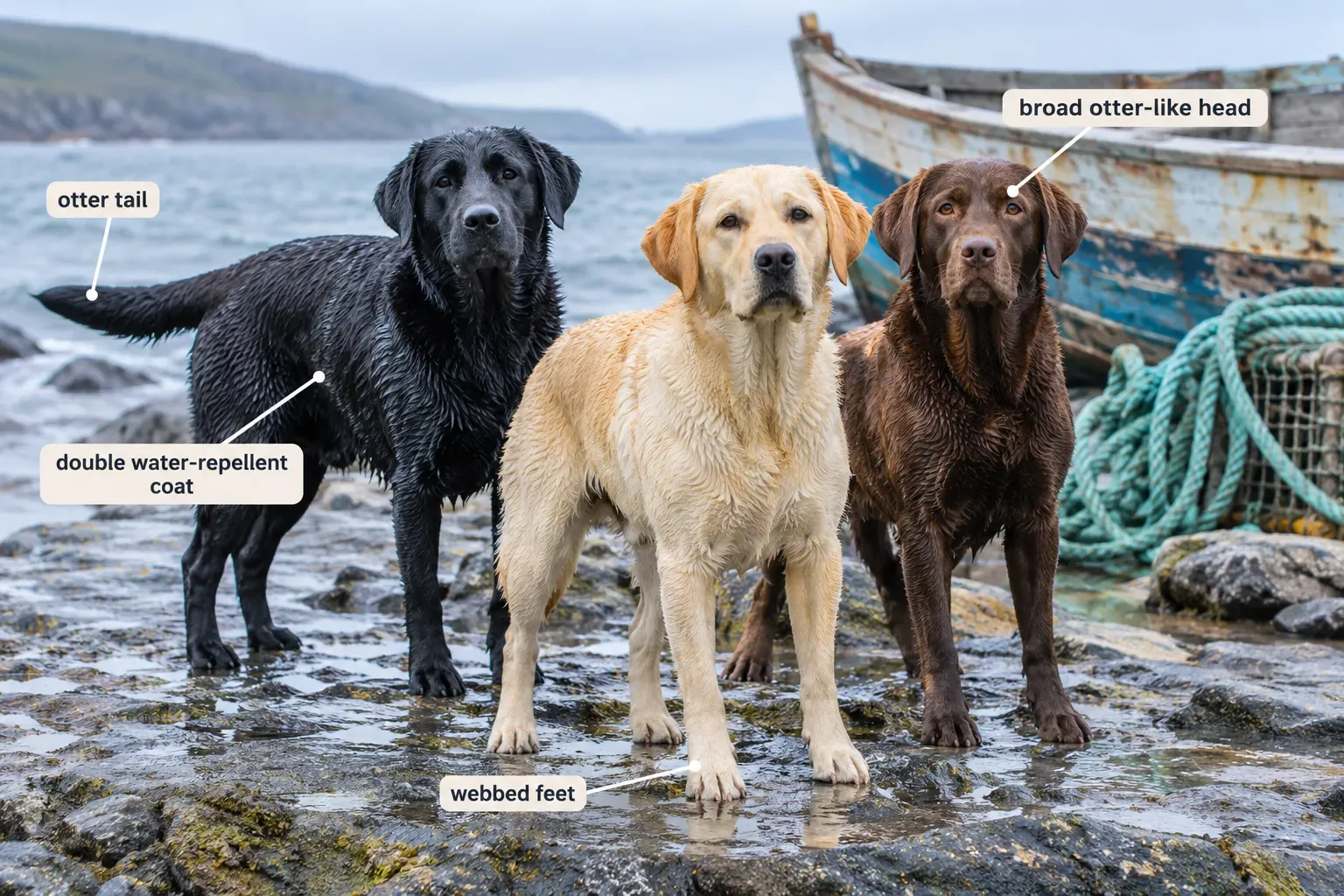
English aristocrats, including the Earl of Malmesbury, imported those dogs in the early 1800s and developed them into the modern breed. The name stuck by accident and nobody corrected it.
Everything people love and complain about traces back to that job. The dense double coat that sheds on your couch kept the dog warm in the North Atlantic. The thick “otter” tail worked as a rudder. The webbed feet were for swimming. And the willingness to work all day for a reward made the dog easy to train, which is also why your Lab will do anything for a piece of cheese.
One detail worth knowing: Cambridge researchers found the appetite-linked POMC deletion in 76% of Labradors bred specifically as assistance dogs, against roughly a quarter of pet Labs. Food-driven dogs train faster. People selected for trainability and got the hunger as a package deal.
What Makes the Labrador Retriever So Special (and So Cute)?
What makes a labrador retriever special is a rare combination: high biddability, low suspicion of strangers, and a mood that stays stubbornly cheerful. The breed standard describes the ideal Lab as kindly, outgoing, and non-aggressive toward people or animals, which is why Labs dominate assistance work, therapy work, detection work, and family life at the same time.
The cuteness is partly structural. Round skull, wide-set brown eyes, soft ear set, and a tail that moves like a metronome set to “delighted.” Add the physical comedy of a 70-pound dog who still believes he fits on your lap.
Owners consistently describe three things they love:
- The goofiness. Labs commit fully to bad ideas. A stick too long for the doorway. A sprint across wet tile.
- The trainability. Give a Lab a job and the dog gets noticeably easier to live with. Withhold the job and your shoes become the job.
- The enthusiasm. Labs treat a grocery run and a vacation with identical excitement.
That same enthusiasm is the reason your garden hose is now three pieces. If you are still comparing breeds, the Doggy Rank IQ breed matchmaker guides line up temperament against household reality.
Labrador Retriever Size, Weight and Lifespan
Adult labrador retriever males stand 22.5 to 24.5 inches at the shoulder and weigh 65 to 80 pounds. Females stand 21.5 to 23.5 inches and weigh 55 to 70 pounds. Typical lifespan is 10 to 12 years, and body weight moves that number more than almost anything else you control.
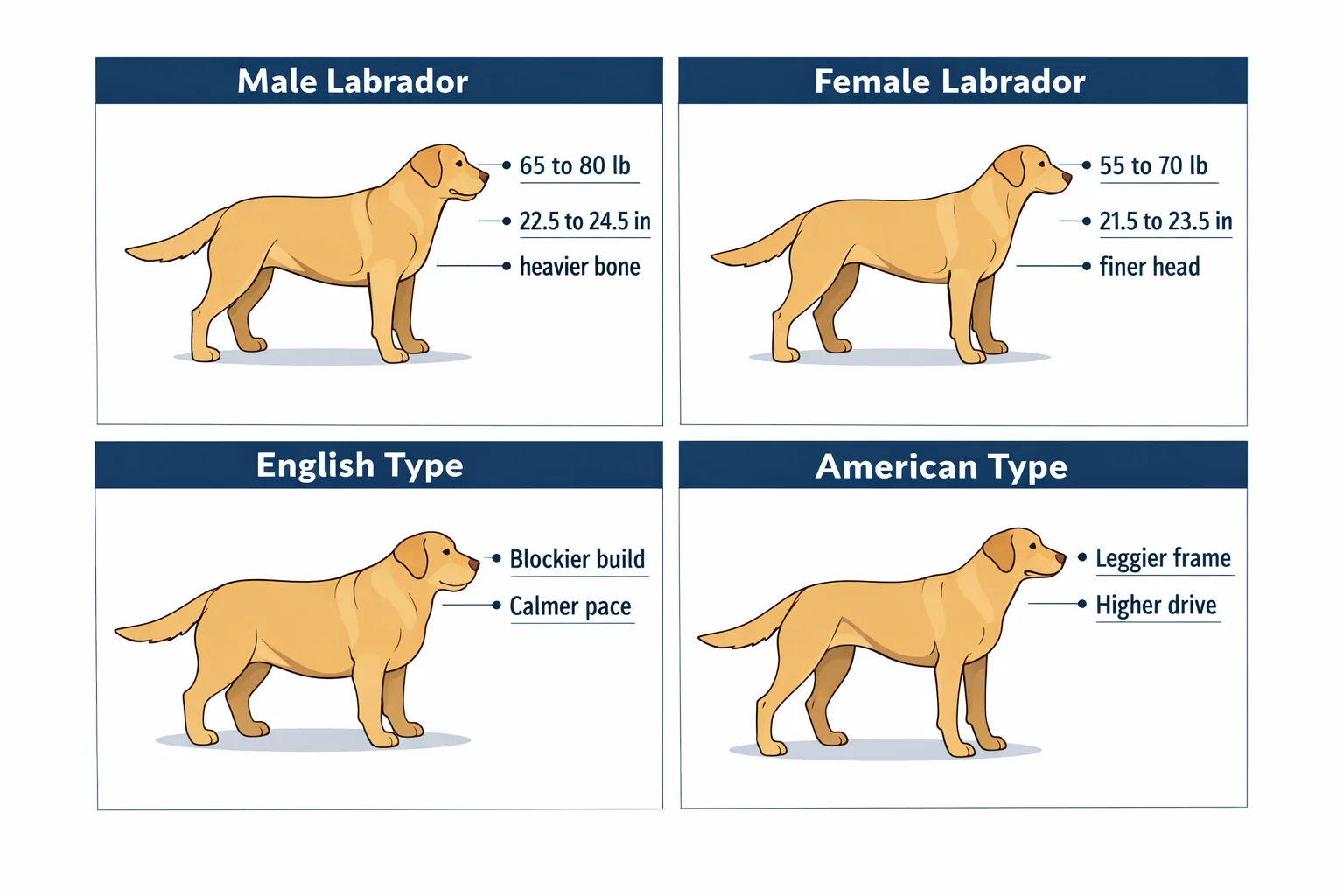
| Lab type | Height | Typical weight | Notes |
|---|---|---|---|
| Male Labrador Retriever | 22.5 to 24.5 in | 65 to 80 lb | Heavier bone, broader head |
| Female Labrador Retriever | 21.5 to 23.5 in | 55 to 70 lb | Finer head, often faster to mature |
| English (show) type | Within standard | Often top of range | Blockier, calmer pace |
| American (field) type | Within standard | Often lower range | Leggier, higher drive |
The Purina Life Span Study followed 48 Labradors from seven litters for 14 years. Dogs fed roughly 25% less than their matched littermates reached a median lifespan of 13.0 years against 11.2 years, needed treatment for age-related disease later (12.0 versus 9.9 years), and showed substantially less osteoarthritis at age eight. That is one study, one breed, and a controlled feeding protocol, so the exact numbers will not transfer perfectly to your dog. The direction is still the clearest longevity lever a Lab owner has.
Labs are a large breed, not a giant one. If you are checking which category your dog falls into, see the dog size guide for large versus giant breeds.
What Is the Labrador Retriever Temperament Like?
The labrador retriever temperament is outgoing, people-focused, and slow to mature. The breed club describes the ideal Lab as tractable and eager to please, which in practice means a dog who wants your attention constantly and is willing to work for it.
Expect mental adulthood somewhere between two and three years. Before that, you have a large, strong, friendly dog with a teenager’s judgment.
Common temperament traits that catch new owners off guard:
- Mouthiness. Retrievers carry things. Puppies carry everything, including your wrist.
- Low guarding instinct. A Lab will usually greet an intruder with a toy. If you want protection, look at the top protection dog breeds guide instead.
- Separation sensitivity. Labs bond hard and many do poorly with long solo days without preparation.
- Water obsession. Puddles count as water.
Individual variation is real. Field-bred lines tend to run hotter and recover from excitement slower. Show-bred lines often settle earlier. Neither guarantees anything about the specific puppy in front of you.
Are Labrador Retrievers Good With Kids and Other Pets?
Yes, labrador retrievers are generally excellent with children and other pets, which is why they appear on almost every family breed list. The tolerance is genuine, but the main risk with kids is not aggression. It is a happy 70-pound dog clearing a toddler like a bowling pin.
Practical guardrails that work:
- Teach a solid “four on the floor” greeting before the dog hits 40 pounds.
- Feed the Lab in a separate room or behind a gate. Food-driven dogs guard food more often than people expect, and children do not read warning signals well.
- Give the dog a bed that children are not allowed to approach. A dog who can leave rarely needs to escalate.
- Supervise all dog-and-child interaction until the child is old enough to follow rules reliably.
With cats and other dogs, most Labs do well, especially when socialized before 16 weeks. Small pets like rabbits deserve caution, since retrieving drive is still drive. For broader comparisons, the family-friendly breeds guide for kids covers alternatives with lower energy demands.
Who Is the Labrador Retriever Made For, and Who Should Skip It?
A labrador retriever is made for households that are active, home a reasonable amount, and relaxed about dirt. Skip the breed if you want a quiet apartment dog, a hair-free home, or a dog who entertains himself.
Choose a Lab if:
- You walk, hike, run, swim, or hunt regularly and want company.
- You have children and want a dog with a forgiving temperament.
- You want a dog you can train to a high level with food rewards.
- Somebody is home for most of the day, or you can arrange midday care.
Skip a Lab if:
- You travel constantly or work 11-hour days away from home.
- Your household is highly sensitive to shedding, mud, or noise.
- You are not willing to measure food and monitor weight for the dog’s whole life.
- You want a dog who matures quickly. The adolescent phase is long and loud.
Decision rule: if nobody in your household wants to take a walk in the rain, pick another breed. Labs do not accept weather as an excuse.
How Much Exercise Does a Labrador Retriever Need?
A healthy adult labrador retriever needs 60 to 90 minutes of real exercise daily, plus mental work. Two short potty walks will not touch it. Under-exercised Labs chew, counter-surf, and bounce off furniture.
What actually tires a Lab:
- Swimming. Low joint impact, high output. Best single option for the breed.
- Retrieve games with rules. Sit, wait, release. The impulse control does more work than the running.
- Scent games. Scatter part of the meal in grass. Ten minutes of sniffing beats twenty minutes of pacing.
- Training sessions. Five to ten minutes, twice daily, using measured kibble.
Puppy caution: limit forced repetitive exercise like long jogs and heavy fetch until growth plates close, usually 12 to 18 months. Free play on soft ground is fine. The joints you protect now are the joints that carry a 75-pound dog at age ten.
Edge case: many Labs will keep retrieving past the point of heat exhaustion. On days above roughly 80°F with humidity, shorten sessions and watch for heavy panting, bright red gums, stumbling, or vomiting. Heatstroke is an emergency. Cool the dog with water and call a vet immediately.
Labrador Retriever Grooming and Shedding
Labrador retriever grooming is simple and constant. The double coat needs brushing two to three times a week, rising to daily during the two heavy shedding periods each spring and fall. There is no coat trick that stops it.
What helps:
- An undercoat rake or rubber curry brush, used outdoors, for 5 minutes most days during a blowout.
- Bathing every 6 to 10 weeks, or after swimming in anything questionable. Over-bathing strips the water-repellent oils.
- Weekly ear checks. Floppy ears plus swimming equals yeast and bacteria. Dry the ears after every swim.
- Nail trims every 3 to 4 weeks, and a toothbrush more often than you currently plan to.
A vacuum with a good brush head matters more than a fancy grooming kit. If you are new to this, the beginner’s guide to dog grooming covers tool choices and the order to do things in.
One honest note: silver, charcoal and champagne Labs carry a dilute gene and may have a higher rate of color dilution alopecia, which causes patchy hair loss. The Labrador Retriever Club lists dilute-locus testing in its screening recommendations.
Common Labrador Retriever Health Problems
The most common labrador retriever health problems are hip and elbow dysplasia, obesity-driven osteoarthritis, exercise-induced collapse, progressive retinal atrophy, and gastric dilatation-volvulus (bloat). Most are partly manageable through breeder screening and body weight.
The Labrador Retriever Club’s 2026 health guidance recommends this pre-breeding baseline:
- OFA or equivalent hip evaluation
- OFA elbow evaluation
- Annual ACVO ophthalmologist eye exam
- Exercise-Induced Collapse (EIC) DNA test
- Dilute locus (D) testing
- Permanent ID for a CHIC record, with CNM, prcd-PRA and cardiac screening also recommended
Ask a breeder for the OFA numbers, not a verbal “the parents are healthy.”
Call a vet immediately if you see: a swollen, hard abdomen with unproductive retching and restlessness (possible bloat, a surgical emergency), collapse or weak rear legs after intense exercise, labored breathing, or signs of heatstroke. Do not wait to see if it improves.
Weight sits underneath most of the rest. Extra pounds accelerate hip and elbow arthritis and shorten the comfortable years. The Purina study’s lean-fed dogs showed substantially less osteoarthritis at eight years old.
What Do Labrador Retrievers Love to Eat? Favorite Foods and Feeding
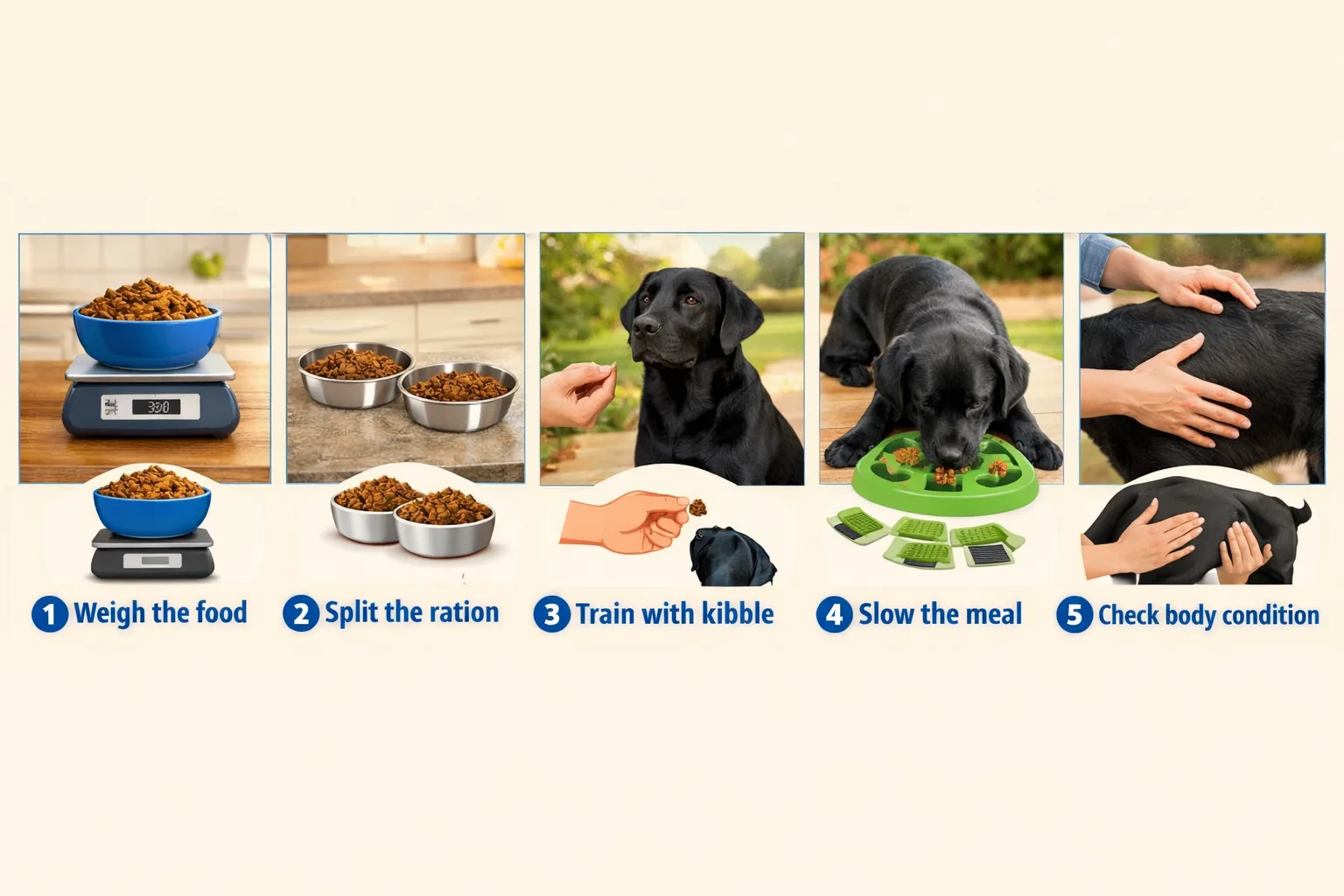
Labrador retrievers love essentially everything, which is the problem. The useful question is how much, and the answer for most adult Labs is roughly 2 to 3 cups of quality dry food per day, split into two meals, adjusted by body condition rather than by the bag’s chart.
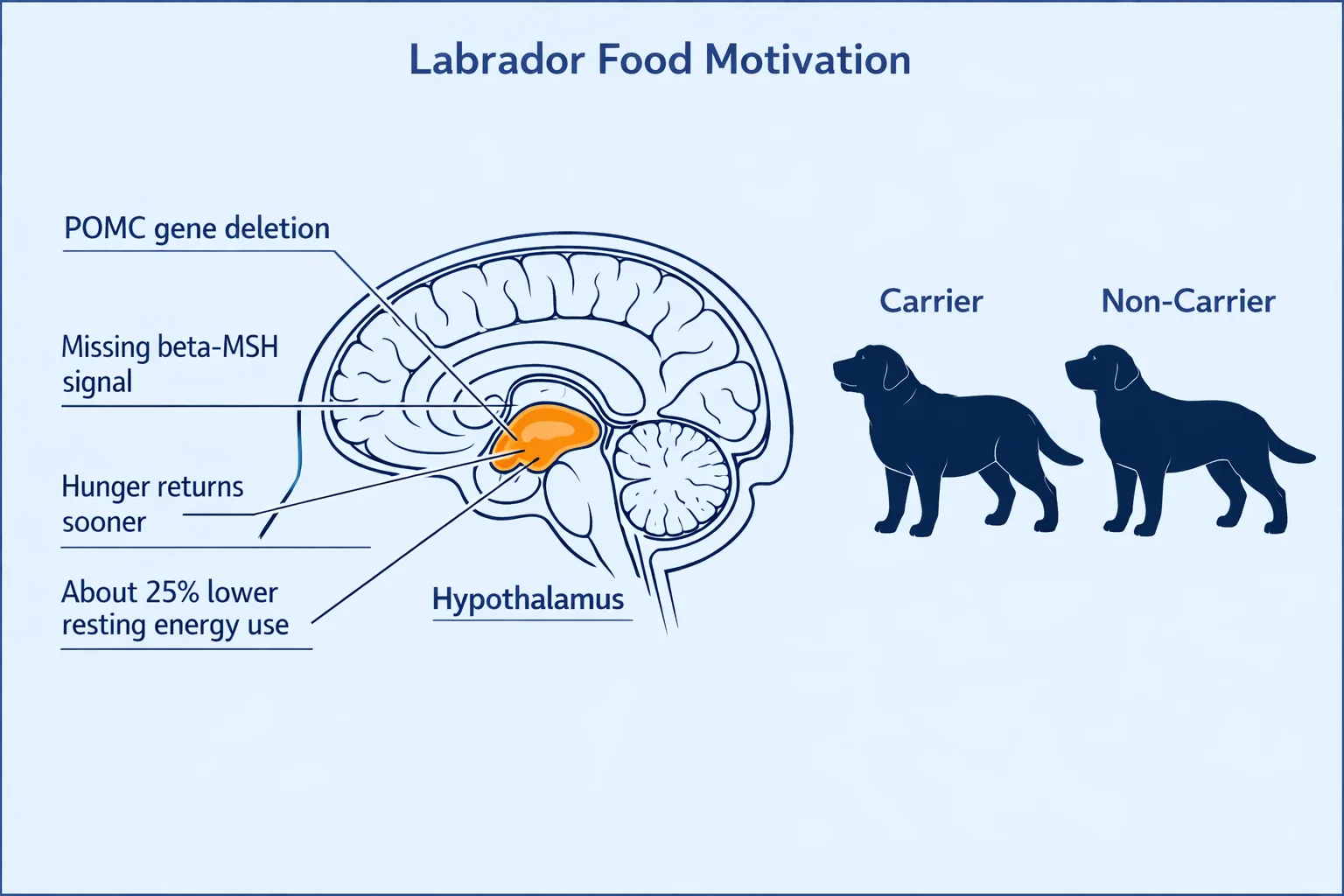
Here is the research behind the appetite. A 2024 Science Advances study from Dr Eleanor Raffan’s team at the University of Cambridge tested 87 adult pet Labradors. Dogs carrying a deletion in the POMC gene were hungrier between meals, worked harder for food in behavioral tasks, and used about 25% less energy at rest than non-carriers. The deletion disrupts coding for beta-MSH and beta-endorphin, neuropeptides involved in satiety and energy balance.
The subtle part matters. Affected Labs can still feel full right after eating. They get hungry again sooner, and they burn less. So the dog is not lying to you. The dog is also not starving.
Earlier Cambridge work put the deletion at about 23% of Labradors, with newer summaries citing roughly 25%. Not every Lab carries it, and carriers are not fated to be fat. Portion size, treat habits, neuter status, age and activity still decide the outcome.
Treats most Labs love that will not wreck the diet:
- Green beans, plain and frozen
- Carrot coins
- Blueberries
- Plain air-popped popcorn, unsalted
- Single-ingredient freeze-dried meat, broken small
Foods to avoid completely: grapes and raisins, xylitol (sugar-free peanut butter and gum), onions and garlic, chocolate, macadamia nuts, cooked bones, and anything with corn cobs, which Labs swallow whole and which cause intestinal blockages.
Keep all treats to 10% or less of daily calories. Pull training rewards from the measured daily ration. If your Lab inhales meals, a slow feeder genuinely helps, and so does scattering kibble on grass. For brand selection, compare options in the guide to choosing the best dog food ingredients and the big four dog food brand comparison.
One note on the news cycle: Loyal’s investigational tablet LOY-002, aimed at dogs aged 10 and older weighing at least 14 pounds, cleared two of three major FDA technical requirements as of early November 2026 (Associated Press via Yahoo). It was not approved as of November 10, 2026, and no Labrador-specific results exist. Keeping your dog lean remains the evidence-backed option.
How to Train a Labrador Retriever
Train a labrador retriever with short, frequent, food-paid sessions, and use the dog’s own measured kibble as currency. Labs learn fast. They also practice bad habits fast, so what you allow at 20 pounds becomes policy at 70.
The four training problems Lab owners report most, and what works:
1. Destructive chewing. Puppies and adolescents chew to relieve stress and boredom. Rotate four or five chew items so each feels new, crate or pen the dog when unsupervised, and run a 10-minute sniff or training session before you expect quiet time. Replace the item, then praise. Scolding after the fact teaches nothing.
2. Leash pulling. Labs pull because pulling works. Stop walking the instant the leash tightens, resume when it slackens, and pay heavily for position next to your leg. A front-clip walking setup reduces pulling power while you teach. Details in the loose leash walking guide.
3. Eating non-food items. Teach “drop” and “leave it” with trades, never chases. If your Lab swallows a sock, rock, or corn cob, call a vet rather than waiting it out.
4. Begging and counter-surfing. Never feed from the table, feed the dog on a fixed schedule, and send him to a mat during human meals with a stuffed frozen toy. Begging extinguishes only if it never pays off once.
Common mistake: using high-value treats for everything. By month three you have a dog who ignores kibble and gained four pounds. Save the good stuff for recall and hard distractions.
Try It: Lab Hunger and Body Condition Check
Many Labs act starving even when they are well fed, and the only reliable way to tell is to look at the dog rather than the bowl. Answer four quick questions below to see whether your labrador retriever is likely at a healthy weight and how to manage the food drive without a daily argument.
Doggy Rank IQ Tool
Lab Hunger and Body Condition Check

Many Labs act starving even when they are well fed. Answer four quick questions to see whether your Lab is at a healthy weight and how to handle the food drive.
How Much Does a Labrador Retriever Cost?
A labrador retriever puppy from a breeder who runs full health testing typically costs $1,200 to $3,000 in the United States, with field-trial or show lines sometimes higher. Rescue adoption usually runs $150 to $500.
Rough budget, based on typical US pricing (your region and vet will move these):
| Cost area | First year | Each following year |
|---|---|---|
| Purchase or adoption | $150 to $3,000 | $0 |
| Vet, vaccines, spay or neuter | $600 to $1,400 | $300 to $600 |
| Food | $500 to $900 | $500 to $900 |
| Gear, crate, bedding, toys | $400 to $700 | $150 to $300 |
| Training classes | $200 to $600 | $0 to $300 |
| Insurance or emergency fund | $400 to $800 | $400 to $900 |
First-year totals commonly land between $2,000 and $4,000 excluding the purchase price. Build an emergency reserve too. Orthopedic surgery for a torn cruciate ligament, which Labs get at above-average rates, frequently exceeds $4,000 per knee.
Cheaper puppy, higher lifetime cost. A breeder who skips OFA hips is not saving you money.
Labrador Retriever Puppy Tips for the First 90 Days
The first 90 days with a labrador retriever puppy decide most of what comes later. Prioritize sleep, socialization, and teaching the dog that your hands and household objects are not food.
Days 1 to 14
- Set up a crate and a pen. A puppy with free run of the house will practice chewing and peeing.
- Expect 16 to 18 hours of sleep per day. An overtired Lab puppy becomes a land shark. Enforce naps.
- Start name recognition and hand-feeding from the measured ration.
Days 15 to 45
- Socialize hard before 16 weeks: surfaces, sounds, stairs, car rides, hats, umbrellas, vacuum, calm adult dogs. Keep every exposure short and positive.
- Begin crate alone-time in small doses. Five minutes, then ten, then twenty.
- Teach “trade” with a toy so the puppy learns that giving things up pays.
Days 46 to 90
- Add loose leash work in the hallway before trying the sidewalk.
- Start a recall word you never use for anything unpleasant.
- Puppy-proof again. Mobility doubles and so does reach.
The thing most new owners underestimate: the exhaustion is real and temporary. Reddit is full of Lab owners describing month three as the worst month. Plan support before you need it, not during. The best ways to train your puppy guide has a week-by-week structure.
What Labrador Retriever Owners Say
Owner reports line up with the research in ways that are almost funny. Two examples from the r/labrador community:
“Owning a Labrador means finding hair in unexpected places”
That comes from an owner on Reddit. It is not an exaggeration and it is not solvable. What is solvable is volume. Brushing 5 minutes daily during spring and fall blowouts removes a meaningful share of the coat before it lands on the sofa. Keep a rubber curry brush by the back door and do it outside. Washable throws on the furniture beat trying to keep the dog off the furniture.
“it feels like we can never relax anymore”
Another owner on Reddit describing adolescent Lab life. The practical fix is structure rather than more exercise. Many owners respond to a wild adolescent by walking further, which builds stamina and makes the problem worse. Instead: two or three 10-minute training or sniff sessions daily, a crate or pen with a frozen stuffed toy for scheduled downtime, and a hard rule that the dog naps in the afternoon. Teaching a Lab to settle is a skill you train, not a mood you wait for.
Labrador Retriever FAQ
Why are Labrador Retrievers always hungry? Roughly a quarter of Labradors carry a POMC gene deletion that disrupts satiety signaling and lowers resting energy use by about 25%, according to University of Cambridge research. Affected dogs get hungry again sooner between meals. Selection for food-motivated, easily trained dogs likely spread the variant.
How much should I feed my Labrador Retriever? Most adult Labs eat 2 to 3 cups of quality dry food daily, split into two meals, but the right amount is whatever keeps ribs easily felt and a visible waist from above. Start with the bag guideline, then adjust by body condition every month.
Do Labradors get overweight easily? Yes. Labs are one of the breeds most prone to obesity, and extra weight accelerates hip and elbow arthritis. Purina’s 14-year Labrador study found lean-fed dogs lived a median 1.8 years longer than their littermates.
What is the difference between a Labrador Retriever and a Golden Retriever? Labs have a short, dense double coat and tend to be slightly higher energy and more food-driven. Goldens have a long feathered coat needing more brushing, often mature a little slower, and carry a higher reported rate of certain cancers. Both are friendly family dogs.
Do all Labradors have big appetites? No. About 75% of Labs do not carry the POMC deletion, and plenty of those dogs eat normally. Carriers also are not guaranteed to become overweight. Feeding practice, exercise, neuter status and age all matter.
What is the best dog food for Labs? Choose a food that meets AAFCO standards for the dog’s life stage, has a named protein first, and lets you measure portions accurately. Large-breed puppy formulas with controlled calcium are sensible for growing Labs. Brand matters less than portion control.
How much exercise does a Labrador need daily? 60 to 90 minutes for a healthy adult, combining physical work like swimming or fetch with 10 to 20 minutes of scent or training work. Puppies need less forced exercise and more free play.
Are silver Labs purebred Labradors? Silver Labs carry the dilute gene and are registered by the AKC as chocolate. Their purebred status is debated within the breed community, and the Labrador Retriever Club recommends dilute-locus testing. Some dilute dogs develop color dilution alopecia.
Conclusion and Next Steps
A labrador retriever is one of the most rewarding family dogs available in the United States, and also one of the easiest to accidentally make unhealthy. The hunger is partly written into the breed, documented in Cambridge’s POMC research, and reinforced by the fact that people spent two centuries selecting dogs who would work for food. You cannot argue a Lab out of it. You can manage it.
Three things to do this week:
- Weigh one meal on a kitchen scale. Most people are off by 20% or more using a scoop.
- Run your hands over the ribs and look down at the waist. Then use the body condition tool above and bring the result to your next vet visit.
- Move training treats into the measured daily ration. Same training, fewer calories, no argument at dinner.
If you are still deciding between breeds, read the guide to choosing the best dog breed for your household before you contact a breeder. A Lab who fits your actual life is worth far more than the one who fits the photos.