
Quick Answer
One Pinterest pin for a two-ingredient frozen dog treat has collected roughly 59,773 saves (ScrapeCreators Pinterest data, September 2026), which is a lot of households planning to freeze yogurt. The honest verdict: the Woof pupsicle ball is worth buying if your dog licks rather than demolishes, if you want a stationary enrichment toy that is genuinely easy to fill and rinse, and if you will actually freeze the filling. Price checked October 2026 on mywoof.com: the standard Pupsicle lists at about $19.99, with a Starter Pack shown at $67 reduced to $44.99. Skip it if your dog is a committed destructive chewer, or if you already own a KONG Classic you are happy to stuff and freeze.
Affiliate disclosure: Doggy Rank IQ may earn a commission if you buy through some links on this page. Recommendations follow the dog in front of you and the available evidence, never commission size.
Key Takeaways: Pupsicle
- A pupsicle is simply a frozen dog treat. The Woof Pupsicle is the branded rubber ball that holds a disc-shaped frozen pop so your dog licks instead of crunching.
- The toy unscrews into two halves, which is the main reason Wirecutter’s reviewer called it a more convenient Kong in its March 17, 2026 review.
- Freezing is the variable that matters. The same review found unfrozen peanut butter or yogurt lasted roughly 10 minutes, while frozen fillings ran far longer.
- A 2026 frozen dog toy comparison from DogNotebook scored it 4.2/5 with an average of about 32 minutes of engagement using frozen wet food and broth, ranking it behind the KONG Classic overall but naming it the premium pick for long-lasting licking.
- Homemade fillings cost pennies. Woof’s own 2026 recipe page encourages them, listing concepts such as Banana Pops, Sweet Potato Pie Pops and Very Veggie Pops.
- Sizing is weight-based: Small for 10 to 25 pounds, Large for 25 to 75 pounds, X-Large for dogs over 75 pounds. Check the dimensions against your dog’s mouth before ordering.
- The recurring complaint is the rubber threaded join. Repeated dishwashing can wear it and make the halves stubborn to unscrew.
- No toy is indestructible. Woof says so itself and recommends supervision, especially for dogs that bite rather than lick.
- Keep all treats, frozen or not, inside the widely used 10 percent of daily calories guideline, and keep xylitol, grapes, raisins, onions and garlic out of every recipe.
What is a pupsicle, and how does the Woof Pupsicle work?
A pupsicle is a frozen treat made for dogs, usually a dairy, broth, pumpkin or meat mixture frozen solid so the dog has to lick it down slowly. The Woof Pupsicle is a specific product: a thick rubber ball that unscrews into two halves, with a weighted base and openings on the side, designed to hold either a branded Pupsicle Pop refill or a homemade frozen disc of your own.
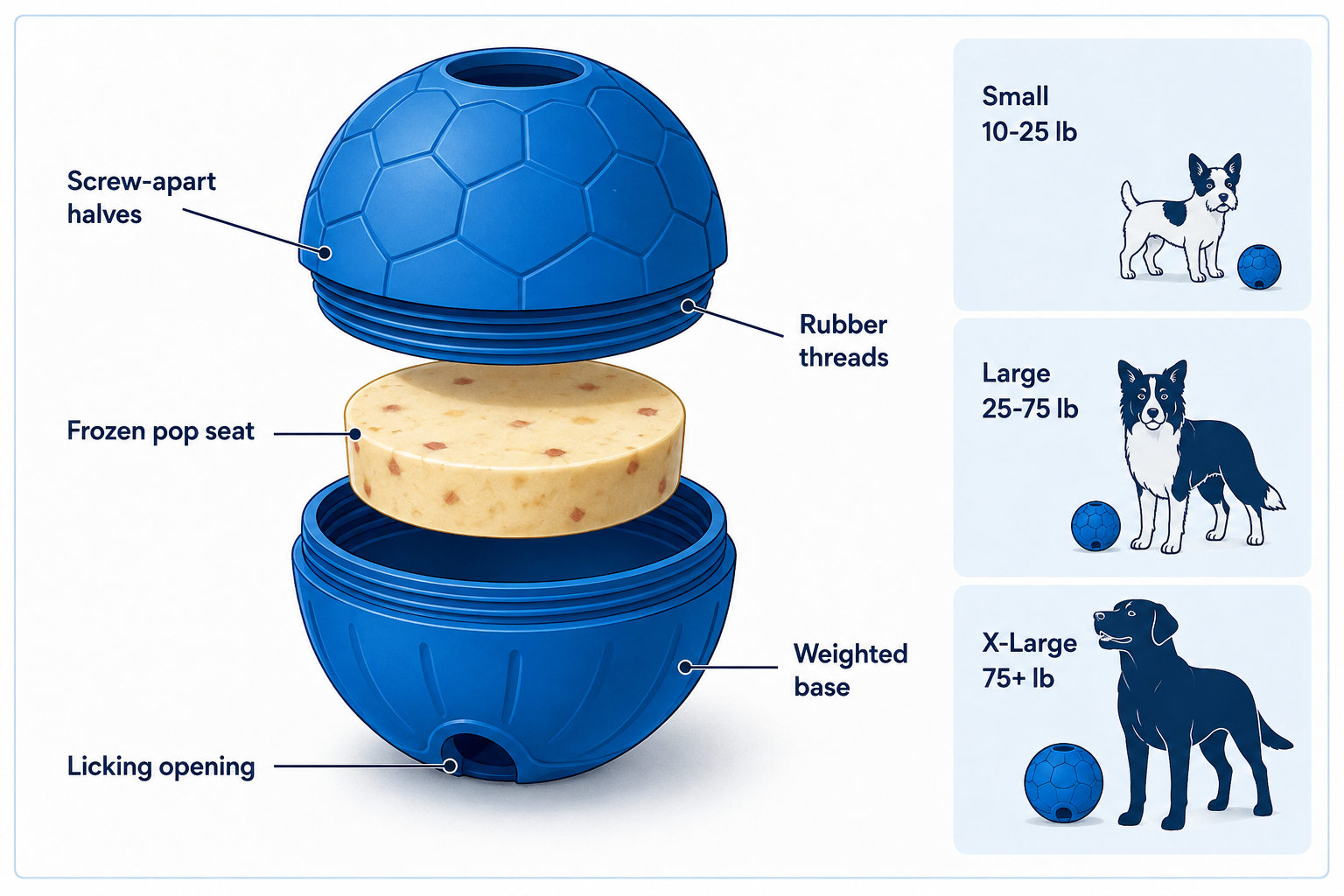
The mechanics are low-tech and that is the appeal. You twist the ball apart, press a frozen pop into the seat, twist it shut, and hand it over. The dog works the opening with its tongue. Because the pop sits inside rubber rather than in open air, the melt is slower and the mess stays mostly inside the toy. DogNotebook’s testing notes point to two design details that matter in a real living room: the weighted base reduces rolling, and the openings help contain drool and residue, which makes it a stationary enrichment toy rather than a fetch toy.
Why licking is the point. Licking is a self-soothing, repetitive behavior. A frozen filling turns one minute of eating into twenty or thirty minutes of slow work, which is the whole premise behind lick mats, stuffed rubber cones and frozen pops generally. That is a practical observation about duration, not a medical treatment for anxiety. If your dog has a diagnosed anxiety problem, a frozen toy is a helpful tool inside a behavior plan, not the plan itself.
Woof Pupsicle sizes and fit
Current official sizing from mywoof.com, checked October 2026:
| Size | Dog weight | Approximate dimensions |
|---|---|---|
| Small | 10 to 25 lb | 2.9 x 2.2 in |
| Large | 25 to 75 lb | 3.6 x 2.8 in |
| X-Large | Over 75 lb | 4.8 x 3.8 in |
Sizing down is the common mistake. A ball small enough to fit fully inside a large dog’s mouth is a swallowing risk, not a bargain. Sizing up slightly is usually the safer error, because a toy that is too big is merely annoying.
Woof also sells a Power Chewer version for stronger jaws. The company states plainly that no toy is indestructible and recommends supervision. That is a fair disclosure and it should shape your expectations rather than reassure you.
Is the Woof Pupsicle worth it?
It is worth it for lick-driven dogs whose owners want an easy-to-fill, easy-to-clean frozen toy, and it is poor value for aggressive chewers or for anyone who already freezes a KONG and is happy with it. Review method for this article: published independent reviews, manufacturer specifications from mywoof.com, retailer listings, and owner feedback. No hands-on test is claimed here. Price checked October 2026.
Strengths. The two-piece screw-apart build is the real advantage over a narrow single-cavity toy. You can see what you are filling and you can reach every surface when you wash it. The weighted base keeps it mostly in one spot. The frozen format stretches a small amount of food across a long stretch of quiet.
Drawbacks. The threaded rubber join is the weak point. Wirecutter reported that repeated dishwashing can wear the coating and make the halves harder to separate, and multiple customer reviewers on Trustpilot describe the same stiffness. Hand washing in warm soapy water is the obvious workaround, and a little less convenient than the marketing suggests. Branded refills also cost meaningfully more per serving than anything you freeze yourself.
Health claims on refills deserve caution. Some premade pops are marketed around calming or gut-health ingredients. Wirecutter noted it could not independently verify those claims. A pop labeled “calming” is a snack with a marketing word on the box, not a veterinary treatment.
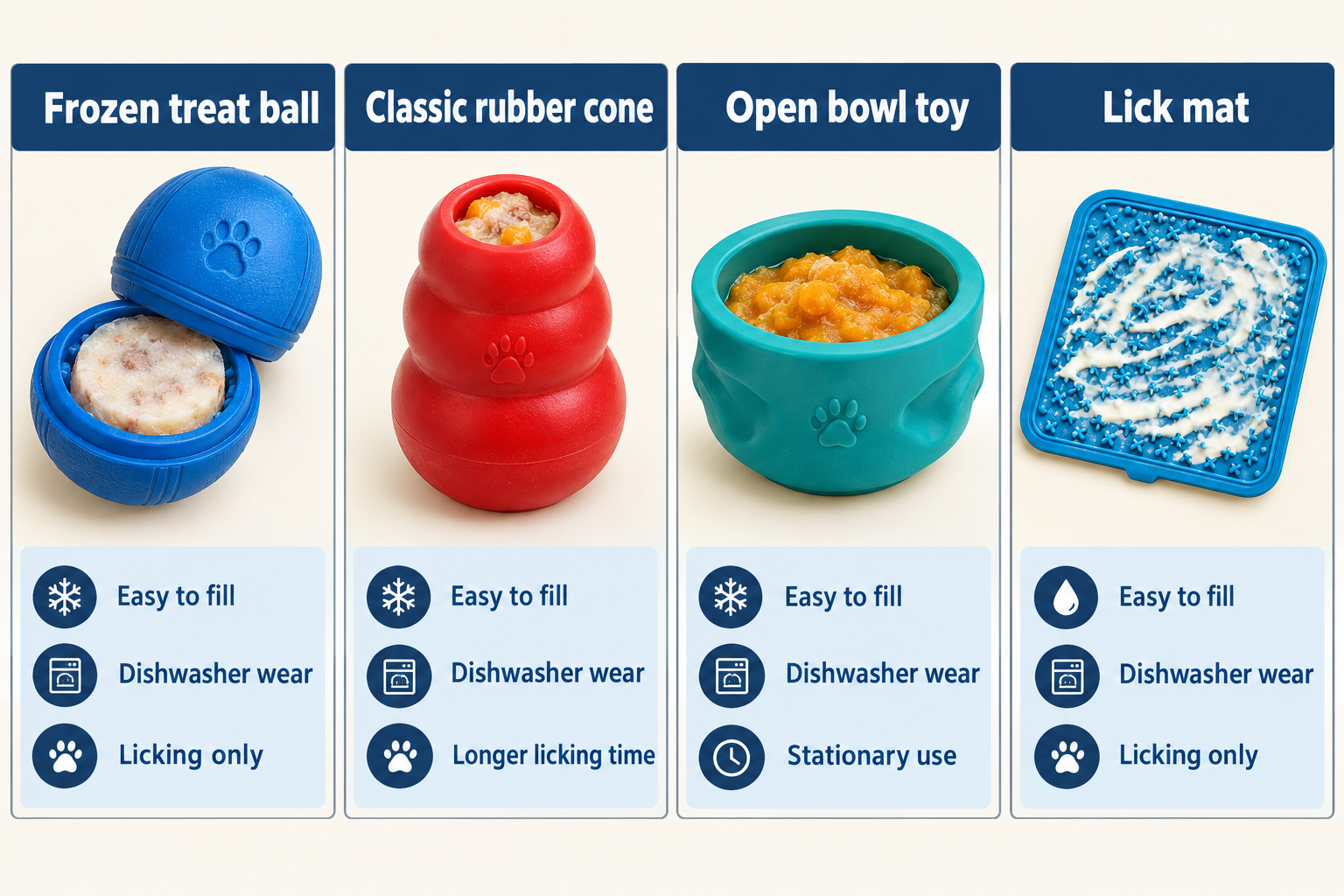
Woof Pupsicle vs KONG Classic vs West Paw Toppl vs LickiMat
| Toy | Format | Refill approach | Cleaning | Best for |
|---|---|---|---|---|
| Woof Pupsicle | Screw-apart rubber ball holding a frozen disc | Branded Pupsicle Pops or your own frozen pops | Easy access, but dishwashing can stiffen the threads | Lickers who need 20 to 45 quiet minutes in one spot |
| KONG Classic (frozen) | Hollow one-piece rubber cone | Any stuffing you own; no proprietary refill | Narrow cavity, needs a brush | Chewers, bouncing, lowest cost per use |
| West Paw Toppl | Open flexible bowl-style toy | Freeze wet food or mash directly inside | Wide opening, simple to wash | Beginners, puzzle stacking, faster sessions |
| LickiMat | Flat textured mat | Thin spread of yogurt, pumpkin or wet food | Easiest of the four, lays flat | Short calm sessions, grooming distraction, small dogs |
Prices vary by size and retailer across Amazon, Chewy and PetSmart, so check current listings rather than trusting a number in any article.
Decision rule. Choose the Woof Pupsicle if filling and cleaning convenience is what keeps you using a toy. Choose the KONG Classic if your dog chews hard or you want the cheapest long-term option. Choose the West Paw Toppl if you mostly freeze wet food and want a wide opening. Choose a LickiMat if you need five calm minutes during nail trims, not forty.
Pupsicle cost vs buying treats
Branded refills are the expensive half of this product. The toy is a one-time purchase at roughly $19.99 for the standard version (mywoof.com, October 2026), and the Starter Pack was listed at $67 reduced to $44.99 on the same page. Pupsicle Pops and the Pupsicle Treat Mix, including the calming beef flavor sold through Chewy’s Woof Pupsicle treat mix listing, are a recurring cost.
Homemade pops are not. A tub of plain yogurt and a can of pumpkin will produce weeks of fills for less than one box of refills. Buy the toy, then treat the branded pops as an occasional convenience for travel or a busy week. If you are weighing recurring spend on dog food and extras generally, our look at whether paying more for premium dog food is actually worth it applies the same logic to the bigger budget line.
Pupsicle vs regular dog treats comparison
Regular biscuits deliver calories in about four seconds. A frozen pupsicle delivers similar calories across twenty to forty minutes of licking, which is why it functions as enrichment rather than a reward. Biscuits still win for training, because training needs speed, repetition and precise timing. Frozen pops win for crate settling, alone-time practice, hot afternoons and the stretch of evening when your dog has decided the sofa needs editing.
Pupsicle molds: where to buy, and what to look for
The Woof Pupsicle and its refills come from mywoof.com, with the toy also stocked through Amazon, Chewy and PetSmart. For homemade pops, any food-safe silicone mold that produces a disc or puck small enough to seat inside your size of ball will work, and a basic silicone ice cube tray is the cheapest possible start. Measure the inside of your toy before buying a mold. Round, shallow and slightly undersized beats a perfect-looking shape that will not fit.
Do all dogs like pupsicles?
No. Some dogs ignore the whole thing, especially dogs that prefer crunching, dogs that find cold unpleasant, and dogs that have never been shown how a food toy works. Individual variation is real here and no product page will warn you about it.
Three fixes worth trying before you give up:
- Start with the halves apart and the pop exposed so the first lick is free.
- Use a filling your dog already loves, not a novel flavor.
- Try it semi-frozen the first time, then move to fully frozen once the habit exists.
Pupsicle melting too fast? Fix the filling, not the toy
A pupsicle that vanishes in ten minutes almost always means the filling was too soft or not frozen long enough. Wirecutter’s reporting lines up with this: unfrozen peanut butter or yogurt produced about ten minutes of interest, while frozen fillings lasted substantially longer.
What actually extends the session:
- Freeze overnight, not for an hour.
- Choose a filling with some body. Yogurt, pumpkin and wet food freeze harder than thin broth.
- Freeze in layers, letting each one set before adding the next.
- Serve indoors on a towel rather than on hot pavement in direct sun.
- Mix in kibble or shredded chicken so there is something solid to work at.
What are 5 easy pupsicle recipes?
The five below use ingredients most kitchens already hold, freeze reliably in a standard mold, and contain nothing on the common toxic list. Woof’s own 2026 recipe page encourages homemade fills and lists concepts including Banana Pops, Cheeseburger Deluxe Pops, Probiotic Pops, Protein Party Pops, Sweet Potato Pie Pops, Very Veggie Pops and Tumm-Emergency Pops, so customizing the filling is a supported use of the toy rather than a workaround.
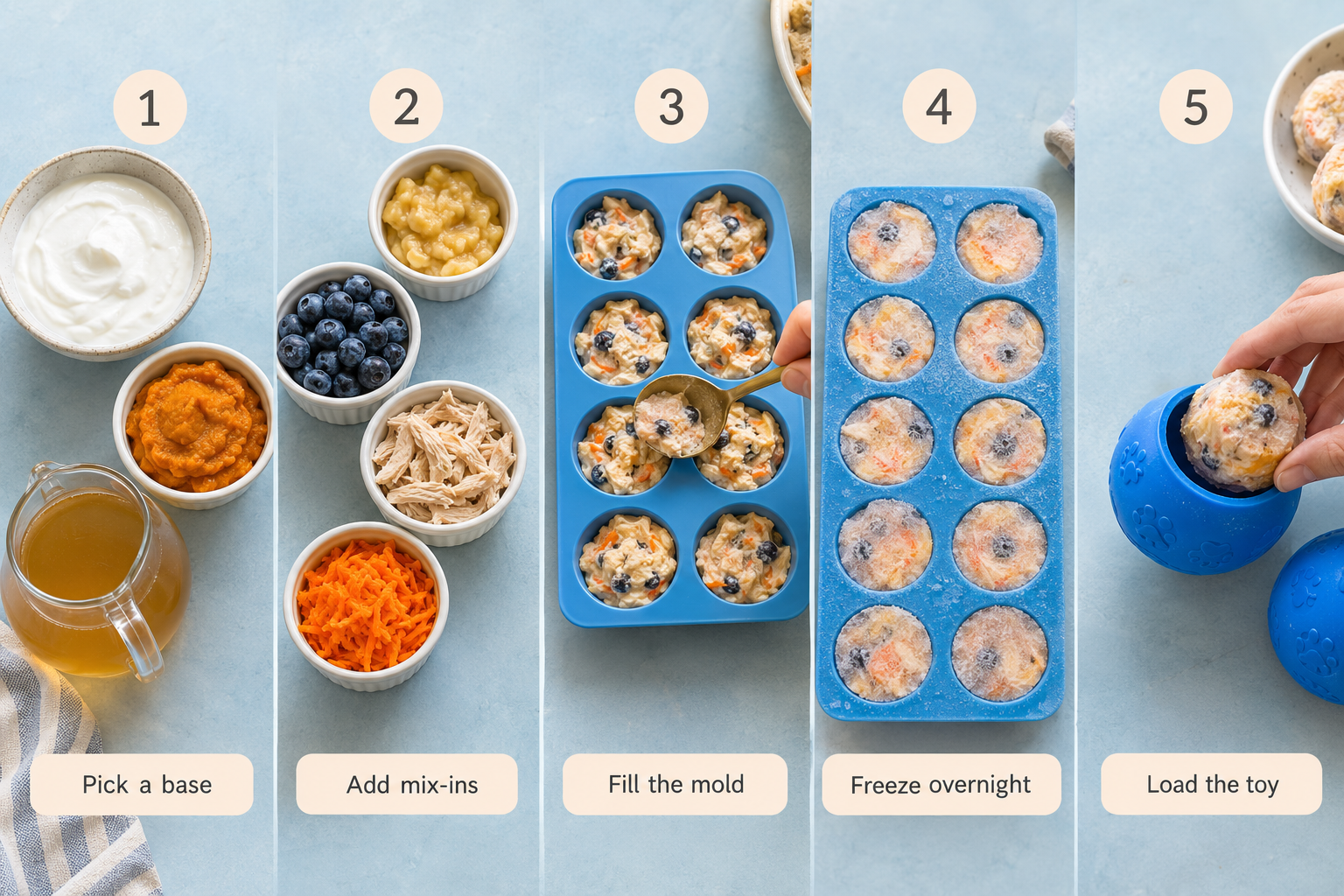
1. Two-ingredient banana yogurt pops. Mash one ripe banana into about one cup of plain, unsweetened Greek yogurt. Spoon into molds, freeze overnight. This is the format behind the widely saved Baking Mischief two-ingredient pupsicles recipe, and it is popular for a dull reason: two ingredients, no cooking, reliable freeze.
2. Pumpkin and bone broth layers. Half a cup of plain canned pumpkin (not pie filling, which often carries spices and sugar) plus a splash of low-sodium, onion-free and garlic-free bone broth. Freeze the pumpkin layer first, then pour broth on top and refreeze. Two textures means two speeds of licking.
3. Dinner pop. Press your dog’s usual wet food into the mold, push a few pieces of their normal kibble into the surface, freeze solid. Calories come out of the daily ration rather than being added to it, which makes this the easiest recipe to justify on a regular basis. If you are already experimenting with dog food toppers worth adding to kibble, the same mixtures freeze well here.
4. Blueberry yogurt pops. Stir a small handful of blueberries, whole or lightly crushed, into plain yogurt. Blueberries turn up constantly in dog recipes for good reason, and our guide to superfoods for dogs including broccoli and blueberries explains what the evidence does and does not support. Keep the portion small. It is a treat, not a supplement regimen.
5. Savory chicken and broth pops. Two tablespoons of plain shredded cooked chicken, no skin, no seasoning, topped with low-sodium broth and a tablespoon of grated carrot. The best option for dogs that turn their nose up at dairy.
For more variations, Woof’s catalog and recipe roundups such as The Ruly Bully’s pupsicle recipe collection cover fruit, veggie and protein-heavy versions. Before improvising, check our safe list of fruits and vegetables dogs can eat.
How long do homemade pupsicles last?
Frozen pops keep their quality for roughly one to two months in a sealed freezer bag or airtight container, and they are safest treated like any home-frozen food: label the bag with the date, keep air out, and discard anything with freezer burn or an off smell. Pops made with fresh meat or broth are better used within a few weeks. Once a pop has thawed, do not refreeze it. In the toy, assume a pupsicle is a single sitting.
Are pupsicles safe for dogs?
Frozen treats are generally safe for healthy adult dogs when the toy is the correct size, the ingredients are dog-appropriate, the portion is small, and the dog is supervised. The risks are not exotic: wrong size, wrong ingredients, too many calories, and an unsupervised chewer.
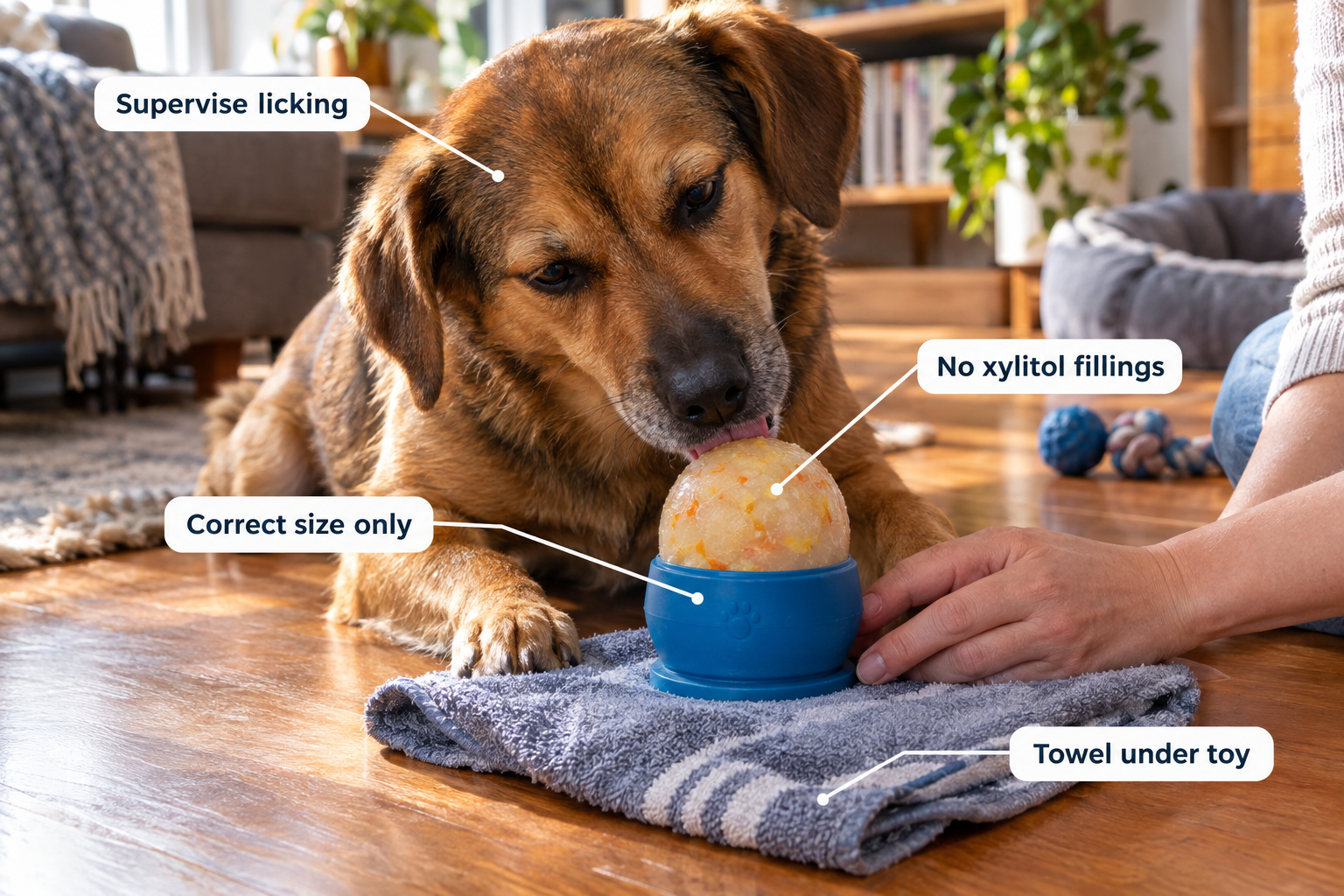
Choking and sizing. Any toy small enough to sit entirely in the back of your dog’s mouth is a hazard. Match the toy to current weight, recheck as puppies grow, and retire a toy once pieces of rubber start coming off.
Supervision. Woof’s own guidance recommends supervision and states that no toy is indestructible, with particular attention to dogs that bite rather than lick. Frozen toys are not a safe solution for a dog left alone all afternoon.
Dental caution. Rock-hard frozen fillings get chewed by some dogs rather than licked. If your dog treats the pop like a bone, serve it semi-frozen instead.
Pupsicle ingredients to avoid
Keep these out of every recipe:
- Xylitol and other sugar alcohols. This is the big one. Xylitol appears in some peanut butters, and the ASPCA Animal Poison Control Center treats it as a serious toxicity risk in dogs. Read the peanut butter label every single time.
- Grapes and raisins. Linked to acute kidney injury in dogs, with no reliable safe dose.
- Onion, garlic, leeks and chives, including in broths and stock cubes. Choose a broth with no onion or garlic and no added salt.
- Chocolate, cocoa, coffee and macadamia nuts.
- Sweetened or spiced pumpkin pie filling.
- Alcohol, raw bread dough, and heavily salted or seasoned meats.
If you are unsure about an ingredient, contact your veterinarian or a poison control service rather than a comment thread. Reading labels carefully is the same skill covered in our guide to reading a dog food label and what AAFCO means.
Can dogs with sensitive stomachs eat pupsicles?
Often yes, if you choose a single base your dog already tolerates and keep the portion very small. Dairy is the usual troublemaker, since many dogs handle lactose poorly. Plain canned pumpkin or a plain portion of their existing wet food is the lower-risk starting point.
Introduce one new filling at a time and wait two or three days before changing anything else, the same cautious approach described in our guide to switching dog food without upsetting their stomach. Dogs with pancreatitis history, food allergies, kidney disease or diabetes need a veterinary conversation before any new fatty, dairy or protein treat.
Pupsicles for senior dogs and puppies
Puppies: fine from the age they are eating solid food, using part of their daily ration rather than extra calories, with the smallest appropriate toy size and close supervision. Teething puppies often love cold, which is the whole appeal.
Senior dogs: fine for most, with two adjustments. Serve semi-frozen if teeth are worn, loose or sore, and keep the toy on a non-slip mat so a dog with stiff hips is not chasing it across the floor. Calorie needs shift with age, and our breakdown of how dog food changes for puppies, adults and seniors covers the context.
How often can you give your dog a pupsicle?
Daily is reasonable for most healthy adult dogs, provided the filling counts inside the widely used veterinary guideline that treats should stay under about 10 percent of daily calories, and provided your dog shows no digestive upset. For dogs with sensitive stomachs, two or three times a week with a single familiar filling is a gentler pattern.
The simplest trick is to stop treating a pupsicle as a bonus. Fill it with part of your dog’s existing dinner and the calorie question disappears. A dinner pop in the toy at 6pm is the same food the bowl would have held, served slowly.
Watch for loose stools, scratching, or a dog that starts guarding the toy. Those are reasons to pause and reassess, not reasons to push through.
FAQ
Do vets recommend pupsicles?
Frozen enrichment toys are commonly suggested by veterinary and behavior professionals for slow feeding, crate settling and heat relief, but no reviewed source labels the Woof Pupsicle itself as vet-approved, and the brand’s calming or gut-health refill claims have not been independently verified. Treat it as a well-designed enrichment toy, not a medical device.
How much does the Woof Pupsicle cost?
On mywoof.com in October 2026, the standard Pupsicle was listed at about $19.99, with a Starter Pack shown at $67 reduced to $44.99. The toy also appears at Amazon, Chewy and PetSmart. Prices change, so check before buying.
Can I use regular peanut butter in a pupsicle?
Only if the label confirms there is no xylitol or other sugar alcohol. Xylitol is a serious toxicity risk for dogs according to ASPCA Animal Poison Control guidance. Use plain peanut butter sparingly, since it is calorie-dense.
How long does a pupsicle keep a dog busy?
Published observations range widely. Wirecutter reported up to an hour for two small dogs with premade pops and roughly 35 to 45 minutes for another dog, while unfrozen filling lasted about ten minutes. DogNotebook’s 2026 testing averaged about 32 minutes with frozen wet food and broth. Your dog’s result will be its own.
Do I need the branded Pupsicle Pops refills?
No. The ball accepts homemade frozen discs, and Woof’s own recipe page promotes making your own. Refills are a convenience purchase.
Is the Woof Pupsicle dishwasher safe?
Woof markets it as easy to clean, but Wirecutter reported that repeated dishwashing can wear the coating on the threaded join and make the halves harder to unscrew. Hand washing in warm soapy water is the safer habit.
What if my dog destroys it?
Stop using it and switch to a toy built for chewing, such as a KONG Classic in the correct size and strength. Woof sells a Power Chewer version, and states plainly that no toy is indestructible. Replace any toy that is losing pieces.
Is a pupsicle better than a lick mat?
Different jobs. A frozen ball usually buys longer, more self-directed time. A LickiMat is cheaper, easier to wash and better suited to short calm sessions such as nail trims or grooming. Many households keep both.
Conclusion
The Woof pupsicle ball earns its place for one specific household: a dog that licks, an owner who will actually freeze something the night before, and a living room that benefits from thirty quiet minutes. It does not earn its place as a recurring refill subscription, and it will not survive a determined chewer.
Your next step takes five minutes. Weigh your dog, confirm which size matches (Small for 10 to 25 pounds, Large for 25 to 75, X-Large above 75), then freeze one tray of the two-ingredient banana and yogurt mix tonight. If your dog licks it clean tomorrow, buy the toy. If your dog loses interest after four licks, you have learned something useful and spent almost nothing. Guidance and prices in this article were checked October 2026.
For more evidence-led gear and feeding breakdowns, browse the Doggy Rank IQ dog food and breed guides.
#pupsicle #dogenrichment #frozendogtreats