
Eighteen dogs. One small paper strip tucked under each lower eyelid. A reunion with an owner who had been gone for about five hours. That setup produced the most quoted dog fact of the last few years, and most of the headlines got the ending wrong.
Quick Answer
So, do dogs cry? Dogs make tears constantly to keep the eye surface wet, and a 2022 study from Azabu University in Japan found that tear volume went up by roughly 10% when dogs were reunited with their owners after five to seven hours apart. That is a measurable change in eye fluid, not sobbing. No published research shows that dogs shed tears because they feel sad, and tears actually running down a dog’s face is usually a sign of an eye or drainage problem that a vet should look at.
Key Takeaways: Do Dogs Cry?
- Dogs have working tear systems. Tears lubricate, clean, and feed the surface of the eye. Every healthy dog produces them all day.
- The 2022 study is real and narrow. Tear volume rose after reunion with the owner, measured by the Schirmer Tear Test, and the effect was socially selective: it did not rise to the same degree when a familiar non-owner arrived.
- Oxytocin was part of the picture. In a second experiment with 22 dogs, oxytocin applied to the eye surface raised tear volume. A control peptide did not.
- What the study did not test: sadness, grief, pain, loneliness, punishment, or being left alone. So it cannot answer “do dogs cry when sad.”
- Dogs express distress with sound and posture, not weeping. Whining, whimpering, pacing, panting, flattened ears, and a tucked tail carry far more information than eye moisture.
- Visible tear tracks usually mean medicine, not emotion. Allergies, blocked tear ducts, conjunctivitis, eyelash and eyelid problems, corneal injury, and eye shape all cause overflow.
- Same-day vet rule: squinting, pawing at the eye, a red or cloudy eye, or thick coloured discharge needs a call today, not a week of watching.
- Breed shape matters. Flat-faced and shallow-socketed breeds overflow more easily, and white coats just show the stain more. Individual variation still beats any breed rule.
Do dogs cry emotional tears? What the 2022 Azabu University study found
Dogs produce physical tears, and one study found those tears increase during a happy social moment. No study has shown dogs producing tears because of sadness. That is the honest boundary, and it is worth knowing exactly where it sits.
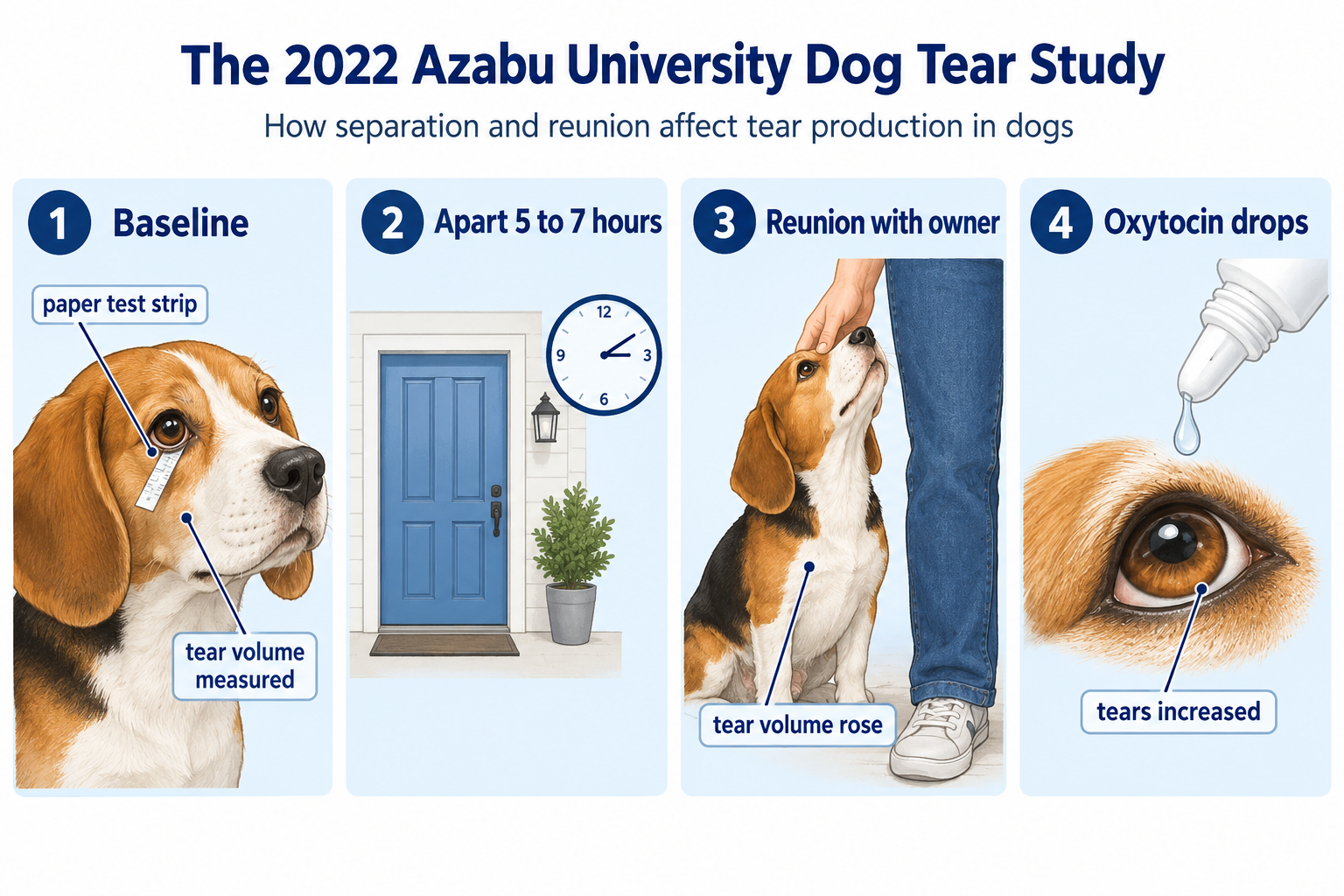
The work came out of Azabu University, led by Kaori Murata with Miho Nagasawa and Takefumi Kikusui, plus collaborators in veterinary medicine and ophthalmology. It was published on August 22, 2022 in Current Biology, and the team’s own summary of the tear and oxytocin findings describes the main result in plain terms.
Here is how the main experiment ran.
- Eighteen dogs living in homes with their owners took part.
- Tear volume was measured at baseline using the Schirmer Tear Test, a standard veterinary strip test that wicks up tear fluid and shows how far it travels in millimetres.
- Owner and dog were separated for about five to seven hours.
- Tears were measured again during the first five minutes of the reunion.
Tear volume went up. The baseline sat around 22 mm on the strip, and the rise after reunion was in the region of 10%, with the owner-reunion comparison reaching statistical significance in the research team’s own write-up of the tear measurements. The interesting part is what happened with a different human. When the dog was reunited with a familiar person who was not the owner, the increase was not the same. The response was tied to a specific relationship, which is the detail that makes the finding more than a plumbing story about eyeballs.
Then the team tested a mechanism. In a separate experiment with 22 dogs, they applied oxytocin solution directly to the eye surface. Tear volume increased. With a control peptide, it did not. Oxytocin is the same hormone already linked to eye-contact behaviour between dogs and people, which is why the researchers connected it to the human-dog bond rather than to distress.
The study measured tear fluid during a happy reunion. It did not measure crying, and it did not measure sadness.
Do dogs actually cry tears like humans
Dogs have the hardware and not the behaviour. They have lacrimal glands, a tear film, and tear ducts that drain fluid away through the nose. What they do not appear to have is the human habit of emotional weeping, where strong feeling produces a visible overflow of tears paired with sobbing. Veterinary explainers are consistent on this point, including the American Kennel Club’s guidance on whether dogs cry tears and what watery eyes mean.
That is a genuinely unusual trait in humans. Emotional tearing is not the default setting across mammals, so finding no evidence of it in dogs is not a sad verdict. It is just a different design.
How is dog crying different from human crying
In people, “crying” bundles three things together: tear overflow, facial expression, and vocal sobbing. In dogs, those parts come apart.
- The tear part is mostly physiology, plus the social bump the 2022 study recorded.
- The expression part shows up in ears, eyes, mouth tension, and posture.
- The vocal part shows up as whining, whimpering, yelping, or howling, which is what most owners mean when they say their dog was crying.
A dog can whine at full volume with completely dry eyes. A dog can also have both eyes streaming while feeling perfectly cheerful about a tennis ball. The two systems do not have to agree. If you like this sort of mismatch between what a dog’s face does and what it means, the same gap shows up in what a dog’s head tilt can and cannot tell you.
Can you tell if a dog is upset by their tears
No. Tears are not a readable emotional signal in dogs, and using them that way leads owners in the wrong direction. A dog whose eyes are wet may have an allergy, a scratched cornea, a blocked duct, or a face shape that drains badly. A dog who is deeply uncomfortable may have bone-dry eyes and a very quiet body.
The 2022 researchers added one more twist. They showed people photographs of dogs with artificial tears applied, and those tearful images drew more positive caregiving responses than the dry-eyed versions. That says something about human perception, not canine strategy. No dog has been shown to produce tears on purpose to get sympathy. A June 2026 review from Dogster on whether dogs can cry describes the 2022 result accurately and makes the same point: more tear fluid at reunion is not proof that dogs cry the way people do, and tearing alongside redness, face-pawing, or discharge belongs in a vet’s hands.
Where the facts end: one study, 18 dogs in the main test, 22 in the oxytocin test, one positive context. That is a starting point for research, not a universal statement about every dog on the street.
How do dogs show sadness if not with tears?
Dogs broadcast distress through sound, body position, and changes in routine. Watch the whole dog over a few days and you get far better information than you will ever get from the corner of an eye.
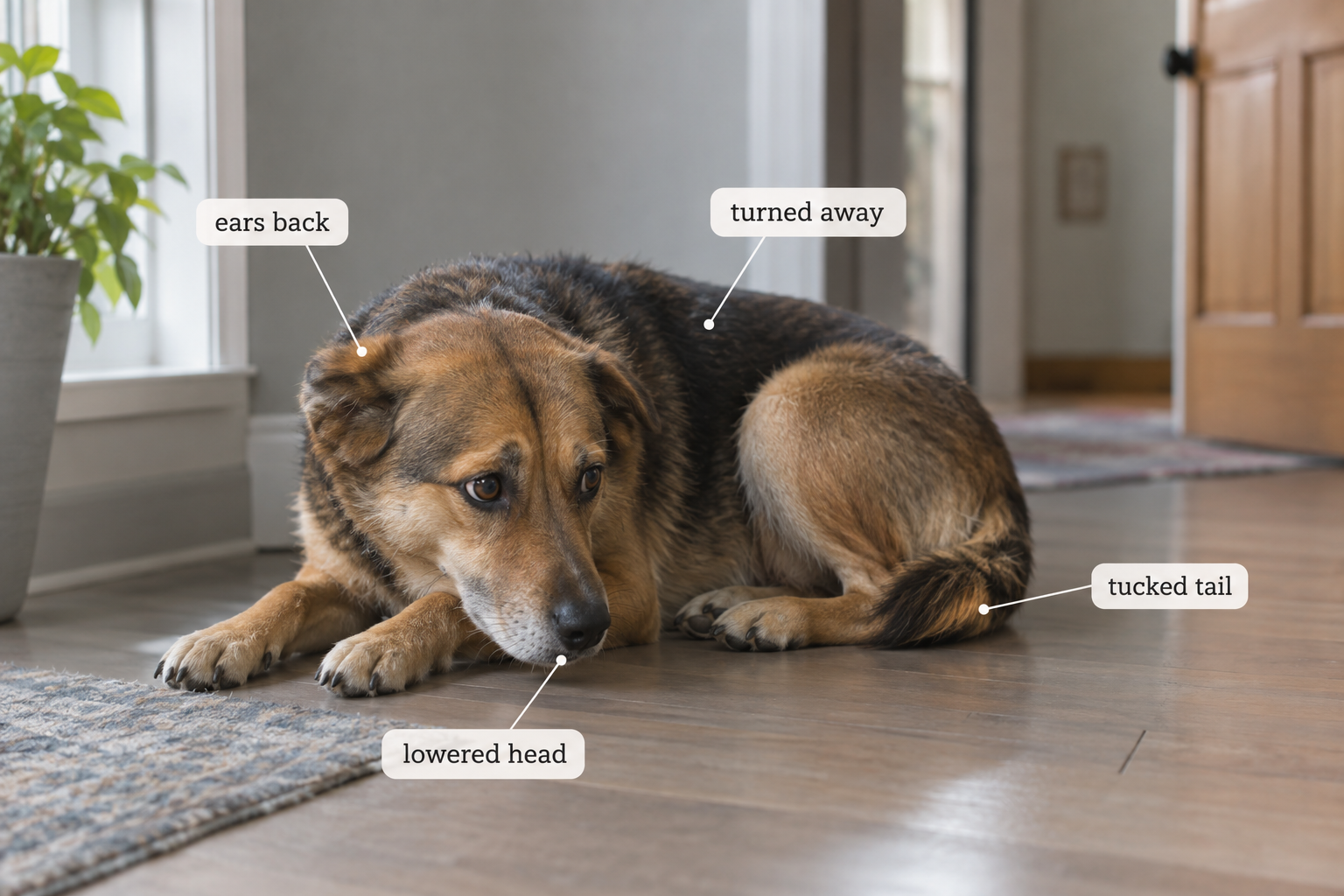
Signals worth taking seriously:
- Vocal: whining, whimpering, repetitive barking, howling, or a short yelp when touched in one spot.
- Posture: low head, ears pinned back, tucked tail, crouched stance, weight shifted backwards.
- Face and breathing: panting with no heat or exercise to explain it, tight mouth, wide eyes with visible white, repeated lip licking, yawning out of nowhere.
- Behaviour change: hiding, clinginess, pacing, refusing food, broken sleep, less interest in walks or play, house soiling in a trained adult dog.
- Pain-specific: reluctance to jump or climb stairs, stiffness after rest, licking one joint, flinching, guarding a body part, sudden grumpiness in a friendly dog.
Pain deserves its own line. Dogs in pain often go quiet rather than loud. If a previously cheerful dog starts sleeping in a different place, stops greeting you at the door, or snaps when handled, treat it as a health question first and a behaviour question second. A big swing in sleep patterns is also worth noticing, since there is a normal range and a point where it stops being normal, covered in what the research found about how much dogs sleep.
Emotional tears vs whining vs medical tearing
Why does my dog cry at night or when I leave?
Night crying and door crying are almost always about need, learning, or stress, not tears. Puppies cry at night because they are young, alone, and possibly bursting. Adults cry when something has changed: a new routine, pain, failing senses, or a history of being left for longer than they can cope with.
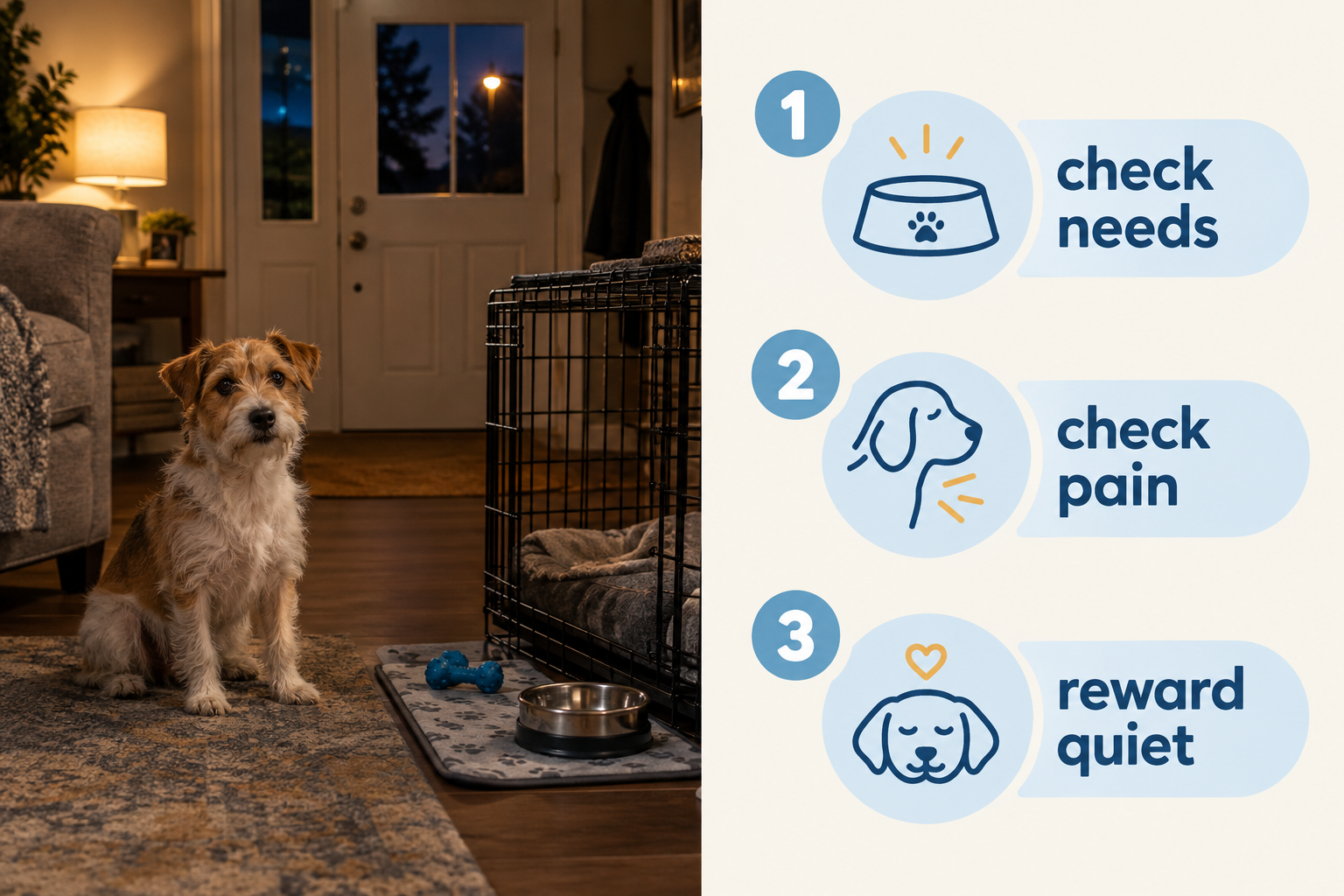
Common causes, roughly in the order worth checking:
- A physical need. Full bladder, thirst, too hot, too cold, hunger, or an uncomfortable bed.
- Pain or illness. Joint pain, dental pain, gut discomfort, and ear infections all show up more at night when there is nothing else to focus on.
- Age-related change. Older dogs with reduced vision or hearing, or with cognitive decline, can become restless and vocal in the dark.
- Separation distress. Crying that starts within minutes of you leaving, with pacing, drooling, destruction near exits, or soiling, is a welfare problem rather than bad manners. Get a vet or a qualified behaviourist involved.
- Learned payoff. If crying has reliably produced company, the crying gets more confident. That is ordinary learning, not defiance.
What actually helps: a predictable evening routine, a last toilet trip late, a sleeping spot near you at first, real daytime exercise and sniffing work, and short practice absences that end before the crying starts. If you want to know whether the crying happens the whole time you are out or just for four minutes, a home camera such as the Furbo Dog Camera gives you a timeline. It records behaviour. It does not treat anxiety, and no camera does.
Owners of crate-training puppies often reach for a heartbeat-and-warmth toy like Snuggle Puppy. Plenty of people find it settles the first nights. The evidence base for that sort of comfort item is thin, so treat it as a cheap thing to try alongside the routine, not as the plan itself.
Do puppies cry differently than adult dogs?
Yes, and mostly for simpler reasons. Puppy crying is high, frequent, and tied to immediate needs: toilet, food, warmth, contact. Bladder control is limited, so a puppy who cries at 3am often genuinely needs the garden. Adult crying that is new deserves more suspicion, because an adult dog has already learned to hold on and settle.
Puppy nights get shorter when daytime needs are met properly, which includes food that suits a growing dog. There is a sensible rundown of what growing dogs need in their first year if feeding is still a question mark. First-time owners weighing up how much night noise to expect may also want a look at breeds that suit first-time owners.
Is it normal for dogs to cry a lot, and what if it will not stop?
Occasional whining is normal dog communication. Frequent, escalating, or new crying is a signal to investigate.
Do this, in order:
- Keep a three-day log. Time, trigger, duration, what stopped it. Patterns show up quickly on paper.
- Book a vet visit. Pain and illness come first. Ask specifically about teeth, joints, ears, gut, and eyes.
- Check the day, not the night. Under-exercised, under-stimulated dogs make noise. Add sniffing walks, food puzzles, chewing, and training games for enrichment.
- Change the response, not the dog. Reward quiet with attention, meet needs before the crying, and avoid punishment, which adds fear to an already stressed dog.
- Get qualified help if there is drooling, destruction, self-injury, or panic when alone.
What the 2022 study measured, in numbers
18
dogs in the main reunion experiment, measured with the Schirmer Tear Test. Source: the Azabu University research report.
5 to 7 hrs
time apart before the reunion test, with tears measured in the first five minutes back together. Source: ScienceDaily report on the study.
~10%
rise in tear volume after owner reunion, from a baseline near 22 mm on the test strip. Source: the study’s tear measurements.
22
dogs in the separate oxytocin experiment, where oxytocin on the eye surface raised tears and a control peptide did not. Source: the oxytocin experiment.
0
experiments testing tears during sadness, pain, grief, or being left alone. The study did not cover them. Source: Dogster’s 2026 review of the finding.
When are watery eyes a health problem?
Treat visible tear tracks as eye fluid that needs explaining, not as a mood report. Any new, one-sided, or worsening tearing deserves a vet appointment, and some signs deserve one today.
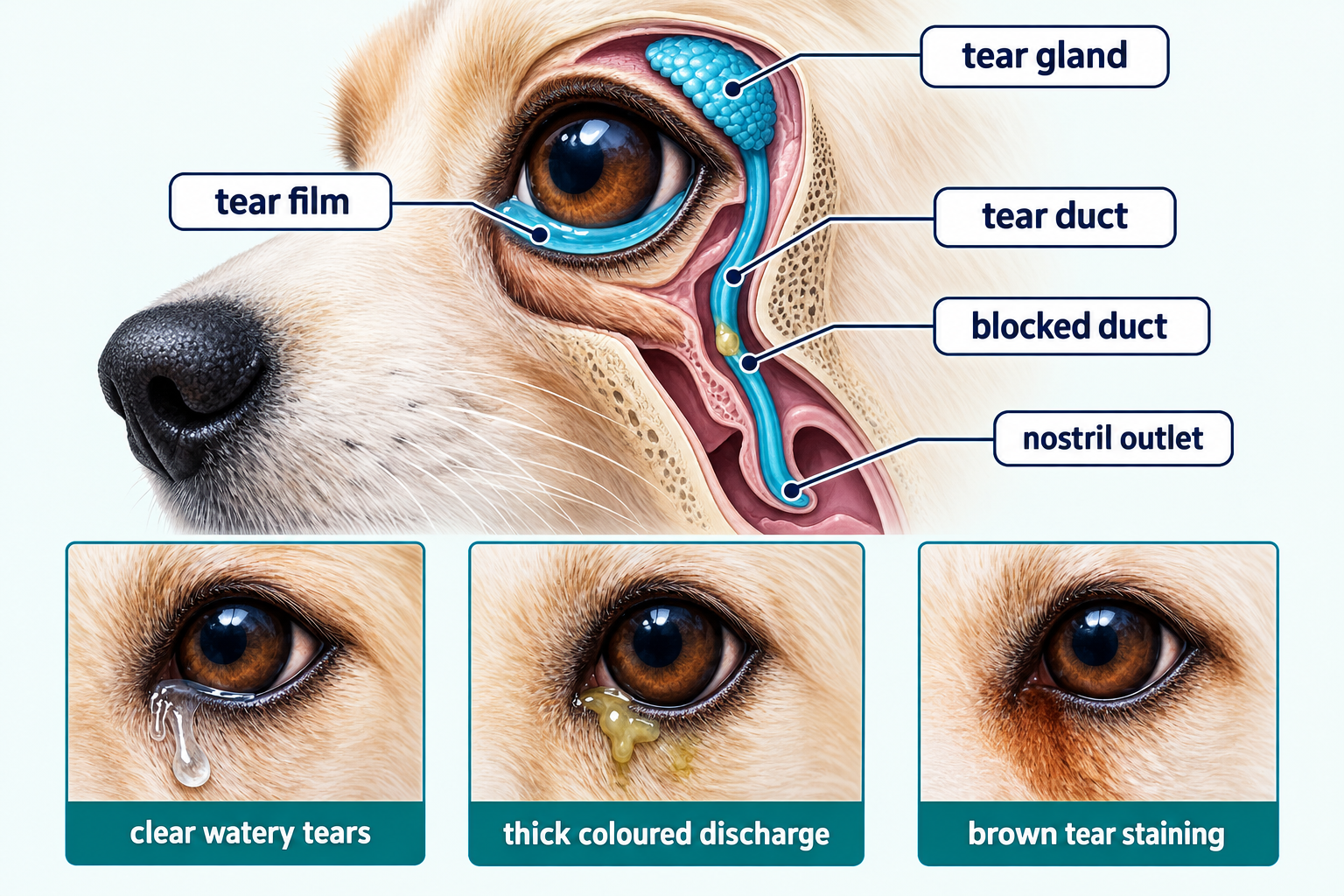
Call your vet the same day if you see:
- Squinting, blinking hard, or holding one eye shut
- Pawing or rubbing the eye on carpet and furniture
- A red, swollen, or cloudy eye
- Thick yellow or green discharge
- A visible scratch, foreign body, or sudden bulging
- Tearing with lethargy, loss of appetite, or facial swelling
Routine appointment is fine for constant mild watering with no pain, long-standing tear staining, or seasonal watering you have already discussed with the vet.
Common medical causes include allergies and irritants, conjunctivitis, blocked or narrow tear ducts, eyelashes growing in the wrong direction, eyelids that roll inward, corneal injury, dental root problems pressing near the tear duct, and glaucoma. Both the American Kennel Club’s guidance on dog eye discharge and Purina’s explainer on whether dogs can cry land in the same place: watery eyes are a medical question first. A September 2026 pet health explainer on what watery eyes in dogs actually indicate says the same thing in plainer language.
For anything structural or stubborn, a general practice vet can refer you to a specialist. Board-certified veterinary ophthalmologists in the United States are certified through the American College of Veterinary Ophthalmologists, and large practice groups such as VCA Animal Hospitals also publish owner-facing eye care material. That is the chain to follow when a problem keeps coming back.
Two products come up constantly in this conversation, so here are neutral fit notes. Optixcare Eye Cleaner is a rinse and lubricant style product used for routine cleaning around the eye; useful for wiping away normal crust, not a treatment for infection, and worth clearing with your vet before using it on a sore eye. Petpost Tear Stain Remover wipes address the brown staining on the fur; cosmetic only, and they do nothing about why the eye is overflowing. Fix the cause, then tidy the fur. Neither product is safe for every dog or every eye condition.
Do all dog breeds cry the same way?
No. The tear system is the same, but face shape changes how well it drains.
- Flat-faced breeds such as Pugs, Shih Tzus, Boxers, and Bulldogs have shallow eye sockets and prominent eyes, so tears spill over the lid instead of draining through the duct.
- Small white-coated breeds such as Maltese, Bichons, and Poodles show the rust-coloured staining far more clearly. The staining is not worse. It is just visible.
- Breeds with loose or droopy eyelids, including Bloodhounds and Shar Pei, are more prone to eyelid conformation problems that irritate the surface.
- Vocal tendencies vary too. Some lines bred for working communication are simply noisier. That is tendency, not destiny, and individual variation beats breed averages every time.
Body size shifts the picture as well, since eye shape and skull shape travel with it. If you are matching a breed to your household, how dog size categories are defined is a useful piece of background. Breed is also not a reliable way to predict one dog’s eyes or one dog’s noise level, the same way breed alone does not predict how dogs see colour.
Do dogs grieve and cry when another pet or owner dies?
Dogs often change behaviour after a death in the household, and owners frequently describe searching, clinginess, reduced appetite, disrupted sleep, and more vocalising. What is not established is that dogs shed tears from grief. The 2022 study did not look at bereavement at all, and nothing in current veterinary guidance treats wet eyes as a sign of mourning.
What the evidence supports is that dogs notice absence and respond to disruption. They lose a companion, a routine, a walking partner, and the emotional temperature of the whole house changes at once. Separating those threads is hard even for researchers, which is why claims here should stay careful.
What tends to help a grieving-looking dog:
- Keep feeding, walking, and sleeping times steady.
- Add gentle enrichment: sniffing walks, food puzzles, short training games.
- Give company without pushing interaction on a dog who wants space.
- Watch weight and appetite, and see the vet if either slips for more than a couple of days.
- Do not rush into a replacement dog to fix it.
As for dogs at the end of their own lives, watery eyes near the end are typically physical: reduced blinking, dehydration, medication effects, or an eye condition. Discomfort shows up in breathing, posture, restlessness, and appetite instead. That is the conversation to have with your vet, and it is one they have every week.
FAQ
Do dogs cry real tears?
Yes, dogs produce real tears to keep the eye surface healthy, and the 2022 Azabu University study measured about a 10% rise in tear volume when dogs reunited with their owners. They are not known to produce tears from emotion the way people do.
Do dogs cry when they are sad?
There is no published evidence that dogs shed tears because they feel sad. Sadness and distress in dogs show up as whining, hiding, reduced appetite, changed sleep, and flat body language rather than wet cheeks.
Why do dogs cry in their sleep?
Whimpering, twitching, and soft barking during sleep usually happen in REM sleep and are considered normal in both puppies and adults. Call your vet if the movements are stiff and rhythmic, the dog is hard to wake, or the episode is followed by confusion, since that pattern can point to a seizure.
How do you know if a dog is crying?
Listen first and look at the body second. Vocal crying means whining, whimpering, or howling with a trigger behind it, while wet eyes with no sound almost always mean an eye or drainage issue.
Do dogs cry at the end of life?
Watery eyes in a dying dog are usually physical rather than emotional, caused by reduced blinking, dehydration, medication, or eye disease. Judge comfort by breathing, posture, restlessness, and appetite, and ask your vet to assess pain directly.
When should I worry about my dog’s excessive tearing?
Worry today if there is squinting, pawing, redness, cloudiness, or thick coloured discharge. Book a routine appointment for mild constant watering, long-term tear staining, or tearing that only shows up in certain seasons.
Do dogs cry to get attention?
Dogs often learn that vocal crying brings company, food, or a door opening, so the whining can become a reliable request. There is no evidence that dogs produce tears on purpose, even though people in the 2022 study rated tearful dog photos more sympathetically.
Does the 2022 study apply to my dog?
Partly. It involved 18 pet dogs in one positive situation, so it supports the idea that dog tear production responds to social reunion with a bonded owner. It cannot tell you anything about your dog’s sadness, pain, or watery eyes.
Conclusion: one clear next step
The surprising part of the 2022 research is not that dogs weep. It is that something as mechanical as tear volume shifted measurably when a dog saw the specific person it was attached to, with oxytocin in the mix. That is a small, careful finding about the human-dog bond, and it stops exactly where the data stops.
Your next step is a two-minute job. Take a clear daylight photo of your dog’s face, both eyes, today. If anything is watering, repeat it tomorrow and the day after. If the tearing is in one eye, getting worse, or paired with squinting, pawing, redness, or thick discharge, ring your vet and send the photos. If the eyes are dry and the crying is vocal, start a three-day log of time, trigger, and duration instead, then bring that to the vet before you change anything in the training.
Guidance in this article was checked in October 2026. Products named here are described for context and fit, not endorsed as safe for every dog, and no product should replace a vet’s assessment of an eye problem.