
Quick Answer
Separation anxiety in dogs is panic that begins when the dog is left alone or separated from a specific person, usually within the first 5 to 30 minutes after departure. The warning signs that matter most are the ones tied to the absence itself: howling, pacing, drooling, destruction aimed at doors and windows, indoor toileting in a house-trained dog, refusing food, and escape attempts that injure paws or teeth. The plan that works is boring and specific: rule out medical causes with a vet, film a baseline absence, then practise departures short enough that the dog never panics, building up only while the dog stays relaxed, as ASPCA separation anxiety guidance describes. Medication can be part of that plan, never a replacement for it.
Key Takeaways: Separation Anxiety in Dogs
- Separation anxiety in dogs is a panic response, not disobedience, spite, or a gap in the dog’s manners.
- Camera footage of the first 30 to 60 minutes after you leave tells you more than any guess, and the Merck Veterinary Manual on dog behavior problems treats that recording as a core diagnostic step.
- Damage near exits, drooling, refusing high value food, and self-injury point to panic. Damage in random spots, with a relaxed dog on camera, usually points to boredom or incomplete house-training.
- Training works by keeping the dog under threshold. ASPCA guidance starts some dogs at absences of one or two seconds and adds time only while the dog stays calm.
- On May 6, 2026 the FDA approved Tessie (tasipimidine), the first drug approved for both canine noise aversion and separation anxiety. It is given about one hour before departure and does not replace retraining.
- Fluoxetine (Reconcile) and clomipramine (Clomicalm) are daily medications also used in canine separation anxiety cases, always with a veterinary diagnosis behind them.
- Crates help some dogs and badly hurt others. A dog who bends bars, bloodies gums, or soaks bedding in a crate needs a different setup, not a stronger crate.
- Improvement is usually measured in weeks and months, not days. Punishment makes the panic worse and risks a bite.
- Guidance in this article was checked in October 2026 against veterinary and welfare sources.
What is separation anxiety in dogs, and how is it different from boredom or isolation distress?
Separation anxiety in dogs is distress triggered by separation from a person the dog is attached to, with the behaviour starting at or soon after departure and stopping when the person returns. Boredom is a different problem with a calmer body. Isolation distress means the dog panics about being alone at all, and settles if any friendly human stays, while a dog with true separation anxiety may still panic with a dog sitter in the room because the missing person is the point.
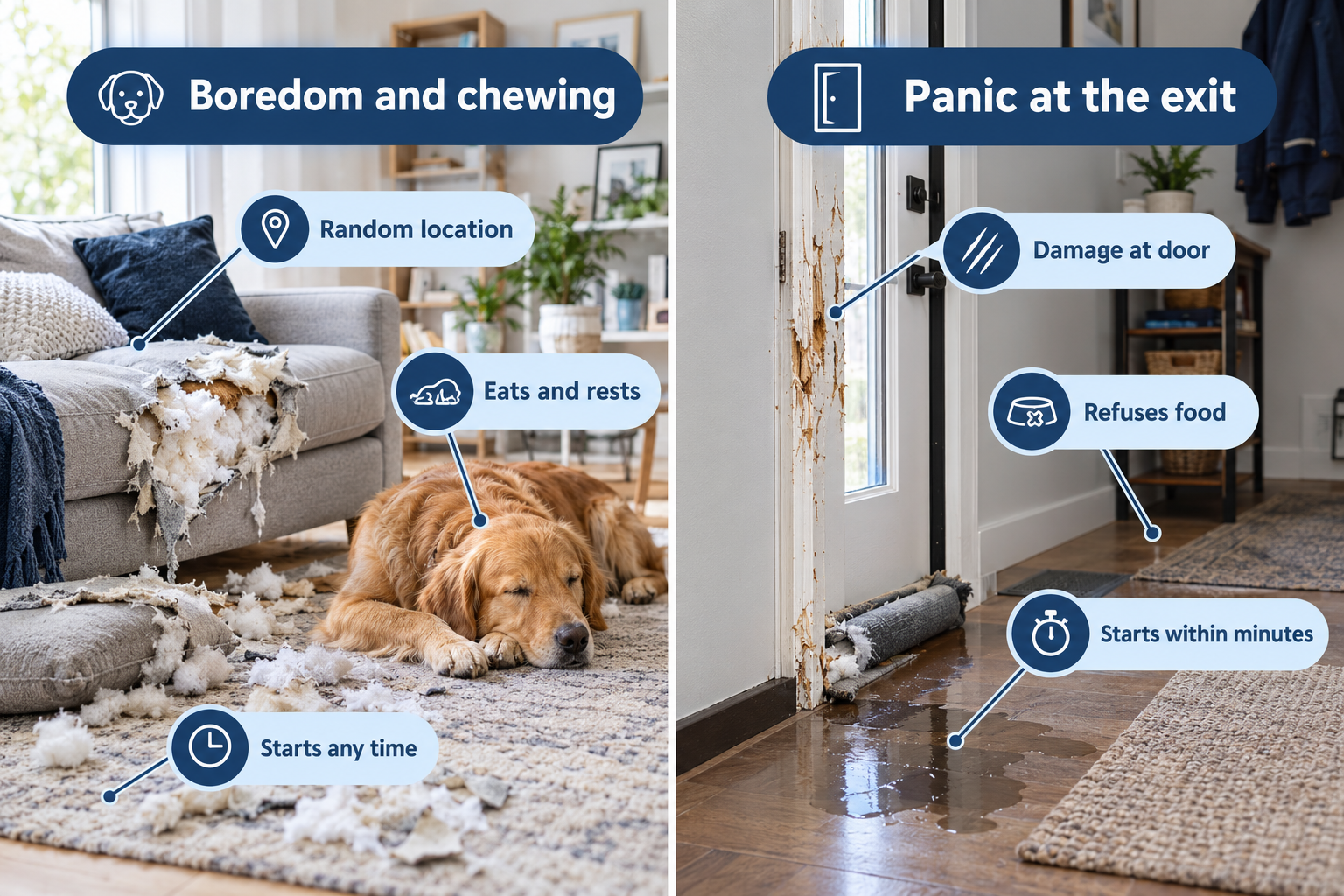
Those labels matter because they change the plan. A bored dog needs more to do. A dog with isolation distress can often be helped by company, shared sitting arrangements, or daycare while training proceeds. A dog bonded to one person needs practice absences from that one person.
Separation anxiety in dogs vs normal behavior
Plenty of normal dogs mope at the door. Plenty whine for 90 seconds, then flop down and sleep for four hours, which is roughly what research on how much dogs sleep would predict. A short grumble followed by rest is not a disorder.
A framework published in Frontiers in Veterinary Science on April 17, 2026, drawing on more than 180 dog and caregiver pairs, argued exactly that: proximity-seeking or some distress during an absence should not by itself be read as pathological attachment. Clinginess is not a diagnosis. The same caution applies to over-reading single behaviours in general, the way people do with dog head tilts.
Veterinary sources use the broader term separation-related behavior for the signs themselves, because barking, chewing, and indoor toileting can also come from boredom, confinement distress, noise sensitivity, incomplete house-training, territorial barking at the hallway, or medical disease. Clinical separation anxiety is one explanation among several, and the footage usually tells you which.
What are the 7 warning signs?
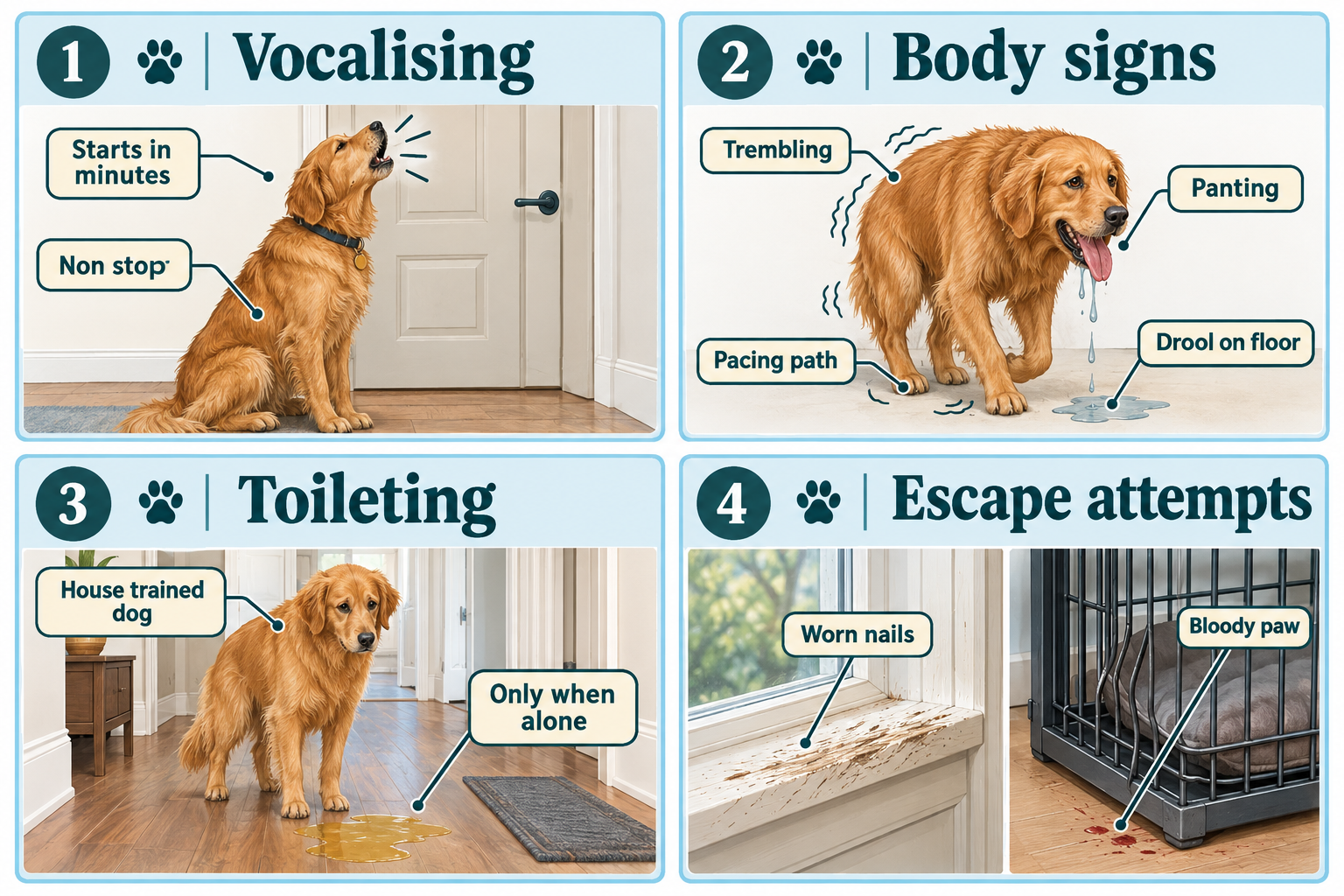
The useful signs all share one feature: they happen around departure or during the absence, and not when you are home. Here are seven, drawn from PDSA advice on separation anxiety and VCA Hospitals’ overview of the condition.
- Vocalising that starts within minutes. Howling, repetitive barking, or long whining that begins almost as the lift doors close and often continues for a long stretch. Neighbours are frequently the first to report this.
- Destruction aimed at exits. Chewed door frames, shredded draught strips, scratched window sills, mangled letterbox flaps. Panic damage has an address. Boredom damage wanders.
- Toileting indoors in a house-trained dog. Urine or faeces produced only during absences, sometimes right at the door, in a dog who is clean the rest of the time.
- Pacing, often along a fixed route. The same loop between the hallway and the sofa, over and over, visible on camera as a worn path rather than a dog settling.
- Panting, drooling, or trembling with no heat or exercise to explain it. A wet patch of drool on the floor is physical evidence of stress you cannot see from the hallway.
- Refusing food, including the good stuff. A stuffed chew toy ignored for 40 minutes, then eaten the moment you walk back in. That is one of the clearest signals that the dog was over threshold.
- Escape attempts and self-injury. Bent crate bars, worn claws, bleeding paws, damaged gums, or injuries from trying to get through a window. This sign needs same-week veterinary attention, not a longer training timeline.
Vomiting during absences belongs on the serious end of the list too. One mild sign on its own is weak evidence. Three or four together, repeating across several absences, is a pattern worth acting on.
How do I know if my dog has separation anxiety? Film the first hour
Set a phone or a home camera to record from before you pick up your keys until at least 30 to 60 minutes after you leave. A Furbo Dog Camera suits owners who want treat-tossing and barking alerts, Petcube suits people who want two-way audio, and a basic Wyze Cam suits anyone who only needs footage on a budget. Any camera that records sound and timestamps works.
Watch for three things: how many minutes until the dog settles, whether the dog eats, and where the dog spends the absence. A dog asleep at minute six does not have separation anxiety. A dog standing at the door panting at minute 40 does have something worth treating.
Does my puppy have separation anxiety or is it normal?
Puppy protest and clinical separation anxiety overlap, which is why early footage helps. A longitudinal puppy cohort published in 2026 reported separation-related behaviour in 46.9% of dogs at six months of age. That figure comes from one puppy cohort, not a representative sample of all dogs, so it does not mean half of adult dogs have a clinical disorder. It does mean low-level separation-related behaviour in young dogs is common.
Treat it as a training stage first. Short, frequent, calm absences beat one long one. If the puppy escalates instead of settling across two or three weeks of short practice, book the vet rather than waiting for maturity to fix it.
What causes separation anxiety in dogs?
Nobody can name one cause. Veterinary behaviour sources point to a mix of genetics, early experience, learning history, routine change, and co-occurring anxiety, with some cases appearing after a specific event and others building slowly.
A study published in Scientific Reports on January 21, 2026 interviewed 15 veterinarians, trainers, and behaviourists across Denmark, Sweden, and Norway. They repeatedly described co-occurring anxiety, adolescence, routine changes, owner stress, breed type, and prior training experiences as recurring contexts in their cases. The authors were clear that these were professional observations, not proven causal risk factors. Useful for pattern recognition. Not a scoring system for your dog.
A genetics paper from March 11, 2026 reported preliminary evidence involving regulation of SLC32A1, a gene relevant to inhibitory neurotransmission, in separation-related behaviour. That is an early biological lead, not a test you can order and not a reason to treat a dog based on breed or pedigree alone.
Worth naming the thing that is not a cause: letting the dog sleep on the bed, or giving affection, does not create separation anxiety. There is also no support for treating the behaviour as a status or dominance problem. A June 25, 2026 study in Animals found that higher rank scores among cohabiting dogs were associated with earlier escape attempts, scratching, and barking during owner absence, but that experimental construct does not show dominance causes separation anxiety, and it is not a reason for confrontational training.
Which dog breeds are prone to separation anxiety?
No breed list predicts an individual dog. Clinicians often mention working and companion types bred for close human contact, including retrievers, German Shepherds, Border Collies, Vizslas, and several toy breeds, and breed type showed up as a described context in the 2026 Scandinavian interview study. That is professional observation, not a prevalence ranking.
Breed shapes tendencies and energy needs, nothing more. Individual variation does the rest, which is the same caveat that applies to claims about the most intelligent dog breeds and about what loyalty actually looks like in different breeds. If you are choosing a dog for a home that is empty eight hours a day, think about alone-time training capacity and daily routine first, which is also the sensible filter in picking a dog for first time owners.
How to treat separation anxiety in dogs: the step-by-step plan
The core method is systematic desensitisation plus counterconditioning: absences short enough that the dog never panics, paired with something good, lengthened only while the dog stays relaxed. ASPCA guidance starts dogs who panic immediately at absences of one or two seconds. The threshold is behavioural, not chronological, and a trainer who specialises in this work, such as Malena DeMartini and her Mission Possible programme, builds plans around that same below-threshold principle.
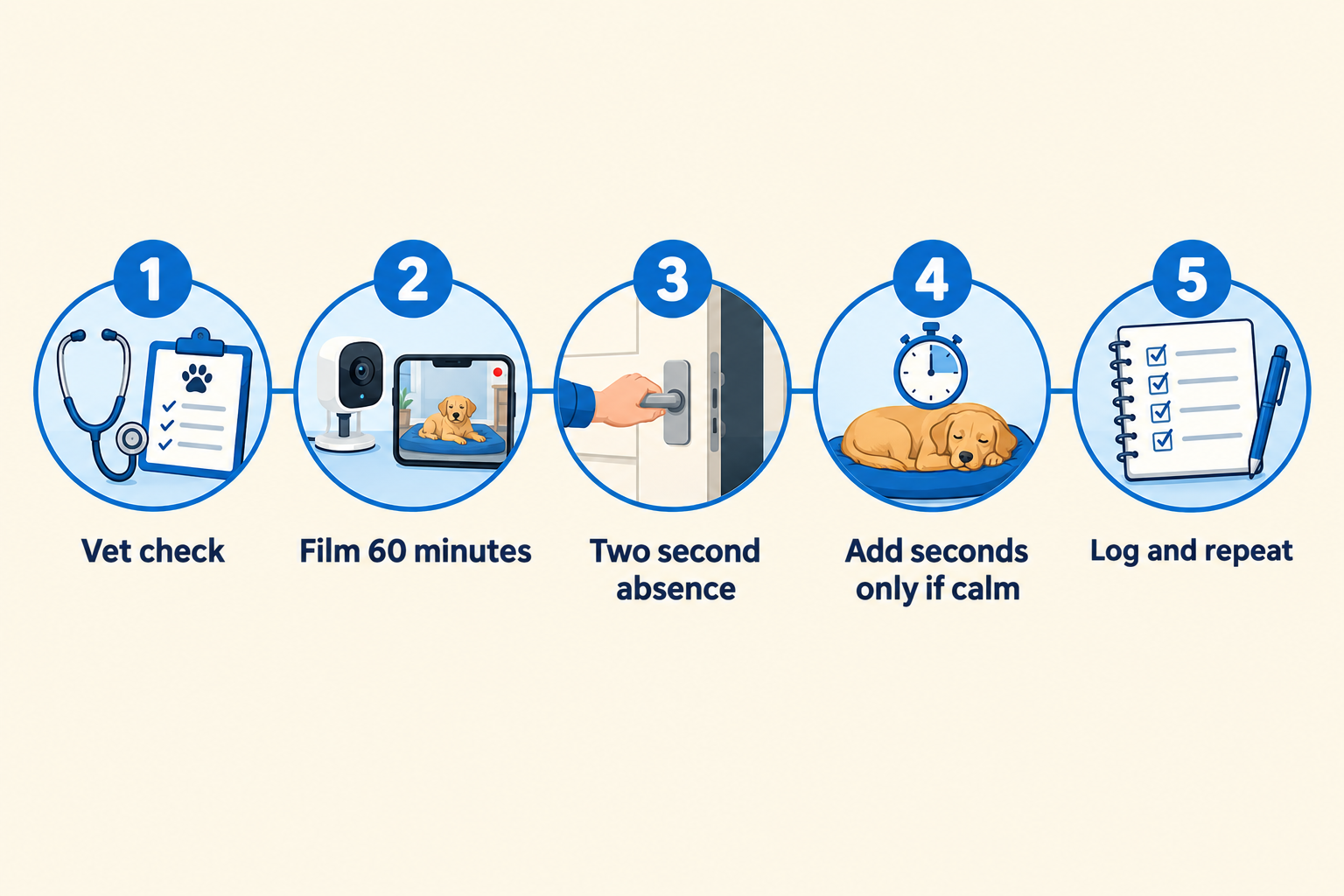
Step 1. Vet exam first. Pain, gastrointestinal or urinary disease, sensory decline, cognitive dysfunction, endocrine disease, and medication side effects can all produce or worsen the behaviour, which is why veterinary advice on easing separation anxiety starts with a physical examination. Sudden onset in an older dog deserves prompt investigation.
Step 2. Get your baseline on video. Record one normal departure. Note the minute distress starts, the minute it stops, whether food is eaten, and what the dog does with the time. Without that number you cannot tell whether week three is better than week one.
Step 3. Separate the departure cues from leaving. Pick up your keys, then sit down. Put your shoes on, then make tea. Open the door, close it, stay home. Repeat until the keys stop meaning anything. This costs nothing and often produces the first visible change.
Step 4. Start absences below threshold. If footage shows panic at 10 seconds, practise two seconds. Step out, step back, no fuss on return. Stay at that length until the dog looks bored by it.
Step 5. Add time in small steps, and vary them. Go up a little, then drop back down, then up again. Mix short reps with slightly longer ones so the next absence is never predictably harder.
Step 6. Stop the session at the first sign of stress. Panting, freezing, repeatedly leaving the mat, abandoning food, or rushing the door means the step was too big. Shorten the next absence. Never wait out the panic, because the dog is rehearsing the fear, not learning that you come back.
Step 7. Keep a log. Date, planned length, what the footage showed. Progress in these cases is slow and uneven, and a log is the only honest way to see it.
Separation anxiety in dogs training tips at home
- Feed the absence, not the greeting. Stuffed rubber toys like the KONG Classic give many dogs something to do in the first minutes. Keep fillings safe by checking the list of foods dogs cannot eat before you get creative.
- Build enrichment earlier in the day. Sniffing walks, scatter feeding, and training games before departures help the dog start the absence tired rather than wound up.
- Use real practice windows. Three two-minute reps while you water the plants beat one hopeful 40-minute test.
- Arrange cover for the gap. Sitters, a neighbour, daycare, or working from home during the early weeks protect the training from being undone by unavoidable long absences.
- Keep arrivals dull. Greet the dog once the dog is settled, not while the dog is spinning at the door.
Training only, training plus medication, or gear: what each one does
| Approach | What the evidence supports | When to use it | Limits to expect |
|---|---|---|---|
| Behaviour training only (desensitisation and counterconditioning) | The method behind ASPCA guidance and the approach reviewed in the IAABC Foundation literature review on behaviour modification for canine separation anxiety | Mild to moderate cases, no self-injury, and an owner who can control absences in the early weeks | Slow. Needs consistency and someone to cover long absences |
| Training plus veterinary medication (Reconcile / fluoxetine, Clomicalm / clomipramine, Tessie / tasipimidine) | Medication is used alongside behaviour modification, not instead of it. The FDA approval for Tessie covers both noise aversion and separation anxiety | Severe panic, self-injury, dogs who cannot be left even for seconds, or stalled progress | Needs diagnosis, contraindication screening, and monitoring. Possible side effects including drowsiness |
| Gear and environment (Furbo Dog Camera, Petcube, Wyze Cam, KONG Classic, Adaptil, Snuggle Puppy) | Cameras provide the diagnostic footage veterinary sources recommend. Food toys, pheromone products, and heartbeat plush toys are support items with mixed or limited evidence | Cameras: every case. Food toys and calming products: alongside training, never as the whole plan | No device treats panic. A dog in distress will ignore the best stuffed toy in the house |
Can separation anxiety in dogs be cured, and how long does it take?
Many dogs improve a great deal and some reach the point where being alone is unremarkable. Veterinary sources describe management and long-term improvement rather than a guaranteed cure, and relapse after a routine change is common. Nobody honest will promise a timeline.
What the available guidance and clinical writing support is a realistic shape to the process:
- Weeks 1 to 2: vet exam, baseline footage, departure cue work. Small wins.
- Weeks 3 to 8: below-threshold absences grow from seconds to minutes. Progress looks like a staircase with the occasional step down.
- Months 2 to 6: absences reach useful real-world lengths for many dogs, especially where medication was added early in severe cases.
- After that: maintenance. A house move, a new baby, a schedule change, or a frightening noise event can set things back, and a short refresher is normal.
Decision rule: if six to eight weeks of consistent, filmed, below-threshold practice produces no measurable change in time-to-settle, stop repeating the same plan and get a veterinary behaviourist involved.
Separation anxiety medication for dogs: what to ask your vet
Medication for separation anxiety in dogs is prescription-only, needs a diagnosis, and works alongside training rather than instead of it. Three names come up most often in the US and UK: Reconcile (fluoxetine) and Clomicalm (clomipramine) as daily medications, and Tessie (tasipimidine), an alpha-2 adrenergic agonist approved by the FDA on May 6, 2026 for both noise aversion and separation anxiety.
The labelled separation anxiety use for Tessie is generally one dose about one hour before departure, with at least three hours between doses and no more than three doses in 24 hours, and the FDA’s materials warn that a dog who becomes drowsy after dosing should not be left alone. Doses, combinations, and suitability are your vet’s call, not an internet list’s.
Useful questions for the appointment:
- Which signs in my footage support a separation anxiety diagnosis rather than something else?
- Is this a daily medication, a before-departure medication, or both?
- What side effects should I watch for in the first two weeks, and when should I call?
- How will we measure whether it is helping, and when do we review?
- What training plan goes with it, and who will coach me through it?
Over-the-counter calming supplements, Adaptil pheromone diffusers and collars, and comfort items such as a Snuggle Puppy are low-risk support options with limited evidence for clinical cases. Reasonable to try. Not a substitute for a diagnosis. Background reading on psychopharmacology in dogs and on dog anxiety medication and treatment options is worth a look before the appointment so you can ask sharper questions.
Common mistakes when treating dog separation anxiety
The most expensive mistake is punishment. Scolding a panicking dog on return, using anti-bark collars, or confronting the damage adds fear to the absence and raises bite risk during handling, which is one of the pathways described in material on why dogs bite their own owners.
Other patterns that stall progress:
- Guessing instead of filming. Half of the cases that look like separation anxiety turn out to be noise reactivity, boredom, or house-training gaps once there is footage.
- Flooding. Leaving the dog alone for hours “to get used to it” rehearses panic.
- Jumping the increments. Going from 30 seconds to 10 minutes because yesterday went well.
- Treating the symptom only. A second dog, a new bed, or a different toy rarely fixes panic about one missing person.
- Dropping the plan when medication starts. Medication lowers the panic so training can work. On its own it is half a treatment.
- Skipping the vet. Sudden onset in a middle-aged or senior dog can be pain, urinary disease, or cognitive decline wearing a behaviour costume.
Shorten the absence, do not wait out the panic. That single rule prevents most of the setbacks owners report.
Does crate training help or hurt separation anxiety?
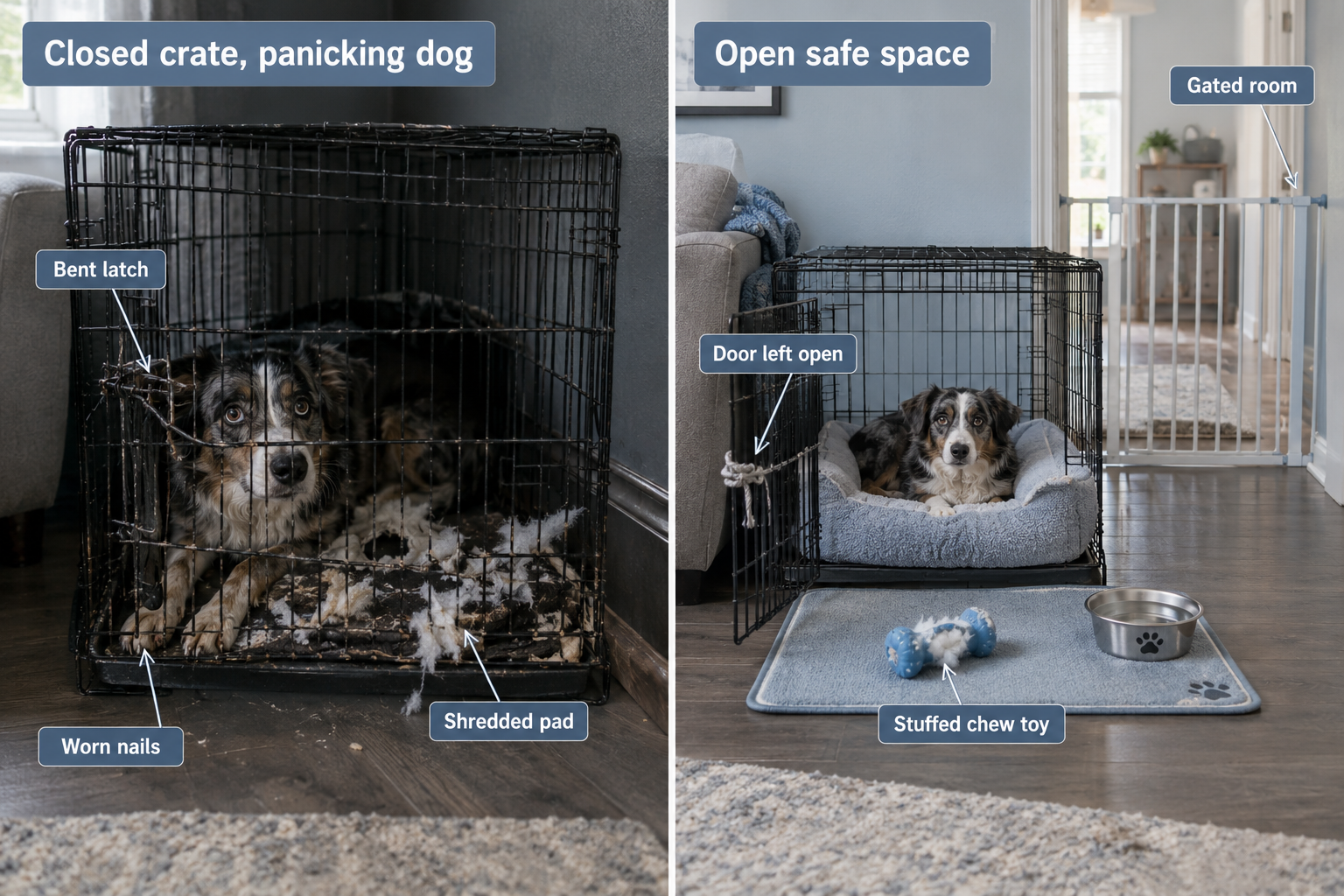
A crate helps dogs who already treat it as a calm resting place, and it actively harms dogs who panic inside it. Footage decides which dog you have.
Use a crate while you work on separation anxiety if the dog enters freely, lies down, chews, and sleeps in it with the door open and with you home. Keep the door open during early absence practice and let the crate stay a choice.
Stop using a closed crate and talk to your vet if you see bent bars, broken nails, bloodied gums, drool-soaked bedding, soiling inside the crate, or frantic digging at the tray. Those dogs often do better with a gated room, a hallway with a washable mat, or a pen in a space with no window access, because confinement distress is a separate problem that a closed door makes worse.
Practical setup notes: pick the crate size by the dog’s standing and lying measurements rather than the label on the box, and check the dimensions against the room before ordering, especially in a flat. Dog size categories are a reasonable starting reference for working out what counts as roomy for your dog.
When should you see a vet or veterinary behaviorist?
Book a vet appointment now if the behaviour appeared suddenly, if your dog is injuring himself, if there is vomiting, diarrhoea, blood, or weight loss, or if your dog is over seven and this is new. Medical causes come first, every time.
Ask for a referral to a board-certified veterinary behaviourist, a Diplomate of the American College of Veterinary Behaviorists, or a qualified veterinary behaviour specialist in your country if:
- the dog cannot be left for even a few seconds without panic,
- there has been self-injury or escape from a crate, window, or balcony,
- six to eight weeks of consistent, filmed training shows no change,
- there is also aggression, noise phobia, or generalised anxiety in the picture,
- or your housing is at risk because of complaints and you need a plan that moves faster than trial and error.
Certified separation anxiety trainers, including those working through Malena DeMartini’s Mission Possible programme, run structured remote plans and coordinate with vets when medication is needed. Specialist guidance and the clinical literature on this condition, including the reviews available through AVMA journals and the IAABC Foundation literature review, consistently pair behaviour modification with veterinary oversight for the severe end of the range.
FAQ
Is separation anxiety in dogs the same as isolation distress?
No. Isolation distress means the dog panics about being alone and settles if any friendly person or sometimes another dog is present. Separation anxiety is tied to a specific person, so a sitter may not prevent the panic. The training method is similar, but the practice absences must involve the right person.
Can separation anxiety in dogs be fixed without medication?
Often yes, in mild and moderate cases, using desensitisation and counterconditioning with controlled absences. Severe cases with self-injury or zero tolerance for being alone usually progress faster and more humanely with veterinary medication supporting the training.
How long should I leave my dog alone during training?
Only as long as the dog stays relaxed. ASPCA guidance starts some dogs at one or two seconds. If the footage shows panting, pacing, or refused food, the last absence was too long and the next one should be shorter.
Do calming toys or pheromone products treat separation anxiety in dogs?
They are support items, not treatments. A KONG Classic can occupy the first few minutes, Adaptil is a pheromone product with mixed evidence, and a Snuggle Puppy offers comfort to some dogs. A dog in genuine panic typically ignores all three.
Should I get a second dog to keep my dog company?
Not as a treatment. If the distress is about one missing person, another dog usually does not help, and you may end up with two dogs barking. Surveys of owner experiences, including the CertaPet separation anxiety survey, show how often owners try environmental fixes before getting a diagnosis.
Does punishment or a bark collar stop the howling?
No. Punishment adds fear to an already frightening situation, can suppress the noise while the panic continues, and raises the risk of a defensive bite. Veterinary behaviour guidance does not support it.
My dog only does this when my partner leaves, not me. Is that still separation anxiety?
It can be. Attachment to one person is common in these cases. Practise absences with that person, film them, and bring the footage to the vet.
Will my dog grow out of it?
Some young dogs settle with short, frequent, calm practice absences. If the signs get worse over two to three weeks of consistent practice, or if there is injury or toileting involved, treat it as a clinical problem rather than a phase.
Conclusion: the one thing to do this week
Record one departure. Camera on before you touch the keys, recording for the first 30 to 60 minutes, sound included. Then write down three numbers: the minute distress started, the minute it stopped, and whether the food was eaten.
That single recording sorts boredom from panic, gives your vet something concrete to work with, and sets the starting length for your first practice absence. Everything else in a plan for separation anxiety in dogs, including training steps, medication decisions, crate choices, and whether to call a behaviourist, follows from what you see in that first hour of footage.
Guidance here was checked in October 2026 against FDA, ASPCA, Merck Veterinary Manual, PDSA, VCA, and peer-reviewed sources linked above. Your vet knows your dog. Bring the video.