
A freshly bathed dog hits the hallway at full speed, shoulder checks the laundry basket, completes four laps of the sofa, then flops down like nothing happened. The towel is somewhere behind the armchair.
That sprint has a technical name, and most dog zoomies are completely normal.
Quick Answer
Dog zoomies are short bursts of fast, looping, apparently random running that veterinary sources call FRAPs, or frenetic random activity periods. Cornell’s Riney Canine Health Center says there is no known specific cause for the behavior, though it may help a dog release pent-up energy or stress. Normal episodes usually run from about 30 seconds to a little over five minutes. Worry about the environment first, then about the dog if the pattern suddenly changes.
Key Takeaways: Dog Zoomies
- FRAP stands for frenetic random activity period. It describes the pattern of running, spinning and looping, not a diagnosis.
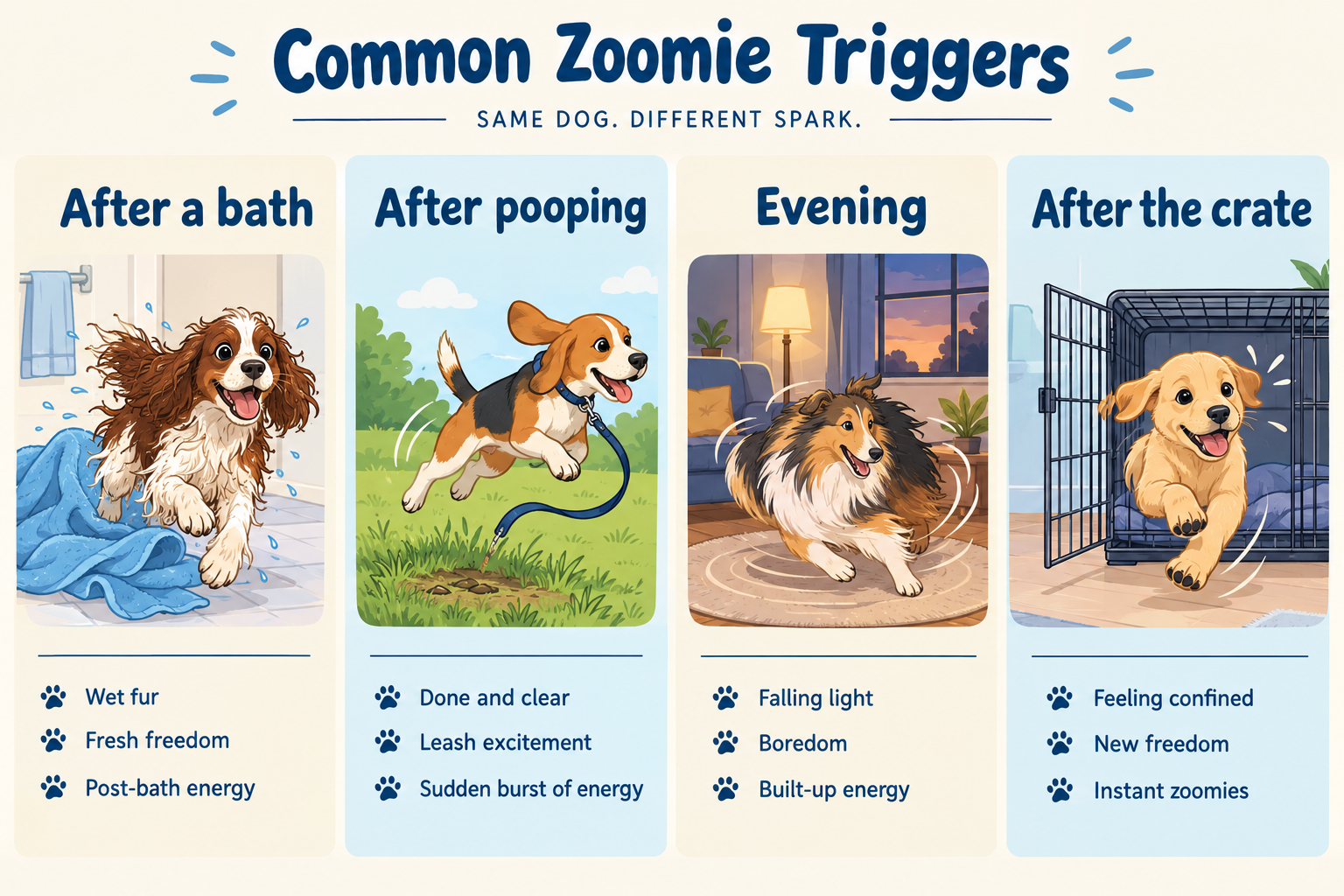
- Cornell lists common triggers as returning home, play, training sessions, pooping, and exciting events.
- Episodes typically last 30 seconds to more than 5 minutes, per veterinary comment reported in July 2026.
- Zoomies are most common in puppies and young dogs, but plenty of adults keep doing it occasionally for life.
- A happy FRAP looks loose and wiggly, often starting with a play bow. A stressed one looks tense, with a tucked tail and ears back.
- Daily dog zoomies are normal for many healthy dogs. A sudden change in frequency matters more than the behavior itself.
- The real risk is usually surfaces and surroundings: wood floors, coffee tables, open gates, roads.
- Extra exercise helps some dogs and not others. Dogs with plenty of walks and enrichment still zoom.
- See a vet if the running comes with confusion, changed sleep, odd vocalizing, trouble moving, or looks repetitive and hard to interrupt.
What are dog zoomies (FRAPs)?
Dog zoomies are brief, self-starting bursts of high speed movement, usually in circles, figure eights or repeated laps of a familiar route. The veterinary term is frenetic random activity period, shortened to FRAP. Cornell’s canine health information describes it as sudden running, spinning or looping that starts without obvious warning and stops just as abruptly.
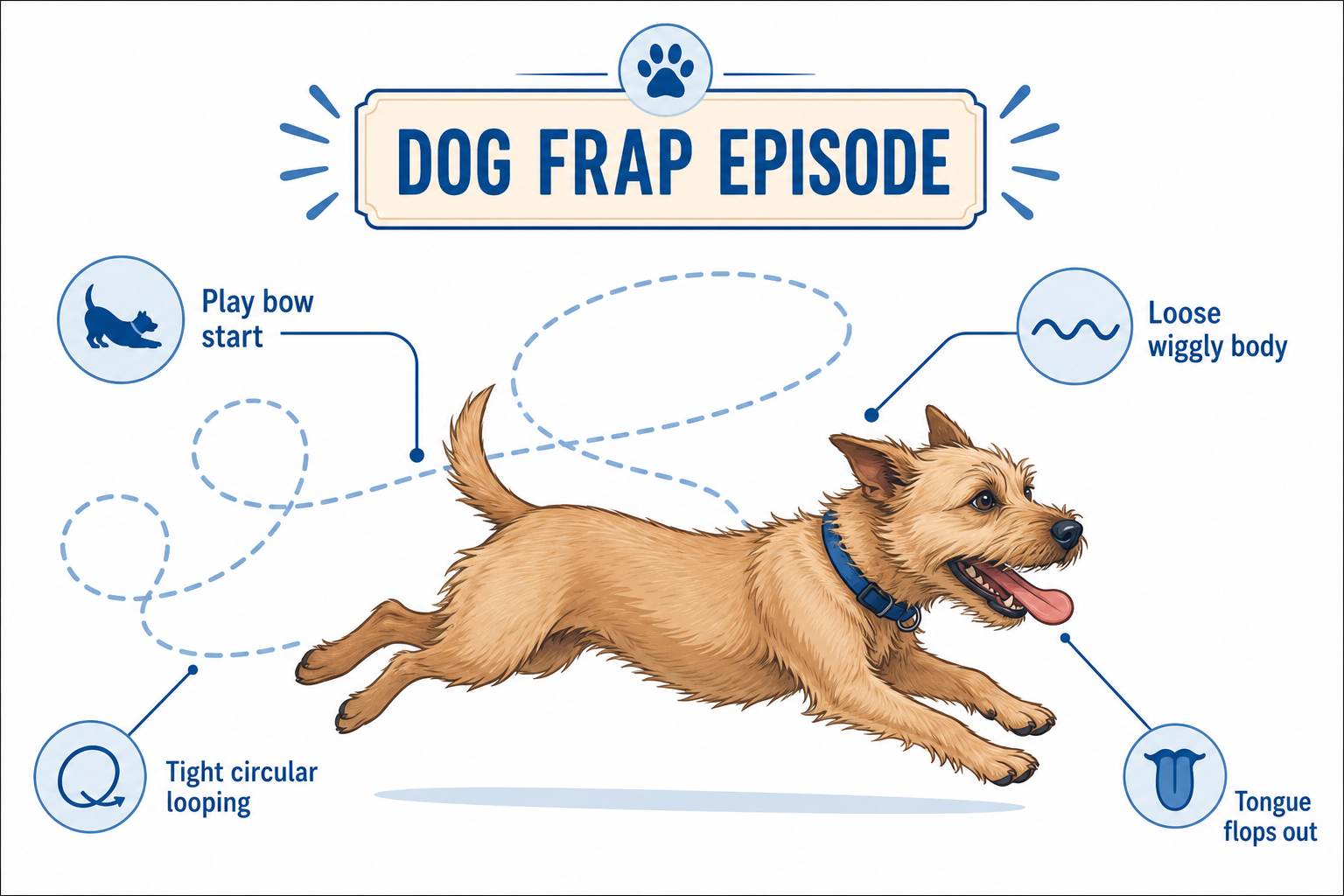
The word FRAP does a specific job. It names a pattern of behavior. It does not name a cause, a mood, or a medical condition. That distinction matters, because the same sprint can come from excitement, from relief, from boredom, or from something the dog found genuinely unpleasant three minutes earlier.
What does FRAP mean in dogs?
FRAP means frenetic random activity period: a short episode of fast, unstructured, often circular movement. “Random” refers to the path and the timing, not to a lack of reason. A dog doing a FRAP usually has a trigger, even if nobody in the room noticed it.
Is it normal for dogs to get zoomies every day?
Yes, for many dogs. Daily zoomies are within normal range, especially in puppies, young adults, and high activity dogs. What matters is whether the pattern is typical for that individual dog.
Use this rule: if your dog has had an evening lap of the living room most days for two years, that is their baseline. If a quiet eight-year-old dog starts doing it nightly out of nowhere, that is a change worth mentioning to a vet.
How long do dog zoomies usually last?
Most normal episodes last from about 30 seconds to a bit over five minutes, according to Dr. Ronit Berdugo, a veterinary partner at SynergyLabs, quoted in reporting on sudden zoomies at home. Then the dog usually downshifts fast, drinks water, and lies down.
Treat length as one signal among several. A three minute sprint is unremarkable. A dog who cannot stop, cannot settle afterwards, or seems unable to hear you at all is a different conversation, covered further down.
Why do dogs get zoomies?
The short answer: nobody has pinned down one mechanism. Cornell states plainly that there is no known specific cause, while offering two plausible functions. Zoomies may help a dog discharge pent-up energy, and they may help relieve stress. Both can be true in the same dog on different days.
Berdugo described the behavior as a quick way to release physical energy, excitement, or stored emotion, and linked it plausibly to activation of the sympathetic nervous system, the arousal system involved in alertness and fight-or-flight responses. Important caveat attached to that: arousal is not the same as fear. A dog can be highly aroused and perfectly content.
So two owners can watch identical behavior and be looking at two different internal states. Which is why the trigger and the body language matter more than the sprint itself.
Common dog zoomie triggers and how to handle each
What time of day do dogs usually get zoomies?
Most owners report two clusters: early morning and evening, roughly 6pm to 10pm. Neither window is a rule. Zoomies follow triggers, and the biggest triggers in a normal household cluster around waking, reunions, meals, toilet breaks and the end of the day.
If your dog’s evening laps look like leftover energy rather than excitement, the fix is usually earlier in the day, not at 9pm. Dogs also sleep a great deal by human standards, which changes what “enough activity” means. Our piece on why dogs sleep so much and what the research found covers how much rest is typical.
Do all dog breeds get zoomies, or just some?
Any healthy dog can get zoomies, regardless of breed or age. Berdugo named Labrador Retrievers, Jack Russell Terriers and Border Collies as examples of commonly energetic dogs, while stating that breed does not determine whether zoomies happen.
Frequency may track activity level more than breed label. A working line spaniel in a quiet flat may zoom more than a laid-back retriever with a big yard. Individual variation beats breed generalization here, and no published rule assigns a zoomie score to a breed. Anyone selling you one invented it.
Body size does change the risk calculation though. A 4kg terrier skidding across tile is a different proposition from a 50kg dog doing the same thing next to a glass table. If you are weighing up body types, our breakdown of dog size categories from small to giant explains where the thresholds sit.
Why do puppies get zoomies more than adult dogs?
Cornell reports FRAPs are most common in puppies and young dogs, with some dogs continuing to have occasional episodes throughout life. Puppies have faster arousal shifts, less practice at self-settling, and a developing nervous system that tips into high gear with very little input.
Puppy zoomies also tend to arrive at predictable moments: after a nap, after a meal, after a toilet trip, and about ten minutes before you hoped they would sleep. Growing dogs have specific nutrition needs during that stage too, which we cover in our guide to what puppy food growing dogs need in year one.
Can zoomies mean my dog has too much energy?
Sometimes, and that is only one hypothesis. Cornell notes that frequent or badly timed episodes can point to not enough physical exercise or mental stimulation. But reporting on the same subject also makes clear that dogs who receive adequate exercise and enrichment still zoom.
Decision rule: add a week of extra sniffing walks and training games, and track whether the episodes drop. If they do, it was energy. If nothing changes, it is simply how your dog resets, and the job becomes safety rather than suppression.
Are zoomies a sign of a happy dog?
Often, but not automatically. Cornell describes a happy FRAP as a loose or wiggly body, playful bouncing, often a play bow before the sprint, and a tongue that may flop out after running. A frightened or distressed episode looks different: tense body, wide eyes, tightly tucked tail, lowered head, ears held back.
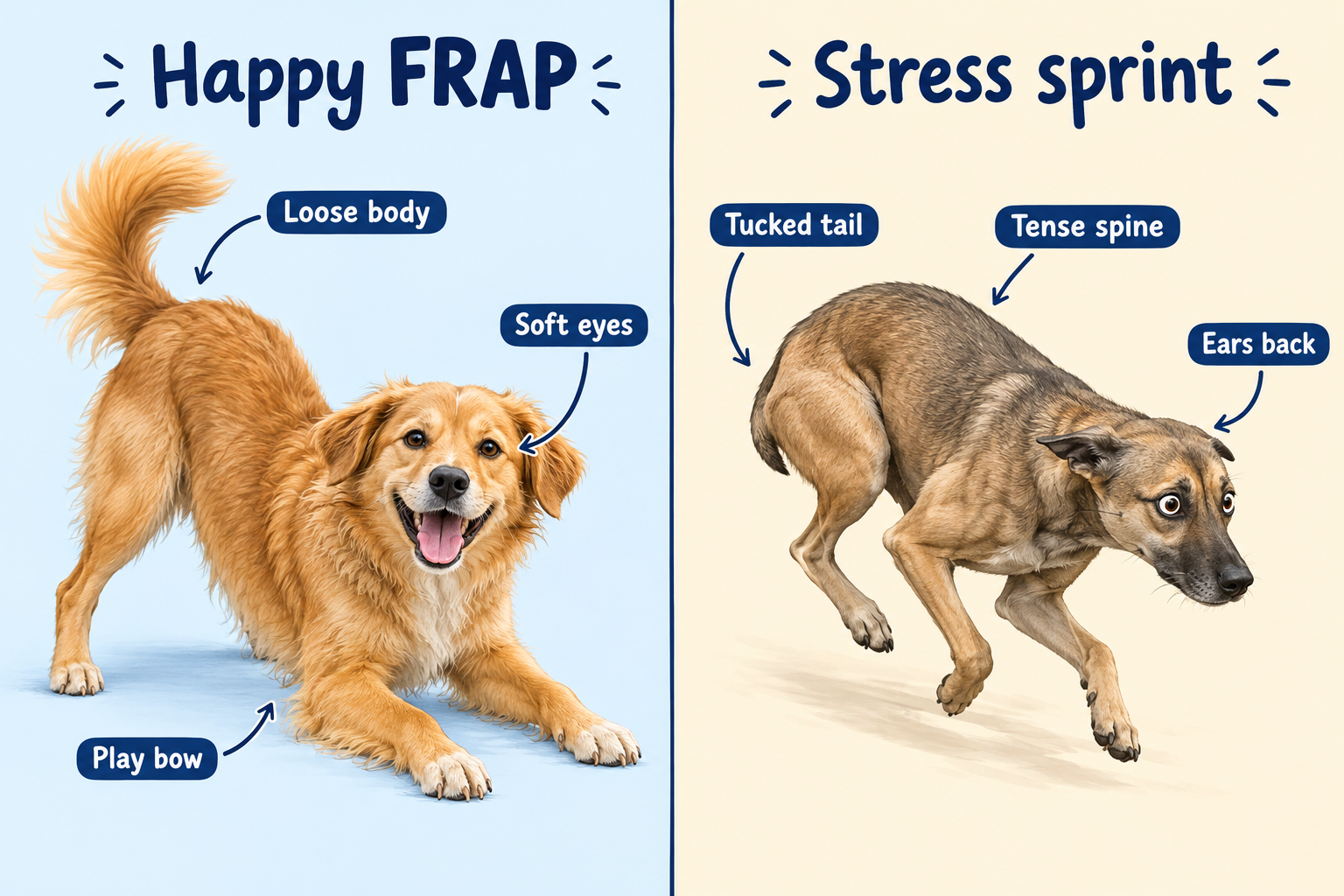
Which is why the post-bath sprint is such a common misread. A dog bolting away from the bathroom may be delighted, or may be shedding the tension of twelve minutes of being held still while someone squeezed a bottle at them. The sprint alone does not tell you. The face, tail and recovery do.
Reading posture is a skill worth building, and it transfers to plenty of other moments. Our explainer on what head tilting in dogs can really mean works through a similar gap between the cute interpretation and the evidence.
Can zoomies be a sign of anxiety or stress in dogs?
They can be. Zoomies after a bath, a vet visit, grooming, crate time, nail trims or a thunderstorm may be stress release rather than celebration. Both Cornell’s guidance and the 2026 veterinary comment treat stress discharge as a plausible function of the behavior.
Three things to check after an emotionally loaded event:
- Posture during the sprint. Loose and bouncy, or stiff with a tucked tail?
- Recovery time. Does the dog settle within a few minutes, or stay pacing and panting?
- Pattern over weeks. Does it only ever happen after the same unpleasant event?
If a dog consistently zooms after one specific routine and looks tense while doing it, change the routine before you change anything else. Shorter grooming sessions, more breaks, better footing, and a reward after each small step.
When are dog zoomies a problem?
Most of the time the dog is fine and the floor is the problem. Zoomies become a genuine concern in three situations: unsafe surfaces or surroundings, joint and mobility limits, and a change from the dog’s normal pattern.
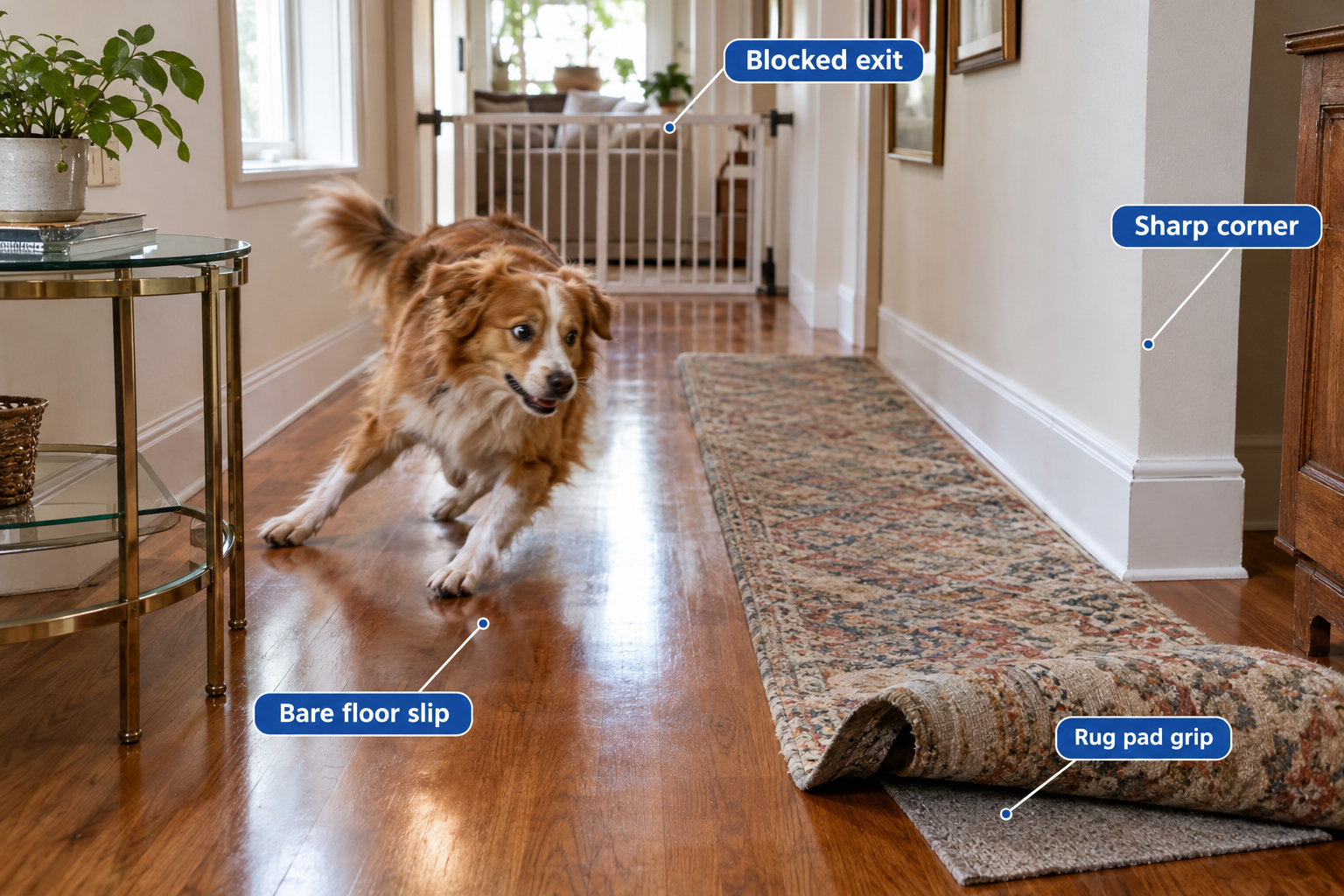
Hard floors are the quiet hazard. A dog at speed on wood, tile or laminate has very little grip, and a tight turn can mean a slip, a strained joint or a collision with furniture. Older dogs, dogs with arthritis, and large or giant breeds carry more of that risk. Rubber-backed runners or non-slip rug pads such as Gorilla Grip pads are one way to add traction in a hallway, and they also suit homes where an aging dog struggles to stand up on smooth floors. Neutral note: we have not run our own grip tests, so treat that as a product category suggestion, not a verified performance claim.
Outside, the issue is containment. A FRAP in a fenced yard is entertainment. The same FRAP on an unfenced verge beside a road is a serious situation, and recall usually fails at full arousal because the dog is not processing much beyond movement.
When should I be worried about my dog’s zoomies?
Worry when the pattern changes, not when the behavior exists. The 2026 veterinary guidance flags a sudden increase in frequency, difficulty calming down, and new zoomies in an older pet as reasons to book a vet appointment, especially alongside confusion, altered sleep, unusual vocalizing, or trouble moving.
Also treat these as reasons to call:
- The dog seems to be running away from something rather than playing.
- Episodes end in limping, stiffness or reluctance to use a leg.
- The running looks repetitive and hard to interrupt, and happens with no trigger.
- Sudden onset in a senior dog paired with disorientation or staring at walls.
Film one episode on your phone. A 30 second clip is worth more to a vet than five minutes of description.
What is the difference between zoomies and seizures in dogs?
Zoomies are directed, coordinated movement with normal awareness. The dog steers, dodges furniture, responds to you at least partly, and stops on their own. A seizure usually involves loss of normal control: collapse, paddling or stiff limbs, altered consciousness, drooling, loss of bladder or bowel control, and a dazed recovery period afterwards.
Some episodes sit in a grey zone, including compulsive-looking circling and repeated tail chasing. Normal zoomies look varied and playful. A compulsive pattern tends to be repetitive, hard to interrupt, triggered by nothing in particular, and often increasing over time. That pattern needs a veterinary assessment rather than a judgment call at home, because neurological, orthopedic and behavioral causes can all look similar from the sofa.
How do you calm zoomies or give them a safe outlet?
The goal is redirection and safety, not elimination. Stop chasing the dog (chasing fuels the game), clear the obstacles, open a path to a safe surface, and let the burst finish. Then offer something that scratches the same itch on purpose, on your schedule.
Is it bad to play with my dog during zoomies?
Joining in is fine when the dog’s body is loose, the space is safe, and you are not adding more arousal to a dog who is already struggling to think. Avoid grabbing, cornering, or wrestling a dog mid-FRAP. That is how accidental bites and bruised shins happen, and it teaches the dog that hands appear at the fastest moment.
Better moves during an episode:
- Stand still and let the dog loop around you.
- Toss a toy in one direction to turn circles into a straight line.
- Open the back door and walk out calmly.
- Sit down. Many dogs wind down faster when nobody is reacting.
How can I help my dog burn energy to prevent zoomies?
Build energy outlets into the day, ideally before the window when zoomies usually show up. Sniffing does more to settle most dogs than distance walking, because it adds mental work rather than just mileage.
Options that fit different households:
- Flirt pole. The Outward Hound Tail Teaser is one widely sold version. Suits dogs who love chasing and owners with a small yard. Not ideal for dogs with existing joint problems, since sudden turns load the hips and shoulders. Keep sessions short and let the dog catch the lure sometimes.
- Fetch with a durable ball. A Chuckit! Ultra Ball is a common pick for strong chewers and launcher use. Check the size against your dog’s mouth, and skip repetitive hard fetch for dogs recovering from injury.
- Sniff walks. Twenty minutes of slow route with free sniffing often beats forty minutes of brisk heel work for settling a dog afterwards.
- Private rental spaces. Platforms such as Sniffspot list private dog parks you can book by the hour. They suit reactive dogs, recall practice, and anyone whose public park has gone chaotic. We have no independent data on availability or pricing in your area, so check local listings yourself before planning around it.
- Secure walking gear. For dogs who pull or spin when excited, a well fitted front clip option such as the Ruffwear Front Range harness is a common choice. Fit matters more than brand, so check the dimensions and measure the girth rather than guessing by weight.
For families with kids who want a dog that matches this kind of activity level, our guide to the best dogs for kids who want to play sets out realistic exercise demands by breed group.
How do I stop my dog from getting zoomies?
You mostly do not, and that is the honest answer. FRAPs are normal behavior with no established treatment, and current professional guidance treats ordinary zoomies as something to manage through safety, exercise and enrichment rather than as a condition to medicate.
What you can change is the timing and the venue:
- Give the dog a planned outlet before the usual zoomie window.
- Make one safe route in the house: rugs down, coffee table moved, glassware away.
- Teach a reliable recall and a settle on a mat when the dog is calm, not mid-sprint.
- Build a predictable wind-down at night: last toilet trip, chew, lights down.
- Keep a two week log of time, trigger and length, so you know your dog’s baseline.
First-time owners often find this stage alarming and then unremarkable within a month. If you are still choosing a dog and want a temperament that suits a quieter home, our list of the best dogs for first time owners is a reasonable starting point.
Frequently asked questions about dog zoomies
Why does my dog get the zoomies after a bath?
Likely a mix of relief, the urge to dry off, and the wish to restore their own scent. Cornell’s guidance treats stress release as a plausible function of FRAPs, so a post-bath sprint is not automatic proof of happiness. Check the tail and face.
Are zoomies good for dogs?
Generally yes, as a normal release of energy or tension, provided the surface is safe and the dog has no joint or mobility problems. The behavior itself is not harmful. The hallway furniture might be.
Why do dogs get zoomies at night?
Because evening collects triggers: your return home, dinner, a last toilet trip, and a day’s worth of rest. If the episodes look like leftover energy, shift a sniffing walk or training session to late afternoon and see whether the pattern changes.
What animals get the zoomies?
Short bursts of sudden fast activity are reported across many species, most familiarly in cats, rabbits, ferrets, horses and farm animals turned out into a field. The FRAP label is used mainly in dog and cat behavior discussion.
Are zoomies at the dog park a bad sign?
Not by themselves. Group play raises arousal fast, and zoomies often spread between dogs. Call your dog out for a short break if the running tightens, the barking rises, or other dogs start chasing rather than playing.
Can older dogs still get zoomies?
Yes. Cornell notes some dogs have occasional episodes throughout life. But a senior dog who suddenly starts zooming, especially with confusion, changed sleep or odd vocalizing, should be seen by a vet rather than celebrated.
Should I let my dog zoom on hardwood floors?
Try not to. Hard floors offer poor traction at speed, which raises the risk of slips and joint strain, particularly for older, arthritic, large and giant breed dogs. Add runners or rubber-backed pads along the usual route.
Conclusion: one next step
Dog zoomies are ordinary. The floor is the part you can actually control.
Do this tonight: walk your dog’s usual sprint route and fix the two worst hazards you find, whether that is a bare patch of laminate, a glass side table, or a gate that does not latch. Then note the time, trigger and length of the next three episodes. Two weeks of that log tells you your dog’s baseline, which is the single most useful thing to bring to a vet if the pattern ever changes.
Guidance referenced here was checked in October 2026, and no specific treatment for FRAPs had been approved or recommended as of that date.