Quick Answer
Most licking is ordinary dog communication, not a problem. The honest answer to why do dogs lick you is that a lick can carry several meanings at once: greeting, social bonding, the salt on your skin, a learned request for your attention, or a polite signal that asks you to ease off. Licking that is sudden, frantic, aimed at a dog’s own body, or pointed at the air and the floor is a different conversation, and that one belongs with a veterinarian. Guidance in this article was checked in October 2026.
Key Takeaways: Why Do Dogs Lick You?
- Licking starts in the litter. Mothers lick puppies to clean and stimulate them, and VCA Animal Hospitals notes the comfort link that can carry into adulthood.
- Affection is a fair interpretation, not a proven one. Greeting licks are commonly affiliative, and certified applied animal behaviorist Mary R. Burch told Chewy a quick lick at homecoming is generally normal.
- Taste matters more than people expect. Sweat, lotion, sunscreen and dinner residue all make your hands and feet interesting.
- Attention is a powerful reward. Purina points out that dogs repeat licking when any human reaction follows, including the reaction of being pushed away.
- Some licking is appeasement. A 2017 study on appeasement signals in dog-human communication linked lip licking and looking away with active submission in greetings and close-contact situations.
- Licking at the air, the floor, or a dog’s own paws is a medical flag first.
- Saliva on intact skin is low risk for most adults. WHO rabies guidance updated September 17, 2026 classifies a lick on intact skin as no exposure requiring post-exposure treatment, while saliva on broken skin or mucous membranes needs assessment.
- Individual variation is the rule. Breed tells you very little about how much a specific dog licks.
Why Do Dogs Lick You? The 7 Reasons, From Love to Anxiety
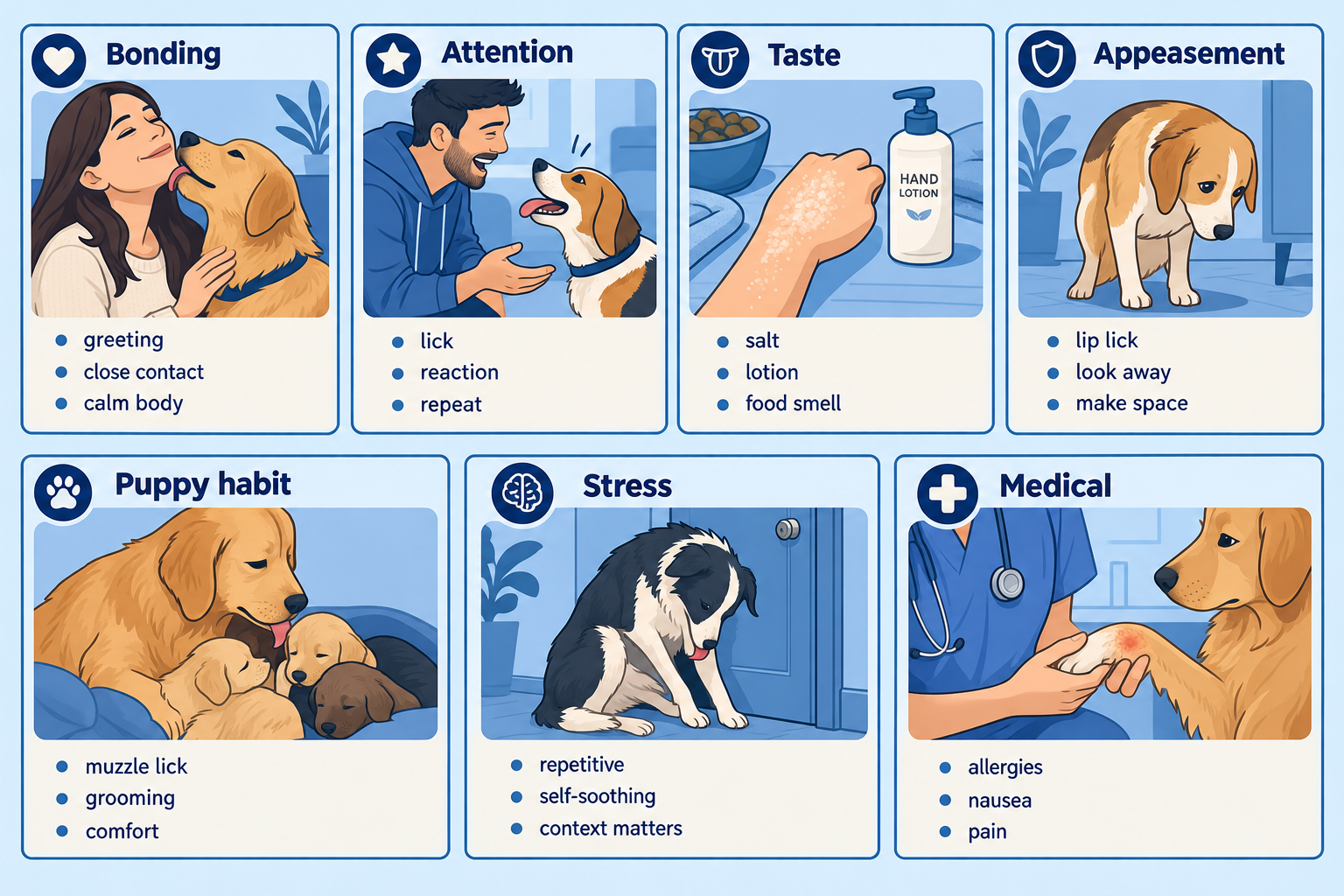
Dogs lick people for seven broad reasons: social bonding, learned attention-seeking, taste and scent, appeasement, puppy behavior that stuck, stress relief, and medical discomfort. Most dogs run two or three of these at the same time, which is why a single explanation rarely fits.
1. Social bonding and the human-dog bond
Dogs lick people during greetings, cuddling, and relaxed physical contact. PetMD’s June 2026 review of licking behavior lists social bonding and communication among the main functions, alongside exploration, grooming, attention-seeking and stress relief.
Where the facts end: nobody has measured “love” in a lick.
The study people usually reach for is Nagasawa et al. 2015, published in Science. That work found that mutual gaze between dogs and owners was associated with rising oxytocin in both, and that oxytocin given to dogs increased gazing behavior in female dogs. It is strong evidence that dog-human interaction runs on some of the same hormonal machinery as parent-infant bonding. It did not study licking. So the fair statement is this: licking happens inside a bonded relationship that research has shown to be hormonally real, and the lick itself has not been tested as an affection signal.
Dogs communicate with a whole body, not one tongue. If you like this kind of question, the same evidence-and-limits approach applies to why dogs tilt their heads and what it can really mean.
2. It worked last time
A dog licks your hand. You look down, say her name, scratch her ear, and laugh. The behavior just got paid.
This is the most underrated reason and the easiest one to accidentally train. Purina notes that dogs may repeat licking because both positive and negative human responses deliver attention. Pushing a dog’s face away is still contact, eye contact, and a reaction. From the dog’s point of view, that is a decent return on one lick.
Decision rule: if the licking happens most when you sit down, pick up your phone, or start a video call, treat it as a learned request first and a feeling second.
3. You taste like something
Human skin carries salt, sweat, body lotion, sunscreen, hand cream, and whatever you had for lunch. Feet after a long walk are a flavor event.
This is not an insult to your hygiene. It is chemistry plus a nose that outclasses yours by a wide margin. Worth a practical note: check the ingredients on any product you put on skin your dog reliably licks, because some human products are not meant to be eaten. If your dog also goes after food residue around the kitchen, it pays to know which foods dogs cannot eat at all.
4. Appeasement, which is not the same as a kiss
Sometimes a lick means “please give me a little room.”
The 2017 appeasement-signal study found that lip licking and looking away can function as appeasement in dog-human communication, and that licking was particularly associated with active submission during some greetings and situations with reduced personal space. Veterinary Partner lists lip or nose licking, yawning, looking away, a tucked posture, raised paws and moving away as possible appeasement signals, and notes that repeated signals in stressful settings can point to chronic anxiety.
What this looks like in a living room: you lean in for a hug, the dog’s head goes low, the tongue flicks out, the eyes slide sideways. That is not a request for more hugging.
5. Puppy behavior that never left
Licking is one of the first social behaviors a dog ever experiences, and some of it persists.
Alexandra Horowitz of Barnard College’s Horowitz Dog Cognition Lab explains through the American Kennel Club that wild canid puppies lick an adult’s muzzle after a hunt, a behavior historically tied to soliciting regurgitated food. In domestic dogs, the suggestion is that muzzle licking became a ritualized greeting rather than a literal food order. Your face is roughly where a muzzle would be. Congratulations.
Limit on that explanation: it is an evolutionary interpretation of a greeting pattern, not a measured motive in your individual dog.
6. Stress, self-soothing, and anxiety
Repetitive licking can be a coping behavior. Licking is rhythmic and self-administered, which makes it a convenient way for a dog to manage arousal, the same category as pacing or chewing a bed seam.
Patterns that suggest stress rather than sociability:
- Licking starts when visitors arrive, when a bag comes out, or when you get ready to leave.
- Licking comes bundled with yawning, a lowered body, panting without heat or exercise, or whale eye.
- The dog licks you, then themselves, then the sofa, in a loop that is hard to interrupt.
- You can interrupt it, and three seconds later it restarts.
Anxiety-driven licking responds to the cause, not to correction. For persistent cases, a veterinarian or a specialist certified by the American College of Veterinary Behaviorists can build a plan that includes management, behavior modification, and medication where it fits. Fear Free certified practices are trained to reduce stress during the visit itself, which matters if the vet clinic is part of what sets your dog off.
7. Medical causes worth ruling out
Licking that is new, intense, or aimed at something other than you deserves an exam. Common medical drivers include:
- Nausea and gut discomfort. Licking lips, licking the air, and licking floors or walls can accompany gastrointestinal upset.
- Itch and skin disease. Allergies, fleas, and infections drive paw and flank licking. Veterinarians may discuss Apoquel or Cytopoint for allergic itch in dogs; both are prescription options for allergy-related itch, both have specific suitability criteria, and neither is a general calming product.
- Pain. Dogs often lick over a sore joint or an injury site.
- Dental problems. Mouth pain can show up as odd lip and air licking.
- Cognitive change in older dogs. New repetitive behaviors in a senior dog deserve a check.
If licking spikes around mealtimes or on an empty stomach, feeding structure may be part of the picture. Reviewing portions, timing and water with vet-informed feeding guidance is a sensible early step, and if a diet change is on the table, do it gradually using a proper food transition schedule.
Why Do Dogs Lick Your Hands and Feet?
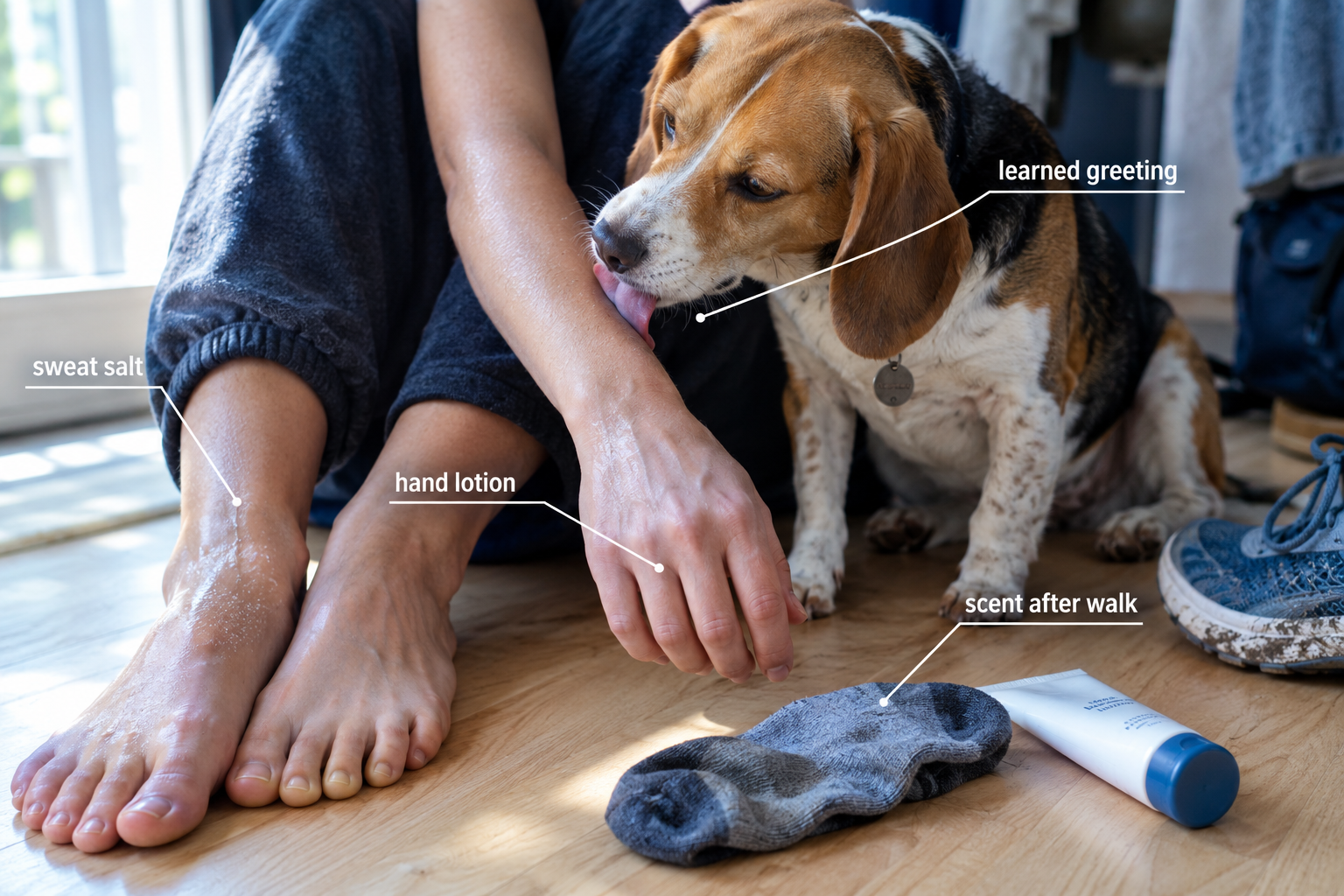
Hands and feet get licked because they are salty, scent-rich, close to the floor, and usually available. They are also the parts of you that touch everything your dog is curious about, which makes them a reasonable place to gather information.
Specific drivers for hands:
- Food residue, hand cream, soap, sanitizer.
- Hands deliver treats, so hands are worth monitoring.
- Hands are the easiest target when a dog wants contact and your face is out of reach.
Specific drivers for feet:
- Sweat and salt concentrate there.
- Feet carry outdoor scent home, which is genuinely interesting to a nose built for it.
- Feet are at dog height, so no negotiation is required.
Is it bad for your dog to lick your feet? For a healthy adult with unbroken skin, foot licking is mainly a comfort question for you. Stop allowing it if you have a cut, a cracked heel, athlete’s foot, a diabetic foot ulcer, or recent surgery, and wash the area afterward if it bothers you.
Affectionate, attention-seeking, anxious or medical licking
| Type | What it looks like | Typical context | What helps |
|---|---|---|---|
| Affectionate or greeting | Short bursts, loose body, wagging, stops on its own | You come home, you sit down together, relaxed contact | Nothing, unless you dislike it. Then redirect to a toy or a sit |
| Attention-seeking | Persistent, aimed at the nearest available skin, pauses to check your face | You are on the phone, eating, working, ignoring the dog | Stop paying it. Reward settling instead. Add enrichment earlier in the day |
| Anxious or appeasement | Lip licking, looking away, lowered head, repetitive and hard to interrupt | Hugs, strangers, vet visits, noise, departures | Remove the trigger, give the dog space, get behavior support for repeat cases |
| Medical | New onset, frantic, or directed at own body, the air, or surfaces | Any time, often with appetite, skin or stool changes | Veterinary exam. Bring a short video and a timeline |
3 to 5 days
Typical window before Capnocytophaga symptoms begin after exposure, per the CDC clinical overview, current 2026.
About 60%
Share of Capnocytophaga infections occurring in people with immunocompromising conditions, no spleen, or heavy alcohol use. CDC.
30 to 60 times
Increased risk of death from serious infection for people without a spleen, according to the CDC.
Intact skin
WHO guidance updated September 17, 2026 treats a lick on intact skin as no rabies exposure requiring post-exposure treatment.
Is It Bad When Dogs Lick Your Face, and Is Dog Saliva Safe for Humans?
For most healthy adults, a lick on intact skin is low risk. Face licking carries more risk than hand licking because the mouth, nose and eyes are mucous membranes, and because any break in the skin changes the calculation.
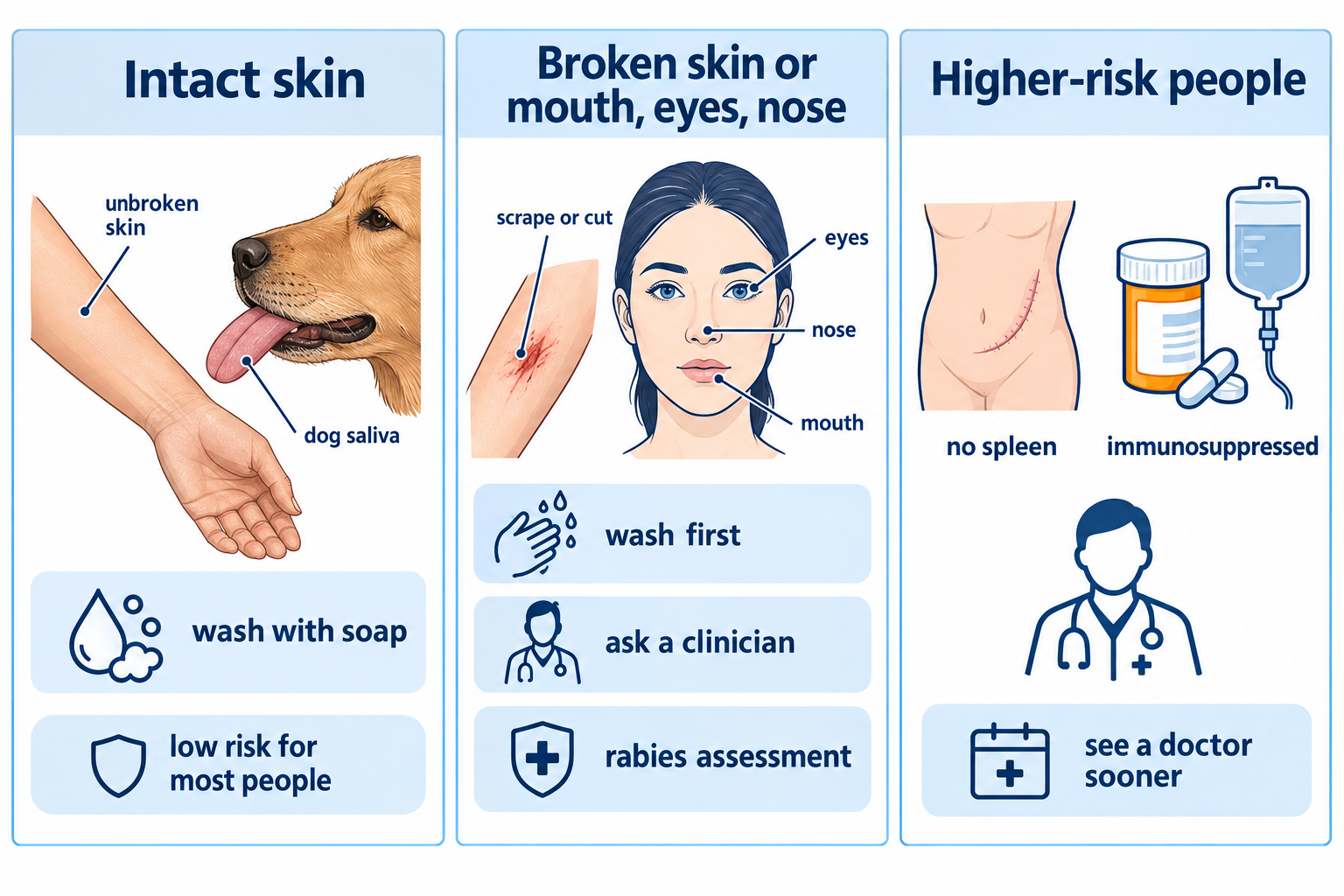
The bacteria part, stated plainly. CDC Yellow Book guidance on zoonotic exposures, updated July 16, 2026, confirms that Capnocytophaga bacteria normally live in the mouths of dogs and cats. Most people exposed to dogs never become ill. Rare infections can be severe, including sepsis, and the CDC’s clinical overview of Capnocytophaga reports symptoms usually starting three to five days after exposure, with far higher risk for people who are immunocompromised, have had a splenectomy, take immunosuppressive medication, or drink heavily.
Rabies deserves one clear paragraph. Under current WHO guidance, a lick on intact skin is classified as no exposure requiring post-exposure prophylaxis. Saliva contacting broken skin or mucous membranes can require urgent vaccination and, depending on the category of exposure, rabies immunoglobulin. If an unvaccinated or unknown dog licks a wound or your eyes, call a clinician rather than searching for reassurance.
Who should not let a dog lick their face or hands:
- People who are immunocompromised, on chemotherapy, or taking immunosuppressants
- People without a spleen
- Infants and very young children
- Anyone with an open wound, fresh surgical site, or active skin infection
- Anyone about to prepare food for other people
And the wound question, since it comes up constantly: do not let a dog lick a cut. A September 2026 explainer on saliva and wound healing notes that any modest antimicrobial properties in dog saliva do not make the practice safe, and that licking is more likely to introduce bacteria than speed healing. Wash the wound, cover it, and keep the dog off it.
For families, the practical version is a household rule rather than a ban: licking hands is fine for healthy adults, licking faces is a no for small children, and hands get washed before snacks. If you are still choosing a dog for a busy house, our guide to the best dogs for kids who want to play covers temperament and management together.
What Does It Mean When a Dog Licks You Constantly?
Constant licking usually means one of three things: the behavior has been reinforced, the dog is managing stress, or something physically uncomfortable is driving it. Constant licking is the one pattern that always earns a veterinary exam before a training plan.
How much licking is normal for dogs?
There is no published threshold, so use function instead of a count. Normal licking has these features:
- It has a trigger you can name, usually greeting, contact, or food smell.
- It stops within seconds to a minute.
- It stops when you stand up or redirect, without a fight.
- It is not paired with skin damage, hair loss, lip smacking, drooling, gulping, or appetite change.
Licking is worth investigating when it is hard to interrupt, happens during calm moments with no obvious trigger, includes the dog’s own body or household surfaces, or has changed noticeably in the last few weeks.
Is licking a sign of stress in dogs?
It can be, and the 2017 appeasement-signal findings support that reading in specific contexts: greetings and close-contact situations, where lip licking appeared alongside looking away as active submission. Veterinary Partner adds the broader point, that repeated appeasement signals in stressful settings can reflect chronic anxiety rather than a one-off moment.
What that study did not establish: that every lick is stress, or that a dog licking your hand on the sofa is unhappy. Context carries the meaning. Same lick, different body language, different conclusion.
Why does my dog lick me when I am sad?
The most defensible explanation is that your dog has noticed a change in you and is doing something that has previously produced contact or a calm response. Humans cry, breathe differently, change posture, change voice, and smell different. Dogs are good at reading changes in the people they live with.
What the evidence supports is sensitivity to human cues and emotional expression. What it does not support is a specific mental state inside the dog, such as deliberate consolation with an understanding of your grief. If your dog comes over and licks your hand while you cry, the useful reading is: your dog noticed, and your dog moved closer. That is already worth something.
Why does my dog lick me excessively at night?
Night licking usually comes down to timing. Evenings are when households finally sit still, which makes them the best available moment for a dog to request attention after a quiet day. Nausea can also worsen on a long empty stomach, so licking that starts around 3am alongside lip smacking, gulping or grass eating deserves a vet conversation about meal timing and gut health. And a dog whose sleep schedule does not match yours may simply be awake and bored, which is easier to understand once you know how much dogs actually sleep and why.
Why Do Some Dogs Lick More Than Others, and Do All Dogs Lick?
Almost all dogs lick to some degree, and the amount varies far more between individual dogs than between breeds. Early experience, learning history, temperament, health, and household routine explain more than ancestry does.
Factors that genuinely shift licking frequency:
- Learning history. A dog whose licking has reliably earned attention will lick more.
- Temperament and anxiety level. Dogs who find social pressure difficult may produce more appeasement licking.
- Health. Itch, nausea and pain raise licking regardless of personality.
- Age. Puppies explore with mouths, seniors can develop new repetitive behaviors.
- Enrichment. A dog with nothing to chew, sniff or solve will use whatever is available, and you are available.
On breeds, the responsible position is plain: no breed is a guaranteed licker, and no breed is guaranteed not to be. People often describe retrievers and spaniels as mouthy and some guarding breeds as more reserved, but those are tendencies in groups, not predictions about your dog. Doggy Rank IQ treats breed as useful background and individual variation as the deciding factor, the same way we treat it in a breed guide for first time owners.
How Do You Stop a Dog From Licking You Too Much, Kindly?
Stop rewarding the lick, give the dog a better outlet, and rule out medical causes if the licking is constant. Punishment is the wrong tool here, because licking is often either learned or stress-driven, and both get worse under pressure.
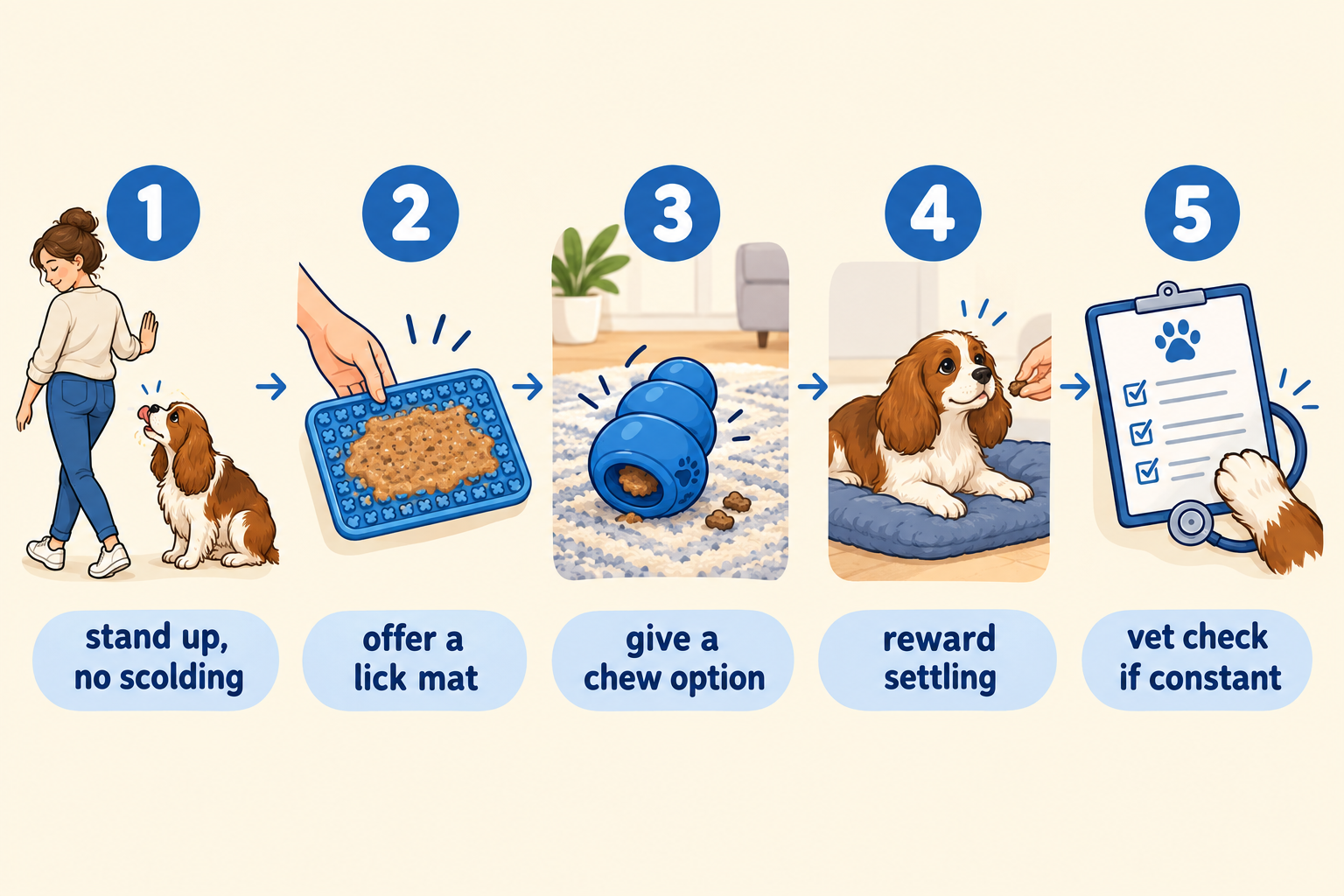
A plan you can start this week:
- Get a vet exam first if the licking is new, frantic, or aimed at the dog’s own body, the air, or surfaces. Bring a 20 second video. Behavior plans built on top of untreated itch or nausea fail.
- Remove the payment. When licking starts, stand up quietly and move away. No scolding, no eye contact, no discussion. Boring, consistent, effective.
- Teach what you do want. Reward a settle on a mat, a hand touch with the nose, or a sit near you. A dog needs a replacement behavior that earns the same attention.
- Give the tongue a legal job. A LickiMat spread thinly with wet food gives licking an appropriate target. A KONG Classic stuffed and frozen does similar work for chewers. Neither product is a treatment for anxiety, and neither fits every dog, so supervise, check the size, and inspect for wear.
- Add real enrichment earlier in the day. Sniffing walks, scatter feeding, short training sessions. Most “attention licking” is a dog with spare capacity.
- Use taste deterrents narrowly, if at all. Grannick’s Bitter Apple is marketed to discourage licking and chewing of a specific area. Some dogs ignore it entirely, and it treats the surface rather than the reason. Keep it off broken skin and off your face.
- Get qualified help for anxiety. A veterinary behaviorist certified by the American College of Veterinary Behaviorists, or a vet working within Fear Free principles, can assess whether medication belongs in the plan alongside behavior work.
Common mistakes worth avoiding:
- Pushing the dog’s face away repeatedly, which is contact and often turns into a game.
- Shouting, which adds stress to a behavior that may already be stress-driven. Escalating pressure around handling is also one route into defensive behavior, which is covered in our piece on why dogs bite their own owners and how to prevent it.
- Being inconsistent, so licking works twice out of ten. Intermittent rewards are the most durable kind.
- Treating a lick mat as therapy. It is a management tool and a good one, nothing more.
An edge case worth naming: if a dog licks you intensely only in one specific place, especially a mole, a scab, or a surgical scar, stop the behavior and have the spot looked at by your own doctor. Dogs notice changes in scent. That is an observation, not a diagnostic service.
FAQ
Why does my dog lick me when I pet her?
Petting is close contact, and close contact is where licking belongs. It can be reciprocal social behavior, or appeasement if the petting is more than the dog wants. Check the body: loose and leaning in means she is enjoying it, head low with eyes sliding away means ease off.
Do dogs lick you because they love you?
Licking happens inside bonded relationships, and greeting licks are commonly read as affiliative by behaviorists. The Nagasawa 2015 oxytocin research supports a real hormonal bond between dogs and owners, but it measured gaze, not licking. Affection is a reasonable interpretation, not a measured fact.
Is dog saliva safe for humans?
For healthy adults with intact skin, the risk is low. Dog mouths carry bacteria including Capnocytophaga, and the CDC notes that serious infections are rare but concentrate in people who are immunocompromised, lack a spleen, or drink heavily. Keep saliva away from wounds, eyes, and small children’s faces.
Do dogs pick a favorite person?
Many dogs show a clear preference, and it usually tracks who feeds, walks, trains and handles them most, plus who matched their social style early in life. Preference is not permanent and it is not a judgment of anyone else in the house.
How does a dog say I love you?
Look for the quiet signals rather than the dramatic ones: choosing to rest near you, following you between rooms, a soft relaxed body, a loose wagging greeting, bringing you a toy, and settling with a sigh when you sit down. Licking fits in that group, but it is not the clearest item on the list.
Why do dogs lick you so much after a walk or a workout?
Salt and sweat. Skin is more flavorful after exertion, and your legs and feet have collected outdoor scent. It is sensory interest, not a comment on your fitness routine.
When is licking an emergency?
Licking alone rarely is. Treat it urgently when it comes with repeated vomiting, retching without producing anything, a bloated or painful belly, sudden drooling, collapse, or signs of pain. Those need same-day veterinary care.
Does licking damage human skin?
Repeated licking can soften and irritate skin, especially around nails, cuticles, and existing cracks. If a spot gets licked daily, keep it covered and dry.
Conclusion: One Next Step
The most useful answer to why do dogs lick you is rarely a single reason. It is a short list, and you can narrow it down with three days of notes.
Here is the next step. For the next three days, write down four things each time your dog licks you: what time it was, what got licked, what happened in the ten seconds before, and what you did in response. Three days of that beats three hours of searching, because it tells you whether you are looking at a greeting habit, a reinforced request, a stress signal, or something medical that needs an appointment.
Then act on the pattern. If the notes show a learned request, stop paying for it and reward settling instead. If they show stress signals clustering around specific events, reduce the pressure and get behavior help. If they show self-licking, air licking, surface licking, or anything new and intense, book the vet exam first.
Dog Advice That Actually Answers the Question works best when the answer fits your actual dog. Three days of notes gets you there. The tongue, unfortunately, is not going anywhere.