
Quick Answer
Yes. Do dogs have belly buttons? Every one of them does, because dogs are placental mammals that grew inside a uterus attached to a placenta by an umbilical cord. The scar is just small, flat, and buried under fur, which is why most owners have petted a thousand dog bellies without ever noticing one. Look along the middle of the underside, a little below where the rib cage ends, for a tiny line, pale patch, wrinkle, or swirl of hair. A smooth flat spot is normal. A soft bulge there may be an umbilical hernia, and anything red, hard, or painful deserves a same-day call to your veterinarian, according to PetMD’s veterinary-reviewed guidance on dog belly buttons.
Key Takeaways: Do Dogs Have Belly Buttons?
- Yes, all dogs have one. Placental mammals get an umbilical cord in the womb and keep the scar for life.
- Location: the abdominal midline, below the last ribs and above the genital area, not near the nipples, as the American Kennel Club explains.
- It looks like almost nothing. A thin vertical scar, a shallow dent, a lighter patch of skin, or a small whorl where the fur changes direction.
- It is an innie, barely. Dogs do not form the raised, folded navel humans do, so “flat” describes it better than innie or outie.
- Puppies have them too. A short dried cord stump falls off in the first days, and the opening closes behind it.
- A soft bulge at that exact spot is usually an umbilical hernia, a common congenital gap in the abdominal wall. Many are small and are repaired during spay or neuter surgery.
- Red, hot, hard, painful, oozing, or paired with vomiting means today, not next week. That combination can mean infection or trapped tissue.
- Nobody talks about dog belly buttons because there is no cord stump to clean, no lint, and nothing to see once the fur grows in.
Why do dogs have belly buttons?
Dogs have belly buttons for the same reason people do. A puppy in the uterus is connected to its mother through a placenta, and the umbilical cord is the plumbing: blood vessels carrying oxygen and nutrients in, waste out. When the puppy is born, that connection is no longer needed, and the point where it attached becomes a scar.
Here is the part that makes the scar so modest. The mother usually handles the cord herself. She licks the newborn, chews through the cord close to the puppy’s body, and keeps the area clean. No clamp, no plastic clip, no hospital photo. The remaining stub dries out and drops off within a few days, the small opening in the abdominal wall closes, and the skin heals into a line you can barely see. VCA Animal Hospitals’ puppy-care article on belly buttons describes this same sequence for newborn litters.
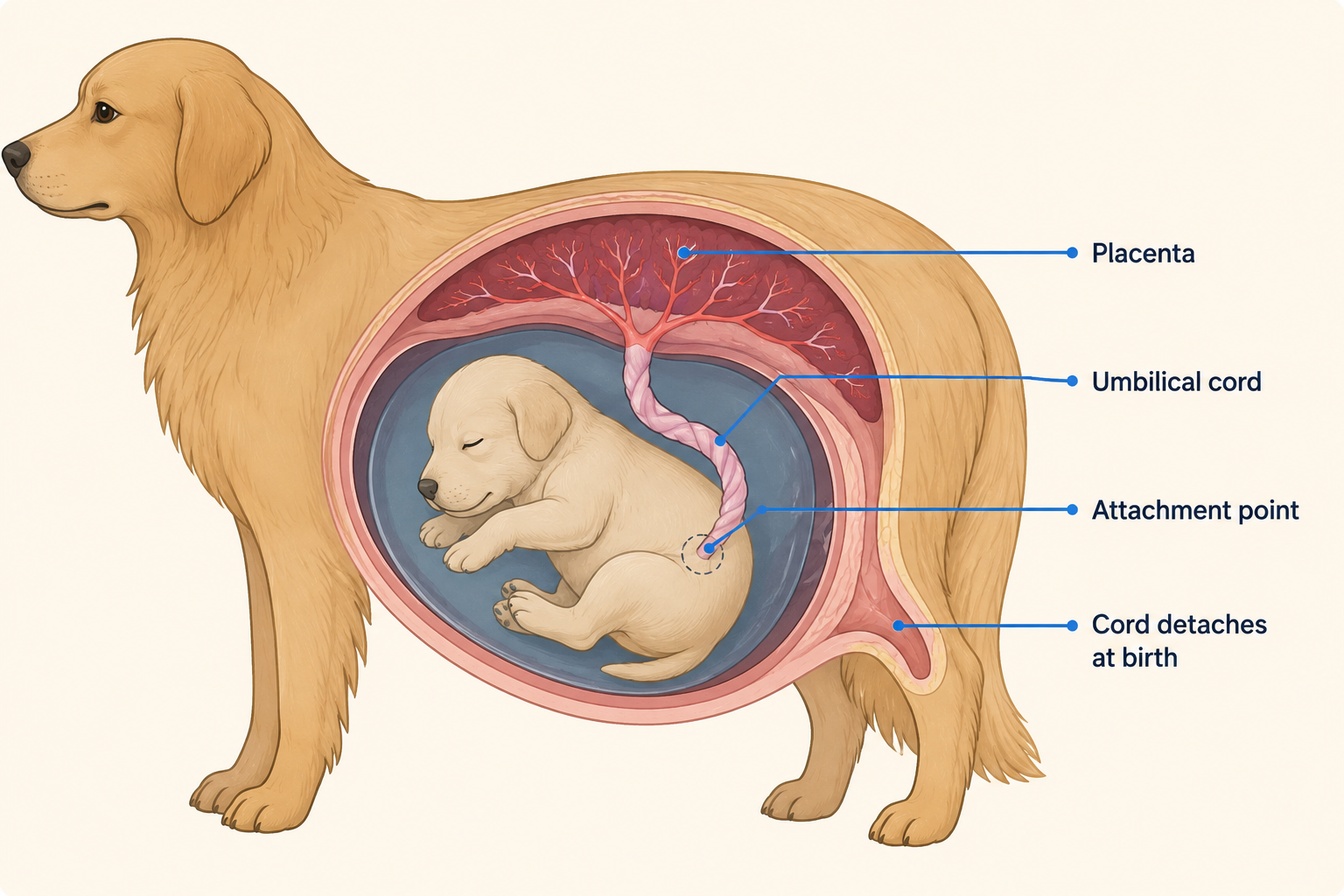
Human navels look different for two reasons: the cord is cut further from the body and clamped, and the healing tissue folds in on itself. Dogs heal flatter. Same biology, different finish.
The umbilical cord is temporary equipment. The belly button is the receipt.
If you like this kind of body-and-behavior science, the same logic shows up in what the research found about dog vision and color. The answer is usually “same machinery, different build.”
Where is a dog’s belly button, and what does it look like?
A dog’s belly button sits on the abdominal midline, on the underside of the body, roughly between the end of the rib cage and the pelvis, and above the genital opening. Chagrin Falls Veterinary Center’s May 2025 explainer describes the normal canine umbilicus as smooth and flat, which is also why people walk right past it.
What you are looking for, in order of how often owners report finding it:
- A small whorl or swirl of fur where the hair changes direction
- A thin vertical scar or wrinkle, often a few millimeters long
- A slightly paler patch of skin on dogs with light bellies
- A shallow indentation you feel before you see it
- Nothing at all, which is still normal
On a short-coated dog with a pink belly, it can be obvious in good light. On a thick-coated dog, you may need to part the fur with two fingers. Dr. Emily Gamm of South Sioux Animal Hospital told PetMD that it is unlikely to be obvious unless the abdomen has been shaved or the fur is parted.
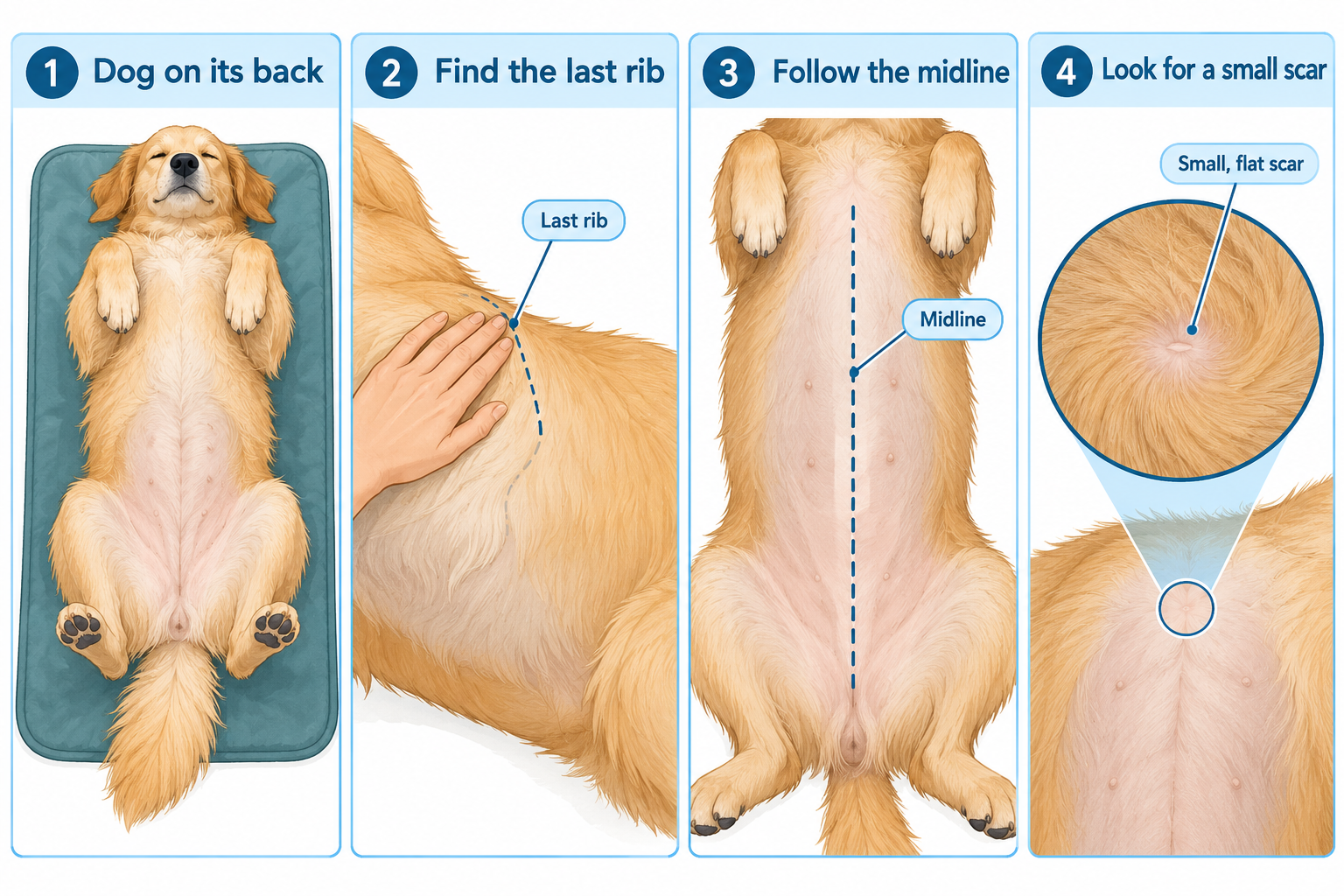
Use the card below to find it and to sort a normal flat scar from something worth a phone call.
Mammals with and without belly buttons
| Animal | Belly button? | Why |
|---|---|---|
| Dog | Yes, flat and faint | Placental mammal; mother chews the cord close to the body, so the scar heals almost level with the skin |
| Cat | Yes, equally faint | Same birth process; the scar is usually hidden under belly fur |
| Human | Yes, obvious | Cord is clamped and cut further out, and bare skin plus folded healing makes a visible navel |
| Horse | Yes, visible scar | Large foal, thicker cord, and a short coat that does not hide the mark |
| Kangaroo | Technically, but not visible | Marsupial; the joey attaches only briefly before moving to the pouch, so no lasting navel forms |
| Platypus | No | Monotremes lay eggs, so there is no umbilical cord and no scar |
Decision rule: if the animal was carried in a uterus with a placenta, assume a belly button exists somewhere. If it hatched from an egg, assume none.
Do dogs have belly buttons like humans, and is it an innie or an outie?
Dogs have belly buttons in the same anatomical sense humans do, but the finished product is not comparable. Functionally identical. Visually, not close.
If you have to pick a word, flat is the honest one. Where humans heal into a folded pit or a small raised knot, dogs heal into a thin line. Writers who look closely often land on “innie, but only just,” including this widely shared Mirror piece on dog belly buttons.
Three differences explain the whole thing:
- Cord length left behind. A chewed cord leaves a shorter stump than a clamped one.
- Healing pattern. Dog abdominal tissue tends to close level rather than fold inward.
- Fur. Even a perfect scar disappears under hair.
One genuine outie exception: a raised, protruding bump at the navel on a dog is normally not a belly button shape at all. It is usually an umbilical hernia or a swelling, which is covered further down. Kinship’s veterinary-reviewed article makes the same distinction between a flat scar and a protrusion.
Why is a dog’s belly button so hard to find?
A dog’s belly button is hard to find because it is small, level with the skin, covered in fur, and has no texture to catch your fingers. Nothing about it asks for attention.
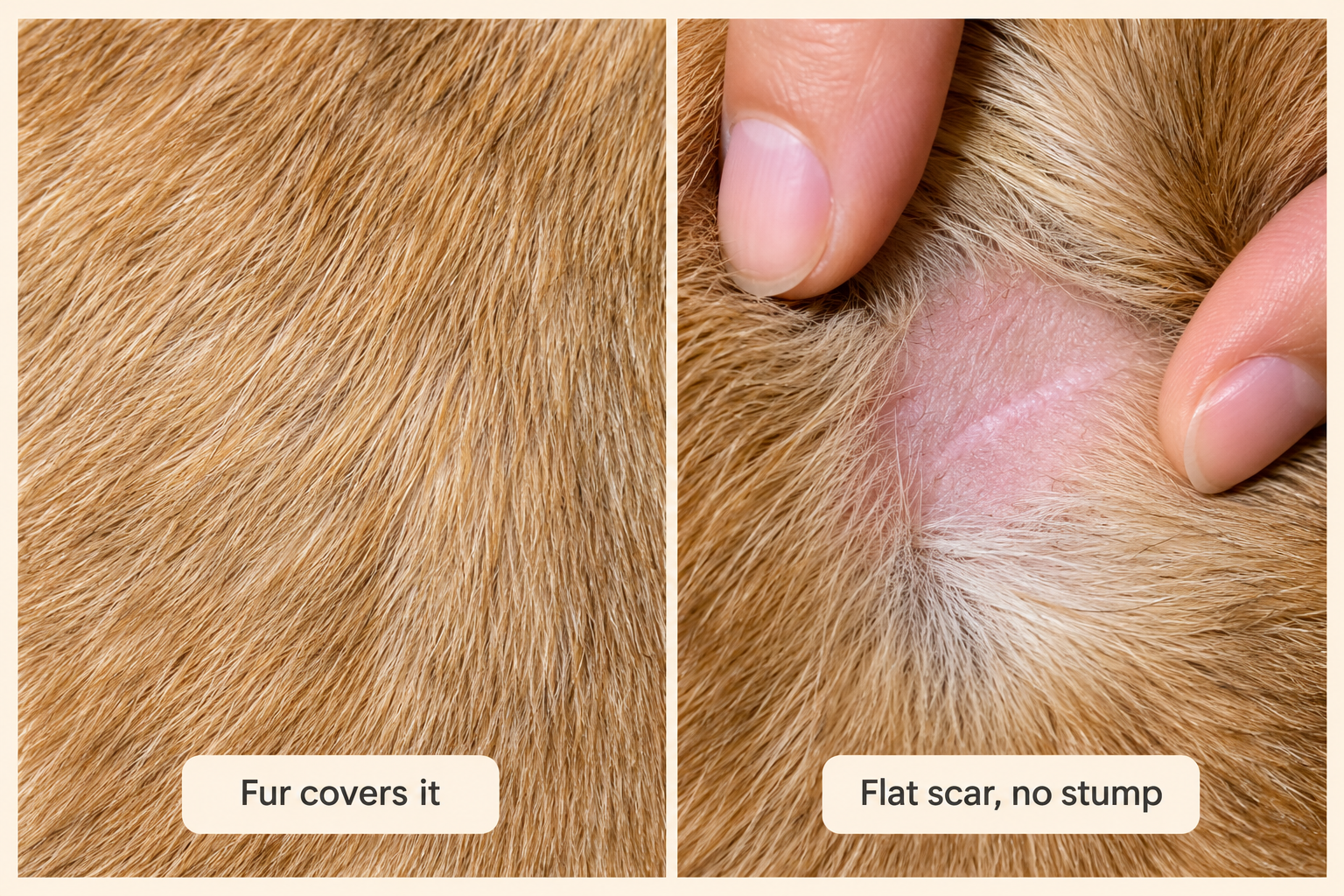
A useful side effect of all this: owners most often spot the area for the first time after a spay, neuter, or ultrasound shave, when the belly is bare and suddenly readable. Several of those owners then panic about a scar that has been there since week one.
Can you feel a dog’s belly button, and is it sensitive to touch?
You can often feel the spot as a slight dent or a faint firm line, but on many dogs you will feel nothing unusual, and that is normal. The scar itself has no special nerve supply, so it is not a secret tickle button.
What is sensitive is the belly in general. The abdomen is thin-skinned, close to organs, and a vulnerable place for any animal to expose. Some dogs flop over for belly rubs and stay there. Others tolerate it for four seconds and then get up with dignity. Both are fine.
How to check without making it weird:
- Pick a calm moment, not right after a meal and not during a thunderstorm
- Use flat fingers, light pressure, and short sessions
- Work with the fur direction first, then part it
- Pair it with something your dog likes, which is ordinary humane training: good things happen when hands touch the body
- Stop at the first sign of stiffening, lip licking, head turning, or getting up
Owners who already do a weekly nose-to-tail check tend to find lumps earlier anywhere on the body. If your dog is not a fan of handling yet, the same gradual approach used in our practical puppy training guide works on adult dogs too, just slower.
Edge case: a dog who suddenly objects to belly handling after previously enjoying it is telling you something about pain, not manners. That is a vet visit, not a training problem.
Do all dogs have belly buttons, including puppies, wolves and street dogs?
All dogs have belly buttons, regardless of breed, size, coat type, or where they were born. Puppies have them. Wolves, coyotes, dingoes, and free-roaming street dogs have them. So does every other placental mammal, as The Dodo’s explainer on the subject notes.
Puppies are the one life stage where you can actually see the evidence. For the first few days, a newborn has a short dark dried cord stump at the midline. It shrivels and falls off on its own. Do not pull it, do not trim it, and do not apply anything unless your veterinarian tells you to. Dr. Rochelle Hartson of IGH Animal Hospital warned PetMD that infection can occur if a newborn’s cord is removed improperly or tied too close to the body, which is one reason hands-off is the default advice for breeders and foster homes.
Wolves and wild canids follow the same process. The mother severs the cord, the stump dries, the opening closes. Nobody photographs it, which is the only difference.
Breed and coat change visibility, not existence. A smooth-coated hound with a pink belly shows the scar readily. A double-coated northern breed hides it completely. If you are still choosing a dog and thinking about grooming and handling needs, our guide to picking a breed that fits your life is a more useful filter than coat colour. And individual variation applies here as everywhere: two littermates can have noticeably different-looking scars.
What is an umbilical hernia in dogs?
An umbilical hernia is a gap in the abdominal wall at the belly button that did not fully close after birth, letting fat or sometimes a loop of intestine push outward under the skin. It shows up as a soft bulge right on the midline. It is one of the more common congenital defects in puppies and is listed among abdominal wall defects in standard veterinary references such as the Merck Veterinary Manual, which is the reference many clinics keep open on the desk.
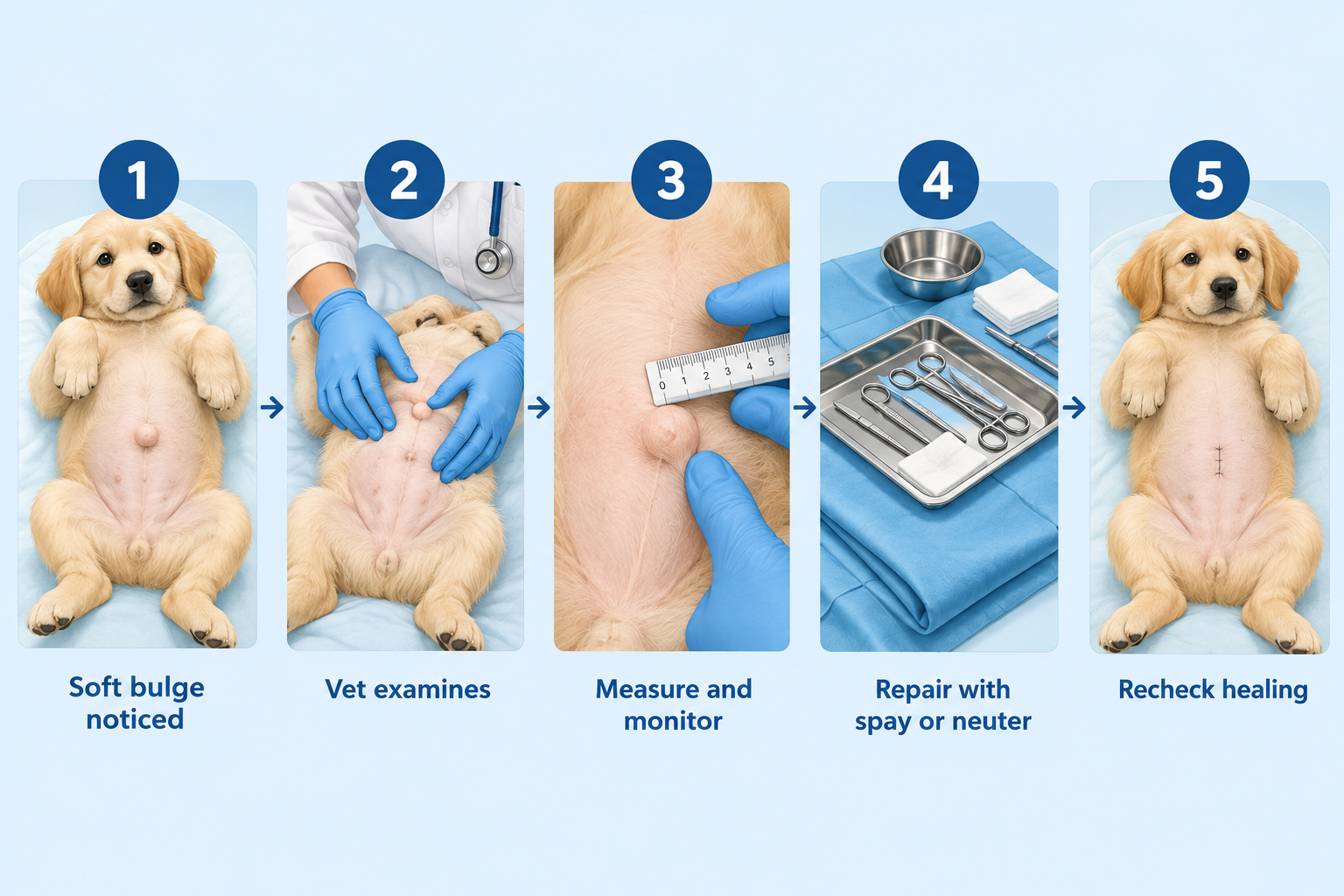
Signs owners usually notice:
- A soft, round swelling at the navel, often marble-sized or smaller
- The bulge gets larger when the puppy stands, barks, or strains, and smaller when lying down
- It can often be gently pushed back in, which vets call reducible
- No pain, no redness, no behaviour change in the uncomplicated version
Why it happens: it is a developmental closure issue, and it tends to run in families, which is why responsible breeders track it in their lines. Trauma to the cord at birth can also play a part. It is not caused by anything the owner did.
Breed predisposition: some breeds are reported more often in veterinary literature, but published lists vary and no single breed guarantees or excludes it. Treat breed as a mild risk note, not a prediction for your individual dog. If you are curious about inherited conditions in general, Embark and similar DNA panels screen for documented genetic variants, and as of October 2026 umbilical hernia is not a simple single-gene test you can buy. Check the company’s current test list rather than assuming coverage.
Repair:
- Small, reducible, fat-only hernias are often monitored rather than operated on immediately, at the vet’s discretion
- The standard efficient plan is repair during spay or neuter surgery, since the dog is already under anesthesia and the incision is in the same area
- Larger hernias, or any containing intestine, are repaired on their own schedule because of strangulation risk
- Surgery means closing the defect in the muscle wall, usually with a short recovery and activity restriction
Cost: published estimates vary widely by country, city, clinic type, hernia size, and whether it is combined with another procedure. No verified figure applies everywhere, so skip the internet averages and ask your clinic for a written estimate that separates the hernia repair from the spay or neuter. Two or three local quotes will tell you more than any national number.
Insurance: coverage for congenital and hereditary conditions differs by provider and policy wording, and a hernia already noted in your puppy’s records before enrollment will usually be treated as pre-existing. Lemonade, Healthy Paws, and Trupanion all publish their own terms on congenital conditions and waiting periods, so the only reliable move is to read the sample policy or phone and ask specifically about umbilical hernia before you buy. Ask whether it is excluded, covered after a waiting period, or covered only if diagnosed after the policy starts.
Should you buy a puppy with an umbilical hernia? Often yes, with conditions. Get the breeder’s written disclosure, have your own vet examine the puppy before or immediately after purchase, agree in writing who pays for repair, and ask whether the parents or previous litters had hernias. A small reducible hernia in an otherwise healthy, well-raised puppy is a manageable known cost. A breeder who shrugs it off or hides it is the bigger problem. The same care applies to feeding that puppy well in the first year, which our guide to what growing dogs need in year one covers in detail.
When should a bump at the belly button worry you?
Call your veterinarian the same day if the bump at the belly button is red, hot, hard, painful, oozing, rapidly growing, or will no longer push back in, especially if your dog is also vomiting, lethargic, or off food. PetMD’s guidance lists swelling, redness, discharge, and a firm bulge as reasons to contact a vet rather than wait.
Why is my dog’s belly button swollen or infected? The usual explanations:
- Umbilical hernia, soft and reducible, the most common cause of a midline bulge in a young dog
- Omphalitis, infection of the umbilical area in neonates, more likely if the cord was cut or tied too close to the body
- Abscess or infected hair follicle in the belly skin, which can sit near the navel by coincidence
- Incarcerated or strangulated hernia, where trapped tissue loses blood supply. This is an emergency
- An unrelated lump such as a cyst, fatty mass, or tumour that happens to be at the midline
What happens if it gets infected? Localised infection causes heat, swelling, pain, and sometimes discharge, and is typically treated with cleaning, antibiotics, and in some cases surgical drainage. In newborn puppies, umbilical infection can spread into the bloodstream and become life-threatening quickly, which is why breeders are told to keep whelping areas clean and to call a vet for any swollen, weeping navel on a neonate. In adults, a strangulated hernia can cut off blood flow to a trapped loop of intestine and requires urgent surgery.
Common mistake: pressing a bulge repeatedly to see if it goes back in. Check once, gently, then leave it alone and let your vet assess it. Squeezing a strangulated hernia does no good and can cause harm.
Normal and no action needed: a flat scar, a pale patch, a small swirl of fur, or a slight dent that has looked the same for years.
Why don’t people talk about dog belly buttons?
Because there is nothing to do with one. Dog belly buttons require no cleaning, no lint check, no piercing, and no grooming attention. They are invisible under fur, they cause no symptoms, and they never come up at a routine vet visit unless something bulges.
The question does keep surfacing in households with kids, usually during a belly rub, often at bedtime, and almost always as an argument. Someone says dogs do not have them. Someone else starts parting fur. For the record, the side arguing yes is correct, and sources from the AKC to Dogster’s veterinary-reviewed overview and the Toe Grips canine health explainer agree on the anatomy.
There is a better reason to learn the location than winning that argument. Knowing where the normal flat scar sits means you will recognise a new bulge there as unusual rather than dismissing it. That is the practical value of the whole topic, and it fits the pattern in other everyday dog questions, like why dogs tilt their heads and what it can really tell you or why dogs sleep as much as they do. Ordinary observation, then a useful answer.
FAQ
Do dogs have belly buttons in the same place as humans?
Yes, roughly. The spot sits on the abdominal midline below the rib cage and above the genital area, the same relative position as a human navel. The difference is appearance, not location.
Can I see my dog’s belly button without shaving anything?
Often yes on short-coated dogs with pale bellies, by parting the fur in good light. On thick or double coats you may only feel a faint line or dent, and some owners never locate it at all. That is not a problem.
Do puppies have belly buttons?
Yes. Newborns carry a small dried cord stump for the first few days, then it falls off and the area heals into a flat scar. Do not pull, cut, or clean the stump unless a veterinarian instructs you to.
Is a lump at my dog’s belly button always a hernia?
No. A soft, reducible midline bulge in a young dog is most often an umbilical hernia, but cysts, abscesses, fatty masses, and tumours can appear in the same area. Only an exam can tell the difference, so get any new lump checked.
Does an umbilical hernia hurt my dog?
Small fat-containing hernias usually cause no pain and no symptoms. Pain, redness, heat, vomiting, or a bulge that will not reduce suggests a complication and needs same-day veterinary attention.
Should I pay to have a small hernia fixed?
Discuss it with your vet. The common approach is to repair it during spay or neuter so your dog goes under anesthesia once. Ask for a written estimate splitting the two procedures, and ask what the plan is if the hernia changes size before surgery.
Do wolves and street dogs have belly buttons?
Yes. Every placental mammal, wild or domestic, develops an umbilical cord in the uterus and keeps a scar afterwards. Platypuses and echidnas, which lay eggs, do not.
Conclusion
Do dogs have belly buttons? Yes, and now you know where to look: centre line of the belly, just past the last ribs, a flat scar or a swirl of fur that has been there since the day the cord dropped off. Nothing to clean, nothing to treat, nothing to worry about.
Your one next step: on the next calm belly rub, part the fur along that midline and find the spot once. Note what normal looks like on your dog. If you ever see a soft bulge there later, you will know it is new, and you will be able to tell your vet exactly how long it has been there and whether it changes when your dog stands up. If the bump is red, hard, painful, or your dog seems unwell, call the clinic the same day instead of waiting for the next appointment. Guidance in this article was checked in October 2026 against AKC, PetMD, VCA Animal Hospitals, and veterinary clinic sources, and canine umbilical anatomy is settled rather than fast-moving, so the advice should hold.